Most sour cups are under-extracted, not spoiled, often falling below the practical benchmark of about 18–22% extraction. The easily missed exception is that a concentrated, low-extraction brew can taste even sourer than a weak one.
You've made your usual morning coffee, taken a hopeful sip, and found something closer to lemon water than the rounded cup you expected. Before you throw out the bag or add another scoop, notice what's missing: sweetness, body, or a flavor you enjoy. Those clues tell you more than sourness alone.
Why Sour Is an Imbalance, Not a Low pH
A pour-over can smell inviting and still taste sharply lemony, with little sweetness and a thin finish. That contrast doesn't automatically mean the beans are spoiled. Taste imbalance is a more useful starting diagnosis than spoilage because sourness depends on how acidity sits alongside sweetness, body, and other flavors.
Coffee behaves a little like tea: a brief steep and a fuller infusion bring out different balances from the same leaves and water. Coffee's flavor compounds do not dissolve in a perfectly separated sequence, but the comparison helps explain why contact matters. Organic acids dissolve readily. Many compounds that contribute sweetness, fullness, and balance need more opportunity to dissolve, through longer contact, adequate heat, or greater exposed surface area. When water passes quickly through coarse grounds, it can carry sharp flavors into the cup without enough of the components that round them out.
Strength and extraction answer different questions
It helps to separate three ideas:
- Strength is how much dissolved coffee material is present in the drink relative to water.
- Extraction is how much material the water dissolves out of the dry grounds.
- Balance is how acidity, sweetness, bitterness, and body taste together.
These are related, but they are not interchangeable. A small, intense drink can still be poorly extracted if the water had limited access to the coffee's soluble material. A lighter-bodied drink, meanwhile, does not automatically need more extraction. A strong, under-extracted cup can taste sharper than a thin one, because intensity and flavor balance answer different questions.
A practical extraction benchmark is approximately 18–22% of the dry coffee mass dissolved into the beverage. In a comparison of brewing methods published in European Food Research and Technology, measured pH values ranged from 5.51–5.92, yet pH and titratable acidity did not directly correlate with perceived acidity. One immersion preparation tasted the most acidic even though it was the least acidic by measurement.
That is why a pH strip cannot tell you whether to adjust your grinder. Chemical acidity and the sensation of sourness aren't interchangeable.
A sour cup isn't necessarily a cup with unusually low pH. It may instead lack enough sweetness and body to balance the acidity already present.
Diagnose the drink rather than the label
Suppose you make a pour-over with a coarse grind. The water drains quickly, and the cup tastes lemony and hollow. Adding more grounds might make the drink more intense, but it would not necessarily help the water reach more of the grounds' soluble material. Strength can rise while the imbalance remains.
Start by distinguishing the kind of sourness. A thin, sharp brew suggests that preparation may be limiting what dissolves. A powerful but puckering cup is different from a clean, sweet coffee with a citrus finish. That difference helps you choose a useful adjustment instead of treating every sharp flavor as the same problem.
Water belongs in a controlled test, not as an automatic explanation. A drinking-water pH label alone does not prove that the water will correct coffee flavor. The pH-balanced drinking water for homes link concerns household water, not a diagnosis of sour coffee, so it cannot establish what your brew needs.
Instant coffee calls for a separate distinction: the coffee has already been extracted before drying. You dissolve it in water rather than extracting it from grounds again. Incomplete dissolution or an unsuitable powder-to-water balance can still make the cup unsatisfying, but grinding finer is not an option.
For brewed coffee, the practical variables include particle size, contact and agitation, and water temperature. Match the adjustment to what you taste, and change one variable at a time.
Sour Coffee Symptoms and the First Fix
Pick the closest row before touching the grinder. Treat the cause as a working diagnosis, then test the proposed change.
| How it tastes | Most likely cause | First fix |
|---|---|---|
| Sharp, thin, lemon-like | Under-extraction from coarse grind, fast flow, or low dose | Grind one step finer or extend contact; change only one |
| Strong and sharply sour, not watery | High strength paired with low extraction | Extract more completely; don't only add water |
| Clean citrus or berry with some sweetness | Intentional acidity in a light roast | Keep it if you like it, or choose a more developed roast |
| Vinegar, fermented, or harsh green after a balanced brew | Roast development or postharvest processing | Switch roast or beans rather than chasing brew time |
| Sour and bitter in the same cup | Uneven flow or channeling | Start with an even pour, then assess grind consistency and gentle agitation |
| Fine at first, more sour after warm storage | Storage-related flavor change | Store cool and sealed, and compare with a fresher bag |
The strong-but-sour trap
The second row is the one people most often misread. Because the cup feels forceful, they assume extraction must be complete. But intensity only tells you how concentrated the drink is, not whether the grounds released a balanced mixture.
In controlled sensory experiments published in Scientific Reports, researchers tested 1.0–1.5% total dissolved solids and 16–24% extraction, finding markedly greater sourness when high strength coincided with low extraction. The same study supports useful brewing benchmarks of approximately 18–22% extraction and 1.2–1.5% total dissolved solids, with taste still guiding the final choice.
Total dissolved solids, usually shortened to TDS, describes beverage strength. A refractometer can help measure it, but you don't need one to run a useful kitchen test.
Say your pour-over tastes dense and sharply tart. Adding water makes it less intense, but you may still notice the same hollow middle and abrupt sour finish. Dilution changed the strength; it didn't change what you extracted from the grounds.
The Specialty Coffee Association's discussion of acidity in drip coffee makes this distinction especially useful: strength and extraction should be assessed separately rather than treated as a single weak-to-strong scale.
Look for improvement beyond less sourness
A successful adjustment should add something desirable. Notice whether the coffee becomes fuller, sweeter, or more coherent from first sip to finish.
- More rounded and sweet: Keep the adjustment and repeat it before changing anything else.
- Less sour but dry or harsh: Back off the change slightly rather than pushing farther.
- Still sour and bitter together: Investigate uneven wetting instead of extending the entire brew.
- Still fermented despite better body: Consider whether the beans' flavor profile is the mismatch.
You're not trying to eliminate all acidity. You're trying to make the drink taste complete.
Bright Fruit Versus a Sour Defect
Is this supposed to taste like fruit, or did something go wrong? The useful distinction isn't whether you can identify lemon. It's whether that lemon-like character comes with sweetness and a satisfying finish.
Use this visual comparison as a sensory starting point.
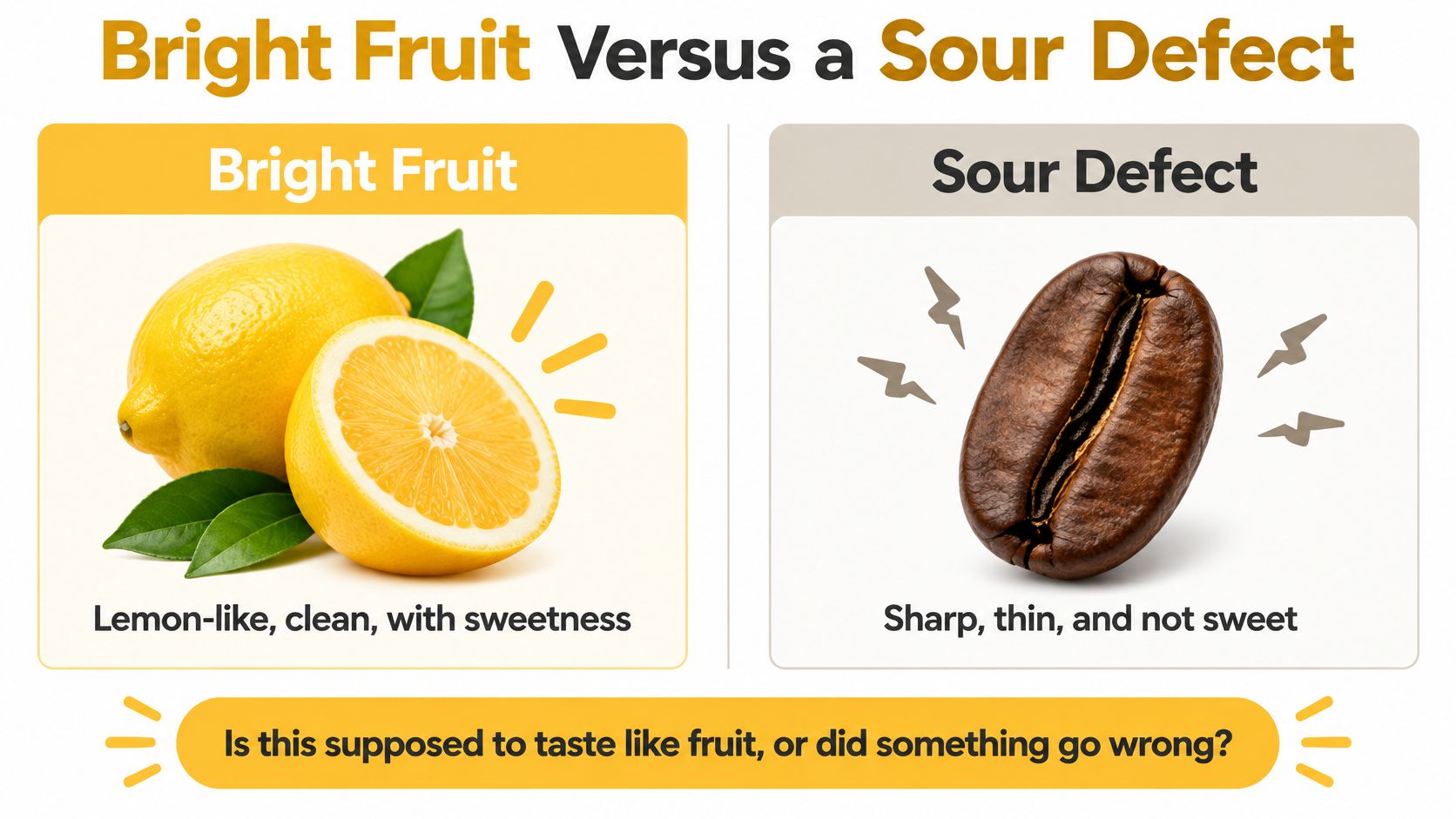
Bright fruit: Lemon-like or berry-like, clean, and supported by sweetness.
Problematic sourness: Puckering, thin, vinegar-like, or harshly green, without enough sweetness to make it enjoyable.
Roast development changes the kind of acidity
Coffee contains several acids, and they don't all contribute the same sensory impression. Citric acidity can suggest citrus; an acetic character can seem more pungent or vinegar-like when it dominates.
A sensory study published in Scientific Reports connects perceived sourness more closely with titratable acidity than with pH alone and describes how roasting changes the acid profile. Citric and malic acids generally decline during roasting, while total titratable acidity can rise to a peak before falling with continued development.
In kitchen terms, roasting does not just turn an acidity dial downward. It changes the mixture of flavors you're trying to balance.
That's why light roast and underdeveloped roast aren't synonyms. A carefully developed light roast can taste sweet and juicy. Another coffee may remain grassy or harshly sour even after competent brewing.
Our guide to types of coffee roast can help you choose a direction based on the flavors you enjoy, rather than assuming darker always means better.
For another way to think about the taste distinction, consider this accompanying video.
Preference isn't a brewing failure
If the cup tastes clean and fruity but you don't enjoy it, you don't have to learn to like it. A more developed roast may suit you better without requiring a new grinder or a complicated recipe.
Conversely, a vinegar-like or fermented note isn't proof of spoilage by itself. Processing and roast characteristics can contribute those flavors, and taste alone isn't a safety test. Don't use a pleasant or unpleasant sip to assess visibly moldy or moisture-damaged coffee.
Once careful brewing produces good body but leaves an unwanted fermented or raw-green character, stop grinding finer indefinitely. Change the coffee rather than forcing a flavor profile you don't want.
How to Rebalance One Brew Variable
Use a scale, a timer, and a short note on your phone. The aim is to make a repeatable comparison, not to build a laboratory on the counter.
This routine keeps your next test focused.
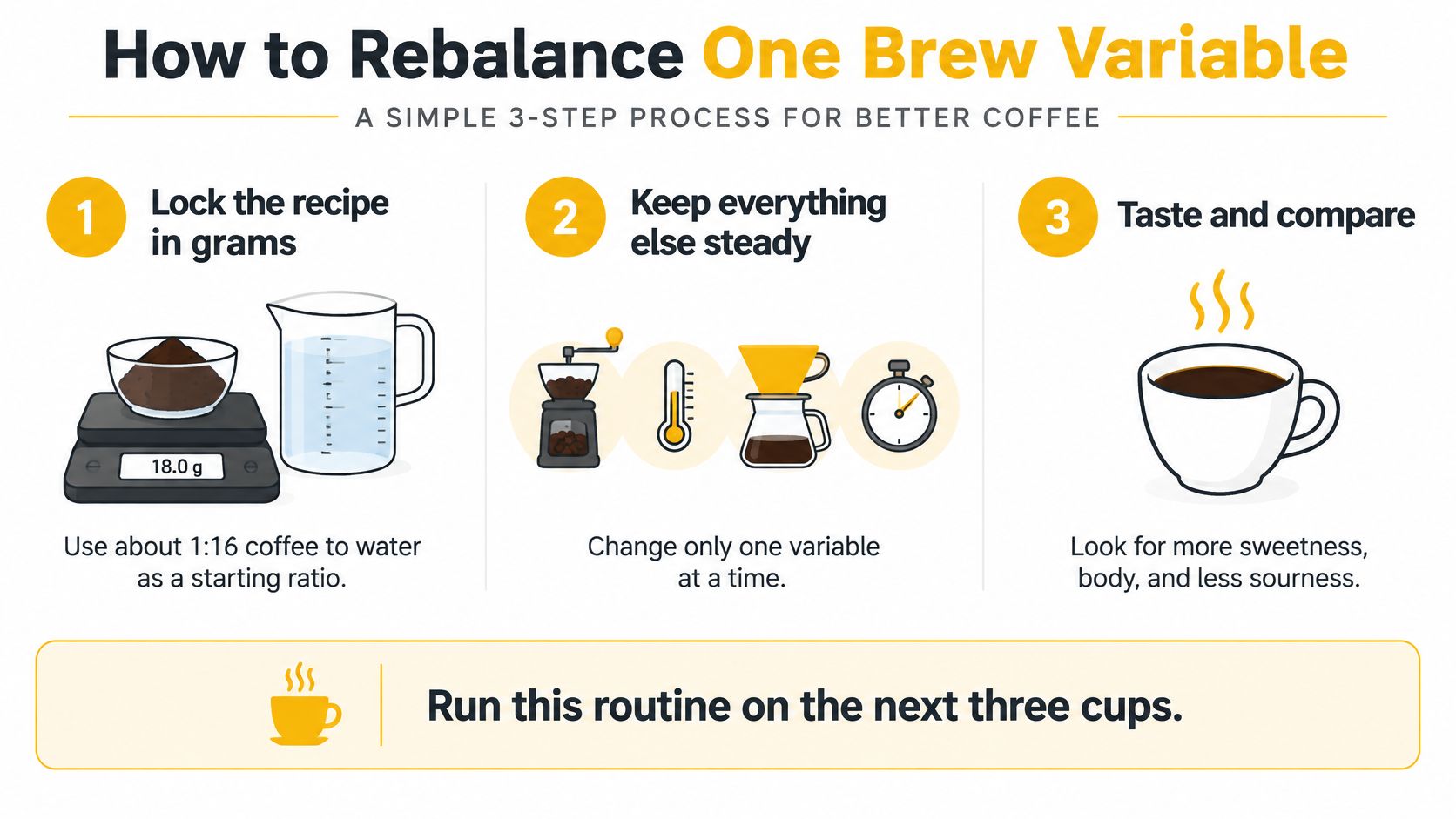
Make a controlled adjustment
- Lock the recipe in grams. Weigh the coffee and brewing water rather than alternating between a scoop and an estimated mugful. Keep your current recipe fixed initially so you can tell whether the preparation change helped.
- Try a slightly finer grind when the cup is hollow and sharp. Smaller particles expose more surface area to water. Keep your pouring approach and kettle setting steady, while recognizing that finer grounds may naturally slow drainage.
- Extend contact when the preparation is clearly rushed. With immersion, let the grounds remain in contact with the water longer before separating them. With pour-over, avoid dumping all the water rapidly and allowing it to escape through a poorly saturated bed.
- Test hotter water if you've been brewing lukewarm. Don't assume that hotter water means a more sour-tasting drink because of pH. In a Scientific Reports study comparing immersion brewing at 4°C, 22°C, and 92°C, hotter samples had lower pH, yet tasters described cold brew as less sour, and titratable acidity didn't differ significantly between hot and cold preparations.
- Use gentle agitation when wetting is uneven. A small stir can break up dry pockets in immersion coffee. For pour-over, distribute water across the bed instead of repeatedly drilling into the same spot.
- Taste before making the next change. Record whether the cup gained sweetness, body, bitterness, or dryness. Keep the change only if it moves the coffee toward a balance you prefer.
Don't turn every control at once
Changing grind, temperature, and contact time together might produce a better drink, but you won't know which adjustment mattered. It can also overshoot into a cup that's harsh or drying.
Practical rule: Choose the smallest change that tests your diagnosis, then repeat the successful recipe before refining it.
Water temperature deserves special care when your kettle routine is inconsistent. Our guide to the best water temperature for brewing coffee offers more detail for matching heat to preparation.
Roast choice is a boundary, not the first control to turn if this same bag recently tasted sweet. First check whether your grind setting moved, your pouring changed, or your water cooled while you were distracted.
After a couple of fair extraction adjustments without meaningful improvement, pause. Inspect the method, the condition of the coffee, and your roast preference rather than buying another accessory.
Sourness by Brewer and by Storage
The useful adjustment is the one your preparation method allows. An espresso grinder offers a different control from an instant packet, and a slow immersion brew needs a different check from a fast-draining filter.
| Method | Typical sour failure | First adjustment |
|---|---|---|
| Pour-over | Fast flow, coarse grind, or a channel | Test a finer grind; separately assess a slower, even pour |
| Espresso | Shot runs too fast and tastes sharp | Finer grind before changing dose |
| French press | Short steep and uneven wetting | Stir to wet the grounds, then test a longer steep |
| Cold brew | Light-roast character, unsuitable dilution, or incomplete steeping | Assess dilution after a complete steep, then consider roast |
| Instant | Low dose, cool water, or undissolved crystals | Full serving, hot water, stir until dissolved |
What the failure looks like in practice
At the pour-over dripper, you notice water rushing down a gap beside the filter bed. Some grounds remain relatively untouched while water repeatedly passes through another area. Keep the dripper level, wet the bed evenly, and avoid a hard stream against the filter wall before deciding that the entire recipe needs more time.
At the espresso machine, the drink runs out quickly and tastes sharply tart. Hold the dose steady and tighten the grind slightly, then watch how the flow changes. Adding more coffee immediately makes it harder to identify whether resistance or dose was the original problem.
With an instant mug at work, you reach the bottom and find gritty residue. There's no reason to troubleshoot extraction yield at the desk: first make sure the serving dissolves completely. For iced instant, mix the powder with a small splash of water before adding the cold ingredients and ice.
A French press rewards thorough initial wetting and an unhurried steep. Cold brew needs its own check: don't assume that every sour batch needs more hours, especially if you're drinking an inadequately diluted concentrate or a roast whose fruit character you dislike.
When the cupboard is the variable
Suppose the recipe hasn't changed, but the bag now lives beside a warm appliance. Compare it with a freshly opened bag before repeatedly recalibrating the grinder.
A 2025 study published in Food Science and Preservation reported that coffee stored at 30°C changed from slightly sour to moderately sour after 11 weeks. That finding doesn't establish a universal shelf life, but it gives you a concrete reason to investigate warm storage.
Keep beans or packets sealed and away from heat. Our guide to how to store coffee beans properly explains how to make that part of your daily routine.
- Only the older bag tastes wrong: Replace that bag before changing your established recipe.
- Every bag tastes wrong: Recheck preparation and clean the equipment before judging the beans.
- The same coffee varies between mugs: Standardize the dose, water quantity, and preparation sequence.
Choose the Next Cup to Brew
Your next cup should answer a specific question. Don't ask whether you can make coffee stronger; ask whether a controlled adjustment makes it sweeter and more complete.
For a thin, lemony drink, test a finer grind or longer contact. For a concentrated but sour drink, improve extraction rather than relying on dilution alone. If clean fruit comes with sweetness and you enjoy it, there's nothing to repair.
Decide when to change the coffee
Some cups deserve a recipe adjustment; others deserve a different bag. If unwanted vinegar-like or green harshness persists through fair brewing tests, choose a more developed roast instead of chasing an increasingly fine grind.
If only an older, warm-stored bag tastes unpleasant, replace it. If several fresh coffees develop the same problem in your kitchen, focus on the shared preparation routine.
- Keep the beans when a modest adjustment restores sweetness.
- Change the roast when balanced brewing reveals a flavor profile you don't enjoy.
- Simplify preparation when inconsistent equipment or a hurried routine makes comparisons difficult.
For camping, commuting, or mornings without a brewer, our Cartograph Organic Instant Coffee - Medium Roast is organic freeze-dried coffee in single-serve packets, with a smooth body and subtle chocolate and cinnamon notes. It removes grind and channeling from the test: keep the water quantity steady, use hot water, and stir until dissolved.
Make one diagnostic cup tomorrow. Write down the symptom, change one relevant variable, and look for sweetness behind the acidity before deciding whether the beans or the preparation need replacing.
We offer organic freeze-dried instant coffee in measured single-serve packets for straightforward preparation at home, at work, or outdoors. Visit Cartograph Coffee to explore our medium roast if you'd like a no-grinder option while you work toward a smoother, more balanced cup.