Ask any seasoned barista, and they'll tell you that one of the biggest secrets to a great cup of coffee isn't the beans—it's the water temperature. There's a "golden range" that coffee pros swear by: 198°F to 205°F (92°C to 96°C).
Nailing this temperature window is one of the simplest yet most impactful changes you can make to your daily brewing ritual. It's the key to pulling out all those rich, sweet, and complex notes from your coffee grounds while leaving the harsh, bitter ones behind.
Finding Your Coffee's Sweet Spot
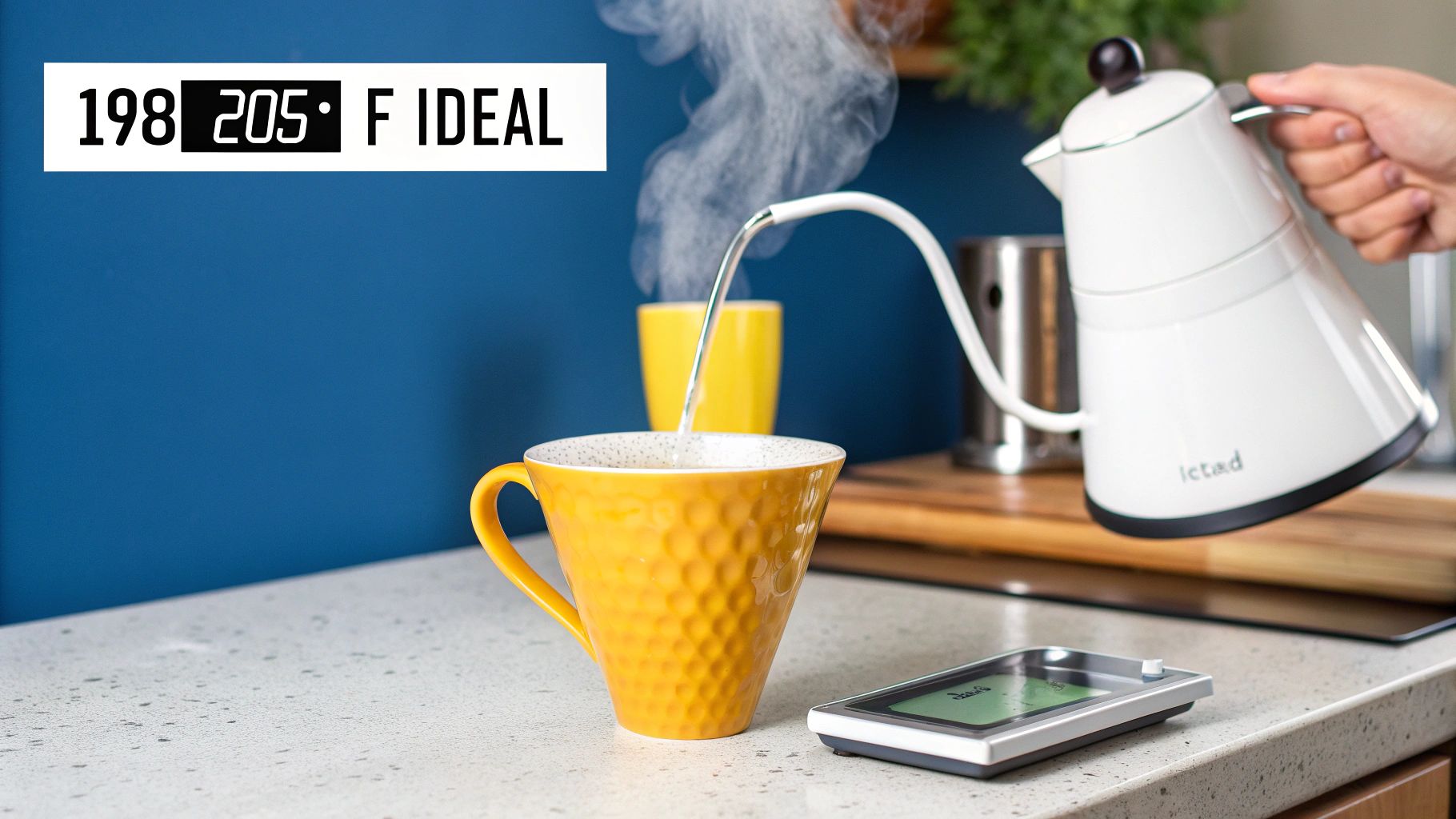
Think of it like cooking. You wouldn't try to sear a steak on low heat or gently poach an egg in a furiously boiling pot. The same logic applies to coffee. Your water is the catalyst, the solvent that dissolves all the flavorful compounds—the bright acids, the deep chocolates, the sweet caramels—locked inside the coffee grounds.
This whole process is called extraction. It’s the magic of dissolving flavor from the grounds into your water. Get the temperature wrong, and the magic falls flat.
-
Water that's too cold (below 198°F) just doesn't have enough energy to do the job right. It struggles to pull out the good stuff, leaving you with a cup that tastes disappointingly weak, sour, and "underextracted."
-
Water that's too hot (above 205°F, and especially at a rolling boil) is too aggressive. It strips everything out of the grounds, including the unpleasant, bitter compounds. The result? A harsh, burnt, and "overextracted" brew.
This isn't just a friendly suggestion; it's a standard backed by decades of experience. The Specialty Coffee Association (SCA) officially defines this golden window as 92°C to 96°C (198°F–205°F) because it's the proven sweet spot for balanced extraction. Studies have shown time and again that brewing below this range simply fails to dissolve enough of the coffee solids, which explains why that lukewarm brew from the office machine tastes so lifeless. If you want to dive deeper, you can explore how temperature impacts your cup to really understand the science.
Quick Guide to Ideal Brewing Temperatures
While the 198°F–205°F range is a fantastic rule of thumb, the ideal temperature can shift slightly depending on your brewing method. The main reason is contact time—how long the water and coffee are hanging out together. A faster brew might need hotter water, while a longer steep can use slightly cooler water.
Here's a handy table to get you started with some of the most popular methods.
| Brewing Method | Ideal Temperature Range (°C) | Ideal Temperature Range (°F) |
|---|---|---|
| Pour-Over | 93°C - 96°C | 200°F - 205°F |
| French Press | 92°C - 95°C | 198°F - 203°F |
| AeroPress | 85°C - 96°C | 185°F - 205°F |
| Espresso | 90°C - 94°C | 195°F - 202°F |
| Instant Coffee | 82°C - 90°C | 180°F - 195°F |
Use these temperatures as your starting point. From there, don't be afraid to experiment a degree or two in either direction to see what tastes best to you.
How Temperature Unlocks Your Coffee's Flavor Story
Ever wonder why that perfect cup of coffee feels so elusive? A huge piece of the puzzle is water temperature. It’s not just about making the water hot; it’s about using temperature as a precision tool to pull the right flavors from your coffee grounds.
Think of it like this: your coffee grounds are tiny, locked treasure chests, and hot water is the key. The temperature of that water determines which chests you can open and what treasures—the flavors—you get to enjoy.
The extraction process follows a predictable path. The first flavors to dissolve are the acids. These are the bright, fruity, and floral notes that give a coffee its liveliness. They don't need much convincing to come out and play, dissolving easily even in cooler water.
Next up, with a bit more heat, you start unlocking the sugars. This is where the magic happens. These compounds bring sweetness, body, and that satisfying, well-rounded flavor that balances out the initial acidity. A truly great brew gets both of these in perfect harmony.
What Happens When the Temperature is Off?
So, what’s the big deal if your water is a few degrees off? It completely changes the final taste.
If your water is too cool, it’s like having a key that only fits the first lock. It’ll pull out those acids, but it just doesn't have enough energy to get to the sugars and deeper flavors. The result is under-extraction: a cup that tastes disappointingly sour, thin, and kind of grassy. If you’ve ever had coffee that made your face pucker, this was probably the reason. Learning how to reduce the acidity of coffee often starts right here, with your water temperature.
On the flip side, water that’s too hot—especially at a full, rolling boil—is like using a sledgehammer instead of a key. It violently rips everything out of the grounds, including the compounds you want to leave behind. These are the bitter, dry, and astringent elements. This is over-extraction, and it leads to a harsh, ashy-tasting brew that completely smothers any of the delicate, sweet notes you were hoping for.
The Flavor Extraction Sequence:
- Acids Unlock First: Bright, fruity, and floral notes.
- Sugars Unlock Second: Sweetness, body, and balance.
- Bitters Unlock Last: Dry, harsh, and astringent compounds.
Getting the temperature right is all about hitting that sweet spot. You need water that’s hot enough to work through the acids and fully dissolve the sugars, but not so aggressive that it releases a flood of bitterness.
That’s why the golden range is 198°F to 205°F (92°C to 96°C). It’s the perfect temperature to unlock the best of what your coffee has to offer, creating a rich, balanced, and delicious story in every single cup.
Dialing in the Temperature for Your Favorite Brewer
There’s no single magic number for the perfect water temperature. Why? Because every coffee maker is a little different. The real secret isn't just the temperature itself, but how it works with contact time—the amount of time your coffee grounds and water are actually hanging out together.
Think of it this way: brewing methods that are quick and to the point, like a pour-over, need hotter water to get the job done fast. On the flip side, methods where the grounds steep for a while, like a French press, do better with slightly cooler water. This prevents you from accidentally pulling out all those harsh, bitter flavors. Getting this balance right is what separates a decent cup from a truly memorable one.
This infographic breaks down how temperature pushes your coffee toward a balanced, sour, or bitter result. It's a great visual for understanding the goal.
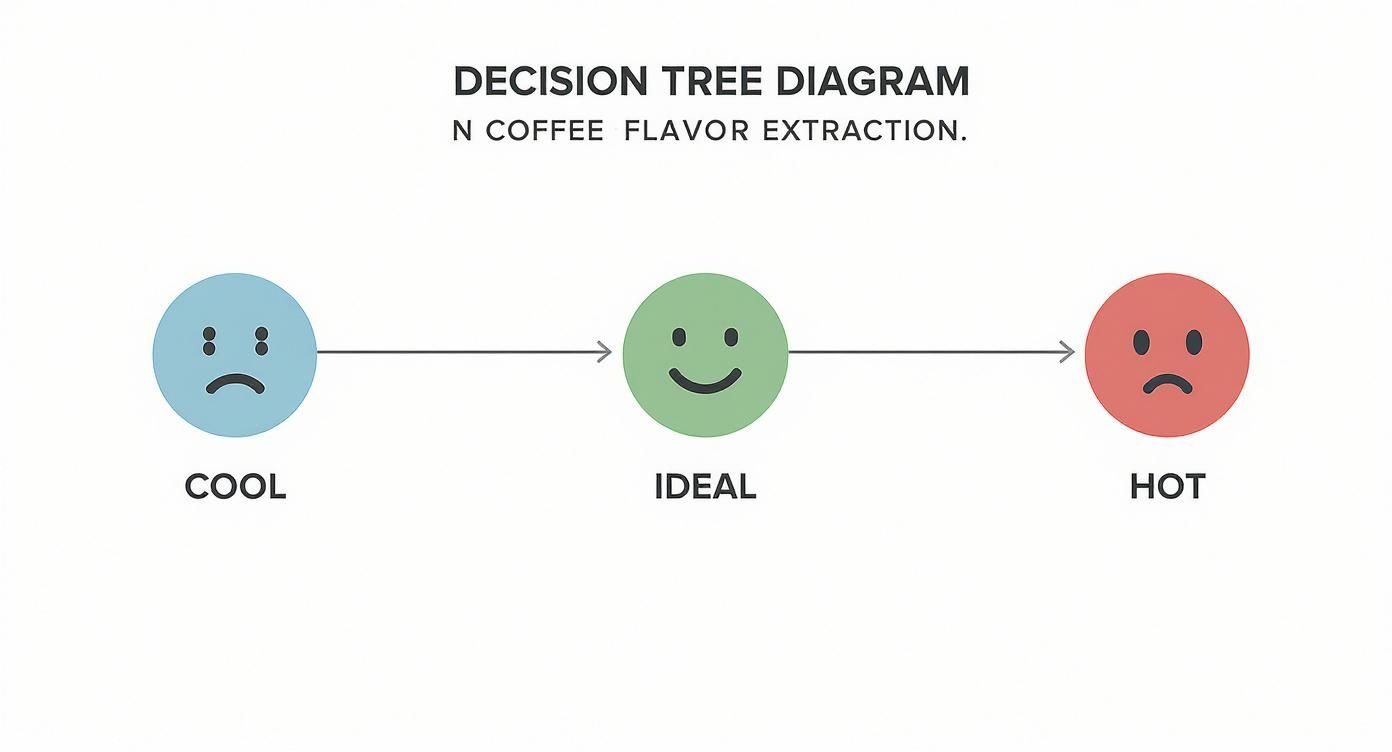
As you can see, you're aiming for that happy middle ground. Veer too far in one direction, and you'll end up with a cup that's either disappointingly sour or unpleasantly bitter.
Pour-Over (V60, Chemex)
When you're making a pour-over, the whole process is over in just a few minutes. Water passes through the coffee grounds and it's done. Since that contact time is so short, you need hotter water to pull out all the good stuff before the brew finishes.
For devices like a V60 or Chemex, you'll want to be on the hotter side of that ideal range. Aim for 200°F to 205°F (93°C to 96°C). That extra heat gives the water the energy it needs to quickly dissolve the sugars and acids, giving you that vibrant, clean, and complex cup pour-overs are famous for. If your water is too cool, you'll almost certainly get a sour, weak-tasting brew.
French Press and Other Immersion Brewers
Full immersion brewers like the French press are the polar opposite of a pour-over. In this case, the coffee grounds are fully submerged in water and just steep there for four minutes or more. Because they have so much time together, you can—and should—use slightly cooler water.
A great starting point is somewhere between 198°F and 203°F (92°C to 95°C). If you use water that's too hot, the long steep time will easily over-extract the coffee, leaving you with a muddy, bitter mess. Dropping the temperature by just a few degrees gives you far more control and a much smoother finish. To see how this method stacks up against others, check out our guide on the best coffee brewing methods.
The Main Takeaway: It's a pretty simple relationship. Shorter brew times need hotter water. Longer brew times need cooler water.
Interestingly, while temperature is a huge piece of the puzzle, it's not the only one. A 2020 study in Scientific Reports confirmed that while temperature definitely speeds up extraction, its direct impact on taste can be minimal if you're willing to adjust other things, like your grind size. It just goes to show how much flexibility you have when you're brewing.
A Quick Word on AeroPress and Moka Pots
The AeroPress is the chameleon of the coffee world; it can handle both super-quick and longer brews. If you're going for a fast, espresso-like shot (under a minute), use hotter water around 205°F (96°C). But if you’re doing a longer, immersion-style brew, you can drop the temperature all the way down to 185°F (85°C) for a smoother, less aggressive cup.
Moka pots are their own unique beast. You don't set the temperature directly, since the pot uses steam pressure to force water up through the grounds. The trick here is to pre-heat your water before putting it in the bottom chamber. This helps the pot build pressure much faster, which means the grounds spend less time getting scorched on the hot metal, preventing that classic metallic, burnt Moka pot taste.
How Altitude Affects Your Boiling Point
Ever tried brewing coffee on a mountain getaway and felt like something was... off? It’s not your imagination. Making coffee in Denver is a fundamentally different game than it is in Miami, and it all comes down to physics.
As you go up in altitude, the air pressure around you drops. This lower pressure makes it easier for water to boil, meaning it happens at a lower temperature.
At sea level, we all know water boils at 212°F (100°C). But for every 500 feet you climb, that boiling point dips by about 1°F (0.5°C). That might not sound like much, but when you’re aiming for that sweet spot of 198°F to 205°F (92°C to 96°C), it changes everything. Suddenly, a kettle at a full, rolling boil might not even be hot enough to properly extract your coffee.
Adjusting Your Brew for Higher Ground
Living at a high elevation means you can't just boil water and assume it's in the right zone. In some places, you might not even be able to reach the hotter end of the ideal brewing range without a specialized pressurized system.
A great analysis on how elevation impacts brewing temperatures from Perfect Daily Grind explains that the boiling point drops about 1°C for every 300 meters (984 feet) you ascend. Do the math, and you'll find that at 5,000 feet, water boils at just 203°F (95°C). You're already at the lower end of the ideal spectrum before you even start.
So, what do you do when your water simply refuses to get any hotter? You have to help it along by tweaking other parts of your brew.
High-Altitude Brewing Tip: When you can't raise the heat, give the water more time or more surface area to work with. The goal is to help it extract all those good flavors from the coffee grounds, even with less thermal energy.
Here are a couple of practical ways to do just that:
- Grind Finer: A finer grind creates more surface area for the water to interact with. This lets the cooler water pull out the soluble compounds more efficiently. Just be careful—go too fine, and you risk clogging your filter and over-extracting bitter flavors.
- Extend Your Brew Time: Let the coffee and water hang out together a little longer. For a French press, try adding another 30-60 seconds to your steep time. For a pour-over, slow down your pour to increase the overall contact time.
With these small but meaningful adjustments, you can easily compensate for the effects of altitude. You can brew a fantastic, balanced cup of coffee no matter how high up you are.
Simple Ways to Control Your Water Temperature
You don’t need a science lab to nail your coffee brewing water temperature. Honestly, mastering this key variable is way easier than it sounds, and there are great options no matter your budget or how deep you want to dive into the coffee rabbit hole.
The most straightforward trick costs nothing but a little patience: it’s the boil-and-wait method. Bring your water to a full, rolling boil, then just take the kettle off the heat and let it rest for a moment.
A good rule of thumb is to wait about 45 to 60 seconds. That brief pause is usually all it takes to drop the temperature from a scalding 212°F (100°C) into that sweet spot of 198°F to 205°F (92°C to 96°C). It’s not perfectly precise, but this simple habit alone can save your coffee from the bitterness of over-extraction.
Stepping Up Your Precision
If you're ready to get a little more serious and take the guesswork out of the equation, a digital thermometer is a game-changer. It's a small investment that gives you immediate, accurate feedback.
Just heat your water and dip the thermometer in as it cools. This gives you the control to really dial things in and discover if that special bag of beans sings at 200°F or maybe even 204°F. It’s a low-cost upgrade that pays huge dividends in flavor. Plus, knowing how to manage temperature manually is a fantastic skill for brewing anywhere, even when you're off-grid. For more tips on that, check out our guide on how to make coffee without electricity.
The Power of Precision: Don't underestimate small changes. Even a two-degree shift in water temperature can completely change the taste of your coffee. A thermometer gives you the power to find that perfect cup and brew it again and again, turning a happy accident into a reliable morning ritual.
For Ultimate Control: The Variable-Temp Kettle
Ready for the pinnacle of convenience and control? Meet the variable-temperature gooseneck kettle. This is the tool for coffee lovers who want to eliminate variables and just enjoy the process. You just dial in your exact temperature, and the kettle not only heats the water perfectly but holds it there for you.
Here’s why they’re worth it:
- Pinpoint Accuracy: If you want 203°F, you get exactly 203°F. Every single time.
- Rock-Solid Consistency: It removes temperature surfing from the equation, making your brews incredibly repeatable.
- The Gooseneck Spout: That elegant, curved spout gives you incredible pouring control, which is an absolute must for methods like pour-over.
While it’s more of an investment, a variable-temp kettle is probably the single best piece of equipment for anyone serious about their coffee. It makes temperature management totally effortless, letting you focus on the fun part—brewing and enjoying.
Answering Your Coffee Water Temperature Questions
Once you start dialing in your brew, a few practical questions always seem to pop up. Perfecting your coffee often comes down to handling these little details, so let's tackle some of the most common queries.
Think of this as your go-to guide for those "what if" moments that can make or break your morning cup. Getting these right will help you brew with confidence, whether you're making a French press with a dark roast or just a quick cup of instant.
Does Water Temperature Matter for Instant Coffee?
It sure does! While instant coffee is made to be incredibly simple, you can still scorch it. Pouring water at a full, rolling boil right onto the granules can create a burnt, bitter, and harsh flavor, ruining what should be an easy, enjoyable cup.
For a much smoother and more balanced result, aim for water that's hot but not boiling. The sweet spot is somewhere between 176°F and 194°F (80°C to 90°C). The easiest trick? Boil your water, take it off the heat, and just let it sit for a minute before you pour. That simple pause makes a world of difference.
What Happens if My Coffee Water Is Too Cold?
Water that isn't hot enough is the primary culprit behind under-extraction. That’s the official term for coffee that tastes sour, weak, and sometimes even a little grassy. The water just doesn't have enough energy to pull out the good stuff.
Think of it this way: all the best flavors are locked deep inside the coffee grounds. Cool water only has enough power to dissolve the easiest compounds on the surface, which happen to be the acids. It can’t get to the sugars and oils that give coffee its sweetness, body, and balance. The result is a thin, sharp cup because all the delicious flavors were left behind.
How Temperature Errors Taste
- Too Hot: Over-extraction creates a bitter, ashy, and hollow-tasting coffee.
- Too Cold: Under-extraction results in a sour, weak, and flat brew.
- Just Right: Balanced extraction gives you a sweet, rich, and flavorful cup.
Should I Use a Different Temperature for Dark vs. Light Roasts?
Absolutely. Tweaking your water temperature for the roast level is a pro-level move that can seriously elevate your coffee game. Baristas do this all the time to coax the best flavors out of different beans, and it all comes down to how soluble the coffee is.
Light Roasts: These beans are denser and less porous, so they hang on to their flavors more tightly. You need more energy to extract their bright, floral, and fruity notes.
- Recommendation: Go hotter. Aim for the high end of the scale, somewhere between 200°F and 205°F (93°C to 96°C), to unlock their vibrant complexity.
Dark Roasts: Because they’ve been roasted longer, these beans are more brittle, porous, and give up their flavors very easily. That also means they’re incredibly easy to over-extract.
- Recommendation: Cool it down a bit. A temperature in the 195°F to 200°F (90°C to 93°C) range is perfect for pulling out rich, chocolaty notes without any of that harsh bitterness.
By making these small shifts, you’re essentially customizing the brew for the beans. It’s this kind of control that turns a good cup of coffee into an exceptional one that truly reflects the bean's character.
Ready to brew a perfect cup on the go without the fuss? Cartograph Coffee offers premium, organic instant coffee that dissolves beautifully in hot water, making it easy to enjoy exceptional flavor anywhere. Discover the convenience of high-quality coffee today at cartographcoffee.com.