Caffeine is 1,3,7-trimethylxanthine, the world's most commonly consumed psychoactive substance; the FDA reference for most healthy adults is up to 400 mg a day, about two or three 12-ounce coffees. It's a naturally occurring stimulant that can make you feel more alert, but a cup isn't a precise dose.
That distinction matters whether you brew at home, mix instant coffee at work, or pack drinks for a camping trip. Your body responds to the milligrams you consume and when you consume them, not the name of the drink or the size of your favorite mug.
What Caffeine Is in a Normal Cup
The plain-language answer to what is caffeine starts with the word stimulant: a substance that increases activity in the central nervous system, which includes your brain and spinal cord. Psychoactive means it affects brain function, including how awake or attentive you feel. It doesn't mean caffeine belongs in the same practical category as every other substance that affects the brain.
A Springer reference chapter on caffeine identifies it as naturally occurring 1,3,7-trimethylxanthine, describes it as the world's most commonly consumed psychoactive substance, and lists coffee, tea, cola, energy drinks, chocolate, some medicines, and supplements among its sources. Coffee is the most important global dietary source, but it's far from the only one.
Typical Caffeine in Common Servings
There isn't a dependable universal caffeine amount for every drink below. Use the product's stated serving and caffeine content rather than treating a beverage category as a measured dose.
| Source | Typical serving | Caffeine | What changes the number |
|---|---|---|---|
| Brewed coffee | The cup size you actually drink | Use the café's or product's published milligrams | Coffee amount, preparation, and serving size |
| Brewed coffee, larger cup | The full larger cup | Use information for that specific size | Cup size, not just the word strong |
| Espresso | The shot serving used by the café | Check caffeine for the shot and drink | Shot count in lattes and Americanos |
| Instant coffee | The manufacturer's prepared serving | Match the stated milligrams to the measured powder | Grams of powder per cup |
| Decaf coffee | The prepared cup | Don't assume caffeine-free | Product and preparation |
| Black tea | The prepared cup | Use product-specific information when available | Leaf amount and brewing method |
| Green tea | The prepared cup | Use product-specific information when available | Preparation and serving size |
| Cola | The labeled serving | Read the brand's caffeine information | Brand formula |
| Energy drink | The labeled serving or full container | Check whether the amount covers the whole container | Can size and formulation |
| Dark chocolate | The portion you eat | Use manufacturer information when available | Product formulation and portion |
| Caffeine tablet | The labeled tablet serving | Read the stated milligrams before combining with drinks | Tablet strength and serving instructions |
Consider brewed coffee and an energy drink. A mug tells you how much liquid you poured; the energy drink's container may state a caffeine amount. Those aren't equivalent pieces of information, so you need the coffee's published caffeine estimate before making a meaningful comparison.
Instant coffee offers a useful measuring opportunity: you can keep the amount of dry coffee consistent. Adding extra water makes that serving more diluted, but it doesn't remove caffeine from the powder you already added.
Practical rule: Measure the coffee ingredient, then identify its caffeine content. Don't use mug size as a substitute for either.
A heaped spoonful and a level measure aren't interchangeable. Likewise, a larger café drink may contain a different coffee quantity, not merely more water or milk.
Before calling a habit moderate, include everything you consume from the table. Counting coffee alone leaves out sources that can change the day's total.
How Caffeine Blocks the Sleep Signal
Say you're settling into a dull morning task. You've eaten breakfast, but your attention keeps drifting, so you make coffee. The familiar lift doesn't mean the drink has replaced your need for rest.
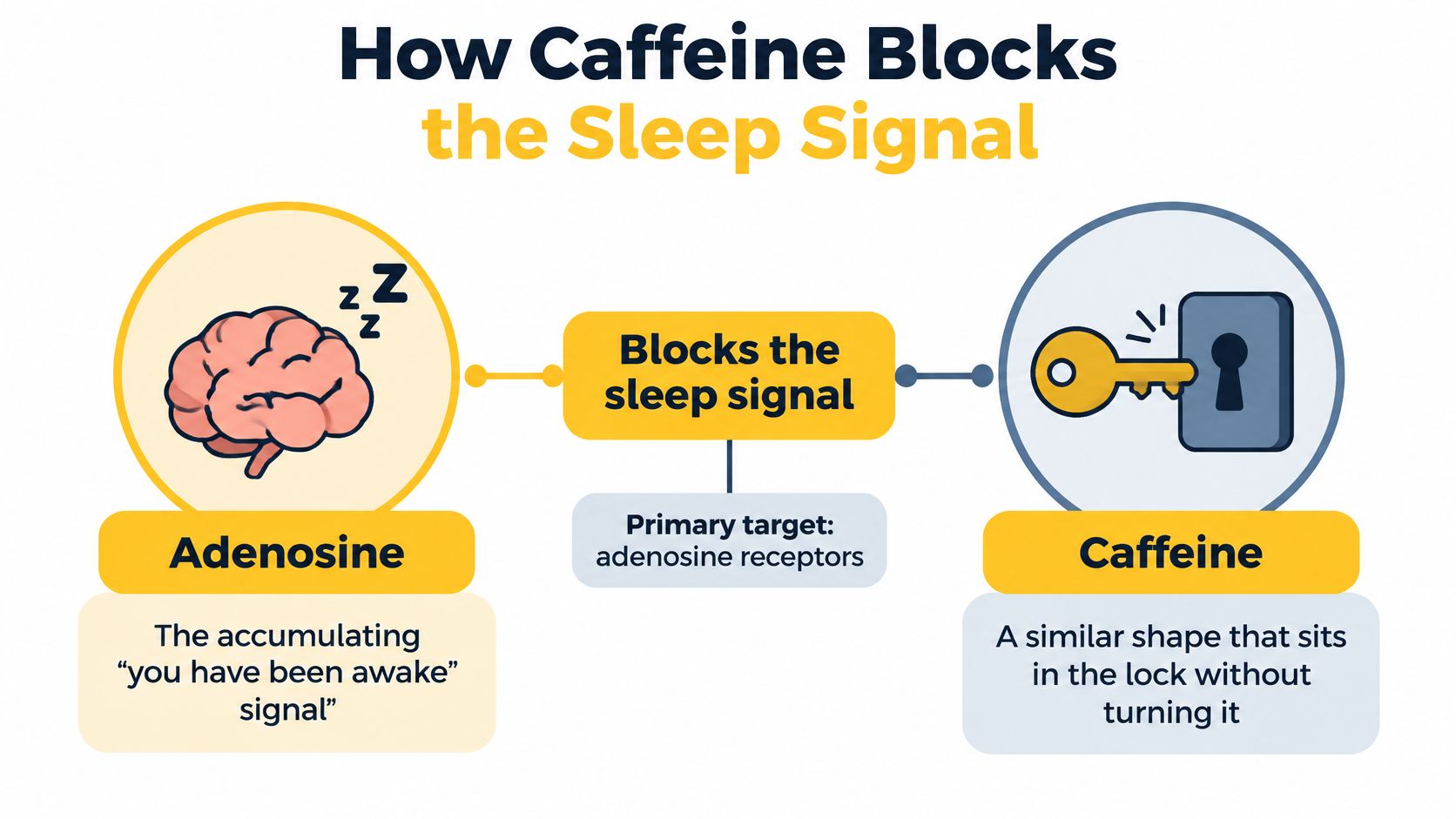
Adenosine is a chemical involved in the brain's sleep-pressure signaling. A useful analogy is a lock and key: adenosine fits into a receptor, a receiving site on a cell, and helps signal reduced activity. Caffeine occupies that receiving site without producing the same signal.
What the Lock-and-Key Analogy Means
The medical term is competitive antagonism. Caffeine competes with adenosine for access to receptors, especially those called A1 and A2A, reducing adenosine's inhibitory effect on nerve-cell activity.
According to the StatPearls clinical overview of caffeine, approximately 99% of an oral dose can be absorbed within 45 minutes, while peak blood concentrations generally occur 15–120 minutes after ingestion. The overview also explains that caffeine's water- and fat-soluble properties allow it to cross the blood–brain barrier efficiently, reaching the brain from the bloodstream.
The basic interaction looks like this:
That timing explains why ordering another coffee because the first hasn't helped yet can be misleading. You may still be waiting for the first serving's strongest effect when you add more.
Alertness Isn't the Same as Fuel
Caffeine can change how awake you feel without supplying the nourishment of a meal or the recovery of sleep. Think of it as temporarily reducing your awareness of a message, not resolving the reason for that message.
For a commute or a focused work session, keep these distinctions clear:
- Allow the first serving to act. Don't immediately follow it with another caffeinated product because you still feel tired.
- Keep food and rest separate. A stronger coffee isn't a replacement for breakfast or adequate sleep.
- Judge the whole task. Feeling more alert doesn't make driving safe if you're struggling to stay awake.
If your morning routine gradually extends into evening coffee, SleepHabits' guide to coffee habits for more restorative nights offers a useful way to think about the relationship between coffee and bedtime.
The important distinction is between feeling stimulated and being rested. Caffeine can help with the former without providing the latter.
How Long One Dose Stays Active
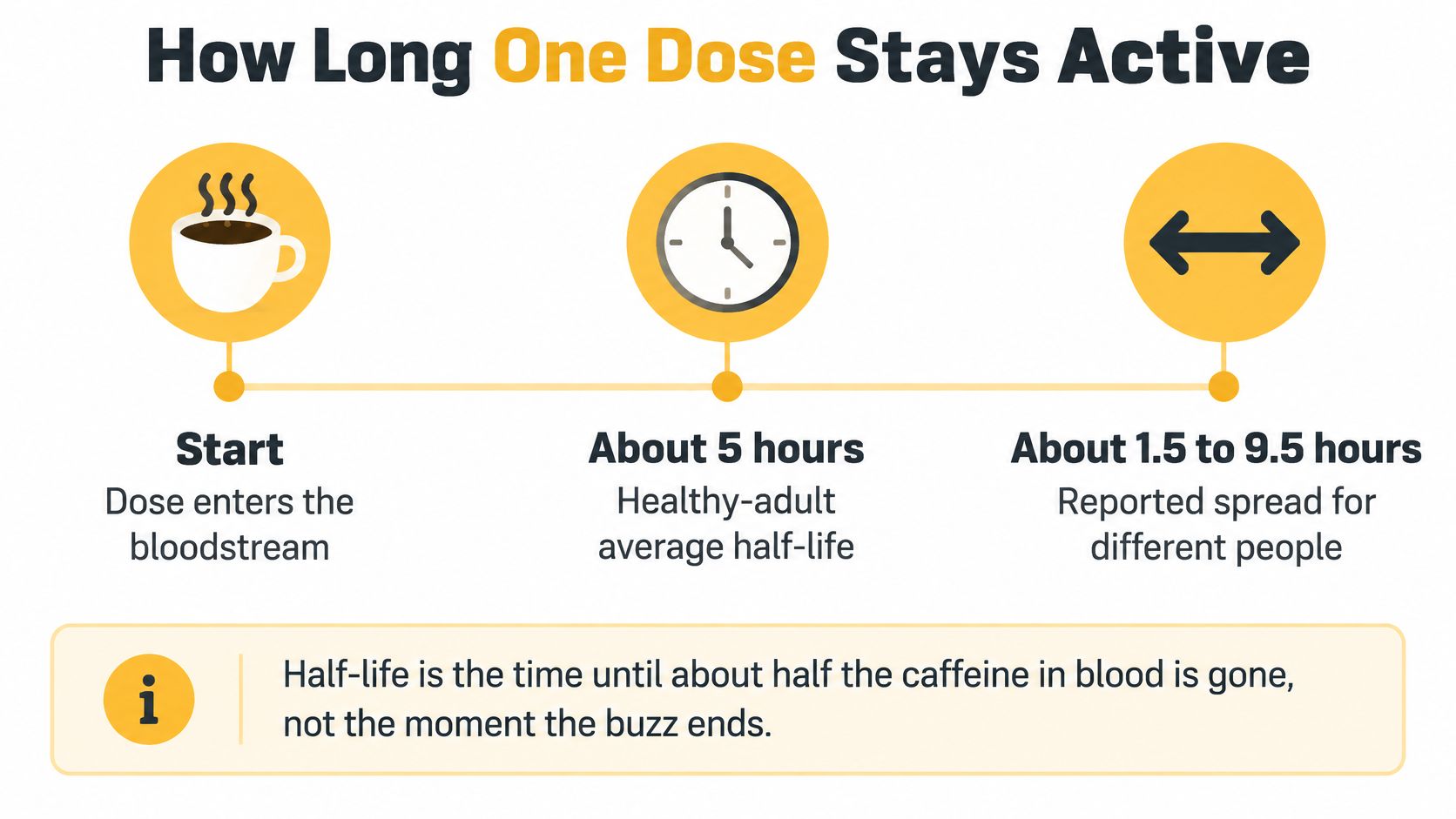
The end of the noticeable buzz isn't the end of caffeine's presence in your body. To understand the difference, use half-life, the time it takes for the amount in the bloodstream to fall by about half.
The National Academies' chapter on caffeine pharmacology gives a healthy-adult average plasma half-life of about 5 hours, with reported values ranging from roughly 1.5 to 9.5 hours. That spread matters: people sharing the same pot of coffee may clear their servings at very different rates.
What Remains After the Lift Fades
Using that average as a simplified calculation, half remains after one half-life and about a quarter remains after another. This isn't a prediction for your body, but it explains why an afternoon serving can still matter when you get ready for bed.
A gradual decline looks different from an on-off switch:
The liver does much of the clearing through an enzyme called CYP1A2. Enzymes are proteins that help chemical reactions happen; this one helps break caffeine into other compounds, including paraxanthine.
Those breakdown products are called metabolites. They're part of the body's processing of caffeine, rather than evidence that the original drink has vanished.
Why a Friend's Cutoff May Not Suit You
Smoking and pregnancy can alter caffeine clearance in opposite directions: smoking can speed it up, while pregnancy, especially later pregnancy, can slow it down. That's not a reason to change either behavior for the sake of coffee. It's a reason not to borrow someone else's caffeine schedule.
You can feel less stimulated while caffeine is still circulating. How wired you feel isn't a reliable clearance test.
Use your sleep pattern to guide a conservative adjustment:
- Move the last serving earlier. Change the timing before assuming you need to abandon coffee altogether.
- Keep the serving consistent. Otherwise, you won't know whether a better night followed an earlier drink or a smaller dose.
- Ask about personal factors. Discuss caffeine with a clinician or pharmacist if your health situation or medicines change.
A wide gap before bed is more useful than a rigid cutoff copied from a friend. The aim is a routine that supports your sleep, not one that merely lets you fall asleep despite late caffeine.
What a Moderate Dose Feels Like
A useful coffee serving should help you do something you value, such as stay attentive through routine paperwork. If the result is shaky hands and a pounding heartbeat, the serving isn't useful just because someone else drinks more.
Moderate describes the fit between dose and person, not a particular mug. Wanted and unwanted effects can sit close together, especially when you increase the amount or drink it quickly.
Pair the Benefit With Its Cost
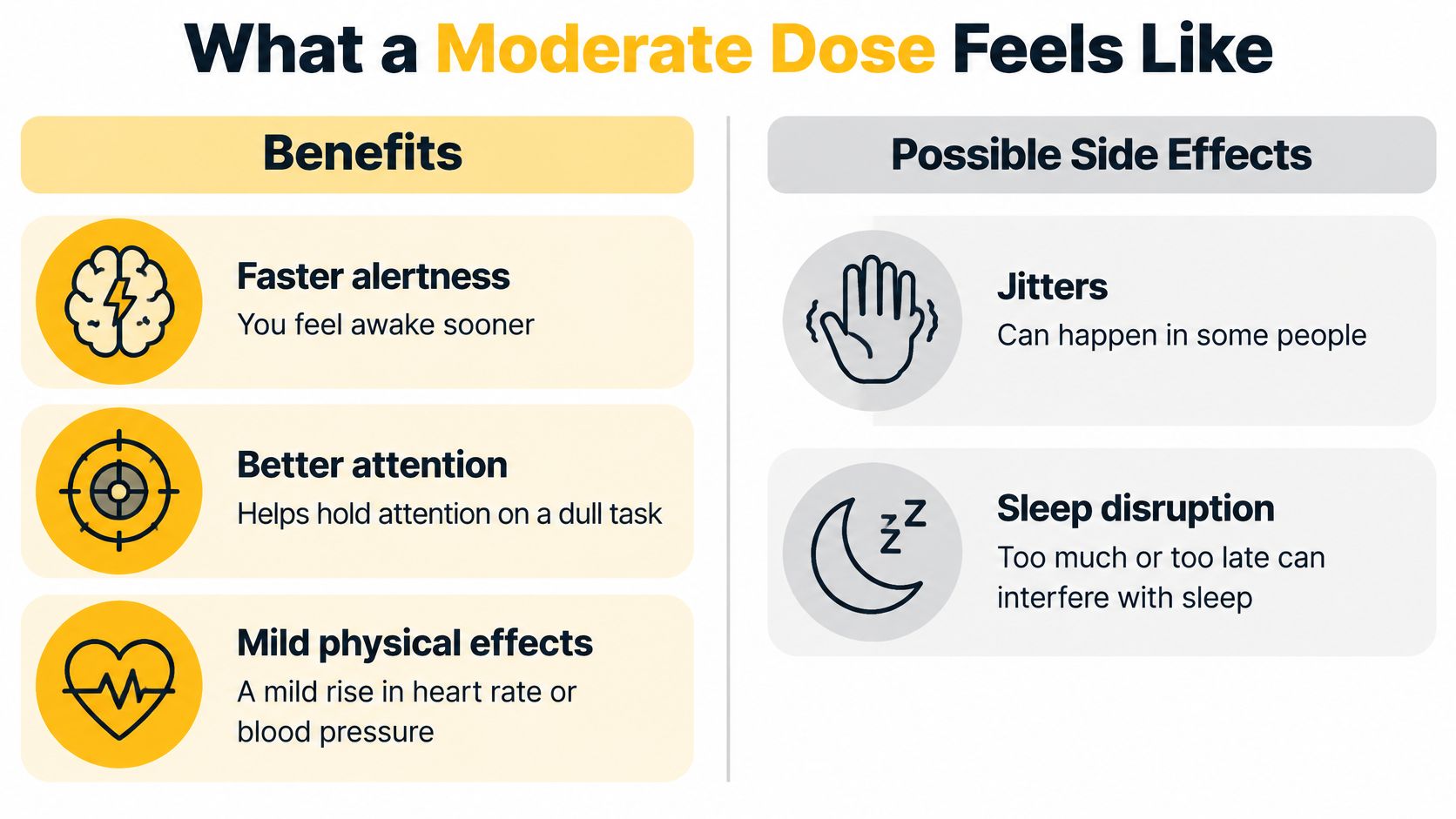
Greater alertness may help you engage with a task. Too much stimulation may instead make it harder to sit comfortably or concentrate without feeling anxious.
Physical sensations deserve the same attention as mental ones. A change that feels mild to one person may be unpleasant to another, and an uncomfortable response isn't something you need to train yourself to tolerate.
These are the kinds of effects coffee drinkers may notice:
Pay attention to the pattern rather than judging a single busy morning. Ask whether the same serving consistently helps, whether discomfort follows it, and whether you're increasing the amount to chase a stronger sensation.
- Useful response: You feel more attentive without an uncomfortable physical rush.
- Too much for you: Nervousness, stomach discomfort, or palpitations outweigh the improvement in focus.
- Poor timing: The workday benefit is followed by difficulty settling down at night.
Familiarity Can Make Changes Harder to Notice
Regular users may feel less of an obvious jolt. That doesn't make progressively larger servings the right answer, and headaches, fatigue, or irritability after a skipped coffee can reflect withdrawal rather than a need to keep escalating intake.
If you want to reduce your intake, a gradual change can be easier to manage than an abrupt overhaul. Keep the routine recognizable while making the coffee amount smaller or replacing a serving with a noncaffeinated option.
For an uncomfortable response, our guide to how to stop caffeine jitters can help you think through what to change. Don't add more caffeine to push through the discomfort.
New or persistent palpitations, severe anxiety, or a major deterioration in sleep deserve a conversation with a clinician. Seek urgent medical help for chest pain, fainting, or other severe symptoms rather than assuming coffee is the explanation.
How Much Caffeine Fits a Healthy Day
The U.S. Food and Drug Administration's caffeine guidance says up to 400 milligrams per day is an amount not generally associated with negative effects for most healthy adults, roughly two or three 12-fluid-ounce cups of coffee. The FDA emphasizes that sensitivity and elimination rates differ widely, so this is a population reference, not a guarantee of comfort.
A ceiling isn't a target. If a smaller amount gives you the benefit you want, there's no reason to increase it to fill an allowance.
Caffeine Ceilings by Situation
Use the situation that fits your health and response, not the most permissive row.
| Situation | Daily reference | Single-dose note | Practical caution |
|---|---|---|---|
| Most healthy non-pregnant adults | The adult reference above | Avoid treating the daily allowance as a single serving | Count all sources |
| Pregnancy | Agree on an appropriate amount with the clinician managing the pregnancy | Ask about serving size and timing | Don't borrow the general adult ceiling |
| Caffeine-sensitive adults | Stay below the amount that causes symptoms | A small serving may still be uncomfortable | Stop earlier if anxiety or palpitations appear |
| Later-day sleep trouble | Reducing the total may help | Move the final serving earlier | A daily allowance doesn't establish a bedtime-safe dose |
| Adolescents | Use pediatric guidance, not the adult reference | Don't combine caffeinated products casually | Review energy drinks with a parent or clinician |
| Pure or highly concentrated caffeine | Don't treat it as an ordinary beverage | Kitchen measurements aren't a safe dosing method | Choose a clearly measured beverage instead |
Medical conditions and medicines can change how caffeine affects you. A clinician or pharmacist can help you identify whether the general adult reference is appropriate in your situation.
Apply the Reference to Your Actual Routine
Start with what you already consume rather than planning around what remains available. Include caffeine-containing pain relievers, supplements, and workout products alongside beverages.
Then consider how the servings arrive. Drinking quickly or combining products before the first has fully acted can produce a different experience from spreading modest servings across the morning.
Personal boundary: Stop at the lower of your appropriate daily reference or the amount that causes unwanted effects.
Choose labels that state milligrams per serving. Words such as strong, bold, or energizing describe an impression, not an amount you can add to a tally.
How Caffeine Adds Up Across a Day
A workday, a travel day, and a camping day can look different while sharing the same counting problem: each new product is easy to consider in isolation. The useful question is what it adds to everything you've already consumed.
A notebook beside your coffee can be a practical reminder to record the serving before moving on:
The European Food Safety Authority's caffeine guidance identifies up to 200 mg as a single dose and up to 400 mg across a day as reference amounts for healthy, non-pregnant adults. Those amounts concern caffeine across products, not separate allowances for coffee, tea, and supplements.
Different Days, the Same Accounting Problem
On an office day, breakfast coffee may be easy to remember. The refill during a meeting, cola with lunch, and chocolate from a desk drawer are easier to overlook. Each belongs in the same running record.
On a travel day, you might finish a café drink before buying an energy drink at the next stop. The change in brand, packaging, and beverage type doesn't create a fresh allowance. Check the full container, not just the number printed beside an unfamiliar serving size.
On an outdoor day, measured instant coffee can simplify serving consistency. But repeated packets, soda from the cooler, and a caffeinated workout product still need to be counted together.
For help comparing coffee formats, our guide to coffee caffeine content provides context for reading serving information.
Convenience Needs a Counting Habit
Portable doesn't automatically mean low risk. Convenient servings are easy to repeat, while a clearly measured serving is easier to record accurately. Neither changes the caffeine itself.
Pure or highly concentrated caffeine is a separate safety concern, not a stronger version of a normal mug. Avoid trying to portion it with ordinary kitchen tools.
For another explanation of caffeine, this video provides additional context:
The most useful record follows your day across locations. Keep it on your phone or in the notebook you carry, so an afternoon purchase doesn't get separated from the morning's intake.
Caffeine Questions Coffee Drinkers Ask
Is Decaf Caffeine-Free?
Don't assume it is. Treat decaf as a product whose caffeine content needs checking, particularly if you're choosing it because of sensitivity or medical advice.
Decaf can still be a practical replacement for regular coffee. The distinction is between reducing caffeine and establishing that a product contains none.
Does Roast Level Tell You the Dose?
Not reliably. Roast descriptions help you choose a flavor profile, but they don't give you the milligrams in your prepared drink.
Use information for the actual product and preparation. A dark-looking brew or an intense taste isn't a measurement, and neither is the word mild.
How Do You Check Caffeine on a Label?
Find the milligrams per serving, then check what the manufacturer calls a serving. Compare that with the amount you'll drink or take.
- Check the container. Establish whether the printed amount covers the entire drink.
- Check the preparation. Match an instant product's caffeine information to the instructed powder amount.
- Check other ingredients. Review supplements and medicines rather than assuming only beverages count.
If caffeine information isn't available, mark the serving as uncertain instead of entering zero. Choose a more clearly labeled option when predictable dosing matters.
Is Tea a Lighter Source Than Coffee?
It can be, but the category alone doesn't establish the dose. The tea, preparation, and serving size all matter.
A switch to tea is useful only if it produces the change you want. Repeated mugs still belong in your caffeine record, and someone who needs a lower intake shouldn't rely on the general healthy-adult reference.
Set Your Cutoff Before the Next Cup
Choose your personal daily ceiling before you make another drink. Use an appropriate health-based reference, then lower it if your symptoms or sleep call for less.
Your cutoff needs a clock time as well as an amount. Our guide to coffee in the afternoon can help you consider where a later serving fits into your routine.
Make a Tally You Can Keep
Use a note on your phone with these entries:
- List each source. Include coffee, tea, soda, chocolate, medicines, and caffeinated supplements.
- Record the milligrams. Use the label or reliable product information, and flag unknown amounts.
- Add the entries. Subtract the total from your chosen ceiling before deciding on another serving.
- Write the time. Record when you finish your last caffeinated drink.
Walk through yesterday before planning tomorrow. Look for the easy-to-forget items, especially a refill, a travel purchase, or a supplement taken outside your usual coffee routine.
Make the Serving Predictable
Our Cartograph Organic Instant Coffee - Medium Roast is organic freeze-dried coffee sold in sealed single-serve packets, made from organic coffee beans only, with no additives or chemicals added. To prepare it hot, open a packet into a mug, bottle, or travel cup, add hot water, and stir until dissolved.
A measured packet helps keep preparation consistent, but it still belongs in the same caffeine tally as any other coffee. A convenient format doesn't replace checking the dose.
Set tomorrow's final caffeine time tonight, keep your remaining allowance visible, and choose a noncaffeinated drink once you reach your boundary.
Cartograph Coffee offers organic instant coffee in sealed, measured servings for home, work, and outdoor trips. Visit Cartograph Coffee to explore an easy-to-prepare option, and keep each serving in your daily caffeine record.