You're halfway through the afternoon, your inbox is still full, and the next task needs a level of concentration that lunch didn't provide. A coffee in the afternoon sounds like the obvious answer. It's warm, familiar, quick, and often attached to a small pause that makes the rest of the day feel manageable.
Then bedtime enters the calculation. Will that cup help you finish the work, or will it leave you staring at the ceiling later? The honest answer isn't a universal “yes” or “no.” Afternoon coffee is a timing, dose, and personal-sensitivity decision.

This guide offers a practical way to make that decision. You'll learn why caffeine can linger, how to estimate a cutoff that fits your bedtime, when a modest serving may be reasonable, and how to preserve the ritual with decaf or a smaller dose. You'll also find options for busy workdays, quiet afternoons at home, family routines, and outdoor trips. If you're comparing coffee with other convenient focus products, this overview of caffeine pouches for focus offers another format to consider.
Introduction Why Afternoon Coffee Feels So Tempting
Lunch is over, the easy tasks are finished, and a routine email suddenly takes real concentration. Your next meeting may still be hours away, yet the coffee machine already feels like the most practical solution. The afternoon cup offers both caffeine and a reason to pause.
That habit is common across age groups. Research on coffee timing found that coffee drinkers aged 13 and older consumed 61% of their caffeine in the morning, 21% in the afternoon, and 18% in the evening (ScienceDirect). Morning remains the main window, while afternoon intake still represents a meaningful share of daily caffeine.
Adolescents in the same research followed a different pattern, dividing caffeine intake almost evenly among morning, afternoon, and evening, at about 33.33% for each period. The finding does not predict your personal response. It does show why “coffee belongs only in the morning” is too narrow a rule.
The appeal is bigger than alertness
An afternoon coffee creates a clear pause in a crowded day. You leave the screen, prepare a drink, and return with one defined task in front of you. The caffeine may support alertness, while the break gives your attention a chance to reset.
The ritual also has a long workplace history. Barcolo Manufacturing Company in Buffalo, New York, introduced an official workday recess in 1902. The Pan-American Coffee Bureau later helped popularize the phrase “coffee break” through a 1952 campaign (European Heart Journal historical account). Sweden's fika tradition offers a familiar example of an afternoon pause that combines a drink with social time.
So the useful decision is personal and practical. How much caffeine are you having, how close is it to bedtime, and what has your sleep history shown? A small serving before an evening shift may fit comfortably. A larger drink late in the day may make tomorrow harder, even if it helps you finish today.
For people comparing coffee with other convenient focus products, this overview of caffeine pouches for focus explains another format.
How Caffeine Works in the Afternoon and Why It Lingers
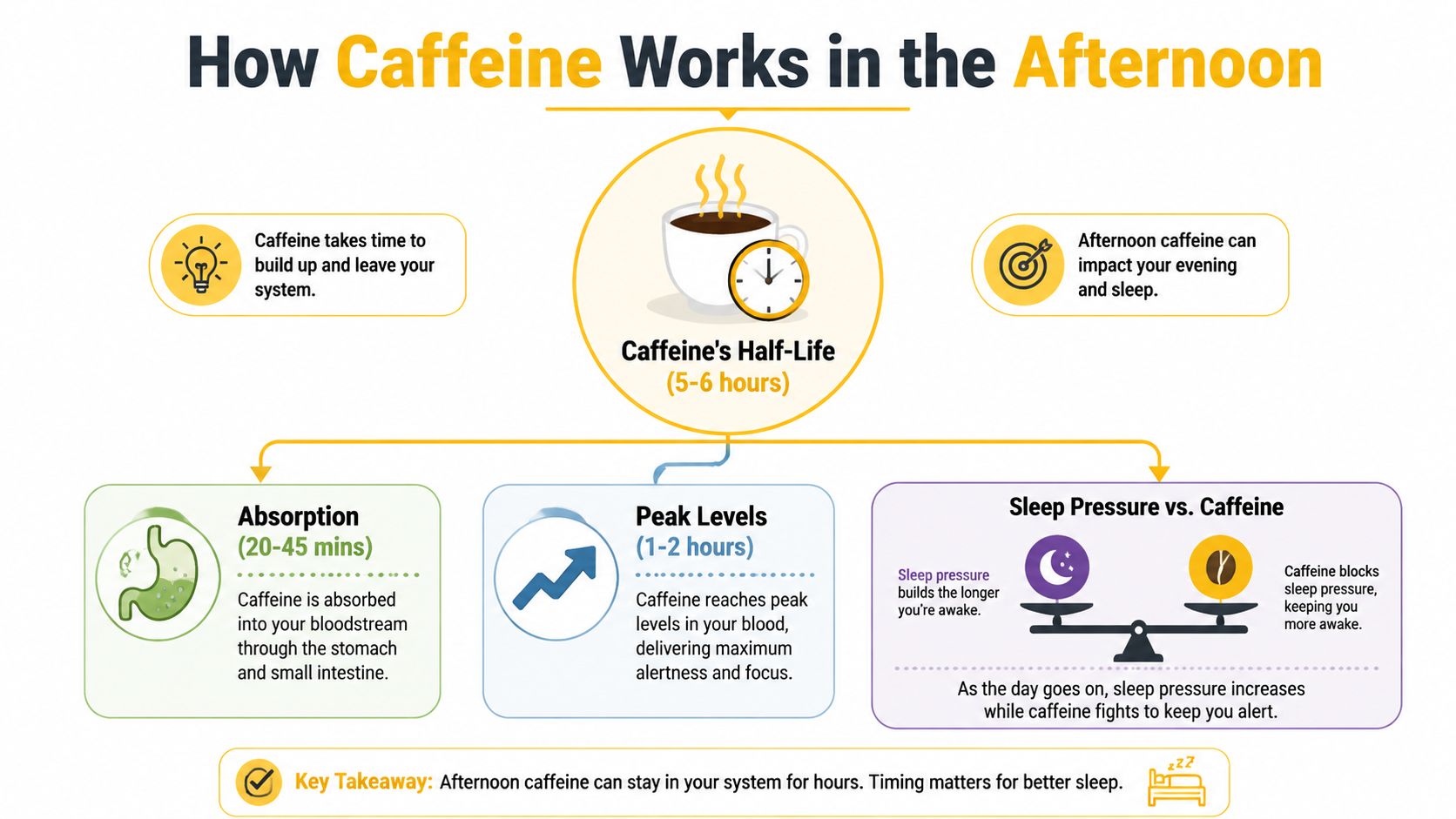
Caffeine works gradually rather than switching alertness on or off. It can brighten your focus for a while, then fade even though some caffeine remains active in your system.
After you drink coffee, your body absorbs the caffeine and its level rises before declining over time. Caffeine partly works by blocking adenosine, a chemical signal linked with sleep pressure. You may feel more awake because your brain is receiving fewer “time to rest” signals. The need for rest itself has not disappeared.
Why a 2 p.m. cup can matter at night
In healthy adults, caffeine's average elimination time is about 5 to 6 hours (Sleep Foundation). A coffee at 2 p.m. can therefore leave roughly half its original dose in circulation around 7 or 8 p.m., with about one-quarter remaining around midnight.
The calculation is simple, but its meaning is easy to miss. Falling asleep after afternoon coffee does not prove that caffeine had no effect. It may still reduce sleep depth, delay sleep, or make sleep more fragmented without causing obvious insomnia.
A 2023 meta-analysis of 24 studies found that caffeine reduced total sleep time by an average of 45 minutes, lowered sleep efficiency by 7%, increased the time needed to fall asleep by 9 minutes, and increased wakefulness after sleep onset by 12 minutes (sleep research summary). The same analysis estimated that a coffee-sized dose of about 107 mg should be consumed at least 8.8 hours before bedtime to avoid measurable sleep loss.
The practical takeaway: caffeine fades slowly, so an afternoon cup can influence the night even after the stimulated feeling has passed.
Coffee's strength isn't only about taste
A bitter, intense drink is not automatically high in caffeine, and a smooth beverage is not automatically low in it. Brewing method, serving size, coffee concentration, and the number of shots all affect the dose. Cartograph Coffee's coffee caffeine guide offers a useful comparison of caffeine levels across common coffee drinks.
That makes “one cup” an imprecise measure. A small home brew and a large café beverage can represent very different caffeine choices, even when both are called coffee.
Your sleep pressure also changes the trade-off. If you are already tired, caffeine can make you feel able to continue while your body still needs rest. That may help with a defined work task, a commute, or an outdoor activity, but it can also extend the day instead of addressing the fatigue.
The following video gives another accessible explanation of caffeine's relationship with alertness and sleep.
Finding Your Personal Caffeine Cutoff Without Guesswork
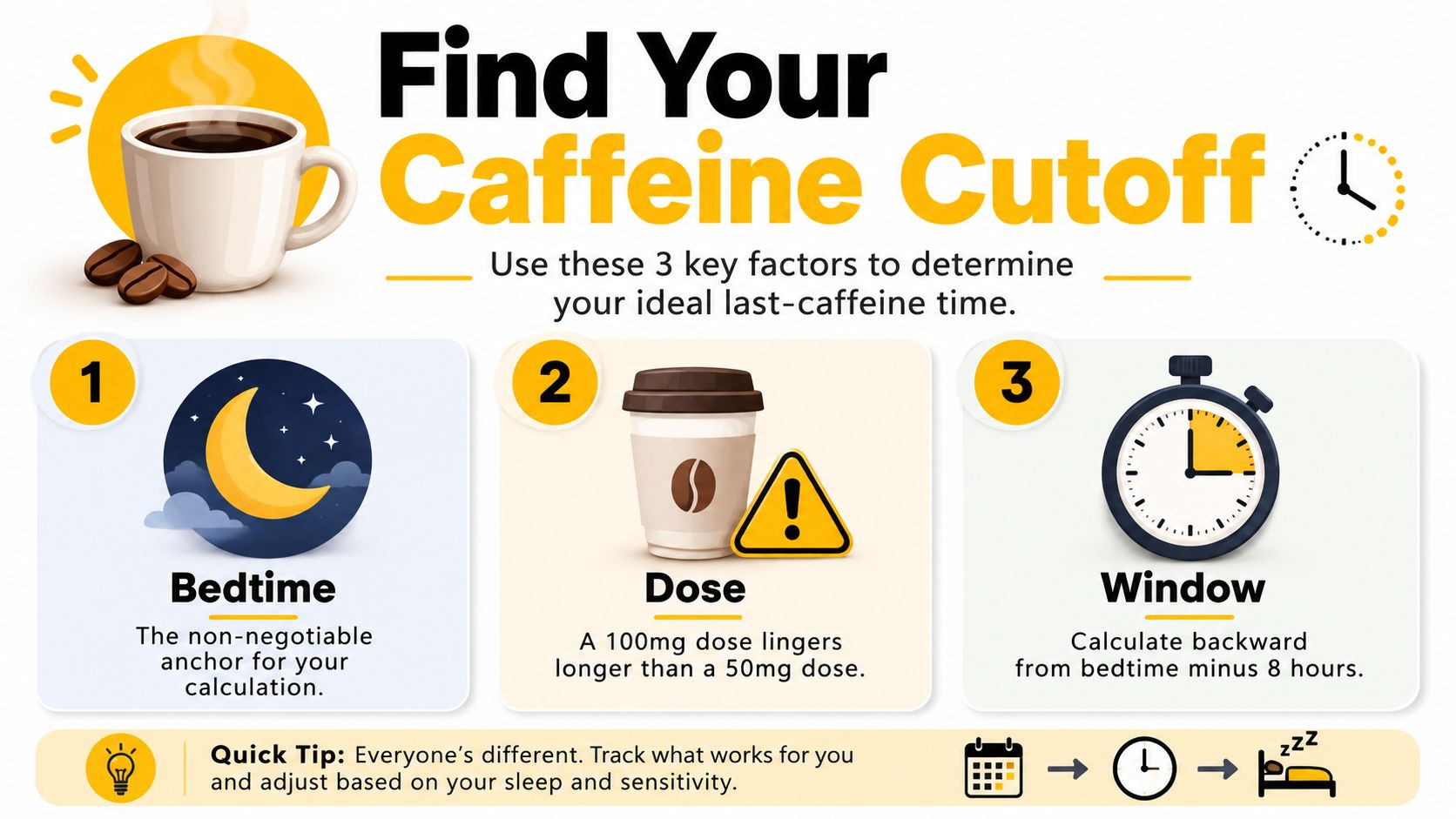
A fixed rule such as “no coffee after 2 p.m.” cannot fit every schedule. A person who goes to bed early and someone who works late may need different boundaries. Your cutoff should begin with sleep time, then adjust for dose and personal response.
Start with your usual bedtime and count backward by roughly 8 to 9 hours as a cautious starting window. Earlier guidance recommends leaving at least 8 hours before bed, while the meta-analysis discussed above estimated that a standard serving of about 107 mg may need 8.8 hours of lead time. Treat these figures as a starting point, not a personal guarantee.
Use three questions
First, anchor the calculation to sleep. If you usually sleep at 10 p.m., an 8-hour buffer places your starting cutoff at 2 p.m. Choose a longer buffer if caffeine affects you strongly, falling asleep is difficult, or you wake without feeling restored.
Second, estimate the dose. A small coffee and a large specialty beverage may share the same name while delivering very different amounts. The evidence uses roughly 100 to 107 mg as a useful reference range, while larger servings call for more caution (randomized caffeine trial). Check the package, ask how many shots the café uses, or keep your home portion consistent.
Third, observe your own response. Regular caffeine use, age, metabolism, and sensitivity can change its effects. Falling asleep quickly does not settle the question if an afternoon drink is followed by more nighttime waking.
Run a simple personal test
For several similar days, keep your drink and bedtime broadly steady. Record:
- Time: When did you finish the drink?
- Dose: Was it decaf, half-caf, a small coffee, or a stronger beverage?
- Sleep: How quickly did you fall asleep, and did you wake more than usual?
- Next morning: Did you feel restored or reach for caffeine immediately?
Change one variable at a time. Move the drink earlier before changing the coffee, bedtime, and evening routine together. The goal is not a laboratory experiment. It is a repeatable pattern that makes the timing-and-dose trade-off easier to judge.
Personal rule: if sleep worsens, move the cutoff earlier or reduce the dose before giving up the afternoon ritual entirely.
When Afternoon Coffee Is Worth It and When It Is Not
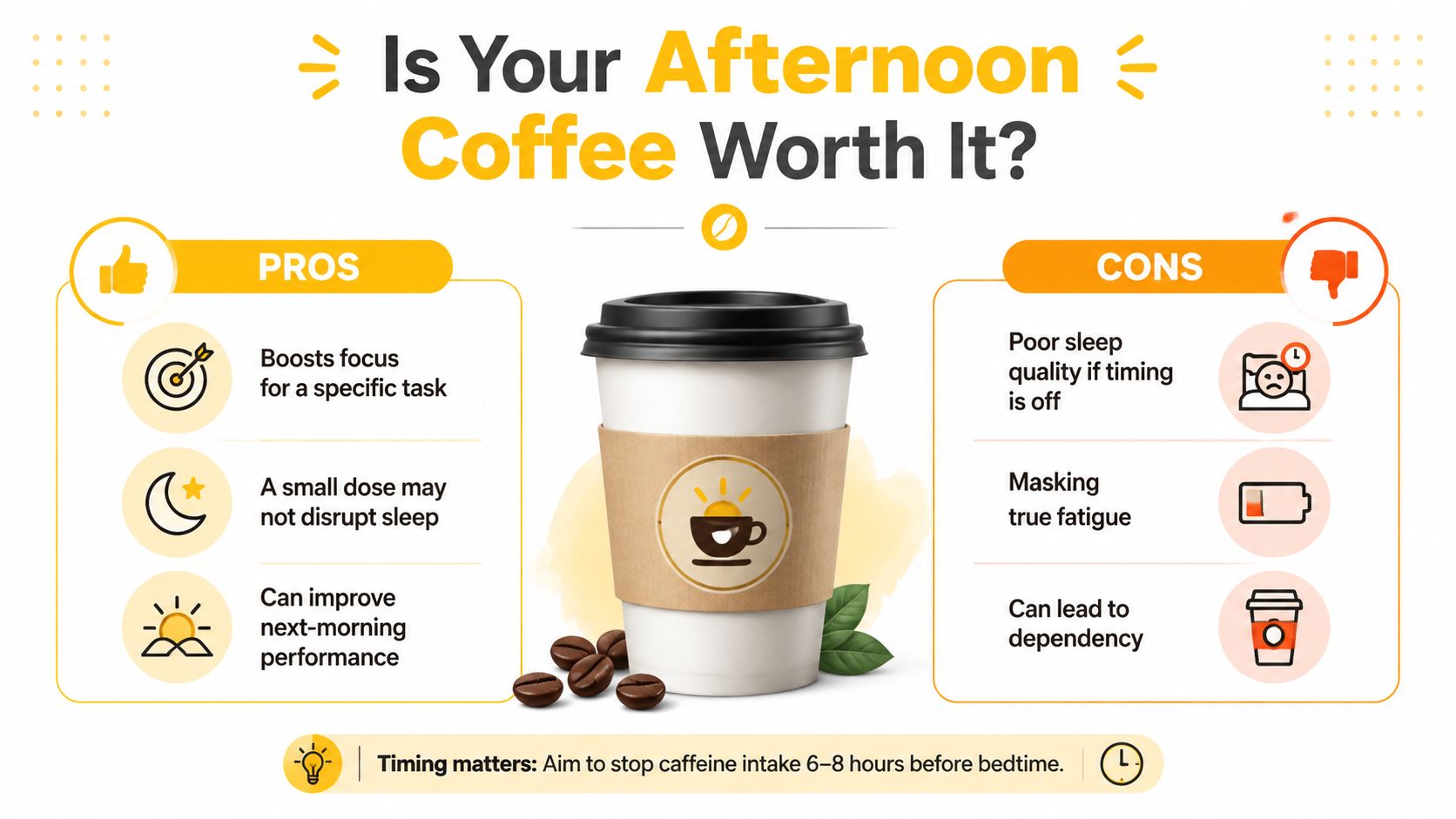
The afternoon cup earns its place when it serves a clear purpose. You might need steady focus for a work task, alertness for a drive, energy for an evening responsibility, or a pleasant pause with friends. A defined use makes the decision easier than reaching for coffee whenever you feel vaguely tired.
Timing and dose work together. A modest serving earlier in the afternoon creates a different trade-off from a large specialty drink close to bedtime. Research discussed earlier suggests that caffeine's effect on sleep depends on both the amount consumed and the hours remaining before sleep. “Afternoon coffee” is therefore too broad a category for a single rule.
Compare the trade-offs
| Situation | Likely benefit | Main concern | Sensible response |
|---|---|---|---|
| A modest serving well before bedtime | Focus for a defined task | Individual sensitivity | Keep the dose measured and monitor sleep |
| A large specialty drink late in the day | Strong short-term stimulation | Delayed or fragmented sleep | Reduce the serving or choose a lower-caffeine option |
| Coffee used to push through repeated exhaustion | Temporary alertness | Masking a need for rest | Address sleep, food, hydration, or workload |
| A social afternoon ritual | Enjoyment and connection | Unplanned extra caffeine | Choose decaf or half-caf when sleep is a priority |
Regular drinkers may experience caffeine differently from occasional drinkers. Research on healthy habitual users found that morning, midday, and afternoon intake did not strongly impair nighttime sleep structure or reported sleep quality (habitual caffeine research). That result does not make late caffeine consequence-free for everyone. It does show why a universal cutoff can be too blunt. Your usual dose, sensitivity, and sleep pattern still matter.
The longer view matters too
The choice is not only about tonight's sleep. One observational study associated restricting coffee intake to the 4 a.m. to noon window with a lower risk of death from any cause over nearly 10 years (timing and long-term outcomes research). This association does not prove that morning-only coffee caused the difference, so it is not a personal medical prescription. It is a reason to consider how often afternoon coffee appears in your routine, not a blanket ban.
Use the cup like a small tool. At work, choose a measured serving for one demanding task. At home, pair it with a planned break instead of repeated refills. Outdoors, check the serving size before adding caffeine to a long, tiring day. If sleep stays steady and the drink provides a real benefit, afternoon coffee may be worthwhile. If it repeatedly delays sleep or leaves you waking more often, reduce the dose, move it earlier, or choose a lower-caffeine option.
Smarter Swaps for a Gentle Afternoon Lift
Sometimes you want the cup, not a powerful stimulant. The aroma, warmth, flavor, and pause can all remain satisfying even when you reduce caffeine.
Start with the drink that matches your main goal. Decaf preserves much of the coffee ritual with very little caffeine, while half-caf keeps some stimulation but makes the dose easier to control. Tea can offer a lighter alternative, although caffeine varies by product and preparation.
| Option | Caffeine Level | Flavor and Ritual | Best For |
|---|---|---|---|
| Decaf coffee | Low, but not necessarily zero | Familiar coffee flavor and full pause ritual | Sleep-sensitive drinkers who want coffee |
| Half-caf coffee | Moderate and portion-dependent | Coffee character with a gentler lift | People reducing caffeine gradually |
| Black tea | Lower than many coffee servings, depending on the product | Brisk, aromatic, and easy to prepare | A lighter workday beverage |
| Green tea | Lower than many coffee servings, depending on the product | Fresh, grassy, and less heavy | A gentler afternoon routine |
| Matcha | Variable and label-dependent | Rich, concentrated, and whisked as a ritual | People who enjoy a slower preparation |
| Herbal infusion | Naturally caffeine-free when the blend contains no caffeinated ingredients | Warm, fragrant, and calming | Evening-bound routines |
Read the label and ask the café
Treat caffeine as an ingredient, not a personality trait. “Strong,” “bold,” or “dark” may describe taste rather than the actual dose, so look for serving information when it's available. At a café, ask whether the drink includes multiple espresso shots or a concentrated cold-brew base.
If you want coffee flavor without the same stimulation, Cartograph Coffee's low-caffeine instant coffee guide can help you compare lower-caffeine approaches. Instant formats can also make portion control easier because you prepare a defined amount rather than accepting an unknown café serving.
For outdoor trips or family afternoons, keep both caffeinated and caffeine-free choices available. That removes the pressure to make every coffee decision at the moment you're already tired.
Easy Afternoon Coffee Rituals and Quick Recipes
A satisfying afternoon drink doesn't need to be elaborate. The aim is to create a clear pause, use a deliberate portion, and finish preparation quickly enough that the ritual supports your day rather than interrupting it.
Half-caf iced latte
Combine a small portion of half-caf coffee with cold milk or an unsweetened milk alternative over ice. Stir thoroughly, then add cinnamon or a little vanilla if you want more aroma without increasing the caffeine.
At work, prepare the coffee in a small jar and keep the milk separate until you're ready to drink it. At home, use a chilled glass so the drink feels distinct from your morning mug.
Sparkling decaf americano
Pour decaf coffee over ice, add cold water, and finish with sparkling water. The result is lighter and more refreshing than a hot drink, with the familiar roasted flavor softened by bubbles.
This works well on warm afternoons when a heavy latte feels unappealing. For camping, carry a decaf instant option, a lightweight cup, and sparkling water if it's practical, or use plain cold water for a simpler version.
Cinnamon oat instant coffee
Stir a measured serving of instant coffee into hot water, then add warmed oat milk and cinnamon. Keep the serving modest if you're protecting sleep, and avoid adding extra coffee because the drink tastes mild.
For a chilled variation, see this instant coffee iced coffee method. A small handheld frother can add texture at home, while a sealed jar lets you shake the drink at a campsite.
Make the pause feel complete
The drink is only part of the reset. Step away from the screen, take a short walk, or finish the cup without opening another task at the same time. If you enjoy a smoother, nitro-style texture, equipment such as branded_1 can turn preparation into a more deliberate home ritual.
Keep the recipe repeatable. A consistent serving makes it easier to learn how your body responds than a different, oversized café drink every afternoon.
Making Afternoon Coffee Work for Real Life at Work Home and Outdoors
An afternoon coffee routine should fit the day you have. A busy professional may need a quick cup between meetings, a parent may want a quiet pause before the evening rush, and a camper may have little equipment but still care about flavor. Treat the decision as a match between timing, dose, and the lift you need.
At work
Choose a measured serving and pair it with one clear task, such as finishing a report or preparing for a meeting. The defined endpoint helps the break stay purposeful instead of becoming a reason to keep sipping. If bedtime comes early or sleep is sensitive, choose decaf or half-caf and let the pause itself provide part of the reset.
Keep instant packets in a desk drawer. That small bit of preparation makes a known portion easier to choose when a busy schedule would otherwise push you toward the largest available drink.
At home
Use coffee to mark the boundary between daytime obligations and the evening routine. A short fika-style pause can be quiet, social, or shared with family. Earlier accounts describe afternoon breaks as part of workplace and social life, so the value lies in the pause as much as in the beverage. Let it refresh the household rather than turn into another rushed chore.
Outdoors
Camping rewards simple preparation. Pack coffee that needs only hot water, bring a cup or method that makes the serving easy to identify, and decide beforehand whether the afternoon drink will be caffeinated or decaf. A scenic setting can make the cup feel restorative, while your usual response to caffeine still applies.
Use this three-part plan:
- Set the anchor: Start with bedtime and count backward.
- Control the dose: Choose a known serving, especially for café-style drinks.
- Judge the result: Keep the routine if sleep and next-day energy stay steady. Adjust the serving or timing if they do not.
Cartograph Coffee organic freeze-dried instant coffee packets offer one convenient way to prepare a portion-controlled drink with hot water at work, home, or outdoors. Afternoon coffee does not need to be a blanket ban or an automatic habit. Make it a flexible pause shaped by your schedule, sleep response, and desired level of lift.
Cartograph Coffee offers organic instant coffee packets for quick preparation with hot water. Visit Cartograph Coffee to explore a portable option for a more deliberate afternoon ritual.