The amount of caffeine in your coffee is a moving target, not a fixed number. We often hear that a standard 8-ounce cup of brewed coffee has about 95 mg of caffeine, but that's just an average. The actual caffeine content in your mug can swing wildly depending on the beans, the roast, and how you brew it.
Your Guide to Coffee Caffeine Content
Trying to figure out the caffeine in your daily cup can feel like a guessing game. Is that dark, bold shot of espresso stronger than a large light roast? Does cold brew really pack a bigger punch? The answers might not be what you expect, and they prove that taste is a poor indicator of caffeine.
It helps to think of it like wine, where different grapes and regions produce different alcohol levels. Coffee is the same. Every step in the journey from a green coffee bean to the liquid in your cup tweaks the final caffeine dose.
Caffeine at a Glance: Typical Amounts by Coffee Type
To get our bearings, let's start with a simple baseline. This table breaks down the average caffeine content for the most popular coffee drinks you'll encounter. Think of it as a quick reference guide before we get into the nitty-gritty of what makes those numbers change.
| Coffee Type | Serving Size | Average Caffeine (mg) |
|---|---|---|
| Drip Coffee | 8 oz (240 mL) | 95 mg |
| Espresso | 1 oz (30 mL) | 64 mg |
| Cold Brew | 8 oz (240 mL) | 150 mg |
| Instant Coffee | 8 oz (240 mL) | 62 mg |
This table shows why it's easy to get confused. While a single espresso shot is incredibly concentrated, a standard cup of drip coffee usually has more total caffeine simply because you're drinking so much more of it.
Key Takeaway: It's a classic coffee misconception. An espresso shot feels stronger due to its concentrated flavor and texture, but a larger serving of drip coffee often delivers a bigger caffeine hit overall.
Of all the variables, the type of coffee bean is one of the most important. As you can see in our guide comparing Arabica vs. Robusta beans, the choice of bean can dramatically alter the final caffeine count. While the industry often uses that 95 mg figure as a standard benchmark, the real-world range for an 8-ounce cup of brewed coffee can be anywhere from 70–140 mg.
Why Your Espresso Shot Isn't the Caffeine Bomb You Think It Is
Most of us have been there. We see that tiny cup of espresso and assume it’s a concentrated jolt of pure energy, the ultimate caffeine powerhouse. And while it’s true that espresso packs more caffeine per ounce than any other coffee, that’s only half the story. The real measure of your daily caffeine intake isn’t about concentration—it’s about how much you actually drink.
Think of it this way: a shot of whiskey is far more potent, ounce for ounce, than a pint of beer. But if you drink the whole pint, you’ll likely consume more total alcohol than you would from that single shot. Coffee works the exact same way. It's the small serving size of an espresso shot that gets lost in the conversation.
The Serving Size Deception
A standard single shot of espresso is a mere one ounce, and it typically delivers around 63 mg of caffeine. It feels intense because it’s a small, powerful package. But compare that to a standard 8-ounce cup of drip coffee, which comes in at about 95 mg of caffeine.
You’re simply drinking a lot more liquid with drip coffee, so you end up consuming more total caffeine. This is the main reason your seemingly milder morning brew often gives you a bigger buzz than a quick espresso. Getting this concept down is fundamental to understanding your personal caffeine intake.
The chart below gives you a quick visual on how popular coffee types stack up in their typical serving sizes.
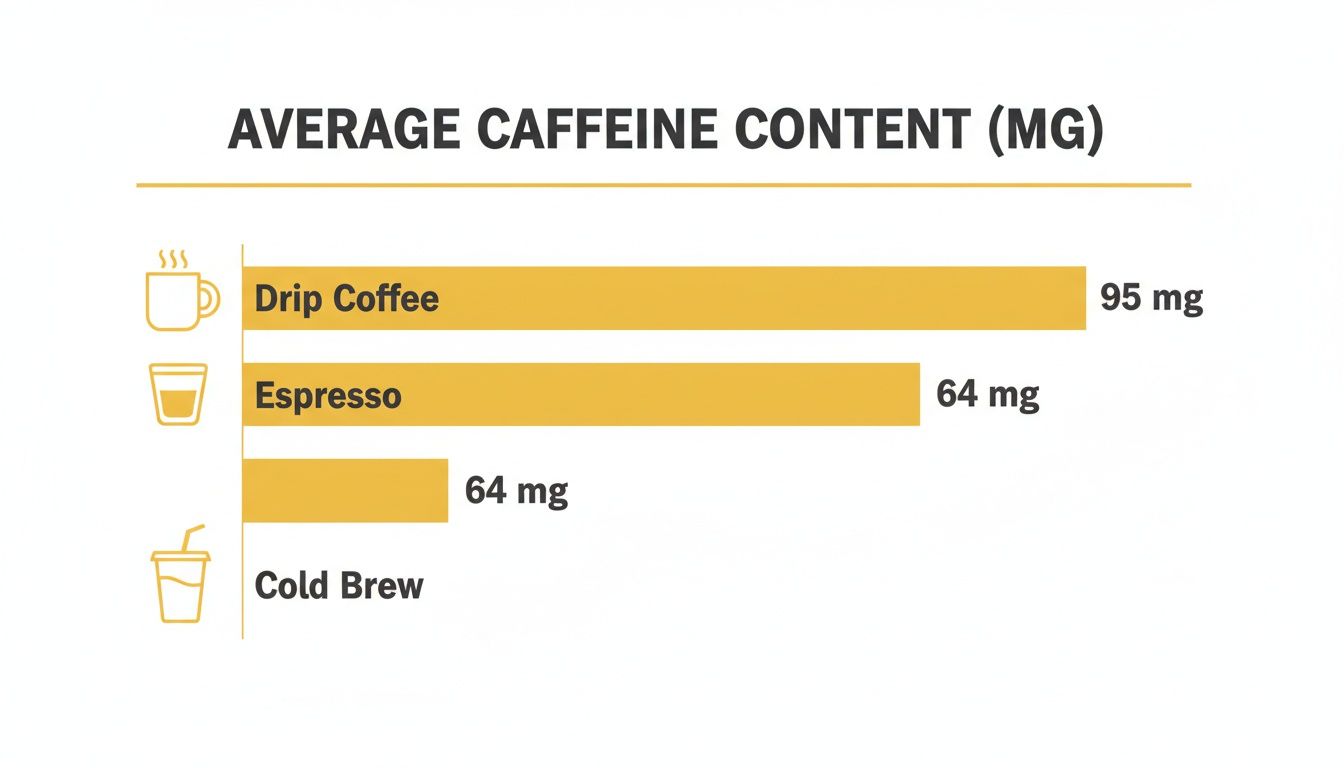
As you can see, both drip coffee and cold brew serve up significantly more total caffeine than a single espresso shot in a standard cup.
A Look Across the Coffee Menu
This "volume vs. concentration" rule applies to pretty much everything on the coffee menu. From instant coffee to single-serve pods, every method has a unique caffeine profile based on how it’s prepared and poured.
Let’s look at a few common examples:
- Drip Coffee: An 8-ounce cup usually has around 95 mg. If you’re like me and prefer a larger 12-ounce mug, you're looking at closer to 142 mg.
- Cold Brew: Known for its punch, an 8-ounce serving can contain 150-200 mg. That's thanks to its long steeping time and high coffee-to-water ratio.
- Instant Coffee: For a quick and convenient cup, an 8-ounce serving of instant coffee offers a more moderate dose, typically between 60–80 mg.
- Single-Serve Pods: These are a bit of a wild card. The caffeine content varies widely, anywhere from 50–150 mg, depending on the pod's size, beans, and how the machine brews it.
So, while an espresso shot is potent, the drinks made with it tell a different story. A latte or cappuccino made with a single shot still has that same 63 mg of caffeine, just mellowed out with milk. Order a "double," and you're getting two shots for a total of around 126 mg—putting you right in the same league as a large cup of drip coffee.
Making Smarter Choices for Your Day
Once you get this, you can make smarter choices, whether you’re at a local café or in your own kitchen. An 8-ounce Americano (a shot of espresso topped with hot water) has about 63 mg of caffeine, while an 8-ounce drip coffee from the same pot has 95 mg. If you want the bigger kick, the drip coffee is the clear winner.
This is also helpful if you’re trying to manage your intake. Knowing that a cup of high-quality organic instant coffee provides a consistent and moderate dose can be a game-changer. For example, the predictable 60-80 mg range in an 8-ounce serving gives you great control, removing the guesswork you might get with other methods. You get a reliable caffeine level every single time.
Ultimately, the strongest coffee isn’t defined by a bold taste or a dark color. It all comes down to the brewing method and—most importantly—how much of it is in your cup.
The Hidden Variables That Change Your Daily Caffeine Dose
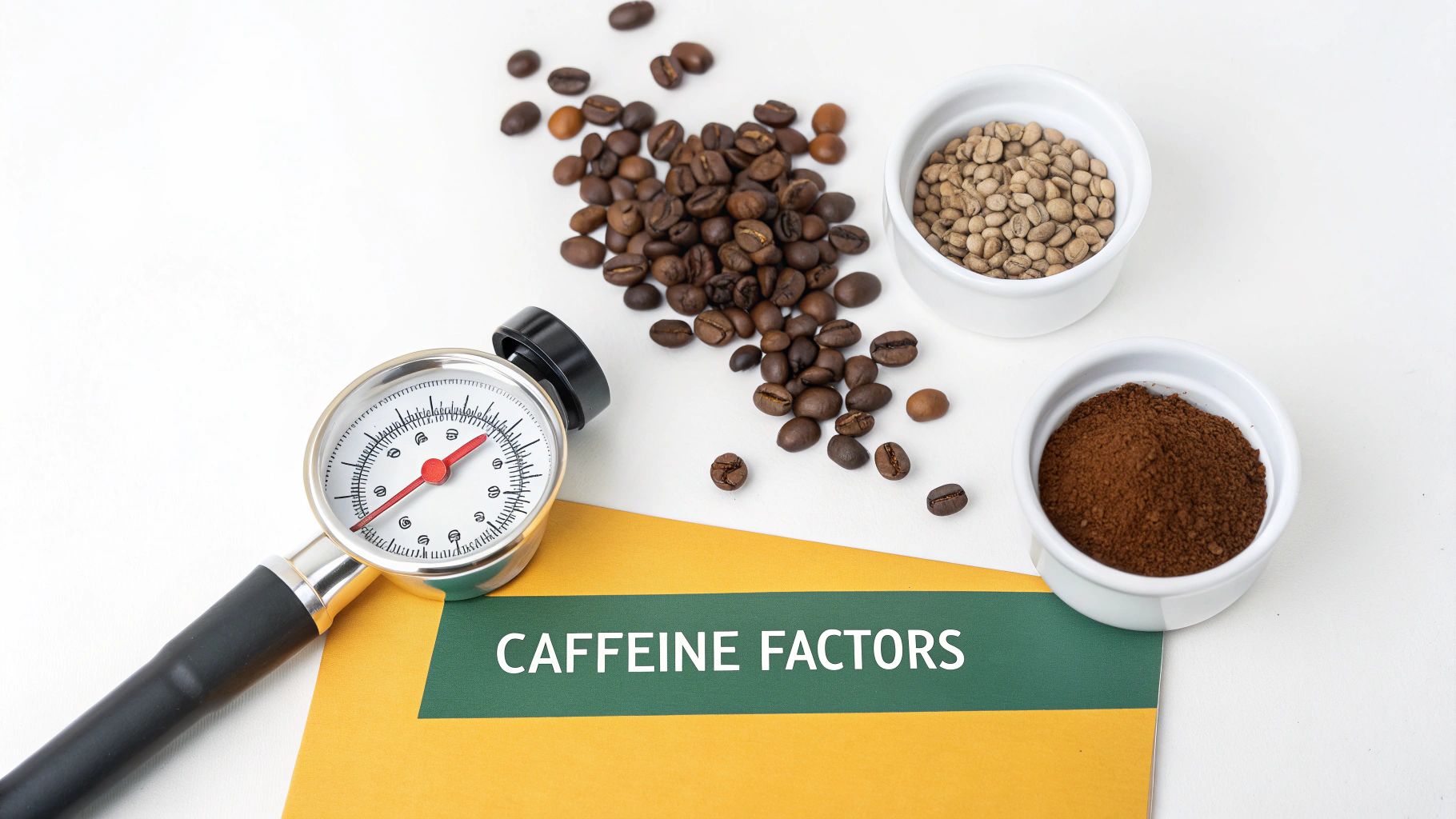
If you think your brew method and cup size are the only things defining your caffeine intake, there’s a much deeper story brewing. A handful of variables can radically change the caffeine in your cup, often without you even realizing it. Getting a handle on these factors is the key to truly understanding—and controlling—your daily dose.
Think of it like baking. You can follow the same basic recipe for a cake, but swapping the flour, tweaking the oven temperature, or changing the bake time will give you a completely different result. Coffee is no different. Let's dig into the key variables that shape the final kick in your cup.
The Power of the Bean Itself
Not all coffee beans are created equal, especially when it comes to caffeine. The biggest factor, by far, is the species of the coffee plant. The two heavyweights you'll find on the market are Arabica and Robusta, and the difference between them is night and day.
- Arabica Beans: Known for their smooth, aromatic, and nuanced flavor profiles, Arabica beans are the darlings of the specialty coffee world. They contain about 1.2% caffeine by weight.
- Robusta Beans: Just like the name implies, Robusta is a hardier plant that produces a bolder, stronger, and more "rubbery" tasting coffee. It also packs a serious punch, clocking in around 2.2% caffeine by weight—nearly double that of Arabica.
This means a cup made with Robusta beans can easily have twice the caffeine as the exact same cup made with Arabica. Many budget-friendly ground coffees and traditional espresso blends use Robusta to boost the caffeine and create a thick, stable crema. If you're on the hunt for the instant coffee with the highest caffeine, the type of bean is the first place to look.
The Great Roast Level Debate
One of the most stubborn myths in coffee is that a dark roast is "stronger" and has more caffeine. The truth is a bit more complicated and really boils down to how you measure your coffee: by the scoop (volume) or by the gram (weight).
As coffee beans are roasted, they lose water and puff up, becoming larger and less dense. So, a dark roast bean is physically bigger and lighter than a light roast bean.
The Scoop vs. Scale Showdown: If you measure coffee with a scoop, you'll fit more of the smaller, denser light roast beans inside. That means a scoop of light roast has a tiny bit more caffeine. But if you measure by weight, you'll need more of the physically lighter dark roast beans to hit your target, giving the dark roast a slight edge.
In the end, the difference is so small it’s practically unnoticeable for the average coffee drinker. You should always choose your roast based on the flavors you love, not its supposed caffeine kick.
The table below breaks down how some of these brewing factors can shift the caffeine in your final cup.
How Brewing Variables Impact Caffeine Content
| Factor | Effect on Caffeine | Practical Example |
|---|---|---|
| Grind Size | Finer Grind = Higher Caffeine | A fine grind for espresso creates more surface area, allowing for rapid and efficient caffeine extraction in under 30 seconds. |
| Brew Time | Longer Brew = Higher Caffeine | Cold brew steeps for 12-24 hours, which is why it extracts so much caffeine, creating a potent concentrate despite the cold water. |
| Water Temp. | Hotter Water = Higher Caffeine | Hot water (195-205°F) is a much more effective solvent than cold water, pulling out caffeine and other compounds much faster. |
| Coffee Ratio | More Coffee = Higher Caffeine | Using 20 grams of coffee for an 8 oz cup will produce a stronger, more caffeinated brew than using only 15 grams. |
As you can see, the way you prepare your coffee plays a massive role in the final caffeine content.
Grind Size, Brew Time, and Water
The next few factors all work together to determine how much caffeine gets extracted from the coffee grounds. Extraction is just a fancy word for the process of hot water dissolving the good stuff in coffee—like caffeine and flavor compounds—and carrying it into your cup.
A finer grind creates more surface area, which lets water pull out caffeine much more quickly. That's why espresso uses a super-fine grind for its fast, high-pressure brew. On the other hand, a coarse grind (like for French press) has less surface area and needs a much longer brew time to get a balanced flavor.
This brings us to brew time. The longer your coffee grounds hang out in the water, the more caffeine they'll release. This is the secret to cold brew’s powerful punch. Even though it uses cold water, the incredibly long steep time—often 12 to 24 hours—allows a massive amount of caffeine to dissolve into the water.
Finally, water temperature and your coffee-to-water ratio are the finishing touches. Hot water extracts caffeine way more efficiently than cold water, which is why most methods recommend a temperature between 195-205°F (90-96°C). Using more coffee grounds for the same amount of water will, of course, make for a stronger, more caffeinated cup.
By understanding these variables, you can go from just drinking coffee to truly crafting it, tweaking each element to brew the perfect cup for your taste and energy needs.
How Coffee Culture Shapes Caffeine Consumption Globally
Your daily coffee ritual might feel like a uniquely personal thing, but it's deeply tied to the culture around you. The way we drink coffee—whether it’s a quick espresso shot at a stand-up bar or several relaxed mugs throughout the day—is shaped by long-standing social norms. And those habits have a huge impact on the average amount of caffeine entire nations consume.
Looking at these global trends holds a fascinating mirror up to our own habits. A morning latte in Los Angeles is a world away from the ceremonial coffee gatherings in Ethiopia, and both are completely different from the high-volume filter coffee flowing in Nordic countries. Each tradition comes with its own distinct caffeine footprint.
The Nordic Love for Filter Coffee
When it comes to the sheer amount of coffee consumed, nobody outdoes the Nordics. Countries like Finland, Norway, and Iceland consistently top the charts for per-capita coffee consumption. Their coffee culture isn’t about intense, small drinks; it’s built around the social ritual of drinking multiple cups of standard filter coffee all day long.
This habit dramatically affects their daily caffeine intake. It’s no surprise that countries with the highest coffee consumption also have a disproportionately high per-capita caffeine exposure. In Finland, the world’s top consumer, people drink an average of three to four cups a day. That translates to an estimated 285–380 mg of caffeine daily. You can explore more data on how different countries consume coffee and see how your own habits stack up.
Cultural Insight: In many Nordic workplaces, taking a "fika"—a coffee and cake break—isn't just a suggestion; it's a cherished part of the workday. This social institution encourages frequent coffee breaks, which normalizes a much higher daily caffeine intake than you'd find elsewhere.
Italy’s Espresso-Centric Approach
Now, let's head south to Italy, the birthplace of espresso. Italian coffee culture is the complete opposite of the Nordic model. It's all about speed, intensity, and small servings. Italians typically knock back a quick, single shot of espresso or a small cappuccino, usually while standing at a bar.
While an espresso shot is very concentrated, the tiny serving size keeps the total caffeine per drink quite low. An Italian might have several coffee breaks throughout the day, but their total caffeine intake in milligrams often stays pretty moderate.
- Morning: A cappuccino is a classic breakfast drink, but it's rarely ordered after 11 a.m.
- Afternoon: A quick "caffè" (a single espresso) is the standard pick-me-up.
- Total Intake: This pattern means their daily caffeine might only add up to 150-200 mg, even with multiple coffee moments.
The Emerging Global Cafe Culture
In many other places, including North America and parts of Asia, a whole different coffee scene has taken root. Driven by the rise of specialty coffee shops, the culture often revolves around large, elaborate, and milky drinks like lattes, Frappuccinos, and big cold brews.
Here, the focus is less on frequent, small doses and more on a single, substantial beverage that serves as a treat or a major energy boost. A 16-ounce latte with a double shot lands you around 128 mg of caffeine, while a large cold brew can easily soar past 200 mg. This culture shapes caffeine intake around singular, high-impact moments rather than a steady stream. By seeing how others do it, we can get a much clearer picture of our own relationship with coffee and caffeine.
Finding Your Personal Caffeine Sweet Spot
You’ve probably heard the magic number: 400 mg of caffeine per day is the generally accepted safe limit for most healthy adults. But think of that number less as a hard rule and more as a general guideline. It's like a highway speed limit—a good starting point, but your ideal speed really depends on traffic, weather, and your own comfort behind the wheel.
The truth is, your perfect caffeine intake is deeply personal. The amount that gives your friend a pleasant boost might leave you feeling jittery and frazzled. It all comes down to your unique biological makeup.
Why Your Caffeine Tolerance Is Unique
Ever wonder why you can handle three cups of coffee while your coworker gets wired after just one? The answer lies in a few key factors you can't see.
- Genetics: Your DNA is the real MVP here. It dictates how quickly your liver produces the enzymes needed to break down caffeine. Some people are born "fast metabolizers" and process caffeine in a flash, while "slow metabolizers" feel the buzz for much, much longer.
- Body Weight and Metabolism: Just like with many other things, body size and your metabolic rate play a role. Someone with a higher metabolism, for instance, might clear caffeine from their system more quickly.
- Regular Consumption: If coffee is a daily ritual, your body adapts by building a tolerance. This is why you might find yourself needing a little more over time to get that same level of alertness you used to.
The goal is to listen to your body, not just the numbers. The best measure of your caffeine limit is how you feel. Paying attention to your body's signals is the key to finding a balance that works for you.
Recognizing the Signs of Too Much Caffeine
Often, the best way to find your sweet spot is to recognize when you've gone past it. Pushing past what your body can comfortably handle usually triggers a few tell-tale signs. Learning to spot them is the first step to dialing in your perfect dose.
If you find yourself feeling any of the following, especially after a cup of coffee, it might be your body's way of saying you've hit your limit:
- Anxiety or Jitters: That restless, nervous, or "on edge" feeling.
- Sleep Disruption: Trouble falling asleep, staying asleep, or just not feeling rested when you wake up.
- Digestive Issues: An upset stomach or general discomfort.
- Rapid Heartbeat: A noticeable and sometimes unsettling jump in your heart rate.
The idea isn't to cut out caffeine entirely, but to manage it so it works for you. By paying attention to these cues, you can adjust your coffee caffeine content and find the perfect amount to sharpen your focus and boost your energy—without any of the downsides. That’s how you turn a simple coffee habit into a truly beneficial part of your day.
Simple Ways to Manage Your Daily Caffeine Intake
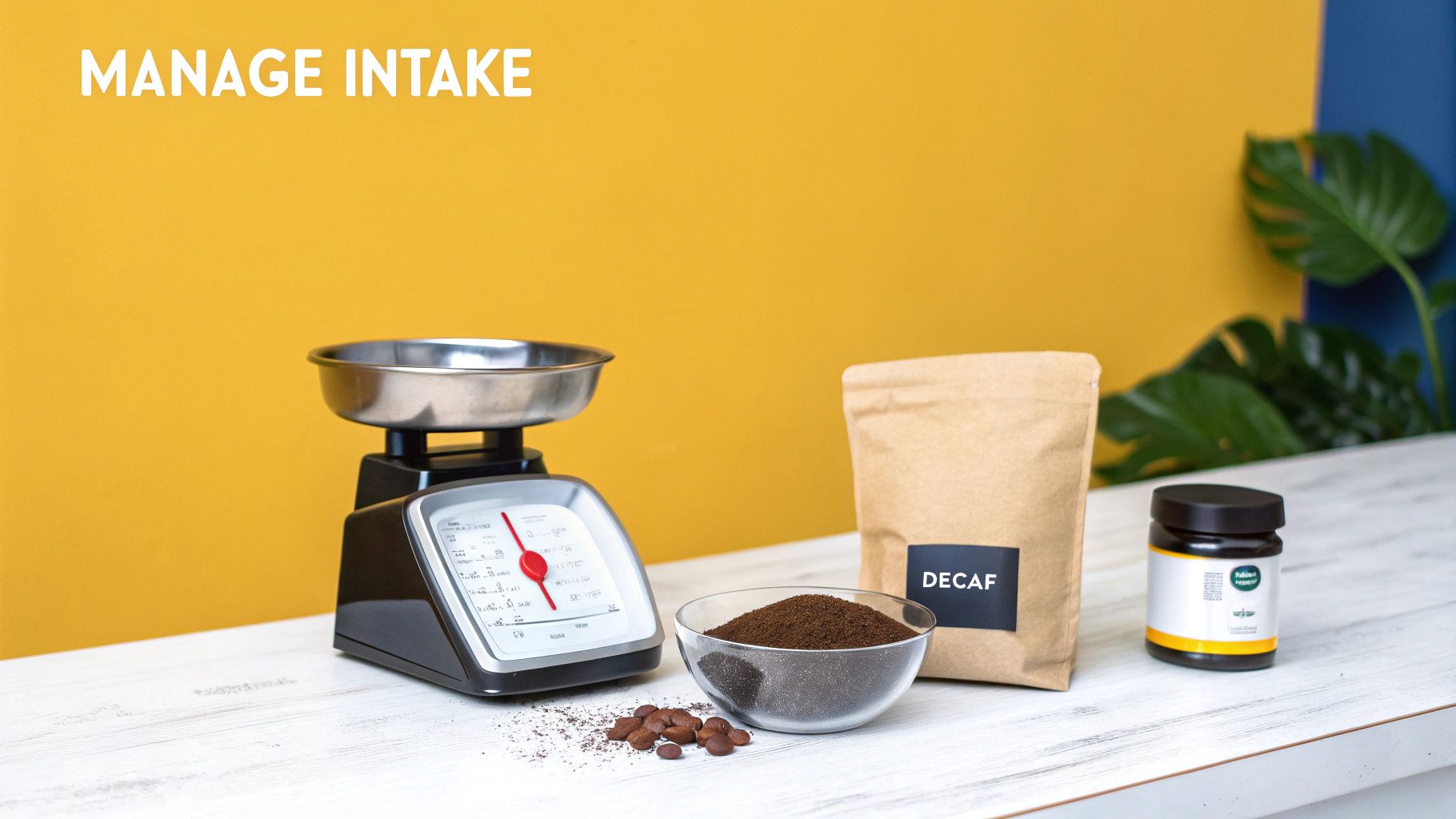
Knowing what affects your coffee's caffeine content is one thing, but putting that knowledge to use is where the real control comes in. Whether you want to dial back your intake a bit or just get a better handle on your energy levels, you don't have to make massive changes. A few small, mindful adjustments can make all the difference.
By simply being more intentional with your coffee ritual, you can make it work perfectly for you. It’s all about putting yourself back in control so you can enjoy every last drop without the jittery downsides of going overboard.
Smart Swaps and Simple Adjustments
One of the easiest tweaks is simply choosing your beans with caffeine in mind. Since Robusta has nearly double the caffeine of Arabica, making the switch to a 100% Arabica coffee is a huge step toward a more moderate cup.
Your brewing technique offers another lever to pull. Less extraction time means less caffeine, so knocking a minute off your French press steep can subtly lower the kick. And don't forget about the most obvious factor: serving size. Trading your 12-ounce mug for an 8-ounce one instantly cuts your intake by a third, and you might not even miss it.
Key Takeaway: You don't have to quit the coffee you love. Small, strategic changes—like choosing different beans or watching your pour—give you precise control over your daily caffeine consumption.
If you do find yourself feeling the effects of too much caffeine, it helps to know what to do. For a deeper dive, we've put together some practical advice on how to stop caffeine jitters and get back to feeling great.
Get Consistent Control with Quality Alternatives
For those who crave total predictability, high-quality alternatives take all the guesswork out of the equation. No more wondering how your brew method or grind size is affecting your dose.
- Premium Instant Coffee: A great instant coffee isn't some mystery blend; it gives you a reliable, consistent amount of caffeine every single time. Cartograph's organic instant coffee, for instance, provides a predictable dose that makes tracking your daily total a breeze.
- High-Quality Decaf: Don't sleep on modern decaf. Processes like the Swiss Water Process remove 99.9% of caffeine without stripping away the flavor. A fantastic decaf is the perfect answer for that second or third cup of the day.
- The "Half-Caf" Method: This one's easy. Just mix your favorite regular and decaf grounds before you brew. You get to slash the caffeine in half while keeping the full-bodied taste and ritual you love.
With these simple strategies, you’re empowered to completely customize your coffee experience. You now have the tools to brew the perfect cup for any moment, whether you need a major morning boost or just a gentle afternoon pick-me-up.
A Few Lingering Questions About Coffee and Caffeine
To wrap things up, let's tackle a few common questions that always seem to pop up. Think of this as a quick-fire round to clear up any final confusion you might have about the caffeine in your daily cup.
The Big Debate: Does Dark or Light Roast Have More Caffeine?
Ah, the classic coffee shop debate. The truth is, it all comes down to how you measure your beans.
Light roast beans are actually denser and smaller than their dark roast counterparts. So, if you measure your coffee with a scoop (by volume), you’ll inadvertently pack more light roast beans into that scoop, which means a bit more caffeine. But if you measure by weight on a scale, the dark roast technically has a slight edge because you need more of the lighter beans to hit the same weight.
The Bottom Line: The difference is so small you'd never notice it. Seriously. Just choose your roast based on the flavors you love—a rich, toasty dark roast or a bright, fruity light roast—not for a phantom caffeine boost.
So, How Much Caffeine Is Really in Decaf?
Here’s a little secret: decaf coffee isn’t completely caffeine-free. The process gets rid of almost all of it, but a tiny bit always manages to hang on.
Most decaffeination methods successfully remove about 97% of the caffeine. This means a typical 8-ounce cup of decaf will have somewhere between 2 and 15 mg of caffeine. It's a minuscule amount compared to a regular coffee, but if you're extremely sensitive to caffeine, it's good to know it's not zero.
Is There an Easy Way to Guess Caffeine Content at a Café?
Trying to figure out caffeine content on the fly can feel like a guessing game, but it’s simpler than you think. Just focus on two key details: the number of espresso shots and the size of the cup.
- For Espresso Drinks: A single shot of espresso typically has around 63 mg of caffeine. When you order a latte or Americano, just ask the barista if it’s a single or a double. A "double" shot means you're looking at roughly 126 mg right there.
- For Brewed Coffee & Cold Brew: With these, size is your best guide. A small (8 oz) drip coffee is usually about 95 mg, a medium (12 oz) is closer to 145 mg, and a large (16 oz) can easily climb past 190 mg. And remember, cold brew packs a bigger punch—often 200 mg or more for a 12-ounce serving.
Just by knowing the shots or the serving size, you can get a pretty solid estimate of what you're drinking.
For a consistently delicious and predictable caffeine experience without the guesswork, Cartograph Coffee offers premium organic instant coffee designed for convenience and quality. Get the perfect cup, every time. Explore our collection at cartographcoffee.com.