Vanilla coffee flavor describes an aroma profile, not proof that a drink was made with vanilla beans; in a ready-to-drink coffee sensory study, 75 ppm delivered the strongest just-about-right result. A small amount of vanilla can increase perceived sweetness without adding sugar, so getting the balance right matters more than adding more flavoring.
The popular advice to reach for vanilla syrup first skips an important question: do you want coffee that smells sweeter, or coffee that contains more sweetener? Those aren't the same drink. My preference is to make the coffee taste complete before turning it into dessert, although there's nothing wrong with choosing dessert deliberately.
Why Vanilla in Coffee Is More About Aroma Than You Think
Vanilla-flavored tells you about a sensory experience. Made with vanilla beans tells you something about ingredients. Treating those descriptions as interchangeable makes choosing coffee unnecessarily confusing.
A coffee can have a vanilla-like character without a vanilla pod ever entering the recipe. Conversely, a beverage made with real vanilla extract can still taste unbalanced if the flavor overwhelms the coffee. Ingredient authenticity and a satisfying cup are related questions, but neither answers the other automatically.
Think of vanilla coffee flavor as an aroma engineering problem: you're deciding which aromatic impression should accompany the coffee, how noticeable it should be, and what else belongs in the finished drink. That framing is more useful than assuming the most expensive ingredient will produce the best result.
Separate the decisions before you brew
When reading a package or planning a homemade drink, ask:
- What creates the vanilla impression? Look for an ingredient description rather than relying on the flavor name alone.
- What adds sweetness? Check sweeteners separately from flavoring. A vanilla description doesn't establish whether sugar has been added.
- What should remain recognizable? Decide whether you want coffee with a creamy aromatic accent or a dessert-style beverage with coffee underneath.
For a home brewer, these questions prevent a familiar mistake: adding flavor until bitterness disappears, then wondering why the drink no longer tastes like coffee. My preferred endpoint is a cup whose original character remains identifiable after the addition.
Evaluate the drink you actually serve
Don't make your decision from the smell of an open bottle. Assess the finished beverage under the conditions in which you'll drink it, including its serving temperature and usual additions.
If you're also sorting out your temperature routine, Maximum Health Products coffee temperature tips offer a separate resource to consult. Keep the practical question simple: does the vanilla feel integrated when you take a normal sip, rather than only when you lean over the cup?
The Vanilla Molecule and Why Roasting Matters
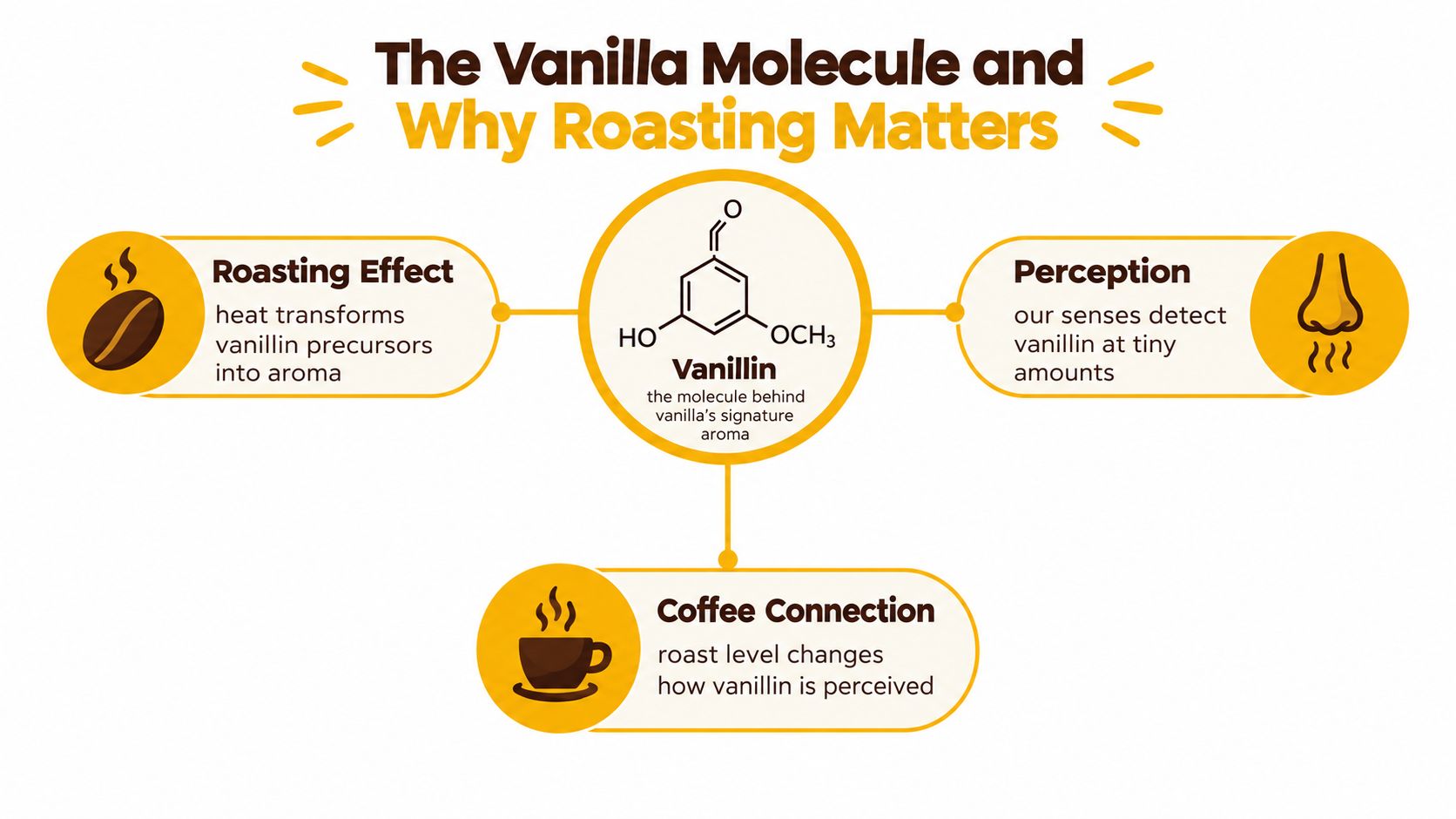
Vanillin is responsible for much of vanilla's characteristic aroma. For a coffee drinker, the useful translation is that a recognizable vanilla impression can have a molecular explanation without requiring an added vanilla ingredient.
During roasting, heat transforms coffee precursors, including chlorogenic acids and lignin-related compounds, through reactions that can form vanillin. Researchers identify it among coffee's odor-active constituents, alongside furans, pyrazines, aldehydes, ketones, and sulfur compounds, and report meaningful changes in its concentration across roast profiles in this review of roasted-coffee aroma chemistry.
The illustration connects that molecule to roasting and perception.
Roast chemistry isn't a tasting guarantee
Roasting doesn't manufacture an isolated vanilla flavor. It produces a mixture of aromatic compounds, which you experience together rather than as separate ingredients. A vanilla-like note may be present but difficult to recognize beside stronger roast aromas.
The distinction between presence and prominence matters. Finding vanillin in an analysis doesn't mean a drinker will describe the cup as vanilla, just as recognizing a custard-like aroma doesn't tell you exactly how much vanillin it contains. The surrounding flavor matters.
Roaster's rule: Choose a roast for what you can taste in the cup, not for a promise that a particular molecule must be noticeable.
Use roast level as a starting hypothesis
A light-to-medium roast is a useful starting point when you want sweet, vanilla-like character without heavier bitterness, smoke, or phenolic aromas dominating. That's a selection strategy, not a guarantee that every lighter coffee will taste creamy.
The cited roasting research also cautions against treating origin as the sole explanation for aroma. In some analytical comparisons, roast conditions distinguish volatile profiles more strongly than geographic origin.
For home tasting, keep your language provisional. Write “creamy aroma” or “vanilla-like finish” rather than deciding immediately that the coffee contains added vanilla. You're recording a sensory observation, not making an ingredient claim.
Natural Vanilla, Synthetic Vanillin, and What Each Actually Means
A vanilla pod and a purified vanillin ingredient aren't equivalent materials. But “different” doesn't automatically mean one belongs in good coffee and the other doesn't.
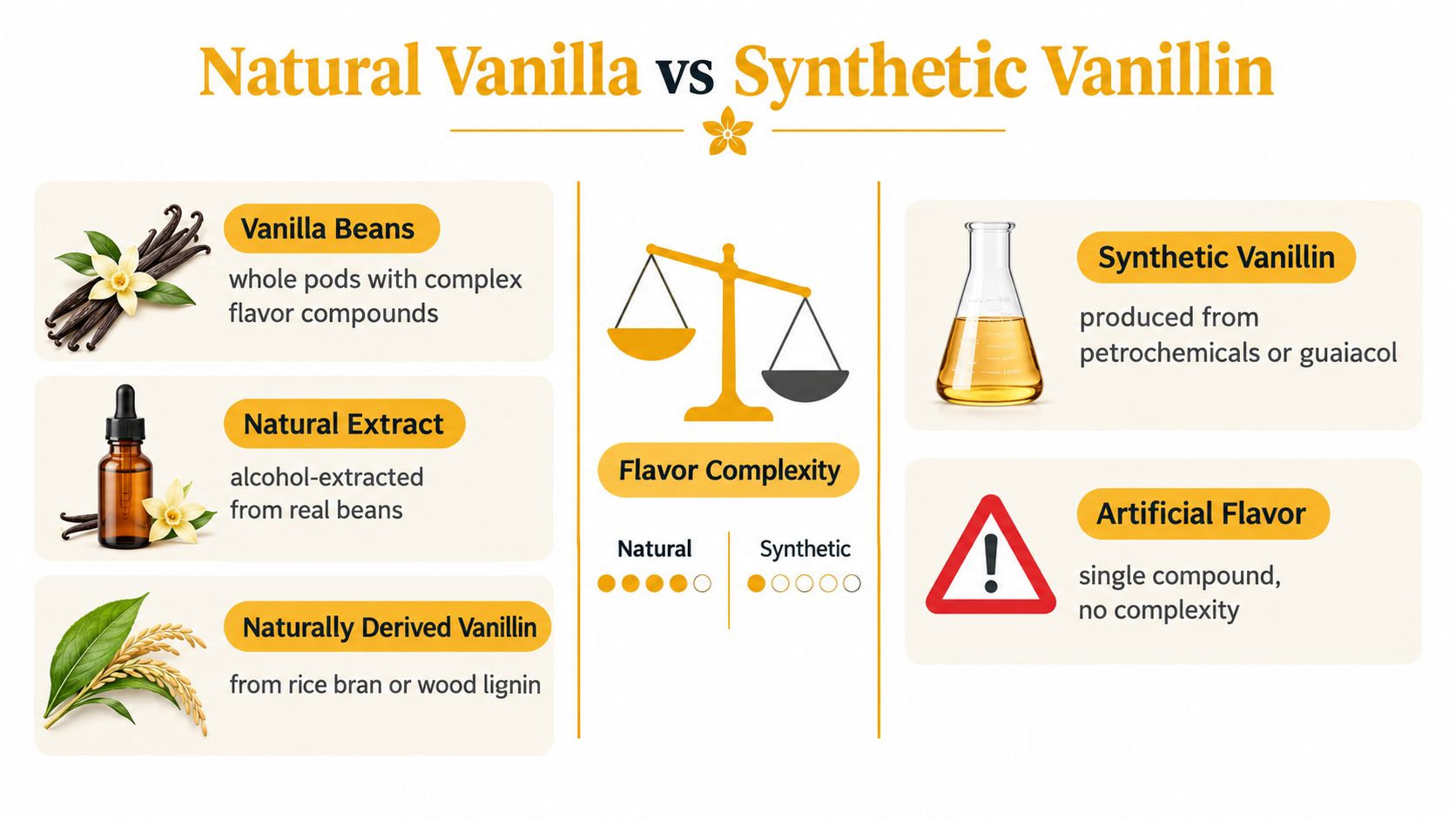
The scale of production explains why this distinction matters: less than 1% of global vanillin comes directly from vanilla plants, while most comes from chemical or industrial routes, according to the overview of vanillin production and sources. That makes bean-derived vanilla a particular sourcing choice, not the default explanation for every vanilla-flavored food or beverage.
This comparison introduces the ingredient categories, but the actual product label should guide your purchase.
Compare materials without assigning moral scores
| Ingredient category | What it means | What to consider |
|---|---|---|
| Vanilla beans | The agricultural ingredient itself | Choose this when using actual vanilla pods matters to you |
| Natural vanilla extract | A flavoring prepared from vanilla beans | Check the complete ingredient list and the producer's description |
| Naturally derived vanillin | Vanillin produced from sources other than vanilla pods through qualifying production routes | Ask what “natural” means for that specific product |
| Synthetic vanillin | Vanillin made through chemical synthesis | Judge the finished flavor and transparency rather than rejecting it by name |
Naturally derived vanillin isn't another name for vanilla extract. The molecule may provide a familiar aroma while its starting material and production method differ from those of a bean extract. Labeling terms also shouldn't substitute for a clear explanation from the supplier.
The infographic's shorthand needs a qualification: an artificial flavor formulation isn't necessarily limited to a single compound, and a natural ingredient doesn't automatically deliver greater complexity in every finished drink. You can't rank a beverage reliably from those labels alone.
Ask better sourcing questions
Bean-based ingredients connect your purchase to an agricultural supply chain. Industrially produced vanillin offers a different route to a repeatable flavor ingredient. Neither description, by itself, establishes the product's environmental footprint, labor practices, healthfulness, or cup quality.
- For authenticity: Ask whether the flavor comes from vanilla beans.
- For transparency: Look for named ingredients and an understandable production description.
- For balance: Taste whether the flavor complements the coffee rather than covering it.
I wouldn't pay extra for the word “natural” without knowing what benefit I'm buying. Bean origin may be that benefit, but it should be an informed preference rather than an assumed quality guarantee.
Syrups, Extracts, and Flavored Instant Coffee Compared
Choosing a delivery format is different from choosing an ingredient origin. You can prefer bean-derived flavor and still dislike a heavily sweetened syrup, or welcome vanillin while wanting complete control over sweetness.
At home, I'd choose the format according to the adjustment I want to make. Syrup suits a deliberately sweet beverage. Extract or another unsweetened flavoring suits a more controlled experiment. Flavored instant coffee suits someone who wants the flavor built into the preparation rather than measured separately.
Vanilla Delivery Formats at a Glance
| Format | Aroma Intensity | Added Sugar | Ease of Use | Best For |
|---|---|---|---|---|
| Vanilla syrup | Depends on formulation and amount used | Check for sugar or alternative sweeteners | Convenient to portion and mix | Sweet café-style drinks |
| Vanilla extract | Adjustable, with results depending on the product | Check the ingredient list | Requires deliberate measurement | Separating aroma adjustment from sweetening |
| Flavored instant coffee | Largely set by the product formulation | Product-dependent | Simple preparation | Repeatable flavor with less measuring |
The table isn't a ranking. It identifies where you have control and where the manufacturer has already made the decision.
Don't let the format hide the sweetener
If a syrup contains sugar, increasing the dose changes both flavor and sweetness. That makes it difficult to discover whether you wanted more vanilla aroma or preferred a sweeter drink. Sugar-free syrup also deserves a label check because “without sugar” doesn't necessarily mean “without sweeteners.”
For a closer look at syrup choices, consult this guide to flavoured syrups for coffee. Decide whether you want a sweetened beverage before treating syrup as your default vanilla ingredient.
Label check: Read the flavor description, ingredient list, and sweetener information as separate pieces of evidence.
Match the format to your routine
For black coffee, I prefer an adjustable flavoring when the purpose is to explore aroma without committing to dessert sweetness. With milk or a plant-based alternative, make the comparison using your usual brand and preparation, not an unfamiliar substitute.
For iced drinks, build the complete beverage before deciding whether to add more flavor. For instant coffee, check whether the product is already flavored before adding another vanilla ingredient.
Convenience is a legitimate preference. If a prepared vanilla instant coffee tastes balanced to you, there's no sensory virtue in making the same drink more laborious. Choose manual dosing when you want control, not because a longer routine must be better.
Pairing Vanilla with Roast Level and Origin
Start with the coffee's character rather than the country printed on the bag. My pairing preference is vanilla alongside a cup I already describe as rounded, gently sweet, or creamy, rather than using it to rescue a cup I find harsh.
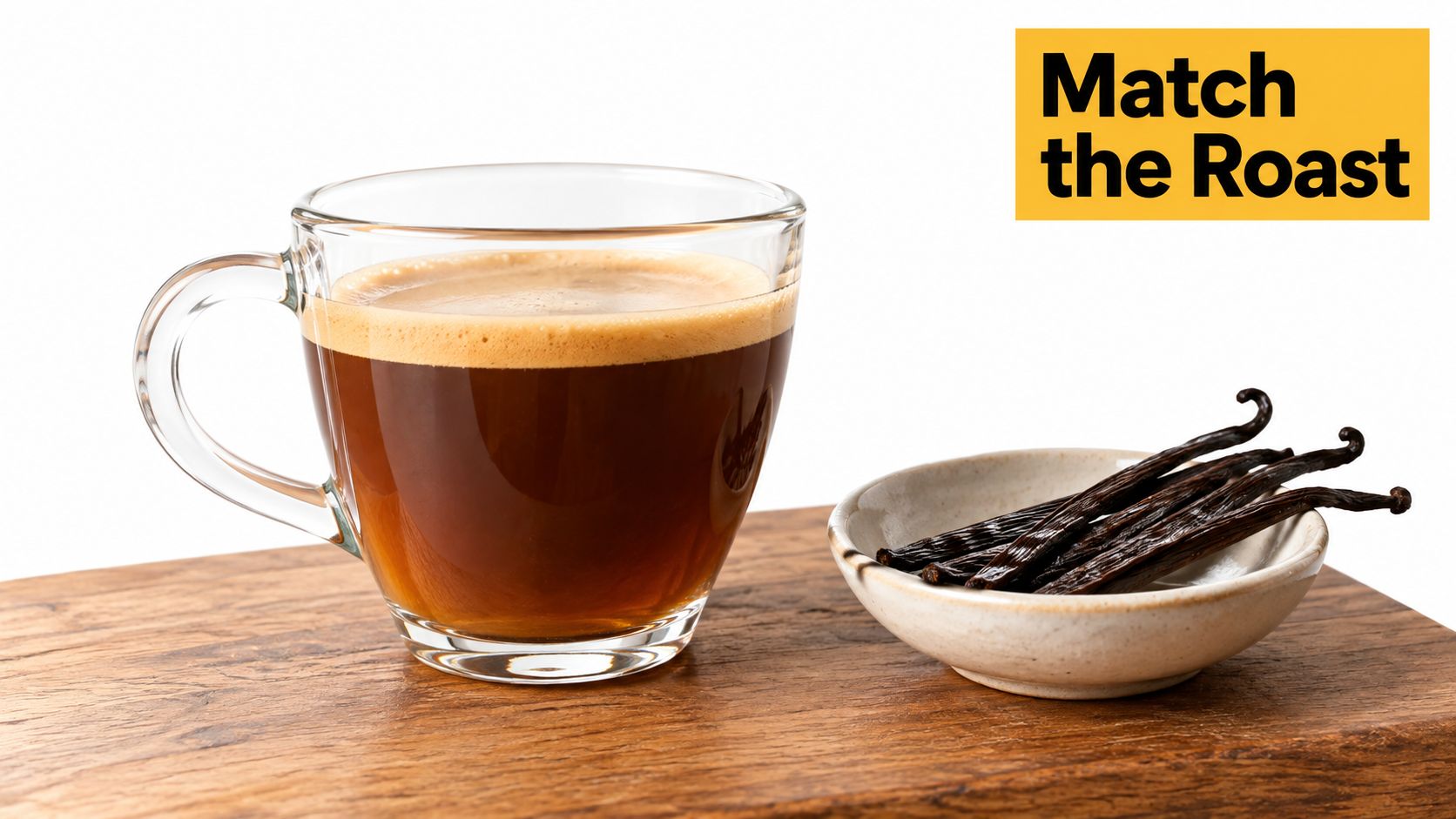
The coffee-and-bean pairing below is a useful reminder to assess both elements together.
Taste the base before choosing a pairing
A Latin American or East African origin label can help you explore coffees, but it shouldn't function as a promise of vanilla compatibility. Pick a coffee because its brewed character supports your intended drink. Use this guide to types of coffee roast to clarify the roast descriptions you're comparing.
My practical pairing criteria are:
- Rounded and cocoa-like: Try a restrained vanilla accent and check whether the coffee remains recognizable.
- Bright and fruit-led: Decide whether you enjoy the contrast before increasing intensity.
- Smoky or earthy: Be especially cautious about adding flavor merely to hide a character you don't enjoy.
Aroma strength depends on more than quantity
Vanillin's reported detection threshold in air is approximately 0.6–1.2 ng/L, and its estimated odor-activity value in roasted coffee is around 10–20, according to this coffee aroma and odor-activity guide. These measurements explain why a relatively minor aromatic constituent can make a noticeable contribution.
They're not home dosing instructions. Brewing dilution, temperature, volatile release, acidity, and bitterness affect the perception of the finished drink. A successful pairing in hot black coffee therefore needs another tasting when you change the serving format.
If you prefer a video alongside your tasting notes, use the embedded player below.
Keep your experiment narrow: hold the coffee preparation steady while you change the vanilla addition. Otherwise, you won't know whether you prefer the new pairing or just brewed a different cup.
How Much Vanilla Is Enough Before Coffee Tastes Artificial
Enough means recognizable but integrated, unless you deliberately want a dessert-style drink. The useful endpoint isn't the strongest vanilla smell you can produce. It's the intensity you still enjoy while drinking the whole beverage.
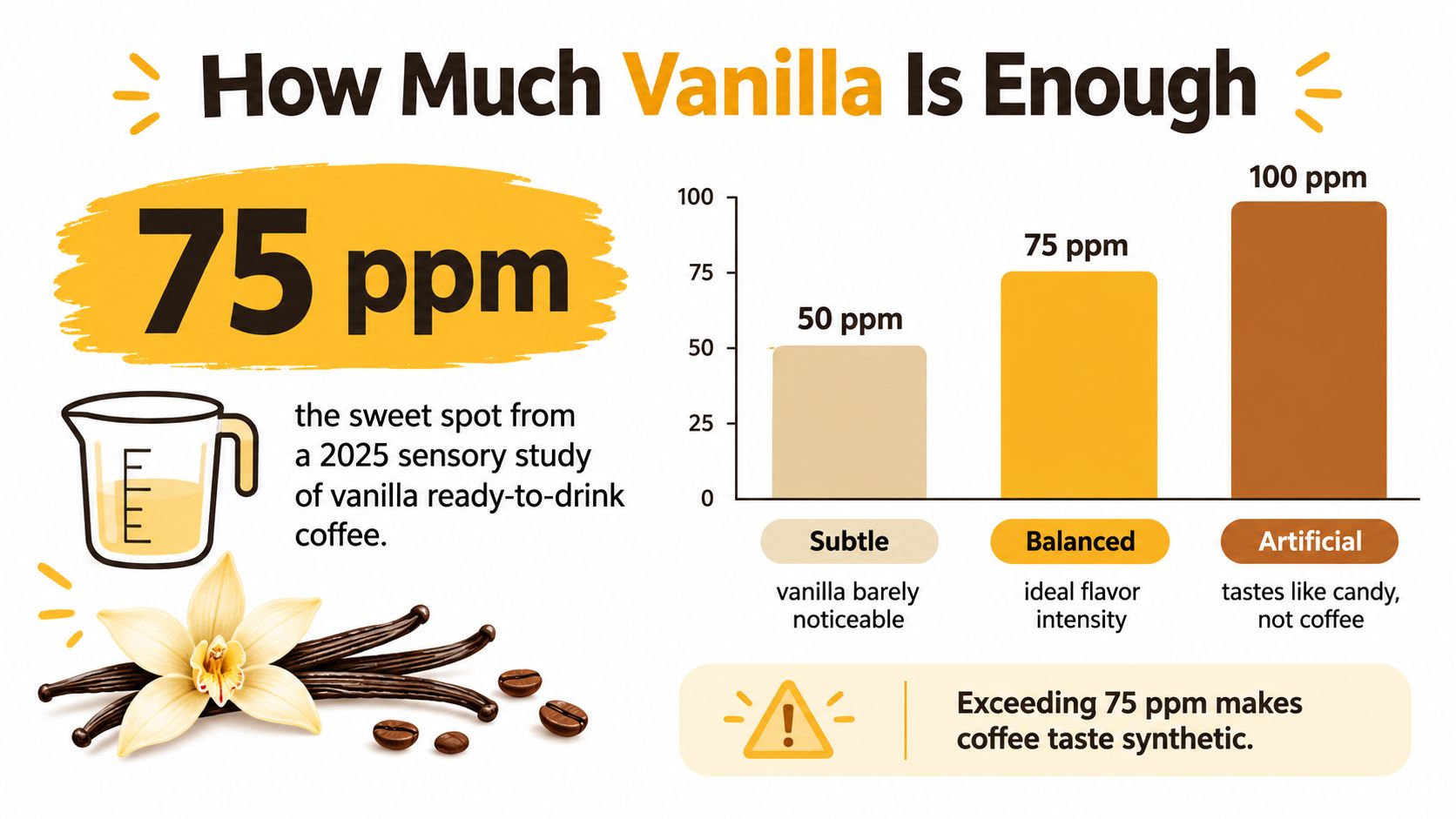
In a 2025 ready-to-drink coffee sensory study, 75 ppm vanilla produced the strongest just-about-right result, increased perceived sweetness by 9.8% and sweet aroma by 14%, and the vanilla version was preferred over the caramel version, as reported in the sensory study's AGRIS record. This is evidence for a particular tested beverage, not a universal recipe for coffee.
The graphic highlights that benchmark, but its broader dose labels require caution.
Use the benchmark without overextending it
The study doesn't establish that every concentration above its best-performing level tastes synthetic, or that the other levels depicted in the graphic produce those same reactions across recipes. Nor does it give you a universal conversion into spoonfuls of extract, pumps of syrup, or portions of instant coffee.
Parts per million describes concentration, while retail vanilla products differ in formulation. Without knowing the flavoring's composition and the complete beverage recipe, copying the study concentration is not a reliable home measurement strategy.
A candy-like impression is a reason to adjust your recipe, not proof that the vanilla came from a laboratory.
Build a sensory scale instead of guessing
Use these descriptions as tasting targets rather than laboratory categories:
- Subtle: You notice a creamy aromatic accent, but coffee remains the first impression.
- Balanced: Vanilla is identifiable, and you can still describe the coffee underneath.
- Dessert-like: Vanilla and sweetness lead the experience. That can be enjoyable when it's intentional.
- Overdone for your preference: The flavor feels distracting, perfumed, or tiring before you finish the cup.
Record vanilla aroma, perceived sweetness, bitterness, and finish separately. That helps you distinguish a welcome aromatic change from an attempt to mask an unsuitable coffee.
Recalibrate for instant coffee, espresso-based drinks, iced coffee, and milk drinks rather than carrying one dose across them unchanged. The finished beverage, not the bottle or dry powder, is your final reference.
Simple At-Home Ways to Get Real Vanilla Notes
A useful home test needs consistency more than specialty equipment. Use matching cups, a spoon or dropper for repeatable additions, and a notebook or phone note.
Start with a light-to-medium coffee you enjoy unflavored. A single-origin coffee can make the experiment easier to describe, but it isn't a requirement, and instant coffee is a perfectly reasonable base.
Build a repeatable comparison
- Prepare a reference cup. Keep some coffee without the added flavor so you can return to its original aroma and finish.
- Measure a restrained addition. Use the same measuring tool each time and record what you added. Don't invent a conversion from the research benchmark.
- Taste at your normal serving temperature. Smell, sip, and compare the finish against the reference. Use your usual milk or sweetener if those belong in the intended drink.
- Change only the flavor dose. Keep the coffee, water, and other ingredients steady until you've identified your preferred intensity.
If you want aroma enhancement, stop when the addition improves the cup without obscuring its identity. If you want dessert character, choose that direction deliberately, then adjust the other ingredients separately.
For more ingredient-led experiments, this guide to flavoring coffee naturally provides another starting point.
Decide what “real” means to you
“Real vanilla notes” can mean a convincing sensory impression or an insistence on vanilla-bean ingredients. Be clear about which you want before spending more.
Natural vanilla also has sourcing considerations: Madagascar supplies roughly 80% of output, and fewer than 15 countries produce commercial quantities, according to this vanilla raw-material market overview. That concentration is a reason to ask about origin and responsible sourcing, not proof that every bean-derived product is either better or worse.
Keep the tasting record you need: the coffee used, preparation, flavoring product, measured addition, and your reaction. A repeatable cup you enjoy is more useful than an elaborate recipe you can't reproduce.
Choosing a Vanilla Coffee That Matches What You Actually Care About
Your best choice depends on what you want to protect: flavor, time, or ingredient values.
- Flavor-first drinkers: Prioritize a coffee you enjoy and a vanilla intensity that preserves its character. Consider unflavored coffee with vanilla-like notes as well as flavored options.
- Convenience-first drinkers: Choose a prepared format that fits your routine, then check whether its sweetness and aroma match your preferences.
- Values-first drinkers: Look for ingredient transparency and meaningful sourcing information rather than relying on “natural” as a complete answer.
You don't have to prefer vanilla beans to care about quality, and you don't have to reject convenience to become a thoughtful taster. Buy the product that answers your actual priorities, then judge it in the cup.
Cartograph Coffee offers organic instant coffee with a focus on quality, flavor, and convenient preparation at home, at work, or outdoors. Visit Cartograph Coffee to explore a convenient coffee base for your routine, then use a controlled vanilla comparison to find the balance you enjoy.