On a grey Monday morning, you spoon a little amber syrup into a steaming mug of organic instant coffee. Caramel-coloured threads spread across the surface, and the first sip tastes softer, warmer, and more personal than the plain cup you nearly settled for. That small addition raises useful questions: what's in those droplets, why do some syrups dissolve cleanly while others cling to the spoon, and how can you create a version that suits your coffee and your diet?
Flavoured syrups for coffee sit at the meeting point of sweetness, aroma, texture, and food chemistry. The guide below takes you from the basics to flavour families, homemade recipes, coffee pairings, storage, and the health questions that labels often leave unanswered. You'll finish with a simple way to test one syrup in your daily routine instead of buying bottles at random. For more ideas about coffee additions, explore what you might put in your coffee.
A Morning Cup Worth Dressing Up
That spoonful isn't just liquid sugar. A well-made coffee syrup is designed to flow through a pump, dissolve in a hot latte, and remain noticeable after ice and milk dilute the drink. In a black instant coffee, the same syrup has nowhere to hide, so its sweetness and aroma need to feel balanced rather than loud.
The habit is far from niche. The National Coffee Association's 2020 National Coffee Data Trends Report found that about 80% of U.S. coffee drinkers customise their beverages in some way, a pattern that helps explain why syrups, sauces, and flavourings have become standard tools in cafés and home kitchens. Independent industry coverage also placed the global flavoured syrups market at about US$65.6 billion by 2025, with annual growth above 5%, showing that coffee flavouring belongs to a much wider beverage economy (Perfect Daily Grind).
Kitchen perspective: Treat syrup as a recipe ingredient, not a rescue ingredient. It should support the coffee's character, not bury it.
You can start with a classic vanilla latte, move toward cinnamon in instant coffee, or use a bright fruit note in cold brew. The important part is learning how sweetness concentration, acidity, and flavour strength affect the final cup. Once you understand those controls, a commercial bottle becomes easier to judge, and a homemade batch becomes easier to adjust.
What Flavoured Syrups Actually Are
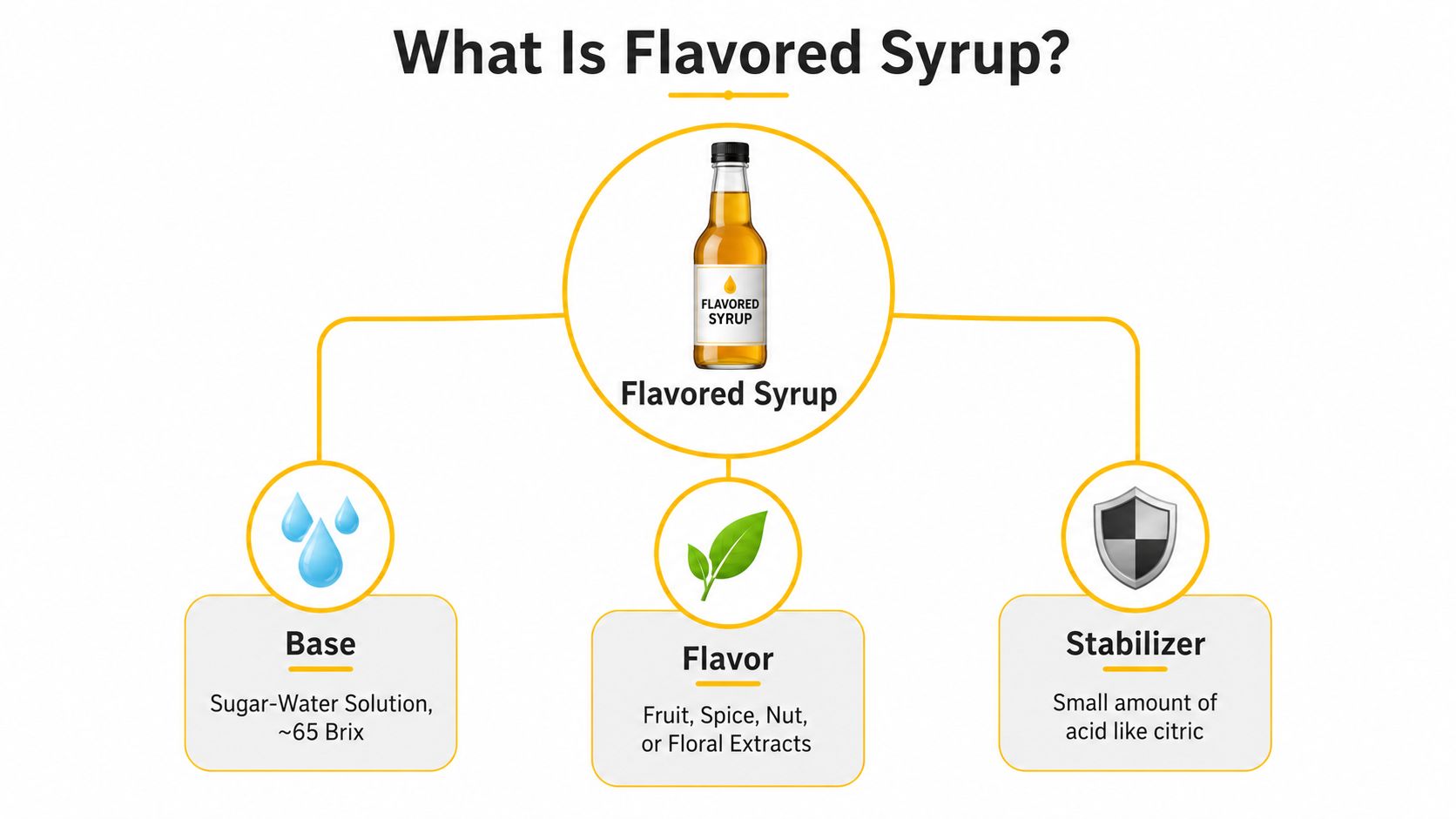
A coffee syrup is a concentrated sugar-and-water liquid carrying flavour. Commercial versions may use vanilla, caramel, nut, fruit, spice, or floral extracts, along with acidity and other processing controls that help the product remain stable. Think of it as a pourable pancake syrup that's thinner, more aromatic, and formulated to dissolve into coffee rather than sit on top.
Brix controls the pour
Brix measures dissolved soluble solids, mainly sugar in a traditional syrup. A finished coffee syrup around 55 to 65 °Brix balances pumpability, mouthfeel, and microbial control, according to Icon Foods' technical guide. A lower-sugar liquid, closer to 45 to 55 °Brix, may work better as a drizzle because it's less suited to consistent pump dosing.
In the kitchen, the difference is easy to feel. A thin syrup runs quickly from a spoon and disappears into hot coffee. A denser syrup falls in a slow ribbon, coats the cup, and may clog a narrow pump if crystals form. More sugar doesn't automatically mean better flavour. It means the formulator has changed viscosity, sweetness, and water availability together.
Acidity and water activity do separate jobs
Acidity affects the environment in which microbes grow. Coffee syrups often use a small amount of acid, such as citric or tartaric acid, to bring the pH down and support stability. Water activity describes how much water is available for microbial use, not just how much water the syrup contains. Lower water activity makes the syrup less hospitable to spoilage.
A technical patent describes shelf-stable concentrated flavourings lasting at least three months at ambient temperature when low water activity and/or acidic pH are used (Justia patent record). Those controls work alongside solids concentration, heat treatment, clean equipment, and suitable packaging. Home cooks shouldn't assume that a thick syrup is automatically safe at room temperature.
A useful product-development benchmark found a flavoured coffee syrup at approximately 66.0 to 66.3 °Brix and pH 5.45 to 5.51, while a coffee extract-to-sugar formula at 1:2 received the strongest sensory acceptance in that formulation study (Justia patent record). The lesson is practical: sweetness, acidity, flavour loading, and shelf stability must be tuned as a group.
The Flavour Families Worth Knowing
A crowded syrup shelf becomes easier to manage when you sort bottles by what they do to coffee, rather than by brand or packaging.
Classic flavours include vanilla, caramel, hazelnut, and toffee. They add rounded, familiar sweetness and work especially well with espresso and milk. Milk softens coffee bitterness and gives heavier aromas a smooth surface to sit on, so caramel and hazelnut feel natural in cappuccinos, flat whites, and lattes. Vanilla is the most flexible choice because it can add warmth without completely changing the drink.
Fruit and floral flavours bring a different kind of energy. Raspberry, cherry, orange blossom, lavender, and rose can make cold brew feel brighter, but they need restraint. Black coffee exposes their aromatic edges, while milk can soften them. Lavender and rose may taste elegant in a lightly sweetened iced drink, yet excessive dosing can make the cup seem perfumed or soapy.
Seasonal profiles usually combine spice extracts, flavour concentrates, or powders. Pumpkin spice, gingerbread, chai, and peppermint create a strong sensory cue, but they can overwhelm a delicate coffee. Use them when you want the flavour to lead, or choose a darker roast and more milk when the coffee needs enough body to stand behind the spice.
| Flavour Families at a Glance | Example Flavours | Best Coffee Match | Typical Brix |
|---|---|---|---|
| Classic | Vanilla, caramel, hazelnut, toffee | Espresso drinks and lattes | Around 55 to 65 °Brix |
| Fruit and floral | Raspberry, cherry, lavender, rose | Iced coffee and cold brew | Around 55 to 65 °Brix |
| Seasonal | Pumpkin spice, gingerbread, chai, peppermint | Milk drinks and festive recipes | Around 55 to 65 °Brix |
The 42.3% share attributed to flavoured syrups in the 2025 coffee-syrup segment and the faster attention around fruit and floral notes indicate a market moving beyond the traditional trio of vanilla, caramel, and hazelnut (Market Intelo). For a deeper look at maple's uses outside breakfast, maple syrup for home cooks offers useful context. Maple can bridge classic and seasonal styles, especially with oat-based drinks and medium-roast coffee.
Simple DIY Syrup Recipes You Can Make Today
Homemade syrup gives you control over the sugar, flavour source, and strength. Use a clean saucepan, a fine strainer, a kitchen scale if you have one, and a sterilised glass jar. These recipes aim for a finished syrup around 60° Brix, but home equipment and evaporation can shift the result.
Vanilla syrup
Combine 125 grams organic cane sugar with 125 grams filtered water in a saucepan. Add one split vanilla bean, bring the mixture to a gentle simmer, and cook for 5 minutes. Remove the pan from the heat, cover it, and steep for 30 minutes before removing the bean.
Strain if needed, cool the syrup, and pour it into a clean jar. The finished batch should yield roughly 250 to 300 ml, depending on evaporation. Taste a teaspoon in plain coffee before bottling the entire batch. If the vanilla feels faint, steep the bean longer next time rather than adding more sugar.
Golden caramel syrup
Place 150 grams organic cane sugar in a dry saucepan over moderate heat. Let it melt and turn amber, moving the pan gently instead of stirring aggressively. Add 150 grams hot filtered water carefully, because the caramel will bubble sharply, then stir until smooth.
Add a small pinch of sea salt and a 0.5% splash of lemon juice relative to the finished batch to help discourage crystallisation. Simmer until the liquid is uniform, cool it, and transfer it to a sterilised jar. Caramel brings its own bitterness, so taste it in a milk drink before deciding whether it needs extra sweetness.
Cinnamon syrup
Make a 1:1 base with 125 grams sugar and 125 grams water. Add two cinnamon sticks per 250 ml of syrup, simmer for 10 minutes, then cover and let the mixture infuse briefly as it cools. Strain through muslin or a very fine sieve to remove particles.
Label every jar with the flavour and preparation date. For more ideas that suit shared meals and family routines, you can browse family-friendly recipes. Keep homemade batches small enough that you can finish them while their flavour is fresh, and adjust one variable at a time. Changing the sugar, spice, and steeping time together makes it hard to identify what improved the cup.
Pairing Syrups With Different Coffee Styles
Coffee style determines how much room a syrup has to speak. Espresso is concentrated and intense, so classic flavours usually provide the most dependable starting point. A latte contains more milk, which carries caramel and hazelnut aromas while smoothing sharper fruit or floral notes. Cold brew often works well with berry, cherry, lavender, or vanilla because its chilled, low-acidity presentation can support a distinct aromatic accent.
Instant coffee benefits from warmth and familiarity. Vanilla and cinnamon can round out the flavour of a freeze-dried coffee without making it taste like dessert. Rose is riskier in a black cup because its floral character remains exposed and can seem soapy if the dose is too high. A Cartograph-style organic instant coffee can be tested with the same principle, start with a restrained amount, stir thoroughly, and only then increase the sweetness.
| Syrup and Coffee Pairing Guide | Best Syrup Families | Pumps per 200 ml | Pairing Note |
|---|---|---|---|
| Espresso | Vanilla, caramel, hazelnut | 1 to 2 | Keeps the concentrated shot rounded |
| Latte | Caramel, vanilla, hazelnut, seasonal spice | 2 to 3 | Milk carries richer flavours well |
| Cold brew | Berry, cherry, lavender, vanilla | 3 to 4 | Bright profiles remain noticeable over ice |
| Instant coffee | Vanilla, cinnamon, caramel | 1 to 2 | Warm spice balances the freeze-dried profile |
Pump counts vary by pump size and syrup density, so treat them as starting points rather than a universal rule. At home, a teaspoon gives you more control than an unknown pump. If you enjoy coffee with breakfast foods, the transparent waffles PNG can accompany a maple, vanilla, or cinnamon coffee without requiring a complicated drink recipe.

Quick decision rule: Choose classic flavours for milk, fruit or floral flavours for black iced coffee, and gentle vanilla or spice for instant coffee.
Storage, Shelf Life, and Keeping Syrups Fresh
A syrup's keeping quality is set in the kitchen before it reaches the refrigerator. Sugar, acidity, water activity, heat, and cleanliness work together. Lower-sugar recipes need more cautious handling, so a homemade batch should not be treated like a commercially tested bottle. For commercial syrups, follow the label instructions, especially after opening. The Icon Foods guide explains why formulation and processing affect stability.
Use a clean glass jar, fresh lid, and utensils that have not touched food. Refrigerate syrups made with fresh fruit, reduced sugar, or uncertain acidity. Make a modest amount, then use it before the aroma and flavour fade.
A practical freshness routine
- Clean the container: Sterilise the jar and lid before filling. Let them drain without touching the inside.
- Use hot-fill carefully: Fill at approximately 82°C, seal promptly, and protect your hands from the hot glass.
- Label the batch: Record the flavour, ingredients, and date.
- Check water activity at home: You cannot measure it accurately with taste or thickness. A low-cost water-activity meter gives a useful reading; without one, treat an unfamiliar low-sugar syrup as perishable and refrigerate it.
- Inspect before use: Cloudiness, gas bubbles, mould, or a sharp vinegar-like odour means discard the syrup.
- Choose glass where possible: Glass is less likely to retain aromas from earlier ingredients.
A pump bottle can hide residue inside its spring and narrow tube. Reuse one only if every internal part can be dismantled and sanitised. Otherwise, dispense with a clean teaspoon. If a syrup changes colour, develops pressure, or smells wrong, do not taste-test it. When the recipe's acidity or preservation is uncertain, refrigeration and a smaller batch provide the safer routine.
Health, Sugar, and Organic Choices
“Sugar-free” and “organic” answer different questions. A sugar-free syrup may reduce sugar intake, while an organic syrup may focus on agricultural certification and ingredient sourcing. Neither label guarantees a better-tasting or more nourishing coffee.
A traditional cane-sugar syrup usually gives the fullest body and the most familiar mouthfeel, but it adds sugar to the cup. Sugar-free products can use intense sweeteners or sugar alcohols, which may produce a cooling sensation, a lingering aftertaste, or a thinner texture. Organic versions may use certified cane sugar, real vanilla, or natural extracts, yet organic sugar still contributes sweetness and energy. Recent market coverage links demand with low-sugar, sugar-free, organic, natural, functional, plant-based, and allergen-free options, while also highlighting the need for clearer comparisons (Data Insights Market).
| Sugar vs Sugar-Free vs Organic Syrups at a Glance | Calories per tbsp | Sweetness Strength | Key Ingredients | Taste Trade-offs |
|---|---|---|---|---|
| Traditional sugar syrup | Varies with recipe | Rounded and direct | Cane sugar, water, flavour | Full body, added sugar |
| Sugar-free syrup | Depends on sweetener | Often very intense | Erythritol, monk fruit, or other sweeteners | Possible cooling or lingering notes |
| Organic syrup | Varies with sugar content | Similar to its sugar base | Certified sugar and natural flavour sources | Potentially cleaner flavour, not automatically lower calorie |
Read the ingredient list instead of relying on front-label language. A short list of sugar, water, spice, vanilla, or fruit extract is easier to understand than a long blend of colours, preservatives, carriers, and sweeteners. “Natural flavour” also doesn't tell you the whole formulation, so compare brands and taste rather than assuming that natural means minimally processed.
For readers reducing added sugar, sugar-free sweeteners for coffee can help you think through alternatives. Test a sugar-free syrup in a stronger milk drink first, where texture and aftertaste may be less exposed. If you follow a medically restricted diet, check the specific sweetener and serving guidance with a qualified professional.
Putting It All Together in Your Daily Cup
You don't need a full syrup bar to improve your coffee. Start with one decision: match the flavour family to the drink you already make. Choose caramel or vanilla for espresso-based milk drinks, berry or lavender for cold brew, and cinnamon for an uncomplicated instant coffee.
Next, make the vanilla batch with the 1:1 sugar-to-water base, cool it, and store it in a labelled swing-top glass jar. Begin with a small spoonful in one cup rather than sweetening an entire pot. That lets you compare the plain coffee with the flavoured version and adjust without wasting a batch.
Finally, test the syrup in one repeatable drink. Try it in a 200 ml cup of organic instant coffee, stir until the syrup disappears, and increase gradually only if the coffee still tastes flat. Keep a short note about sweetness, aroma, and aftertaste. This gives you a clear target if you later buy a commercial bottle.
If you enjoy experimenting with floral combinations, the iced lavender latte recipe offers a useful comparison point for judging how a delicate syrup behaves in a cold, milk-based drink. The aim isn't maximum sweetness. It's a cup where the coffee, flavour, and texture remain recognisable together.
Cartograph Coffee offers organic instant coffee designed for convenient preparation at home, work, or outdoors, making it a practical base for testing homemade vanilla, cinnamon, and caramel syrups. Visit Cartograph Coffee to explore the coffee options and start building a personalised cup without giving up convenience.