The popular advice is simple: choose instant coffee because it's automatically the greener option. That advice is incomplete. A jar can avoid some energy at the kitchen counter while depending on bean cultivation, intensive factory processing, and packaging choices that create burdens elsewhere.
Sustainable instant coffee only makes sense when you ask a more precise question: sustainable by which metric, and at which stage of the lifecycle? Carbon emissions, farming practices, factory energy, packaging waste, labor conditions, and brewing habits can point in different directions. A responsible evaluation therefore looks beyond the convenience of dissolving granules in hot water.
Rethinking What Sustainable Instant Coffee Actually Means
A freeze-dried jar may look like a low-waste pantry product. It needs no grinder, filter, or espresso machine, and the finished coffee is compact. Yet the beans have already traveled through farming, processing, roasting, extraction, concentration, and drying before they reach your cupboard. The clean appearance of the final product tells you little about the energy used inside the factory.
The category is large enough for those choices to matter. One industry report found that instant coffee represented almost one-third of global retail coffee sales in 2022, while the market reached nearly USD 32 billion that year. The same report said Nestlé held more than one-third of the market, making improvements in sourcing, processing, packaging, and distribution relevant to a substantial share of consumer demand. See the industry assessment of coffee's global supply chain for the underlying context.
Sustainability changes with the boundary
A life-cycle assessment can measure the product from farm to factory, or it can include preparation and disposal. Those boundaries matter. Instant coffee can perform well per drink because it uses less coffee bean mass and often needs less energy to prepare than drip coffee. But the production stage can require more beans and more industrial energy than ground coffee.
That creates the central tension:
- At the cup: instant coffee can reduce brewing equipment, coffee mass, and preparation energy.
- At the factory: extraction and drying add process energy, especially when the plant relies on inefficient or fossil-based systems.
- At the farm: bean cultivation still determines major environmental and social outcomes.
- After use: the jar, pouch, sachet, or laminate may create very different waste burdens.
Packaging deserves its own scrutiny rather than a vague “eco” label. Readers comparing jars, refill pouches, and flexible formats can use this guide to find sustainable packaging examples, then ask whether the material protects coffee without creating a difficult recycling problem.
Practical rule: A sustainability claim is incomplete if it describes only the cup, only the farm, or only the package.
The Five Stages of an Instant Coffee Lifecycle
An instant coffee product passes through five connected stages. Each stage has different decision-makers and different opportunities for improvement.
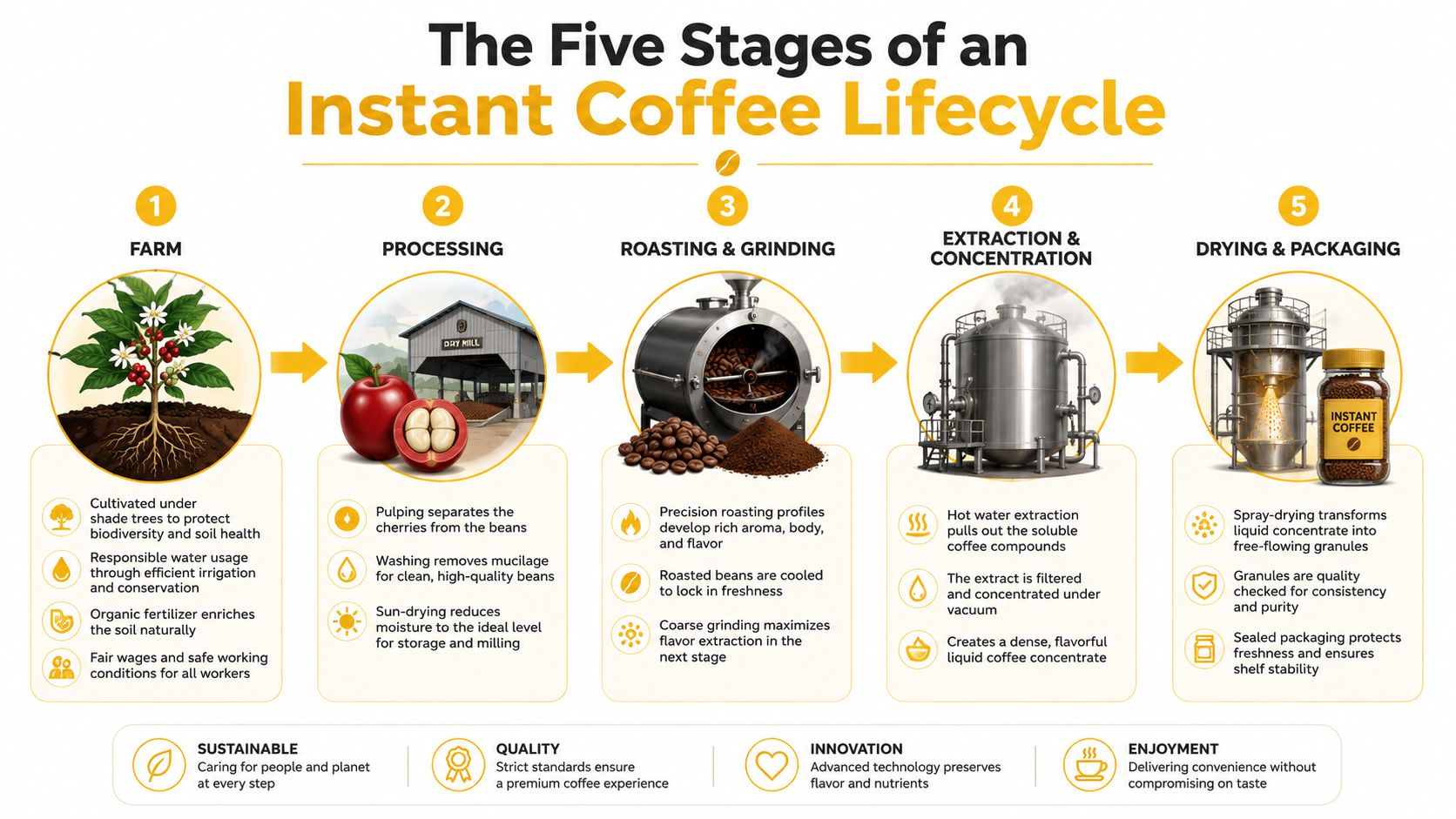
1. The farm
Coffee begins as a crop, not a granule. Farmers manage shade, soil fertility, water, pests, fertilizer, harvesting, and worker safety. The green beans selected for instant production still carry the environmental and social consequences of those decisions. A brand that names a region or cooperative gives buyers more information than one that says “responsibly sourced.”
2. Roasting and preparation
Roasters heat green beans, develop the flavor profile, and prepare them for extraction. The equipment may be gas-fired, electrically powered, or connected to a larger industrial energy system. Centralized production can create efficiency through scale, but it can also concentrate energy demand in a factory that handles large volumes.
3. Extraction and drying
The factory brews a concentrated coffee extract, then removes water. Spray-drying uses a hot stream to turn liquid into powder. Freeze-drying freezes the extract and removes ice under vacuum, creating larger soluble particles and often preserving more aroma. The instant coffee production process shows why the finished granule hides several energy-intensive operations.
4. The package and the cup
A product may come in a glass jar, plastic container, metal tin, refill pouch, or individual stick. The package protects coffee from oxygen and moisture, but its material and format affect transport and disposal. At home, the preparation stage usually involves heating water, measuring granules, and dissolving them, without grinding or filtering.
5. End of life
The final stage includes the container, lid, label, sachet, and any coffee residue. Recyclability depends on the actual material combination and local collection system, not just a symbol printed on the label. Reusing a jar can extend its function, but reuse doesn't remove the need for the original container or solve a multilayer pouch's disposal limits.
These stages explain why a single “sustainable” badge can't describe the whole product. A coffee may have strong farm credentials but poor packaging, or efficient packaging but opaque sourcing. The useful question is always: which stage improved, and what tradeoff remains?
Instant Coffee Versus Ground and Espresso by the Numbers
The strongest evidence for instant coffee appears at the serving level. An Oregon government environmental summary reported that instant coffee had the lowest carbon footprint in three different studies, mainly because it uses less bean mass and generally requires less preparation energy than drip brewing. One separate comparison reported 24 g CO2e per cup for instant black coffee, compared with 38 g CO2e for brewed black coffee. It also reported 0.16 kg CO2e per liter for instant coffee, compared with 0.25 kg CO2e per liter for brewed coffee. These figures come from the review of coffee preparation footprints.
| Metric | Instant | Ground Drip | Espresso |
|---|---|---|---|
| Preparation equipment | Usually just a cup and kettle | Grinder, brewer, filter, and vessel | Espresso machine and grinder |
| Coffee material per drink | Often lower | Often higher than instant | Depends on dose and recipe |
| Main preparation burden | Heating water | Heating water, grinding, filtering | Heating water and operating a high-pressure machine |
| Industrial tradeoff | Extraction and drying energy | Roasting and grinding | Roasting, grinding, and machine energy |
| Main uncertainty | Factory energy and packaging | Grinder, brewer, and coffee dose | Machine type, use frequency, and dose |
Why the result changes at the factory
A University of Manchester assessment found that instant coffee can have higher impacts and costs per tonne produced than ground coffee because it requires double the amount of green coffee beans and 7 to 11 times more energy. Those figures apply to production, not to a finished drink prepared in a home kitchen, which is why they don't contradict the cup-level results. Read the production sustainability assessment for that distinction.
Espresso adds another variable. The machine can draw substantial electricity, but the result is a small, concentrated drink. Ground coffee sits between the formats only if the comparison uses the same serving size, coffee dose, brewing method, and equipment assumptions.
For caffeine comparisons, the amount of coffee used and the product formulation matter. Readers who want to understand that variable can review this explanation of instant coffee caffeine content.
The honest conclusion isn't that one format always wins. Instant can be the lower-impact choice per cup while carrying greater burdens per unit of coffee produced. Your answer depends on the functional unit, the factory's energy system, the package, and how much water and coffee you use at home.
How Instant Coffee Is Made and Why the Process Matters
Most instant coffee begins with a concentrated brewed extract. Manufacturers then choose how to remove water, and that decision affects energy demand, aroma retention, texture, and cost.
Spray-drying
Spray-drying pushes concentrated coffee into a hot drying tower through an atomizer. Tiny droplets expose more surface area to the heated air, allowing water to evaporate quickly and producing a fine soluble powder. The method supports high throughput, but the hot-air system creates a significant thermal energy demand.
Freeze-drying
Freeze-drying first freezes the coffee extract. A vacuum then allows the ice to leave as vapor without passing through a normal liquid stage. This method can preserve more volatile aroma compounds and produce a different granule structure, but the refrigeration and vacuum equipment add electrical demand.
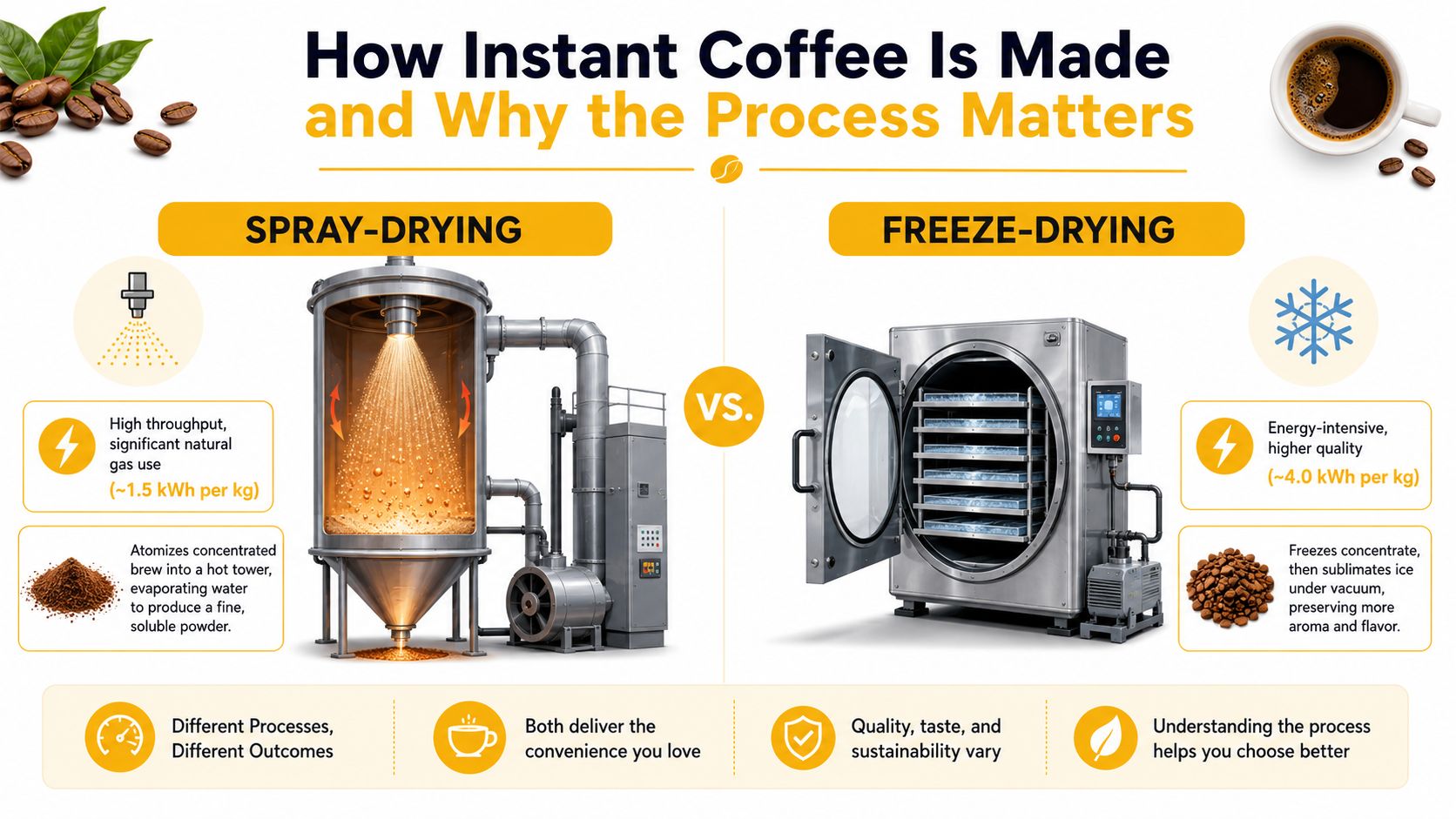
The product's footprint also depends on the bean, roast, extraction efficiency, and plant design. A factory that uses heat integration, lower-carbon electricity, or recovered coffee grounds can perform differently from a similar factory using standalone fossil-fuel combustion. A 2024 life-cycle assessment found that replacing fossil-fuel internal-combustion electricity with a combined cooling, heat, and power system using dried spent coffee grounds plus natural gas reduced global warming potential by 45.2% versus the base case. The same assessment found grid electricity outperformed internal-combustion engines across environmental indicators. See the instant coffee plant life-cycle assessment for the technical comparison.
What the label can reveal
Three label signals offer useful clues, though none proves a low footprint on its own:
- Drying method: Freeze-dried and spray-dried products reflect different process choices, but the label rarely discloses the factory's energy source.
- Origin detail: A named country, region, or cooperative provides more traceability than a broad sourcing statement.
- Added aroma ingredients: “Coffee” as the only ingredient is easier to interpret than a product containing added flavorings, though ingredient simplicity isn't a complete sustainability assessment.
A production method is a clue, not a verdict. The factory's electricity, heat recovery, packaging, and sourcing still determine much of the result.
Reading Certifications and Claims Without Getting Burned
Certification labels answer narrower questions than many packages imply. A farm standard may address labor, pesticides, biodiversity, or shade, while an organic standard focuses on permitted agricultural inputs and production rules. Neither automatically tells you how much energy the instant factory uses or whether the pouch is recyclable.
Separate a named standard from a slogan
Third-party certifications can provide a defined standard and an audit mechanism. Fairtrade, Rainforest Alliance, UTZ, Bird Friendly, Smithsonian, USDA Organic, and EU Organic don't all measure the same things, so compare the scope before treating a mark as proof of total sustainability.
| Claim or Certification | What It Actually Covers | Independent Audit? | Credibility Rating |
|---|---|---|---|
| Fairtrade | Trading and social requirements under its standard | Depends on the scheme and supply-chain verification | Meaningful for covered criteria |
| Rainforest Alliance | Farming and supply-chain requirements under its standard | Yes, within the certification system | Meaningful for covered criteria |
| UTZ | Agricultural and supply-chain requirements under its former standard framework | Historically audited through the scheme | Relevant where legacy references remain |
| Bird Friendly or Smithsonian | Shade-grown habitat criteria | Certification-based | Narrow but specific |
| USDA Organic or EU Organic | Organic production rules | Certification-based | Specific to organic requirements |
| “Carbon neutral” | A claim about emissions accounting and mitigation | Varies by program | Cannot assess without documentation |
| “Ethically sourced” | Brand-defined sourcing language unless a standard is named | Usually unclear | Treat cautiously |
| “Eco-friendly” | Broad promotional language | Usually unclear | Not a guarantee |
A carbon-neutral claim deserves especially careful reading. Some programs account for operational reductions, while others may rely on offsets or supply-chain interventions. The label alone doesn't tell you whether reductions occurred at the farm, factory, transport, or packaging stage.
Use a simple credibility test
Ask three questions:
- Who defines the standard?
- Who checks compliance?
- What does the standard exclude?
A coffee can carry a credible agricultural certification while saying nothing about its drying energy. Conversely, a brand may publish factory improvements without holding a farm certification.
Organic status can be useful when it matches your priorities, but it shouldn't replace a wider review. This guide to organic certified coffee helps clarify what organic certification means before you compare it with other claims.
Decision rule: If a sustainability statement can't be connected to a named, auditable standard or specific supporting evidence, treat it as a story, not a guarantee.
What to Look for When Buying Sustainable Instant Coffee
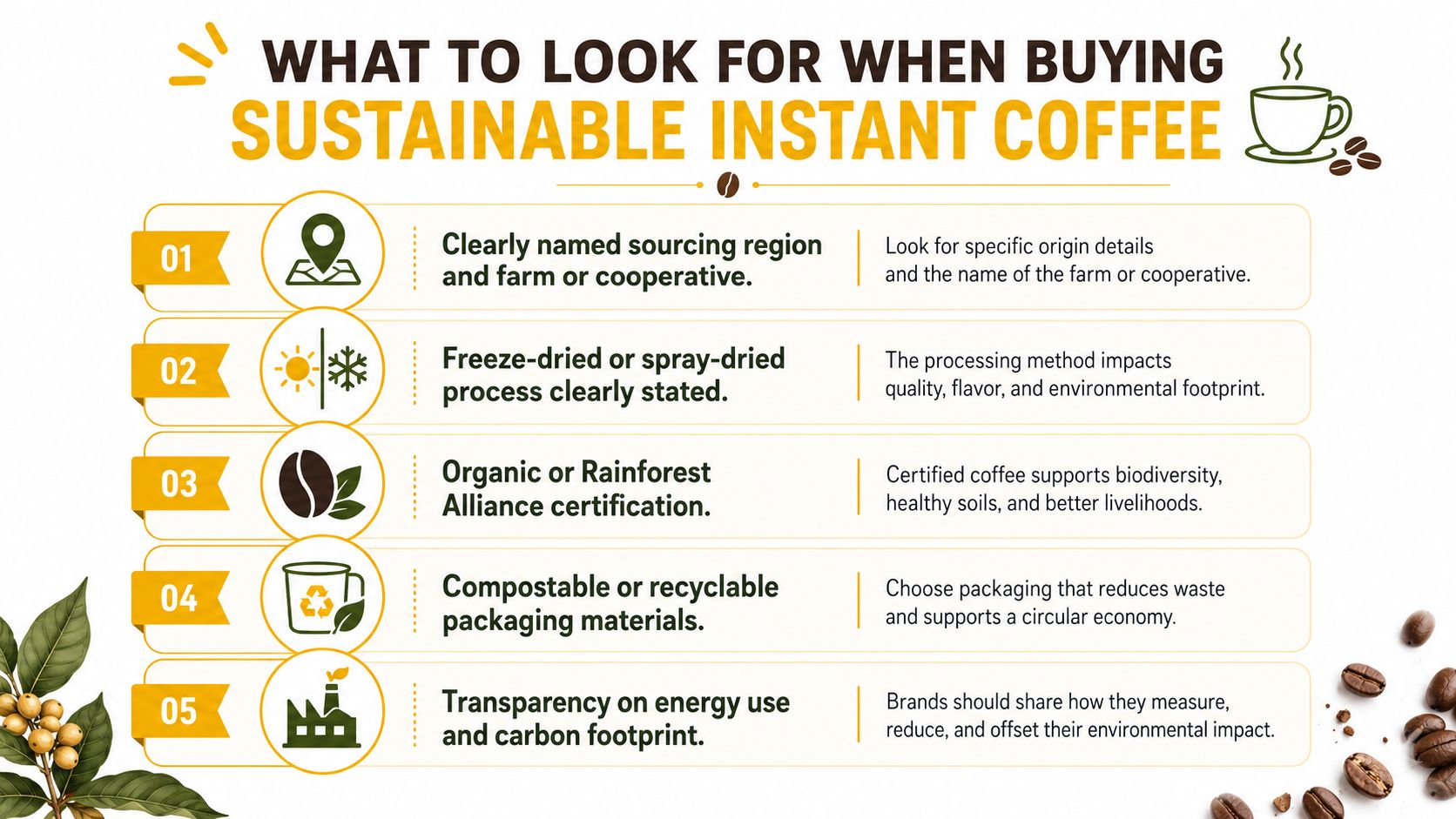
A practical shelf check should take less than a minute. Start with information the package can show clearly, then investigate the brand's deeper disclosures when you have time.
A quick buying checklist
- Traceable origin: Look for a named country, region, farm, or cooperative. Greater detail doesn't prove low emissions, but it gives you something concrete to verify.
- Declared process: Check whether the coffee is freeze-dried or spray-dried. This reveals the manufacturing route, even if the label doesn't disclose energy use.
- Recognized certification: Look for an identifiable third-party scheme rather than an unsupported phrase such as “responsibly grown.”
- Clear packaging material: Favor packaging with a realistic recycling or reuse pathway in your area. A lightweight format may reduce material use, but a material that can't be collected locally can still create waste.
- Factory transparency: Search for information about renewable electricity, heat recovery, spent-ground use, process emissions, or packaging assessments.
Match the format to your habits
Bulk jars or larger containers can avoid some repeated individual packaging. Single-use sticks may suit travel and reduce the need for equipment, but every serving adds another wrapper. Aluminum and tin can be durable options, while glass can support reuse. The right answer depends on the specific material, closure, label, and local waste system.
Don't buy more coffee than you can use. Heat, moisture, and oxygen can reduce quality, and wasted coffee carries the full footprint of its cultivation and manufacturing without delivering a drink. Store the container sealed and away from heat, and reuse a suitable jar for dry goods once it's empty.
Brew efficiently, then reuse
Use only the water you need, bring it to the temperature your coffee requires, and measure a consistent amount of granules. The most sustainable serving is often the one you finish rather than discard. For readers comparing disposable drinkware and compostable options, this coffee cup operator guide provides useful context on what operators should consider beyond the word “compostable.”
An informed purchase isn't about finding a perfect package. It's about choosing a product that gives you evidence across several stages instead of asking you to trust one attractive claim.
Applying These Standards to Cartograph Coffee
A brand example becomes useful only when you apply the same test you'd use for any product. Cartograph Coffee describes its product as organic freeze-dried instant coffee in packets, made with coffee beans as the sole ingredient, and presents ethical sourcing and responsible labor practices as part of its approach. Those are relevant signals, but they don't answer every lifecycle question.
Score the evidence, not the impression
Use this six-part review:
- Sourcing: Does the brand name the origin, farm, or cooperative, and can it explain how labor and purchasing practices are verified?
- Production: Does it disclose how the coffee is brewed, concentrated, and dried, rather than using only quality language?
- Drying choice: Freeze-drying identifies the process, but it doesn't reveal the plant's electricity source, heat recovery, or total energy demand.
- Packaging: Packets may reduce equipment and support portability, yet the exact layers and local disposal route still need checking.
- Certification: Organic labeling addresses defined production requirements. Ask whether an independent certification body verifies the claim and what the certification covers.
- Footprint data: Look for measured emissions, waste, water, or energy information. Without those figures, a consumer shouldn't assume the product has a lower impact at every stage.
This framework keeps convenience and sustainability separate. A lightweight packet may reduce transport burden compared with a heavier setup, but packaging performance depends on its material structure and end-of-life pathway. A freeze-dried product may preserve flavor and meet a buyer's needs, while the factory still deserves scrutiny for its electricity and heat systems.
Cartograph's published product description provides a starting point for those questions, not a universal sustainability verdict. The same checklist works for a supermarket jar, a specialty sachet, or a refill pouch. Compare the evidence stage by stage, identify what the brand measures, and mark unsupported claims as unknown rather than automatically positive.
The useful outcome isn't a perfect score. It's a more honest comparison between what the package promises and what the lifecycle evidence actually shows.
Cartograph Coffee offers organic freeze-dried instant coffee packets made with coffee beans and no added ingredients, designed for convenient preparation away from brewing equipment. If you want to examine that format alongside the sourcing and packaging questions discussed here, visit Cartograph Coffee and review the product information before choosing.