When you grab a jar of instant coffee, you can generally expect a standard cup to have between 60 and 85 mg of caffeine. This range is pretty reliable, making it a great choice for a quick, predictable energy lift. Unlike brewed coffee, where the caffeine can swing wildly depending on how you make it, the process for creating instant coffee locks in a consistent dose. You get the same kick from every spoonful.
Understanding Your Daily Cup of Instant Coffee
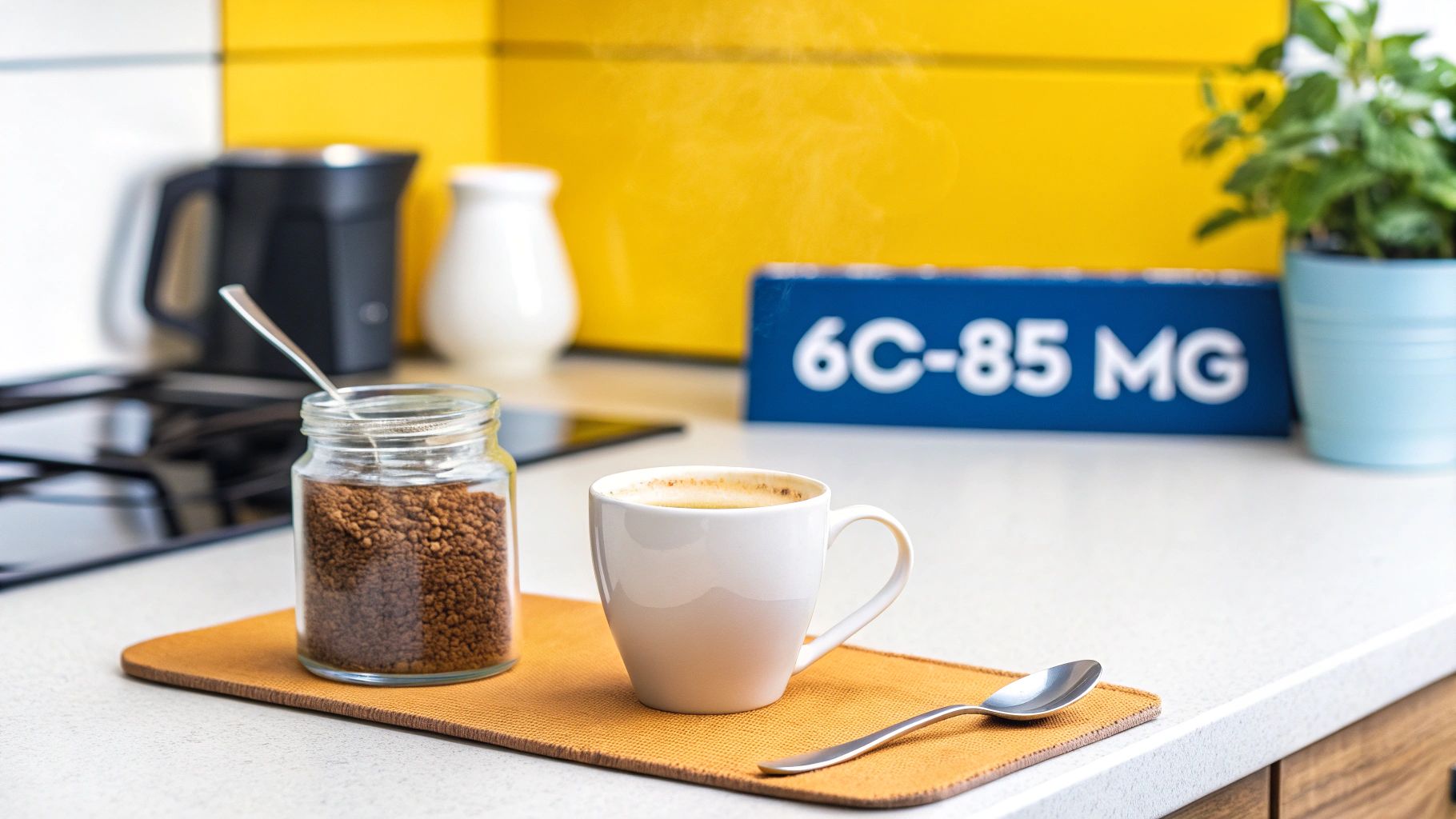
If you're looking for a dependable energy boost without any of the guesswork, knowing the instant coffee caffeine content is your first step. The real beauty of instant coffee is that consistency. It’s like using a trusted recipe—you know exactly what you’re getting every time you scoop those granules into your mug.
This predictability makes it a fantastic option for anyone trying to keep an eye on their daily caffeine intake, whether you're a busy professional juggling meetings or an adventurer needing a quick fix on the trail.
Studies back this up, showing that an average 8 oz (237 mL) cup of instant coffee lands right in that 60-85 mg range. One particular study got even more specific, finding that a single teaspoon of instant coffee granules dissolved in 160 mL of water averages out to about 64 mg of caffeine.
How Instant Coffee Compares
So, how does that stack up against your other coffee options? It's helpful to see the numbers side-by-side. The differences can be pretty surprising and really show why instant coffee is such a smart choice for a controlled, moderate lift.
Caffeine at a Glance: Instant vs. Other Coffees
Here’s a quick comparison of the average caffeine you'll find in a standard 8 oz (237 mL) serving of your favorite coffees.
| Coffee Type | Average Caffeine Content (mg) |
|---|---|
| Instant Coffee | 60–85 mg |
| Drip/Brewed Coffee | 95–165 mg |
| French Press | 100–135 mg |
| Cold Brew | 150–235 mg |
| Espresso (1 shot) | 60–75 mg |
| Decaf Coffee | 2–5 mg |
As you can see, instant coffee hits a really nice middle ground. It gives you less of a jolt than a strong cup of drip coffee or a potent cold brew, which can sometimes leave you feeling jittery. This moderate amount is often just what you need to sharpen your focus without going overboard.
The real advantage of instant coffee is control. You're not guessing about extraction times or grind size—the caffeine dose is locked into the granules, delivering a consistent experience every single time.
For those days when you need a bit more punch from your convenient cup, you might want to check out our guide on finding the instant coffee with the most caffeine.
Ultimately, the steady and reliable instant coffee caffeine content makes it a practical and trustworthy part of any daily routine.
Factors That Influence Caffeine in Instant Coffee
That 60-85 mg range is a great rule of thumb, but it’s not the whole story. The actual caffeine kick in your cup of instant coffee can swing up or down based on a few key variables. Think of it less like a fixed number and more like a starting point that gets tweaked along the way.
The journey from a coffee cherry on a farm to the dark granules in your jar is full of decisions, and many of them have a direct impact on that final caffeine count. It all starts with the bean itself.
Bean Type: The Foundation of Caffeine
In the coffee world, two beans reign supreme: Arabica and Robusta. They have completely different personalities, especially when it comes to caffeine content.
- Arabica Beans: Celebrated for their smooth, complex, and often sweeter flavors. They're the lower-caffeine option, containing roughly 1.2% caffeine by weight.
- Robusta Beans: Just like the name implies, these beans are tough. They deliver a bold, strong, and more "classic" coffee taste, but they also pack a serious punch—we're talking caffeine levels of 2.2% or more by weight. That's nearly double the caffeine of Arabica.
Most instant coffee brands create a blend of both to strike a balance between flavor, cost, and that all-important caffeine level. If an instant coffee is heavy on the Robusta, you can bet it's going to have more caffeine in every spoonful. To really get a feel for what makes them so different, you can explore the unique qualities of Arabica vs. Robusta beans in our detailed guide.
Roasting and Manufacturing Nuances
Once the beans are chosen, the way they're roasted and dried introduces even more variables. There's a common myth floating around that darker roasts are stronger in caffeine. The truth is actually the opposite, but only slightly.
The roasting process burns off a tiny bit of caffeine, but more importantly, it makes the beans less dense. So, if you measure your coffee by the scoop, a lighter roast might give you a smidge more caffeine because the beans are heavier. But if you measure by weight, the difference is almost zero. The drying method—freeze-drying versus spray-drying—also has very little effect on the final caffeine number, though freeze-drying is generally better for preserving flavor.
The most powerful control you have over your coffee's caffeine level isn't in the factory—it's right in your kitchen. The way you prepare your cup is the final, and most important, step.
Your Preparation, Your Control
At the end of the day, you're the one in charge. The easiest way to dial the caffeine in your mug up or down is simply by adjusting how much coffee you use.
A single teaspoon of instant coffee will land you squarely in that standard 60-85 mg zone. Need an extra lift to get your morning started? A second teaspoon will pretty much double that dose. It's that simple. Remember, adding more water will dilute the taste, but it won't change the total amount of caffeine you've already spooned into the cup.
Instant Coffee vs. Other Brews: A Caffeine Showdown
So, when you grab a quick cup of instant coffee, how does it really stack up against the latte you get from your favorite barista? Knowing the numbers behind instant coffee caffeine content is useful, but putting it in a head-to-head comparison with other brews is where you see its real strength: a reliable, moderate boost without the wild highs and lows.
Think of it this way: instant coffee is like a trusty daily driver. It gets you where you need to go, reliably and without any surprises. On the other hand, espresso and cold brew are more like high-performance sports cars—they deliver a powerful punch, but sometimes it's more than you need. This isn't just about which has more caffeine; it's about what kind of ride you're looking for.
Drip Coffee and French Press
For most people, a standard drip coffee machine is the go-to benchmark. A typical 8-ounce cup of brewed coffee lands somewhere between 95 to 165 mg of caffeine. The French press, which delivers that rich, full-bodied flavor from a longer steeping time, is right in that same ballpark, usually containing 100 to 135 mg.
Notice the gap? Both of these methods deliver a significantly bigger jolt than your average cup of instant coffee, which typically has 60-85 mg. That difference makes instant a fantastic option if you're sensitive to caffeine or just want to sidestep the jitters that a stronger brew can sometimes bring on.
Espresso and Cold Brew: The Heavy Hitters
Espresso is a really interesting one. A single 1-ounce shot packs about 60-75 mg of caffeine, which looks surprisingly similar to a whole mug of instant. The catch? It's incredibly concentrated. And since most coffee shop drinks start with a double shot, you're actually looking at 120-150 mg right off the bat.
Then you have cold brew, the undisputed heavyweight champion. Its long, slow steeping process and high coffee-to-water ratio create a seriously potent drink. A single 8-ounce serving can pack a massive 150-235 mg of caffeine, and sometimes even more.
The key takeaway here is all about control. While other methods can vary wildly based on who’s brewing or how long it steeps, instant coffee gives you a consistent, manageable dose every single time.
This chart breaks down the main things—bean type, roast level, and how much you use—that determine the final caffeine kick in any cup of coffee.
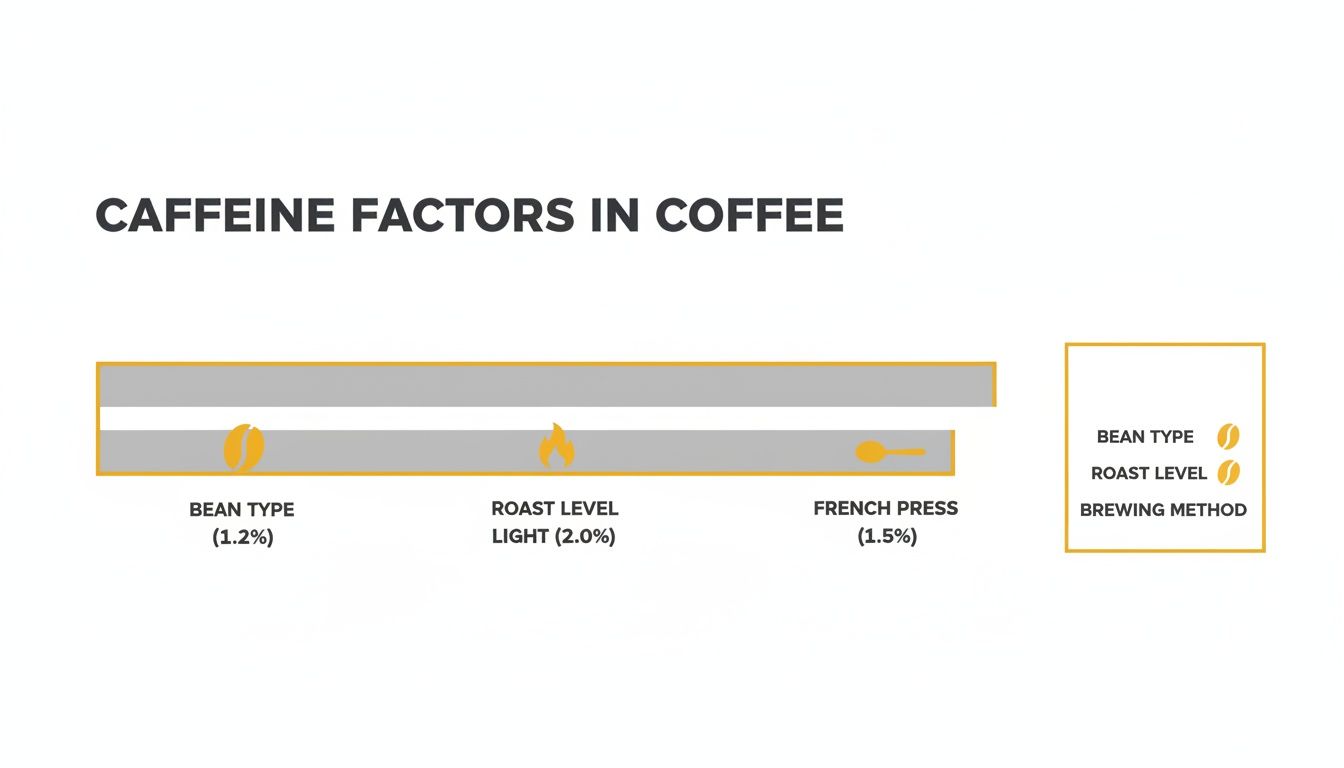
As you can see, the type of bean and the amount of coffee you scoop are the biggest factors you can directly influence, putting you in the driver's seat of your caffeine intake.
For anyone who wants to dial in their daily energy with precision, the predictability of instant coffee is hard to beat. If you want to dive deeper into how all these variables play together, check out our comprehensive guide to coffee caffeine content. At the end of the day, choosing instant means choosing consistency in a world of otherwise unpredictable brews.
Why the World Runs On Instant Coffee
It’s easy to write off instant coffee as a compromise—something you settle for when you can’t get the "real thing." But that perspective misses the bigger picture. This humble brew is a quiet giant, powering mornings and fueling late-night work sessions from Sydney to Shanghai. Its popularity isn't just a fluke; it's a testament to its reliable, predictable delivery of caffeine, something modern life practically runs on.
When you're racing against the clock or trying to power through an afternoon slump, the last thing you need is a guessing game. Instant coffee takes the variables out of the equation. It offers a consistent energy boost you can count on, cup after cup. That very efficiency is why it's become a staple in fast-paced cultures all over the globe.
A Global Caffeine Powerhouse
The numbers here really tell the story. Instant coffee isn't some niche product; it makes up over 34% of all retail brewed coffee consumed on the planet. Its grip is especially strong in places like Australia, where it represents over 75% of all coffee bought. The Asia-Pacific region is its biggest market by far.
Why? Because that predictable 60–85 mg of caffeine per cup hits a universal sweet spot. It delivers accessible energy for everyone, which you can read more about in this deep dive into its global preference on Spilling-the-Beans.net.
This isn't just a passing fad. It’s a reflection of how people manage their energy today. Your quick cup is part of a massive global movement—one that values smart, efficient, and dependable fuel for navigating a hectic schedule.
Choosing instant coffee is about more than just convenience. It’s about predictability—knowing exactly what you’re getting, so you can focus on what’s ahead without worrying about an unexpected jolt or a caffeine crash.
Efficiency for the Modern World
In a world that refuses to slow down, instant coffee provides a moment of simple, effective clarity. It’s not hard to see why its appeal is so universal:
- No Equipment, No Problem: All you need is hot water. You can be in a hotel room, at a campsite, or in an office with nothing but a kettle, and you're good to go.
- Perfectly Portioned: Brands like Cartograph Coffee have nailed this with single-serving packets. No more stale jars or wasted coffee—just freshness every single time.
- Consistent Kick: You get the same satisfying energy lift with every cup, which makes managing your daily caffeine intake incredibly easy.
At the end of the day, the global embrace of instant coffee comes down to its role as a smart tool for modern living. It gives us the fuel we need with the simplicity we crave, proving that sometimes the most straightforward solution is the best one.
Managing Your Caffeine for a Healthy Lifestyle
Knowing the numbers behind instant coffee's caffeine is one thing, but actually using that knowledge is where the real magic happens. The goal is to get all the good stuff—like better focus and a nice energy boost—without the downsides. It really comes down to finding what works for you.
So, how much is too much? Most health experts, including the FDA, point to 400 milligrams of caffeine per day as a safe upper limit for healthy adults. That’s roughly what you'd get from four or five standard cups of instant coffee.
But here’s the thing: we all handle caffeine differently. What’s a perfect pick-me-up for one person might make someone else feel like they’ve got a case of the jitters. The most important rule is to listen to your own body.
Recognizing Your Caffeine Limits
Your body is pretty good at telling you when you've crossed a line. If you can learn to spot the signs, you can dial back your coffee intake before you start feeling overwhelmed.
Common signals that you might be overdoing it include:
- Restlessness or Jitters: That classic "too much coffee" feeling of being on edge.
- Anxiety: A noticeable uptick in nervousness or worry.
- Rapid Heart Rate: Your heart just feels like it’s beating a little too fast.
- Sleep Difficulties: Trouble winding down at night, especially if you had caffeine late in the day.
If any of these sound familiar, it might be time to cut back a little. The good news is, instant coffee makes that incredibly simple.
The consistency of instant coffee is its greatest strength for mindful consumption. Unlike brewed coffee with its wild variations, you know that one teaspoon delivers a reliable dose, making it simple to track and adjust your daily total.
Using Instant Coffee for Smart Caffeine Management
Because instant coffee is so predictable, it’s a fantastic tool for managing your caffeine intake. If you realize four cups a day is pushing it, you can cut back to three and know you’ve made a precise reduction.
Let's say one teaspoon of your favorite Cartograph Coffee is the perfect way to start your day. You can stick with that. If a busy afternoon calls for a little extra help, you can add a half-spoonful and know exactly what you’re getting. This puts you in the driver's seat, removing the guesswork and letting you enjoy your coffee exactly how you want to.
Got Questions About Instant Coffee Caffeine? We’ve Got Answers.
Let's dive into some of the questions we hear all the time about the caffeine in instant coffee. Getting these cleared up will help you dial in your daily cup perfectly.
Does Adding More Water Reduce Caffeine?
Nope. Adding more water to your instant coffee won't change the caffeine content, but it will dilute the taste, making it weaker. The total amount of caffeine is already set by how many coffee granules you spoon into your mug.
Think of it this way: one spoonful of instant coffee has the same caffeine punch whether you stir it into a small six-ounce cup or a big twelve-ounce mug. All that changes is the concentration.
Is the Caffeine in Instant Coffee Less Effective?
The caffeine molecule itself is the same no matter where it comes from, so its effect on your body doesn't change. What does change is the experience.
A strong, drip-brewed coffee can pack a bigger caffeine wallop, giving you a more intense jolt. Instant coffee, with its more moderate 60-85 mg per serving, offers a smoother, more controlled lift. For many people, this is actually preferable, as it helps sidestep the jitters and the dreaded afternoon crash.
The caffeine in instant coffee is just as effective, but its moderate dose provides a more predictable and balanced boost, minus the overwhelming kick you might get from stronger brews.
Does Freeze-Dried Coffee Have More Caffeine?
How the coffee is dried—whether through freeze-drying or spray-drying—doesn't really move the needle on the final instant coffee caffeine content. What truly matters are the beans used in the blend (like Robusta vs. Arabica) and, of course, how much coffee you actually use.
While many people find that freeze-drying does a better job of preserving the coffee's delicate flavors and aromas, it doesn't significantly change the caffeine levels.
Ready for a premium instant coffee that delivers consistent flavor and energy every single time? Cartograph Coffee offers single-serving packets of high-quality, organic instant coffee that are perfect for your busy life. Explore our collection today!