“Just add boiling water” is incomplete advice for instant masala chai. A sweetened, milk-containing premix needs different handling from an unsweetened tea-and-spice powder, and adding more powder can increase sugar and creaminess when all you wanted was stronger tea. The better approach is to choose the formula for the occasion, understand what's already inside, and adjust the cup deliberately.
What Instant Masala Chai Is and How Much to Use
Instant masala chai is a powdered mix built around soluble tea extract and spices, often with milk solids or creamer and sugar, that reconstitutes in water or milk. Ginger, cardamom, cinnamon, clove, and black pepper provide the familiar warming character, although recipes differ.
“Instant” describes a product designed for quick preparation. It doesn't mean someone merely ground a finished pot of chai into powder. Some mixes are complete beverages requiring only water; others need milk and sweetener.
When comparing masala chai instant mixes, first identify which type you're holding. A sachet of complete premix and a spoonful of concentrated, unsweetened powder aren't interchangeable.
Dosing Instant Masala Chai by Occasion
Use the manufacturer's serving as the starting point rather than treating a heaped teaspoon as a universal measure.
| Occasion | Powder per cup | Milk and sweetness |
|---|---|---|
| Morning office cup | Label's full serving, with the stated liquid amount | Use warm dairy or oat milk if the formula calls for it; sweeten after mixing |
| Camping, limited water | Label's serving for a smaller cup; reduce liquid cautiously | Choose a water-ready premix, powdered milk, or shelf-stable milk |
| Family serving, lower sugar | Label's serving of unsweetened mix | Prepare with water and suitable milk; let each person sweeten their own cup |
| Evening, lower caffeine | Label's serving of a caffeine-free blend, or a reduced portion of tea-based powder | Choose a rooibos or explicitly caffeine-free base when available |
For camping, a complete premix reduces the ingredients you need to carry. For family use, an unsweetened formula gives each person more control without changing everyone else's drink.
Practical rule: Start with the occasion, then adjust powder, liquid, and sweetness separately. Changing everything together makes a disappointing cup harder to diagnose.
Sachet weights, powder density, and intended mug sizes differ. Taste the prepared serving before deciding that the product needs extra powder.
How to Brew Instant Masala Chai Step by Step
Use a kettle, a mug with room for stirring, and a teaspoon or small whisk. Keep the packet nearby until you know whether its stated liquid amount includes milk or means water alone.
The basic sequence is simple.
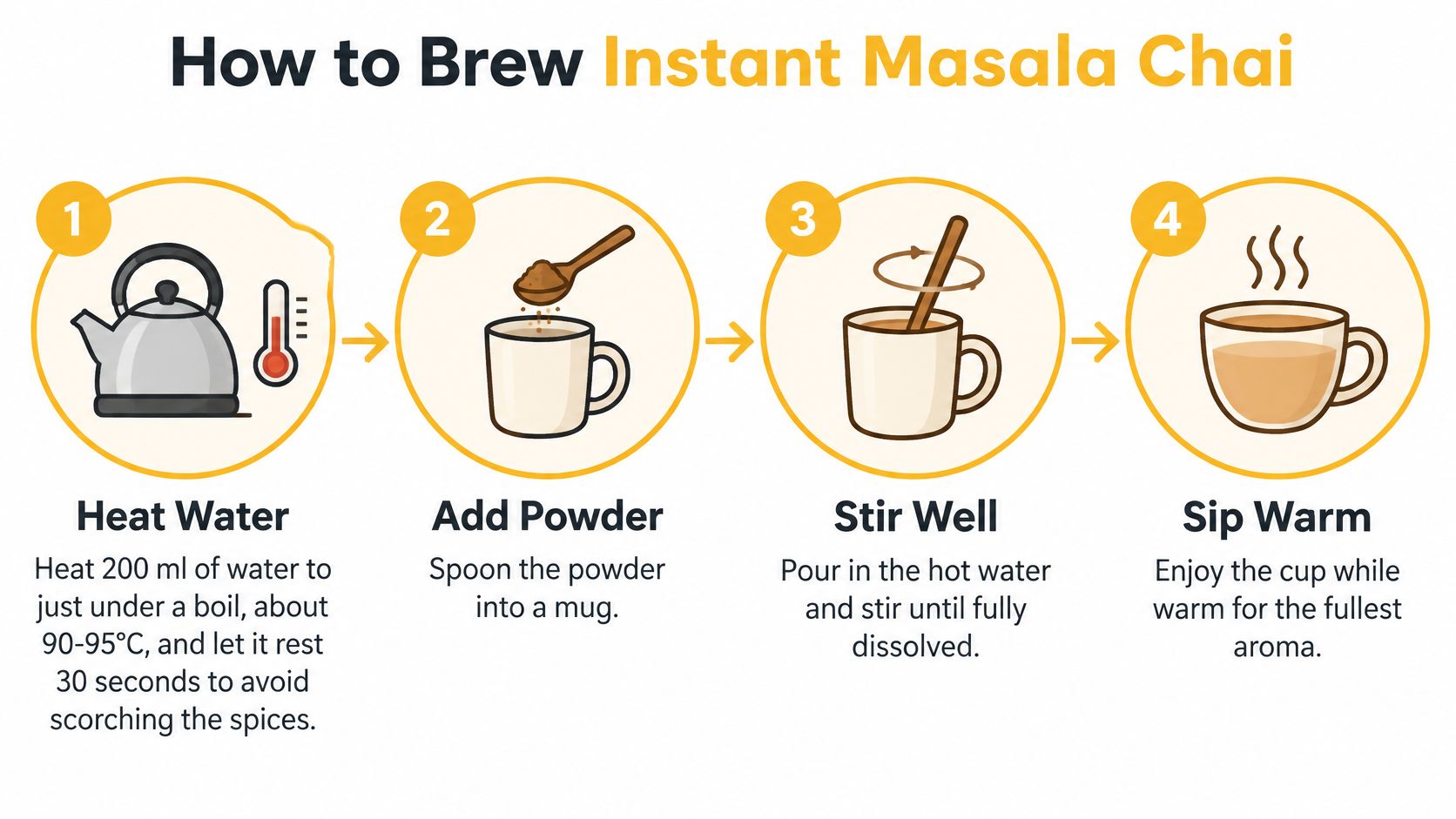
Build a Smooth Base Before Diluting
- Heat the liquid. Heat fresh water and let vigorous bubbling settle before pouring, unless the pack specifies another method. You're reconstituting an extract, not brewing raw tea leaves, so prolonged boiling in a saucepan usually adds unnecessary work.
- Measure the powder into a dry mug. Use the serving printed on the pack, preferably measured by weight if a weight is given. The common slip is substituting a large household spoon for the manufacturer's intended measure.
- Add a small splash of water. Stir until the powder forms a smooth, loose paste, pressing soft clumps against the mug's side. Pouring all the liquid onto a mound of powder can leave dry pockets inside floating lumps.
- Add the remaining water gradually. Stir around the sides and across the bottom, or use a small whisk while keeping its head submerged. Stop when the soluble portion is incorporated rather than assuming visible foam means the drink is mixed.
- Add warm milk if needed. Warm it separately until steaming gently, without letting it boil over, then stir it into the tea base. Don't automatically add milk to a complete premix, because that may make the cup richer and less tea-forward than intended.
- Taste, then finish. Add sweetener only after the final dilution, followed by a light pinch of cardamom or black pepper if desired. Heavy dusting can leave a gritty surface and overwhelm the blend.
A smooth drink doesn't always mean a perfectly sediment-free drink. Soluble tea extract dissolves, but actual ground spices may leave a fine deposit. Hard lumps are a mixing fault; a little spice sediment can be part of the formula.
Make a Cold Version Carefully
Check whether the powder is suitable for cold preparation. If it is, work it into a paste with a little cool water, then gradually stir in cold milk or water and shake in a sealed container.
If it resists dissolving, use a small splash of warm water first, then add cold liquid and ice. Don't keep adding powder to compensate for ice dilution before tasting the finished drink.
Look for an even tan colour, integrated sweetness, and a spice finish that's warming rather than abrasive.
What Goes Into the Powder and Why Aroma Fades
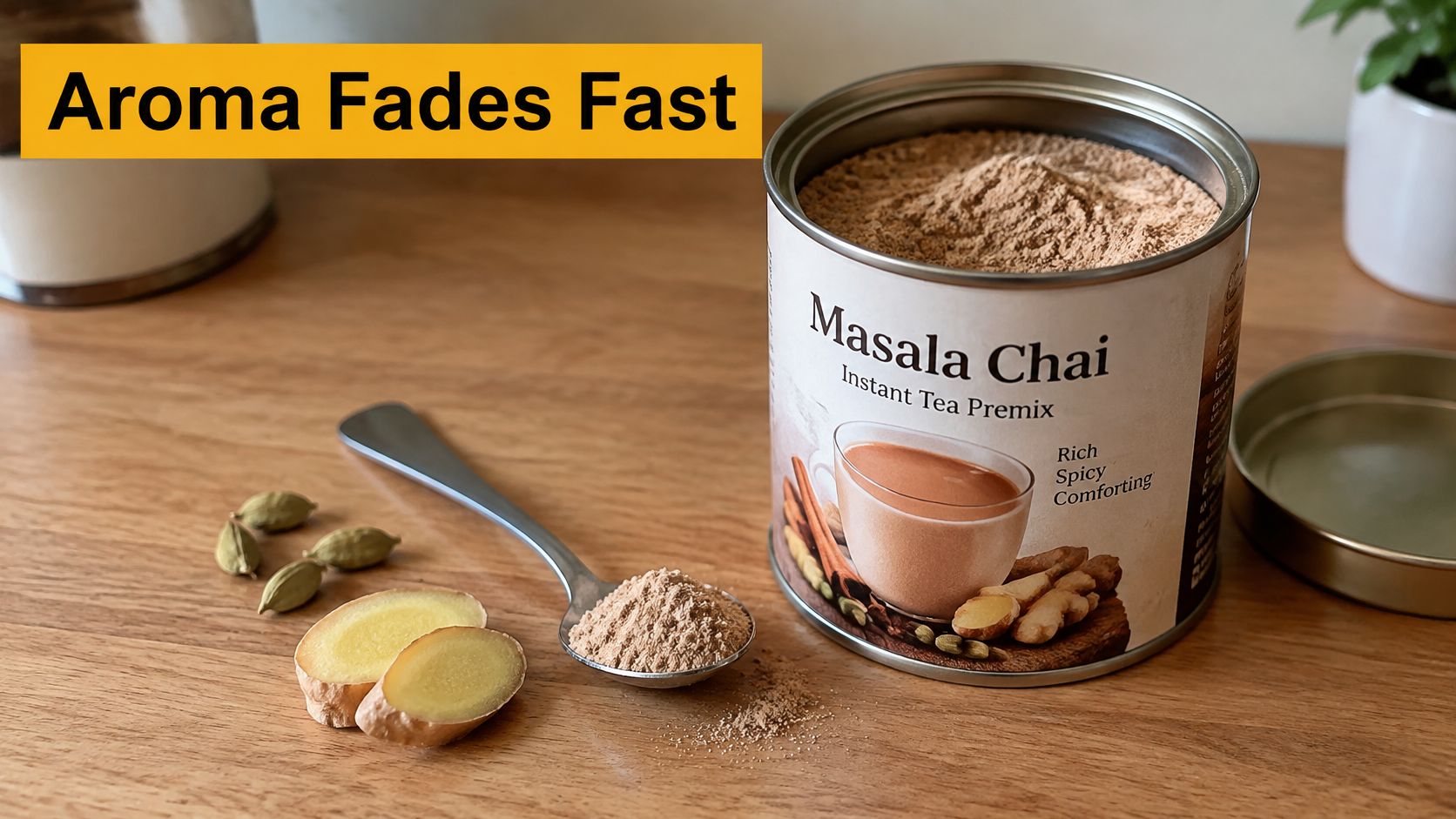
Think of a spice tin left open beside the stove. Its contents may still look normal after the brightest scent has faded. Instant chai presents a similar challenge: keeping flavour ingredients in the powder isn't the same as preserving their aroma.
A typical premix combines several ingredients with different jobs.
| Ingredient | What it contributes |
|---|---|
| Soluble tea extract | Tea flavour, colour, and body |
| Milk solids or creamer | Richness and a creamy mouthfeel |
| Sugar or another sweetener | Sweetness and balance |
| Ground spices or spice extracts | Warmth, fragrance, and distinctive character |
| Flow or anti-caking ingredients | Easier pouring and more consistent handling |
That's a functional breakdown, not a guaranteed ingredient order. A sugar-led mix and a tea-led mix can both be sold as instant chai.
Why More Spice Doesn't Always Mean More Fragrance
The central manufacturing trade-off is cost versus aroma retention. The Arabian Journal of Chemistry paper on instant-tea processing describes volatile-aroma losses during concentration and drying, with freeze-drying generally preserving aroma better but costing more than spray-drying.
Manufacturers can protect delicate flavour components or add them after the highest-heat processing stage. For the buyer, this means a longer spice list doesn't necessarily promise a more fragrant cup.
Judge aroma twice: when you open the package and when you prepare the drink.
A lively opening scent is encouraging, but it doesn't prove when the spices were added. Likewise, a dusty smell can reflect processing, age, or poor storage rather than a single manufacturing fault.
For a visual accompaniment to the ingredient discussion, watch the embedded video.
Choose by the prepared cup, not the drying method alone. An economical powder with balanced tea and well-preserved spice can be more satisfying than an expensive blend whose aroma doesn't survive preparation.
How Instant Chai Tastes Compared With Brewed Chai
Brewed chai is like broth made from separate ingredients; instant chai is closer to a well-made stock cube. The latter offers repeatability and less work, but you inherit more of the manufacturer's decisions.
The sweet, milky, spiced profile isn't an instant-product invention alone. TASTE's history of masala chai describes its emergence as a mass-market Indian beverage primarily during the early twentieth century, shaped by tea promotion and local adaptations involving milk, sugar, and spices.
Instant Masala Chai Versus Brewed Masala Chai
| Trait | Brewed stovetop chai | Instant masala chai |
|---|---|---|
| Active preparation time | Measure, simmer, monitor, and strain | Measure, dissolve, and serve |
| Spice character | Fresh, sharp, and layered when freshly prepared | Rounded and repeatable; delicate notes can be muted |
| Sweetness | Set by the cook | Often pre-sweetened; check the label |
| Tea strength | Adjusted through leaf quantity and simmering | Built into the formula, then adjusted through concentration |
| Caffeine | Determined by tea choice and extraction | Determined by the tea base and powder portion |
| Cleanup | Saucepan, strainer, and utensils | Usually mug and spoon |
The preparation difference matters most when you're interrupted. A stovetop pot needs attention; an instant cup doesn't require monitoring milk as it rises.
Freshly crushed cardamom or sliced ginger also gives brewed chai a different aromatic shape. You can change when each spice enters the pot, whereas an instant blend delivers the balance chosen during formulation.
Sweetness and tea strength are separate controls in homemade chai. In a sweetened premix, increasing the powder usually increases both, which makes correcting weak tea less straightforward.
Choose for the Experience You Want
Convenience also includes serving format. The Matcha Bike's mint-green bikes serving campus matcha offer a useful example of a different portable tea experience: a prepared drink brought to the customer rather than a powder carried by the drinker.
For your own routine, ask whether you want fresh, adjustable spice or an uncomplicated, repeatable cup. Brewed chai suits the former; instant suits the latter.
Neither format guarantees better flavour. A carefully balanced powder can beat a poorly judged stovetop pot, while fresh brewing gives a patient cook more room to customise.
Ways to Boost Flavor and Fix Common Problems
Improve the note that's missing rather than adding every spice you own. A little fresh ginger can brighten a rounded blend, while extra clove may make the same cup feel medicinal.
Choose an addition that complements the drink you already have.

Add Character Without Rebuilding the Recipe
- Fresh ginger: Steep thin slices in the hot water before mixing, then remove them. This adds a sharper ginger note without increasing the premix's sugar.
- Crushed cardamom: Warm a lightly crushed pod with the milk, then strain. It adds a floral fragrance that's different from increasing spice heat alone.
- Cinnamon stick: Infuse a short piece while warming the milk and remove it before pouring. This avoids the sandy texture of a heavy ground-cinnamon topping.
- Fuller-bodied milk: Try whole milk or a creamy, unsweetened oat milk when the texture feels watery. Change the milk, not the powder, to assess the difference.
- Black pepper: Add a light pinch for a warmer finish. Stop before pepper becomes the dominant flavour.
The same restrained approach applies to other drinks. This guide to flavouring coffee naturally offers related ideas for experimenting with familiar flavouring ingredients.
Match the Fix to the Fault
- Thin cup: Reduce the water in your next serving. This concentrates the existing balance without adding more sweetened powder.
- Flat aroma: Add a little fresh cardamom or ginger. This supplies a new aromatic note, although it can't restore an old powder's original freshness.
- Too sweet: Add unsweetened warm milk if a larger, milkier drink suits you. You'll dilute sweetness, not remove sugar, so choose an unsweetened formula next time if total sugar is the concern.
Change a single variable, taste, and stop when the cup improves. More complexity isn't automatically better chai.
Keeping the Powder Dry and Fresh
Damp sugar clumps because moisture helps neighbouring particles stick together. Instant chai can behave similarly: tea solids, sugars, milk-derived ingredients, and spices can absorb moisture, making the powder harder to pour and prepare.
An instant-tea thesis hosted by Middle East Technical University reports hygroscopicity values of approximately 17.33% to 22.58% under a 25°C and 75% relative-humidity test, and discusses powder moisture around 3% to 5% for stability. These are technical reference conditions, not a way to calculate the remaining life of an opened household tin.
Turn Moisture Control Into Handling Habits
You can't assess powder moisture accurately by looking at it. You can, however, prevent avoidable exposure.
- Seal promptly: Close the tin or reseal the pouch immediately after measuring.
- Use a dry spoon: Don't return a spoon that has touched milk, water, or a steaming mug.
- Avoid steam: Store the pack away from the kettle, cooker, and dishwasher.
- Pack trips carefully: Prefer intact single-serve packs or clean, dry, tightly sealed portions.
- Inspect changes: Notice persistent hard lumps, unusual odours, discolouration, or damaged packaging.
Smokey Rebel's guide to understanding anti-caking agents in food provides useful background on ingredients that help powders remain free-flowing. They don't make an open container immune to humidity.
Don't Confuse Caking With a Safety Test
Hard lumps can indicate moisture exposure, but they don't establish whether a product is safe. Don't treat “use it quickly” as a remedy for damp powder, mould, or an abnormal smell.
For related dry-product handling principles, the guide to instant coffee shelf life is a useful companion, though a milk-containing chai needs its own package instructions. At work or outdoors, smaller packs can reduce repeated opening and make careful storage easier.
Choose an Organic or Clean-Label Instant Chai
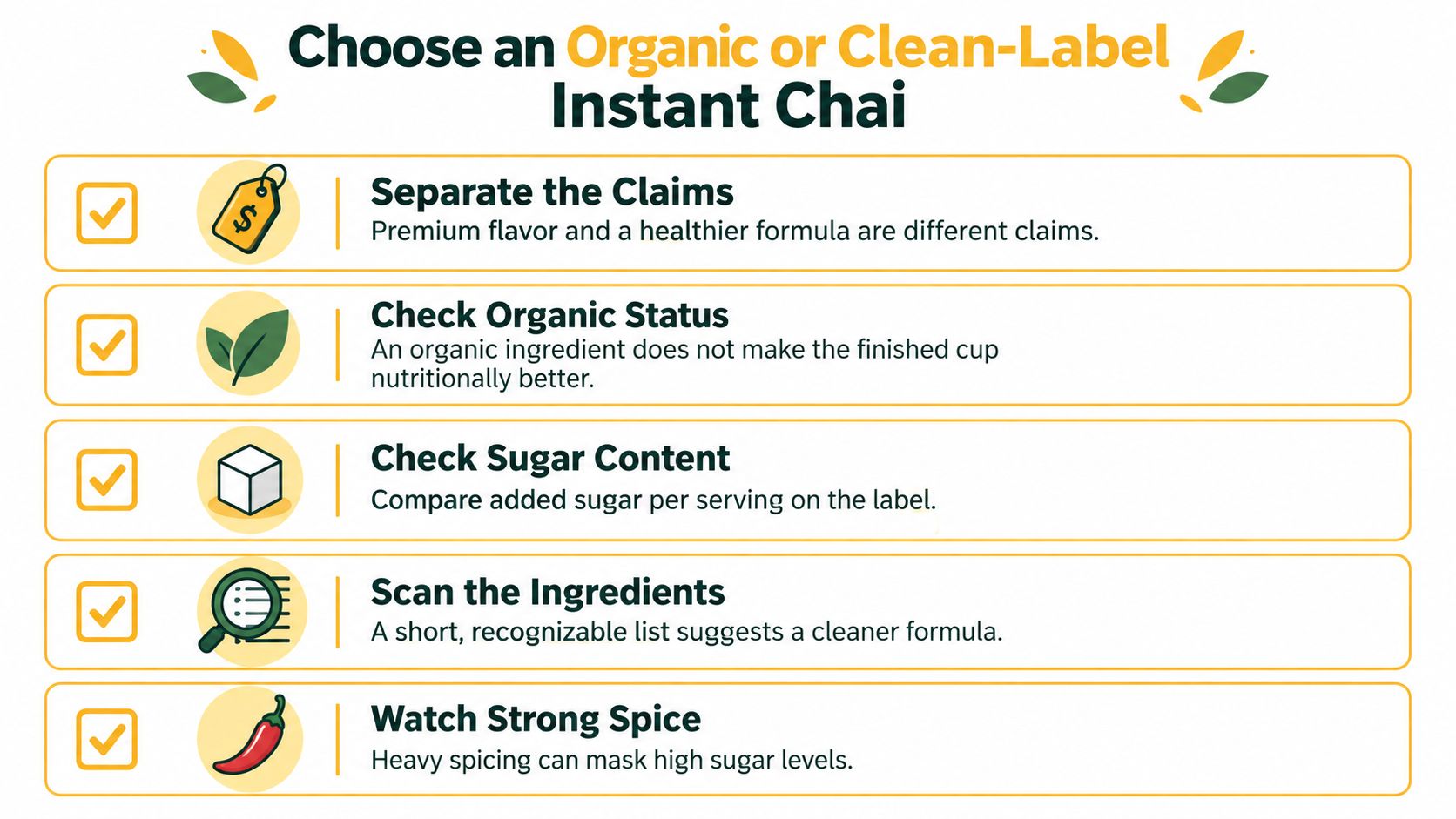
Premium flavour and a nutritionally preferable formula are separate claims. A strongly spiced chai can still contain substantial added sugar, while an organic ingredient doesn't tell you how much sugar or caffeine ends up in your mug.
Health-oriented tea marketing deserves careful reading. MarketIntelo's tea-market report identifies demand for organic, sugar-free, and health-oriented products, but those categories don't describe the same product attributes.
Use the package as evidence rather than letting a reassuring phrase make the decision.
Label Terms on Instant Chai Packs and What to Check
| Label term | What it usually means | What to check |
|---|---|---|
| Unsweetened | No added sweetening ingredient in the mix | Total sugars, milk-derived sugars, and anything you add |
| Organic | An organic production or certification claim | Whether it covers the finished mix or particular ingredients |
| Clean label | Marketing shorthand for a simple-looking formula | The actual ingredient list, not the phrase alone |
| Anti-caking agent | An ingredient that helps keep powder free-flowing | Its identity and whether it matches your preferences |
| Natural flavor | A flavouring described as naturally derived | Whether the specific spices are named |
| Caffeine | Caffeine may be present even without a stated amount | Tea base and any manufacturer-provided amount per serving |
A short ingredient list can be easier to understand, but length alone isn't a nutrition score. Equally, a flow agent has a practical purpose; its presence doesn't establish that the drink is inferior.
Buy for the Cup You'll Actually Make
- Read sugar per serving: Check the serving size alongside the nutrition panel. A larger powder portion changes what you consume.
- Confirm the milk ingredients: Adding plant milk doesn't make a powder dairy-free if it already contains milk solids.
- Identify the base: Black tea contains caffeine; plain rooibos doesn't. Spices don't cancel caffeine, and a reduced portion isn't equivalent to a verified caffeine-free product.
- Seek useful disclosure: If caffeine matters to your evening routine, prefer a clearly identified caffeine-free blend or ask the manufacturer for information.
Organic status is another distinct purchasing consideration. The guide to organic instant coffee offers a related perspective on evaluating organic claims in a convenient beverage format.
Choose the label that matches the occasion. For a lower-sugar family drink, prioritise an unsweetened mix; for an evening cup, prioritise a suitable base rather than mild-tasting spices. Skip claims that don't give you enough information to make that choice.
Cartograph Coffee offers organic instant coffee for convenient cups at work, at home, and outdoors, along with practical beverage guides to help you make informed choices. Visit Cartograph Coffee to explore its coffee and apply the same label-first, flavour-focused approach to your everyday drinks.