For most healthy adults, up to 400 milligrams of caffeine per day is not generally associated with negative effects. During pregnancy, the commonly recommended ceiling is 200 milligrams per day from all sources.
Those numbers answer the basic question, but they don't tell the whole story. The same daily total can feel comfortable when most of it arrives early in the morning and interfere with sleep when the last serving comes late in the afternoon. Your body, medications, health, serving sizes, and timing all influence where your personal limit sits.
What the Science Says About Daily Caffeine Limits
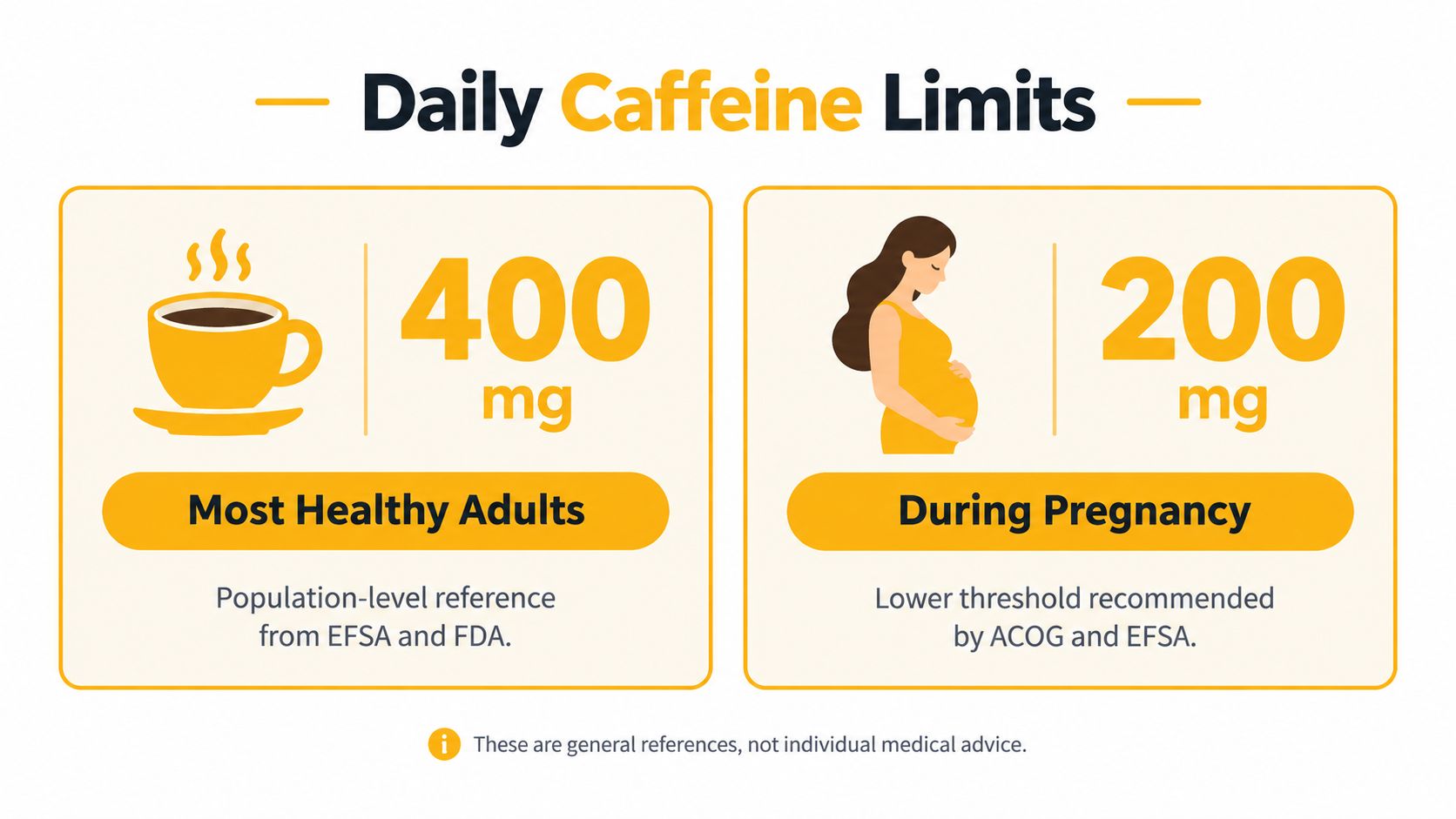
The 400 mg figure is a population-level reference point, not a personal target. The U.S. Food and Drug Administration equates it with roughly two to three 12-fluid-ounce cups of coffee, while noting that caffeine varies widely by coffee type, brewing method, serving size, and brand. Your daily total includes coffee, tea, soft drinks, energy drinks, chocolate, supplements, and medicines. FDA guidance on daily caffeine intake
Pregnancy uses a lower benchmark. The European Food Safety Authority identifies 200 mg per day from all sources as an amount that does not raise safety concerns for the fetus, and the American College of Obstetricians and Gynecologists describes intake below that level as moderate. The tally covers tea, cola, chocolate, supplements, and caffeine-containing medicines as well as coffee.
A daily ceiling does not predict your best routine
Two ideas make these benchmarks easier to apply.
Individual sensitivity varies. Insomnia, anxiety, jitters, a rapid heartbeat, or stomach discomfort can appear below the general adult benchmark. Medical conditions and medications may also affect caffeine metabolism or tolerance, so the same dose can be comfortable for one adult and disruptive for another.
Dose and timing matter alongside the daily total. EFSA identifies 200 mg as a generally safe single dose for healthy adults, while its daily guidance allows up to 400 mg spread across the day. Four modest servings spaced out can feel different from one large serving consumed quickly. A dose that feels fine at 9 a.m. may still interfere with sleep when taken at 4 p.m., even if the day's total stays unchanged. EFSA's caffeine topic guidance
Serving estimates also need context. Coffee preparation can change the amount in your cup, so review coffee caffeine content for the drink you prepare. You can also explore cleaner cup of coffee tips when refining your routine. The practical goal is to understand what you are consuming and find an amount that supports alertness without costing you sleep or comfort.
Why the Same Cup Affects You Differently
Caffeine clears from the bloodstream at different speeds. Your body works like a tank with a slow drain: each coffee adds more liquid, while earlier servings are still leaving. A cup at 9 a.m. and the same cup at 4 p.m. can therefore produce very different results, even when your daily total stays the same.
Caffeine's average half-life is roughly five to six hours, though individual values vary widely. After one half-life, about half of a dose remains in the body, so a later serving can overlap with bedtime. The genes CYP1A2 and ADORA2A help explain some differences. CYP1A2 is associated with how quickly the body clears caffeine, while ADORA2A is associated with sensitivity to effects such as alertness, anxiety, or sleep disruption. These mechanisms and their practical effects are discussed in this overview of caffeine's individual effects and sleep considerations.
Tolerance changes the signal, not necessarily the exposure
A regular coffee drinker may stop noticing a strong buzz from a familiar serving. The reduced sensation does not show that caffeine has stopped affecting the body or sleep. Tolerance can soften the signal while the caffeine remains present.
Coffee also varies before it reaches your cup. Bean choice and preparation influence caffeine content, so one light home coffee may feel different from a stronger café drink. The comparison of Robusta and Arabica coffee beans helps explain why the raw material matters, while serving size and brewing method determine how much reaches the drink.
Use three questions to find your own threshold:
- How much did I consume? Count milligrams, not only cups.
- When did I consume it? A late serving has more time to overlap with sleep.
- How did I respond? Track sleep quality, nervousness, palpitations, stomach discomfort, and next-day energy.
A daily total can fit a general guideline and still be poorly timed for your routine. Dose and timing belong together.
Caffeine Equivalents in the Drinks You Actually Have
A “cup” does not describe a consistent caffeine dose. Brewed coffee can vary with serving size, preparation method, bean choice, brand, and strength, so two drinks with the same label may affect your daily total differently. Milligrams provide a clearer record than cup counts.
Use the table as an inventory guide, not a set of universal values. Check the product label or manufacturer's nutrition information whenever it is available.
| Source | Typical serving | Caffeine (mg) |
|---|---|---|
| Brewed coffee | Serving varies by size and preparation | Varies substantially |
| Espresso | Serving varies by café and preparation | Varies |
| Cold brew | Serving varies by concentrate and dilution | Varies substantially |
| Black tea | Serving varies by tea and steeping | Varies |
| Energy drink | Serving varies by product and container size | Check the label |
| Cola | Serving varies by brand and size | Check the label |
| Dark chocolate | Serving varies by cocoa content and portion | Varies |
| Caffeine-containing medicine or supplement | Product-specific serving | Check the label |
The FDA uses 400 mg as a rough comparison for two to three 12-fluid-ounce cups of coffee, while also explaining that actual caffeine content varies. That makes “I had three coffees” incomplete information. Three small, lightly brewed servings can produce a very different total from three large, concentrated drinks. FDA's explanation of coffee serving variability
Build the total from the whole day
Begin with your first caffeinated item and add each later source. Include coffee, cold brew, tea, cola, chocolate, pre-workout products, and medicines that list caffeine. Check the serving size carefully, because one container may hold more than one serving.
Matcha also belongs in this calculation. Powder quantity, preparation style, and serving size can change the amount, so consult matcha latte caffeine information instead of assuming every latte contains the same dose.
Timing gives the total more meaning. A morning drink and a similar serving late in the afternoon may add the same milligrams, yet the later dose has more opportunity to interfere with sleep. Track both the amount and the clock time, then use your sleep and next-day energy as practical feedback.
Practical rule: Count caffeine in milligrams when you can, record every source, and judge your daily total alongside when you consumed it.
When the Limit Should Be Lower Than 400 mg
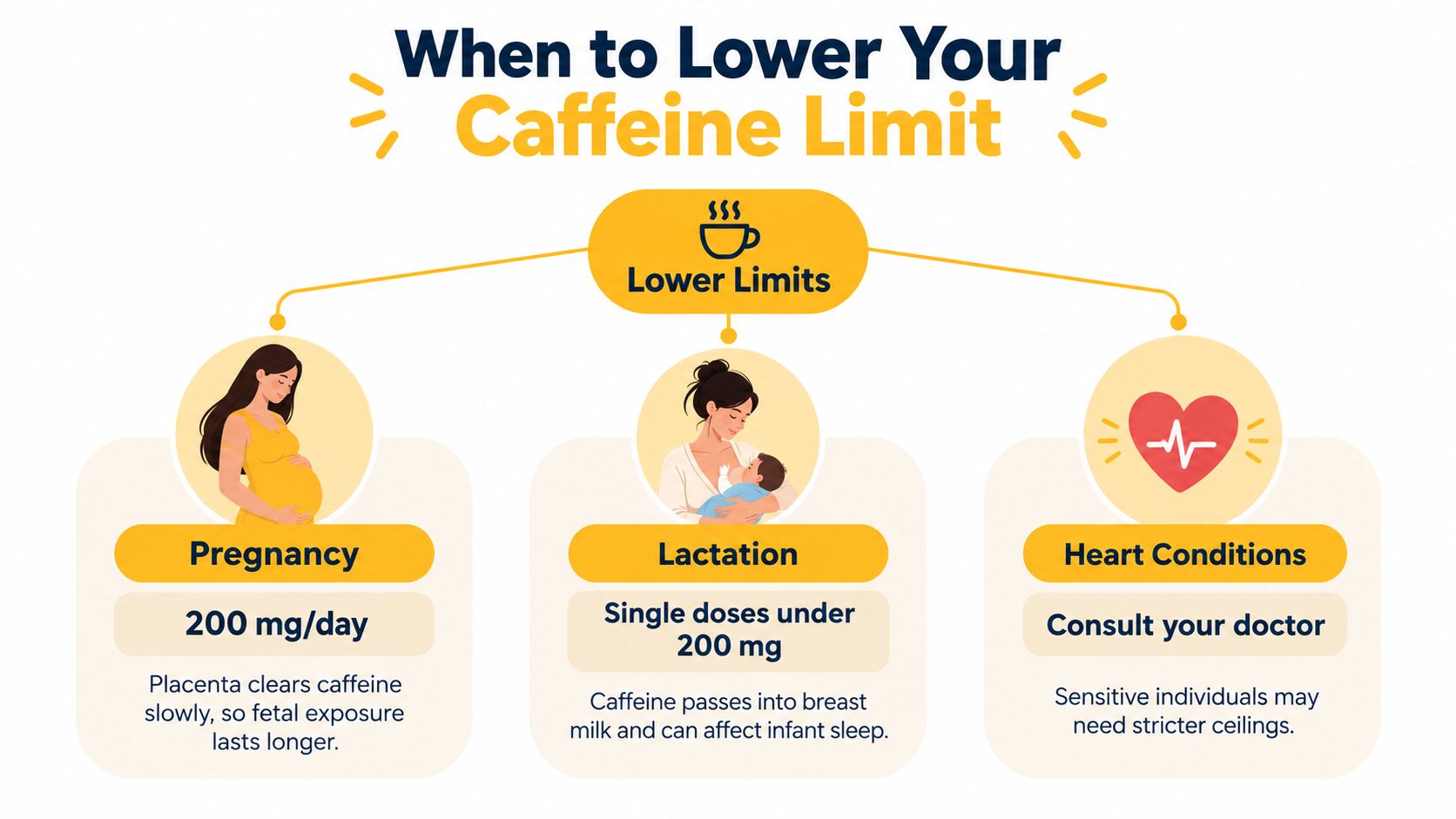
The general adult reference is not a universal personal allowance. Pregnancy, certain health conditions, medication interactions, and strong caffeine sensitivity can all make a lower ceiling more suitable. The same daily total may feel manageable for one person and disruptive for another, depending on health, metabolism, and timing.
Pregnancy and lactation need separate attention
During pregnancy, EFSA sets the daily reference at 200 mg from all sources, below the general healthy-adult benchmark. Caffeine crosses the placenta, while fetal caffeine metabolism is limited. Several small servings therefore still add to total exposure, even when each serving seems modest. Measure the actual dose, especially with instant coffee, because “one cup” can mean different amounts depending on the spoonful and mug size.
For people who are breastfeeding, EFSA reports that single doses and habitual intake up to 200 mg are not expected to raise safety concerns for breastfed infants. An infant's response still deserves attention. If a parent notices changes that seem connected to caffeine, a healthcare professional can help interpret the pattern. EFSA guidance on pregnancy and breastfeeding
Health conditions and medicines can change the answer
Arrhythmias, uncontrolled hypertension, marked caffeine sensitivity, anxiety, and sleep disorders may call for an individualized limit below the general reference. Some medicines and medical conditions can also slow caffeine metabolism or make its effects more noticeable. Ask a clinician how caffeine fits your specific situation instead of testing the general maximum yourself.
Children and adolescents should not treat the adult benchmark as a personal allowance. Their development, body weight, and usual caffeine products differ from the population represented by adult guidance, so a parent or healthcare professional should provide age-appropriate advice.
Older adults with cardiovascular conditions may also need more caution. A familiar serving can become uncomfortable when it interacts with symptoms, treatment, or a changed sleep schedule.
Seek medical advice if caffeine consistently brings on palpitations, a rapid heartbeat, severe anxiety, or sleep disruption. The 400 mg figure is a reference point, not a challenge and not individualized medical advice.
What Too Much Caffeine Actually Feels Like
Too much caffeine often announces itself through a cluster of sensations rather than one unmistakable signal. You might feel restless, shaky, unusually tense, or unable to settle. Someone else may mainly notice a racing heartbeat, stomach discomfort, nausea, headache, or a night of poor sleep.
The amount that triggers those effects differs widely, so symptom-based awareness matters. A daily total that looks acceptable on paper can still be too much if you consistently feel worse after drinking it.
Read the pattern, not just the number
Use a short symptom audit when your routine feels off:
- Jitters or tremor: Note whether they appear soon after a concentrated serving or after several smaller servings have accumulated.
- Anxiety or agitation: Record whether caffeine intensifies an already stressful day.
- Heart sensations: Palpitations or a rapid heartbeat deserve attention, especially if they recur.
- Stomach discomfort: Coffee, caffeine, and the food around them can all contribute, so describe the timing clearly.
- Sleep disruption: Include difficulty falling asleep, waking during the night, and feeling unrefreshed the next morning.
A simple example might be a person who feels comfortable after morning coffee but becomes tense after adding a later energy drink. The useful conclusion isn't automatically “energy drinks are bad” or “coffee is safe.” It may be that the combined dose, timing, or product concentration exceeds that person's threshold.
Stop adding caffeine when symptoms begin, and seek medical advice for severe or persistent symptoms.
Chest pain, severe palpitations, vomiting, confusion, or a concerning change in consciousness warrants prompt medical attention rather than self-experimentation. If you take a supplement or medicine containing caffeine, bring its label to the conversation so a clinician can assess the complete intake.
Symptoms also provide a reason to review your assumptions. “I drink this every day” describes habit, not harmlessness. “I don't feel a buzz” describes perception, not necessarily the absence of sleep or cardiovascular effects.
Timing, Sleep, and the Hidden Cost of Late Caffeine
A daily total can look modest on paper and still interfere with sleep. The missing variable is timing. Caffeine does not disappear when the cup is empty. If you have it late in the day, some of that dose can still be active at bedtime, which helps explain why the same amount may feel fine at 9 a.m. and much less fine at 4 p.m.
Research on sleep points in the same direction. A 2023 meta-analysis associated caffeine consumption with about 45 minutes less total sleep and a 7% reduction in sleep efficiency, and the size of that effect varied with dose, timing, habitual use, age, and genetics. Because of that, a single “safe per day” number is only part of the story.
A practical starting point is to keep caffeine out of the roughly eight to ten hours before bedtime. Use that window like a label check, not a rule carved in stone. Someone who falls asleep early may need an earlier cutoff. Someone who clears caffeine more slowly may also need more distance between the last serving and bed. The case for thinking carefully about coffee in the afternoon is really a timing question, not just a milligram question.
Keep the experiment simple. Leave your morning serving alone for a few days. Move the later one earlier, shrink it, or swap it for a non-caffeinated drink, then notice what changes: time to fall asleep, overnight waking, and how steady you feel the next morning.
How to Track Your Intake and Find Your Personal Threshold
Run a one-week audit. Write down every caffeinated item, its serving size, the milligrams on the label, the time you consumed it, and your sleep quality that night. Add symptoms such as jitters, anxiety, palpitations, or stomach discomfort.
Include sources people often forget, including tea, cola, chocolate, supplements, and caffeine-containing medicines. A food-tracking tool such as Calorie Genie AI can help organize entries, but a notes app works too.
At the end of the week, look for the lowest total and latest time that repeatedly coincide with poor sleep or uncomfortable symptoms. That pattern is more useful than treating 400 mg as your personal target. Set a conservative threshold, then reassess if your health, medication, pregnancy status, or schedule changes.
Cartograph Coffee offers organic instant coffee designed for convenient use at work, home, or outdoors, making it easier to prepare a consistent serving while you track your caffeine. Visit Cartograph Coffee to explore its coffee options and build a routine that fits your preferred timing and personal threshold.