Spray-dried instant coffee accounted for 63.52% of the global instant-coffee market in 2025, according to Mordor Intelligence's market analysis. The cup most commonly purchased is not the one that retains the most aroma. That split is the useful way into freeze dried vs spray dried coffee. A drying method is a process attribute. It is not a quality guarantee. Roast, milk, and how you add the water often decide the cup more than the dryer does.
Freeze Dried and Spray Dried Coffee at a Glance
Freeze-dried coffee keeps more aroma and fits flavor-led buying. Spray-dried coffee is cheaper to run, works as a continuous process, and fills most of the mass market. Neither label tells you the roast was good, the extract was strong, or the powder was packed well.
| Criterion | Freeze-dried | Spray-dried |
|---|---|---|
| Core process | Frozen extract dehydrated under vacuum | Concentrated extract atomized into hot air |
| Heat exposure | Low | High |
| Aroma retention | High, keeps more volatile aromatics | Lower, loses delicate low-boiling notes |
| Granule form | Porous, flaky, larger | Smooth, spherical, fine |
| Production speed | Slow, batch-based | Continuous and high-throughput |
| Equipment and energy | Costly vacuum and refrigeration | Lower cost per unit produced |
| Typical retail price | Premium | Mass-market |
| Best fit | Aroma, taste and premium gifting | Budget, bulk and everyday use |
Read the aroma retention and price rows first. Those two decide most real purchases. The other rows explain why those two diverge.
Freeze-dried means frozen extract dehydrated under vacuum. Spray-dried means concentrated extract atomized into hot air. The table describes typical production, not every brand. A careful spray-dried powder can still beat a weak freeze-dried one when the roast is dark or the drink is mostly milk.
Two questions carry the rest of this comparison. How much aroma survives the dryer, and what does a cup cost once you count servings? The process steps come first, because heat and structure set both answers.
How Each Drying Process Turns Extract into Powder
Both methods start from brewed, concentrated coffee. They part ways at the moment water leaves the extract. The two sequences below stay parallel so you can compare them step for step.
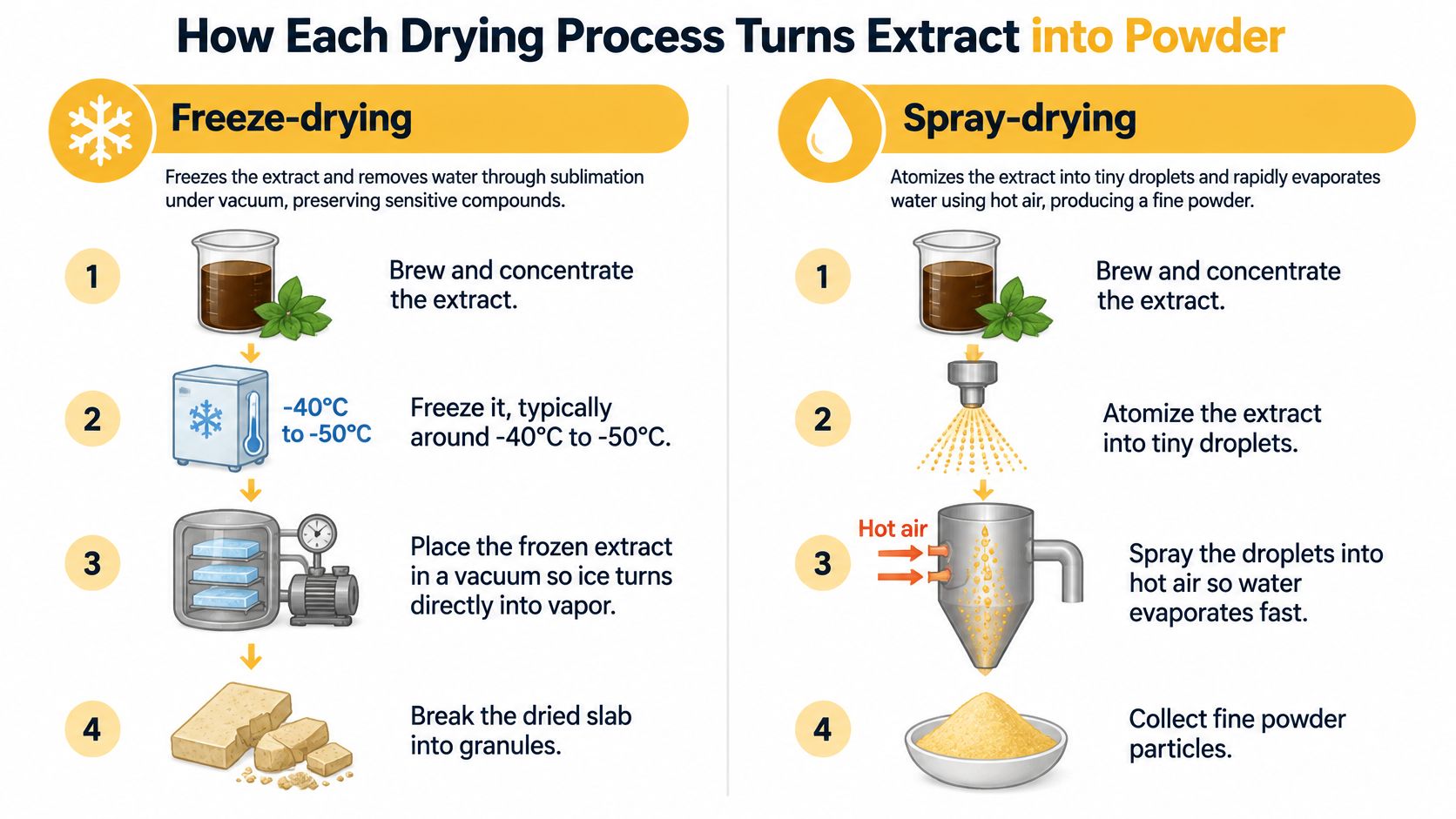
Freeze-drying
- Brew and concentrate the extract. Solids have to be high enough that the dried cake holds together, and low enough that freezing stays even.
- Freeze it, typically around -40°C to -50°C. A laboratory comparison of the two dryers places the freeze in that range so the ice is stable before vacuum is applied.
- Hold the frozen slab at about 30 to 40 Pa. At that pressure ice turns straight into vapor. There is no melt stage to wash aromatics out with liquid water.
- Break the dried cake into porous granules. Low temperature limits heat damage to volatile aromatics. The cycle is slow, and it needs costly vacuum and refrigeration equipment.
Spray-drying
- Concentrate the extract. One modeled optimum sits near a 42% initial coffee-extract concentration, reported in a technical comparison of freeze-drying and spray-freeze-drying.
- Atomize it into a hot chamber. The same model placed an operating point at 423.15 K (150°C).
- Let water leave in seconds. Droplets dry into powder while the line keeps running.
- Collect the fine particles. Throughput is the gain. The same heat drives off delicate, low-boiling aromatics.
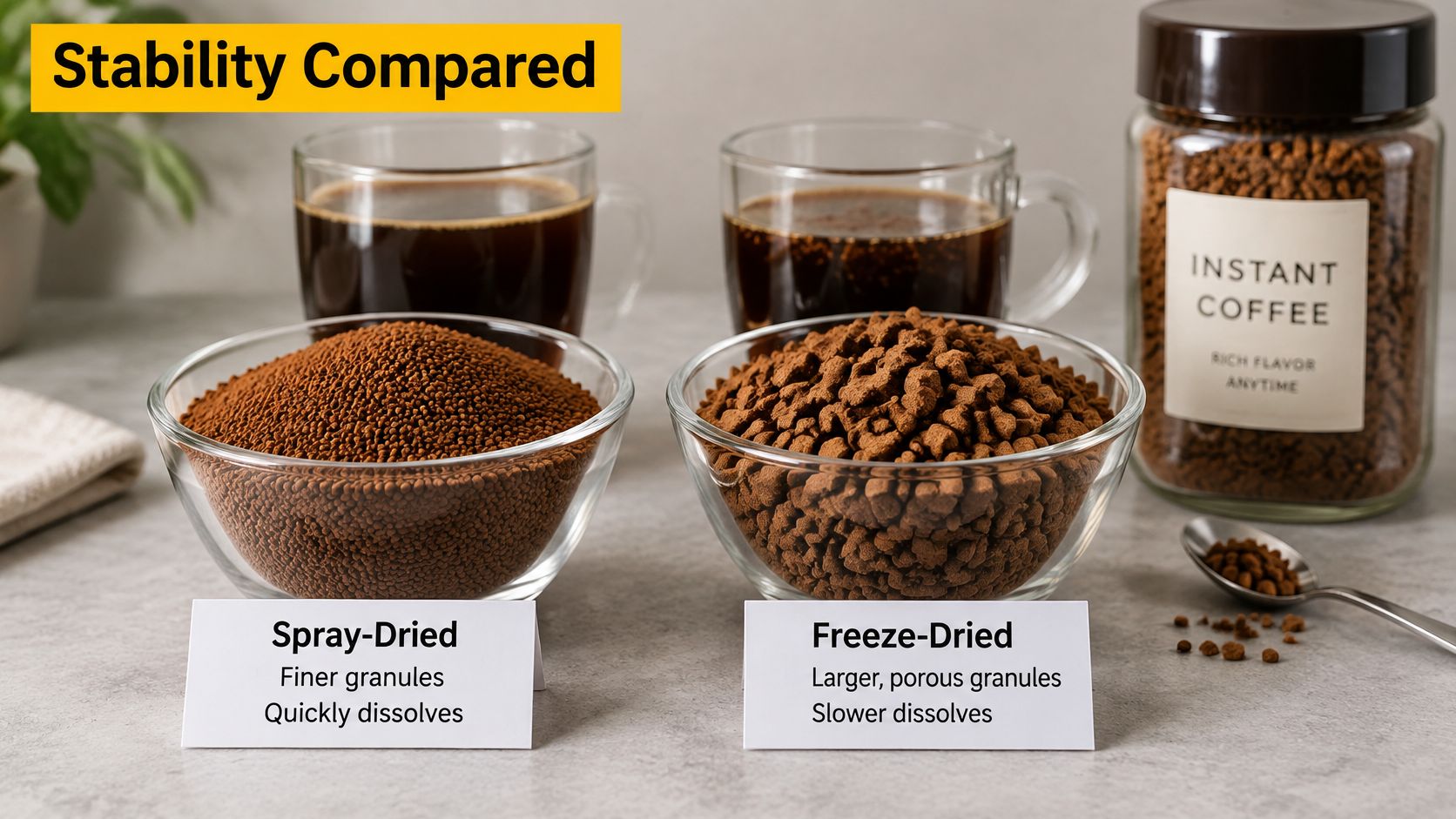
Structure matters as much as heat. That lab comparison found spray-dried particles averaged about 10 micrometers, smooth and spherical, against about 40 micrometers for porous, flaky freeze-dried particles, with moisture at 4.72% and 7.46%. Those shapes control how fast a spoonful dissolves and how a jar ages, which is a different question from how much smell survives the dryer. If you want the shared starting point, brewed extract turned into a jar, our note on what instant coffee is sets that up without picking a dryer.
How Much Aroma Each Method Keeps
The metric is the share of total volatile aroma compounds still in the powder, measured against the concentrated extract before drying. In a 2024 HS-SPME/GC-MS comparison, freeze-dried coffee kept 75.98% at laboratory scale and spray-dried coffee kept 50.11%, so the freeze-dried powder held about 1.52 times more total volatiles, as reported in that 2024 volatile comparison. The same 2024 comparison found higher levels of pyrazines and furans in the freeze-dried powder. Those families read as roasted, toasted, and caramel-like. A thinner top note is easiest to notice in black, hot coffee with nothing else in the mug.
Does the gap survive the factory
At industrial scale the same comparison measured 73.39% for freeze-dried coffee and 45.13% for spray-dried coffee, about 1.63 times more volatiles in the freeze-dried powder. Differences were statistically significant. Retention fell slightly for both methods once the work left the lab, so a benchtop result should not be copied onto a commercial jar without a check. The drop from lab to factory was small next to the gap between methods, which is the useful part for a buyer comparing powders. The freeze-dried advantage did not disappear.
| Method | Lab scale | Industrial scale |
|---|---|---|
| Freeze-dried | 75.98% | 73.39% |
| Spray-dried | 50.11% | 45.13% |
A 1.5-fold gap in total volatiles is not a 1.5-fold gap in flavor. Total volatile retention counts what the instrument detects, not how the compounds smell together or how your dose and water temperature release them. A freeze-dried powder can still taste flat if the roast is dark and the brew is weak, because the dryer cannot add back aromatics the roast never developed.
Aroma retention is one measure of the cup, not a full quality score. It does not score bitterness, body, or how the drink tastes once milk covers the top note. Roast level, dose, water temperature, and milk decide more of the final cup than the dryer label does. At that point, the drying method stops predicting the sip.
Solubility, Density and Storage Stability Compared
Particle size, residual moisture, and density decide what happens between opening a packet and taking a sip. They do not rank one drying method above another on taste. They set how fast the powder wets, how much space it needs in a pouch, and how much room it has left before humidity turns it into a sticky block.
Spray-dried granules are fine, smooth spheres. Freeze-dried granules are larger, porous, flaky pieces. The porous freeze-dried structure wets quickly, so it often clears in cold water with less stirring. That same openness leaves more surface for moisture. In the benchmark below, freeze-dried powder carried more residual water than spray-dried powder, so a packet left open in a humid kitchen has less margin. Lower moisture gives spray-dried powder a storage edge, not a flavor advantage.
A soluble-coffee benchmark in Food and Bioproducts Processing measured bulk density at 0.328 g/mL for spray-dried powder and 0.345 g/mL for freeze-dried powder. Tapped density came in at 0.388 g/mL and 0.361 g/mL. Loose, the freeze-dried powder is slightly heavier per milliliter. After tapping, the spray-dried powder packs tighter. Spray-freeze-dried powder was much denser, 0.612 g/mL bulk and 0.679 g/mL tapped, and it showed instantaneous solubility tied to a highly porous morphology. Density alone does not forecast dissolution. Morphology and how the powder is wetted share the work.
| Property | Spray-dried | Freeze-dried | Spray-freeze-dried |
|---|---|---|---|
| Average particle size | about 10 micrometers | about 40 micrometers | Not reported in these benchmarks |
| Moisture content | 4.72% | 7.46% | Not reported in these benchmarks |
| Bulk density (g/mL) | 0.328 | 0.345 | 0.612 |
| Tapped density (g/mL) | 0.388 | 0.361 | 0.679 |
What the densities mean for a pack
These figures are process-dependent benchmarks, not universal specs for every brand. Packaging and fill specs should use bulk and tapped density, not mass alone. A light, fragile granule fills a pouch differently from a compact powder at the same gram weight. Matching serving mass alone can still ship a pack that looks short or a jar that cakes because headspace and fragility were ignored.
Storage life is mostly a moisture and seal problem, whatever the dryer was. For coffee, keep packets sealed until use in a cool, dry place. That routine matters more than the drying method once the packet is open. Our notes on instant coffee shelf life cover how long that seal is doing the work.
Other dried foods run into the same water problem. IFM Gourmet Food Store's egg white guide walks through how residual moisture and rehydration change a powder you cook with. The comparison is useful for the physics, not for coffee flavor. A coffee packet still has its own roast, grind, and extract behind the powder.
What Each Method Costs to Make and Buy
Freeze-drying carries vacuum chambers, refrigeration, and slow batch cycles, so each kilogram absorbs more equipment time and energy. Spray-drying runs continuously at large capacity and is generally cheaper per unit, which is why it dominates mass-market jars.
Dataintelo's instant espresso coffee figures put the 2025 average retail price at $7.20 for spray-dried coffee and $24.60 for freeze-dried coffee. That is more than three times the spray-dried average. Read the scope tightly. These are instant espresso averages, not a universal price for every instant coffee on the shelf.
| Cost item | Freeze-dried | Spray-dried |
|---|---|---|
| Core equipment | Vacuum chambers and refrigeration | Spray dryer with hot-air chamber |
| Production cycle | Slow, batch-based | Continuous, high-throughput |
| Cost per unit produced | Higher | Lower |
| Average retail price, instant espresso 2025 | $24.60 | $7.20 |
Price is not a cup score
A higher shelf price mixes process cost with brand positioning. It does not prove the coffee tastes better in your mug. A dark roast built for milk can hide the aroma gap you paid for. A light, aroma-led coffee can make a cheap spray-dried powder taste hollow even when the math looks smart.
Cost per cup, worked on one pack
Divide the pack price by the number of servings, and compare products with the same serving size and a similar roast. Cartograph Organic Instant Coffee - Medium Roast costs $7.99 USD. Read the serving count on the label, divide $7.99 by that count, and set the result next to a spray-dried medium roast, not next to the $24.60 espresso average. Taxes, discounts, and shipping are calculated at checkout, so the receipt can move the per-cup figure even when the sticker does not. A 200 pack is offered when it is stocked, which is the fair bulk comparison if you drink instant every day.
Energy use is a different ledger from the sticker price. Ask a producer how the plant is powered before you treat either dryer as the greener buy.
Nutrition and Environmental Impact Compared
What the cup chemistry supports
A comparative analysis of drying method and roast found that freeze-drying better preserved non-volatile compounds such as total dissolved solids and polyphenols, and that the effect interacts with roast level. No single dryer wins across every coffee. A darker roast has already changed those compounds before either process begins, so the dryer cannot rescue a roast that has flattened the chemistry. Process conditions shape the powder; they do not guarantee the cup.
Lower residual moisture in spray-dried powder bears on storage, not on nutrient content. Calories, caffeine, and vitamins are not separated by drying method on a typical nutrition panel, so check the panel on each pack rather than assuming the dryer decides them. Cartograph Organic Instant Coffee - Medium Roast is made from organic coffee beans only, with no additives or chemicals, and it is free from preservatives and synthetic flavors. That is a recipe fact, not a drying-method result.
What the energy story cannot show yet
Freeze-drying uses vacuum equipment and refrigeration across slow batch cycles. Spray-drying uses heated air in a continuous line. Each plant draws a different energy profile. Published energy and emissions figures for either method are scarce, so a greener label without numbers is a slogan.
Before you buy on environmental grounds, ask the producer three things.
- Energy source. Is the plant on grid power, and what is the grid, or do they buy specified renewable electricity?
- Published figures. Do they release energy use or emissions per kilogram of powder, for the dryer you are buying?
- Packaging. What is the packet made of, and is that format recycled in your area?
Only that producer's own figures should settle the comparison. For a broader look at how we frame the tradeoff, see our piece on sustainable instant coffee.
Choose the Right Instant Coffee for Your Habits
Freeze-dried does not always mean better tasting. It generally keeps more aroma and more of those non-volatiles, but roast level changes the outcome. A well-built spray-dried coffee can beat a weak freeze-dried one in dark roasts or milk drinks, which is the point of a comparative look at drying method and roast. "Freeze-dried" on a label is a process attribute. It is not a complete quality guarantee.
| Situation | Better fit | Why it matters |
|---|---|---|
| Tasting black coffee for aroma | Freeze-dried | Keeps more volatile aromatic compounds |
| Dark roast or milk-based drinks | Test both | A well-formulated spray-dried powder can match a weak freeze-dried one |
| Iced or cold-water coffee | Freeze-dried | Porous granules rehydrate quickly |
| Humid conditions or long storage | Spray-dried | Lower residual moisture supports storage stability |
| Budget or bulk buying | Spray-dried | Lower average retail price |
| Premium gifting or tasting | Freeze-dried | Aroma-led premium positioning |
| Camping and travel | Either, keep packets sealed | Sealed single-serve packets protect either powder until use |
A short decision path
- Aroma first, drunk black. Choose freeze-dried, and taste it without milk before you judge the brand.
- Budget per cup under pressure. Choose spray-dried, then divide pack price by servings so you are comparing cups, not stickers.
- Heat or humidity in storage. Choose the lower-moisture product and keep it sealed in a cool, dry place.
- Mostly iced coffee. Choose freeze-dried. Porous granules wet faster when the water is cold.
- Milk, or a dark roast. Do not pick from the label. Run the test below.
Buy one packet of each method. Brew both black with the same water and the same volume. Repeat with the same amount of milk. Repeat iced by stirring the powder into a small splash of water first, then adding cold water, milk, and ice. Score aroma, body, bitterness, and aftertaste on separate lines. A powder can win on smell and lose on bitterness once milk is in the cup.
Our medium roast is freeze-dried and dissolves without a grinder, brewer, filters, or cleanup. It has a smooth body and subtle notes of chocolate and cinnamon, in sealed single-serve packets that are light enough for a carry-on, backpack, or camping kit. Confirm those tasting notes on the product page before you treat them as your cup. Water, milk, or sweetener can be adjusted to taste. For hot coffee, empty one packet into a mug, add hot water, and stir until it dissolves.
Run one trial this week. Brew a freeze-dried pack black and with milk, set it beside a spray-dried product at a similar cost per cup, and decide on aroma and price together.
Cartograph Coffee makes organic freeze-dried instant coffee for people who want a straightforward cup at home, at a desk, or on a trip, without treating the drying method as a magic label. If aroma, packet convenience, and a clear cost per serving are what you are weighing in freeze dried vs spray dried coffee, start with a medium roast and taste it the way you drink it. Visit Cartograph Coffee to see the current packets and pick a size that matches how often you brew.