At its most basic, instant coffee is simply real, brewed coffee that has had all of its water removed, leaving behind dehydrated crystals or a fine powder.
It’s a bit like powdered milk or those dehydrated soup packets you find at the store. You're starting with the real thing, but it's been concentrated down to its shelf-stable essence for ultimate convenience. Just add hot water, and voilà—the coffee is brought back to life.
Understanding the Basics of Instant Coffee
A lot of people ask if this convenient version is "real" coffee, and the answer is an emphatic yes. The journey from a green coffee bean to the granules in your jar starts the exact same way as any other bag of coffee. The beans are harvested, processed, roasted, and ground.
From there, the ground coffee is brewed into a super-concentrated liquid. The final, game-changing step is removing all the water from this concentrate. This is what turns liquid coffee into a shelf-stable solid that can sit in your pantry for months, ready whenever you are.
This transformation is usually done in one of two ways.
The Two Paths to Instant Coffee
How instant coffee is made has a huge impact on the final quality, aroma, and flavor you get in your cup. Knowing the difference between the two main methods is key to picking one you'll actually enjoy drinking.
Here's a quick look at the two main methods for making instant coffee.
Table: Instant Coffee at a Glance
| Characteristic | Explanation |
|---|---|
| Origin | Made from 100% real coffee beans that are roasted and ground. |
| Process | Brewed coffee concentrate is dehydrated using either spray-drying or freeze-drying. |
| Form | Exists as soluble crystals or powder that dissolves in water. |
| Purpose | To provide a quick, convenient coffee experience without brewing equipment. |
As you can see, it all starts with real coffee, but the magic—and the difference in quality—happens in the dehydration step.
-
Spray-Drying: This is the fast and cheap route. The coffee concentrate is sprayed as a fine mist into a chamber of extremely hot air. The water evaporates almost instantly, leaving behind a fine powder. While it’s efficient, the intense heat can scorch the coffee, destroying many of the delicate aromatic compounds that make coffee taste so good.
-
Freeze-Drying: This is the gentler, more premium method. The coffee concentrate is frozen solid and then placed in a powerful vacuum. Through a process called sublimation, the ice turns directly into vapor, skipping the liquid phase entirely. This preserves far more of the coffee’s original, nuanced flavors and aromas.
This difference in processing is often what separates a harsh, one-note instant coffee from a smooth, aromatic cup that can genuinely stand up to a traditional brew.
Quality-focused brands like Cartograph Coffee will almost always choose freeze-drying to protect the integrity and flavor of the beans.
Ultimately, the goal is to pack the complete coffee experience—flavor, aroma, and caffeine—into a format that just needs hot water. While instant coffee has a long history of being all about convenience, modern techniques have opened the door for specialty brands to create high-quality organic options that can satisfy even the most discerning coffee drinkers.
If you're still curious, you can learn more about whether instant coffee is real coffee in our detailed guide.
The Surprising History of Instant Coffee
Instant coffee might seem like a product of our fast-paced modern world, but its story is much older and more interesting than you might think. It’s a tale of innovation, necessity, and a world-changing war that turned a novelty into a kitchen staple, forever altering how we get our caffeine fix.
The first whispers of a "just-add-water" coffee came about in the late 1800s. While a few different inventors tinkered with the idea, it was a Japanese chemist named Satori Kato who first showed off a practical version at the Pan-American Exposition way back in 1901. A few years later, in 1910, George Constant Washington patented his own method, and by 1919, "Red E Coffee" was on the market.
But the real breakthrough came in 1938 when Nestlé developed a new, scalable spray-drying process for its now-famous Nescafé. This innovation arrived just in time to serve a customer that desperately needed it: the U.S. military on the brink of World War II. By the end of the war, over 80% of GIs were drinking instant coffee daily. Millions of soldiers brought that habit home, and a market that was barely a blip before the war exploded in the 1950s. If you're curious about how that market has grown since, you can dive into this detailed industry report.
The Wartime Catalyst
You really can't overstate the impact of World War II on instant coffee's popularity. Out on the battlefield, there was no time or equipment for traditional brewing, yet the need for that familiar, morale-boosting cup of coffee was greater than ever. Instant coffee was the perfect answer—it was light to carry, lasted forever, and could be made with just a little hot water.
Nescafé became a standard-issue item in every American soldier's rations. For an entire generation of young men, this was their first real introduction to coffee, and it was defined by speed and ease.
When these soldiers returned, they didn't leave their coffee habits behind in Europe or the Pacific. They wanted that same quick, no-fuss brew at home, and the booming post-war economy created the perfect conditions for instant coffee to take over American kitchens.
Post-War Boom and the Long Road to Quality
The 1950s and 60s became the golden age of instant coffee. Ads pitched it as the choice for the modern, busy family, a symbol of efficiency and progress that fit perfectly with the convenience-obsessed culture of the era.
But this focus on speed came at a cost. The early spray-drying methods were harsh, often boiling away the delicate flavors and leaving behind a bitter, flat taste. For decades, instant coffee got a bad rap—it was seen as a sad compromise you made when you didn't have time for the real thing.
Thankfully, that started to change. The big turning point was the refinement of freeze-drying in the 1960s. This gentler process removed water without extreme heat, preserving much more of the coffee's original aroma and flavor. It was the first real step in bridging the quality gap between instant and brewed coffee. Today, brands like Cartograph Coffee have built on that foundation, pairing that sophisticated technique with high-quality organic beans to finally shatter the old stereotypes and prove that instant can be genuinely delicious.
How Instant Coffee Is Actually Made
To get why one instant coffee can taste amazing while another falls flat, you have to look at how it’s made. The whole process boils down to a single, critical challenge: how do you remove the water from brewed coffee without stripping away its soul—all those delicate flavors and aromas?
It all begins with a huge batch of very strong, concentrated liquid coffee. From that point on, the path from a liquid brew to a dry crystal takes one of two completely different routes: spray-drying or freeze-drying. These methods are what ultimately define the quality, taste, and even the price of the coffee you buy.
The Brute Force Method: Spray-Drying
Spray-drying is the classic, faster, and much cheaper way to make instant coffee. Imagine a giant, super-hot blow dryer. The liquid coffee concentrate is atomized into a fine mist and sprayed into a tall chamber filled with scorching hot air, often hitting temperatures of 480°F (250°C).
The intense heat makes the water in each tiny coffee droplet evaporate almost immediately. What’s left is a fine powder that settles at the bottom of the chamber. While this is incredibly efficient for making huge quantities of coffee, that same heat is its biggest flaw.
The high temperature tends to burn off many of the coffee's most fragile aromatic compounds, which is why spray-dried coffee can often taste a bit harsh, flat, or even slightly burnt. It gets the job done quickly and keeps costs down, but it’s a trade-off that sacrifices flavor and nuance.
The Artisan Approach: Freeze-Drying
Freeze-drying is the more sophisticated, gentle alternative. It’s a method that puts preserving the coffee's original character first, well ahead of speed or cost. The process itself is pretty cool science. First, the coffee concentrate is flash-frozen into a solid block, which effectively locks in all those precious flavor and aroma compounds.
Next, this frozen slab of coffee is placed into a powerful vacuum chamber. This is where the magic really kicks in. Through a process called sublimation, the frozen water turns directly into a gas, skipping the liquid stage entirely—think of how dry ice just vanishes into vapor without ever melting.
By completely avoiding high heat, freeze-drying coaxes the water out while leaving the coffee’s complex flavor and aromatic oils almost perfectly intact. This results in a lighter, more porous crystal that holds onto the depth and vibrancy of the original brew.
This careful preservation is precisely why premium and specialty brands, like Cartograph Coffee, overwhelmingly choose freeze-drying. Yes, it’s more expensive and takes longer, but the difference in taste is night and day. It delivers a cup that is remarkably close to freshly brewed coffee. For a closer look at the science, check out our guide on how instant coffee works and what it means for your morning ritual.
To understand how these methods came to be, the infographic below shows a quick history of instant coffee's journey.
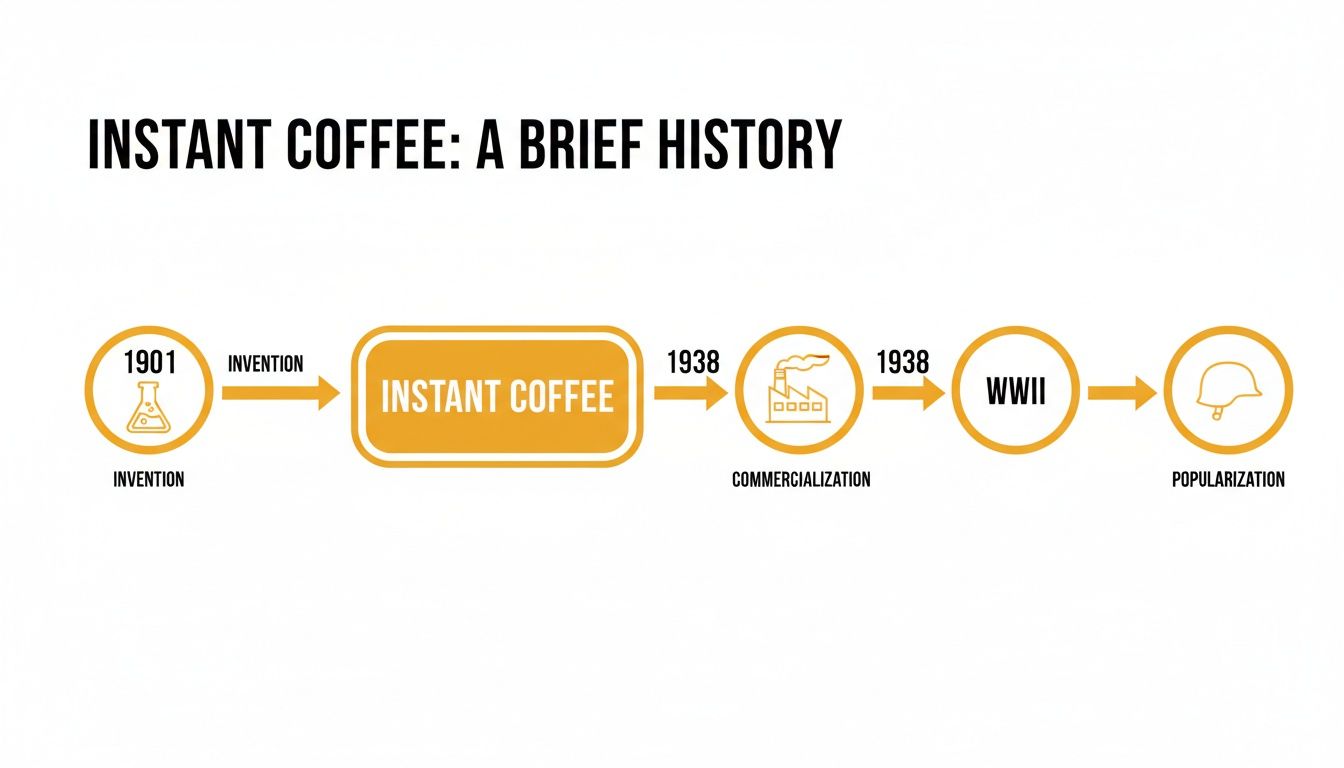
This journey from early experiments to modern techniques shows just how far instant coffee has come.
Comparing Spray-Drying vs Freeze-Drying Methods
So, how do the two methods stack up? The choice between spray-drying and freeze-drying has a direct and noticeable impact on what you end up tasting in your cup. Here’s a quick breakdown of the key differences.
| Feature | Spray-Drying | Freeze-Drying |
|---|---|---|
| Process | Hot air (~480°F) evaporates water from a fine coffee mist. | Frozen coffee is placed in a vacuum, turning ice directly into vapor. |
| Flavor Profile | Often flat, one-dimensional, sometimes with burnt or bitter notes. | Complex, vibrant, and much closer to the original brewed coffee. |
| Aroma | Significantly diminished due to high heat destroying delicate oils. | Well-preserved, retaining the coffee's original aromatic character. |
| Texture | Fine, uniform powder. | Irregular, porous crystals or granules. |
| Cost | Lower production cost, resulting in a cheaper final product. | Higher production cost, leading to a more premium price point. |
Ultimately, while both methods produce coffee that dissolves in water, freeze-drying is the clear winner for anyone who prioritizes taste. It’s the difference between a coffee that’s just convenient and one that’s genuinely delicious.
Instant Coffee vs Brewed Coffee: The Ultimate Face-Off
So, what's the real story when you put a quick cup of instant coffee up against a classic, fresh brew? For years, this wasn't even a fair fight. Brewed coffee was the undisputed champ of flavor, while instant was that dusty jar you only touched in emergencies.
But things have changed. A lot.
This isn't about crowning one winner anymore. It’s about understanding the trade-offs and appreciating what each one does best. Thanks to some serious innovation, modern instant coffee has closed the quality gap in a big way, making a genuinely delicious cup that challenges all those old, stale assumptions.
The Flavor and Aroma Showdown
Let's be honest—a meticulously prepared pour-over made with freshly ground beans will almost always have a more intricate and lively flavor profile. That's because the brewing process is designed to pull out a huge spectrum of delicate oils and aromatic compounds. It’s what gives you those layers of flavor, from bright fruity notes to rich, chocolatey undertones. The whole ritual—the smell of blooming grounds, the steam—is a huge part of the experience.
Historically, instant coffee just couldn't hang. The traditional production methods, especially the high-heat spray-drying process, essentially cooked away all those beautiful, subtle compounds. What you were left with was often a flat, sometimes bitter flavor that just screamed "coffee" but lacked any real personality.
This is where premium, freeze-dried instant coffee flips the script. By gently removing the water at low temperatures, this method does a fantastic job of preserving the coffee's original character. You can now find specialty instant coffees with clear tasting notes of cherry, citrus, or nuts—flavors once reserved for the brewed coffee world. It might not capture 100% of the original magic, but it gets you remarkably close.
Decoding the Caffeine Content
A lot of people think instant coffee is the weaker sibling, but the caffeine levels can be surprisingly similar. It all comes down to how you measure and mix it.
Here’s a general breakdown:
- Brewed Coffee: A typical 8-ounce cup of drip coffee lands somewhere between 70 and 140 milligrams of caffeine, averaging out around 95 mg.
- Instant Coffee: A teaspoon of instant coffee dissolved in an 8-ounce cup usually contains between 30 and 90 milligrams of caffeine.
The huge range comes from the type of beans used (Robusta has way more caffeine than Arabica) and, more importantly, how strong you make it. If you like a bold cup and use a heaping spoonful of instant, you could easily match—or even surpass—the caffeine kick of a standard brewed coffee.
The biggest takeaway here is control. With instant coffee, you're the master of your caffeine destiny. Need a little less? Use a smaller scoop. Need an extra jolt? Add a bit more. It's much simpler than trying to tweak a drip machine on the fly.
The Real Difference is Convenience
This is where instant coffee is the undisputed champion. It's the reason it's stuck around and is now thriving. The convenience is just on another level. You don’t need any special gear—no grinder, filters, or press. All you need is a mug and some hot water. And cleanup? What cleanup?
To get a full picture of how these two coffees diverge from the very beginning, our article comparing instant coffee vs ground coffee breaks it all down.
Just think about how it fits into real life:
- The Busy Professional: You’ve got five minutes between calls. You can have a genuinely great cup of coffee in your hands in less than 60 seconds.
- The Outdoor Adventurer: Lugging a French press on a hike is a pain. A few lightweight packets of quality instant coffee? No brainer.
- The Mid-Afternoon Slump: You need a quick boost at your desk without derailing your workflow for a coffee run. Instant is there when you need it.
Brewed coffee is a wonderful ritual. Instant coffee is an elegant solution. While the first offers a deeper sensory journey, the second delivers an excellent coffee experience without the hurdles of time and equipment. Thanks to modern production, you finally don't have to sacrifice taste for speed.
How to Choose a High-Quality Instant Coffee
Staring at the coffee aisle trying to find a great instant coffee can feel like a guessing game. But once you know the right signals to look for on the label, you can easily tell the good stuff from the rest. It’s all about learning to read the story the packaging is telling you.
The first clue is how the coffee was made. As we talked about earlier, instant coffee is created using either spray-drying or freeze-drying. Brands that genuinely care about flavor will almost always use freeze-drying. It’s a much gentler, low-temperature process that does a fantastic job of preserving the coffee’s delicate aromatic compounds. If you see “freeze-dried” on the label, that’s a huge green flag.
Decoding the Coffee Bean Type
Just like with the bags of whole beans you see at a café, the type of bean used in your instant coffee is a game-changer. There are two main players on the field, and knowing the difference will help you find a coffee you’ll actually enjoy drinking.
-
100% Arabica: Grown at high altitudes, these are the beans specialty coffee is known for. They deliver complex, aromatic flavors—think notes of fruit, flowers, and caramel with a pleasant, bright acidity. If a smooth, nuanced, and less bitter cup is what you're after, always look for "100% Arabica."
-
Robusta Blends: Robusta is a much hardier bean and packs a serious punch, often with double the caffeine of Arabica. It produces a bold, strong, and intense flavor that can sometimes come across as harsh or even a little rubbery. To keep costs low and caffeine high, most mass-market instant coffees rely on Robusta or a blend.
For a taste that comes close to a freshly brewed cup from your favorite coffee shop, a 100% Arabica instant coffee is the way to go, hands down.
Reading Beyond the Marketing Hype
So, you’ve checked for freeze-drying and 100% Arabica beans. The final clues are in the ingredients list and any certifications on the package. This is where you can spot any red flags and confirm a brand’s commitment to quality.
The best instant coffees have a simple, clean ingredients list: 100% coffee. That’s it. Be on the lookout for products loaded with added sugars, artificial flavors, powdered milk, or other fillers. These are almost always used to cover up the taste of cheap, low-grade beans.
A truly high-quality instant coffee doesn't need anything extra to taste good. The flavor should come from the coffee bean itself, not from additives.
Finally, check for certifications that matter to you. A USDA Organic seal, for example, tells you the coffee was grown without synthetic pesticides or fertilizers. That means a cleaner cup for you and a healthier planet. Certifications like Fair Trade also show that the farmers who grew the beans were paid a fair price for their hard work.
This commitment to transparency is exactly what brands like Cartograph Coffee are all about—using only 100% organic, freeze-dried Arabica beans. By learning to read the labels, you can pick a convenient coffee without ever having to compromise on taste or quality.
Making the Perfect Cup of Instant Coffee

So, you’ve picked up some high-quality, freeze-dried instant coffee. Great choice. Now comes the fun part: brewing it right. While speed is the name of the game, a couple of small adjustments can take your cup from just "good enough" to genuinely fantastic, coaxing out all the rich, aromatic notes hiding in those crystals.
Forget what you’ve always done—dumping crystals in a mug and hitting them with boiling water. A little more intention is all it takes to turn a quick caffeine hit into a truly satisfying coffee experience.
Master the Basics for a Better Brew
The single biggest mistake people make? Using water that’s way too hot. Pouring boiling water directly over instant coffee scorches the granules, which is what creates that bitter, harsh flavor that gives instant a bad rap.
For a smoother, more balanced cup, you want your water between 195°F and 205°F (90°C to 96°C). The easiest way to nail this without a special kettle is to simply bring your water to a boil, then let it rest for about 30 to 60 seconds before you pour. It’s a tiny bit of patience that pays off big time in flavor.
Next up is the coffee-to-water ratio. A solid starting point is one teaspoon of instant coffee for every six ounces of water. Think of this as a baseline, not a rule. If you like your coffee stronger, add a little more; if you prefer it milder, use a bit less. Adjust until you find what tastes perfect to you.
Here's a pro tip for a completely smooth, clump-free brew: Start by mixing your coffee crystals with just a splash of cold or room-temperature water. Stir until it forms a thick, syrupy paste. Then add your hot water. This little trick ensures every granule dissolves perfectly.
Get Creative with Your Instant Coffee
That jar of instant coffee on your shelf is more than just a fast track to a hot drink—it's a surprisingly versatile ingredient. Once you've got the basic brew down, a whole world of coffee-based creations opens up right in your kitchen.
Here are a few ideas to get you started:
- Quick Iced Latte: Dissolve one or two teaspoons of instant coffee in a tiny bit of hot water. Pour this coffee concentrate into a glass full of ice, top it off with your favorite milk, and give it a stir. Sweeten if desired.
- Whipped Dalgona Coffee: This viral trend is popular for a reason—it’s delicious and simple. In a bowl, combine equal parts instant coffee, sugar, and hot water. Use a hand mixer to whip it until it forms glossy, stiff peaks. Spoon this fluffy creation over a glass of iced milk.
- Energizing Coffee Smoothie: Add a teaspoon of instant coffee granules straight into the blender with your go-to smoothie ingredients—think banana, protein powder, and almond milk—for a powerful morning boost.
- A Baker's Secret Weapon: Dissolving a small amount of instant coffee in your wet ingredients can seriously deepen the flavor of anything chocolate. It won't make your brownies or cakes taste like coffee, just more intensely chocolatey.
By putting these simple techniques into practice, you can ensure every cup of instant coffee you make is the best it can be. It's proof that convenience doesn't have to mean compromising on quality.
Why Premium Instant Coffee Is on the Rise
Let's be honest: for a long time, instant coffee was seen as a last resort. That dusty jar in the back of the cupboard was for emergencies only. But those days are long gone. A quiet revolution has been brewing, driven by our modern lives that demand both quality and convenience, with no room for compromise.
This shift makes perfect sense. With the boom in remote work, people want a fantastic cup of coffee between Zoom calls without the whole ceremony of grinding beans and cleaning a French press. And as more of us head outdoors for everything from weekend camping trips to serious backcountry adventures, we need a lightweight, no-fuss coffee that actually tastes good. We're just not willing to choke down a subpar cup anymore simply because we're away from our kitchens.
A Market Responding to Modern Needs
This isn't just a small trend—it's a massive global movement. The instant coffee market was recently valued at an incredible USD 80.2 billion and is expected to climb to USD 110.28 billion by 2030. That kind of growth is fueled by a new wave of coffee lovers who appreciate efficiency but aren’t about to give up the coffee culture they enjoy. If you're curious about the numbers, you can dive into the full research on Grand View Research.
At its heart, this surge reflects a broader consumer desire for products that fit seamlessly into their lives. People want ethically sourced, high-quality options that are also incredibly practical. This is where premium instant coffee shines, meeting the demand for an exceptional product that is ready in seconds.
The broader movement toward specialty foods and gourmet products is a huge part of this story. You can see this focus on premium ingredients and transparent sourcing in the selections offered by retailers like IFM Gourmet products. This kind of conscious consumerism has completely raised the bar for what instant coffee can and should be.

The Future of Convenient Coffee
The new generation of instant coffee is built on a simple, powerful promise: great coffee, anywhere, anytime. By pairing superior, 100% Arabica beans with sophisticated freeze-drying methods, brands are finally delivering a product that lives up to that promise. The focus has shifted from mass production to mindful creation, with an emphasis on organic ingredients and sustainable practices.
This is the very principle Cartograph Coffee was founded on. We saw a clear need for a coffee that could keep up with busy lives without forcing anyone to settle on taste or ethics. By choosing only the best organic, freeze-dried beans, we make sure every single cup is a moment of pure coffee joy—whether you're at your desk, on a mountain trail, or just enjoying a quiet morning at home.
The future of coffee is convenient, delicious, and ready for whatever your day holds.
Ready to experience the new standard in instant coffee? Discover Cartograph Coffee and enjoy a perfect cup, wherever your adventures take you. Shop our organic instant coffee today.