Let's cut right to it. The ideal coffee pot ratio—what a lot of us in the coffee world call the 'Golden Ratio'—hovers between 1:15 and 1:18.
What does that mean in plain English? For every 1 part of coffee, you'll want to use 15 to 18 parts of water. If you're using scoops or spoons, that translates roughly to 1 to 2 tablespoons of ground coffee for every 6 ounces of water.
Your Quick Guide To The Perfect Coffee Pot Ratio
Think of your coffee-to-water ratio as the recipe for your perfect cup. It's a lot like baking a cake—the right balance of ingredients makes all the difference. Too much coffee and you get a brew that's sludgy and bitter. Too little, and it's watery and disappointing. Nailing this balance is the single biggest leap you can take toward making incredible coffee at home, every single time.
This guide is designed to give you a solid, actionable starting point. We’ll give you the numbers you need to immediately improve your next brew before we get into the finer points of why it all works. The idea is to stop guessing and start brewing with real confidence.
Understanding The Golden Ratio
The "Golden Ratio" isn't just a catchy phrase; it's the standard championed by the Specialty Coffee Association (SCA) for a reason. It represents that sweet spot where you extract all the good stuff from the beans—the sweetness, the complex flavors, the pleasant acidity—without pulling out the harsh, bitter compounds that can ruin a perfectly good morning.
This visual helps break down how it all works.
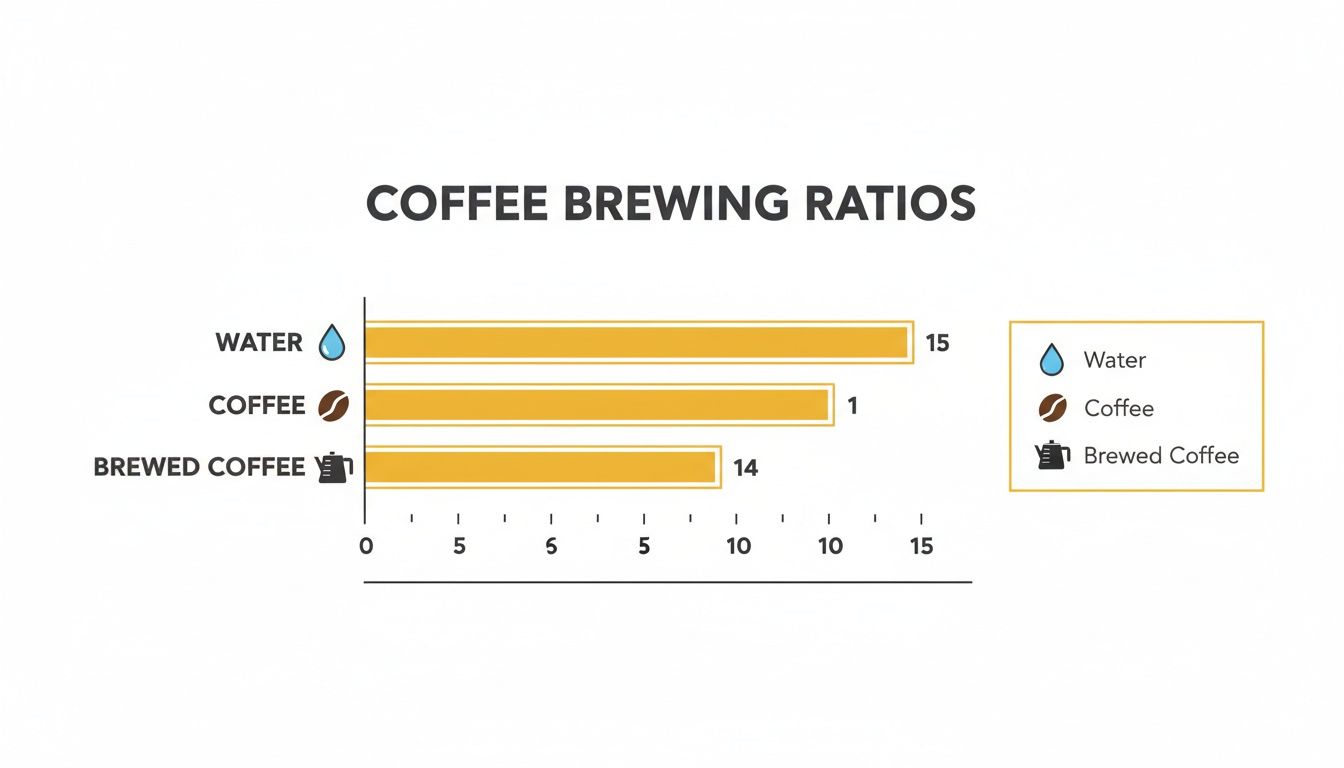
As you can see, not all the water you pour in makes it to your cup. The coffee grounds themselves soak up a surprising amount, which is why starting with the right amount of water is so crucial to hitting your final target.
Why Start With A Ratio?
Using a consistent ratio takes the guesswork out of brewing coffee. It's the key to making sure your coffee tastes just as good whether you're brewing a single mug for yourself or a full 12-cup pot for guests. It’s simply a more reliable method than just scooping and hoping for the best.
To get a better handle on how these measurements apply to your daily routine, you can explore our guide on the ideal grams of coffee per cup.
Why This Ratio Is Your Most Important Brewing Tool
Think of the coffee pot ratio as the master recipe for your perfect cup. It’s a lot like baking a cake—if your measurements for flour, sugar, and liquid are off, the result is a disaster. The same principle applies to coffee.
Get the proportion of coffee to water wrong, and you'll know it immediately. Stray too far one way, and you're left with a brew that's dense, bitter, and completely overpowering. Go the other direction, and you get a weak, watery mug of disappointment. This simple measurement is the single most powerful tool you have for controlling flavor.
It's about more than just making your coffee stronger or weaker; it’s about dialing in the science of extraction. The whole point of brewing is to pull the right amount of flavorful compounds from the coffee grounds into your water.
The Science Of Extraction Simplified
Coffee brewing is a delicate balancing act. When you nail the coffee-to-water ratio, you sidestep the two most common brewing mistakes:
- Under-extraction: This is what happens when you have too much water or the brew time is too short. The water rushes through the grounds without grabbing enough of the good stuff, leaving you with a coffee that tastes sour or overly acidic.
- Over-extraction: This is the opposite problem. Too little water for your coffee dose means the water hangs around for too long, pulling out harsh, bitter compounds. The result? A brew with a burnt, unpleasant aftertaste.
Mastering your coffee pot ratio puts you in the driver's seat. It turns a simple morning ritual into a craft you can get right every single time, ensuring every pot you brew is a great one.
A Cornerstone In A Growing Market
Understanding this ratio is more important than ever. Projections show that the at-home coffee market is set to explode into a $96.45 billion global industry by 2025, accounting for a massive 20% of the entire coffee market.
For the millions of us brewing at home, sticking to a standard 1:16 to 1:18 ratio is the secret to getting the best flavor out of our beans. This is especially true when you consider that Americans average 3.1 cups daily, and recent U.S. data shows that 45% of consumers drank a specialty coffee just yesterday. Getting this fundamental step right has never been more relevant.
You can dive deeper into these global coffee consumption trends to see just how much brewing habits are changing around the world.
How To Measure Your Coffee And Water Like A Pro
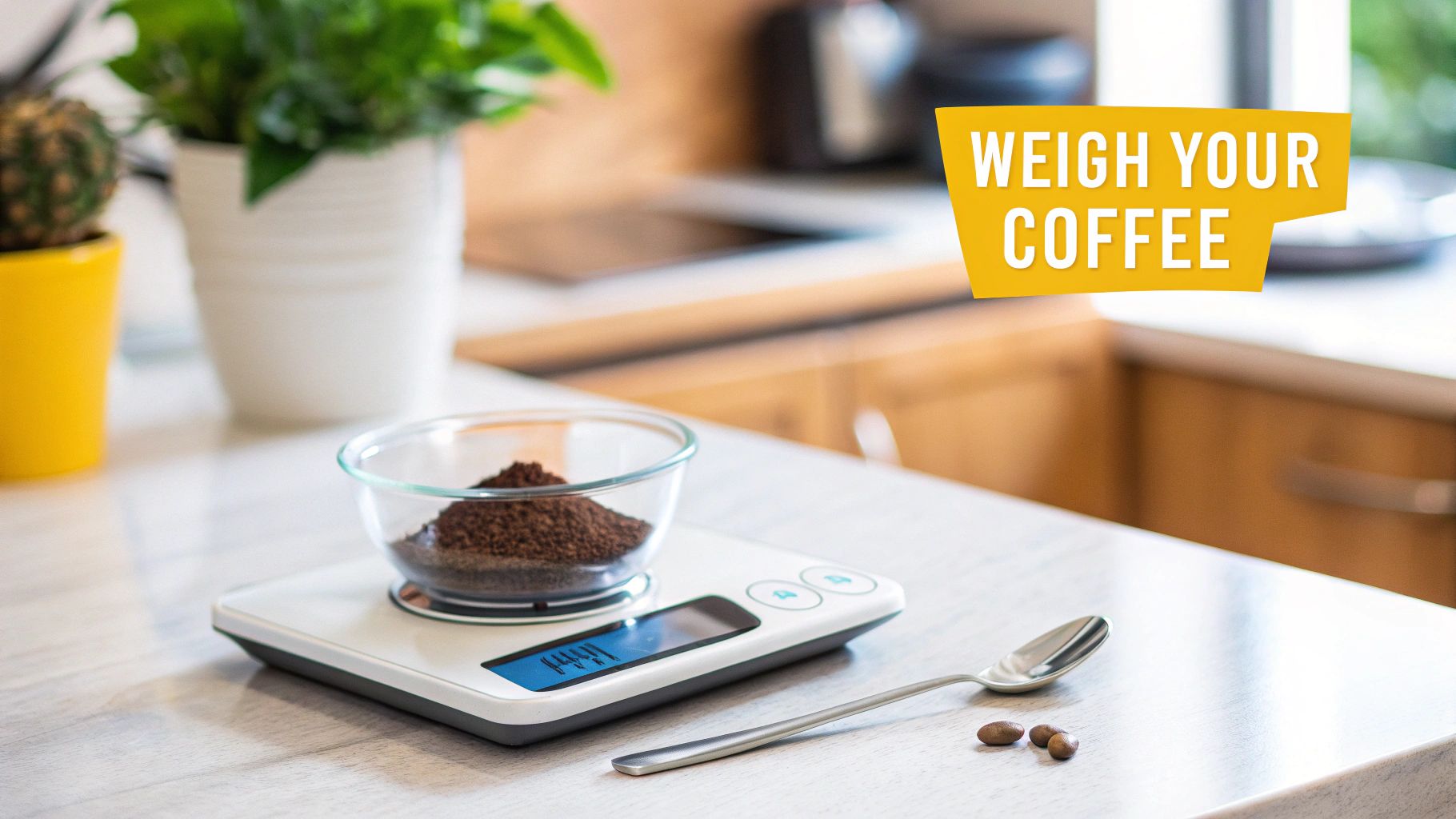
Knowing the ideal coffee pot ratio is one thing, but actually nailing it every morning? That's what separates a decent cup of coffee from a truly fantastic one. The secret to consistently delicious coffee isn't some complicated trick; it's just about measuring your ingredients properly.
Think of it as the difference between stumbling upon a great brew by accident and becoming your own personal barista who gets it right every single time. There are a few common ways to measure your coffee, each with its own quirks. Let's walk through them so you can find the best fit for your routine.
The Gold Standard: A Kitchen Scale
Want to know the single best way to improve your coffee game? Get a digital kitchen scale. Measuring by weight (grams) is hands-down the most accurate and reliable method, and it’s what every professional barista relies on.
Coffee beans aren't all created equal—they vary in size and density depending on where they're from and how they're roasted. A scale cuts through all that variability. It ensures that 20 grams of a light, fruity Ethiopian bean is the exact same amount of coffee as 20 grams of a dark, earthy Sumatran bean. Spoons and scoops simply can't offer that kind of precision.
The Old Faithful: A Coffee Scoop
Most of us have seen a coffee scoop—it’s that little plastic spoon that often comes tucked inside a new coffee maker. The standard scoop is meant to hold about two tablespoons of ground coffee, which translates to roughly 10 grams. It's convenient, for sure, but it’s not foolproof.
The problem with scoops is that the actual amount of coffee you get can be a bit of a moving target. Here’s why:
- Grind Size: Finely ground coffee is denser and packs in tighter, so a scoop will hold more coffee by weight than a coarse grind.
- Roast Level: Dark roast beans are lighter and less dense than light roasts, meaning a scoop of dark roast actually weighs less.
- The "Heaping" Factor: Is it a level scoop or a heaping one? That small difference can easily throw your ratio off by a few grams.
Using a scoop is definitely a step up from just guessing, but it’s a far cry from the consistency you get with a scale.
The "In a Pinch" Method: A Tablespoon
If you're left with no other option, you can always reach for a regular tablespoon from your kitchen drawer. It's the most accessible tool, but it's also the least accurate. A standard measuring tablespoon holds around 5 grams of ground coffee, but that can vary wildly.
All the issues that make coffee scoops inconsistent—grind size, roast level, leveling—are even bigger problems with a tablespoon.
To really see how much these volume measurements can differ, check out our guide on how many teaspoons you need for coffee. It's a real eye-opener.
A tablespoon will do the job when you're in a bind, but if you rely on it every day, you’ll find it tough to get that perfect, repeatable cup. Honestly, if you’re looking to make a real difference in your daily brew, a simple digital scale is the best investment you can make.
Measurement Methods Comparison
To help you decide which tool is right for you, here’s a quick rundown of the pros and cons of each measurement method.
| Measurement Method | Pros | Cons | Best For |
|---|---|---|---|
| Digital Scale | Extremely precise and consistent. Works for any grind or roast. | Requires a small investment and an extra step. | Anyone serious about brewing consistently great coffee at home. |
| Coffee Scoop | Convenient, easy to use, and often comes free with coffee makers. | Inaccurate due to grind size, roast level, and packing. | Casual coffee drinkers who value convenience over precision. |
| Tablespoon | Readily available in every kitchen. No extra equipment needed. | The least precise method, leading to very inconsistent results. | Coffee emergencies when no other tools are available. |
Ultimately, the best method is the one that fits your lifestyle and helps you enjoy your coffee the most. But for that truly exceptional cup, a scale is your best friend.
Applying The Ratio To Any Coffee Pot Size
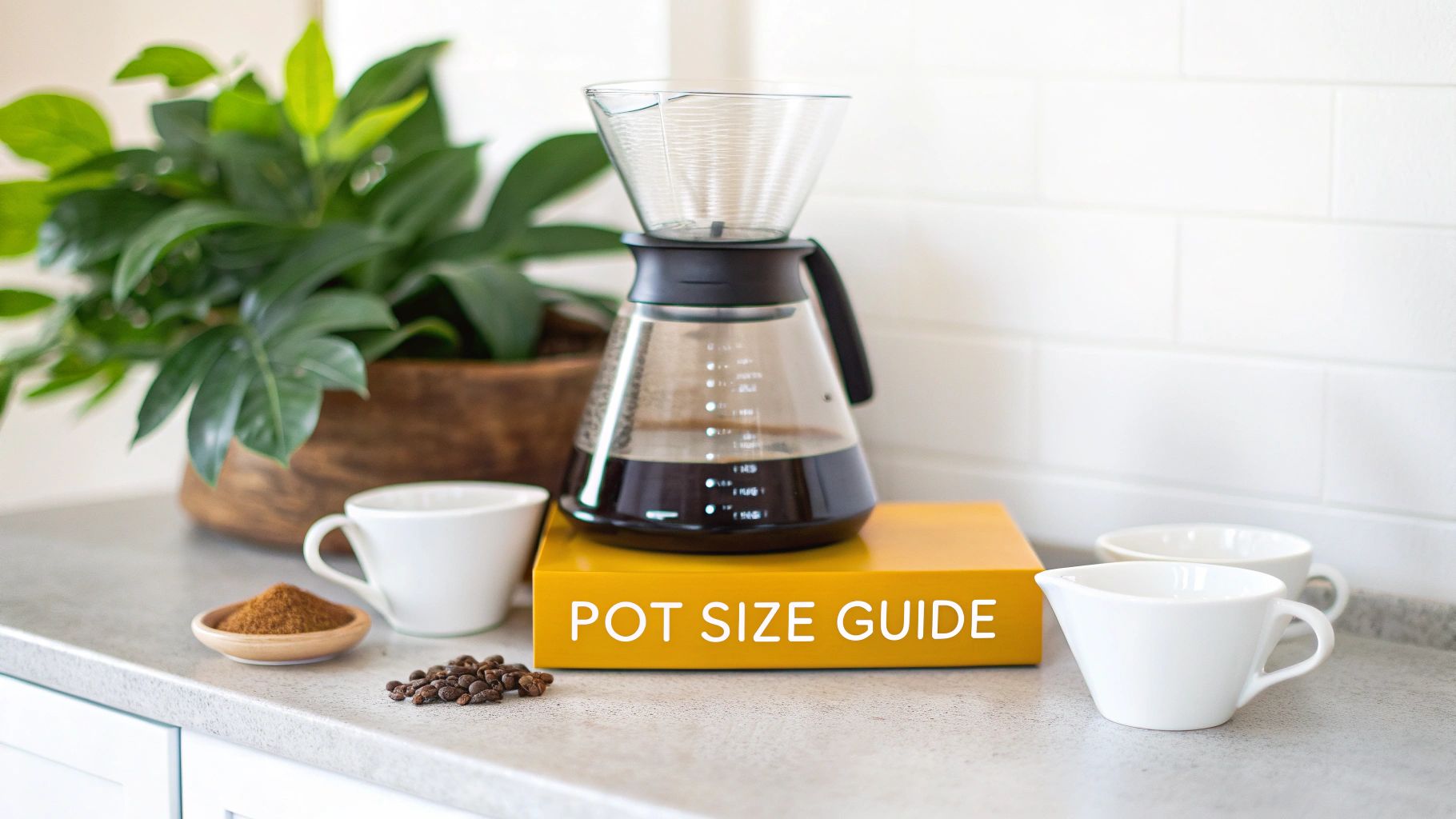
Alright, we've talked theory, but now it's time to put the coffee pot ratio to work on the machine that's actually sitting on your kitchen counter. This is where we turn those numbers into your delicious morning reality. Let's break down the exact measurements you’ll need for the most common brewer sizes and take all the guesswork out of it.
First things first, we need to clear up a massive point of confusion. A "cup" on your coffee maker is not the same as a standard 8-ounce measuring cup. For most manufacturers, a single "cup" is just 5 or 6 ounces of water. This little detail is the number one reason a "12-cup" pot never seems to serve more than a few people. Always check your machine's manual if you can, but for these examples, we'll stick with the industry-standard 6-ounce cup.
Ratios For Common Pot Sizes
Here are some practical starting points for the most popular automatic drip coffee makers out there. We're using the 1:17 ratio as our guide—that's about 1 tablespoon of coffee for every 6 ounces of water—which gives you a balanced, flavorful brew every time.
For a 4-Cup Coffee Pot:
- Water: 24 ounces (fill to the 4-cup line)
- Coffee Grounds: 4 tablespoons (or 2 standard scoops)
- By Weight: 21 grams of coffee to 700ml of water
For an 8-Cup Coffee Pot:
- Water: 48 ounces (fill to the 8-cup line)
- Coffee Grounds: 8 tablespoons (or 4 standard scoops)
- By Weight: 42 grams of coffee to 1.4 liters of water
Think of these recipes as your blueprint for a consistently great pot of coffee. Following them will help you steer clear of a brew that’s watery and weak or one that's way too strong.
Measurements For Larger Brewers
Need to brew for a full house or a busy office? The same rules apply, just on a bigger scale. Sticking to the coffee pot ratio is what keeps you from just tossing in extra grounds and hoping for the best—a classic recipe for a bitter, over-extracted mess.
For a 10-Cup Coffee Pot:
- Water: 60 ounces (fill to the 10-cup line)
- Coffee Grounds: 10 tablespoons (or 5 standard scoops)
- By Weight: 53 grams of coffee to 1.75 liters of water
For a 12-Cup Coffee Pot:
- Water: 72 ounces (fill to the 12-cup line)
- Coffee Grounds: 12 tablespoons (or 6 standard scoops)
- By Weight: 63 grams of coffee to 2.1 liters of water
The idea of a scalable coffee ratio isn't new; it has evolved from 18th-century Turkish brewing methods all the way to today's drip standards. This underlying consistency is what allows both home brewers and pro baristas to nail the flavor.
This foundational ratio of roughly 60 grams of coffee per liter (a 1:16.7 ratio) is a true cornerstone of the modern coffee world. It influences everything from professional cupping protocols to the daily habits of the 66% of Americans who drink coffee every single day. If you're curious, you can learn more about the global statistics driving coffee trends.
With these examples in hand, you’re ready to get that perfect extraction, whether you're brewing for yourself or a crowd.
Brewing Great Coffee In The Great Outdoors
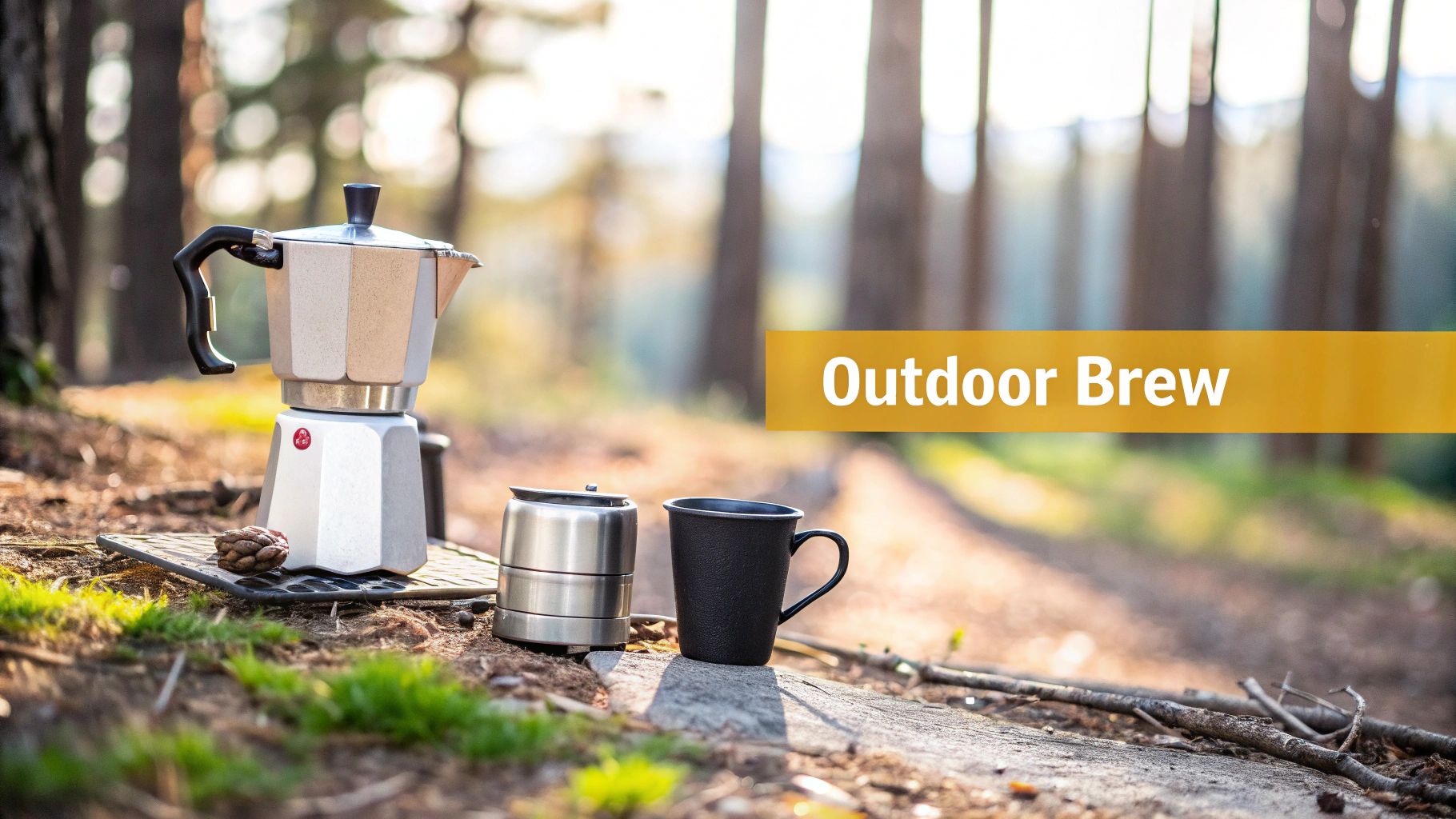
Let's be honest, that first cup of coffee hits different when you're out in the wild. But lugging a digital scale and your entire home coffee bar into the woods isn't exactly practical.
The good news? You don't have to. The same coffee pot ratio principles we use in the kitchen work just as well by the campfire. The trick is simply to adapt your measurements for a more rugged, on-the-go setup.
Adapting Ratios For Common Camping Methods
Without a scale, your best friend is a simple scoop or tablespoon. The key is to do a tiny bit of homework before you leave. Figure out roughly how many grams your favorite coffee scoop holds. If your go-to home recipe calls for 30 grams of coffee and you know your scoop holds 10 grams, then you're set—just pack three level scoops.
This little bit of prep work pays off big time when you're trying to make a decent cup at a chilly campsite.
- Percolator: These old-school pots have a reputation for making bitter, over-cooked coffee, but they don't have to. The secret is to use a slightly coarser grind and lean toward a 1:18 ratio. A little less coffee for the amount of water helps counteract the constant recirculation, keeping things smooth.
- French Press: A camping classic for a reason. For that rich, full-bodied brew you know and love, stick close to a 1:15 ratio. Since the grounds are fully immersed, that extra bit of coffee is what gives it that signature robust flavor.
- Pour-Over: Lightweight, simple, and clean. A plastic or silicone pour-over cone is a backpacker's dream. Keep your ratio right around 1:16 or 1:17, just like you would at home. Pro tip: pre-measure your beans into individual baggies for each day to make it brain-dead simple.
Want to dive deeper into brewing in the wild? Check out our complete guide on the best way to make coffee while camping.
The Ultimate Convenience: Instant Coffee
For those who prioritize pack weight and simplicity above all else, you just can't beat a high-quality instant coffee. It completely removes the need for grinders, filters, and measuring. All you need is hot water.
And we're not talking about that dusty jar in your grandma's cupboard. With a premium instant like Cartograph Coffee, you get genuine café-level flavor without any of the fuss or extra gear.
The classic coffee pot ratio—typically around 1 to 15—has been a cornerstone of brewing since the mid-20th century. This same principle allows Cartograph Coffee to blend convenience with exceptional flavor, upholding a tradition that fuels millions of daily coffee drinkers.
The "ratio" for great instant coffee couldn't be easier. Just follow the directions on the packet, which is usually one packet or 1-2 teaspoons for every 8 ounces of water. You can fill a thermos with hot water in the morning and be ready for a perfect cup anytime, anywhere. It's proof that you never have to choose between convenience and great taste.
Got Questions About Coffee Ratios? Let's Brew Some Answers.
Even when you think you have the perfect recipe, a few questions always pop up when you're dialing in your daily brew. Honestly, the path to a consistently great cup of coffee is all about those little tweaks and troubleshooting moments. We've gathered the most common questions about the coffee pot ratio right here to help you fine-tune your technique with confidence.
Think of this as the final polish on your brewing skills. Nailing these details is what separates a pretty good cup of coffee from your perfect cup of coffee.
My Coffee is Too Weak or Too Strong—What Do I Do?
This is easily the most common issue, and thankfully, it's a simple fix. If your coffee just isn't hitting the spot, your first move should always be to adjust the amount of coffee you're using, not the water.
- Is your coffee tasting weak and watery? This is a classic sign of under-extraction. The easiest fix? Add a bit more coffee. If you were using a 1:17 ratio, try bumping it up to a slightly stronger 1:16. That small adjustment is often all it takes to bring out the body and flavor you're looking for.
- Is it too strong or unpleasantly bitter? That's over-extraction talking. While your first instinct might be to just add more water, a better approach is to use slightly less coffee. Shifting from a 1:16 ratio down to a milder 1:17 or 1:18 can smooth out that harshness beautifully.
Pro Tip: Only ever change one thing at a time. By tweaking just the coffee dose first, you can figure out the real problem without messing with your total brew time or water volume. It makes it so much easier to pinpoint what’s working.
Does the Roast Level Affect My Ratio?
You bet it does. The roast level changes the physical density of the bean and how easily it releases flavor, so a single ratio might not work perfectly for every bag of coffee you buy.
Lighter roasts are harder and denser, meaning their flavor is a bit more locked up. They often need a little more help, so a stronger ratio (think 1:15 or 1:16) can ensure you're getting a full, balanced extraction. On the flip side, dark roasts are much more porous and give up their flavor in a flash. Using a milder ratio (like 1:17 or 1:18) is a great way to keep them from tasting overly bitter or smoky.
How Does Grind Size Play Into All This?
Grind size is the silent partner to your coffee pot ratio. If you get one wrong, it can throw the whole thing off. A finer grind creates a ton of surface area, letting water pull out flavor much, much faster. If you stick with the same ratio but suddenly grind finer, you’re almost guaranteed a bitter, over-extracted cup.
To fix this, you'd want to use a little less coffee (a milder ratio) or shorten the brew time. Conversely, a coarser grind has less surface area and extracts flavor more slowly. It might need a stronger ratio (more coffee) to avoid tasting weak and sour. The real secret is to find a grind size that works for your brewer and stick with it. It’s all about building a consistent, repeatable process for a great cup, every single morning.
Ready to take the guesswork out of your on-the-go coffee? Cartograph Coffee offers premium, organic instant coffee that delivers exceptional flavor without the need for scales or grinders. Just add hot water for a perfect cup, every time, anywhere your adventures take you.