Let's get right to it. For a standard 8-ounce cup of coffee, the simplest answer is to use 1 to 2 teaspoons. If you like a lighter, more delicate coffee, stick with one. For a stronger, bolder flavor that really wakes you up, go with two.
This is a fantastic starting point, but the real magic happens when you start tweaking that ratio to match your personal taste and the specific coffee you're brewing.
Your Quick Guide to Coffee Ratios

Learning how many teaspoons of coffee to use is the first real step toward becoming your own favorite barista. It stops you from just guessing and hoping for the best, turning your morning routine into a reliable process for a great cup, every single time.
While that “1-2 teaspoons” rule is a solid foundation, a few key things can change the final result. Think of it like cooking—you wouldn't use the same amount of salt in every dish. The perfect amount always depends on your ingredients and how you want it to taste.
For coffee, those key variables are:
- Coffee Type: Instant coffee is highly concentrated, so you need less. Ground coffee is much bulkier and requires a bit more.
- Strength Preference: Are you in the mood for a gentle morning sip or a powerful, full-bodied brew?
- Mug Size: It seems obvious, but a bigger mug needs more coffee to avoid tasting watery.
Understanding the Basics
With the world drinking an estimated 2.25 billion cups of coffee every day, it’s clear that getting this simple measurement right is a big deal. For a bit of context, just one teaspoon of instant coffee can have anywhere from 9 to 27 milligrams of caffeine. Knowing your dose helps you stay within the FDA's recommendation of under 400 milligrams a day for most adults. You can read more about global coffee consumption trends and stats to see just how popular this ritual is.
To make things easy, here’s a quick reference table to get you started with a standard 8 oz cup.
Quick Guide How Many Teaspoons of Coffee Per Cup
This table is your cheat sheet for nailing the perfect brew in a standard 8 oz (240 ml) mug.
| Coffee Type | Light Strength | Medium Strength (Standard) | Strong Strength |
|---|---|---|---|
| Instant Coffee | 1 Teaspoon | 1.5 Teaspoons | 2 Teaspoons |
| Ground Coffee | 2 Teaspoons | 3 Teaspoons | 4 Teaspoons |
Pro Tip: Think of this chart as your starting point, not a strict rule. Don’t be afraid to adjust by a half-teaspoon up or down to find what tastes best to you. Making coffee should be a fun and personal ritual, not a rigid science experiment.
Later on, we'll get into exactly why these measurements are so different and how you can easily adjust them for any size of cup or travel mug.
Why You Can't Just Swap Instant and Ground Coffee
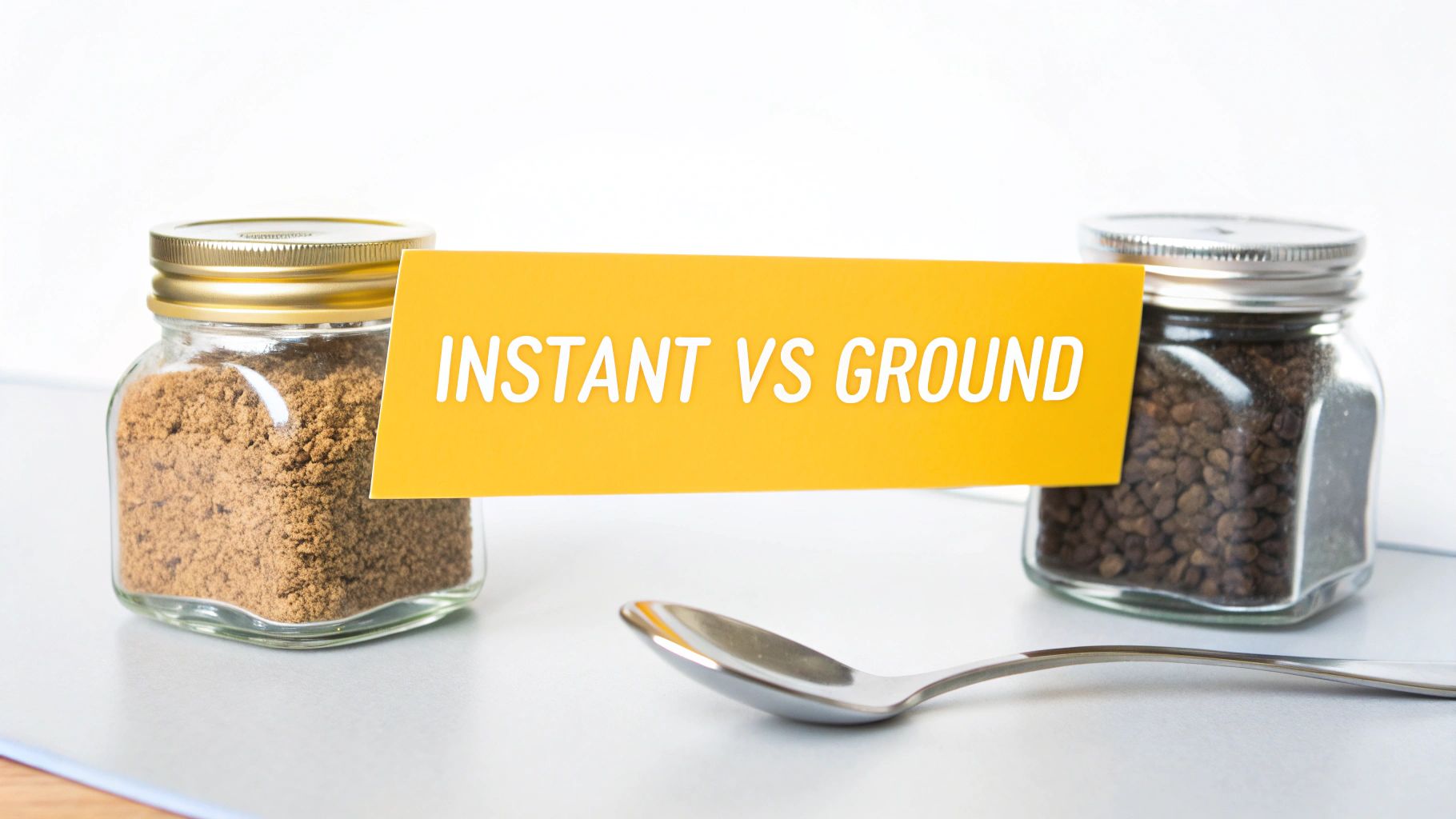
Ever wondered why the directions for instant and ground coffee are so wildly different? It’s a classic mistake to swap them one-for-one, but it’ll leave you with a brew that’s either disappointingly weak or far too strong. The secret isn't just about taste; it comes down to how each one is made and what you're actually doing when you add water.
Think of instant coffee as a concentrate. It’s coffee that has already been brewed and then dehydrated into tiny, soluble crystals. When you pour in hot water, you’re just rehydrating it—not actually brewing anything. Because it's so concentrated, a little goes a long way. That's why the standard is just 1-2 teaspoons per 8 oz cup. All that flavor is ready to dissolve in a flash.
Ground coffee, however, is a different beast entirely. It’s like using loose-leaf tea. The beans have been roasted and ground, but all their incredible flavors and oils are still trapped inside the solid particles. It’s your job to get them out.
The Art of Extracting Flavor from Ground Coffee
To pull those rich flavors out of ground coffee, you need way more coffee to start with. The water has to fully saturate the grounds to extract all the good stuff, and a single teaspoon just won't give it enough to work with.
This is where you hear baristas talk about the "golden ratio." While everyone has their favorite, it generally lands somewhere between 1:15 to 1:18. That's a fancy way of saying one part coffee to 15-18 parts water.
When you translate that from precise grams to simple kitchen spoons, it becomes clear why you need to be more generous. This is how we arrive at the standard recommendation of 2-4 teaspoons (or 1-2 tablespoons) for the same 8 oz cup.
Understanding this core difference is the key to brewing success. Instant coffee rehydrates, while ground coffee brews. One is a quick reconstitution, and the other is an active extraction process, which is why figuring out how many teaspoons for coffee is crucial for each type.
It's All About Density
The physical shape and weight matter, too. Instant coffee crystals are often light and airy, whereas ground coffee is much denser. So, a level teaspoon of ground coffee will always weigh more than a level teaspoon of instant. It’s another reason the measurements can't be treated the same.
For a deeper dive into getting that quick cup just right, check out our guide on how much instant coffee per cup. In the end, respecting what makes each coffee type unique is what separates a decent cup from a truly great one.
The Problem with Using a Teaspoon for Measurement
When you ask, "how many teaspoons for coffee," the first thing you probably do is reach for a spoon in your cutlery drawer. It's easy and seems logical, but here’s the truth: that spoon is the single biggest reason your coffee tastes different every day. It introduces a wild amount of guesswork that can sabotage a perfectly good brew before you even start.
Think about it like baking a cake. You wouldn't just grab a soup spoon to measure your flour and expect consistent results, right? You’d use a proper measuring spoon. Applying that same precision to your coffee is the key to unlocking cafe-quality flavor at home. Your average kitchen teaspoon just isn't a reliable tool for the job.
Why Your Spoon Is So Inconsistent
The issue really boils down to a few factors that stack up against you. Even knowing the standard size of a teaspoon doesn't help much when we're talking about the decorative, varied spoons in most people's kitchens.
Here are the main culprits sabotaging your daily brew:
- Size Variation: The spoons in your cutlery set were made for stirring sugar or eating yogurt, not for precise measurement. They come in all shapes and sizes, meaning your "teaspoon" could hold a lot more or less than mine.
- The Scoop Factor: How are you scooping? Is it a level scoop or a heaping scoop? A big, rounded heap of coffee can easily be 50-75% more than a level one. That’s a massive difference in strength.
- Grind Size Impact: This is a big one. The size of your coffee grounds completely changes how much you can fit in a spoon. Finely ground coffee packs down tightly, while coarse-ground coffee is fluffier with more air pockets. A teaspoon of fine espresso grounds will always weigh more than a teaspoon of coarse French press grounds.
The Takeaway: Using a random spoon from your drawer is like trying to follow a recipe when your measuring cups change size every morning. You might get lucky once in a while, but you'll never get that consistently delicious cup you're after.
The Ultimate Tool for Consistency
So, what's the fix? It’s simple: a digital kitchen scale.
Measuring your coffee by weight (in grams) instead of volume (in teaspoons) removes all that guesswork. A scale doesn't care if your scoop is rounded or flat, or if your grind is fine or coarse. 10 grams is always 10 grams.
This simple switch from volume to weight is the secret every single barista relies on. It guarantees the most fundamental part of your brew—the coffee-to-water ratio—is spot-on every single time. It puts you in the driver's seat, ensuring your coffee tastes exactly the way you want it, day in and day out.
How to Customize Your Perfect Brew
Alright, let's get past the basic recipes. This is where you take the wheel and become your own barista, crafting a cup of coffee that’s exactly how you like it. Whether you need a bold, punchy start to your morning or a lighter, more nuanced sip for the afternoon, learning to tweak your brew is the key.
It all boils down to one simple concept: the coffee-to-water ratio. By adjusting how much coffee you use for the same amount of water, you gain complete control over the final strength and flavor. It’s the secret to getting a consistently great cup every single time.
Adjusting for Strength
Ever made a cup that was a little too weak or way too strong? Fine-tuning that is easier than you think. It's not about randomly adding or removing a scoop; it's a deliberate adjustment.
- For a Stronger Brew: Simply add a little more coffee. If you normally use 2 teaspoons for your 8 oz cup, try bumping it up to 2.5 teaspoons. You're giving the water more coffee solids to extract flavor from, which creates a richer, more robust taste.
- For a Milder Brew: You guessed it—do the opposite. Dial it back to 1.5 teaspoons for the same 8 oz of water. This results in a lighter-bodied coffee where more delicate notes can shine through.
Here's the pro tip: only change one thing at a time. Keep your water volume, water temperature, and brew time the same. That way, you know for sure that any difference you taste is coming directly from the amount of coffee you used.
Scaling for Any Cup Size
So what happens when you switch from your standard 6 oz mug to that massive 16 oz travel tumbler? You can't just use the same two teaspoons and expect anything other than vaguely coffee-flavored water. The ratio needs to scale with the cup size.
A good rule of thumb to start with is 1 teaspoon of ground coffee for every 3 to 4 ounces of water. That’ll get you a solid, standard-strength brew.
Of course, "a teaspoon" isn't a perfect science. How you scoop, the spoon you use, and even the grind size can change how much coffee you're actually using. This is where a little visual aid comes in handy.
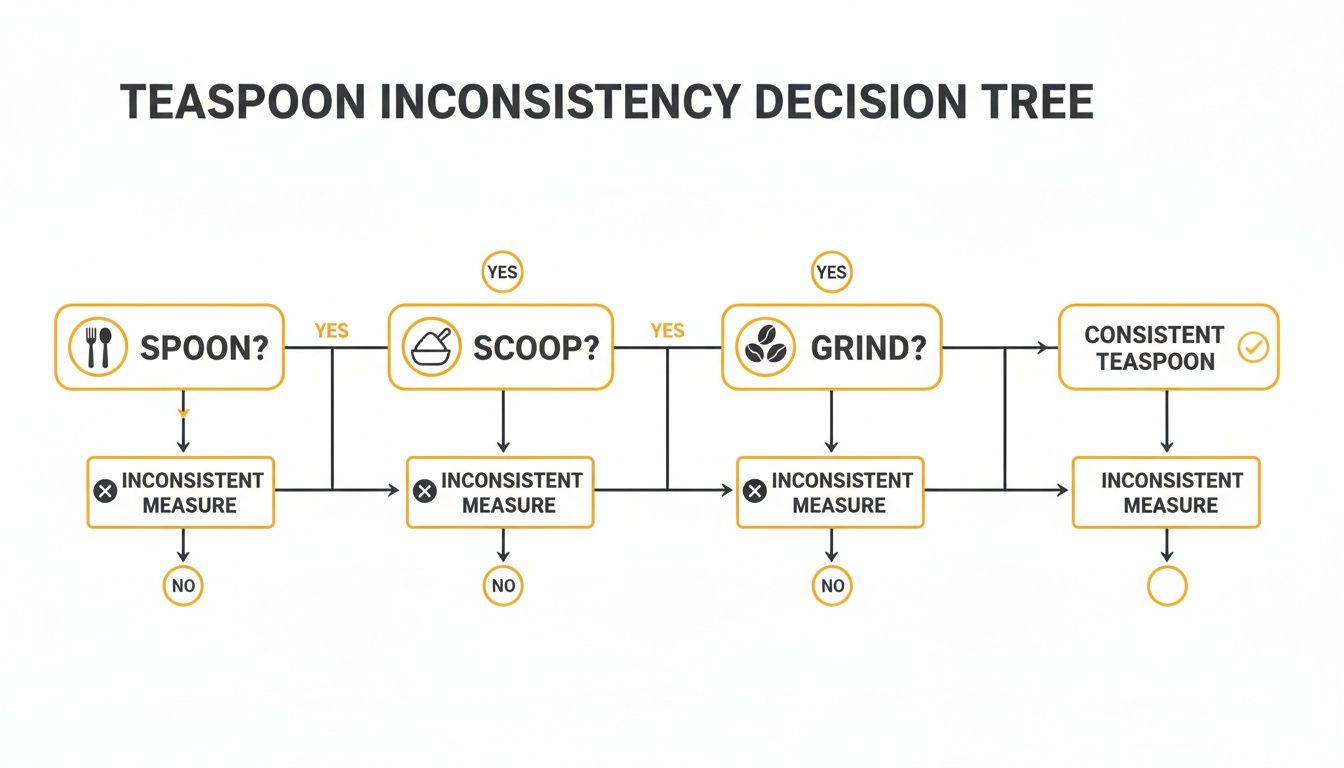
As you can see, all these little factors can throw off your consistency. That's why having a solid starting point is so important.
Coffee Measurement Guide for Common Cup Sizes
To take the guesswork out of it, here’s a quick-reference table. It gives you reliable starting points in both teaspoons and grams, whether you’re brewing a standard cup or need something with a little more kick.
| Cup Size (oz / ml) | Standard Strength (Teaspoons) | Standard Strength (Grams) | Strong Strength (Teaspoons) | Strong Strength (Grams) |
|---|---|---|---|---|
| 6 oz / 180 ml | 1.5 - 2 | 4 - 5 g | 2.5 | 6 g |
| 8 oz / 240 ml | 2 - 2.5 | 5 - 6 g | 3 | 7.5 g |
| 12 oz / 355 ml | 3 - 3.5 | 7.5 - 9 g | 4 | 10 g |
| 16 oz / 475 ml | 4 - 4.5 | 10 - 11 g | 5 | 12.5 g |
This chart is your new best friend for brewing on the fly. Use these numbers as your baseline, and don't be afraid to adjust them to find what tastes best to you.
Remember, the coffee grounds are just one part of the equation. Getting the water right is just as crucial for pulling out all those amazing flavors. To dive deeper, check out our guide on finding the best water temperature for brewing coffee to really elevate your game.
Making Great Coffee Anywhere

A fantastic cup of coffee shouldn't be limited to your kitchen counter. Whether you're a busy professional, a weekend camper, or an adventurer on the move, convenience is key—but that doesn't mean you have to sacrifice quality. The skill of knowing exactly how many teaspoons of coffee to use travels with you, guaranteeing a perfect cup no matter where you find yourself.
Think of this as your on-the-go brewing playbook. The same principles you've learned about ratios and strength are just as relevant at a campsite as they are at your desk. It’s all about adapting your technique to the tools you have on hand.
Quick Coffee for the Busy Professional
You’re at your desk, the clock is ticking, and you need a quality caffeine fix in under a minute. This is where high-quality instant coffee becomes your best friend. Forget the scale and fancy gear; all you need is your trusty measuring spoon for a fast, simple, and delicious brew.
- For a standard 8 oz mug: Use 1.5 to 2 level teaspoons of Cartograph Coffee.
- For a larger 12 oz mug: Bump that up to 2.5 to 3 level teaspoons.
This no-fuss method delivers a surprisingly rich and flavorful cup without breaking your focus. It’s proof that a satisfying coffee break can be both quick and incredibly easy, fitting perfectly into a packed schedule.
Brewing in the Great Outdoors
There's something special about making coffee while camping, but it definitely calls for a minimalist approach. With limited gear, your knowledge of coffee ratios becomes your most valuable tool. You can still pull off a fantastic brew with just a spoon, hot water, and your favorite grounds. And if you're looking to up your campsite kitchen game, checking out some simple camping cooking hacks can make the whole experience even better.
For a straightforward method, try a classic immersion brew often called "cowboy coffee."
- Heat your water in a pot until it’s just short of a rolling boil.
- Pull it from the heat and add your ground coffee. A solid starting point is 2 teaspoons per 8 ounces of water.
- Give it a gentle stir and let the grounds steep for about four minutes.
- To help the grounds settle to the bottom, you can sprinkle a little cold water on top. Then, just pour slowly into your mug, leaving the sediment behind.
Key Takeaway: The fundamental principles of brewing never change. Whether you're using a high-tech machine or a simple pot over a campfire, the relationship between coffee, water, and time is what ultimately creates a delicious result.
This method gives you a robust, flavorful cup that makes any outdoor adventure even more memorable. To get ready for your next trip, check out our guide on choosing the best coffee for backpacking to make sure you have the right fuel for the journey.
Common Questions About Measuring Coffee
Even after you've got the basics down, a few questions always seem to pop up when you're really trying to nail that perfect cup. I've heard them all over the years, so I've put together the most common ones right here. Think of this as the final polish on your brewing skills.
We'll clear up any lingering doubts, from converting teaspoons to grams to fine-tuning the strength of your brew. Let’s get those last few details sorted out so you can brew with complete confidence.
How Many Grams Are in One Teaspoon of Coffee?
This is a fantastic question, and the answer gets right to the heart of why serious coffee drinkers swear by their scales. There's no single answer, because it all depends on what kind of coffee you're scooping.
- Ground coffee: A level teaspoon usually holds about 2 to 2.5 grams. The finer the grind, the denser it is, so it will weigh a bit more. A coarser grind is fluffier and weighs less.
- Instant coffee: Those little granules are much lighter and more porous. A level teaspoon of instant will typically weigh somewhere between 1.5 and 2 grams.
That small difference might not seem like much, but it’s exactly why a digital scale is your best friend for a consistently great brew. It just completely eliminates the guesswork.
Can I Use a Regular Spoon From My Drawer?
Look, in a real pinch, you can use whatever you've got. But if you care about your coffee tasting the same way tomorrow as it did today, grabbing a random spoon from the cutlery drawer is a big gamble.
Those spoons aren't standardized at all—they're made for soup and cereal, not for precise measuring. One might be deeper, another wider, and a third might be surprisingly shallow. This means your "teaspoon" measurement could be all over the place, leaving you with a weak, watery brew one morning and a sludgy, overpowering cup the next. For a predictable result, at least stick with a proper measuring spoon.
The Bottom Line: A cutlery spoon is just too inconsistent for good coffee. A standardized measuring spoon is a huge step up, but a digital scale is the only way to guarantee flawless, repeatable results every single time.
Does Water Quality Change How Much Coffee I Use?
This is a great question, and thinking about it is what separates a good brewer from a great one. The quality of your water—whether it's hard, soft, or filtered—has a massive impact on how your coffee tastes, but it doesn’t actually change the ratio of coffee to water.
Your two-teaspoons-per-cup rule stays the same no matter what water you're using. The difference is that the minerals and other stuff in unfiltered tap water can get in the way of the extraction, muddying the flavors and hiding all the wonderful, subtle notes in your beans.
For the best possible taste, always start with filtered water. Think of it like giving your coffee a clean, blank canvas to paint its flavors on.
How Do I Make Coffee Stronger Without Making It Bitter?
Ah, the classic balancing act! Getting a strong, bold cup that's still smooth is totally achievable. The trick is to understand that strength and bitterness are two different things, and they come from different parts of the brewing process.
To make your coffee stronger, the first and simplest step is to add more coffee. If your go-to is two teaspoons for an 8 oz cup, try bumping it up to 2.5 or even 3 teaspoons. This increases the coffee-to-water ratio, giving you a richer, more full-bodied brew.
Bitterness, on the other hand, is almost always a dead giveaway of over-extraction. That’s what happens when you pull too many of the harsh, unpleasant compounds out of the grounds. The two main culprits are:
- Water that’s way too hot: A furious, rolling boil (212°F or 100°C) will literally scorch your coffee. You want the water just off the boil, ideally between 195-205°F (90-96°C).
- Brewing for too long: Letting your coffee sit for ages, especially in something like a French press, is a surefire way to get a bitter cup.
The secret is simple: for more strength, use more coffee—not more time or more heat. That’s how you get a brew that's both powerful and perfectly smooth.
Ready to put this into practice with a coffee that’s built for convenience without cutting any corners on quality? Cartograph Coffee makes a premium organic instant coffee that’s perfect for a quick, delicious cup whether you're at home, in the office, or out on an adventure.
Discover the rich, smooth flavor of Cartograph Coffee today.