If you're looking for the short answer, here it is: for a standard 8-ounce cup of coffee, you'll want to start with 15 grams of ground coffee. This isn't just a random number; it's based on the "Golden Ratio" of 1 gram of coffee for every 16 grams of water, a sweet spot that baristas and coffee lovers swear by.
Getting the grams right is hands-down the single biggest improvement you can make to your daily brew.
The Secret to Consistently Great Coffee
Ever wonder why your coffee is fantastic one morning and just... meh the next? I can almost guarantee it's not the beans, and it's probably not your fancy brewer. The real culprit is almost always guesswork.
Using scoops and tablespoons is the enemy of a consistently delicious cup. The moment you switch to a simple digital scale and start measuring in grams, you unlock the secret to cafe-quality coffee at home, every single time. It's a game-changer.
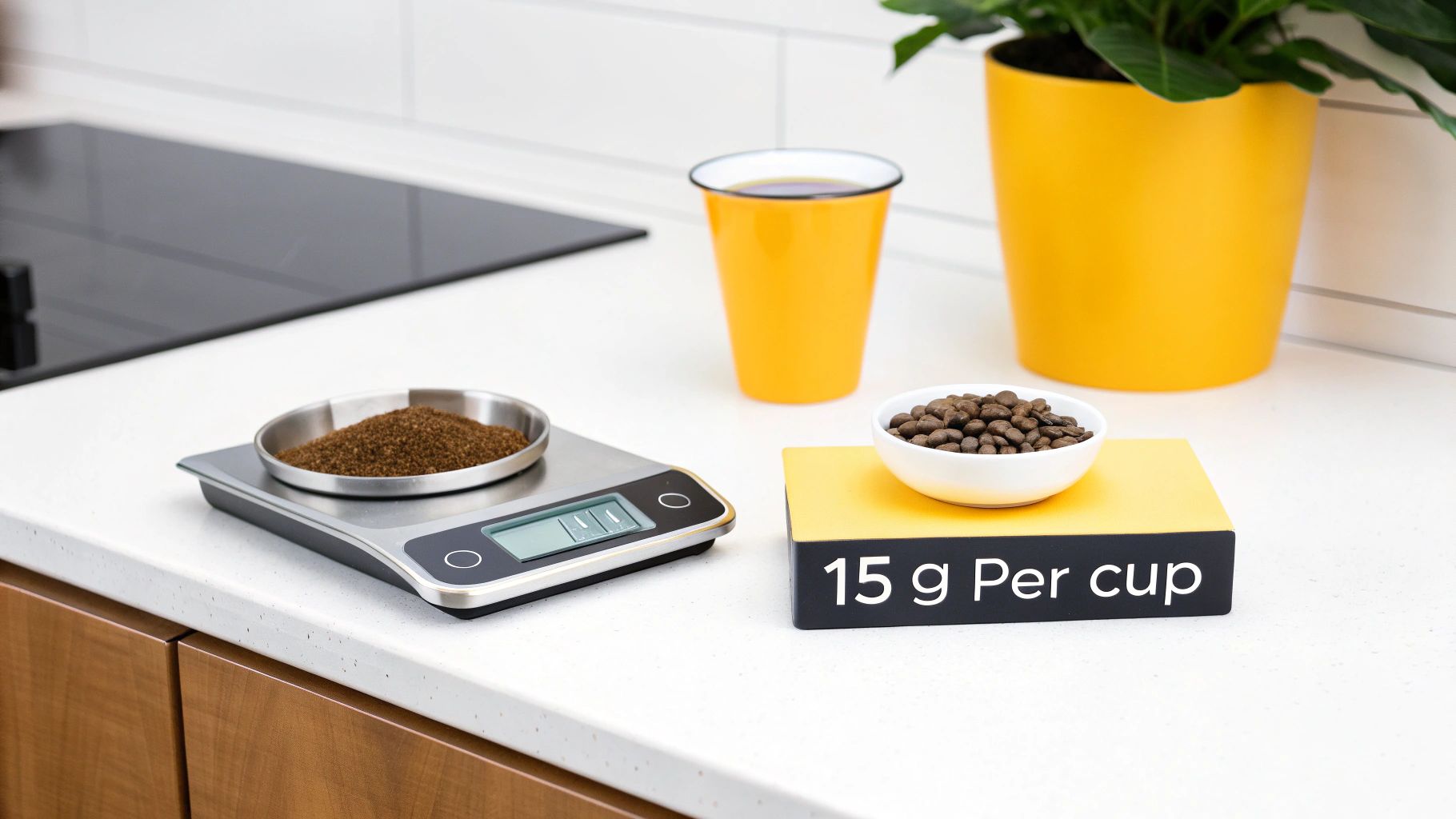
This simple shift from measuring by volume to measuring by weight gives you complete control. It's the foundation for experimenting with different brewing methods and truly understanding how tiny tweaks can totally transform the flavor in your cup.
Unlocking Flavor Through Precision
Think of brewing coffee like baking a cake. You wouldn't just eyeball the flour and hope for the best, right? The same logic applies here. Weighing your coffee and water means you can repeat that "perfect" cup day after day, and more importantly, make small, intentional changes to discover what you really love. It turns brewing from a chore into a craft.
This level of precision is what separates good from great, whether you're a home brewer or a cafe owner trying to build a following. Consistency is key in a business setting, and so is getting customers to come back. For cafe owners, a simple but effective strategy involves boosting cafe loyalty through stamp cards.
Even when you're short on time, this principle holds true. High-quality instant coffees, like our own here at Cartograph, are built on precision. We've done the measuring for you, ensuring a great cup even when you don't have a scale handy.
It all circles back to knowing your numbers. If you're ready to dive deeper, our guide on the best way to prepare coffee at home can help you perfect the entire process.
Why Weighing Your Coffee Is a Game Changer
Ever wonder why that perfect cup of coffee you brewed on Tuesday feels impossible to recreate on Wednesday? It’s not a mystery—it’s a measurement problem. Using scoops or tablespoons to measure coffee is like baking a cake by just guessing how much flour to throw in. Sure, it might work out sometimes, but consistency is a total long shot.
Making the switch to a simple kitchen scale is the single biggest leap you can take toward better coffee. Seriously. It completely removes the guesswork and introduces precision, transforming your coffee routine from a random game of chance into a reliable, repeatable craft.
This move from volume (scoops) to weight (grams) is so crucial because coffee beans themselves are wildly inconsistent. A scoop of a dark roast, which is physically less dense, will weigh a lot less than the exact same scoop of a dense, light-roasted bean. The size of your grind matters, too; a scoop of coarse grounds is full of air pockets and weighs less than fine grounds. This is exactly why your coffee strength can feel all over the map from one day to the next.
The Power of Precision and Control
Once you start measuring your grams of coffee per cup with a scale, you suddenly have absolute control. You can finally lock in that perfect recipe and brew it the exact same way, every single time. It gives you the power to make tiny, deliberate tweaks—like adding just one more gram of coffee—and actually taste the difference it makes.
This is the kind of detail that separates a good cup of coffee from a truly exceptional one. It’s the secret behind every great barista’s consistency and the first step to really understanding how to dial in a brew for your personal taste.
When you weigh your coffee, you stop being a passive participant in your morning ritual. You become the architect of your brew, able to fine-tune strength, body, and flavor with surgical precision.
Consistency on a Global Scale
This focus on precise measurement isn’t just for coffee nerds at home; it’s a global standard. Every single day, the world drinks an estimated 2.25 billion cups of coffee. If we use the FDA's baseline of about 10.6 grams per 8-ounce cup, that means a staggering 23.85 million kilograms of coffee are brewed daily to keep up with demand.
That massive number shows just why consistency is so critical, both for big coffee companies and for you in your kitchen. You can dive deeper into these fascinating coffee consumption statistics if you're curious.
Ultimately, weighing your coffee grounds is about taking back control. It's a small, inexpensive step that pays you back with huge improvements in flavor, consistency, and the simple joy of a great daily cup. Once you start, you'll never look at a coffee scoop the same way again.
Mastering the Golden Ratios for Brewing
Ever wonder how your favorite barista nails that perfect cup every single time? It's not magic; it's a recipe. Just like a chef, they rely on precise coffee-to-water ratios to craft a balanced and delicious brew, and you can do the same thing at home.
These recipes, often called "Golden Ratios," are the secret to unlocking the full potential of your coffee beans. The most common ones you’ll see are 1:15, 1:16, and 1:18. It’s a simple concept: the first number is one part coffee, and the second is how many parts water you'll use, all measured in grams. Getting a handle on this is the first step toward taking control of your coffee and brewing a cup that’s perfect for you.
This is where a kitchen scale becomes your best friend. Scoops are wildly inconsistent, but a scale gives you precision.
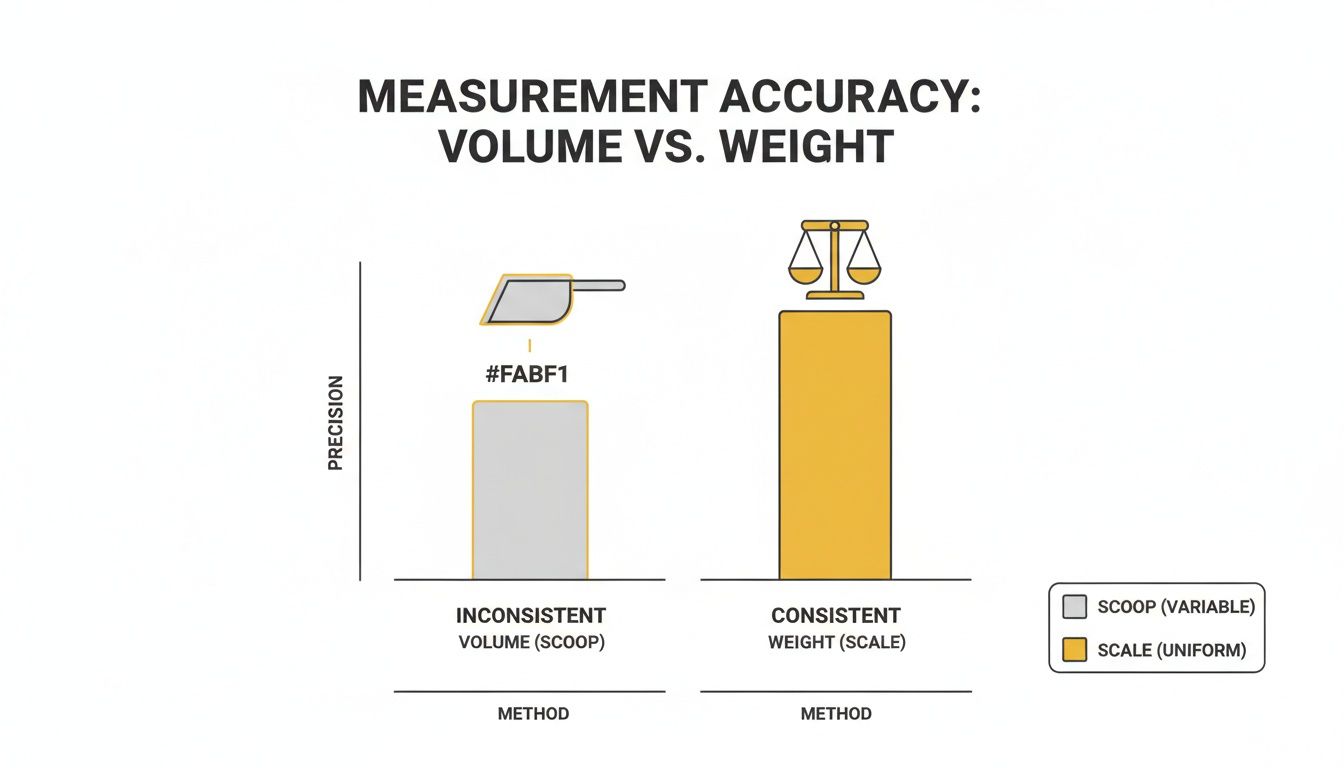
As you can see, weighing your coffee in grams is the only way to get repeatable results. It's the difference between hoping for a good cup and knowing you'll get one.
Choosing Your Ideal Ratio
So, where do you start? The right ratio really comes down to what you like and the kind of flavors you want to pull from the beans. Each one directly changes the strength and extraction, giving you the power to fine-tune every brew.
- 1:15 Ratio (1 gram coffee to 15 grams water): This one will give you a stronger, bolder, and more robust cup. If you enjoy a richer flavor and a heavier body, this is a great place to start, especially for full-immersion methods like a French press.
- 1:18 Ratio (1 gram coffee to 18 grams water): Looking for something a bit more delicate? This ratio creates a lighter, more nuanced brew. Using more water helps highlight the brighter, more subtle notes in a coffee, which is why it's a favorite for many pour-over fans.
The Specialty Coffee Association (SCA) often points brewers toward a starting ratio between 1:16 and 1:18. This range is widely considered the "golden" sweet spot for getting a balanced extraction that’s not too weak or too overpowering.
Your choice of ratio is a powerful tool. A 1:16 or 1:17 ratio is a fantastic, reliable middle ground. From there, you can start experimenting. Want a stronger brew? Nudge the ratio down toward 1:15. Prefer something lighter and brighter? Move it up toward 1:18. This simple adjustment is how you become your own expert barista, tailoring each cup exactly how you like it.
Tailoring Your Grams for Different Brew Methods
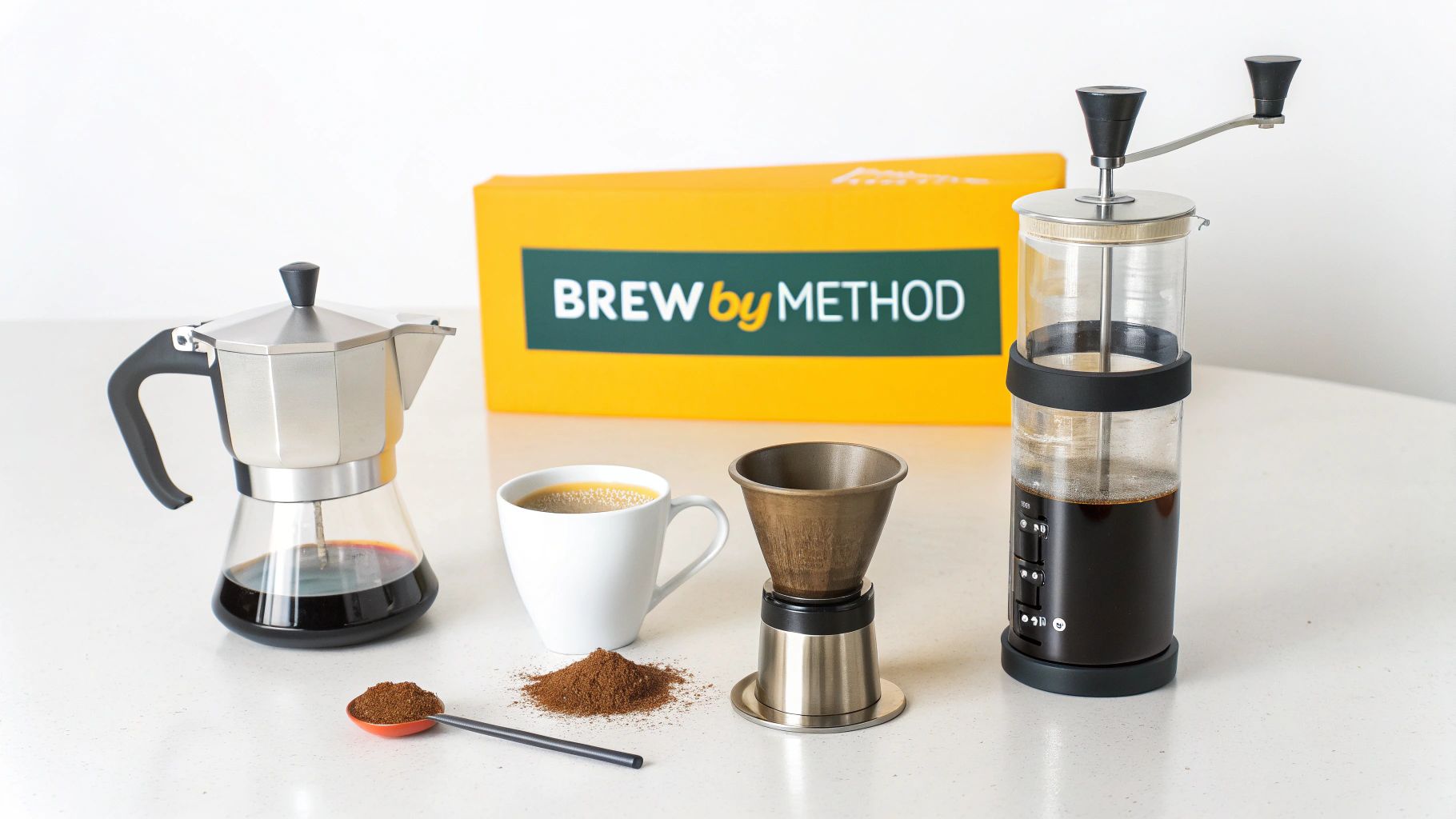
Getting your head around coffee ratios is the first step, but putting them into practice is where the real craft of brewing begins. Your brewing gear isn't just a passive tool; it's an active partner in creating flavor, and each one demands a slightly different approach to the grams of coffee per cup.
The way water and coffee interact—whether it's a long, lazy soak or a quick, controlled pass-through—fundamentally changes the final taste in your mug. It’s a lot like cooking. You wouldn't use a slow cooker and a frying pan in the same way, right? The same logic applies here. A French press and a pour-over dripper need their own unique recipes to really shine, and adjusting your coffee dose is the secret to unlocking the best flavor from whichever brewer you're using.
Even the cup you pour it into matters. A good guide to choosing takeaway coffee cups can be surprisingly helpful for understanding how different sizes and materials can affect the experience.
Full Immersion vs. Pour-Over Brewing
The biggest fork in the road is whether your method is full immersion or pour-over (also known as percolation).
-
Full Immersion (Think French Press, AeroPress): In these brewers, the coffee grounds are fully submerged and hang out in all the water for the entire brew time. This style usually benefits from a slightly stronger dose—something closer to a 1:15 ratio—to build a rich, full-bodied cup with a really satisfying texture.
-
Pour-Over & Drip (V60, Chemex, Drip Machines): With these, water flows through the bed of coffee grounds. This approach is all about control and clarity. You'll often get better results with a slightly lighter dose, maybe around a 1:16 or 1:17 ratio, which allows the more delicate, nuanced flavors of the coffee to sing without being muddled or overpowering.
If you want to dive deeper into what makes each brewer tick, our guide on the best coffee brewing methods breaks down the unique personality of each one.
Starting Grams for Popular Brewers
Ready to get started? Here are some solid starting points for a standard 12 oz (355ml) mug. Think of these as a baseline—your personal taste is the ultimate guide, so feel free to tweak them.
| Brew Method | Water (g/ml) | Suggested Coffee (g) | Common Ratio |
|---|---|---|---|
| Drip Coffee Machine | 355g | 21g | 1:17 |
| French Press | 355g | 24g | 1:15 |
| Pour-Over (V60) | 355g | 22g | 1:16 |
| AeroPress | 240g | 16g | 1:15 |
Pro Tip: If you're an AeroPress user, you've probably seen recipes that create a strong concentrate you then dilute with hot water. The 16g to 240g recipe above is designed to produce a ready-to-drink cup straight from the brewer, no extra water needed.
The Instant Coffee Advantage
This whole conversation about precise measurement isn't just for coffee geeks. It’s actually so important that the FDA has a standard baseline suggesting around 10.6 grams of coffee per 8-ounce cup. This became particularly important with the rise of instant coffee, as it helped guarantee people were getting a consistent flavor from jar to jar.
For specialty instant brands like Cartograph Coffee, this standard is a benchmark we use to develop products that deliver a reliable and genuinely delicious experience every single time. With our high-quality instant coffee, we’ve already done all the careful weighing and measuring for you. Each serving is perfectly dosed to take the guesswork out of the equation, giving you a flawless cup when you value both exceptional quality and ultimate convenience.
Adjusting Your Recipe to Find the Perfect Strength
Once you've got the basic ratios down, the real fun starts. This is where you graduate from simply following a recipe to creating your own signature brew. Think of those golden ratios as your starting map, but your own taste buds are the true compass. The goal is to tweak and tune until the coffee is perfect for you, turning a daily routine into a rewarding ritual.
This process is a lot simpler than it sounds. It’s all about making small, intentional changes and paying attention to how they affect the final cup. Your palate is an incredibly sensitive tool, and learning to trust it is the secret to becoming your own best barista. The first step? Learning to diagnose your coffee.
A Simple Troubleshooting Guide
Is your coffee not quite right? The flavor is telling you exactly what to do next—you just need to learn its language. Here are the two most common issues and how to fix them with a simple adjustment to your grams of coffee per cup.
-
If your coffee tastes sour, weak, or thin: This is a classic sign of under-extraction. You simply didn't pull enough of the good stuff out of the grounds.
- The Fix: Increase your coffee dose by one gram. Adding just a little more coffee helps balance the extraction and adds body. Alternatively, try a slightly finer grind to increase the surface area and help the water extract more flavor.
-
If your coffee tastes bitter, harsh, or unpleasantly strong: This usually points to over-extraction. You’ve pulled too much from the beans, including the undesirable bitter compounds.
- The Fix: Decrease your coffee dose by one gram. Using a bit less coffee can stop the brew from becoming overpowering. You could also use a slightly coarser grind, which lets water flow through more easily and reduces the extraction of those bitter notes.
Key Takeaway: Think of dialing in your coffee like focusing a camera lens. A tiny adjustment in one direction brings everything into sharp focus, while turning it the other way makes it blurry. Adjusting your dose by just one gram at a time is the best way to zero in on that perfect flavor.
While the FDA's standard of 10.6 grams per cup gives us a useful starting point, coffee habits around the world prove there’s no single "correct" strength. Preferences vary wildly from culture to culture. This just goes to show that the ultimate authority on your perfect cup is you. You can dive deeper into how coffee consumption differs around the world on cafely.com.
So, embrace the process of experimentation. It's how you'll discover a brew that's uniquely yours.
Frequently Asked Questions About Coffee Measurements
Even after you get the hang of ratios, a few real-world questions always seem to pop up. Think of this as the final piece of the puzzle—a place to tackle those last lingering curiosities so you can start brewing better coffee with confidence.
Let's clear up the common "what ifs" with some straight-to-the-point answers.
How Many Grams of Coffee for a 12 Oz Cup?
For a standard 12 oz cup, which holds about 355ml of water, a great starting point is anywhere from 21 to 24 grams of coffee. This sweet spot lands you squarely within the "Golden Ratios" of 1:15 to 1:17 that baristas love.
My advice? Start right in the middle with 22 grams. Brew it, taste it, and then trust your gut. If it feels a bit too punchy, dial it back to 21 grams next time. If it’s a little weak for your liking, bump it up to 23.
Does Roast Level Change How Many Grams I Should Use?
This is a fantastic question, and it gets right to the heart of why weighing your coffee is so important. The short answer is no—your target weight in grams should stay the same no matter the roast. But the volume is a totally different story.
Dark roast beans are less dense than light roast beans because they've expanded and lost water weight during the roasting process. A scoop of dark roast actually weighs less than the same size scoop of light roast. This is exactly why sticking to a specific gram target is your key to consistency, brew after brew.
How Do These Measurements Apply to Instant Coffee?
High-quality instant coffee, like what we make here at Cartograph, is a different beast entirely. It's a super-concentrated form of brewed coffee, so you'll use a lot less. Our packets are already pre-measured for you, typically calling for just 2-4 grams for a perfect 8-10 oz cup.
The real secret here is to simply follow the directions on the package. With premium instant, all the hard work of extraction and balancing has been done for you. We've taken the guesswork out of it so you can get a perfect cup every single time.
What if I Don’t Have a Scale?
Look, a digital scale is your best friend for consistency, but we’ve all been in a pinch. If you don't have one, you can get by with tablespoons as a rough estimate.
As a general rule of thumb, one level tablespoon of whole beans is about 5-7 grams. For ground coffee, it’s a bit lighter, closer to 5 grams. For a deeper dive on this, check out our guide on how many teaspoons to use for coffee.
Just remember, it's an approximation. It'll get you in the ballpark, but a scale is what gives you that repeatable, delicious result every morning.
Ready to experience the convenience of perfectly measured, high-quality coffee without the guesswork? Cartograph Coffee offers organic instant coffee designed for a flawless cup, every time.
Explore our collection of premium instant coffees at cartographcoffee.com