At 8 p.m., you want coffee without the jolt. You tear open a decaf instant packet, stir it into a large mug, and settle in, assuming the cup contains no caffeine at all. That assumption is understandable, but it isn't quite accurate.
Caffeine in decaf instant coffee is usually much lower than in regular coffee, yet “decaffeinated” doesn't mean caffeine-free. The amount that remains depends on the original beans, the decaffeination process, the instant-coffee manufacturing steps, the amount of powder you use, and the size and strength of your drink. Those details matter if you're protecting sleep, reducing stimulants during pregnancy, managing anxiety, or trying to understand what you're drinking.
What “Decaf” Actually Means in Your Cup
The word “decaf” describes a major reduction, not total removal. In the United States, the Food and Drug Administration requires at least 97% of the original caffeine to be removed before coffee can be marketed as “decaffeinated,” leaving up to roughly 3% of the bean's original caffeine after processing. Britannica's explanation of decaffeination provides useful context for that standard.
That percentage can sound reassuring until you translate it into a cup. Imagine a swimming pool filled with caffeine. Removing 97% would leave only a small remainder compared with the original volume, but the remainder wouldn't be empty. A teaspoon left in a pool is tiny relative to the pool, yet it still exists. Decaf works in much the same way: the stimulant load falls dramatically, while a measurable amount may survive.
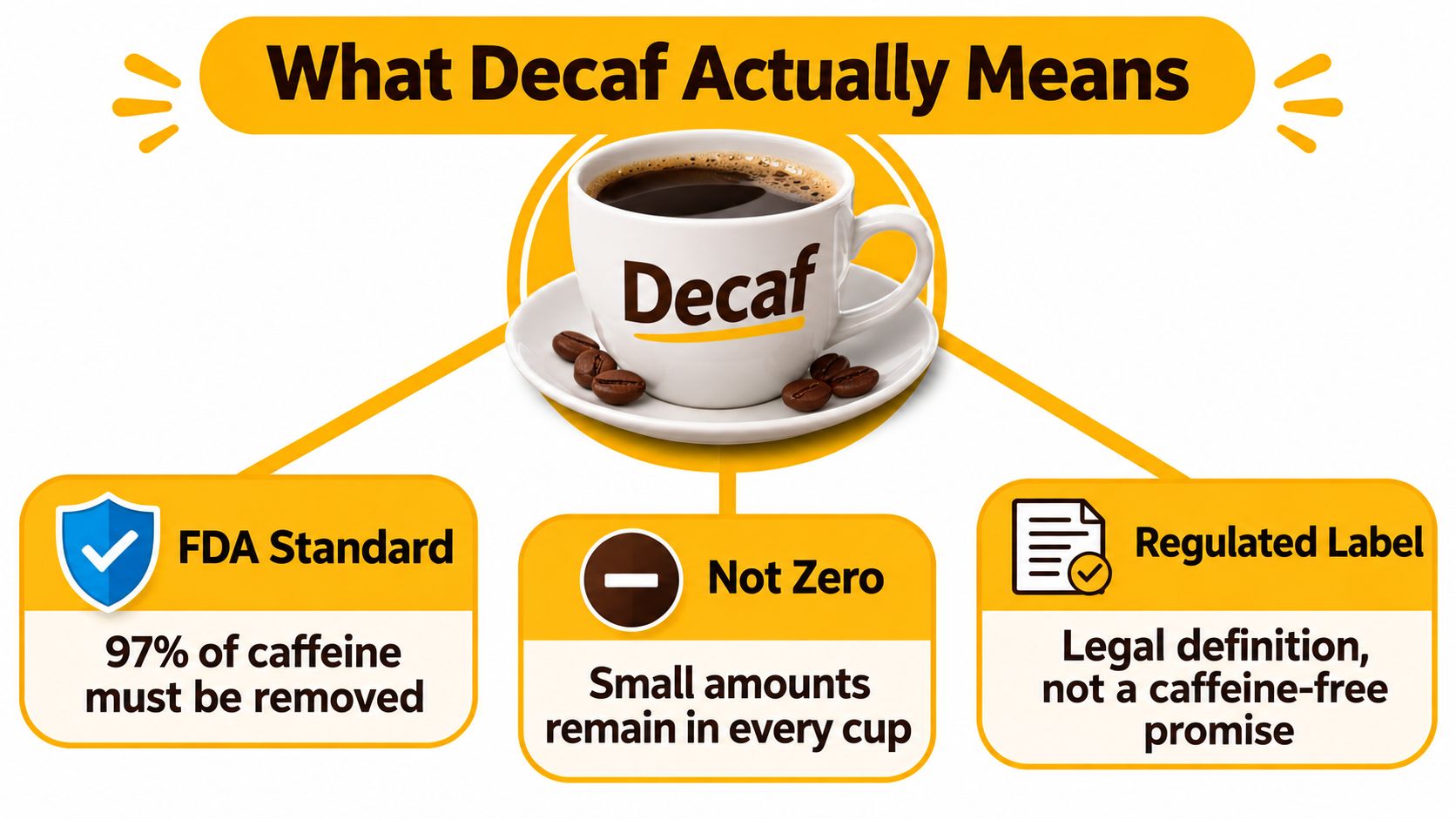
Why the label can mislead
For an 8-fluid-ounce serving, the FDA describes typical decaffeinated coffee as containing 2 to 15 milligrams of caffeine. That range refers to decaffeinated coffee generally, not every individual instant product, so your prepared cup can fall outside your expectation if you use more powder or make a stronger drink.
A reader choosing decaf instant coffee at night might reasonably interpret the label as “safe from any caffeine.” A more accurate interpretation is “substantially lower caffeine than regular coffee.” That distinction is particularly important for people who react strongly to stimulants, monitor total intake during pregnancy, or wake easily after evening coffee.
Practical rule: Treat “decaf” as a low-caffeine category, not a zero-caffeine guarantee.
Serving size adds another layer. A standard 8-ounce reference doesn't describe a large travel mug, a concentrated camping cup, or a drink made with two heaped spoonfuls. If you want a broader explanation of how instant decaf fits into a daily routine, Cartograph Coffee's guide to instant decaf coffee offers related context. Readers comparing lower-caffeine drinks can also explore Pep Tea's weight loss tea picks for another perspective on decaffeinated beverages.
How Decaffeination Methods Shape Residual Caffeine
Coffee producers remove caffeine before roasting the beans. The basic aim is straightforward: draw caffeine out while retaining as much of the coffee's aroma, body, and flavor compounds as possible. The method influences that balance, but a method name alone doesn't tell you the exact caffeine content in the finished instant powder.
Three routes from bean to decaf
Direct solvent processing uses a solvent to pull caffeine from prepared beans. The solvent interacts with the bean material and carries caffeine away, after which the beans are processed for roasting. This route can achieve deep caffeine removal, but the final result still depends on the bean, process controls, and how the finished product is formulated.
Water processing uses water to dissolve caffeine and other soluble compounds, followed by filtration or another separation step. Producers work to return desirable coffee compounds to the bean or retain them in the process. Contact time, temperature, and selectivity affect how much caffeine is removed and how much flavor character remains.
Supercritical carbon dioxide processing uses carbon dioxide under controlled pressure and temperature. In that state, carbon dioxide can move through the bean and selectively extract caffeine. Producers value the method for its selectivity and potential to preserve flavor, although the process description still isn't a substitute for a measured value on the finished product.
Why instant coffee needs its own explanation
Instant coffee isn't brewed coffee with the water removed from your kitchen cup. Manufacturers brew coffee at an industrial scale, produce a coffee extract, concentrate it, and dry that extract into powder or granules. The beans have already gone through decaffeination, and the extract then passes through additional manufacturing stages before you dissolve it at home.
That sequence matters because caffeine in the finished drink depends on more than the percentage removed from the raw bean. It also depends on the coffee species and starting caffeine concentration, the efficiency of decaffeination, the amount of powder in the package, and the preparation instructions.
A process label can tell you how the producer removed caffeine. It can't, by itself, tell you how many milligrams are in your scoop. For people who need a tightly controlled intake, a prepared-serving result is more useful than a general statement such as “water processed” or “solvent free.”
Typical Caffeine Numbers in Decaf and Regular Coffee
A useful starting point is the FDA's typical 2 to 15 milligrams per 8-fluid-ounce cup for decaffeinated coffee. That range is broad enough to show why one universal number can mislead, but narrow enough to establish that decaf is substantially lower in caffeine than regular coffee. The FDA's consumer guidance on caffeine explains the typical decaf range and the fact that measurable caffeine can remain.
USDA FoodData Central values cited in a consumer reference place decaffeinated brewed coffee at roughly 2 milligrams per 8 ounces, compared with about 95 milligrams for regular brewed coffee. The same reference places regular instant coffee near 62 milligrams per 8-ounce serving. These are useful benchmarks, not guarantees for every brand or preparation. The cited comparison of decaf and regular coffee shows why product type matters.
| Coffee type | Caffeine per 8 oz, typical reference | Notes |
|---|---|---|
| Decaffeinated coffee | 2–15 mg | FDA range for typical decaf coffee |
| Decaffeinated brewed coffee | About 2 mg | USDA-based reference value |
| Regular brewed coffee | About 95 mg | USDA-based reference value |
| Regular instant coffee | About 62 mg | USDA-based reference value |
Why instant decaf doesn't fit one tidy number
Instant coffee starts with a brewed extract, but the final dose depends on how much dried extract you dissolve. One person may use a level spoon in a small cup, while another uses a generous scoop in a large mug. Both may use the same jar and experience different total caffeine intake.
An older University of Florida analysis cited by the FDA found measurable caffeine in nearly all of the decaf coffees it tested, while one instant decaf sample was the exception and showed no detectable caffeine. That finding shouldn't be turned into a promise that instant decaf is always the lowest-caffeine option. It demonstrates something more useful: format alone doesn't settle the question.
Brand and batch variation matter too. A decaf label places a product in a regulated category, but it doesn't make every product identical. If you're comparing instant and brewed options, Cartograph Coffee's guide to instant coffee caffeine content is a relevant resource for understanding why preparation and serving size belong in the comparison.
Why Two Scoops Are Not Twice as Harmless
A cup's caffeine dose depends on two quantities: the concentration in the powder and the amount of powder you use.
Caffeine in the drink = caffeine concentration in the powder × grams of powder used.
Water changes the drink's volume and taste. Adding more water spreads the same caffeine through a larger mug, making it weaker without removing caffeine. Adding more powder increases the total dose, even if the water level stays unchanged.
The serving-size problem
Analytical guidance reports that instant-coffee serving recommendations commonly range from 2 to 4 grams of powder per cup. Producers often claim less than 5 milligrams per serving, yet laboratory testing can still detect residual caffeine. This technical guidance on residual caffeine in decaffeinated instant coffee explains why the stated powder quantity matters.
Suppose the powder concentration remains constant. A 2-gram serving contains half as much powder as a 4-gram serving, so the larger serving can contain approximately twice the caffeine. The label's “per serving” figure only makes sense when your scoop matches the serving size used for that figure.
Mug size introduces another variable. To keep a large mug tasting strong, you may add more powder and therefore increase the dose. If you use the original amount of powder and add water, the drink becomes weaker in flavor while containing roughly the same total caffeine.
Every extra scoop is a dosing decision, whether or not the mug tastes stronger.
Repeated cups add up
Suppose a prepared cup contains 5 milligrams of caffeine. Five cups made to that same tested value would provide about 25 milligrams in total. This is an example of serving-size arithmetic, not a claim that every decaf instant coffee contains 5 milligrams. It shows why the number of cups belongs in the calculation alongside the amount used for each cup.
Camping makes the measurement problem more obvious. Without a scale, a rounded spoonful can exceed the package's assumed serving, especially when you are filling a large mug. That difference may matter little for occasional use, but it matters more when you choose decaf to reduce caffeine as far as practical.
Check the stated serving size, measure the powder when possible, and count your actual cups. Those steps give a clearer estimate than treating the word “decaf” as a caffeine-free guarantee.
How Researchers Actually Measure Residual Caffeine
A producer can describe a careful decaffeination process, but laboratory testing answers a more direct question: how much caffeine remains in this product? Researchers commonly use analytical techniques such as high-performance liquid chromatography, or HPLC, to separate caffeine from other compounds and quantify it. Another investigation used thermogravimetry with gas chromatography and mass spectrometry to detect caffeine in a decaffeinated instant-coffee sample despite a manufacturer claim of less than 5 milligrams per serving.
What HPLC adds to the label
HPLC turns a vague question into a measured concentration. In an analysis of nine decaffeinated retail coffee samples, average caffeine concentration was about 16,791 milligrams per kilogram, while individual decaf samples ranged from roughly 9,083 to 20,879 milligrams per kilogram. The published HPLC study demonstrates substantial variation among products labeled decaffeinated.
Those concentration figures describe the coffee material, not automatically the amount in your mug. To estimate the prepared dose, you also need the mass of powder used. A larger scoop can produce a larger caffeine intake even when the powder concentration remains unchanged.
The result consumers should request
For instant coffee, the most useful result is caffeine reported in two ways:
- Per gram of powder, which helps compare the underlying product.
- Per prepared serving, based on a defined powder amount and cup preparation.
Lot-level testing matters because coffee composition and processing can vary between production runs. A brand that provides a recent analytical result, names the method used, and explains the assumed serving size gives consumers more practical information than a process description alone.
The evidence also challenges a common assumption. Instant coffee isn't automatically the riskiest decaf format. The older analysis cited by the FDA included one instant decaf sample with no detectable caffeine, while the broader set of decaf coffees showed meaningful variation. The defensible conclusion isn't that instant is always lower. It's that measurement matters more than format stereotypes.
Cumulative Intake, Sensitivity, and Real-World Risk
A person sensitive to caffeine may finish a decaf instant coffee at 4 p.m. and still notice an effect at bedtime. Another reader may drink the same product after dinner without difficulty. The difference can reflect both personal sensitivity and total intake from the day, not just whether the jar says "decaffeinated."
The FDA-cited range of 2 to 15 milligrams per 8-fluid-ounce cup, together with the University of Florida analysis, gives useful context: decaf usually contains less caffeine than regular coffee, measurable residue is common, and results vary by product. Those figures are a starting point, not a guaranteed dose for every mug.
A daily total can matter
Caffeine's effect depends on the whole routine. Consider a pregnant reader who has already consumed caffeine earlier in the day, then drinks one decaf instant coffee in the afternoon and another in the evening. Each cup may be modest, yet both still contribute to the daily total. The earlier five-cup calculation shows how quickly repeated servings can add up, while this scenario highlights a different question: how much caffeine remains after all sources are counted?
Cup size and powder quantity change that answer. A level serving prepared as directed is not equivalent to a heaped scoop dissolved into a large mug. Water changes concentration and volume, but the powder determines how much caffeine enters the drink.
Sensitivity changes the practical limit
A coffee drinker choosing decaf for flavor may tolerate residual caffeine comfortably. Someone who develops restlessness, a racing heartbeat, or poorer sleep after small amounts may need a stricter routine. Pregnancy, anxiety symptoms, medication interactions, and clinician-set limits also make individual guidance more important than a generic decaf label.
Ask a clinician or pharmacist:
- What daily caffeine limit applies to my situation?
- Should caffeine from chocolate, tea, cola, and medicines be included?
- Is avoiding caffeine completely necessary, or is a measured low intake acceptable?
- What symptoms should prompt me to reduce intake or seek advice?
These questions help translate a laboratory result into a decision about an actual drink. If a personal limit is very low, request a tested caffeine value per serving and confirm the powder amount used for that result. If the product gives no such information, use less often or choose a product with clearer testing details rather than treating “decaf” as a zero-caffeine guarantee.
Handled with transparent labeling, decaf instant coffee is a manageable, low-dose choice rather than a hidden-dose trap.
What to Look for on a Decaf Instant Coffee Label
A useful label answers practical questions, not just regulatory ones. Look for:
- Caffeine per serving: A milligram value is more useful than “decaffeinated” alone.
- Powder amount: Check whether the serving assumes 2, 3, or 4 grams, since analytical guidance identifies that range as common.
- Cup size: Confirm whether the stated value applies to an 8-ounce cup or another preparation.
- Testing information: Prefer brands that identify HPLC, GC-MS, or another analytical method and explain whether results apply to a production lot.
- Preparation guidance: A label should make clear whether a larger or stronger drink requires more powder.
If a brand doesn't publish a caffeine value, contact it directly and ask four questions: How many grams define one serving? What cup volume was tested? Was the finished instant powder analyzed? Does the result apply to a specific production lot?
For busy professionals, a small evening cup made with the stated serving is a different decision from a large morning mug or several camping cups. The calculation starts with the powder, not the water. Cartograph Coffee's information on low-caffeine instant coffee is relevant for readers comparing convenient instant options and thinking about serving consistency.
Cartograph Coffee offers organic instant coffee for at-home, work, and outdoor use, with its decaffeinated product positioned as a lower-caffeine option rather than a caffeine-free promise. That kind of distinction gives shoppers a clearer basis for choosing a product that matches their routine.
Choose a decaf instant coffee with a clearly defined serving and transparent residual-caffeine information, then prepare it according to the stated amount. Visit Cartograph Coffee to explore its organic instant coffee options for lower-caffeine routines at home, at work, or outdoors.