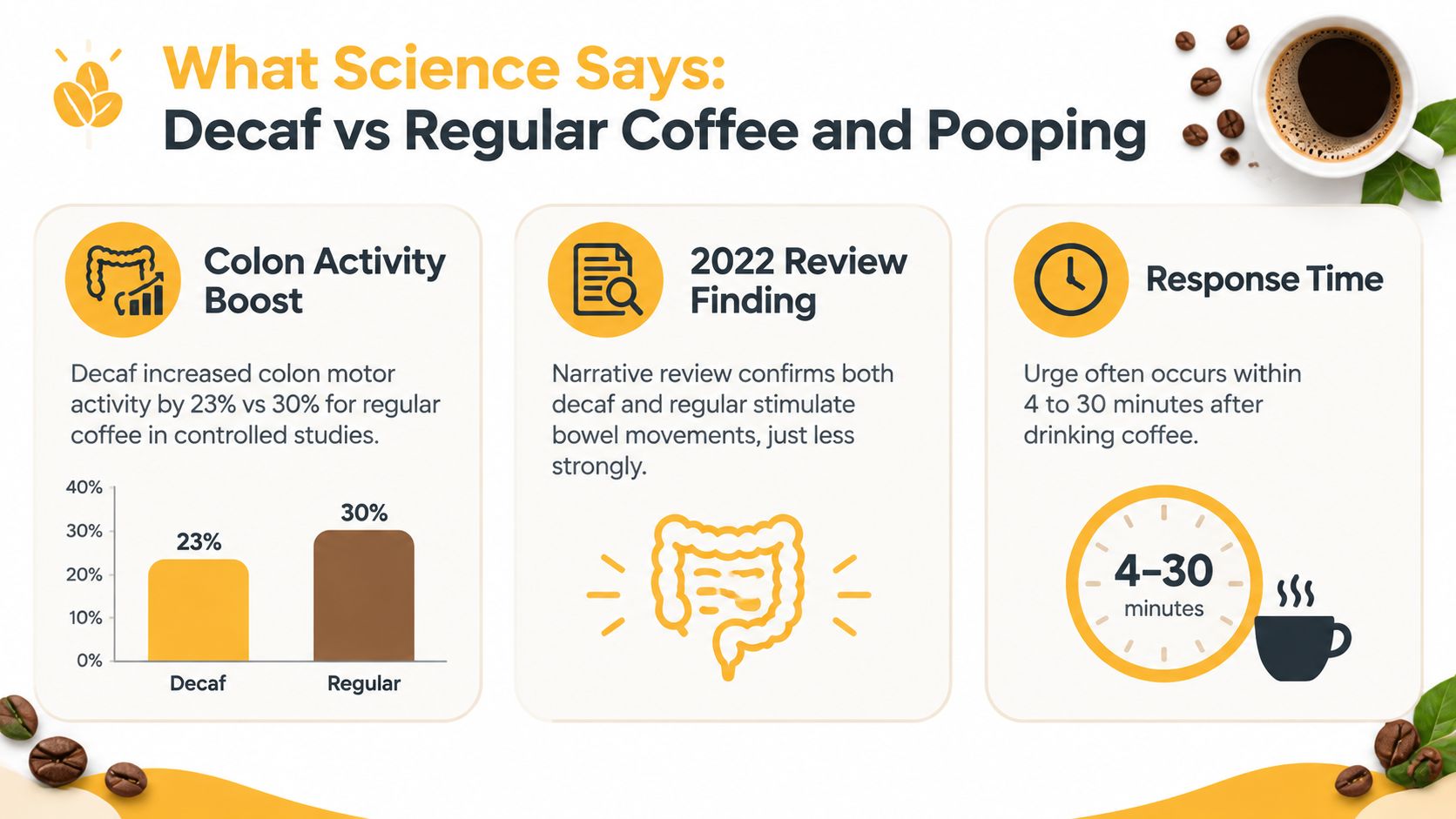
Yes, decaf coffee can make some people poop, although its effect is usually weaker than regular coffee. In controlled research, regular coffee produced about 23% more colonic activity than decaf, while both could stimulate the bowel within minutes in some responders.
You switch to decaf to avoid jitters, settle into a quiet morning, and then find yourself looking for the bathroom before the first meeting. That reaction can feel confusing, especially if you thought caffeine was the entire reason coffee gets things moving.
The better answer to “will decaf coffee make you poop?” is not a universal yes or no. Some people respond to coffee itself, not only to caffeine. Other people can drink decaf without noticing any bowel change at all. Your gut sensitivity, morning routine, serving size, and individual bowel physiology all influence the outcome.
This guide separates the coffee effect into two questions: how strongly can decaf stimulate the colon, and how comfortable is that stimulation for you? You'll learn why the gastrocolic reflex matters, what human motility studies found, who tends to respond, and how to adjust your routine if you want regularity without an urgent bathroom trip.
Introduction Why Your Morning Decaf Still Sends You to the Bathroom
A woman who normally drinks regular coffee may switch to decaf because she wants the ritual without the caffeine-related restlessness. The next morning, she drinks the same familiar warm mug, starts answering messages, and feels the same unmistakable pressure in her lower abdomen. The coffee changed, but the bathroom pattern didn't disappear.

That experience fits the evidence. A controlled human study found that both caffeinated and decaffeinated coffee increased colonic activity, although decaf produced a smaller response than regular coffee. The researchers also observed activity within four minutes in responders, showing that a fast bathroom urge doesn't require a large caffeine dose (controlled human motility study).
The practical answer: Decaf isn't inert, but it usually gives the bowel a softer nudge than regular coffee.
The distinction matters because a bowel movement can be useful when you're trying to establish a comfortable morning routine, but frustrating when it arrives as urgency, cramping, or loose stool. A gentler signal may suit someone who wants predictable regularity without the intensity of regular coffee. It may not satisfy someone who depends on coffee to produce a bowel movement on demand.
Your response also may not match another person's. One manometry study found a measurable rectosigmoid response in only a subset of healthy participants, even among people who considered themselves coffee responders. That responder pattern is the central idea: the question isn't only what decaf contains. It's also how your gut interprets the signal.
How Coffee Makes You Poop Even Without Much Caffeine
Your digestive tract behaves less like a passive pipe and more like a conveyor belt with sensors. When your stomach receives a drink, it can send signals to the colon to create room and move existing contents forward. This coordinated response is known as the gastrocolic reflex.
The gut alarm system
Think of the stomach as the alarm button and the colon as the conveyor belt. Drinking coffee stretches the stomach and introduces warmth, liquid volume, and coffee compounds. The colon may respond with pressure waves and propagated contractions, which can push stool toward the rectum.
The process can unfold in several connected steps:
- The stomach receives the drink. Stretching tells the digestive system that new contents have arrived.
- The gut sends signals onward. Nerve and hormone pathways communicate with the lower bowel.
- Coffee compounds add stimulation. Caffeine is one possible trigger, but it isn't the only one.
- The colon increases motor activity. Pressure waves and contractions move material along.
- You notice the result. If stool is already in the lower colon, the signal may create an urge to use the bathroom.
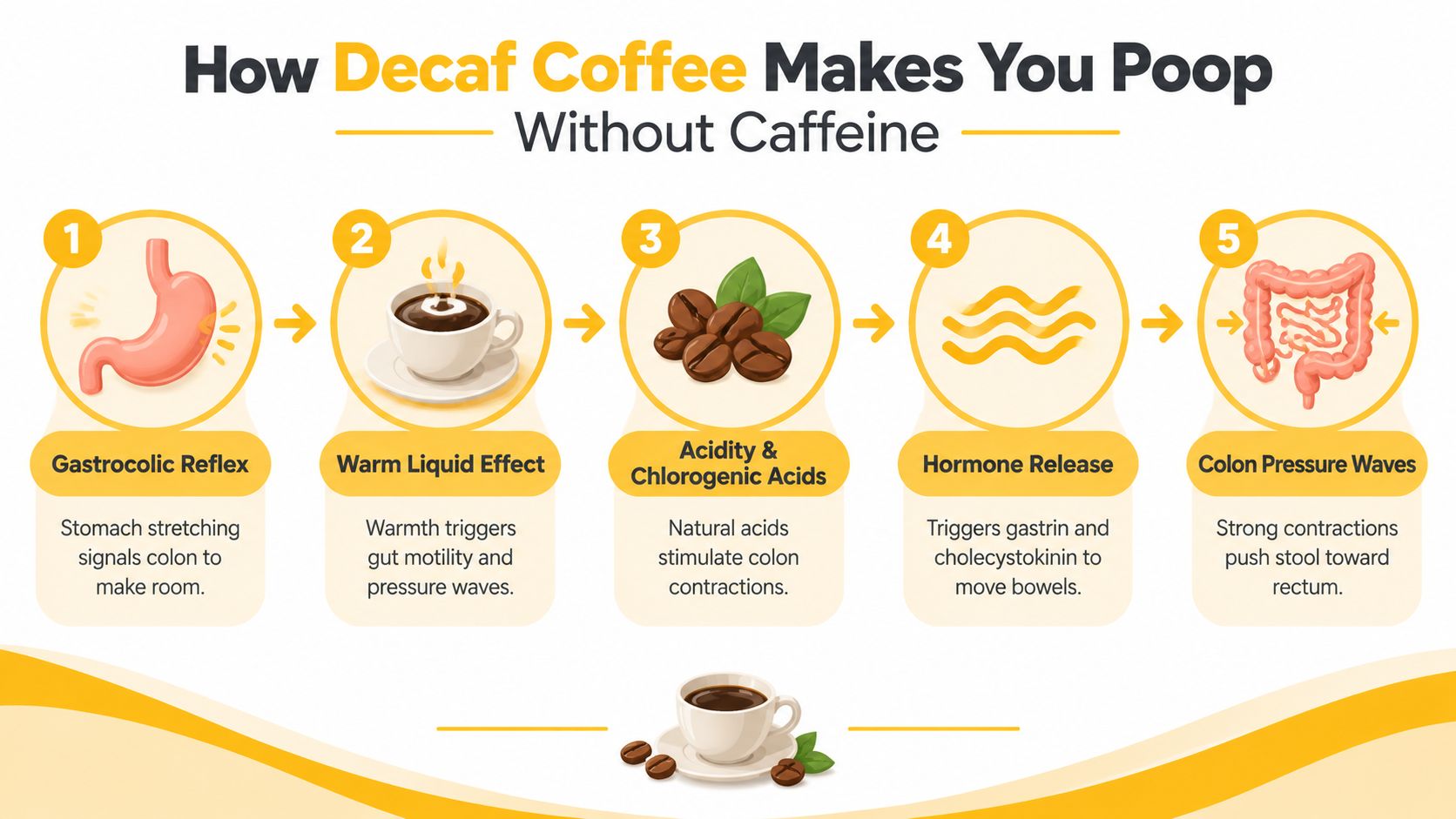
Coffee may also influence digestive signaling through compounds other than caffeine. Chlorogenic acids and other naturally occurring coffee constituents are possible contributors, although the exact pathway isn't settled well enough to say that one compound explains everyone's response. The key point is simpler: removing most caffeine removes one stimulant, but it doesn't remove coffee's entire chemical profile.
Warmth and liquid volume can contribute to the sensory experience, too. They don't guarantee a bowel movement, and they shouldn't be treated as a standalone laxative mechanism. Instead, they can join the stomach-stretch signal and coffee-specific chemistry, creating a stronger combined prompt in people whose colons are responsive.
The manometry research offers a useful reality check. After drinking black, unsweetened coffee, both regular and decaf increased rectosigmoid motility within four minutes in 8 of 14 responders, and the effect lasted at least 30 minutes (human manometry study). The non-responders didn't show the same change, so the response isn't automatic.
If coffee also leaves you feeling distended, the bowel movement may not be the only issue to investigate. Your preparation, speed of drinking, and additions can affect comfort, so a neutral guide to coffee and bloating can help you separate the drink itself from the rest of the routine.
The most useful mental model is a multi-button system. Caffeine presses one button, while stomach stretching, warmth, coffee compounds, and your learned morning pattern may press others. Decaf leaves several of those buttons available.
What Scientific Studies Show About Decaf and Bowel Movements
The strongest human evidence points to a responder pattern, not a universal rule. Decaf can increase colonic activity, yet its average effect is smaller than regular coffee and varies widely between individuals. A cup may be a gentle prompt for one person and have little noticeable effect for another.
What the controlled comparison found
A controlled study compared caffeinated coffee, decaffeinated coffee, a meal, and water. Both coffee types increased colonic activity. Regular coffee produced an effect about 23% stronger than decaf and about 60% stronger than water (1998 controlled study). Among responders, researchers observed the change within four minutes, which helps explain why a bathroom urge can arrive soon after the last sip.
The comparison clarifies the practical question. Decaf did not match regular coffee's strength, but it also did not behave like plain water for every responsive participant. The result supports a middle ground: decaf is gentler, not inert.
A 2022 narrative review found the same general pattern. It summarized research showing that regular and decaffeinated coffee can increase pressure waves and propagated contractions compared with water. The review also notes that decaf commonly contains 2 to 15 mg of caffeine per cup (2022 gastrointestinal review). “Caffeine-free” is therefore an imperfect everyday label. Decaf contains far less caffeine, but usually not zero.
Why the findings don't predict your morning perfectly
A motility study records bowel movement inside a controlled setting. Your own result also depends on whether you have eaten, how sensitive your gut is, how quickly you drink the coffee, and whether stool is already waiting in the rectosigmoid area. A contraction can occur without producing a bowel movement, while a quiet test day does not rule out a response later.
The responder study shows why personal results diverge. Only 8 of 14 participants displayed a rectosigmoid response to both regular and decaf coffee, while non-responders showed no change in that test (responder study). That finding does not establish a universal share of people who react in daily life. It does show why two people can drink the same brew at the same time and experience different urgency.
Track your own pattern rather than judging one surprising morning. A downloadable bowel chart PDF can help record timing and stool characteristics while you adjust your brew or routine.
Decaf Versus Regular Coffee and How They Affect Your Gut Differently
Regular coffee usually delivers a stronger overall gut signal because it combines coffee's natural compounds with more caffeine. Decaf removes most caffeine while retaining much of coffee's wider chemical profile. That makes decaf gentler for many drinkers, but not inert. A responder may still notice movement or urgency, while a non-responder may feel little change from either brew.
The practical difference is a tradeoff between stimulation and comfort. Regular coffee may create a more noticeable push when you want a bowel movement, yet that stronger signal can feel like cramping or sudden urgency. Decaf may offer a softer nudge that better suits people who want the morning ritual without making the bathroom feel time-sensitive.
| Feature | Decaf Coffee | Regular Coffee |
|---|---|---|
| Caffeine | Contains a small residual amount, rather than being completely caffeine-free | Contains substantially more caffeine than decaf |
| Colon stimulation | Can increase activity in some responders, often with a gentler overall effect | Usually provides the stronger coffee-related motility signal |
| Other coffee compounds | Retains naturally occurring coffee constituents that may contribute to bowel activity | Retains those compounds alongside more caffeine |
| Timing | May still prompt an urge soon after drinking in responsive people | May feel faster or more forceful for some drinkers |
| Comfort tradeoff | May be easier to tolerate when urgency or cramps are a concern | May be less comfortable for people sensitive to stimulation |
| Predictability | Depends heavily on personal response and the rest of the drink | Can vary too, despite its stronger average effect |
Timing can change the experience. A cup taken after food may feel different from coffee consumed on an empty stomach. Drinking quickly, choosing a large serving, or adding milk and sweetener can also change the complete stimulus reaching your gut. The bathroom response may therefore reflect the whole routine, not decaf status alone.
Acidity deserves a separate distinction. Coffee's acidity may bother some stomachs, but it should not be treated as a guaranteed explanation for bowel urgency. Roast level and brewing method may change flavor and tolerance, yet neither automatically predicts how your colon will respond.
A useful choice rule: Choose decaf when a gentler coffee routine and better comfort matter more than a strong bowel stimulus.
For readers comparing functional coffee products, a Sippin On Shroomboom coffee review offers a separate product perspective. Check the ingredient list and your own tolerance, since added ingredients can affect the experience as much as the coffee itself.
Who Is Most Likely to Feel the Effect From Decaf

A morning decaf can send one person toward the bathroom while leaving another unchanged. The clearest explanation is responder versus non-responder biology. Some lower bowels react to coffee-related signals, while others barely register the same drink.
The difference is not about how much caffeine reaches the gut. Sensitivity, routine, and what is already moving through the bowel can change the experience. Decaf lowers one source of stimulation, but it does not make the drink inert.
Several patterns make a response more likely:
- You already notice a coffee-bathroom connection. A dependable reaction to regular coffee suggests that your gut responds to coffee-related cues. Decaf may soften the effect without removing it, much like turning down a speaker rather than switching it off.
- Your bowel is sensitive. Ordinary contractions may feel like urgency, pressure, or cramping when your digestive system is easily irritated. Decaf may be the more comfortable choice, but a gentler signal can still feel noticeable.
- Your cup belongs to a fixed routine. Drinking coffee after waking, before breakfast, or at the same time each morning can pair the beverage with familiar bathroom timing. The brain and gut learn repeated patterns, so habit may become part of the signal.
- Your morning includes several triggers. Warm liquid, breakfast, movement after waking, and stomach filling can arrive together. Decaf may be only one ingredient in that combined message, which explains why changing the coffee alone does not always change the result.
- You already have stool ready to move. Coffee cannot create stool instantly. It can encourage the colon to act, making an urge easier to notice when material is already in the lower bowel.
Your response may also shift with stress, sleep, and day-to-day bowel patterns. That makes personal observation more useful than treating “decaf” as a fixed promise of gentleness.
For persistent discomfort, a guide to gut issue recovery can help you examine broader habits instead of blaming one cup. For brew choices, the best coffee for gut health offers coffee-specific context. Use those ideas alongside your own comfort, urgency, and timing patterns.
Practical Tips to Enjoy Decaf Without Unwanted Urgency
A decaf cup can feel comfortable one morning and surprisingly urgent the next. Treat that variation as useful feedback, not proof that decaf either always works or never works for you. Keep the coffee itself consistent, change one factor at a time, and record when the urge appears, whether it feels comfortable, and whether your stool changes.
Adjust the routine before abandoning decaf
Timing can shift the experience. If your cup sends you searching for a bathroom at an inconvenient moment, try drinking it after food instead of immediately after waking. A meal may alter how the gastrocolic reflex and coffee signal overlap, although each person's response remains individual.
Serving size and strength matter too. A large or highly concentrated drink may create a stronger sensory and digestive load than a smaller, milder cup. Aim for the least stimulating serving that still tastes satisfying, rather than treating coffee like a digestive treatment.
Try this sequence:
- Keep the coffee consistent. Use the same decaf product and preparation for several mornings.
- Change timing first. Compare drinking it before breakfast with drinking it afterward, while keeping the serving unchanged.
- Reduce intensity if needed. Dilute the coffee, make it less concentrated, or choose a smaller serving.
- Review additions. Remove one creamer or sweetener at a time if your usual drink causes gas or loose stool.
- Record comfort, not just frequency. A bowel movement without pain is different from urgency, cramping, or diarrhea.
Decaf is gentler than regular coffee, but it is not always inert. Residual caffeine may matter for someone with high sensitivity, while other coffee compounds can also contribute to the response. The boundary between regular and decaf is therefore more like a dimmer switch than an on-or-off button.
Treat the bowel response as feedback
A rat study found that coffee and decaf changed gut microbiota after three days, but did not significantly change transit time or smooth muscle contractility in that model (discussion of the mechanistic study). The result is a useful caution: feeling an urge does not prove that coffee has sped up your entire digestive process. A bowel signal and overall gut transit are related, but they are not the same measurement.
If acidity seems connected to discomfort, explore ways to reduce the acidity of coffee. Keep a simple record of brew strength, timing, food, and symptoms. That record can show whether you are a responder who needs a gentler setup or a non-responder who can enjoy decaf without special adjustments.
Stop experimenting and seek medical advice if bowel changes are persistent, severe, painful, or accompanied by other concerning symptoms.
Final Takeaways for Choosing Decaf With Confidence
Your morning decaf may lead to a bowel movement, or it may do nothing noticeable. It can, but not for everyone. Human studies suggest that some responders experience increased colonic activity, while regular coffee usually produces a stronger effect. Caffeine is only one part of the picture. Other coffee compounds and the gastrocolic reflex can also signal the colon.
Use your response as a guide:
- Choose decaf when you want coffee's flavor and ritual with a gentler chance of stimulation.
- Choose regular coffee when you tolerate its stronger effect comfortably and want caffeine.
- Adjust timing, concentration, serving size, and additions before deciding that coffee itself is the problem.
- Track urgency, cramps, stool changes, and comfort, not just whether you went. Responder biology varies, so another person's reaction cannot predict yours.
Decaf works more like a dimmer than an on-or-off switch. It often lowers stimulation without removing every possible gut signal. The best routine is not the one that sends you to the bathroom fastest. It is the one that preserves an enjoyable coffee ritual without unwanted urgency, cramps, or disruption.
If bowel changes remain persistent, severe, or painful, seek medical advice rather than continuing to adjust your brew.