It all comes down to one thing: caffeine. That’s the real difference between a cup of regular coffee and its decaf counterpart. Regular coffee packs that familiar punch, while decaf goes through a process to remove at least 97% of its caffeine, leaving just a whisper behind. Your choice really depends on what you're after—the jolt of energy or just the comforting, rich taste of coffee.
An At a Glance Comparison of Decaf and Regular Coffee
Before we get into the nitty-gritty of decaffeination methods and flavor profiles, let's start with a simple side-by-side look. This quick overview will help you grasp the essential differences right away, setting the stage for the finer points we'll cover later on.
The most obvious distinction is the caffeine level. Health experts tell us that a typical 8-ounce cup of regular coffee has somewhere between 70–140 mg of caffeine. In contrast, that same cup of decaf contains up to 7 mg, and often much less. You can find more insights about caffeine levels in coffee from health professionals online. It’s this massive difference that makes decaf the go-to for anyone sensitive to caffeine or for those who want a warm cup in the evening without it messing with their sleep.
Choosing between regular and decaf isn't just about avoiding the jitters. It's about fitting your coffee habit into your life—whether you need a kickstart to your morning, a relaxing after-dinner drink, or a late-night work companion that won't cost you a good night's sleep.
Quick Comparison Regular Coffee vs Decaf Coffee
To make it even simpler, this table lays out the fundamental differences. Think of it as your cheat sheet for picking the right coffee for the right moment.
| Feature | Regular Coffee | Decaf Coffee |
|---|---|---|
| Caffeine Content | High (70-140 mg per 8 oz) | Very Low (0-7 mg per 8 oz) |
| Primary Use Case | Energy boost, improved focus, pre-workout | Flavor enjoyment, evening drink, caffeine sensitivity |
| Typical Flavor Notes | Bolder, more robust, and often more acidic | Milder, smoother, sometimes with a slightly altered taste |
| Ideal Time of Day | Morning, early afternoon | Afternoon, evening, or anytime without a stimulant effect |
Let's Talk Caffeine: The Real Numbers Behind Your Cup
When we pit decaf against regular coffee, the most obvious battleground is caffeine. But it's not as simple as "caffeine vs. no caffeine." The real story is in the numbers, and they can vary quite a bit depending on everything from the bean's origin to how you brew it.
An average 8-ounce cup of regular brewed coffee can pack anywhere from 70 to 140 milligrams of caffeine. Think of this as a ballpark figure, because the final amount in your mug is anything but standard.
On the other side of the ring, decaf isn't entirely caffeine-free. For a coffee to earn the "decaffeinated" label, it has to have at least 97% of its original caffeine removed. This process leaves a tiny amount behind, usually somewhere between 2 and 7 milligrams per 8-ounce cup. It's a whisper, not a shout.
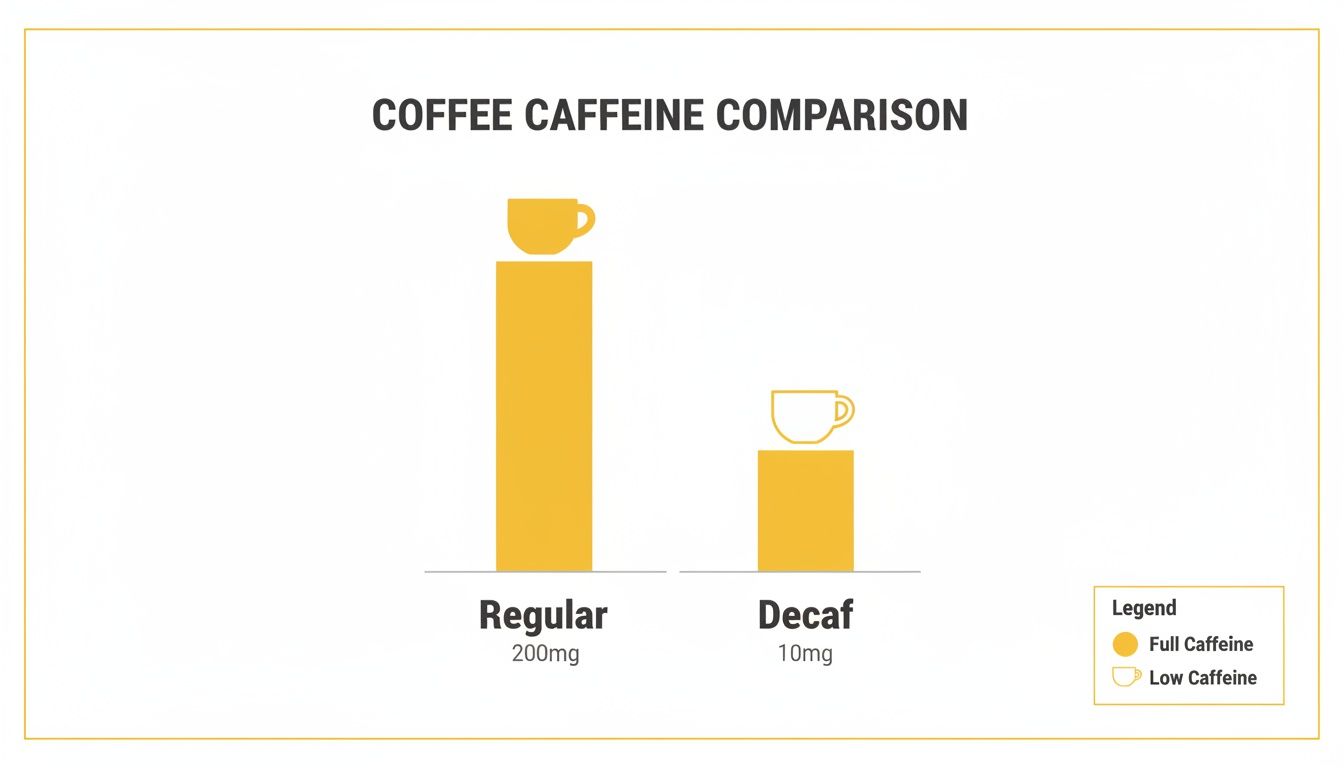
As you can see, the gap is massive. Decaf has a trace amount, while regular coffee delivers a significant dose.
To put that into perspective, a can of cola typically has around 34 mg of caffeine, and a cup of black tea sits at about 47 mg. So, a standard cup of coffee gives you more than double the kick of tea, while a cup of decaf has far less. If you want to get really granular, you can explore our full guide to coffee caffeine content.
Why Isn't Caffeine Content a Fixed Number?
The way you make your coffee dramatically changes its caffeine punch. A quick espresso shot and a slow-steeped cold brew from the exact same beans will give you wildly different results.
Here’s a quick look at what you can generally expect from different brewing styles:
- Drip Coffee (8 oz): Your classic go-to, averaging around 95 mg.
- Espresso (1 oz shot): Small but mighty. This concentrated shot delivers about 64 mg.
- Cold Brew (8 oz): This one's a heavy hitter. The high coffee-to-water ratio and long steeping time can push the caffeine content up to 150-200 mg.
But the brewing method is just one piece of the puzzle. Several other factors come into play.
Other Key Factors Influencing Caffeine
1. The Bean Itself The two superstars of the coffee world, Arabica and Robusta, are born different.
- Arabica Beans: These are known for their delicate, aromatic flavors. They’re also naturally lower in caffeine, at about 1.5% by weight.
- Robusta Beans: As the name implies, these beans are tough. They have a bolder, more intense flavor and pack almost double the caffeine—often 2.5% or even higher.
2. The Roast Level It’s a common myth that dark, roasty coffee is "stronger" in caffeine. In reality, it’s the other way around, though the difference is subtle.
- Lighter Roasts: Since caffeine burns off a little during the roasting process, beans roasted for less time hold onto slightly more of their original caffeine.
- Darker Roasts: The longer roasting time gives these beans a bold flavor but also reduces the caffeine content just a tiny bit.
The biggest caffeine influencer is always the bean type. A Robusta bean will always have more caffeine than an Arabica, no matter how it’s roasted.
3. Grind Size and Brew Time The mechanics of brewing matter, too. The finer your grind, the more surface area is exposed to the water, which means caffeine is extracted more quickly and efficiently.
Likewise, the longer your coffee grounds hang out in the water—think French press or cold brew—the more time there is to pull caffeine out. This is why a quick espresso shot has less total caffeine than a big cup of slow-drip coffee, even though the espresso tastes more concentrated.
How Coffee Becomes Decaf: A Look at Decaffeination Methods
Ever wonder how they get the caffeine out of a coffee bean? It's a surprisingly delicate process. The whole goal is to target and remove one specific compound—caffeine—while leaving all the other complex, wonderful flavor compounds right where they are. This all happens long before the beans ever see a roaster.
No matter the method, the first step is always the same: unroasted, green coffee beans are soaked in water. This opens up the bean's pores and gets the caffeine molecules ready to be extracted. From there, the paths diverge into two main camps: processes that use solvents and those that don't.
Solvent-Based Decaffeination
The most common methods worldwide use a solvent to specifically bond with and strip out the caffeine molecules. The beans are either soaked right in the solvent or in a water solution that contains it.
Two main solvents get the job done:
- Ethyl Acetate: You might see this marketed as the "sugarcane process" when it's derived from natural sources. Ethyl acetate is an organic compound found in many fruits, which is why it's sometimes promoted as "naturally decaffeinated."
- Methylene Chloride: This is another very effective solvent. Now, I know the word "chemical" can be a bit jarring, but these processes are tightly regulated. After decaffeination, the beans are steamed and rinsed thoroughly, removing any leftover solvent to levels far below what safety standards allow.
Once the caffeine is gone, the beans are washed, steamed, and dried back to their original moisture content, ready for the roaster. Both of these methods are incredibly efficient, removing at least 97% of the caffeine.
The Bottom Line: Solvent-based methods are the industry workhorses because they're efficient and cost-effective. Despite the use of chemicals, the final product is regulated to be completely safe for you to drink, with only tiny, trace amounts of solvent remaining.
Chemical-Free Decaffeination Methods
For those who'd rather skip the chemical solvents altogether, a couple of really clever alternatives have become popular. These methods rely on the natural properties of water and carbon dioxide to pull the caffeine out.
The Swiss Water Process
This is probably the most famous chemical-free method, and it’s a favorite among organic and specialty coffee roasters. It’s a gentle, 100% chemical-solvent-free process that uses nothing but water, temperature, and time.
Here's a quick rundown of how it works:
- Creating the Extract: First, a batch of green beans is soaked in hot water to create what’s called Green Coffee Extract (GCE). This first batch of beans is thrown out, but the water—now full of all the soluble coffee solids except caffeine—is the key.
- Removing the Caffeine: A fresh batch of green beans is then submerged in this GCE. Because the water is already saturated with coffee solids, it can't pull any more flavor from the new beans.
- The Magic: The GCE has no caffeine, but the beans do. This difference in concentration naturally causes only the caffeine molecules to move from the beans into the water. This caffeine-rich GCE is then run through carbon filters that trap the caffeine.
- Ready for Roasting: The decaffeinated beans are then dried, with their original flavor profile largely intact. The GCE is reused for the next batch, making the whole thing a sustainable, closed-loop system.
The CO2 Process
The Carbon Dioxide (CO2) method is another brilliant, solvent-free technique. It uses something called "supercritical CO2," which is carbon dioxide put under pressure until it's somewhere between a liquid and a gas.
In this process, water-soaked green beans are placed in a high-pressure tank. The supercritical CO2 is pumped in and circulated through the beans, where it acts like a natural solvent, bonding only with the caffeine molecules. The CO2, now carrying the caffeine, is moved to a different chamber where the pressure is lowered. The CO2 turns back into a gas, leaving the caffeine behind.
This method is incredibly selective and does a fantastic job of preserving the coffee's delicate flavor and aroma compounds. If you're wondering how these methods impact other types of coffee, you can learn more about instant decaf coffee and the impressive quality now available.
Comparing the Flavor, Aroma, and Acidity

Let's clear the air on one of the biggest myths in coffee: that decaf is a bland, lifeless impersonation of the real deal. While that stereotype might have held some water years ago, modern decaffeination has completely changed the game. Today, the taste difference between a great decaf and its caffeinated twin is surprisingly subtle.
A coffee bean's unique flavor, aroma, and body come from a symphony of hundreds of chemical compounds. Even the most precise decaffeination process can gently tweak this delicate balance.
Caffeine isn't the only thing that's water-soluble in a coffee bean—some flavor compounds are, too. This means that during the process, it's possible to lose tiny traces of these compounds, which can slightly alter the final taste.
The Impact on Flavor and Body
In the past, decaf often had a reputation for tasting flat, muted, or even a bit papery. This was a direct result of older, less refined decaffeination methods that stripped out much more than just the caffeine.
Thankfully, those days are largely behind us. High-quality modern techniques, like the Swiss Water Process or the CO2 method, are engineered to minimize this flavor loss. They do an incredible job of zeroing in on caffeine molecules while leaving the bean's inherent character almost entirely intact.
Key Takeaway: A high-quality specialty decaf will always taste better than a low-grade regular coffee. It's that simple. Modern decaffeination aims to make the cup virtually indistinguishable from the original, and it gets remarkably close.
So what are the small differences you might still pick up on?
- Body and Mouthfeel: Some people find that decaf can have a slightly lighter body. It's often a very minor change, but the coffee might feel a touch less heavy on the palate.
- Flavor Nuances: The most delicate floral or bright, fruity notes might be a little less prominent. However, the core foundational flavors—think chocolate, caramel, and nuts—are usually preserved beautifully.
Aroma and the Sensory Experience
Aroma is a massive part of taste perception, and it's another area where decaffeination can have a small effect. The aromatic oils in coffee are volatile, and a bit can be lost when the beans are exposed to heat and moisture.
While today's methods are designed to protect these precious oils, a slight softening of the aroma is sometimes unavoidable. You might notice the scent of freshly ground decaf is a touch gentler than regular beans from the same batch.
This isn't necessarily a drawback. For many, this mellowing results in a smoother, more rounded cup that's perfect for winding down in the evening.
Unpacking the Acidity Question
In the specialty coffee world, acidity is a celebrated trait—it's the bright, tangy sparkle that makes a coffee feel vibrant and lively. The decaffeination process often has a noticeable effect here, which can be a huge plus if you prefer a less acidic brew.
Many of the compounds that contribute to a coffee's perceived acidity are slightly reduced during decaffeination. This tends to produce a cup that's smoother and mellower, with less of a sharp "bite." For anyone sensitive to acidic foods, this is often a welcome side effect of going decaf.
If you're looking for ways to manage acidity in any cup, we have some tips. You can read our guide on how to reduce the acidity of coffee, as things like roast level and brew method make a huge difference.
Ultimately, when it comes to taste, the gap between decaf and regular has never been smaller. A skillfully processed decaf from a quality-focused roaster offers a rich, complex, and deeply satisfying experience that stands shoulder-to-shoulder with any regular brew.
Health Benefits and Considerations: What's Really in Your Cup?
When we talk about decaf versus regular coffee, the conversation almost always turns to health. Both versions of our favorite brew actually share a surprising number of benefits, which mostly comes down to the rich supply of antioxidants packed into the coffee bean itself. But, of course, the presence or absence of caffeine creates two very different health profiles.
Figuring out these differences is key to matching your coffee choice with what your body needs and how you live your day. It’s not about one being definitively "better," but which one is better for you at a particular moment.
Both regular and decaf are fantastic sources of polyphenols and hydrocinnamic acids. These are powerful antioxidants that help your body fight off oxidative stress. This shared antioxidant punch is a major reason both types of coffee are linked to a lower risk of certain health issues.
The Common Ground: Health Perks in Both Coffee Types
Before we get into what separates them, it's worth appreciating what regular and decaf coffee have in common. The core health benefits are baked right into the bean's natural chemistry, and most of that goodness stays put whether the caffeine is there or not.
Here are a few of the key advantages they both bring to the table:
- Packed with Antioxidants: Believe it or not, coffee is one of the single biggest sources of antioxidants in the average Western diet. These compounds work to neutralize harmful free radicals, protecting your cells from damage.
- May Lower Risk of Certain Diseases: Studies have connected both coffee types with a reduced risk of developing several conditions. For instance, research suggests that both regular and decaf drinkers may have a significantly lower chance of developing Type 2 diabetes.
- Good for Your Liver: There's a consistent link in research between drinking coffee—caffeinated or not—and better liver health, including a lower risk of liver disease.
These shared benefits mean you don’t have to get a caffeine buzz to reap some of coffee’s most important health rewards. That’s great news for anyone who’s sensitive to stimulants but still wants the positive effects of a daily cup.
Regular Coffee: The Boost and Its Boundaries
Let's be honest: the main health story for regular coffee is all about the caffeine. Caffeine is a natural stimulant, and its effects on our central nervous system, metabolism, and even physical performance are well-documented.
For a lot of us, a cup of regular coffee is the go-to tool for getting alert and productive. The 70-140 mg of caffeine in a typical 8-ounce cup can give your metabolism a temporary nudge—up to 11%—and sharpen your focus. But that stimulant effect can be a double-edged sword. For the estimated 10-20% of adults who are extra sensitive to caffeine, it can trigger things you don't want, like insomnia, anxiety, or heart palpitations. You can learn more about how coffee's composition impacts health at JH-Analytical.
The key with regular coffee is self-awareness. It can be a powerful ally for focus and energy, but you have to listen to your body to avoid getting overstimulated or wrecking your sleep.
Decaf Coffee: The Mellow Alternative
Decaf offers the perfect solution for anyone who loves the flavor and ritual of coffee but could do without the intense buzz. With just 2-12 mg of caffeine per cup, it neatly sidesteps the potential downsides of its caffeinated cousin, making it an ideal choice for a whole lot of people.
This makes decaf a fantastic option in a few common scenarios:
- Evening Enjoyment: Craving a coffee after dinner? Decaf lets you indulge without worrying about staring at the ceiling all night.
- Caffeine Sensitivity: If regular coffee gives you the jitters, anxiety, or an upset stomach, decaf is a much gentler experience.
- Managing Your Total Intake: For those of us who could easily drink coffee all day, switching to decaf in the afternoon is a smart way to keep total caffeine consumption in check.
Interestingly, decaf might even have some unique cardiovascular perks. While both types are linked to a 25-30% lower risk of Type 2 diabetes thanks to their polyphenols, some studies suggest decaf specifically helps improve what's called endothelial function. In simple terms, this supports better blood vessel health and could contribute to a lower risk of heart disease.
To help you weigh your options, here’s a quick look at how the two stack up on the health front.
Health Impact Profile: Regular vs. Decaf Coffee
This table offers a clear, side-by-side look at the potential positive and negative health effects of drinking regular versus decaf coffee. It's a quick guide to help you decide which is the right fit for your body and lifestyle.
| Health Aspect | Regular Coffee Impact | Decaf Coffee Impact |
|---|---|---|
| Alertness & Focus | High impact; caffeine enhances cognitive function. | Minimal impact; no significant stimulant effect. |
| Sleep Quality | Can negatively impact sleep, especially when consumed late. | Generally safe for evening consumption without affecting sleep. |
| Anxiety & Jitters | May trigger or worsen anxiety in sensitive individuals. | Unlikely to cause jitters or anxiety; a calming alternative. |
| Metabolic Rate | Provides a temporary but significant boost to metabolism. | Negligible effect on metabolic rate. |
| Heart Health | Mixed; may raise blood pressure short-term. | May improve blood vessel function and is gentler on the system. |
| Antioxidant Level | Very high; a primary source of dietary antioxidants. | Slightly lower than regular but still a very rich source. |
Ultimately, choosing between decaf and regular is a personal health decision. Regular coffee delivers a clear boost for energy and mental performance, while decaf provides a safe, enjoyable way to get most of coffee's antioxidant goodness without the stimulant kick.
When to Choose Decaf vs. Regular Coffee
Knowing the science behind decaf and regular coffee is helpful, but the real trick is knowing how to use that knowledge in your day-to-day life. Your coffee choice doesn't have to be a lifelong commitment to one or the other. Think of it as a strategic decision that can change with the time of day, what you need to get done, and how your body is feeling.
Instead of getting stuck on which is "better," let's reframe the question: "Which one is right for me, right now?" This simple shift turns your coffee habit into a powerful tool. By matching the right brew to the situation, you get exactly what you need—whether that's a jolt of energy to get you going or a moment of pure, comforting flavor.
The Morning Kickstarter
The Goal: Shake off that morning grogginess, get your brain firing for the workday, and kickstart your day with a reliable energy boost.
The Choice: Regular Coffee
This is the classic scenario where a fully caffeinated coffee really delivers. That caffeine hit works as a central nervous system stimulant, blocking the neurotransmitters that make you feel tired and ramping up your alertness. Science backs it up: a morning cup of regular coffee is proven to sharpen focus and improve cognitive function, making it the perfect sidekick for your most important morning tasks. It's more than just a routine; it's a functional drink that gets your brain in the game.
The Pre-Workout Energizer
The Goal: Boost your physical performance, push your endurance, and find the motivation for a tough workout at the gym or a long run.
The Choice: Regular Coffee
Caffeine is one of the most studied and effective performance enhancers out there. Drinking a regular coffee about 30-60 minutes before you exercise can genuinely improve your strength, power, and stamina. It helps trigger an adrenaline release that preps your body for intense effort and can even make the workout feel easier, letting you push yourself a little harder. For both serious athletes and weekend warriors, it’s a natural way to get more out of your training.
Situational Tip: If you're sensitive to caffeine or find coffee a bit harsh on your stomach before a workout, give cold brew a try. It’s naturally lower in acid, making it a gentler option that still packs a serious caffeine punch.
The Afternoon Focus Without the Jitters
The Goal: Beat that dreaded mid-afternoon slump and stay productive through late meetings, but without the anxiety or sleepless night that can follow.
The Choice: Decaf Coffee
For a lot of us, another cup of regular coffee after 2 p.m. is a one-way ticket to a restless night. This is where decaf becomes your secret weapon. You still get the comforting ritual and familiar taste of a coffee break, which can be enough of a mental reset to get you back on track. And since it only has a tiny amount of caffeine (usually 2-7 mg), it won't mess with your sleep or give you that over-caffeinated, anxious feeling. It's the perfect way to power through the afternoon.
The Evening Wind-Down
The Goal: Savor the rich, warm flavor of coffee after dinner or while relaxing, with zero stimulating effects to interfere with your sleep.
The Choice: Decaf Coffee
This is decaf's moment to shine. It lets you completely separate the pure enjoyment of coffee's flavor from its job as a stimulant. A warm mug of decaf can be a wonderfully soothing part of your evening routine. It's perfect alongside a dessert, a good book, or a quiet conversation. You get all of the sensory pleasure and even some antioxidants, without sacrificing a good night's rest.
Got Questions About Decaf? We've Got Answers.
Even after you get the main differences between regular and decaf coffee, a few practical questions always seem to pop up. Let's tackle some of the most common ones I hear, with straightforward answers to help you pick the right brew for you.
Does Decaffeination Strip Away the Antioxidants?
This is a great question. While the decaffeination process can slightly lower the total antioxidant count, decaf coffee is still absolutely packed with them. The reduction is usually pretty small—around 15%—so you're still getting a major antioxidant boost.
Modern, water-based methods are especially good at keeping these compounds intact, so you end up with a cup that’s both flavorful and good for you. In the end, both types of coffee are fantastic sources of antioxidants.
The bottom line is you don't have to give up the big health perks when you switch to decaf. You're still getting a hefty dose of the very things that make coffee such a healthy habit.
Is Organic Decaf Worth It?
For anyone who pays close attention to what they eat and drink, going for organic decaf is a smart move. It’s your guarantee that the coffee beans were grown without any synthetic pesticides or fertilizers, giving you a cleaner product from the very start.
And when you find a coffee that’s both organic and uses a chemical-free decaffeination method like the Swiss Water Process, you've hit the jackpot. That combination gives you peace of mind, knowing your coffee is as pure as it gets.
Can I Drink Decaf if I Have a Health Condition?
For people who need to keep a close eye on their caffeine intake—like during pregnancy or for certain heart conditions—decaf is often the go-to. It lets you enjoy the ritual and taste of coffee without the jolt from a powerful stimulant.
But remember, it's not 100% caffeine-free. There are still trace amounts in there, so it's always best to have a chat with your doctor. They can give you advice tailored to your specific health situation and make sure it’s a safe choice for you.
Ready to enjoy a premium coffee experience without the caffeine? Cartograph Coffee offers exceptional organic instant decaf that delivers rich flavor and convenience in every cup. Explore our collection and find your perfect brew today!