You're standing in the kitchen, the kettle's just finished, and you've got one hand on a mug while the other reaches for a jar of coffee powder. The label says organic, but the question is simpler than marketing makes it sound. Is this just regular instant coffee with a cleaner story, or does organic coffee powder change what's in the cup, how it was made, and whether it's worth trusting for your morning routine?
The short answer is that the label covers two things at once. It points to how the coffee was grown, and it also sits on top of a specific powder format that needs careful processing, packaging, and storage to stay consistent. That's why the category is bigger than a health-store trend, the organic coffee market has been estimated at $12.05 billion in 2025 with a projection to $19.36 billion by 2030 in one industry report, and at USD 8.1 billion in 2025 with a projection to USD 14.12 billion by 2031 in another, both pointing to sustained demand across major regions like Asia-Pacific, Western Europe, and North America. Organic coffee isn't niche anymore, it's part of a large, expanding trade as reported by The Business Research Company.
What Organic Coffee Powder Actually Means
A lot of people hear organic coffee powder and picture a healthier version of whatever's already in the pantry. That's close, but incomplete. The phrase usually refers to coffee that was grown under organic farming rules and then processed into a powdered form, most often instant or soluble coffee, so you can dissolve it in hot water instead of brewing grounds and filtering them out.
The label matters because it tells you about the farm side and the format side at the same time. On the farm side, organic production avoids prohibited synthetic inputs and leans on soil health, composting, crop management, and certification audits. On the format side, the powder has to be made in a way that preserves flavor, dissolves cleanly, and stays stable on a shelf.
What it is not
It's not the same thing as regular ground coffee. Ground coffee still needs a brewer, whether that's a drip machine, French press, pour-over cone, or moka pot. It's also not identical to every instant coffee on the shelf, because “instant” just describes the convenience format, not the farming method behind it.
That's why the distinction matters for a commuter, a camper, or anyone who wants coffee fast. You're not only buying a flavor profile, you're buying time savings and predictability. A skeptical coworker may call it marketing, but the clean answer is that organic coffee powder means organic coffee turned into a dissolvable powder, not a separate species of coffee magic.
Practical rule: if you can explain it in one sentence, it should sound like this, “It's organic coffee that's been processed into a powder so I can make it quickly without brewing equipment.”
The market context also helps. The organic coffee category has been documented for decades, and the broader demand has only widened. That's one reason shoppers now expect this product to behave like a serious pantry staple, not a novelty item FAO market paper on organic coffee trade.
From Cherry to Jar How Organic Coffee Becomes Powder
A jar of organic coffee powder begins with coffee cherries, not with a powder at all. Farmers harvest the cherries, then use wet or dry milling to remove the fruit and prepare the beans. From there, the beans are roasted, brewed, concentrated, and dried into the shelf-stable form you scoop out at home, on a commute, or at a campsite.
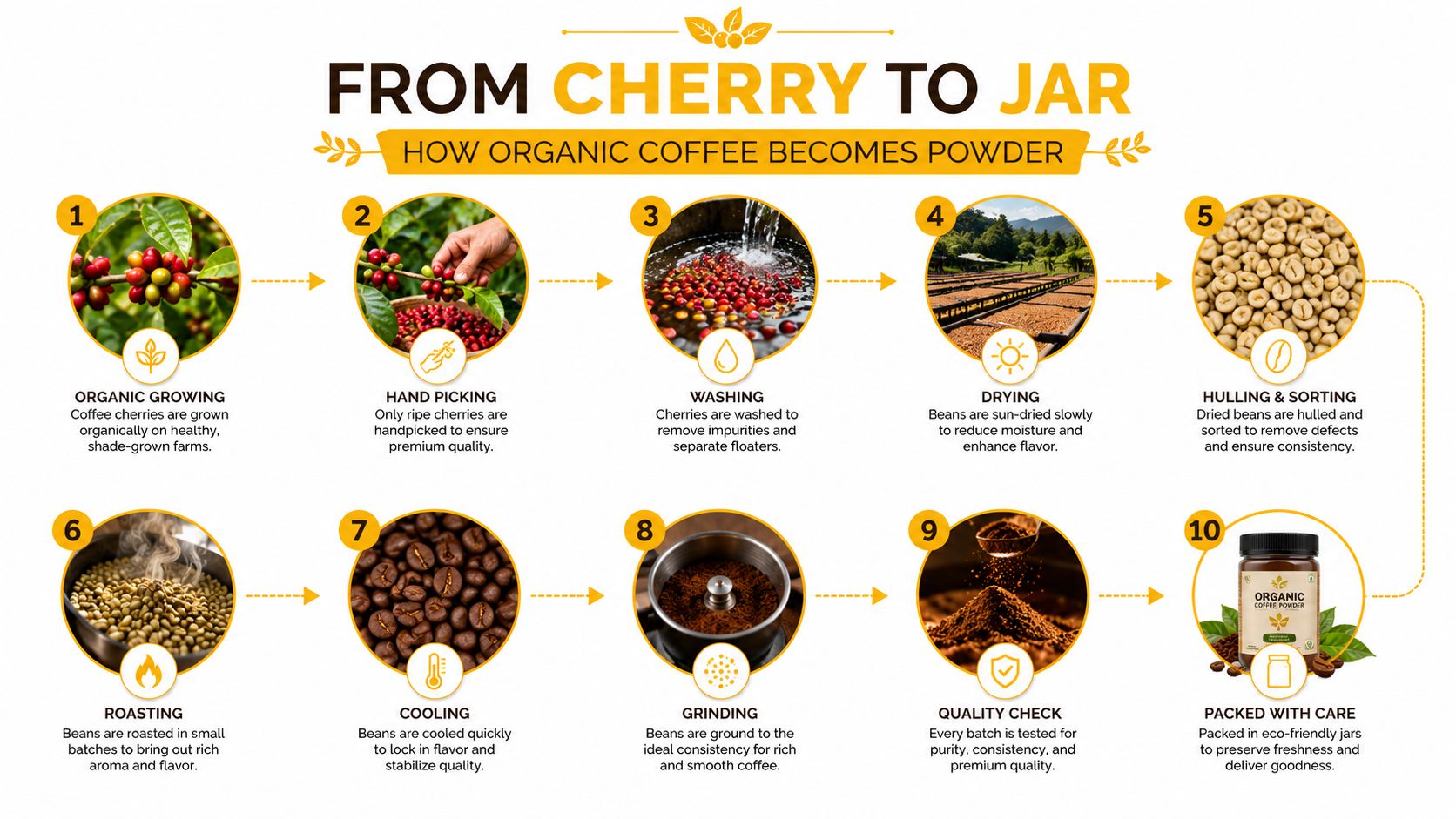
Why organic certification matters in processing
Certification is more than a farm label. The producer has to keep records, maintain audit trails, and separate organic lots from non-organic inventory so the beans do not get mixed with conventional product. That separation matters because once a lot is blended or mislabeled, the certified chain no longer matches the claim on the package.
The clean way to understand it is simple. Farm rules shape what enters the chain, and processing rules shape what leaves it. Soluble coffee costs more because it requires controlled sourcing, traceability, and additional processing steps that turn brewed coffee into a stable powder.
Why the powder format asks for more care
The production method depends on the final texture. Some manufacturers use spray drying, which turns liquid coffee into fine particles quickly. Others use freeze drying, which preserves more structure and is often linked with a cleaner, more aromatic instant cup. Either way, the coffee has to be concentrated first, then dried into a product that dissolves when hot water touches it.
That is why format quality matters so much in instant coffee. The same organic bean can taste sharp, stale, or flat if the transformation is rushed or the packaging is weak. If you want a visual walkthrough of how instant coffee is made, this instant coffee production process guide is a useful companion.
Organic on the label tells you about farming discipline, not automatic flavor quality. The powder still has to survive roasting, extraction, drying, and storage.
The FAO's trade paper shows that organic coffee has moved through international markets for years, not sitting at the edge of them FAO organic coffee market paper. That long trade history is part of why the powder category now feels mature rather than experimental.
How Organic Coffee Powder Stacks Up Against Other Options
A traveler standing in a grocery aisle, or a commuter trying to choose a desk stash, is usually comparing more than one kind of coffee at once. Organic coffee powder, regular instant coffee, fair trade bags, 100% Arabica specialty coffee, and even green coffee for home roasting can all look related on the shelf, but they answer different needs.
The simplest way to sort them is by the job each format does. If speed and low cleanup matter most, powder has a clear edge. If you want the most direct control over flavor, whole-bean specialty coffee usually gives you more room to adjust grind, dose, and brew method. If sourcing claims matter most, certification details deserve closer attention than the brewing format alone.
| Format | Brewing Time | Certifications | Price Tier | Best For |
|---|---|---|---|---|
| Organic Coffee Powder | Fast, just add hot water | Organic, sometimes additional sourcing claims | Usually mid to higher | Travel, commuting, quick home cups |
| Regular Instant Coffee | Fast, just add hot water | Often none | Usually lower | Pure convenience and budget |
| Fair Trade Coffee | Depends on format, usually brewed | Fair Trade, sometimes organic too | Varies | Buyers focused on producer standards |
| 100% Arabica Specialty Coffee | Slower, needs brewing gear | Often origin and quality grading, sometimes organic | Often higher | Flavor-first drinkers |
| Green Coffee | Slow, requires roasting | Rarely ready-to-drink certifications | Variable | Home roasters and experimenters |
The trade-off is straightforward. Organic coffee powder gives you convenience without forcing you to ignore sourcing. Regular instant coffee may be just as quick, but it usually gives you less visibility into farming practices. Specialty coffee can produce a more layered cup, yet it asks for gear, time, and more attention at brew time.
Where the format wins
Powder makes sense in real life, not just in product descriptions. Camping kits, office drawers, hotel rooms, and early departures all benefit from something that dissolves cleanly in hot water. That is why instant coffee is a format designed for speed and predictability.
The wider coffee market helps explain why these choices keep showing up. Market overviews from FAO-linked market summary and World Coffee Research both show a category that still rests on familiar habits, familiar bean types, and familiar buying patterns. Organic powder fits inside that established pattern, rather than sitting outside it.
For people trying to keep a small, practical setup, the logic is similar to reusable carry gear. A compact tote and a tin of coffee both earn their place by solving a daily problem without adding clutter, and this essential guide for eco-friendly totes is a useful parallel on choosing a carry solution that works in transit, on errands, or at a campsite.
Real Benefits Taste Health and Sustainability
A bag of organic coffee powder can promise a lot, but the value usually shows up in three places, taste, health, and sustainability. Those benefits do not come from one single label. They come from different parts of the chain, from farming choices to processing to how carefully a producer handles the finished powder.
Taste is shaped by more than the label
Organic farming can support cleaner-growing conditions, yet the cup still depends heavily on roast level, extraction, and the way the powder was made. A well-processed powder from a thoughtful producer will often taste cleaner and more balanced than a poorly made one, even if both are technically organic. Flavor in coffee works like a relay, each step passes something forward, and a weak handoff shows up in the mug.
That matters for shoppers who buy organic expecting quality, not just a farming claim. A low-grade instant powder can still taste flat or harsh if the roast was pushed too far or the drying process was rough. By contrast, a careful producer can preserve more of the coffee's natural sweetness and keep bitterness from taking over.
Health claims need a careful read
Organic certification meaningfully restricts agricultural inputs, but independent residue testing is still necessary to answer specific safety questions. The health conversation gets fuzzy when branding outruns evidence, especially for shoppers who want to know what the label does and does not cover. Independent testing found AMPA, a glyphosate breakdown product, in 100% of the organic coffees tested, which is exactly why certification should not be treated as the final word on residue concerns Clean Label Project coffee study.
The research base also leaves some important gaps. A review literature on organic coffee research shows that much of the discussion still centers on sustainability, agroforestry, certification governance, and climate resilience, rather than consumer-facing residue testing or product-format safety questions. Shoppers often want a direct answer to what is in the cup, while the literature often stays focused on broader production systems. That mismatch is part of why residue testing and traceability matter so much to careful buyers.
Sustainability is where the case is strongest
Organic systems are most compelling when you care about soil health, biodiversity, and farming practices that reduce dependence on synthetic inputs. That does not make every organic coffee perfect, and it does not remove shipping, packaging, or labor questions from the picture. It does mean the label often points toward a more soil-conscious production model.
The appeal is easy to understand for people who want convenience without feeling disconnected from sourcing. That is also why the broader market keeps growing, as shown in The Business Research Company market report. It reflects a steady demand for coffee that fits daily routines while still matching values around farming and environmental care. For a commuter, a camper, or someone packing light, that middle ground can be the whole point.
Brewing and Storing Organic Coffee Powder the Right Way
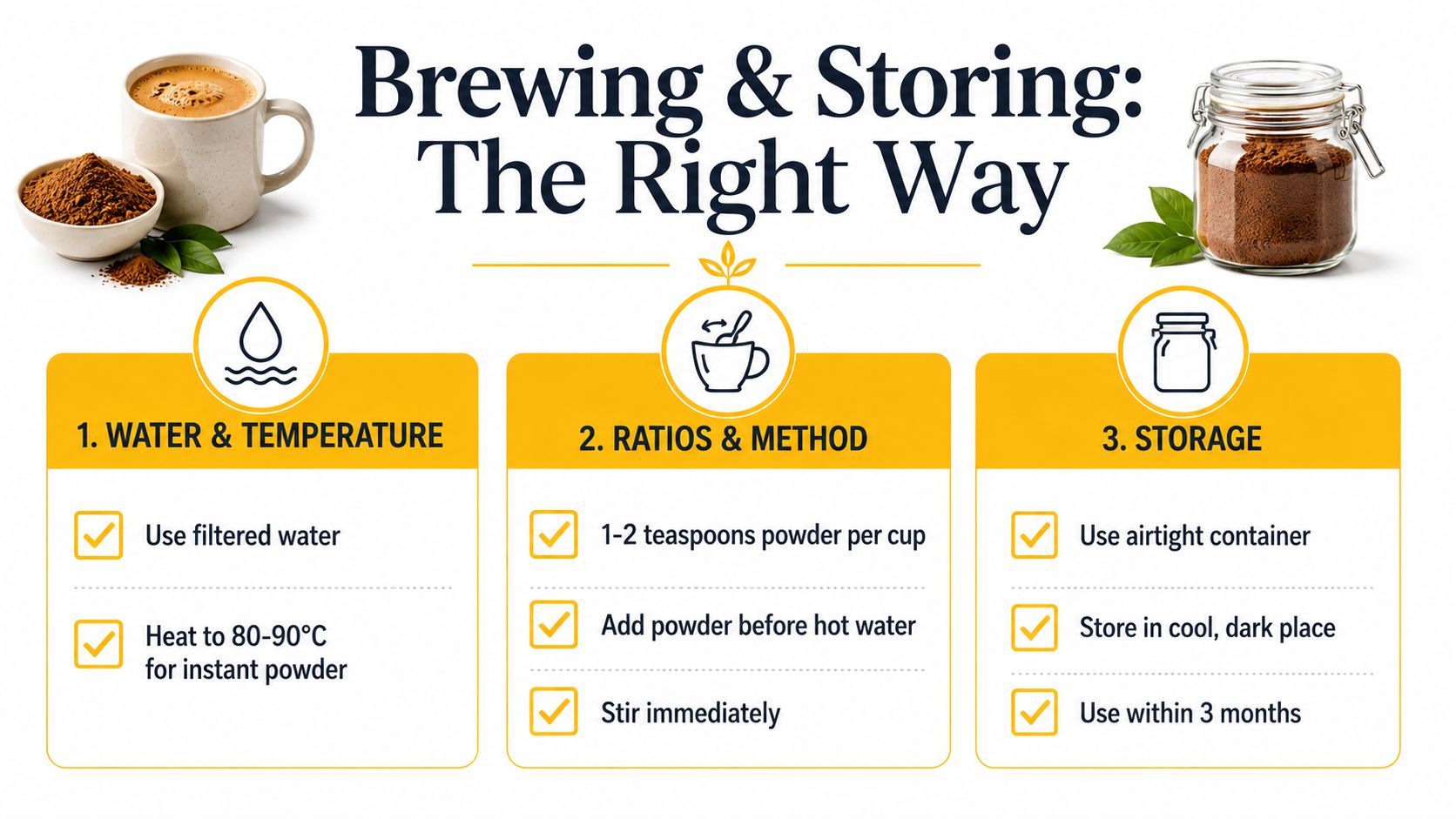
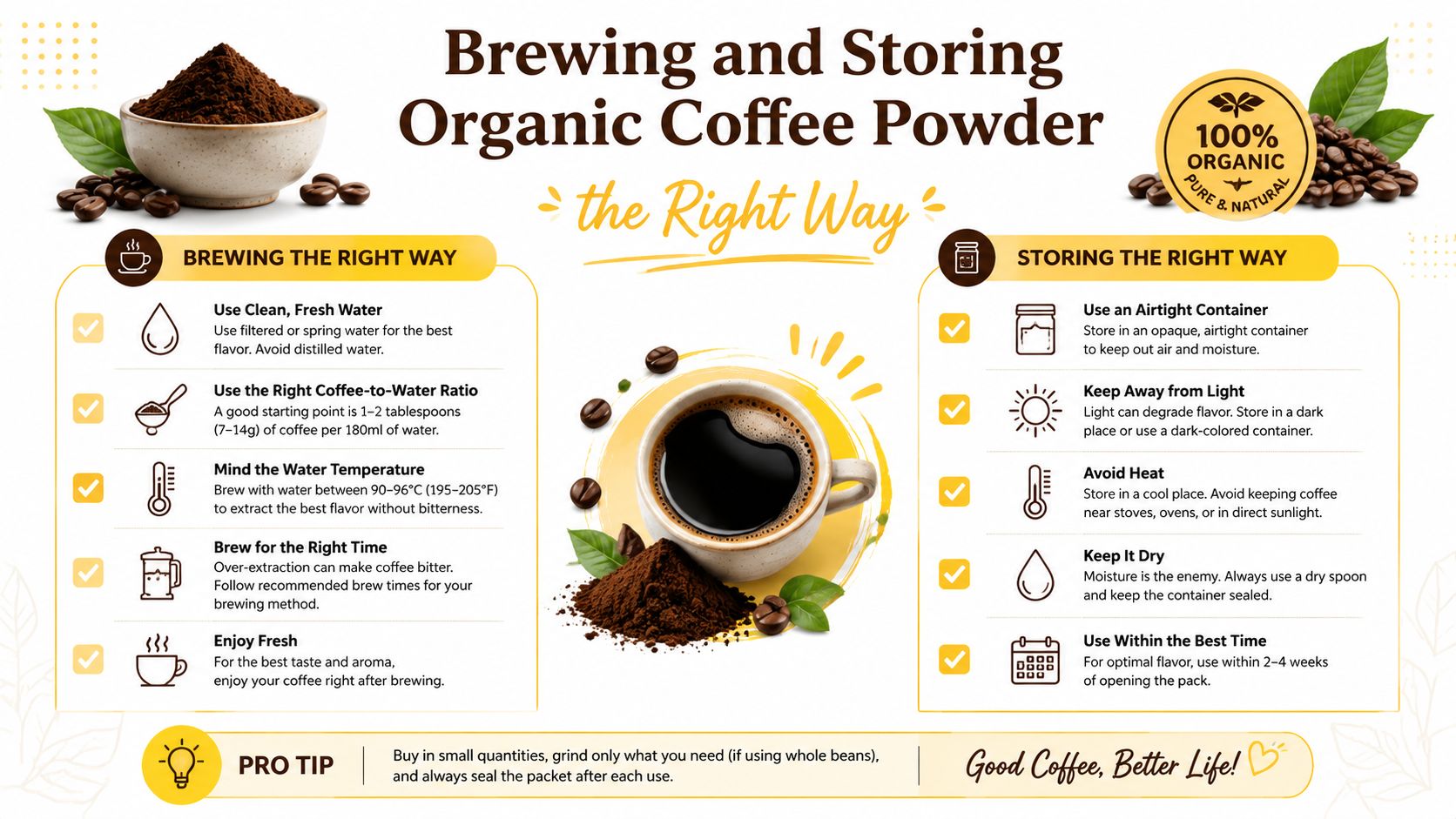
The first variable is water, because even a good powder tastes dull if the water is too hot or too cold. For instant powder, aim for 80 to 90°C, which is hot enough to dissolve the coffee cleanly without pushing it into a scorched, bitter edge. If you are making a cup quickly at home, in a hotel room, or at a trail stop, dissolve the powder in a little water first, then adjust with more hot water, milk, or sweetener.
Brewing habits that make a noticeable difference
A ceramic-insulated travel mug helps here because it holds temperature steadier than a thin cup, so the drink stays in that target range long enough to taste balanced. Start with the powder in the mug, add a small splash of hot water, and stir before filling the cup the rest of the way. That first stir matters more than it sounds, since it breaks up clumps and gives the powder a more even dissolve, much like wetting dry cocoa before adding the full amount of liquid.
If you want a cleaner result, use enough powder to give body without turning the cup muddy. Too little and the flavor can taste thin, almost like tea that has lost its backbone. Too much and the cup can become flat or overly dense, especially if you plan to add milk afterward. Add milk after the powder has dissolved, because the coffee mixes more evenly once the base is already clear.
Storage is where many good cups get lost
Coffee powder is hygroscopic, which means it absorbs moisture from the air. Once that happens, clumping is only part of the problem. The aroma fades, the surface can pick up stale notes, and the cup starts to taste older than it should. A supplier spec for instant coffee recommends sealed packaging, storage below 20°C, relative humidity below 60%, and a 24-month shelf life supplier spec for instant coffee powder.
At home, the simplest routine is the most effective. Keep the powder in an airtight container, put it in a cool, dark cupboard, and avoid leaving the lid open while water boils or the kitchen gets steamy. If you scoop from the jar with a damp spoon, you are feeding the same moisture problem from the other direction.
That is why aroma is often the best quick check. If the powder smells flat before brewing, storage is usually the first place to look. A well-kept jar can still make a pleasant cup for a long time, but once air and moisture get in, the flavor drops faster than many buyers expect.
Reading Certification Labels and Sourcing Claims
A bright seal on the front can feel reassuring at first glance, especially when you are standing in a store or scrolling through a product page and trying to decide fast. USDA Organic, EU Organic, and JAS all confirm organic compliance in their own systems, but each seal has limits. None of them automatically tells you whether the powder was checked for every residue concern, whether the farm relationship is transparent enough for your standards, or whether the company is serious about lot-level tracking. Fair Trade points to a different set of priorities, Rainforest Alliance points to another, and Demeter is about biodynamic practice rather than a blanket promise of cup quality.
The better habit is to read for detail. A page that only says “organic” gives you less to work with than one that names the origin, lot details, and any third-party verification. If the company also explains how the coffee is sourced and how custody is handled from farm to finished jar, you have a clearer basis for trust. That matters whether you are buying for a kitchen shelf, a travel mug, or a pack that needs to hold up on a commute.
Organic certification is a useful baseline, but it does not fully answer questions about traceability, lot separation, or residue testing. A coffee buyer may want those answers because the label alone does not show how carefully the supply chain is documented. The broader conversation around coffee sourcing has been moving toward that kind of accountability, and a gear for good overview can help frame why buyers keep asking for clearer proof of where products come from. For a wider view of how organic claims are discussed in coffee, see this organic certified coffee overview.
What to look for on a product page
A stronger product page gives you more than a badge. It should state where the coffee came from, how it was processed, whether the lot was kept separate from non-organic inventory, and whether the producer mentions any third-party verification. That still does not guarantee perfection, but it gives you concrete details instead of a marketing shortcut.
Look for origin names, lot numbers, and testing or certification details on the product page. If the wording stays broad, that is a sign to slow down and ask more questions. Specific farms, regions, or lots usually show more care than vague claims with no support behind them.
A seal starts the conversation, it does not finish it.
The important habit is reading for specificity, look for origin names, lot numbers, and third-party verification details on the product page.
A Focused Buying Guide for Quality-Minded Coffee Drinkers
If you care about both quality and values, don't buy organic coffee powder just because the label feels reassuring. Buy it because the producer gives you enough detail to trust the cup, and because the format fits your life. That means looking for a short ingredient list, clear origin information, intact packaging, and a roast or extraction style that matches how you drink coffee.
Cartograph Coffee is one example of a brand that sells organic instant coffee packets and describes a 100% organic Arabica freeze-dried coffee approach, which is the kind of format that makes sense when convenience matters but bean quality still matters too. The useful part isn't the logo, it's the idea that instant coffee can be treated as a serious coffee product rather than an afterthought. You can compare that mindset with options like this organic Peru coffee 1 lb bag if you want to judge how an organic powder stacks up against a more traditional single-origin format.
A quick buying checklist
- Ingredient simplicity: Look for coffee first, not a long add-in list.
- Origin clarity: Prefer products that name the source country or region.
- Packaging integrity: Choose sealed packs or jars that block air and moisture.
- Use case fit: Pick powder if you need camping convenience, office speed, or a low-mess travel cup.
- Taste expectation: Accept that instant is a different format, not a weaker version of brewed coffee.
advantage of a good powder is that it respects your routine. If you're brewing at dawn before a commute, or making a cup at a campsite with one pot and limited patience, the format is doing exactly what it should. That's not settling, that's choosing the right tool.
FAQs and Quick Tips for Every Type of Coffee Drinker
Does organic instant coffee have the same caffeine as regular instant? It can, but the label alone doesn't tell you the exact caffeine level. The amount depends more on the coffee blend, serving size, and how concentrated the powder is than on the word organic.
Is it okay in moderation during pregnancy? Many people choose to limit caffeine during pregnancy, so the safest move is to check with a clinician about your own intake. The organic label doesn't change the caffeine question, it only changes how the coffee was produced.
Is it better than cold brew for busy mornings? For pure speed, powder usually wins because it's instant. Cold brew can be smoother, but it takes planning and refrigeration, which makes it less practical for rushed mornings.
What's the best camping method? Use a mug, hot water, and a spoon. Dissolve the powder first, stir well, and skip extra gear unless you really want it.
Quick tips
- Commuters: Pre-pack single servings so you don't guess on the train platform.
- Campers: Keep the powder sealed and dry, moisture is the enemy.
- Families with kids: Store it apart from sweeteners and drink mixes to avoid mix-ups.
- Health-focused drinkers: Read beyond the organic seal and look for traceability details.
If you want an organic coffee powder that treats convenience like a real product design choice, take a look at Cartograph Coffee. The brand's organic instant format is built for people who want a fast cup without giving up on sourcing, and it's a straightforward place to start if you're ready to compare labels, packaging, and flavor with more confidence.