You're standing in front of a coffee shelf, looking at bags labeled light, mild, medium, and dark. One promises brightness, another says smooth, and a third uses “mild” without explaining whether that means less acidity, less caffeine, or just less roasted flavor. You want a cup with character, but you don't want bitterness or heaviness before the day has properly started.
Mild roast coffee is best understood as a drinker-centered description, not a precise roast grade. In practice, it usually points toward the balanced middle of the spectrum, especially medium roast, where caramel-like sweetness, moderate body, and recognizable bean character meet. That makes it useful for people who want coffee that's smooth and approachable without tasting flat.
The important question isn't whether a bag uses the word “mild.” It's what the roast, bean, brew method, and serving format will do in your cup. Once you understand those relationships, you can choose more confidently for flavor, digestive comfort, caffeine expectations, convenience, and everyday routine.
Introduction to Mild Roast Coffee and Why It Matters
A bag marked “mild” can lead to very different first sips. One coffee may taste sweet and rounded, another bright and tangy, while a third carries smoky flavors despite the same label. Mild describes an experience more often than it describes a standardized roast endpoint, so the package word alone cannot predict the cup.
For many drinkers, that experience feels gentle rather than forceful. You may find soft sweetness, moderate acidity, a smooth texture, and an aftertaste without a strong burnt edge. The term often separates this style from very light coffees built around sharp fruit and dark coffees shaped mainly by roast flavors.
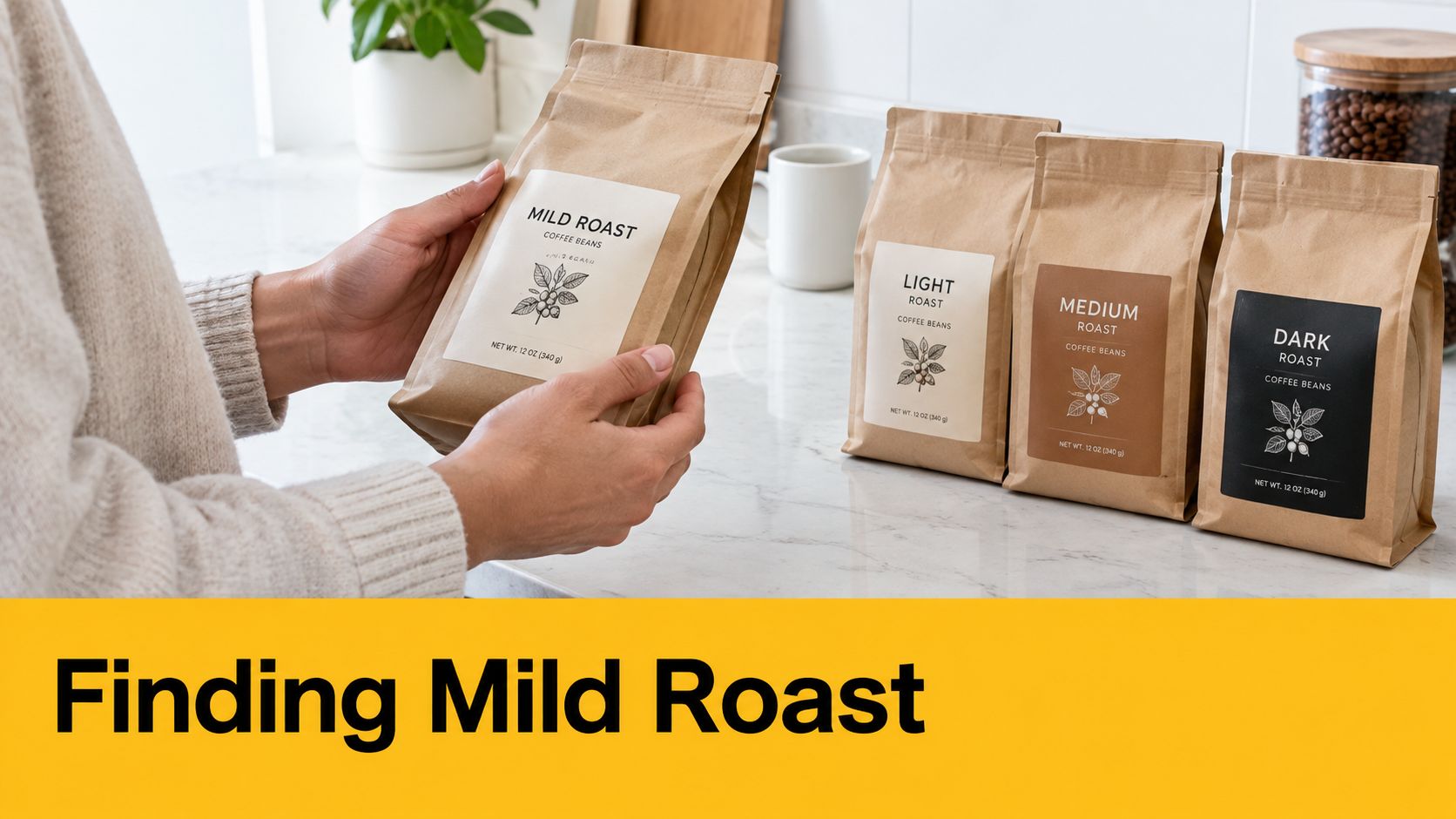
A practical meaning for everyday buyers
Roast choice works like a volume control. Light roasting tends to make origin-specific acidity and aromatics more prominent. Dark roasting raises roast-derived bitterness, smoke, and body. Mild roast sits near the middle, where the coffee's identity remains present but the cup feels less demanding.
That middle is why the term appears so often in everyday buying conversations. One 2025 market estimate places medium roast at 42.3% of global roasted coffee consumption, while another 2025 report places medium roast preference at 49%. Together, those figures suggest that the style many drinkers call mild is a mainstream choice rather than a niche preference (market estimate and roast preference data).
“Mild” still cannot tell you everything. Bean origin, processing, freshness, brewing, and serving format can shift the result, even when two bags sit around the same roast position. Treat the word as a starting signal, then read the tasting notes and preparation guidance.
Why the distinction improves your choices
A quiet breakfast may call for a rounded cup. A work mug may need familiar sweetness without a heavy smoky finish. A quick instant coffee while traveling adds another consideration: preparation time. Cartograph Coffee's organic instant coffee format is designed for home, work, travel, and outdoor use, so it addresses convenience while the roast choice shapes whether the cup tastes bright, balanced, or bold.
The useful question is not whether mild is printed on the package. Ask what level of acidity feels comfortable, how much roast flavor you want, and how the coffee will be prepared. That approach turns a vague label into a practical choice.
What Mild Roast Coffee Really Means
You want a coffee that tastes rounded at breakfast, keeps some origin character, and does not lead with smoke or char. A bag labeled mild roast may fit that preference, but the phrase does not identify one official roast grade.
Mild roast coffee isn't a formal roast grade with one universal definition. It is a drinker-centered description for a balanced point around medium roast. One roaster's mild may sit closer to light, while another's may approach medium-dark. Because the label shifts between roasters, the tasting notes and brewing guidance deserve more attention than the adjective alone.
Toast offers a useful comparison. Bread heated briefly stays pale, soft, and grain-forward. More heat and time bring golden color, aroma, and sweetness. Still longer produces firmer texture and darker, more bitter or charred flavors.
Coffee beans change in a related way, although their chemistry is more involved. Roasters control time, temperature, airflow, and the point at which the beans leave the roaster. As roasting develops, beans lose moisture, darken, form new aromas, and move from flavors associated with green coffee toward flavors created by heat. An overview of roasting time and coffee chemistry describes this relationship between development and flavor.
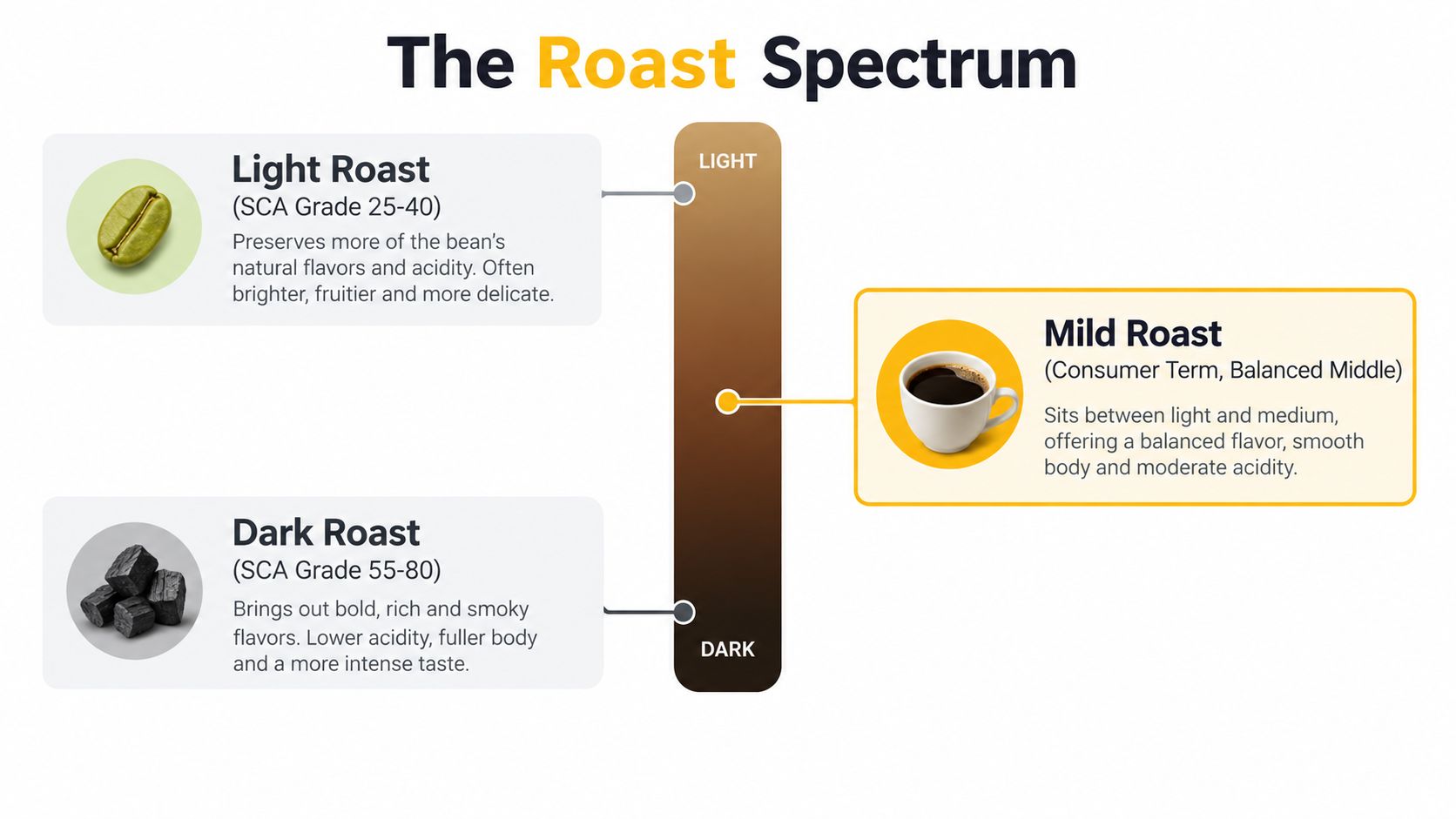
Reading the spectrum without getting trapped by labels
Use the roast spectrum as a direction, not a strict scale:
- Light roast: Shorter development preserves more of the bean's original acidity and aroma.
- Mild or medium roast: More development adds sweetness and body while retaining recognizable origin character.
- Dark roast: Longer development emphasizes roast flavors, deeper bitterness, and heavier texture.
The word “mild” also does not mean weak. Weak describes the concentration of the brewed drink, while mild describes the flavor experience. A mild roast brewed with too little coffee or too much water can taste thin. The same beans, prepared carefully, can produce a rich and satisfying cup.
What to look for on the package
Read beyond the front label. Caramel, cocoa, nuts, brown sugar, and milk chocolate usually point toward a rounded profile. Lemon, jasmine, and stone fruit suggest more brightness, while smoke, charcoal, and dark chocolate indicate stronger roast character.
Useful rule: Treat “mild” as an invitation to investigate the flavor notes, not as a complete tasting description.
For a balanced daily coffee, look for medium or medium-light wording, a clear sweetness description, and instructions suited to your equipment. That makes the label useful without treating it as a precise grade.
How Mild Roast Compares to Light Medium and Dark Roasts
Suppose one coffee tastes like berries and tea, another like caramel and nuts, and a third like smoke and bittersweet chocolate. Roast level helps explain that shift, although the label “mild” does not mark a formal point on every roaster's scale.
Light roast usually preserves more acidity and floral or fruit-like aromas. Medium roast develops more caramelized sweetness and body. Dark roast gives the roasting process a stronger voice, often producing smoke, char, and a longer bitter finish.
Mild roast generally sits near medium roast, sometimes slightly lighter or darker according to the roaster. Its appeal is a drinker-centered sweet spot: enough clarity to show the bean's character, with enough sweetness and texture to keep the cup comfortable and rounded.
| Roast Level | Flavor Profile | Acidity and Body | Best For |
|---|---|---|---|
| Light | Citrus, berries, florals, tea-like aromatics | Brighter acidity, lighter body, crisp finish | Drinkers who want vivid origin character |
| Mild or medium | Caramel, nuts, cocoa, balanced fruit | Moderate acidity, rounded body, smooth finish | Everyday drinkers seeking balance |
| Dark | Toast, smoke, bittersweet chocolate, char | Lower perceived brightness, heavier body, longer finish | Drinkers who prefer bold roast flavor |
Why the differences appear
Light roasting ends earlier, so more of the bean's original chemical character remains available in the cup. Light roast beans are commonly dropped around 196°C to 205°C, or 385°F to 401°F. Medium roast receives more development, allowing sweetness and roasted aromas to become more prominent without fully covering the origin. Dark roast continues further, making roast-derived flavors more likely to outweigh the bean's individual character.
Mild roast works well beside food because it has enough sweetness and body to support a meal without taking over. A light roast can sharpen the fruitiness of a pastry, while a dark roast can match a rich breakfast. Mild roast sits between those effects, with enough body for milk and enough clarity to remain enjoyable black.
Choosing by sensory preference
Choose light when you enjoy tartness, floral aroma, and a clean finish. Choose mild or medium when you want dependable sweetness, moderate body, and fewer sharp edges. Choose dark when smoky, bitter, and heavy flavors appeal to you.
A simple question makes the choice clearer: do you want to taste the bean's origin, the balance between bean and roast, or the roast itself? Mild roast usually suits the second preference. For drinkers who want a familiar daily cup without losing all origin character, that middle ground can be more useful than chasing a strict roast label.
Is Mild Roast Less Acidic or Lower in Caffeine
A drinker chooses mild roast for a gentler cup, then finds bright acidity or unexpectedly strong energy. The name suggests a fixed result, but “mild” usually describes a drinker-centered sweet spot around medium roast, not a formal guarantee about stomach comfort or caffeine. Roast development matters, yet bean chemistry, brewing, grind, water, dose, and serving size shape the cup too.
The acidity answer is more complicated
Lighter roasting generally preserves more chlorogenic acids than darker roasting. One summary reports roughly 50% of chlorogenic acids survive in light roast, compared with about 20% to 30% in medium roast and under 10% in dark roast (roast development and acidity chemistry). These compounds contribute to the coffee's chemical profile, but their presence does not predict stomach comfort by itself.
Light coffee may taste brighter because it retains more acids associated with citric and malic character. Extraction then changes how that brightness appears. A suitable brew can make it lively and clear, while uneven or excessive extraction can make it seem sour or astringent. Mild roast often softens that sharp impression compared with a lighter roast, yet it can still taste bright.
Chemical acidity and perceived comfort are different questions. A coffee can measure as more acidic without causing the same response for every drinker. Preparation adds another variable: cold brew can taste less acidic than hot brew regardless of roast, so anyone seeking a gentler experience should consider both the beans and the brewing method. For practical ways to adjust the cup, see this guide to reducing coffee acidity.
The practical answer: Mild roast may taste smoother than light roast, but it is not automatically less acidic or easier on your stomach.
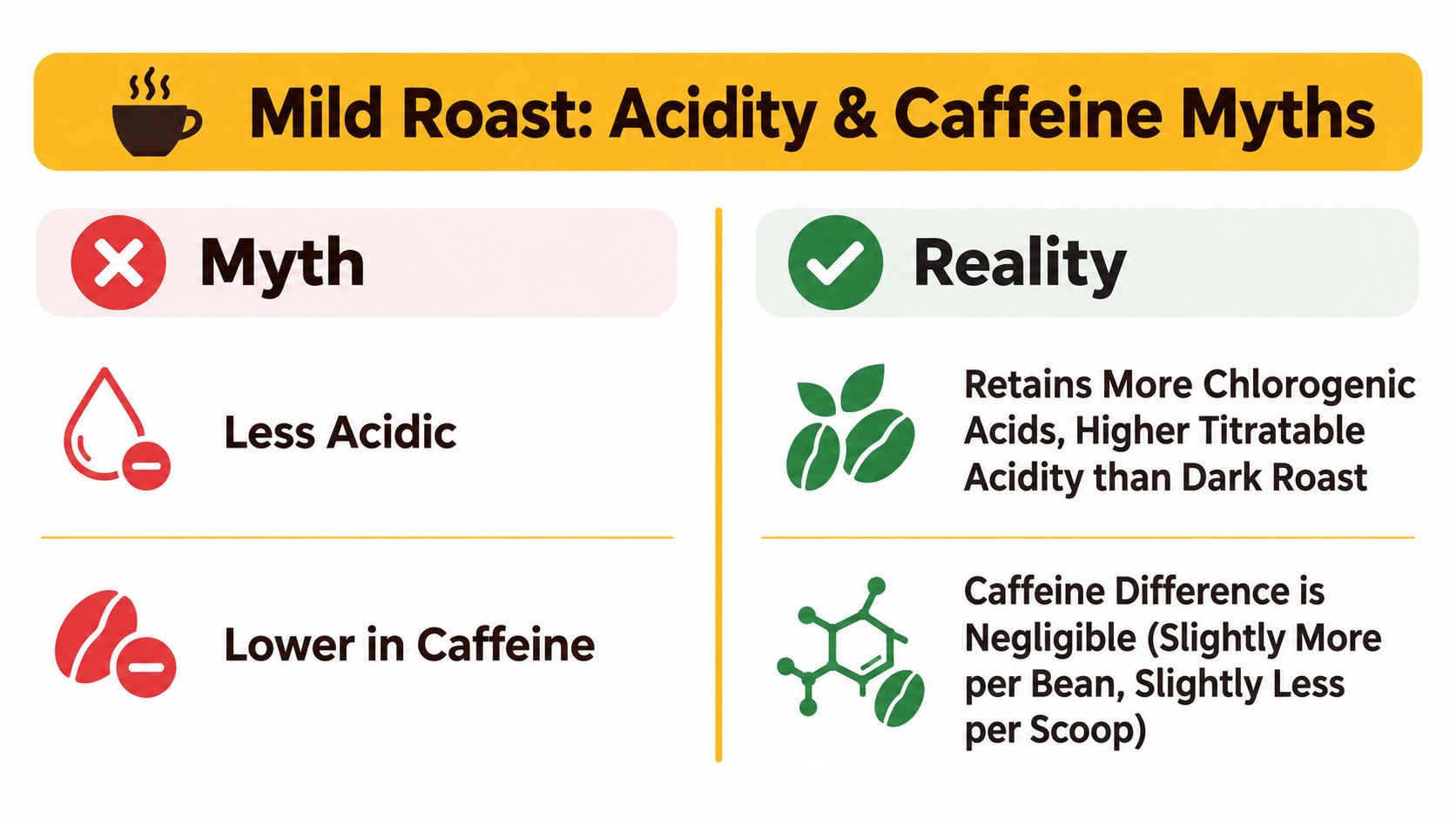
Caffeine depends on how you measure
Roasting changes caffeine concentration only modestly, so roast color alone cannot promise a stronger or weaker serving. The more useful question is how you measure the coffee.
By weight, caffeine is often broadly similar across roast levels. By volume, lighter beans are denser, while darker beans expand more during roasting. A scoop of lighter beans can therefore contain more coffee material than the same scoop of darker beans.
Your actual cup also depends on dose, grind, water volume, and brewing style. A weighed recipe may produce a similar caffeine expectation across roast levels, while a scoop-based recipe can behave differently. Mild roast is not automatically lower in caffeine.
Instant coffee adds a separate practical variable. Its serving is determined by the product portion and the amount of water added, rather than by the density of whole beans in a scoop. For caffeine and acidity, choose based on the finished serving and your response to it, not the roast name alone.
How to Brew Mild Roast Coffee for Balanced Flavor
A mild roast can taste sweet and rounded, yet the same beans may produce a sour or thin cup when the recipe leaves too much flavor behind. Because medium-style beans tend to be denser and less soluble than dark-roasted beans, they often respond well to hotter water and a slightly finer grind. The goal is balance, not maximum intensity.
Start with water around 94°C to 96°C, or approximately 201°F to 205°F, then adjust according to taste. Use a finer-to-medium grind and a brew ratio near 1:16.5 to 1:17 as a practical starting point for dense beans.
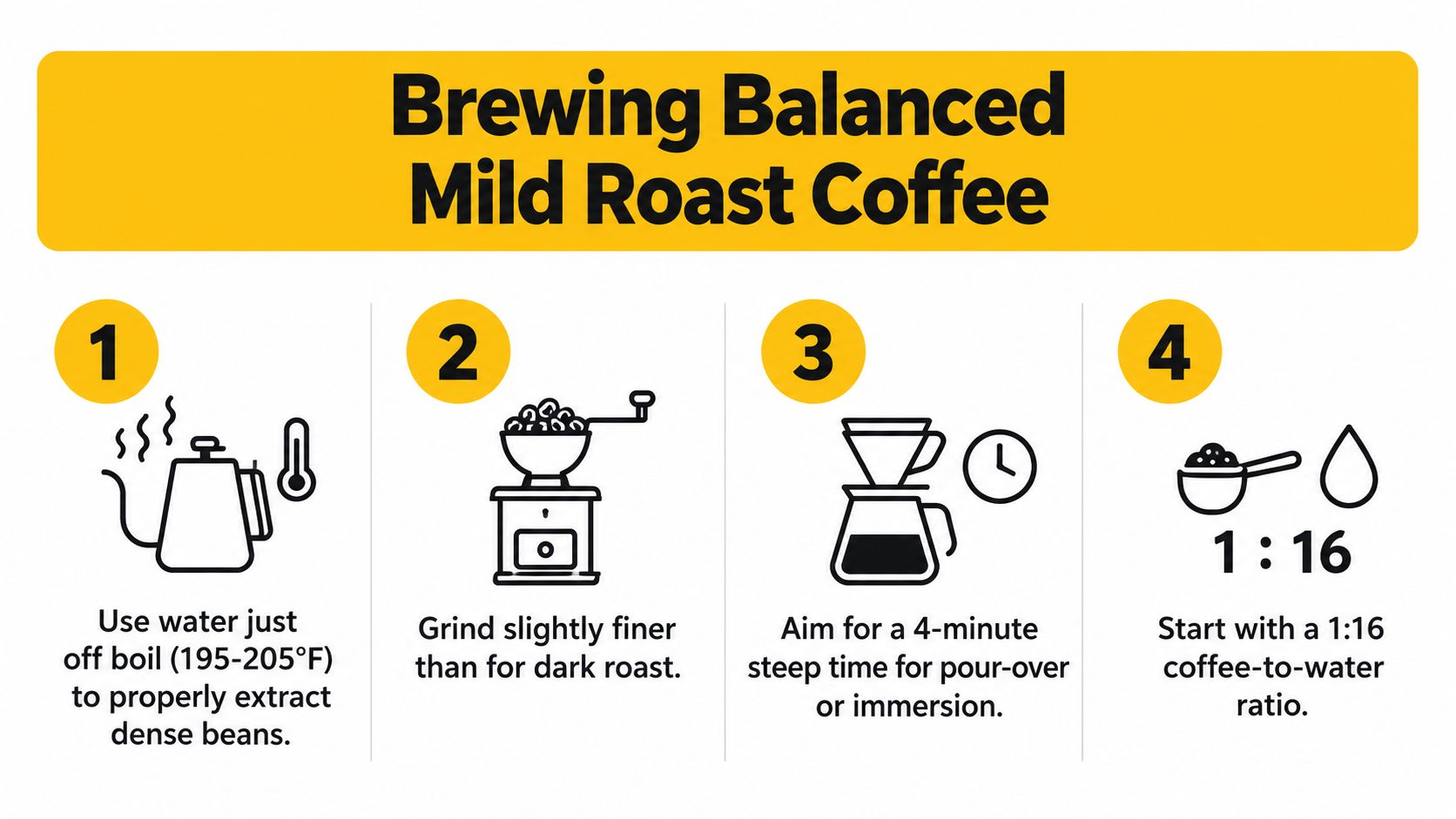
A reliable starting recipe
For pour-over or automatic drip, use freshly ground mild roast coffee, hot water, and the ratio above. Pour in controlled stages so the grounds become evenly saturated instead of flooding one area. Contact time varies with the brewer, filter, dose, and grind, so use flavor as your guide rather than chasing one fixed time.
If the cup tastes sour, grassy, or hollow, increase extraction. Grind a little finer, raise the water temperature, or let the coffee brew longer. If it tastes dry, harsh, or bitter, reduce extraction by grinding slightly coarser, lowering the temperature, or shortening the brew.
French press changes the texture as well as the extraction. Begin with a medium-coarse grind, let the grounds remain fully immersed, and press gently. A weak cup may need a finer grind or longer steep. If sediment and dryness take over, grind coarser and press more slowly.
Instant coffee needs a different approach
Instant coffee removes grinding and many brewing variables, but water temperature still shapes the result. Use hot water that is not aggressively boiling, dissolve the crystals completely, and adjust the amount of coffee to your taste. A larger serving does not automatically create a better cup.
Mixing the crystals with a small amount of cool water first can create a smooth slurry before you add the rest. This helps prevent dry pockets and produces a more even drink when you are preparing coffee at a desk, campsite, or hotel room.
For a broader comparison of pour-over, immersion, drip, and other coffee brewing methods, choose the approach that fits your equipment and routine.
Here's a visual walkthrough for a balanced preparation:
Use taste as your diagnostic tool
- Sour and sharp: The water may not have extracted enough flavor.
- Thin and empty: The recipe may be too dilute, or the grind may be too coarse.
- Dry and puckering: Extraction may be uneven or excessive.
- Sweet and clear: Keep the recipe stable and change one variable at a time.
When to Choose Mild Roast Pairings and Quality Cues
Mild roast fits routines where you want coffee to support the moment instead of defining it. It works at a breakfast table, beside a laptop, or in a travel mug because its balanced profile can remain pleasant across different serving styles. You can drink it black, add milk, or use it as a base for a simple iced coffee without automatically creating a heavy flavor.
Food pairing becomes easier when you think in terms of intensity. Mild roast's sweetness and moderate body complement foods that are delicate or lightly rich:
- Pastries: Caramel and nut-like notes can support croissants, scones, and simple cakes.
- Fruit: A balanced cup can accompany berries or stone fruit without creating a sharp clash.
- Light breakfasts: Eggs, toast, yogurt, and oatmeal leave room for the coffee's aroma.
- Creamy desserts: Moderate roast character can cut through sweetness without the smoky edge of a dark roast.
Match the format to the day
A pour-over gives you control when you want to taste aromatics. Automatic drip suits a shared morning pot. French press offers more texture. Instant coffee makes sense when carrying a grinder, scale, or brewer isn't practical, such as at work, while camping, or during travel.
Quality still matters in a convenient format. For an organic instant mild roast, look for clear origin information, an organic certification statement, a roast description that explains the intended flavor, and notes that sound specific rather than merely “smooth” or “premium.”
A good product description should help you predict the cup. If it tells you whether the coffee leans toward cocoa, nuts, caramel, fruit, or brighter acidity, you can pair it with your preferences instead of buying based on the word mild alone.
Keeping Mild Roast Fresh and Choosing Your Next Cup
Mild roast coffee depends on balance, and delicate aromatics can disappear when coffee meets oxygen, heat, moisture, or light. Store whole beans in an airtight opaque container in a cool, dry cupboard. Keep instant coffee sealed tightly after opening, and avoid storing it beside a kettle or stove where repeated heat and humidity can reach the container.
Freshness starts with the package. Look for a roast date when buying whole beans, then give the coffee time to settle before judging it. Freshly roasted coffee can release trapped gas, which may make early brews taste uneven. Once opened, protect the coffee from air and moisture and use your senses to watch for fading aroma, dull sweetness, or stale flavors.
For more detailed storage guidance, follow this guide on storing coffee beans properly.
A simple buying checklist
- Flavor direction: Choose balanced notes such as caramel, cocoa, or nuts if you want a rounded daily cup.
- Acidity preference: If bright coffee bothers you, avoid choosing solely by roast name and consider a brew method that produces a gentler experience.
- Caffeine expectations: Judge the recipe and serving style, not just the roast label.
- Convenience: Select whole bean, ground, drip, or instant according to where and how you'll drink it.
- Values and transparency: Check for origin details and organic certification if those choices matter to you.
The most useful definition is also the simplest: mild roast is a balanced middle ground for drinkers who want flavor without extremes. Once you connect roast level with brewing and format, the label becomes a guide rather than a guess.
Cartograph Coffee offers organic instant coffee for home, work, travel, and outdoor routines, including occasions when you want mild roast character without carrying brewing equipment. Visit Cartograph Coffee to explore a convenient option for building a smoother daily coffee ritual.