If you're looking to lower the acidity in your coffee, the quickest fixes are choosing dark roast beans from low-altitude places like Brazil or Sumatra and switching up your brewing style. Methods like cold brew or a French press, which rely on coarser grinds and cooler water, are fantastic at extracting fewer of those acidic compounds. These simple swaps are often all it takes to get a smoother, more comfortable cup.
What Coffee Acidity Really Means for Your Cup
When you hear a coffee pro talk about "acidity," they're probably not talking about pH levels. In the coffee world, acidity is a flavor note—that bright, tangy, almost fruity quality that gives a cup its crisp, lively character. Picture the tartness of a green apple or the zesty kick of a lemon. This "brightness" is actually a prized trait in many high-end Arabica coffees.
But what tastes bright and complex to one person can feel sour and harsh to another, especially if you have a sensitive stomach. The very same organic compounds, like citric and malic acid, that create those desirable flavors can also be the source of discomfort. Grasping this difference is the first real step toward brewing coffee that not only tastes great but feels good, too.
The best part? You have a ton of control over the final acidity level. It all comes down to a few key decisions:
- Bean Origin and Type: Where your coffee is from and its specific variety have a massive impact.
- Roast Level: The roasting process fundamentally changes the bean's chemical structure, including its acid content.
- Brewing Method: How you choose to make your coffee determines which flavors and compounds end up in your mug.
This decision tree offers a great visual overview of the different paths you can take to dial down the acidity.
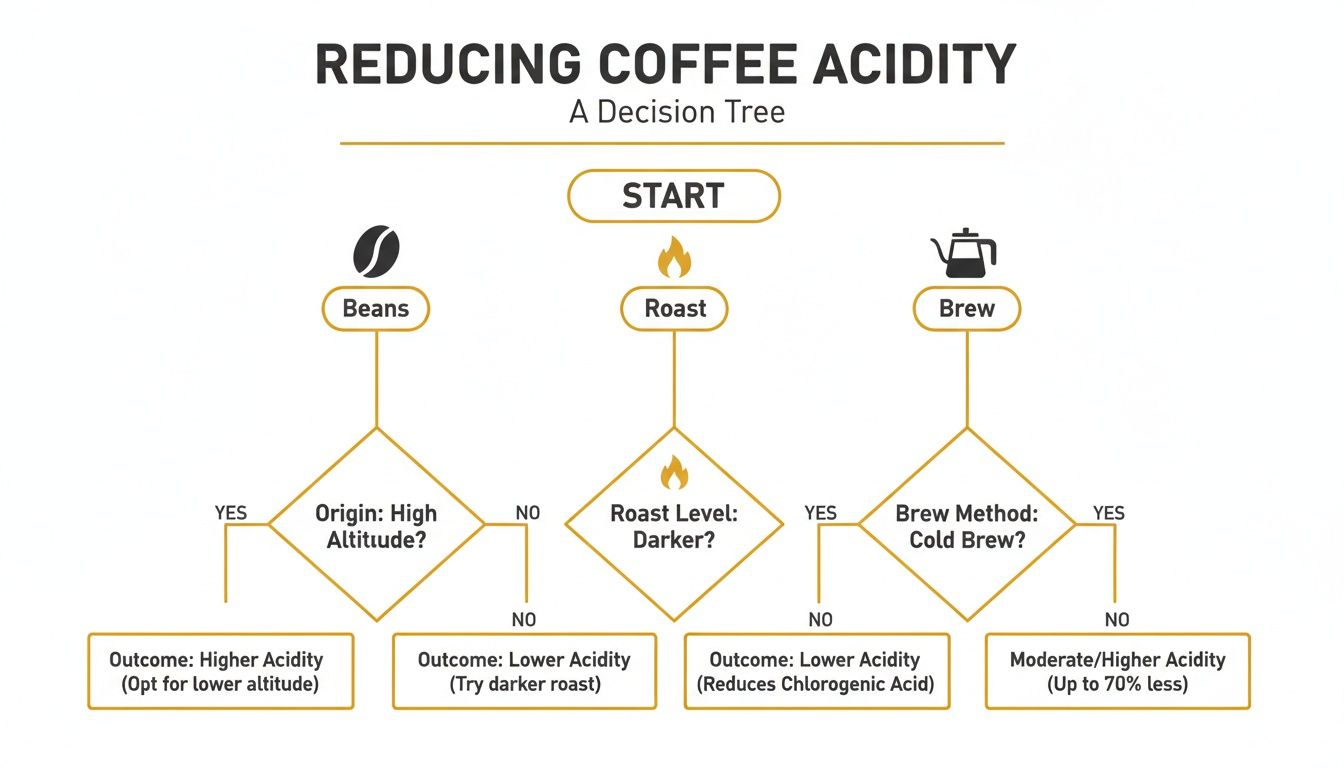
As you can see, your choice of bean, how it's roasted, and the way you brew it are the three most powerful levers you can pull to craft a smoother coffee experience.
Key Takeaway: Taming coffee acidity isn't about some complex chemical battle. It's about making smart, intentional choices. By picking the right beans and using a gentler brewing process, you can easily minimize harshness without sacrificing rich, satisfying flavor. A great starting point is understanding the different types of coffees out there; if you begin with a naturally low-acid bean, you're already halfway to a better brew.
Quick Guide to Lowering Coffee Acidity
For those who want a quick reference, this table summarizes the most effective ways to reduce coffee acidity, from the coffee shop to your kitchen counter.
| Technique | Impact Level | Best For |
|---|---|---|
| Choose Dark Roasts | High | Anyone wanting a rich, bold flavor profile with noticeably less bite. |
| Select Low-Altitude Beans | High | Coffee drinkers who prefer earthy, nutty, and chocolatey notes. |
| Use a Coarser Grind | Medium | Drip, pour-over, and French press users looking for a quick adjustment. |
| Brew with Cooler Water | Medium | People who want to smooth out their current beans without changing them. |
| Try Cold Brewing | Very High | Those with sensitive stomachs or anyone who loves an ultra-smooth, mellow coffee. |
This isn't an exhaustive list, of course, but focusing on these key areas will give you the most significant results in your quest for a less acidic cup.
Start with the Right Beans and Roast
Your quest for a smoother, less acidic cup of coffee doesn't start with your coffee maker. It begins with the beans themselves. Honestly, this is the single most important choice you can make to fend off that unwanted sourness or stomach-churning acidity.
Think of it this way: you can’t make a great marinara sauce with bad tomatoes. If you start with beans that are naturally low in acid, you're already halfway to a gentler brew.
Choose Beans from Low-Altitude Regions
Geography plays a massive role in how a coffee bean tastes. Beans grown way up in the mountains—think Ethiopia or Kenya—tend to be dense and develop bright, complex, and very acidic flavors. While coffee aficionados love these, they're probably not what you're looking for.
Instead, zero in on beans from lower-altitude growing regions. These coffees ripen in warmer climates, which naturally leads to a more mellow, less acidic profile.
- Brazil: A classic choice for nutty, chocolatey coffee with almost no sharp acidity.
- Sumatra (Indonesia): Famous for its earthy, syrupy, and incredibly smooth character.
- Mexico: Often produces beans with a gentle sweetness and a nice, balanced mildness.
By picking beans from these places, you're setting yourself up for success from the very beginning.
Go for a Darker Roast
The roaster's craft is where the real acid-taming magic happens. As beans tumble in the heat, their chemical makeup changes dramatically. Light roasts are pulled from the roaster early, preserving a lot of the original organic acids that give them that bright, zesty kick. Darker roasts do the complete opposite.
The longer a bean roasts, the more these acidic compounds break down and diminish. It’s not just a flavor shift; the bean's actual chemistry is being altered to become less acidic. In fact, one analysis found that switching from a light to a dark roast can slash total acids by about 0.8 mg/mL, making it a much friendlier option for your stomach. You can dig into more of these coffee acidity findings on greenplantation.com.
A Quick Tip: A common myth is that dark roasts are "stronger," but they actually have slightly less caffeine by weight than light roasts. The extended roasting process makes the beans lose mass, and with it, a little bit of caffeine.
Consider the Bean Species
Finally, the type of coffee plant matters. The two big players on the world stage are Arabica and Robusta, and they bring very different things to the table when it comes to acidity.
- Arabica beans are prized for their complex, aromatic flavors, but they are generally higher in acidity.
- Robusta beans, on the other hand, are naturally lower in acid and higher in caffeine. They deliver that bold, "classic" coffee punch.
While the specialty coffee world often sings the praises of 100% Arabica, don't shy away from blends that incorporate some Robusta if low acidity is your top priority. You can learn more in our guide on Arabica vs. Robusta beans.
Putting it all together—a low-acid origin, a dark roast, and the right bean variety—creates a powerful trifecta for brewing the smoothest cup possible.
Mastering Your Brew for a Milder Flavor
Choosing the right beans is a huge first step, but your brewing technique is where the real magic happens. This is where you get to take the wheel and steer the final flavor of your coffee. How you extract flavor from the grounds has a direct, powerful impact on the acidity that ends up in your cup. With just a few tweaks, you can transform a sharp, tangy coffee into something wonderfully smooth and mellow.
Think of it like searing a steak. Too much heat for too long, and you get something tough and charred. But with the right temperature and timing, you get perfection. Coffee is no different; gentler extraction methods pull out those deep, rich flavors we all love while leaving the harsher, more acidic compounds behind.
Embrace Immersion and Colder Temperatures
The secret to a less acidic cup often comes down to two things: water temperature and contact time. Hot water is incredibly efficient at extraction—it quickly dissolves oils, sugars, and, of course, acids. By simply lowering the temperature, you change the very chemistry of what dissolves into your water.
This is exactly why immersion brewing methods are a game-changer for anyone looking to dial back the acidity. These methods, where the grounds are fully submerged for the entire brew, give you pinpoint control over both temperature and duration.
- French Press: This classic uses a coarser grind and a longer steep time. The result is a full-bodied coffee that’s naturally less acidic than what you’d get from a fast-drip method.
- AeroPress: While famous for its espresso-style shots, you can easily use it for a full-immersion brew with lower-temperature water for an exceptionally smooth cup.
Lowering your water temperature is one of the easiest and most effective things you can do. The standard brewing range is usually around 195-205°F, but try dropping it to 185°F. You'll be surprised at how much that can mellow out the acidic bite. You can learn more in our complete guide to the best water temperature for brewing coffee.
The Ultimate Acidity Killer: Cold Brew
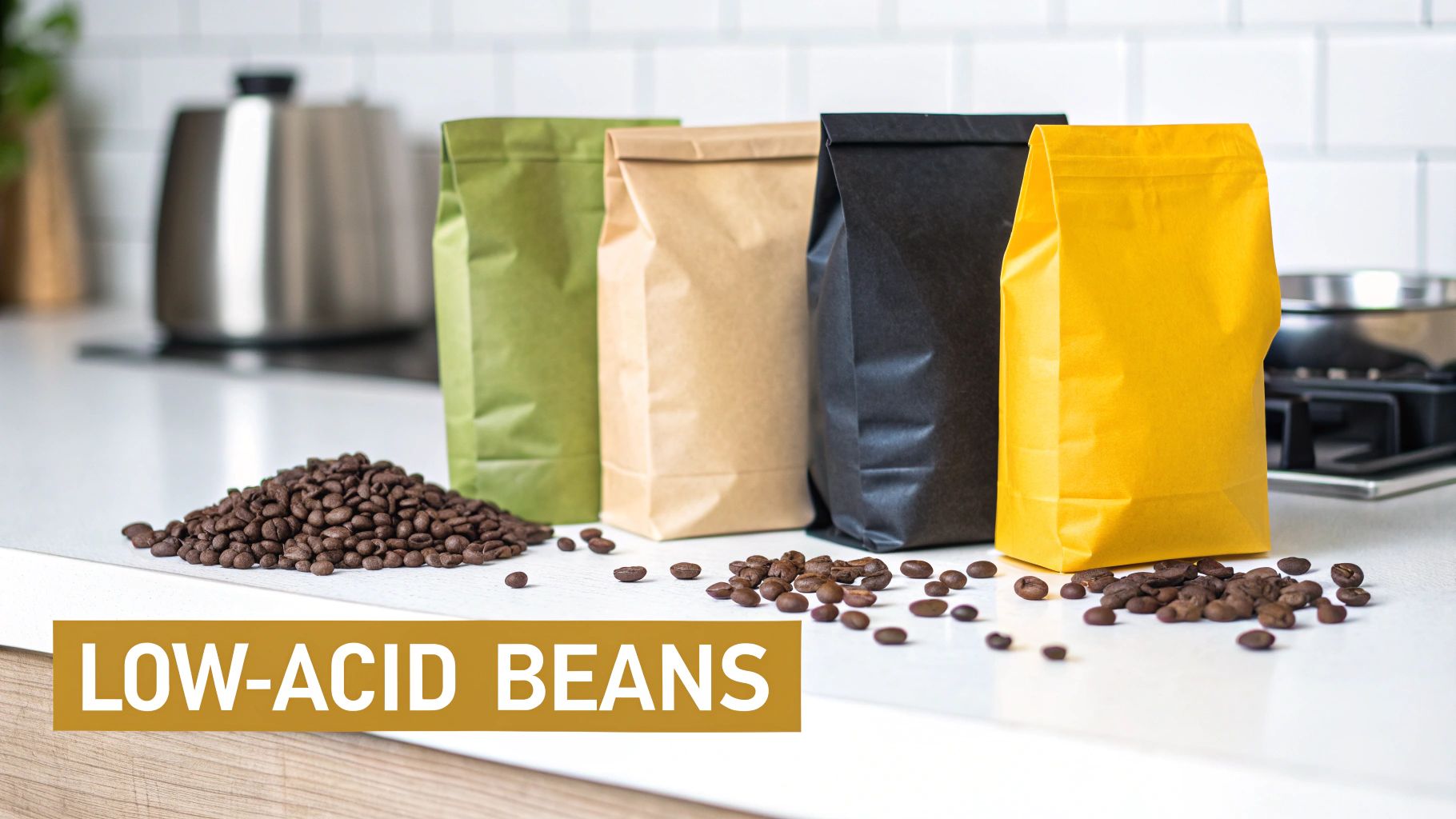
If you're serious about slashing acidity, cold brew is the undisputed champion. This isn't just a trend; it's pure science. Instead of heat, cold brew relies on time—steeping coarse grounds in cold or room-temperature water for 12 to 24 hours.
This long, slow, and cold process completely changes the extraction. Industry research has shown that cold brewing can reduce coffee's acidity by as much as 70%. Its pH level hovers around 5.10, a significant jump from hot coffee’s 4.85 average, making it a lifesaver for anyone with a sensitive stomach. By skipping the heat, you extract far fewer of the organic acids responsible for that sharp taste, leaving you with a brew that's rich in flavor but incredibly low in bite.
Real-World Impact: The difference isn't subtle; it's night and day. A bean that tastes bright and citrusy as a hot pour-over can become a smooth, chocolatey, and naturally sweet drink when prepared as a cold brew. It’s the single most effective method for reducing acidity, bar none.
Adjust Your Grind for Smoother Extraction
Finally, let's talk about your grinder. The size of your coffee grounds directly controls the surface area exposed to water. A finer grind creates more surface area, which leads to a faster, more intense extraction that pulls out more of everything—including acids.
By switching to a coarser grind, you reduce that surface area. This simple change slows down the whole extraction process, making it much harder for the water to pull out those harsh-tasting acidic compounds. Water flows through the grounds more gently, giving you a less aggressive brew and a smoother final cup. This trick works wonders for just about any brewing method you can think of.
Dialing In Your Brew for a Smoother Cup
Even with the perfect low-acid beans, your brewing technique is where the magic really happens. This is your chance to steer the final flavor, and a few small adjustments can transform a sharp, tangy coffee into something wonderfully smooth. You don’t need to buy a whole new setup; often, the biggest wins come from the simplest tweaks.
One of the most overlooked factors? Your water. Its mineral content plays a huge role in what flavors get pulled from the grounds, making it a powerful tool for taming acidity at home.
It Might Just Be Your Water
The water you brew with can either crank up the acidity or help mellow it out. If you’re using heavily filtered, reverse osmosis, or distilled water, it's essentially a blank slate, lacking the minerals needed to buffer the coffee's natural acids. This can actually make the sour notes stand out more.
On the flip side, hard water—the kind that’s rich in minerals like calcium and magnesium—can be your best friend in this fight. These minerals act as a natural buffer, taming some of those sharper acidic compounds during extraction. This doesn't mean you have to use straight tap water if you hate the taste, but it's worth knowing that overly soft water might be working against you.
A Quick Experiment: If you normally use a water filter, try brewing a small batch with your regular tap water (as long as it’s safe and tastes decent). Give them a side-by-side taste test. You might be surprised to find the tap water version is noticeably smoother.
Finding the Brew-Time Sweet Spot
Brew time is a delicate dance between sour, sweet, and bitter. It’s all about giving the water just enough time to dissolve the good stuff without overdoing it.
- Too short? You get under-extraction. The first compounds to dissolve are the bright, sour-tasting acids. Cut the brew short, and you'll end up with a thin, underdeveloped, and unpleasantly sharp cup of coffee.
- Too long? You get over-extraction. After the good flavors are out, you start pulling out bitter, astringent compounds that can be just as jarring as harsh acidity.
The goal is that sweet spot in the middle, where you’ve coaxed out enough sweetness to balance the acids but stopped before the bitterness crashes the party. For a pour-over, that’s usually somewhere between 2.5 to 4 minutes. For a French press, aim for around 4 minutes. Try adjusting your time by just 15-20 seconds at a time to see how it shifts the balance in your cup.
Immersion vs. Drip: A Tale of Two Methods
How the water and coffee interact also makes a massive difference. Percolation methods, like a V60 pour-over or your standard drip machine, work by constantly passing fresh water over the grounds. This is a very efficient way to extract flavor and tends to highlight the brighter, more acidic notes in a coffee.
Immersion methods, on the other hand, submerge the grounds in water for the entire brew time. Think French Press or an AeroPress. This gentler, more saturated extraction typically yields a fuller-bodied coffee with a rounder, less acidic profile. In fact, some research suggests that immersion styles can score up to 30% higher for low-acidity mouthfeel than percolation methods, giving you a brew with more body and less bite. If you want to dive deeper into the science, you can find more about how brewing impacts flavor on pmc.ncbi.nlm.nih.gov.
Mastering these variables gives you the control you need to troubleshoot any brew and finally perfect your daily cup.
Quick Fixes: Neutralizing Acidity in Your Cup
Let's face it, sometimes you just get a bad cup of coffee. You might be at the mercy of the office coffee pot, a hotel breakfast bar, or maybe you just brewed a batch at home that turned out way too sharp.
When you can't go back and change the beans or the brew method, you're not out of luck. A few simple, safe additives can rescue your cup in seconds, neutralizing that harsh, acidic bite on the spot.
The Baking Soda Trick
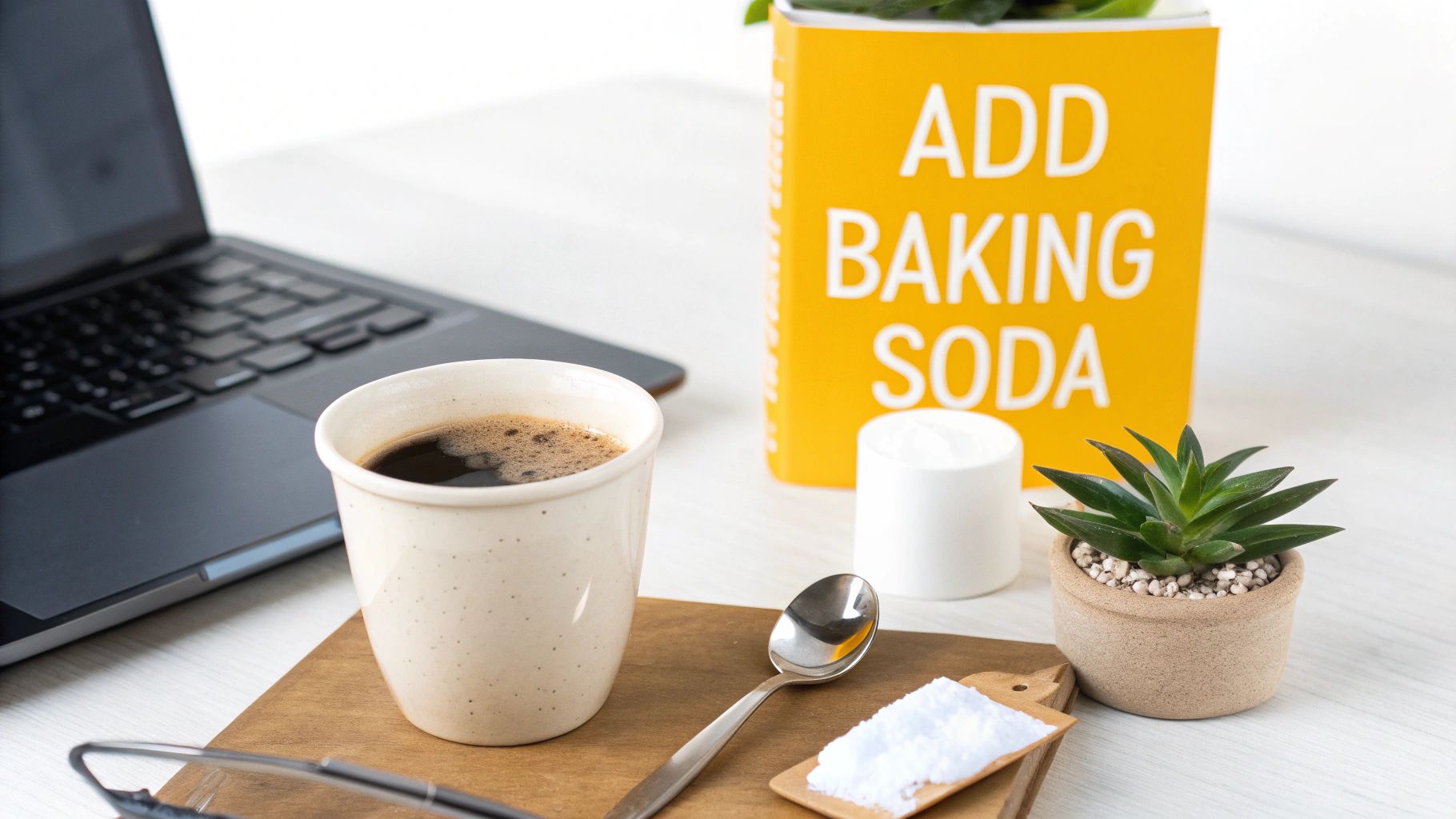
Believe it or not, the best tool for the job is probably already in your kitchen pantry: baking soda. It’s a classic trick for a reason. Baking soda (sodium bicarbonate) is a simple alkali, which is just the chemical opposite of an acid.
When you stir a tiny pinch into your coffee, it gets to work immediately, neutralizing some of the acids and raising the brew's overall pH. This chemical reaction is all it takes to tame those sour notes, leaving you with a much smoother, rounder-tasting coffee. Seriously, the key here is to use a very, very small amount—just a dash.
A Word of Caution: It’s incredibly easy to overdo it. Start with a literal pinch, just enough to cover the tip of a spoon. Too much will leave your coffee tasting flat and a bit salty. My advice? Add a tiny bit, stir well, take a sip, and only add more if it's still too sharp.
Milk, Cream, and Their Alternatives
Another fantastic option for mellowing out a harsh cup is adding a splash of milk, cream, or a plant-based alternative. While dairy doesn't neutralize acid in the same direct chemical way as baking soda, it works wonders on your palate.
The fats and proteins in milk and creamers bind to the chlorogenic acids in coffee. This does two things: it masks the perception of acidity and bitterness while also giving the coffee a richer, fuller body. It's a win-win.
Here’s a quick rundown of what to reach for:
- Whole Milk & Heavy Cream: These are the heavy hitters. Their high-fat content is incredibly effective at smoothing over any rough edges and adding a luxurious, velvety texture.
- Plant-Based Milks: Oat milk and soy milk are excellent choices, as their natural creaminess does a great job of mellowing out acidity. Almond milk is a bit thinner, but it can still help take the edge off a particularly bright coffee.
Both of these methods are perfect for those coffee emergencies when you need a quick fix. They’re the ideal tools for reducing coffee acidity when you’re away from your own setup and can't control the brew.
Common Questions About Reducing Coffee Acidity
After diving into all the techniques for taming a sharp brew, a few practical questions almost always come up. It's one thing to know the theory, but putting it into practice can feel a little tricky. Let's clear up some common hang-ups and bust a few myths.
Think of this as your go-to guide for those "what if" scenarios, from dealing with instant coffee to figuring out if you really have to give up your favorite light roast.
Is Instant Coffee Less Acidic?
Not always. The acidity in instant coffee comes from the exact same place as any other coffee: the original beans and their roast level. Many mass-market instant coffees can still be surprisingly acidic if they're made from beans that are naturally high in acid.
The good news is that some brands are now making low-acid instant coffee on purpose. They do this by starting with low-acid beans and giving them a darker roast. If you're looking for a stomach-friendly and super convenient option, keep an eye out for instant coffee that’s specifically labeled as low-acid or dark roast.
Can I Still Enjoy Light Roasts?
You absolutely can, but you have to be smart about how you brew it. If you're like me and love the bright, complex flavors of a light roast, your brewing method is your secret weapon against its acidity.
Cold brew is your best friend here. It’s a fantastic way to enjoy a light roast because the cold water extraction process can slash the perceived acidity by up to 70%. You still get those wonderful floral or fruity notes, just without the harsh bite.
If you prefer a hot cup, you can still make it work. Try grinding the beans much coarser than you normally would and slightly shortening your brew time. This adjustment reduces the extraction of the most aggressive acids, leading to a much smoother finish.
Is Coffee Acidity Bad for My Health?
For most of us, the natural acids in coffee are completely harmless—in fact, they're a huge part of what makes coffee taste so great. The real issue is for people with specific health conditions like acid reflux, GERD, or a sensitive stomach. For them, a highly acidic cup can definitely trigger discomfort.
So, tweaking your coffee's acidity is really about managing your personal comfort, not dodging a universal health risk. If you think coffee is causing you problems, the best move is always to chat with a doctor.
And one last thing: let's bust the myth about sugar. A spoonful of sugar might make your coffee taste less sour, but it does absolutely nothing to change its chemical makeup. The acid is still there. To actually lower the acidity and avoid potential stomach irritation, you need to rely on the bean selection and brewing methods we've covered.
At Cartograph Coffee, we believe great coffee should be accessible and enjoyable for everyone, everywhere. Our organic instant coffee is crafted for those who value quality and convenience, offering a smooth, delicious cup without the hassle. Find your perfect brew at https://cartographcoffee.com.