At 65% relative humidity, exposed instant coffee exceeded critical moisture levels within one week, then showed rapid visual degradation, impaired dissolution, and reduced brew quality within three months, according to the University of Udine storage record. That single result explains most failed advice about how to keep instant coffee fresh. The powder isn't waiting for its printed date to expire. It's absorbing water from the air every time you open the container.
Cold storage gets most of the attention, but humid air does the damage first. A jar opened twice a day beside a kettle faces repeated moisture exposure, even if the kitchen feels cool. A sealed packet in a dry cupboard faces almost none. Your goal isn't to find the coldest spot in the house. It's to limit the number of times moist air reaches the powder and to shorten each exposure.
That distinction changes what you buy, where you put it, and when you replace it.
Storage Conditions That Change Freshness Most
Keep the powder dry before you worry about making it cold. Instant coffee is hygroscopic, meaning it readily absorbs water from surrounding air. Once moisture enters, you'll see clumping, slower dissolving, and duller flavor. Heat and oxygen then accelerate aroma loss, especially after the original barrier package is opened.
Humidity decides the timeline
In a 2025 study of instant coffee removed from its original packaging at 20°C, powder at 11% relative humidity remained stable, powder at 32% showed a notable pH decline in brewed coffee after six months, and powder at 65% exceeded critical moisture levels within one week, according to the PubMed study record. At that highest humidity, researchers also observed rapid visual deterioration, slower solubilization, and reduced brew quality within three months.
Those conditions aren't exotic. Steam from a kettle, dishwasher, or shower can raise the air around an open jar for long enough to matter. Camp kitchens add rain and overnight condensation. If you're checking damp packs and bottles after a trip, the same habit helps you prevent mold in travel gear. Coffee needs that same separation from wet equipment.
| Condition | Measured value | Effect on coffee |
|---|---|---|
| Relative humidity 11% | Stable through the full study period | No quality change observed |
| Relative humidity 32% | Initially stable | Brewed coffee pH declined after six months |
| Relative humidity 65% | Critical moisture exceeded within one week | Brew quality reduced within three months |
| Moisture content 4-5% or lower | Target for dry storage | Quality retained over the shelf life |
| Storage at 20°C and 70% relative humidity | Moisture rose to about 6.8% | Moisture well above the dry range |
| Storage at 20°C | Reference storage temperature | Sensory quality acceptable for roughly 24-36 months |
| Storage above 30°C | Shelf life decreases sharply | Faster loss of aroma |
| Storage at 50°C | Most damaging condition tested | Aroma and sensory quality hit harder than at high humidity and 20°C |
Heat still matters
Don't trade a dry cupboard for a hot one. Vehicles, sunny windowsills, garages, and cupboards above ovens push coffee toward faster aroma loss. Stable room temperature works because it avoids both heat damage and the condensation caused by repeated cooling and warming.
Practical rule: Choose the spot you'd trust for dry paper, not the spot you'd choose for milk.
Whole beans and instant powder share enemies, but they don't respond at the same speed. Our guide on storing coffee beans properly covers the bean-specific routine. For instant coffee, moisture control comes first, because the dry, soluble powder can take up water during a single careless opening.
How to Seal and Store Instant Coffee Step by Step
Use this routine tonight, before you buy another container. Most freshness loss comes from ordinary habits, not from lacking specialized equipment. You're trying to reduce three things: humid air, oxygen, and time with the lid off.
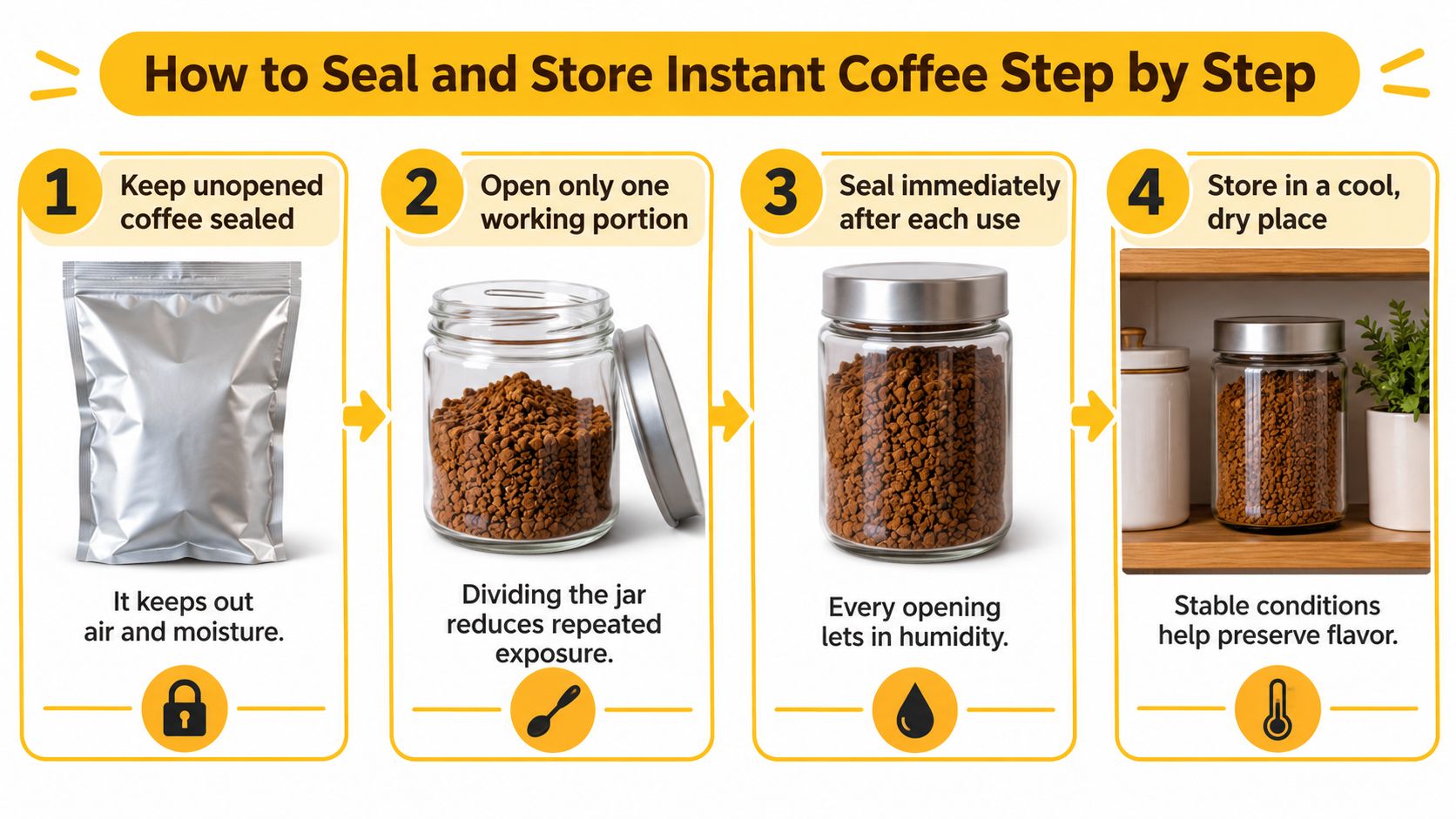
- Keep unopened coffee in its original package. The foil pouch or sealed packet is built as a barrier against moisture and oxygen. Don't open a fresh pack early just to transfer it into a nicer jar.
- Move opened bulk coffee into a clean, opaque, airtight container. Pick glass or metal with a tight gasket and as little empty headspace as you can manage. Wash and dry it completely first, because a container that feels dry can still hold water around the seal.
- Write the opening date on the lid. A printed best-by date tells you little after the barrier is broken. The opening date lets you judge age and decide whether a flat cup reflects storage time or a poor seal.
- Use a completely dry spoon. Don't rinse the spoon and shake it off over the jar. That small amount of water lands directly on powder designed to dissolve, and repeated damp scoops create hard patches that spread through the container.
- Close the container immediately after dispensing. Don't leave it open while water heats or while you answer a message. Scoop, seal, then brew. It's the shortest step here and the one I'd fix first.
- Squeeze excess air from a flexible pouch before resealing. Press gently from the bottom toward the closure, then check that the seal tracks meet along their full length. Coffee trapped in the closure can leave a narrow channel for air.
- Store it in a cool, dry cupboard. Keep it away from the kettle, sink, dishwasher, stove, and refrigerator door. A lower interior cupboard usually beats a countertop canister because it sees less steam, sunlight, and temperature swing.
Two fixes that often disappoint
Silica gel can't rescue a loose lid. Use a desiccant only when it's appropriate for food contact and physically separated from the coffee. If the packet is torn, unlabelled, or loose in the powder, leave it out.
Repeated freezing and thawing creates the same basic problem. Each return to warm air gives moisture a chance to condense. A reliable seal in a stable cupboard is simpler and easier to repeat correctly.
Packaging design matters because barrier materials determine how much protection remains before and after opening. Our overview of instant coffee packaging explains those formats in more detail. Whatever format you choose, organic certification doesn't change how moisture and oxygen act on the powder. The same sealing routine applies.
Do a ten-second check when you finish. The powder should look dry and free-flowing, the lid should resist evenly, and the jar should smell clearly like coffee. If you can't get a clean seal, replace the container before you blame the coffee.
Why the Fridge Often Makes Coffee Worse
Refrigerating an opened jar sounds cautious. It's often the fastest way to introduce the moisture you're trying to avoid.
The issue isn't cold by itself. It's temperature cycling. You take a cold jar into a warm kitchen, open it, and humid air reaches cold surfaces inside the container. Water can condense there, then the powder absorbs it. Put the jar back, repeat tomorrow, and you've built a daily clumping routine.
What the evidence points to
The 2025 findings make moisture the decisive household variable. At 20°C, powder at 11% relative humidity remained stable, while powder at 65% exceeded critical moisture within one week and its freshness index fell to 31%, according to the PMC full-text study. Dissolution and brew quality then declined within three months.
I wouldn't use those results to claim every sealed commercial package behaves exactly like exposed powder. The study examined exposed powder, not every package design. But the direction is useful: check the seal and surrounding humidity before you chase a colder location.
A dry, stable cupboard beats a colder container that's opened into humid air every morning.
A better cold-weather routine
If a jar arrives from a cold porch, vehicle, or campsite, let the sealed container reach room temperature before opening it. That pause reduces the temperature gap that encourages condensation. Once it's open, return it to the same dry cupboard instead of rotating it between environments.
Freezing follows the same logic. It offers little benefit when you open the coffee often, and repeated thawing repeats the condensation risk. Cold storage may still suit a specialized formulation, an unusually hot climate, or a rarely opened reserve if the packaging directs you to use it. Follow that product's instructions rather than a universal fridge rule.
For everyday use, don't ask whether the fridge is cold enough. Ask whether your routine keeps humid air out. That's the more useful question.
Freshness Signs and When to Replace Your Coffee
Start with the shelf-life range, then trust your senses. Research on soluble coffee reports approximately 18-36 months when the product remains dry, with moisture below roughly 4-5% and storage near 20°C, according to the soluble coffee shelf-life proceedings. The same research reports acceptable sensory quality for roughly 24-36 months at 20°C, with shelf life decreasing sharply above 30°C.
Treat those figures as quality ranges under protective conditions, not promises for every opened jar. Samples kept at 20°C and 20% relative humidity stayed near 3.5% moisture, while samples at 20°C and 70% relative humidity rose to about 6.8%. Your storage habits can move coffee away from the favorable end of the range long before the calendar does.
Read the powder before the date
| Sign | Likely cause | What to Do |
|---|---|---|
| Clumps or hard lumps | Moisture entered the package | Reseal tightly, then use soon |
| Slow to dissolve | Moisture damage to the powder | Brew a test cup, use it in recipes or drink it soon |
| Cardboard or flat taste | Oxidation and age | Replace it and buy smaller packs |
| Rancid, sour or off notes | Oxidation, long storage or heat | Discard it |
| Dry, free-flowing, clean aroma | Good condition | Keep sealed and use as planned |
Clumping is usually your earliest warning. Break up a small amount and brew it rather than stirring the whole jar with a damp utensil. If it dissolves slowly and tastes dull, finish it quickly in a recipe where coffee supports other flavors, or replace it if you bought it for drinking straight.
Cardboard or flat taste points more toward oxidation and age than a single humid opening. Buying a smaller pack next time is better than trying to revive it. More powder per cup can make a weak brew stronger, but it won't restore missing aroma.
Rancid, sour, or otherwise off notes are the stop sign. Don't mask them with milk or sweetener and call the coffee saved. Discard it, wash and fully dry the container, and inspect the gasket before refilling it.
Run a fair test
Brew a small cup with your usual water, ratio, and temperature. If you have a fresh packet, taste both without sweetener. A dry powder with a clean coffee aroma can still be usable after a date has passed. A powder that smells stale before water touches it won't improve in the cup.
That's how to keep instant coffee fresh without wasting good coffee or drinking bad coffee out of obligation. Let aroma, flow, dissolution, and taste make the decision.
Storage Setups for Home, Office and Travel
Match the container to how often you open it. The best setup isn't the largest jar or the most elaborate canister. It's the one that leaves most of your supply sealed while a small working portion absorbs the daily openings.
Different containers create different exposure patterns, as this comparison shows.
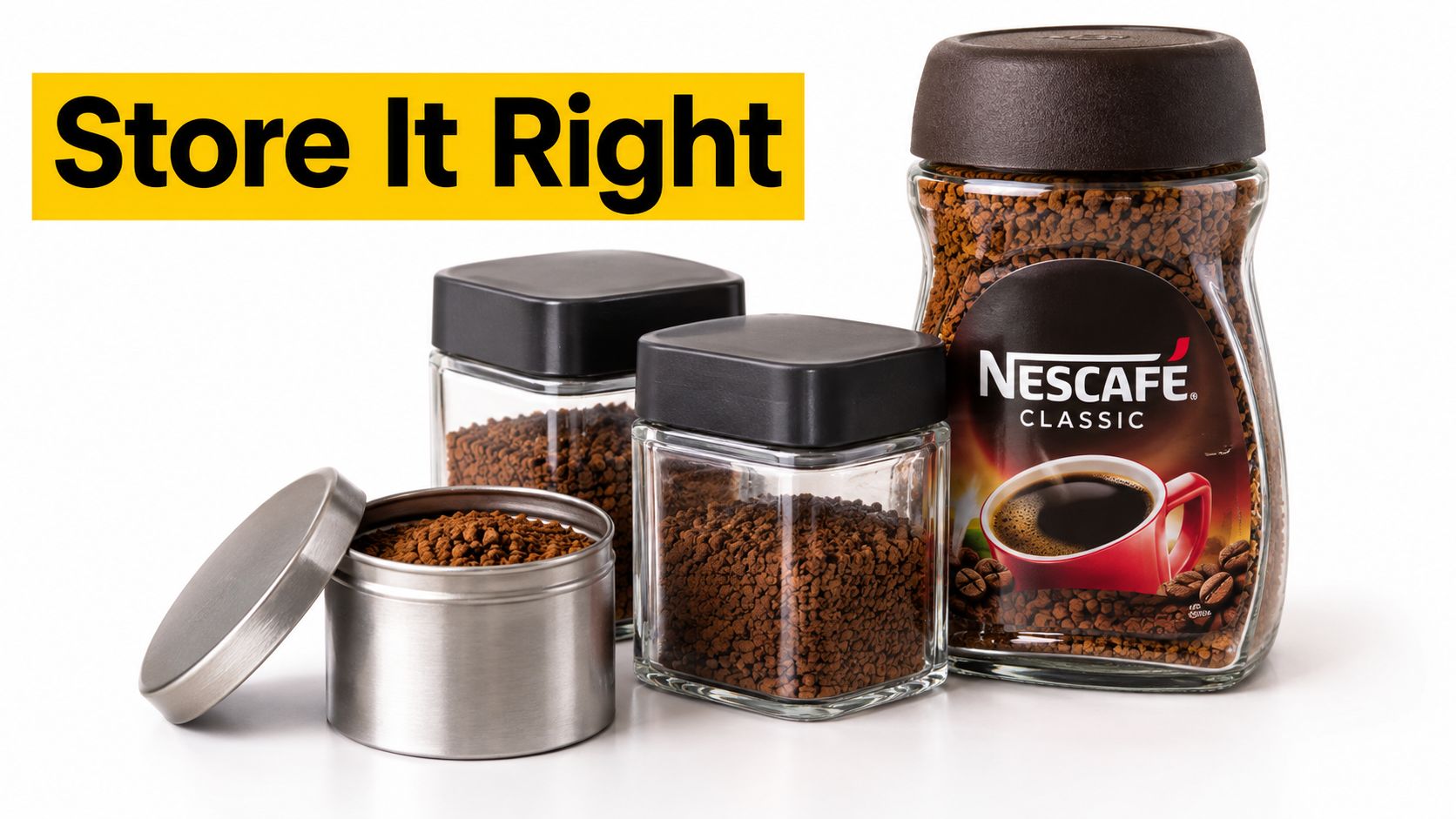
Four setups that work
- Home with a large jar: Divide the supply into smaller airtight containers and open only one at a time. If you drink instant coffee only on weekends, buy smaller packs instead. A half-empty bulk jar gives you more headspace and months of repeated openings.
- Office desk: Keep one small sealed tin or a few packets at your desk and leave the main supply at home. Don't store the working portion beside a kettle or shared coffee machine, where steam and frequent handling work against the seal.
- Camping or travel: Carry one or two sealed single-serve packets for the outing in a small airtight tin or zip bag, then place that inside a dry bag. Keep packets off tent floors and cooler lids, because both collect condensation overnight. Count the days away, pack the servings you'll use, and leave the reserve sealed at home.
- Car: Put packets in a shaded bag rather than the glovebox or a sunny door pocket. A parked car can become the hottest storage place you own. Bring the coffee inside at the end of the trip instead of treating the vehicle as a pantry.
A short demonstration can help you check whether your own container is helping or hurting, particularly the seal and headspace.
Why packets simplify the routine
Single-serve packets remove the repeated-opening problem. Each packet is a measured serving that stays sealed until you're ready to make coffee. Keep packets sealed until use and store them in a cool, dry place, whether they're in a desk drawer or camping kit.
Cartograph Organic Instant Coffee - Medium Roast is one option built around that approach. The packets are lightweight and portioned, and are easy to carry in a carry-on, backpack, or camping kit. You still need to protect the outer packet from punctures and prolonged dampness, but you don't expose tomorrow's serving when you make today's cup.
For more ways to plan coffee around commuting and trips, see our ideas for instant coffee on the go. The transport rule stays simple: sealed, shaded, and separated from wet gear.
Do one thing today. Choose a single dry storage spot, test the seal on your current pack, and write the opening date where you'll see it. That small reset will do more for your next cup than moving the jar to the fridge.
If you want coffee that's portioned before storage becomes a chore, Cartograph Coffee offers organic freeze-dried instant coffee in single-serve packets that stay sealed until brewing. Keep a few at home, at work, or in your travel kit, then open one only when you're ready for a cup.