You're standing beside a trailhead before sunrise, or sitting at an airport gate with a demanding day ahead. The water is hot, but your grinder, brewer, and fresh beans are at home. The nearby café is closed, and the coffee machine offers a cup that tastes more like burnt compromise than a useful start.
Instant coffee on the go solves a practical problem without requiring you to lower your standards. The right organic, freeze-dried coffee gives you a compact format, repeatable preparation, and a cleaner packing list. It's especially useful when every gram, minute, and dry storage space matters.
Instant coffee also has deeper roots than its budget reputation suggests. A British patent for a coffee compound appeared in 1771, an early American instant coffee product was created in 1853, and Dr. Sartori Kato developed the first successful stable soluble coffee powder in Chicago in 1901. Mass production followed in 1909, while a major process breakthrough arrived in 1937 through Nestlé scientist Max Morgenthaler in Switzerland. (Grand View Research's instant coffee market history)
Why Premium Instant Coffee Wins on the Road
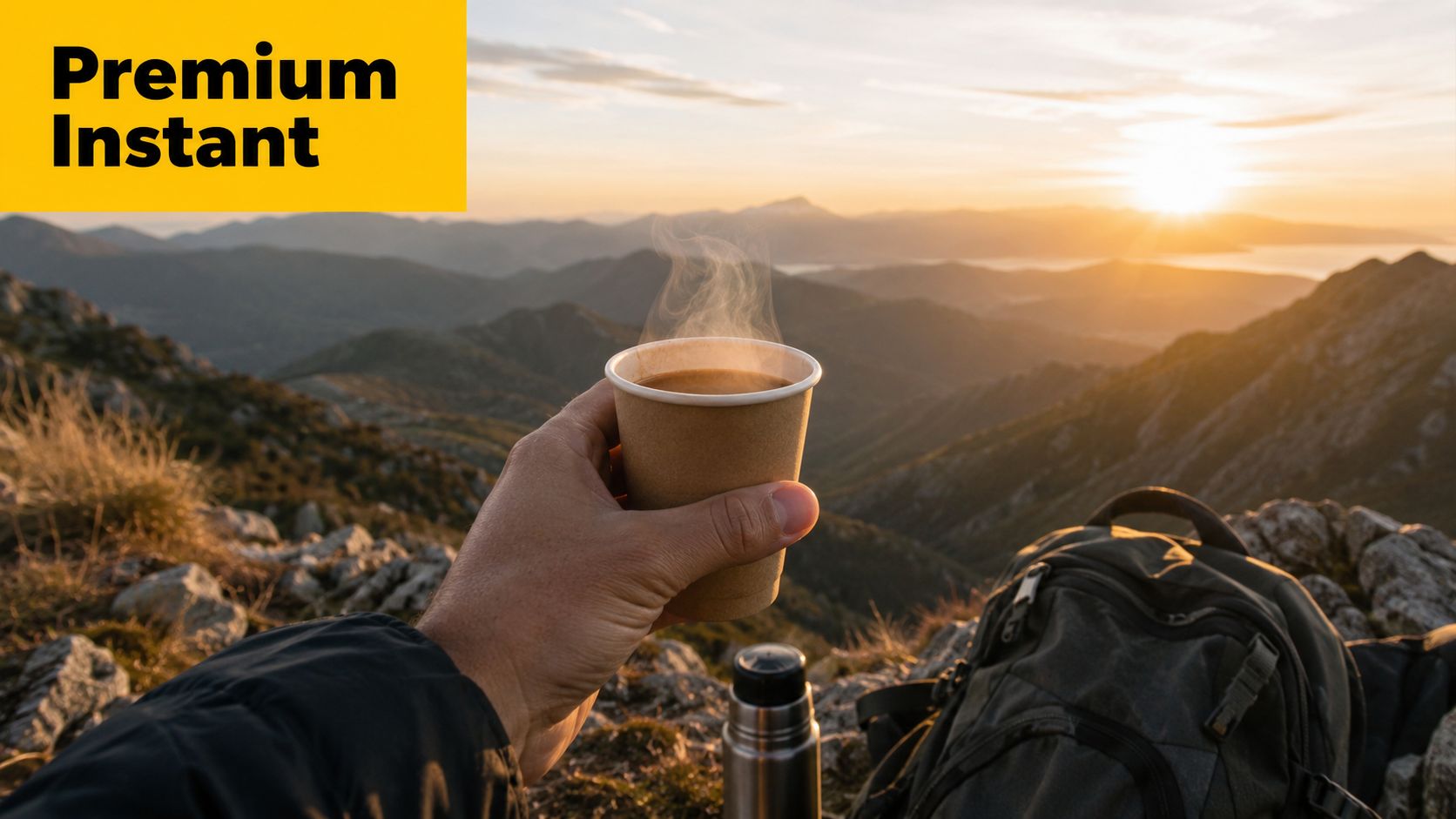
At a mountain camp, elaborate brewing gear can become a liability. A hand grinder takes time, grounds scatter in wind, and a delicate pour-over setup needs a stable surface that may not exist. On a business trip, the same issue appears in a different form. A busy morning between meetings leaves little room for weighing beans or searching for a reliable café.
Premium instant coffee changes the decision. You're not accepting a poor substitute because conditions are difficult. You're choosing a format that provides portable flavor and predictable preparation when fresh brewing would be inconvenient.
Flavor without the full kit
A well-made instant coffee can preserve meaningful roast character, especially when the coffee starts with good green beans and careful processing. Organic certification, a short ingredient list, and a roast profile suited to soluble coffee give you better signals than a luxury-looking package alone.
The practical advantage is consistency. You can prepare the same coffee at a campsite, in a hotel room, or at an office desk without changing grinders, filters, or extraction timing. That matters during an early summit push, when you want warmth and caffeine rather than a complicated ritual, and during back-to-back airport layovers, when your carry-on needs to stay organized.
For frequent flyers, coffee belongs in the same planning system as chargers, documents, and sleep essentials. These broader corporate travel tips from Passport Premiere are useful because a reliable personal coffee routine supports the same goals, fewer avoidable decisions and less dependence on whatever happens to be available.
A deliberate performance choice
The global category reflects how well instant coffee fits mobile routines. One market estimate places worldwide instant coffee revenue at about USD 80.2 billion in 2024, with a projection of USD 110.28 billion by 2030 at a 5.4% CAGR. Another forecast estimates USD 84.6 billion in 2025 revenue and projects USD 127.7 billion by 2033. (Mordor Intelligence market analysis)
Those estimates don't prove that every instant product tastes good. They do show that convenience, portability, and broad adoption have made the format a serious category rather than a niche fallback.
For a closer look at what separates specialty soluble coffee from generic powder, explore this guide to premium instant coffee.
Choosing the Right Format for Your Journey
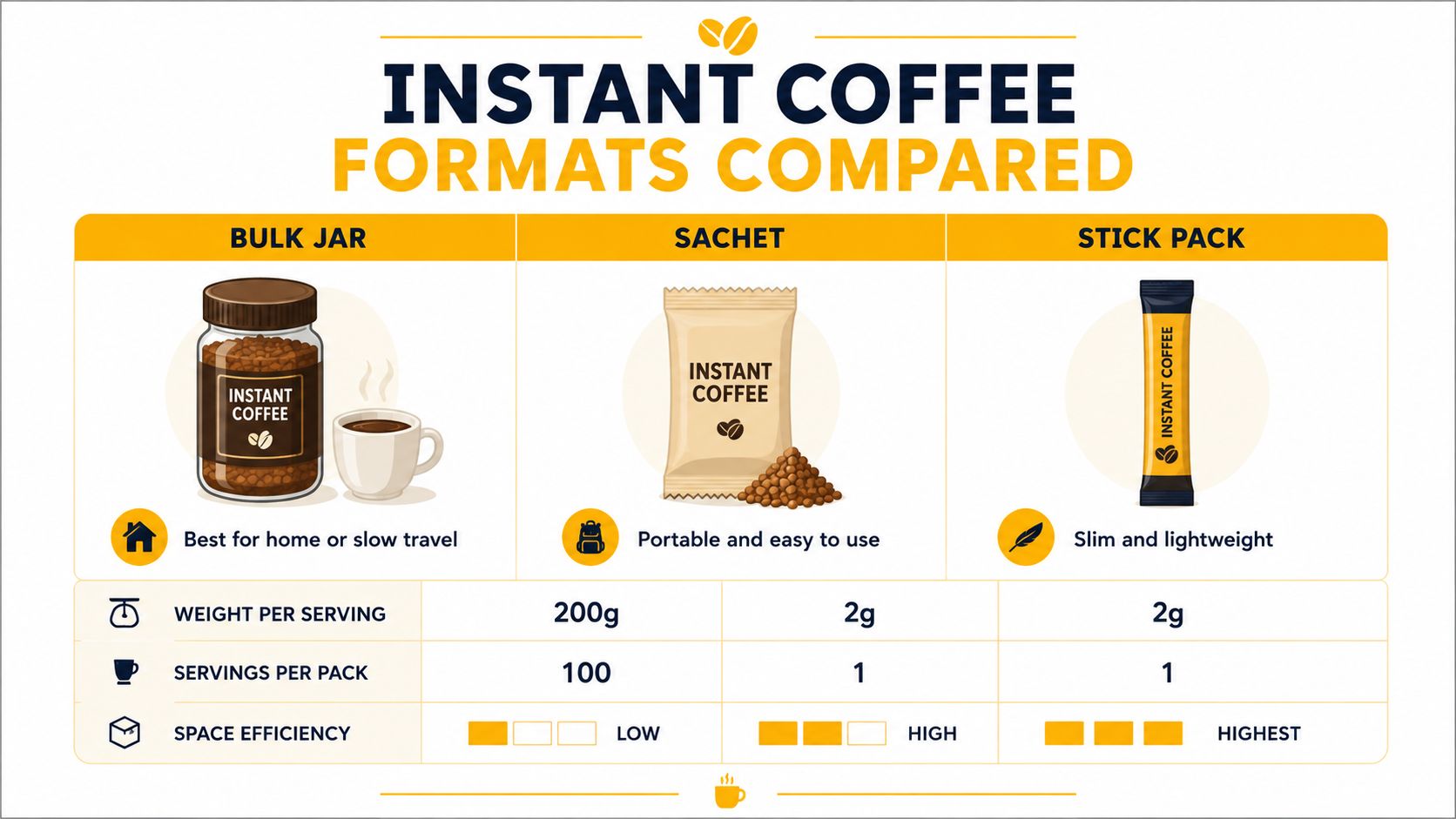
Format determines how well your coffee travels. A large jar may work beautifully in a kitchen, but it becomes awkward in a backpack and exposes the remaining powder to humid air every time you open it. Single-serve packaging takes a different approach. Each portion stays sealed until you need it, which protects freshness and removes guesswork.
Match the package to the trip
Use the destination and routine as your starting point.
| Format | Best use | Main advantage | Main trade-off |
|---|---|---|---|
| Bulk jar | Home, van travel, or extended stays | Flexible servings | Larger, heavier, and repeatedly exposed after opening |
| Sachet | Office drawers, hotels, and short trips | Simple portion control | More individual wrappers to manage |
| Stick pack | Backpacking, commuting, and air travel | Slim profile and efficient packing | Usually intended for one preparation |
A bulk jar makes sense when you'll prepare coffee repeatedly in one protected place. It's economical in packing materials and lets you adjust strength, but it needs an airtight lid and careful handling.
A sachet suits the person who wants to grab one serving and go. Keep a few in a desk drawer, toiletry pouch, or travel organizer. The sealed portion also limits the time coffee spends exposed to damp air.
A stick pack is the easiest choice when space is tight. Its narrow shape fits beside a first-aid kit, stove fuel, or laptop charger, and you won't need a scoop. For trail use, that simplicity beats carrying a jar that may crack, leak, or take up valuable room.
Inspect the barrier, not just the branding
Look for packaging that feels purpose-built for humidity. A strong moisture barrier, a secure seal, and an undamaged wrapper matter more outdoors than decorative design. Reject packets with weak seams, pinholes, or powder clinging heavily to the inside, all signs that storage or handling may have compromised the contents.
Portion control also improves repeatability. If your preferred coffee tastes balanced at a certain serving size, single-serve formats remove one variable from a rushed morning. For more guidance on selecting and using instant coffee packets, focus on the package's real job, protecting the powder until the moment you mix it.
Mastering Storage and Moisture Protection
On a wet commute or beside a rain-darkened tent, humidity can undo a carefully chosen instant coffee. Heat may dull aroma, but moisture changes the powder itself, causing clumps, slower dissolution, and a less clean cup.
A controlled stability study stored instant coffee at 65% relative humidity. The powder crossed critical moisture levels within one week. After three months, it showed rapid visual degradation, impaired solubilization, and lower brew quality.
A damp backpack, humid office, or repeatedly opened container can create trouble well before the coffee appears spoiled.
Protect the powder before the trip
Use layers of protection instead of relying on one bag.
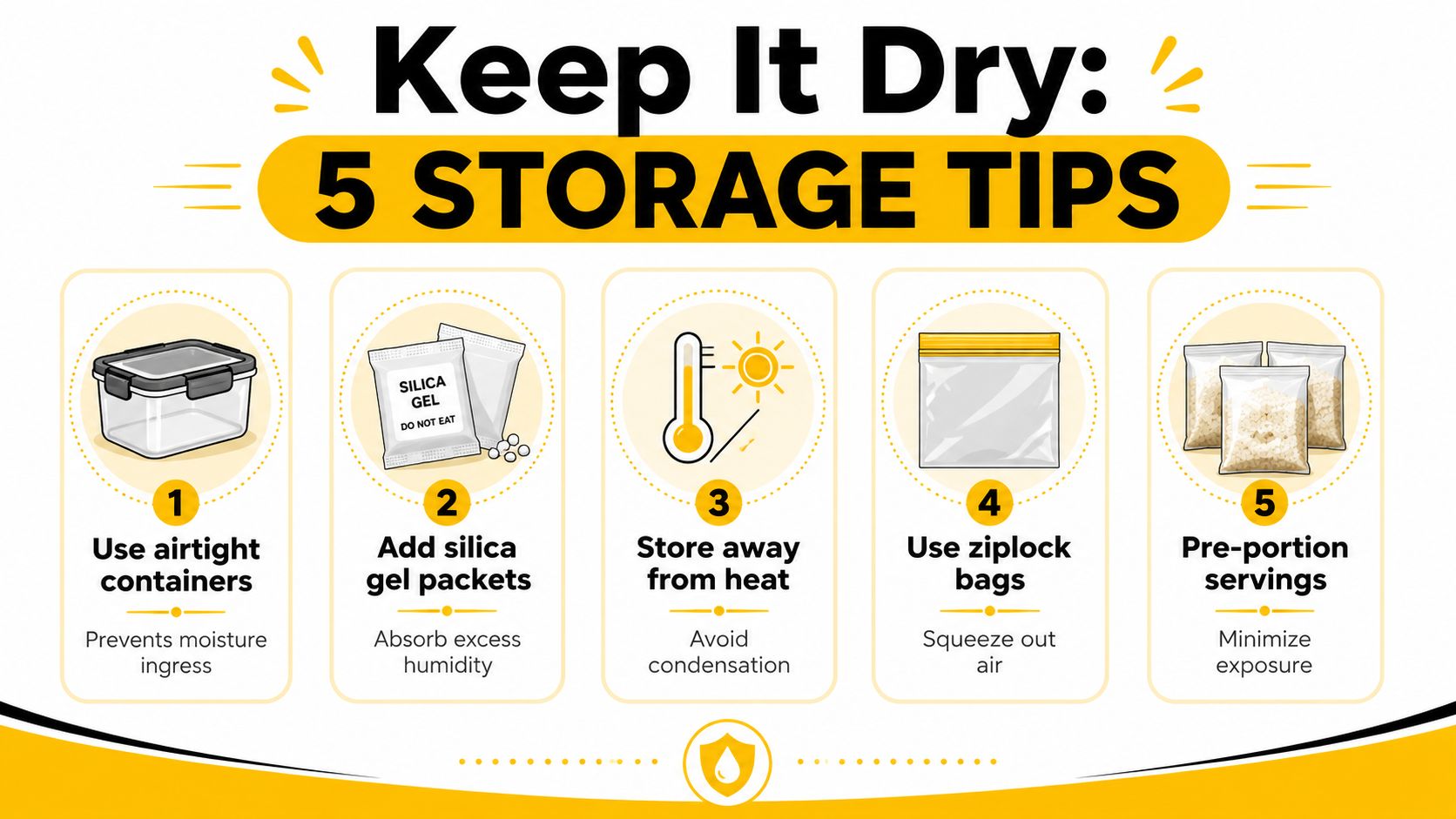
- Keep sealed servings intact: Avoid opening packets at home and repacking the powder without a clear reason. The factory seal is the first moisture barrier.
- Add an outer dry pouch: Place packets in a small dry bag or rigid food container to guard against rain, spilled water, and condensation inside a backpack.
- Separate wet equipment: Keep coffee away from damp towels, water filters, and used cook pots. An outer pouch offers little protection if wet gear goes inside it.
- Use desiccants responsibly: A silica gel packet in the outer container can absorb excess humidity. Keep it separate from the coffee, and never use it as a substitute for intact primary packaging.
- Open only what you'll use: Reseal the outer container promptly after removing a serving. Each opening brings more humid air into the storage space.
Practical rule: Airtight storage and quick resealing belong to the brewing process, not the housekeeping checklist.
The study measured dissolution with 1.7 g powder in 100 mL water at 80 ± 2 °C, using 20 rpm stirring and samples taken at 3, 10, 20, 30, 45, 60, and 120 seconds to estimate solubilization kinetics. The study also used a benchmark dissolution method, showing why moisture control matters before preparation begins.
Trail brewing requires no laboratory equipment. It does require sound storage habits, because damp coffee can perform poorly even when your water and mixing technique are right. For practical guidance on instant coffee shelf life, use storage time, packaging condition, and humidity exposure together when deciding what to carry.
This short video reinforces dry-storage habits for portable food and drink supplies.
Brewing Techniques for Any Environment
Instant coffee rewards a light touch. The powder has already gone through an extraction and drying process, so your task is to dissolve it evenly and preserve the aroma. Excessive stirring, poor water, or an unsuitable temperature can make a good product seem flat.
At an office desk or hotel room
Start with a clean mug and hot water. Add the powder first, pour in a small amount of water, and stir into a smooth concentrate before filling the mug. This wetting step breaks up dry pockets and reduces floating clumps.
An instant coffee sample in one physical-quality test dissolved in hot water in 26.20 seconds, while cold-water dissolution took 2.17 minutes. (Physical-quality and dissolution study)
That difference explains why hot water remains the dependable default. Cold mixing can work, but it needs more time and more agitation.
At camp
Use a kettle, pot, or thermos to heat water. If you're using a camp stove, remove the vessel from direct heat before pouring. Water that's aggressively boiling can exaggerate bitterness in a darker roast and make the cup feel harsh.
For a balanced cup, pour hot water in two stages. First make a small slurry, stir until smooth, then add the rest. This takes only a few seconds and works even when you're wearing gloves or working on an uneven picnic table.
A process study reported 98.22% to 98.25% solubility, with 1.57% to 1.61% moisture and 8.47% to 8.53% Brix. It also reported its highest solubility result, 98.28%, at 120°C. (Instant coffee process study)
Those laboratory benchmarks describe product behavior under specified conditions, not a command to use boiling water outdoors. They reinforce a more useful point: processing quality and preparation method both shape dissolution.
Cold coffee on the move
For iced coffee, dissolve the powder in a small amount of warm water first. Add cold water, then pour over ice if you have it. Dropping dry powder straight into a bottle of cold water often leaves stubborn granules and forces you to shake harder than necessary.
If you're carrying a thermos, prepare the concentrate before leaving camp and dilute it once you're moving. This keeps the process contained, prevents spills, and gives you a cold coffee option without adding a brewer to your pack.
Essential Gear and Portable Accessories
The best portable coffee kit is small because instant coffee already handles the extraction work. Accessories should solve a real problem, not recreate a café counter in your backpack.
The high-value essentials
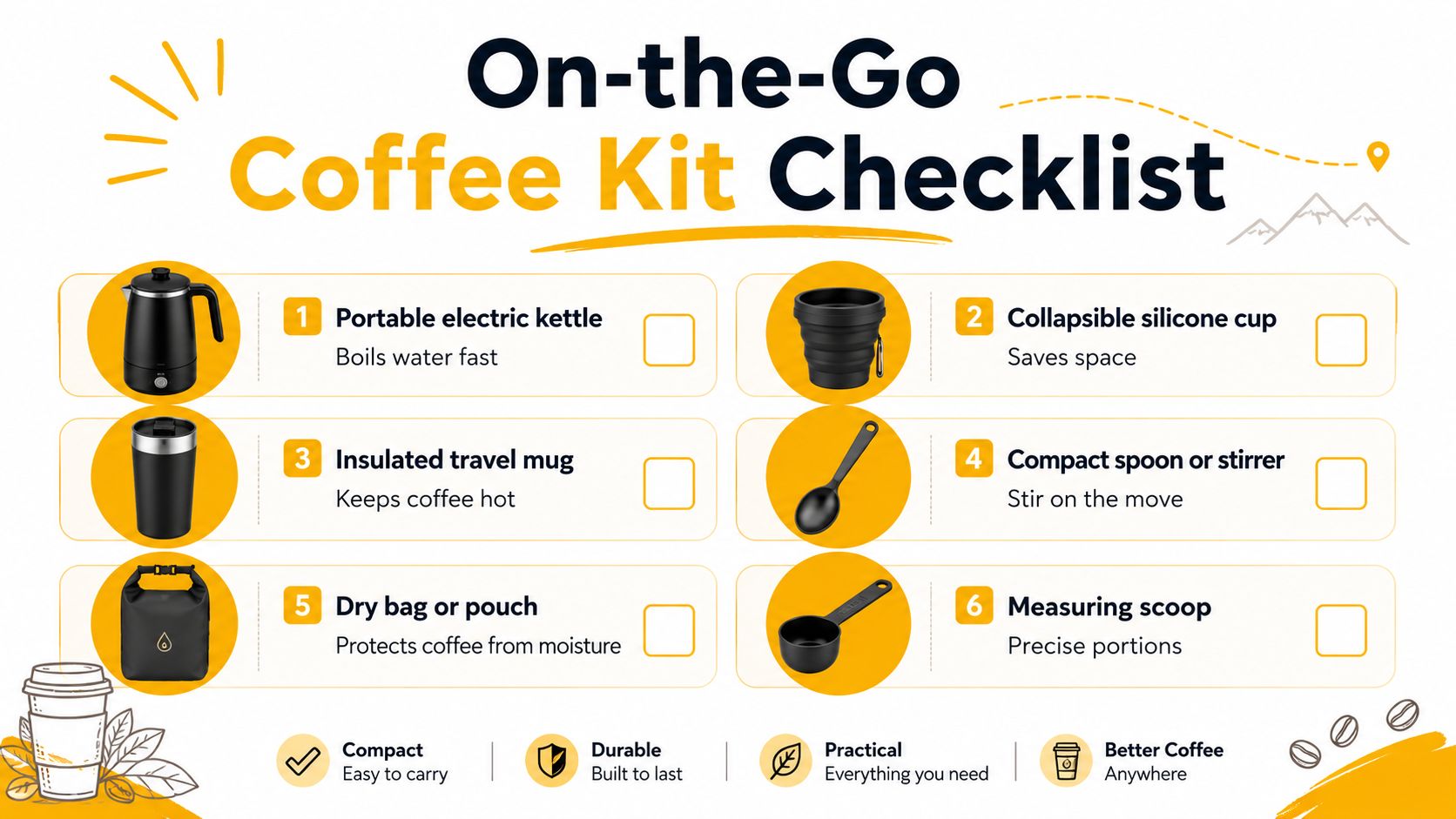
An insulated travel mug earns its space on cold hikes and long commutes. Choose one with a secure lid and a shape that fits your vehicle's cup holder or pack side pocket. A collapsible silicone cup saves more room, but it won't retain heat as effectively and can feel less stable on uneven ground.
A compact spoon or stirrer is more useful than a miniature whisk. Instant coffee needs thorough mixing, not foam. A short metal spoon lasts longer than disposable plastic and can serve for oatmeal or drink powders.
For heat, compare the environment. A portable electric kettle works well in hotel rooms and offices with reliable power. A small camping kettle or pot is more practical outdoors, where electrical access isn't available. Carrying both is unnecessary unless your travel pattern includes both settings.
What usually isn't worth carrying
A separate scale is valuable at home when you're dialing in a recipe, but single-serve packets make it redundant on the road. The same applies to a grinder, paper filters, and a manual brewer if your priority is fast, low-maintenance coffee.
A dry pouch is a better investment than decorative coffee gear. It protects the packets from the same moisture problem that can ruin an otherwise carefully selected product.
For a minimalist kit, pack:
- One heat source: Kettle, pot, or access to a hot-water dispenser.
- One durable cup: Insulated for heat retention, collapsible for minimal volume.
- One stirrer: Compact, washable, and strong enough for repeated use.
- One dry container: A pouch or container that separates coffee from wet equipment.
- Single-serve portions: Enough for the trip, with a little margin for delays.
Cartograph Coffee offers organic instant coffee in single-serve freeze-dried sticks and packets, including 10-pack, 30-pack, and 50-pack options, designed to be mixed with hot water. That makes the format relevant for commuters, campers, and travelers who want portioned coffee without carrying a jar.
Health and Sustainability on the Move
A portable coffee choice should satisfy more than convenience. Health-conscious buyers often want organic ingredients, transparent labeling, fewer unnecessary additives, and consistent caffeine information. Those preferences are becoming more visible in instant coffee market discussions, alongside interest in natural ingredients, reduced additives, and functional additions. (Coherent Market Insights analysis)
A clean label doesn't automatically make a product healthier for every person. It gives you better information for making a decision. Check the ingredient panel, serving guidance, roast description, and any certification details rather than assuming that premium packaging guarantees responsible sourcing or a particular nutritional profile.
Acrylamide deserves a measured response. Recent market analysis identifies it as a concern for the instant coffee category, but that concern doesn't justify treating all instant coffee as identical or making unsupported health promises. Choose transparent products, follow the serving guidance, and consider your overall caffeine habits rather than judging the format in isolation.
Convenience and environmental responsibility
Single-serve packaging creates a waste challenge, especially when users discard wrappers on trails, beaches, or roadside stops. The solution is simple but essential: pack every wrapper out and use a small rubbish pouch in your coffee kit.
Sustainability also includes sourcing and product design. Younger consumers are increasingly asking for ethical sourcing, sustainability, and functional benefits, while sachets and single-serve packs remain closely associated with grab-and-go and workplace use. (FoodNavigator reporting on instant coffee trends)
The same leave-no-trace discipline applies to water-based adventures. If you're planning an outing near the coast, guidance on responsible recreation, such as these Kona eco snorkel tours, reinforces a principle worth carrying into every coffee break: convenience should never mean leaving evidence behind.
Premium instant coffee earns its place when quality, portability, storage discipline, and responsible use work together. Pack sealed portions, keep them dry, brew with hot water when possible, and carry your waste out.
Cartograph Coffee offers organic instant coffee in portable single-serve formats for workdays, camping trips, travel, and quick home preparation. Visit Cartograph Coffee to choose a packet format that fits your next commute, flight, or trail morning.