The usual tip is to sniff the jar, grab the strongest French vanilla, and stir a spoon into hot water. That shortcut skips the only facts that change the drink. The front name is a flavor target. It does not say whether you are buying coffee, sugar, creamer, or a vanilla stand-in.
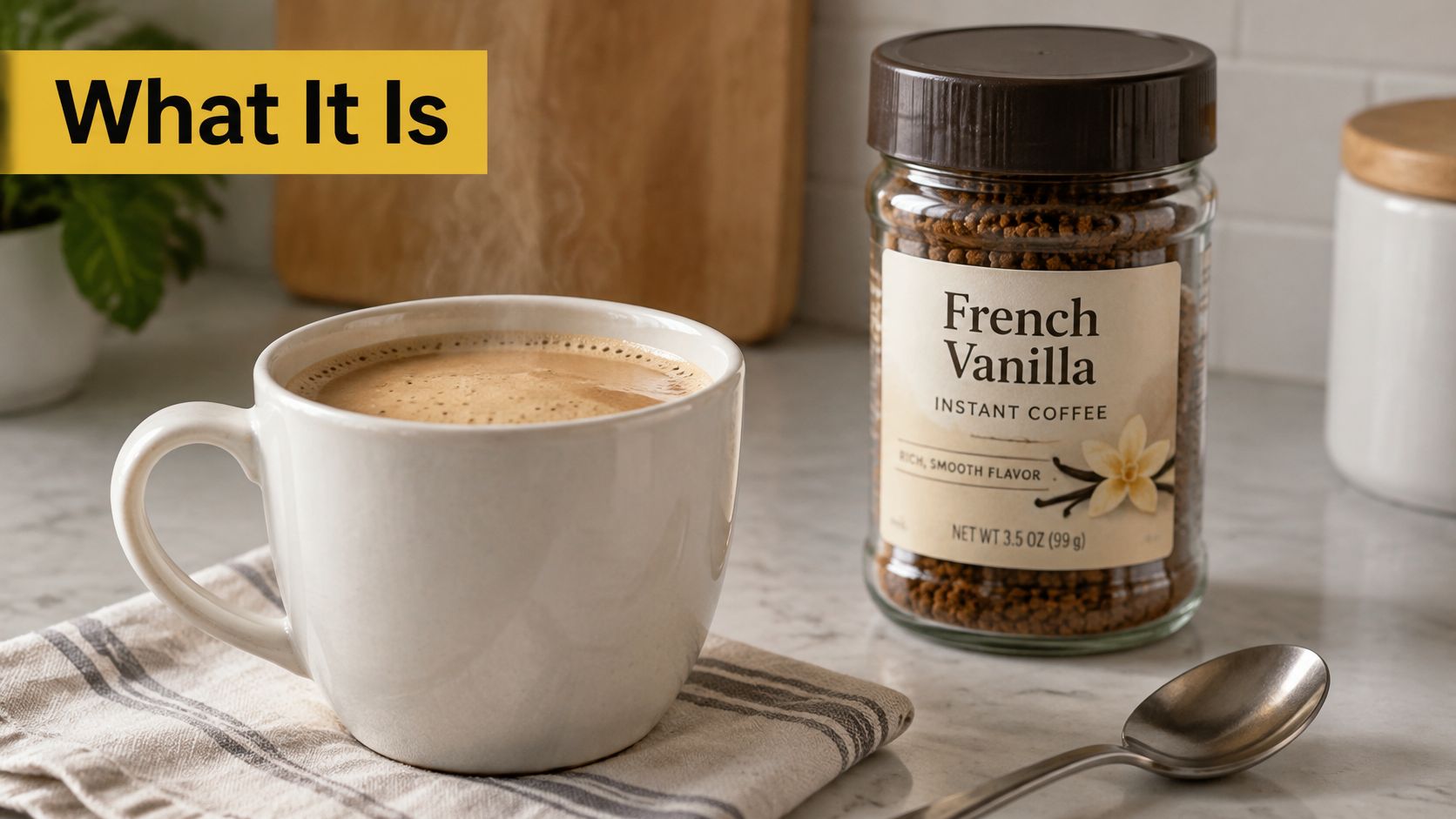
French vanilla instant coffee is soluble coffee built for a soft, dessert-style cup. Treat the name as a clue, then read the panel. Aroma in the shop aisle is the least reliable part of the decision.
What French Vanilla Instant Coffee Really Is
Open two vanilla things on the same counter. Boxed pudding can smell huge. A scraped bean smells softer, and the pod is true vanilla. French vanilla instant coffee has the same split. A big smell is not the same as the ingredient the name suggests.
The powder is dried coffee, not an origin and not a vanilla grade. The beans may be arabica, a milder variety, or a blend. The target taste is soft and custard-like, with caramel and a light floral note, closer to crème anglaise than to a sharp splash of extract. Sugar and creamer are a third layer. Some jars include them. Some don't.
Powdered coffee dates to a British patent for a "coffee compound" in 1771, modern instant took shape through early-1900s processes and Nestlé's 1938 Nescafé, and freeze-drying in the 1960s improved aroma, as Smithsonian Magazine records. Early instant was light, shelf-stable, and needed only hot water. That is still the practical point.
You don't need a grinder, a brewer, or anything from the fridge. The name sets a flavor target, not a recipe, so the ingredient panel is what you read next.
Labels That Change the Cup
| Label style | Typical contents | Sweetness and dairy | Best for |
|---|---|---|---|
| Vanilla-flavored instant coffee | Coffee plus extract, vanillin, natural flavor, or artificial flavor | Often unsweetened and dairy-free | Black coffee and lower-sugar diets |
| French vanilla instant coffee | Coffee plus a custard-style vanilla character, sugar optional | Light to moderate sweetness, creamer not assumed | An everyday flavored cup |
| French vanilla cappuccino mix | Coffee, sugar, and dairy or non-dairy creamer | Very sweet, calories and milk allergens likely | An occasional dessert-style drink |
| French vanilla with creamer | Combined powder, or coffee plus a separate creamer | Calories and vegan status follow the creamer | A latte-like cup when dairy or calories are acceptable |
| Organic coffee, vanilla added by you | Organic instant coffee, vanilla and sugar kept separate | Sweetness optional, usually no creamer | Buyers who want bean quality visible |
French vanilla is a flavor name, not a regulated recipe. Two jars can share those words and still taste nothing alike.
Read the row against the panel
Match the front label to one row, then ignore the marketing line and read ingredients in order.
Vanilla-flavored instant coffee is the plainest row. You are buying coffee plus vanilla extract, vanillin, natural flavor, or artificial flavor. It is often unsweetened and dairy-free, which suits black coffee and a lower-sugar habit.
French vanilla instant coffee aims at custard, caramel, and a creamy impression. Sugar may be there. Creamer is not assumed. "Creamy" can be a flavor note rather than milk.
A cappuccino mix stacks coffee with sugar and a dairy or non-dairy creamer. Calories jump, and milk allergens are common. That is a dessert drink, not a weekday default.
French vanilla with creamer may be one powder or coffee plus a separate stick. Vegan status and calories follow the creamer panel, even when the coffee looks simple.
Organic coffee with vanilla you add keeps the bean visible. You choose the sweetness with your own sugar or extract instead of drinking a sweetness level the factory already locked in.
A louder vanilla smell can be concentrated vanillin or sweetener, not better beans or real extract.
Mark four lines before you pay.
- Flavor source: extract, vanillin, natural flavor, or artificial flavor.
- Sweetener: sugar, syrup solids, or a non-nutritive sweetener, and how high it sits on the list.
- Creamer or milk: dairy, coconut, oat, or none.
- Allergen and vegan wording: milk, soy, or a vegan claim you can verify.
Health-led buyers should look for lower-sugar and additive-free wording instead of judging by aroma. An IMARC instant coffee market report identifies that demand, along with growth in flavored, organic, and functional formats. "Organic" can still sit on a very sweet mix, so the four lines still decide the cup.
Pick the row that matches the drink you want on a normal day.
Ratios for Hot Iced Milk and Trail Cups
Sweetness and vanilla fall out of balance when the cup is too big. Fix the method first, then stay on one row. A GII Research instant coffee briefing points to demand for single-serve, portable coffee among busy buyers, with premium, organic, and sustainability themes growing at the same time. None of that helps if one vague "add hot water" line washes the flavor out.
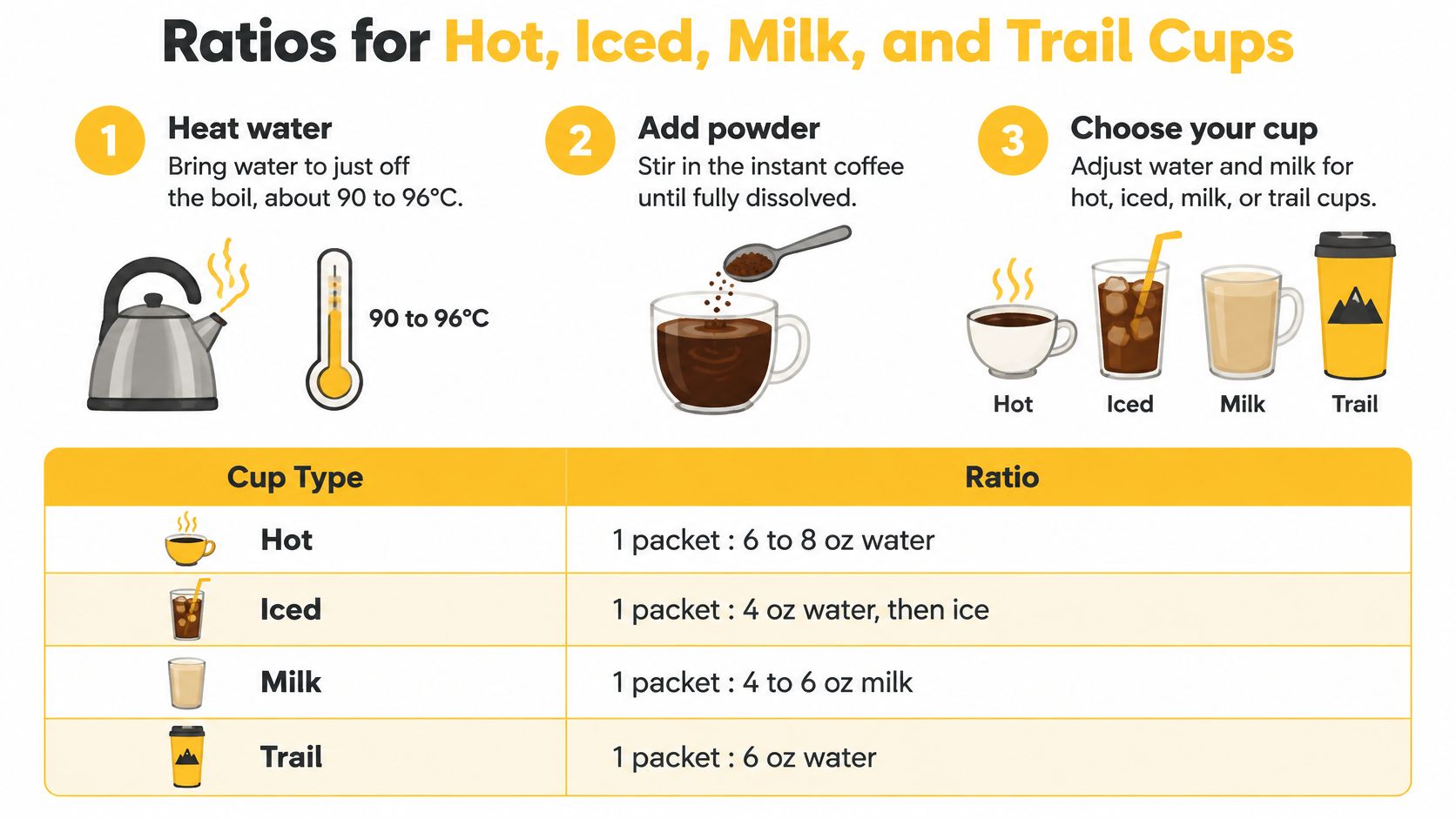
The splash matters more for a flavored powder than for plain coffee. Vanilla and sugar stay loud while coffee taste thins, so you dissolve first and dilute second. Spoon-to-water math is laid out in this instant coffee water ratio guide.
- Heat the water to just off the boil, about 90 to 96°C. A hard boil drives aroma off the surface.
- Stir the powder into a splash of about 30 to 40 ml until no dry granules remain.
- Add the rest of the liquid only up to the row you chose.
- Taste before milk, oat drink, or ice. Those dilute vanilla fastest.
- For iced coffee, dissolve fully in the hot splash, then pour over ice. Cold water should not have to melt the granules.
- For milk or oat drinks, keep the coffee concentrated in that first splash, then add about 150 ml of warm milk or oat beverage.
- On the trail, use the smallest volume that dissolves a 2 g sachet, about 120 to 150 ml, and dilute only if fuel allows a second heat.
- For a household, multiply that same ratio per person instead of guessing with a heaped spoon.
Match a row before you add anything else
| Cup | Powder | Liquid order | Add after it dissolves |
|---|---|---|---|
| Hot black | 2 g | 30 to 40 ml splash, then 200 to 240 ml total water | Nothing |
| Stronger hot | 3 g | Splash, then about 200 ml total water | Nothing |
| Iced | 3 g | 80 ml hot water first, fully dissolved | About 150 g ice |
| Milk or oat | 2.5 to 3 g | 60 ml hot water, then 150 ml warm milk or oat drink | No ice |
| Trail, limited fuel | 2 g | 120 to 150 ml of water that is already hot | A second dilution only if fuel allows another heat |
Lukewarm water leaves grit and a chalky vanilla taste. Too much water makes a thin sweet drink with little coffee left. Ice added before the powder dissolves locks in clumps.
Convenience and flavor are not opposites if you keep the row fixed. A camper with one boil and a desk drink from a kettle can use the same powder without inventing a new recipe.
Caffeine Dose and Quality Signals
A stronger vanilla aroma does not mean stronger coffee, better coffee, or real vanilla. For caffeine, the useful starting point is the amount of coffee powder in the cup. Regular instant coffee provides about 31.4 mg of caffeine per gram, so 2 g is roughly 63 mg and 3 g is roughly 94 mg.
| Preparation | Coffee amount | Liquid | Approx. caffeine |
|---|---|---|---|
| Per gram of regular instant powder | 1 g | Not yet brewed | 31.4 mg |
| Standard sachet-style cup | 2 g | 200 to 240 ml | 63 mg |
| Stronger spoon | 3 g | About 200 ml | 94 mg |
The CoffeeHQ caffeine methodology lists USDA-derived figures of about 3,140 mg per 100 g of regular instant powder. Its prepared-drink estimates are about 47 mg per 6 fl oz and 62 mg per 8 fl oz. These are benchmarks, not exact predictions for every French vanilla mix: the amount of coffee in the powder changes when flavoring, sugar, or creamer makes up part of the serving. For a closer estimate, check the label's serving weight and use this guide to instant coffee caffeine content.
What the package should print
Look for both serving mass and prepared volume. “One cup” is hard to compare across brands, while a stated gram weight gives you a repeatable starting point. At home, 2 g in 200 to 240 ml makes a practical reference cup; on the road, the printed serving weight helps you portion without a scale.
Treat the caffeine figures as a guide for plain instant coffee. In a flavored mix, some of each gram may be sugar, creamer, or flavoring rather than coffee, so the actual caffeine can differ. The listed serving weight still helps you compare products and keep your own portions consistent.
Quality signals that are not the vanilla smell
- Organic certification matters if you want to avoid conventional inputs.
- Single-origin points to a traceable bean character beneath the flavor.
- A blend can suit you better when you want a steady coffee base that does not compete with vanilla.
- Freeze-dried granules may be a useful signal when aroma retention matters more than the lowest price.
- A short ingredient list helps if you want an unsweetened style.
Check sugar and dairy in the ingredient list, then consider caffeine separately. Adding more powder can strengthen the coffee, but in a sweetened or creamed mix it also increases those ingredients. The flavor name alone cannot tell you what is in the cup.
How the Powder Gets Its Vanilla Taste
Making instant coffee is two jobs. Pull soluble compounds out of brewed coffee, then remove the water. The vanilla taste you meet in the cup is whatever survives that drying, plus whatever flavor was added.
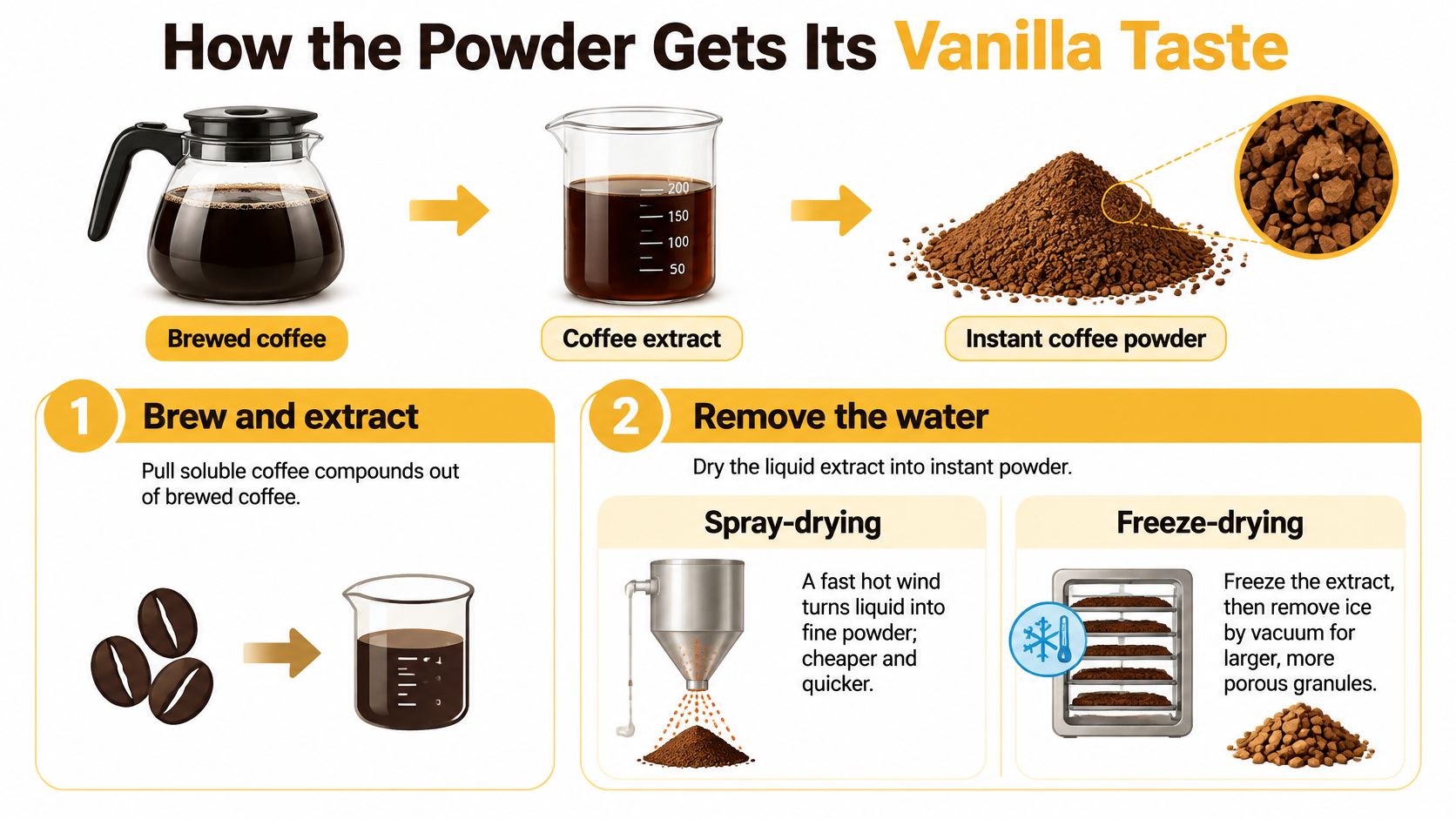
Spray-drying is a fast hot wind
Spray-drying is generally faster and less expensive. It also puts the extract under more heat. Heat strips volatile aroma. Floral and caramel notes fade, and a blunt vanillin note can take over the cup. You can still get a pleasant sweet vanilla smell. You have lost the custard side that makes the style interesting. How those notes are built is covered in this vanilla coffee flavor piece.
Freeze-drying stays colder and keeps more aroma. Thick coffee extract dries slowly because it is viscous, so the gentler path costs time. A porous freeze-dried particle lets hot water in quickly and helps vapor escape while the powder is made and while you mix it.
A process study on PubMed Central found that vacuum foaming followed by microwave-assisted freeze-drying cut drying time by more than 40% while retaining aroma and dissolving cleanly. That is a factory result, not a home trick. The useful lesson is smaller. Judge the finished powder, not the liquid extract before it was dried, because heat changes the balance.
Process rule: Colder drying tends to keep the custard and caramel side of French vanilla. Heavy heat can leave mostly sweet vanilla aroma.
Two checks you can do at home
Dissolving comes first. The powder should go into hot water quickly, with no visible sediment. Grit is a failed cup, not a rustic texture.
Smell and taste twice. Once right after mixing, and again after the jar has been open for a while. Storage flattens the same notes heat already threatened. If day-one coffee smells like caramel and week-three coffee smells only like candy vanilla, the process and the storage both showed up in the cup.
Buy the colder-dried powder when aroma is the point. Buy the cheaper spray-dried tin when you mainly want sweet vanilla and a fast cup. Those are different products wearing similar names.
Office Camping and Family Cups
The day picks the jar. The method stays the same.
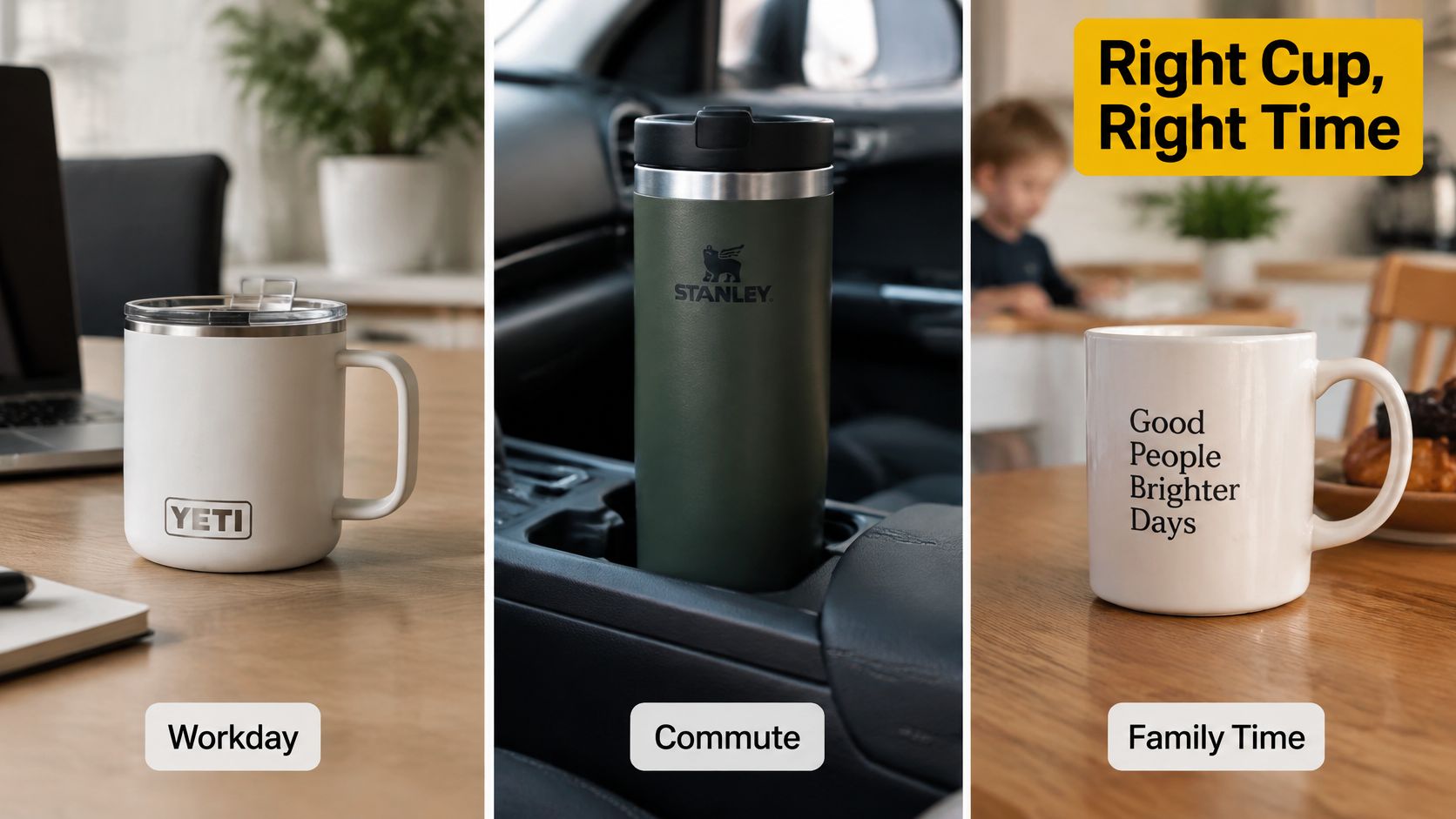
At a desk, a single-serve unsweetened or lightly sweet powder plus a kettle beats a cappuccino mix at midafternoon. The mix is dessert, and the caffeine still counts. Keep the jar sealed so office air doesn't flatten the vanilla. Use a normal hot cup, not a mug filled to the brim, or the flavor washes out before the meeting ends.
Camping is the original job of this format. The powder is light, stable, and ready once water is hot. Dissolve a sachet in water you already boiled for a meal, and skip a second boil when fuel is short. Pack the empty sachet out with the rest of your trash. Don't bury the plastic.
At home with a family, split the use by person instead of inventing a new recipe. Adults can take the black cup or the oat version. A sweeter cappuccino-style packet is an occasional treat, not the default, because sugar and caffeine add up across servings. If the jar has no creamer, one organic powder can serve a plain cup and an iced cup without a second product.
Look for decaf French vanilla when someone wants the flavor without the dose. Don't hand a child a full adult serving. Scale by the grams printed on the label. In the United Kingdom, Speciality Food Magazine reported that 80% of households bought instant coffee for at-home consumption in 2023, and French Vanilla was Little's bestselling decaffeinated instant flavor. The scene chooses the row. It does not call for a different way of mixing.
Choose the Jar That Matches the Cup
Choose the row before you choose the brand.
If you want coffee with a vanilla accent, buy unsweetened vanilla-flavored instant, or buy plain organic instant and add vanilla yourself. If you want a dessert drink, buy the cappuccino-style mix and treat it as occasional.
Then run one check on the jar in your hand. Does the label state grams per serving, and does the sweetener match the row you picked? Organic certification and a short ingredient list matter most for health-conscious buyers. Single-serve packaging matters most for work and trails. A family tin pays off only when more than one person will drink that sweetness level.
Buy the cup you will drink on a normal Tuesday, not the aroma that smells strongest in the shop.
If the powder is unflavored, add vanilla yourself after it dissolves. Brew one test cup at the gram weight printed for a single serving. Taste it black before you decide the next purchase should be a sweeter mix. A jar that only smells impressive in the aisle, then needs a heap of powder and a lot of milk, is the wrong jar.
Cartograph Coffee makes organic instant coffee for work, camping, and home, with the cup built around the coffee rather than a creamer mix. If you want a coffee-first base and prefer to decide on vanilla and sweetness yourself, that is the fit. Visit Cartograph Coffee and raise a better cup.