Forget everything you think you know about instant coffee. Seriously. Modern decaf instant coffee delivers a rich, satisfying flavor without the caffeine, completely shattering the old stereotype of a bland, watery brew. This isn't your grandparents' coffee; today's top-shelf options prove that convenience and exceptional quality can actually go hand-in-hand.
Redefining Your Coffee Experience
For years, the phrase "decaf instant" felt like a compromise—something you drank out of necessity, not desire. Coffee lovers would reluctantly reach for it to dodge the jitters or a sleepless night, accepting a less-than-stellar taste as part of the trade-off. That story has completely changed.
The coffee scene today is packed with high-quality, specialty-grade options that put flavor first. Brands like Cartograph Coffee are leading this movement, using far better beans and smarter processing methods to create a decaf instant that easily holds its own against its caffeinated cousins.
Why People Are Making the Switch
The rising popularity of premium decaf instant isn't just about ditching caffeine. It’s about embracing a lifestyle that values both well-being and convenience. People are realizing they can have the comforting ritual and rich taste of coffee any time of day, without any of the downsides.
So, what's behind this shift?
- Mind-Blowing Flavor: Modern techniques are so much better at preserving the delicate, aromatic notes of the coffee bean. The result is a cup that’s smooth, bold, and surprisingly complex.
- Healthier Habits: We're all more mindful of our caffeine intake these days. People want alternatives that support their well-being without forcing them to give up a daily ritual they love.
- Unbeatable Convenience: Let's be honest, making a fantastic cup of coffee in seconds is a game-changer. It fits perfectly into a hectic schedule, whether you're at home, in the office, or out on an adventure.
This guide will walk you through everything you need to know about this impressive beverage. After all, to truly appreciate great decaf instant coffee, it helps to understand how its quality is communicated, often through effective food product photography that shapes how we see it. We’ll dive into the science of decaffeination, compare different coffee types, and share practical tips for brewing a cup so good, you won’t even miss the buzz.
Choosing decaf instant is no longer a sacrifice—it's a smart choice for a flavorful, fast, and mindful lifestyle.
From Green Bean to Instant Crystal
Ever wonder how a humble coffee bean becomes the convenient crystals sitting in your kitchen? It's a fascinating process, a real marriage of nature and science, all designed to capture the soul of a perfect brew in a form you can enjoy anywhere. The whole journey starts with a simple green, unroasted coffee bean, packed with potential flavor and, of course, caffeine.
For decaf instant coffee, the very first move is getting the caffeine out. Before any roasting or brewing can happen, that caffeine needs to be gently removed. Think of it like carefully taking the pit out of an avocado without bruising the fruit—the goal is to remove one thing while keeping all the good stuff perfectly intact. The care taken at this stage really dictates the final flavor.
The Decaffeination Starting Point
Once the right beans are chosen, they head off for decaffeination. The best methods, which we'll get into later, use natural elements like pure water to coax the caffeine out. This is so important because it ensures the bean's delicate oils and aromatic compounds—the very building blocks of its taste—aren't stripped away.
This careful preservation is what separates great decaf from the rest. After the beans are decaffeinated, they're ready for the next big step: roasting. Just like with any high-quality coffee, this is where the magic really starts to happen. Heat unlocks the complex sugars and acids inside the bean, developing those rich, deep flavors we all look for in a great cup.
The whole idea is simple but powerful: capture the soul of a freshly brewed coffee and make it last. This process locks in the nuanced flavors of the original bean, making sure the final result is miles away from the bland, bitter powders of the past.
Brewing and Capturing the Essence
After roasting and grinding, the decaf coffee is brewed, but on a massive, industrial scale. Huge batches are expertly brewed to pull out the perfect balance of flavor and aroma, creating a highly concentrated coffee liquid. This concentrate is the heart of what will eventually become your instant coffee.
The real challenge is turning this liquid into a shelf-stable solid without wrecking its character. There are two main ways to do this:
- Spray-Drying: This is a common method where the coffee concentrate is sprayed into a chamber of very hot air. The water evaporates almost instantly, leaving behind a fine coffee powder. It’s fast and cost-effective, which is why it's often used for mass-market products.
- Freeze-Drying: This is the gold standard for premium instant coffee, and for good reason. The coffee concentrate is first frozen solid to around -40°C and then placed in a powerful vacuum. The ice turns directly into vapor, skipping the liquid stage entirely in a process called sublimation.
Freeze-drying is a much gentler technique that does a far better job of protecting the coffee's delicate aromas and flavors, giving you a richer, more authentic taste. It’s why quality-focused brands like Cartograph Coffee will only use this method. The process really does define the quality in your cup. If you want to get into the nitty-gritty, check out our guide on how instant coffee works.
And people are definitely catching on. The global instant coffee market, valued at USD 88.40 billion in 2026, is expected to jump to USD 132.03 billion by 2032. This isn't just a trend; it's a major shift as more of us look for that perfect blend of quality and convenience. From the green bean to the final crystal, every step is carefully managed to make sure you get a delicious, hassle-free cup of decaf coffee, every single time.
Exploring the Science of Decaffeination
Getting caffeine out of a coffee bean without wrecking its flavor is a delicate dance. It’s a fascinating mix of science and a deep respect for the coffee itself. It’s not just about what you remove; it’s about everything you manage to leave behind.
Understanding these methods is the key to knowing why some decaf instant coffee tastes wonderfully rich and complex, while others just fall flat.
Think of a green coffee bean as a tiny, natural vault packed with over a thousand different compounds that create its unique taste and aroma. Caffeine is only one of them. The real challenge is to pick the lock, single out the caffeine, and leave all those precious flavor oils and aromatic molecules completely untouched.
It wasn't always done with such care. The earliest decaffeination methods used harsh industrial solvents like benzene, a chemical we now know is a serious health risk. While the industry has thankfully moved on, the "chemical decaf" stigma lingers—and for good reason. Some common methods today still rely on synthetic chemicals.
Chemical Solvents: The Direct Approach
The most widespread solvent-based methods use chemicals like methylene chloride or ethyl acetate. In these processes, green coffee beans are steamed to open their pores and then washed repeatedly with the solvent. The chemical bonds to the caffeine molecules, pulling them out of the bean.
Afterward, the beans are steamed again to wash away any remaining solvent. While it’s an effective way to remove caffeine, it has some serious drawbacks. Critics point out that this direct approach can also strip away some of the bean's natural oils and delicate flavor compounds, leaving you with a less vibrant cup.
Beyond flavor, many of us simply prefer to avoid coffee that’s been in contact with synthetic chemicals, even if the leftover amounts are considered "safe" by official standards.
The Swiss Water Process: A Gentle, Flavor-First Bath
For anyone looking for a purely natural alternative, the Swiss Water Process is the gold standard. It's an ingenious, chemical-free method that uses only pure water, relying on the principles of solubility and osmosis to gently coax the caffeine out. It’s an elegant solution designed to put flavor preservation first.
Here’s a breakdown of how it works:
- Creating the "Flavor-Charged" Water: To start, a batch of green coffee beans is soaked in hot water. This first step extracts both the caffeine and all the soluble flavor compounds. This batch of beans is discarded, but the water—now saturated with all the good stuff from the coffee—becomes the secret sauce: the Green Coffee Extract (GCE).
- Filtering Out the Caffeine: The GCE is then passed through a series of activated carbon filters. These filters are specifically designed to capture only the larger caffeine molecules while letting all the smaller, precious flavor molecules pass right through.
- The Decaffeination Bath: Now, a fresh batch of green coffee beans is soaked in this flavor-rich, caffeine-free GCE. Because the water is already full of coffee flavor compounds, the flavor in the new beans has nowhere to go. It’s a one-way street: only the caffeine moves from the beans into the water, migrating from high concentration (the bean) to low concentration (the GCE).
This clever process ensures the beans keep their original character. The result is a cup of decaf that is remarkably full-bodied and flavorful—a perfect example of how science can work with nature, not against it.
The CO2 Process: Harnessing Natural Pressure
Another highly respected, chemical-free method is the CO2 Process. This technique uses carbon dioxide—the same gas in sparkling water—to selectively remove caffeine. By putting CO2 under high pressure at a specific temperature, it enters a "supercritical" state where it acts like both a gas and a liquid.
In this state, CO2 becomes a completely natural and effective solvent. It's circulated through a tank of water-soaked green beans, where its tiny molecules are able to penetrate the beans and bond exclusively with the caffeine. The CO2, now carrying the caffeine, is then moved to a separate chamber where the pressure is released. The CO2 turns back into a gas, leaving the caffeine behind.
Best of all, the clean CO2 can be captured and reused, making this a highly sustainable and efficient process.
Comparing Coffee Decaffeination Methods
To make sense of these options, it helps to see them side-by-side. The choice of method has a direct impact on the final taste and purity of your coffee.
| Method | Process Overview | Chemicals Used | Flavor Impact |
|---|---|---|---|
| Direct Solvent | Beans are steamed and rinsed directly with a chemical solvent (e.g., methylene chloride) to remove caffeine. | Yes (Synthetic) | Can strip some natural oils and flavor compounds, potentially leading to a thinner, less complex taste. |
| Indirect Solvent | Water absorbs caffeine from beans, then a solvent removes caffeine from the water. The water is then reused. | Yes (Synthetic) | Generally considered gentler on flavor than the direct method, but still involves chemical contact. |
| Swiss Water Process | Uses a flavor-charged, caffeine-free Green Coffee Extract (GCE) to remove caffeine via osmosis. | None | Excellent flavor retention, as the GCE prevents desirable compounds from leaving the bean. Very clean taste. |
| CO2 Process | Supercritical CO2 is used as a natural solvent to selectively bond with and remove caffeine molecules. | None | Preserves flavor and oils very well due to the selective nature of CO2. Also a clean, pure profile. |
As you can see, methods like the Swiss Water Process and CO2 Process stand out for their ability to deliver a delicious cup of decaf without introducing synthetic chemicals into the equation.
This image shows the journey from a raw bean to a finished coffee crystal, highlighting how decaffeination is a key step.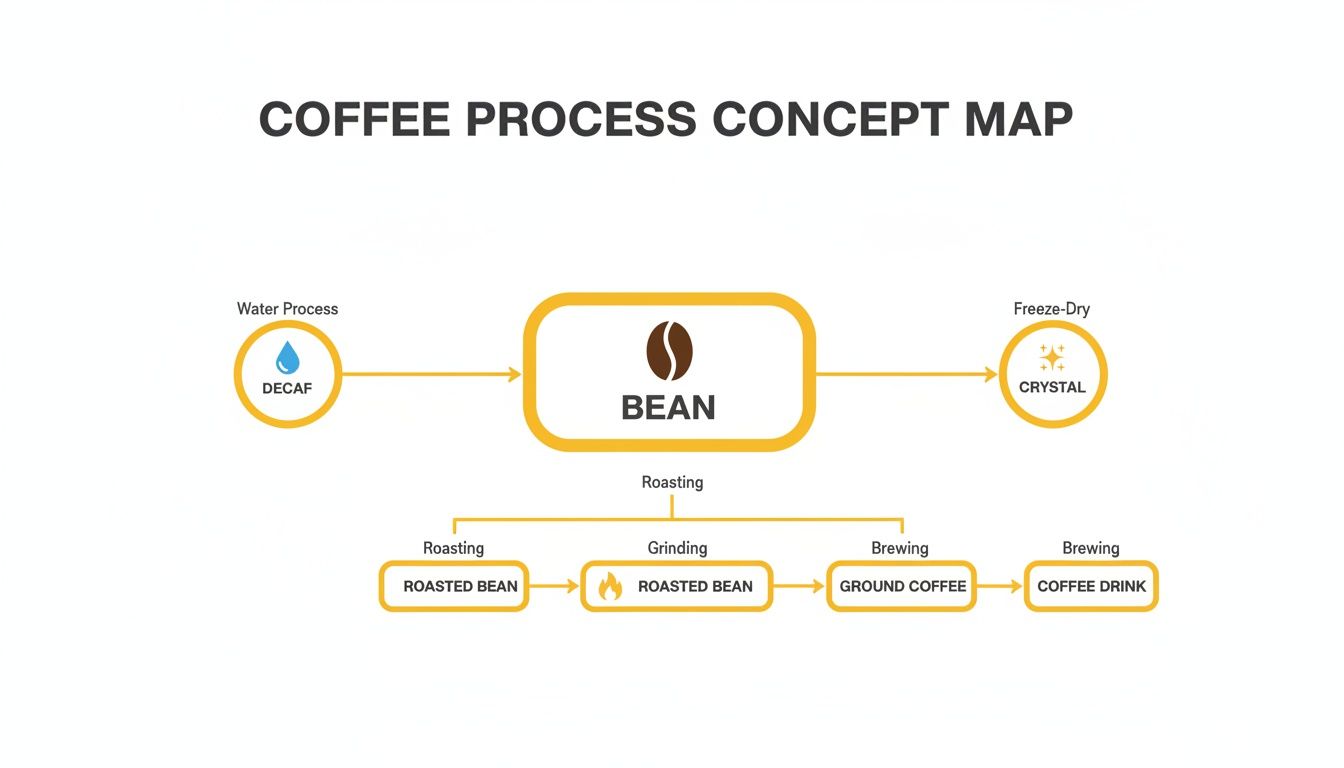
The visual makes it clear: producing great decaf instant coffee isn't an accident. It requires specific, deliberate steps to protect the coffee's natural flavor.
For us at Cartograph Coffee, choosing a decaffeination method isn't just a technical detail—it’s a promise. By using certified organic, chemical-free processes, we make sure every cup of our decaf instant coffee is pure, clean, and tastes exactly as it should: rich, aromatic, and deeply satisfying.
Decaf Instant vs Other Coffee Choices
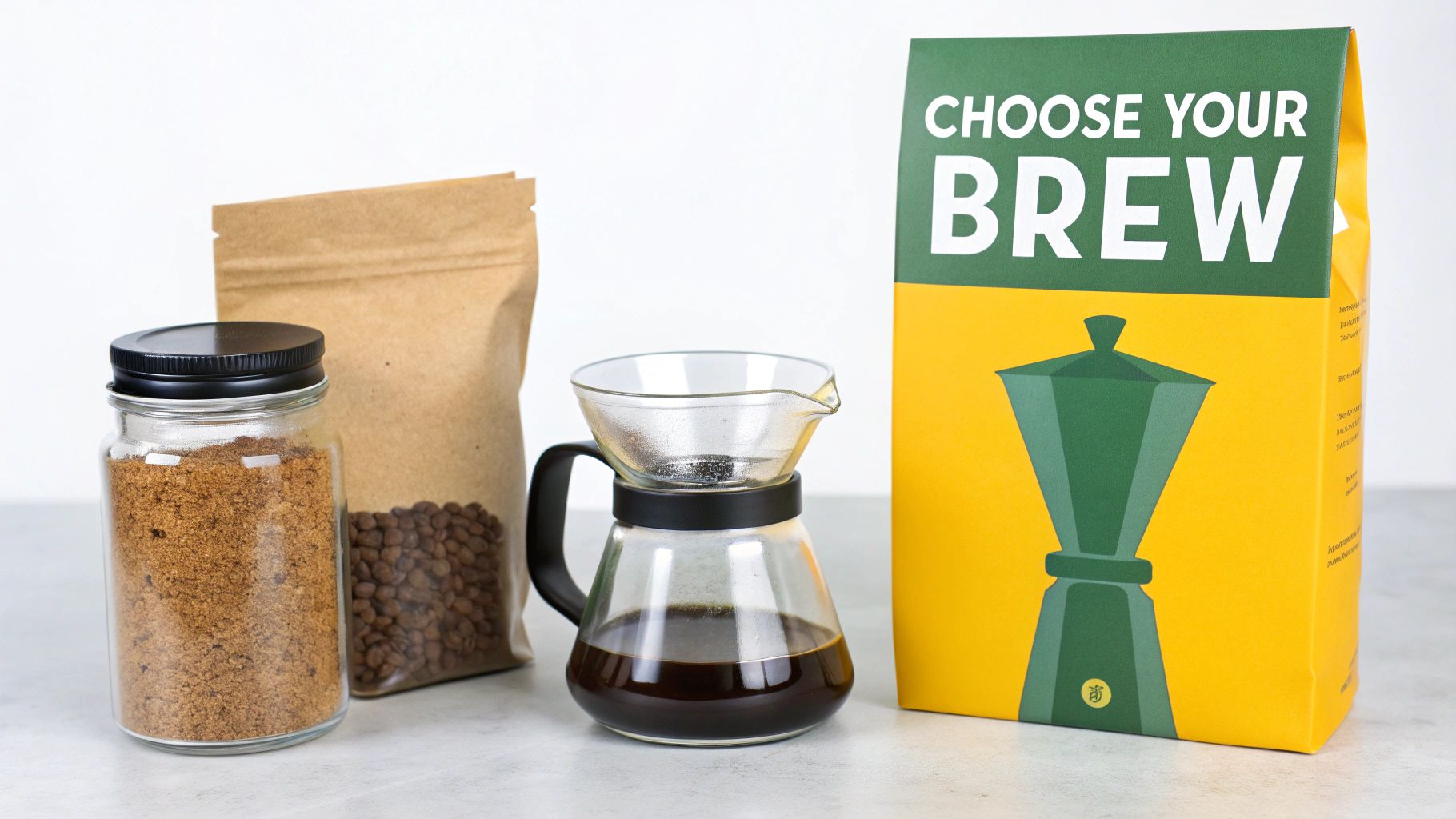
Let's be honest, the "right" coffee is all about the moment. The slow, satisfying ritual of a weekend pour-over is a completely different beast from grabbing a quick, warming cup on a chilly morning at a campsite. Understanding the real-world trade-offs between different coffee types is key to a great experience every time.
When we stack decaf instant coffee up against its caffeinated twin and traditional ground coffee, the goal isn't to crown one as "best." It's about figuring out the right tool for the right job. Each one shines in different situations, offering a unique mix of convenience, flavor, and prep time.
The Great Divide: Ground vs. Instant
The biggest split in the coffee world is between ground and instant. Think of ground coffee as making dinner from scratch. You need equipment—a brewer, filters, maybe even a grinder—and you need a bit of time. The reward for your effort is a deeply nuanced flavor that reflects the bean's origin, the roast, and your own brewing skills.
Instant coffee, on the other hand, is like a fantastic meal-prep service. All the hard work of brewing has been done for you by experts, with the coffee’s essence perfectly captured. All you have to do is add hot water to bring it back to life. It’s a fundamentally different approach.
This creates two distinct experiences:
- Ground Coffee: A hands-on ritual for those slow moments when you want to customize every detail.
- Instant Coffee: A fast, consistent, and reliable solution built for speed and simplicity.
Decaf Instant vs. Regular Instant: The Caffeine Question
When you compare decaf and regular instant coffee, you’re really only changing one thing: the caffeine. Both give you that amazing convenience, portability, and dead-simple preparation. A high-quality freeze-dried instant, whether it’s decaf or not, can deliver a surprisingly rich and complex flavor that shatters old stereotypes.
The choice here comes down to function. Need that morning kickstart to get your brain in gear? Regular instant is your best friend. Craving that comforting coffee flavor in the evening without staring at the ceiling all night? Decaf instant coffee is the obvious choice.
The ability to enjoy coffee anytime, day or night, is a total game-changer for a lot of people. Decaf instant gives you the complete sensory experience—the aroma, the warmth, the flavor—without the jitters, making it a must-have for any coffee lover's pantry.
A Quick Guide: Which Coffee When?
To help you decide, let's put these coffees side-by-side and see how they stack up in the real world.
Decaf Instant Coffee vs Other Coffee Types
This table breaks down the core differences, so you can easily match the right coffee to your situation.
| Coffee Type | Convenience Level | Brew Time | Flavor Profile | Best For |
|---|---|---|---|---|
| Decaf Instant Coffee | Highest | < 30 Seconds | Smooth, balanced, and surprisingly rich | Evening relaxation, travel, camping, quick office breaks, caffeine-sensitive folks |
| Regular Instant Coffee | Highest | < 30 Seconds | Bold and robust, with a noticeable caffeine kick | Busy mornings, pre-workout energy, when you need speed and a jolt |
| Ground Decaf Coffee | Moderate | 3-5 Minutes | Complex and nuanced, brew-method dependent | Leisurely weekend mornings, after-dinner coffee, when you have time for a ritual |
| Ground Regular Coffee | Moderate | 3-5 Minutes | The most diverse and complex flavor potential | The classic morning ritual, coffee connoisseurs, social coffee gatherings |
Ultimately, having a few different types of coffee at home is like having a well-stocked toolkit. While freshly ground coffee will always be the purist’s choice for a slow, thoughtful brew, decaf instant coffee has earned its place as the ultimate problem-solver for a busy life, delivering a genuinely great cup when time and simplicity matter most.
The Real Benefits of Choosing Organic
Choosing organic decaf instant coffee is about so much more than a label. It's a conscious decision for a cleaner, purer cup of coffee, and it reflects a commitment to quality that starts long before the beans ever see a roaster. When you spot that "certified organic" seal, think of it as a promise—a guarantee of care and transparency from the soil all the way to your final sip.
This commitment begins right at the source: the farm. Organic coffee is grown without synthetic pesticides, herbicides, or fertilizers. Instead of relying on a chemical cocktail, farmers use natural, time-tested methods like composting and crop rotation to build rich, healthy soil. It’s the difference between a garden tended with care and one sprayed for convenience. The healthier the environment, the more vibrant and flavorful the coffee.
This natural approach doesn't just help the planet; it directly impacts the taste in your mug. Beans grown in this kind of nutrient-dense, chemical-free soil have the chance to develop far more complex and nuanced flavors. Without synthetic inputs getting in the way, the coffee’s true character shines through, giving you a cleaner, richer, and more authentic taste experience.
A Purer Path from Farm to Crystal
That organic promise extends far beyond the farm. For a decaf instant coffee to earn its organic certification, every single step of its journey has to meet incredibly strict standards. This absolutely includes the decaffeination process itself. As we've touched on, methods that rely on chemical solvents can leave behind trace residues—something many of us would rather avoid.
Organic standards demand a cleaner path. That’s why you’ll almost always find premium organic decaf coffee made using chemical-free methods like the Swiss Water Process or the CO2 Process. These techniques use natural elements—pure water or carbon dioxide—to gently coax the caffeine out while meticulously preserving the bean's delicate flavor compounds.
Choosing organic is your assurance that the entire process is free from synthetic additives. It’s a guarantee of purity, ensuring nothing stands between you and the authentic taste of high-quality coffee.
This dedication to a clean process is really hitting home with coffee drinkers everywhere. The market shows a clear shift toward decaf that aligns with wellness values. In fact, organic decaffeinated coffee now makes up around 65% of the total decaf demand, as people actively seek out the purity of chemical-free methods. It's a major reason why the global decaf market, currently valued at USD 2.39 billion, is expected to keep growing.
More Than Just a Health Choice
Opting for organic decaf instant coffee is also a powerful vote for a more sustainable and ethical coffee industry. By their very nature, organic farming practices are better for the planet. They promote biodiversity, conserve water, and improve soil quality for generations to come. It’s a holistic approach that supports the entire ecosystem, not just the coffee plant itself.
This mindful approach creates a positive ripple effect. It supports the small farmers dedicated to responsible land stewardship and helps ensure everyone along the supply chain is treated fairly. When you choose a brand like Cartograph Coffee, you're not just buying a great product; you're supporting a system that values both people and the planet. To learn more, check out our guide on what makes our organic instant decaffeinated coffee a choice you can truly feel good about.
Ultimately, every cup of organic decaf instant coffee tells a story of integrity. It's a choice that delivers cleaner flavor, peace of mind, and a real connection to a more responsible way of making the coffee we all love.
How to Brew the Perfect Cup Every Time
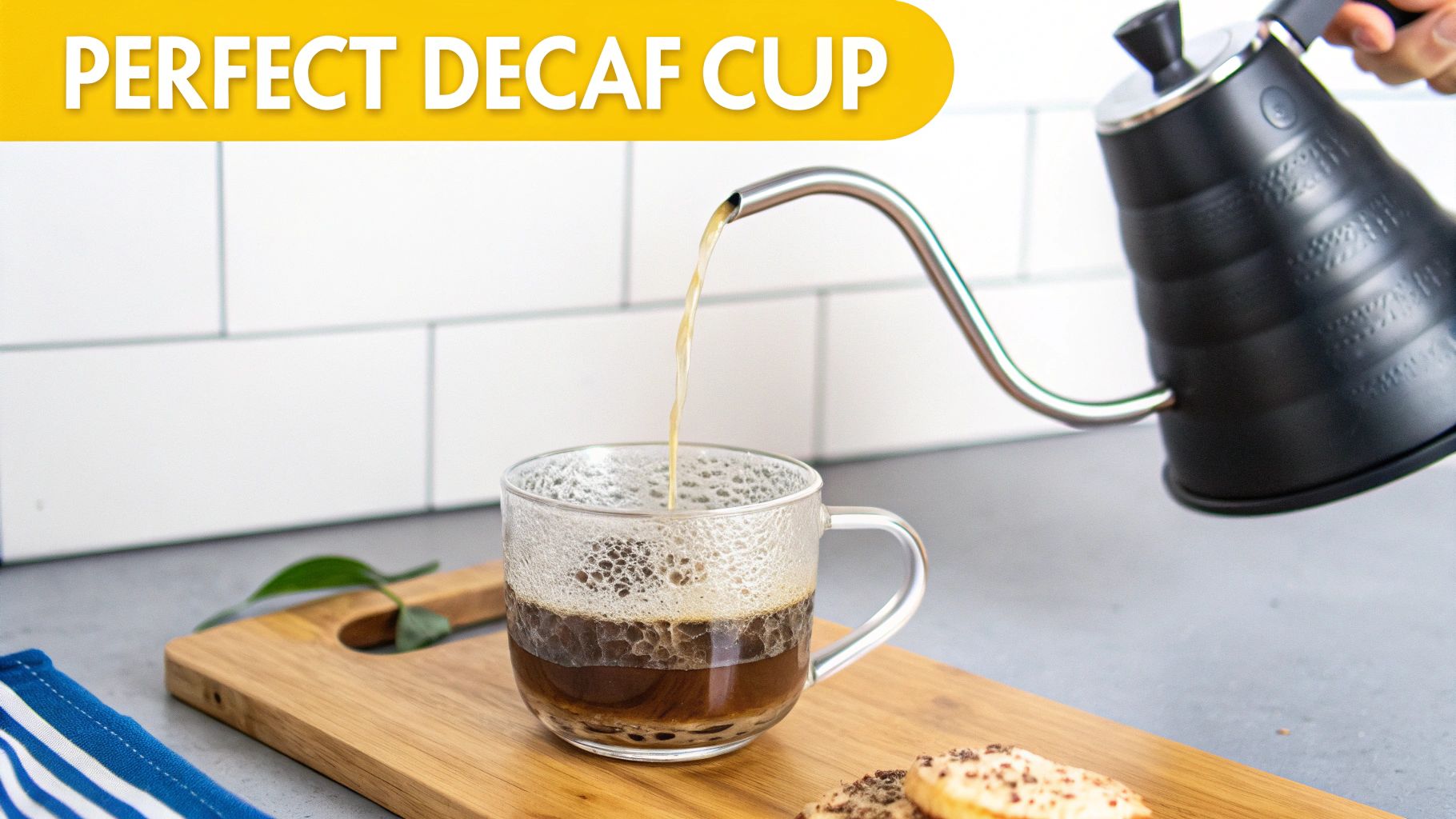
Making a great cup of decaf instant coffee is refreshingly simple, but a few small details can take your brew from just "good" to genuinely exceptional. It’s all about unlocking the full, rich flavor that a premium coffee like Cartograph works so hard to create.
And it all starts with the water.
The single biggest mistake people make is using boiling water. When a kettle is screaming hot, that water will scorch the delicate coffee crystals, leaving you with a bitter, flat-tasting cup. You want it hot, but not that hot. The sweet spot is just off the boil, somewhere between 195°F and 205°F (90-96°C).
The easiest way to nail this? Just let your kettle sit for about 30 to 45 seconds after it clicks off. This brief pause makes a world of difference, allowing the coffee’s smoother, more complex notes to come alive. For a more detailed look, check out our complete guide on how to make perfect instant coffee.
Finding Your Perfect Ratio
With your water at the right temperature, the next step is getting the coffee-to-water ratio just right. This really comes down to personal taste, but a fantastic starting point is one to two heaping teaspoons of coffee for every 8 ounces (237ml) of water.
Use that as your baseline and tweak it from there. If you love a bolder, more robust cup, add a little extra. Prefer something a bit milder? Use a little less. Experimenting is half the fun!
Get Creative with Your Decaf Instant Coffee
One of the best things about decaf instant is just how versatile it is. Don't feel limited to a simple hot black coffee—those easily dissolvable crystals are perfect for all sorts of delicious creations.
Here are a few ideas to get you started:
- Quick Iced Latte: Dissolve two teaspoons of decaf instant in just a splash of hot water to make a strong coffee concentrate. Pour it over a tall glass of ice, top with your favorite milk (dairy or plant-based), and give it a good stir.
- Rich Coffee Smoothies: Toss a teaspoon of coffee crystals straight into the blender with your other smoothie ingredients. It adds an amazing roasted depth to a banana and protein smoothie without any of the caffeine jitters.
- Flavorful Baking Booster: This is my favorite trick. Add a teaspoon of decaf instant to your chocolate recipes. It won't make your brownies taste like coffee—it just makes the chocolate taste more intensely chocolatey.
A common myth is that "decaf" means "flavor-free." A high-quality decaf instant proves that wrong, delivering all the aromatic satisfaction you expect from great coffee. It's the perfect way to enjoy that flavor any time of day, in any form.
Proper Storage for Lasting Freshness
Finally, let's talk storage. To make sure your last cup tastes just as fresh as your first, you have to protect it from its biggest enemies: moisture, air, and light. These are what cause coffee crystals to clump up and lose their aroma.
The solution is simple: keep your decaf instant in a cool, dry, and dark place, like a pantry or kitchen cabinet. Most importantly, make sure the container is sealed tight after every single use. An airtight container is your best friend for locking in that rich flavor and keeping your coffee from going stale.
Got Questions About Decaf Instant Coffee? Let's Clear Things Up.
Even for seasoned coffee lovers, switching to decaf instant can bring up a few questions. It’s totally normal to be curious. Let's tackle some of the most common ones so you can feel great about the coffee in your cup.
Is Decaf Actually Caffeine-Free?
This is probably the number one question I get, and it's a great one. The short answer is no, but the amount left is tiny. No decaf coffee is ever 100% caffeine-free.
Even the best decaffeination methods remove around 97% of the caffeine, not all of it. So, a typical cup of decaf instant coffee might have about 2-5 milligrams of caffeine. To put that in perspective, a regular cup of coffee often has 95 milligrams or more. For most people, that trace amount is so small you'd never notice it—no jitters, no sleepless nights.
Okay, But Does It Taste... Weird?
Let's be honest, decaf has a bit of a reputation, and it wasn't always a good one. A decade or two ago, you could often taste the difference. But today? That's a whole different story.
Modern, chemical-free methods like the Swiss Water Process have completely changed the game. They're incredibly precise.
Think of it like a meticulous puzzle: the goal is to find and remove only the caffeine molecule while leaving the hundreds of other delicate compounds that create aroma and flavor right where they belong.
When you start with high-quality beans and use a gentle process, the result is a cup of decaf that’s every bit as rich and satisfying as the real deal. You truly get all of the flavor and none of the buzz.
Ready to taste a decaf that doesn't compromise? Cartograph Coffee’s premium organic instant decaf is crafted to deliver a rich, full-bodied cup every single time. Discover the difference here.