If a scoop tastes strongly of coffee, does that tell you how much caffeine you'll get? It doesn't. Coffee ice cream caffeine depends on the coffee input, recipe concentration, and how much you eat, not on flavor intensity alone. A useful answer therefore starts with two measurements, milligrams per 100 grams and milligrams per serving, then places your serving inside a daily budget.
Caffeine Per Serving in Coffee Ice Cream Compared With Coffee
Coffee ice cream can contain almost no caffeine or an amount approaching a cup of coffee. Most ordinary servings sit below a cup, but dense or concentrated products can close that gap. That's why a single “typical” number misleads.
The clearest laboratory anchor comes from the 2015 peer-reviewed Hungarian survey, which measured 377 food and beverage samples and found five tested ice creams contained 1.7 to 24.8 milligrams per 100 grams. The same survey found home-prepared coffee drinks ranged from 41 to 203 milligrams per serving, averaging 73.1 milligrams.
Per 100 Grams Versus Per Serving
A per-100-gram figure describes concentration. It doesn't describe your bowl.
A 100-gram portion at the top of that laboratory range contains 24.8 milligrams. But a standard 2/3-cup serving can weigh considerably more than 100 grams, especially in dense products. The per-serving figure is therefore the fair comparison with a mug of coffee.
Compare servings with servings, and concentrations with concentrations. Mixing the two makes a product look weaker or stronger than it is.
| Product or drink | Caffeine per 100 g | Caffeine per serving | Source basis |
|---|---|---|---|
| Coffee ice cream, USDA average | 0.5 mg | 0.5 mg per 100 g portion | USDA FoodData Central analysis |
| Coffee ice cream, lab survey range | 1.7-24.8 mg | 1.7-24.8 mg per 100 g portion | 2015 Hungarian survey of five products |
| Lighter coffee ice cream | Use label serving weight | about 25 mg (2/3 cup) | Consumer guidance |
| Super-premium coffee ice cream | Use label serving weight | 30-50 mg (2/3 cup) | Consumer guidance |
| Coffee sorbetto | Use label serving weight | 39-84 mg (2/3 cup) | Consumer guidance |
| Coffee gelato | Use label serving weight | 43-91 mg (2/3 cup) | Consumer guidance |
| Brewed coffee, 8 oz | Use prepared serving | 80-100 mg | Common reference |
| Home-prepared coffee drink | Use prepared serving | 41-203 mg, average 73.1 mg | 2015 Hungarian survey |
Read the frozen-dessert rows from top to bottom. The USDA average is very low, laboratory-tested products occupy a modest range, and premium serving estimates rise from lighter ice cream to gelato. At the upper end, gelato overlaps brewed coffee.
For a broader comparison with drinks, see our guide to coffee caffeine content. The practical conclusion is simple. A small scoop usually supplies a fraction of a coffee, while a large or concentrated serving can become nutritionally similar to one.
How Ingredients and Serving Size Set the Caffeine Level
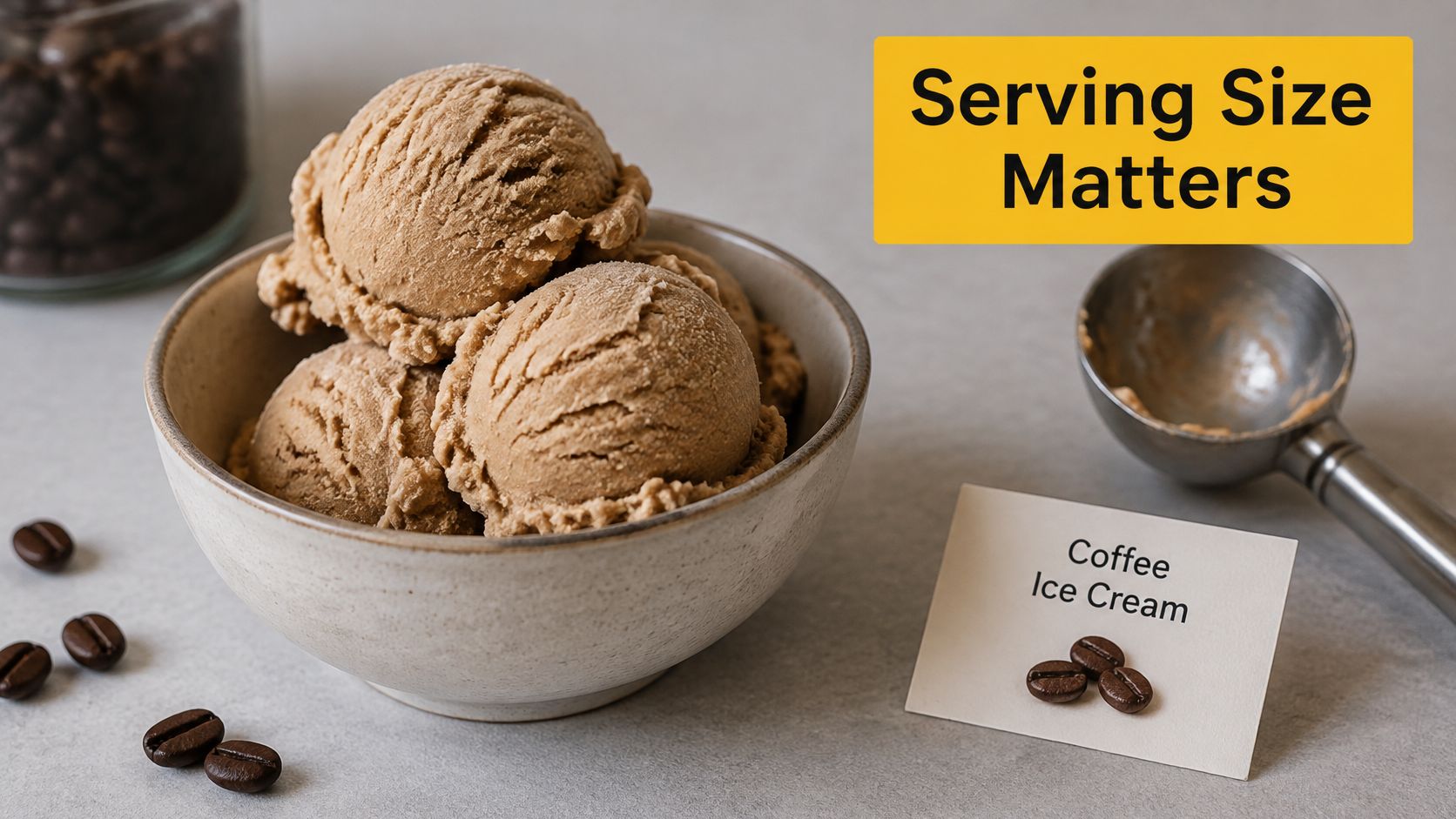
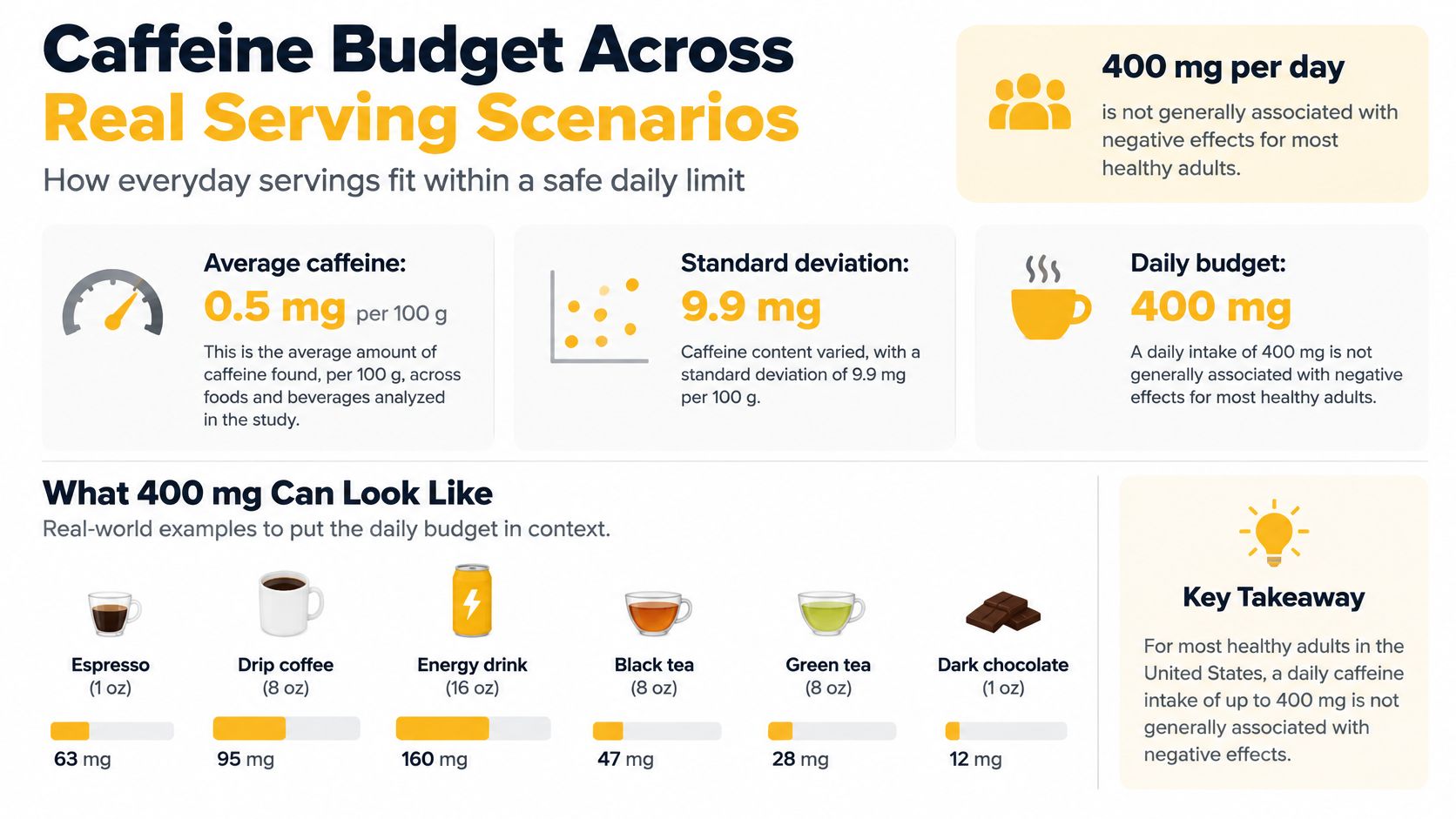
A broad average hides the products that matter most. A recent USDA FoodData Central based analysis reported coffee ice cream at an average of 0.5 mg per 100 g, with a 9.9 mg standard deviation. That spread tells you some products sit far from the average, so you shouldn't treat it as a prediction for a particular pint.
Three Drivers Do Most of the Work
- Coffee input: Brewed coffee, espresso, instant coffee, and concentrated extract don't carry equal caffeine loads. Instant coffee powder can be especially concentrated before dilution.
- Serving weight: A dense 2/3-cup serving can weigh well over 100 grams, so the same recipe delivers more caffeine per bowl than its per-100-gram figure might suggest.
- Recipe design: Coffee used only as a light flavoring behaves differently from coffee solids built into the base.
An experimental study in Foods found no detectable caffeine in its control formulation, but coffee silverskin flour produced 214.90 mg per 100 g at one inclusion level and 335.25 mg per 100 g at a higher level. Those are specialized experimental recipes, not typical shop products. They still prove that ingredient choice can change the result dramatically.
| Ingredient or formulation | Caffeine per 100 g | Note |
|---|---|---|
| Control formulation, no coffee solids | None detected | Baseline with no caffeine |
| Coffee silverskin flour, lower inclusion | 214.90 mg | Experimental, replaces part of the fat phase |
| Coffee silverskin flour, higher inclusion | 335.25 mg | Experimental, higher inclusion level |
| Instant coffee powder, average | 3,954 ± 2,355 mg | Concentrated coffee input |
Think of a teaspoon of strong espresso beside a large bowl of weak tea. Taste and volume point in different directions. A bold-tasting ice cream may rely on flavoring with little caffeine, while a milder one may contain concentrated coffee solids.
Start with the ingredient list. Then ask for caffeine per serving and per 100 grams instead of settling for yes or no.
Caffeine in Other Caffeinated Desserts and Everyday Sources
Coffee ice cream isn't the only sweet that can carry caffeine. Chocolate desserts can get caffeine from cocoa ingredients, tea-based desserts can get it from tea, and cola counts as its own source. A product doesn't need “coffee” in its name to affect your total.
The reverse also matters. A coffee-named dessert may use mostly flavoring, while a chocolate or tea dessert made with substantial caffeinated ingredients may contribute more than expected. Appearance and flavor names are weak evidence.
Use the Same Basis Every Time
Run every comparison in the same order:
- Find the serving weight: Note grams before looking at any caffeine number.
- Find caffeine per 100 grams: This lets you compare concentration between brands.
- Convert to your portion: Scale the figure to the amount you'll eat or drink.
- Compare with coffee: Put the result beside a familiar cup to judge whether it's minor or substantial.
Check a comparable USDA FoodData Central entry when a package gives no caffeine figure. Brand, recipe, and preparation can change estimates, so treat a database match as a guide rather than a lab result for that exact tub.
Comparison rule: Don't call a dessert caffeine-free because its front label doesn't mention caffeine. The package or a reliable database entry needs to support that conclusion.
This matters beyond dessert. Tea or cola served with ice cream adds to the same daily total, as do chocolate pieces, fudge ribbons, and cocoa-based mix-ins. If cocoa itself is part of your comparison, our explainer on caffeine in cocoa versus coffee shows how to keep the serving basis consistent.
People who track caffeine because it affects focus may also value REVETIX on evidence-based attention support as wider reading on separating evidence from marketing claims. For food choices, stay with the measurement routine. No dessert should be treated as caffeine-free unless its label or database entry says so.
Caffeine Budget Across Real Serving Scenarios
A serving number becomes useful when you compare it with your day. FDA caffeine guidance cites 400 mg per day as an amount not generally associated with negative effects for most adults. It isn't a target to reach, and personal sensitivity still matters.
| Serving | Caffeine per serving | Share of 400 mg adult limit |
|---|---|---|
| Lighter coffee ice cream, 2/3 cup | about 25 mg | about 6% |
| Super-premium coffee ice cream, 2/3 cup | 30-50 mg | 8-13% |
| Coffee gelato, 2/3 cup | 43-91 mg | 11-23% |
| Brewed coffee, 8 oz | 80-100 mg | 20-25% |
How Totals Stack
Say you drink an afternoon coffee, then eat a lighter coffee ice cream. The dessert adds a modest slice, but the coffee still dominates. Replace that dessert with a stronger gelato at the top of its range, and you've added roughly another coffee-sized contribution.
A late dessert after tea and chocolate works differently. No single item needs to be large for the combined total and timing to matter, particularly if caffeine affects your sleep. Medications and supplements can add to the same exposure, so read their labels too.
A camping meal shows another stacking pattern. Instant coffee with dinner plus coffee ice cream afterward gives you two coffee-based sources in a short period. Our guide to how much caffeine is safe per day can help you plan that total before the second serving.
Some groups need a lower ceiling. Pregnancy guidance commonly uses a limit below 200 mg per day, so the same shares effectively double. Readers who want pregnancy-specific context can review caffeine guidance for expectant mothers. Caffeinated beverages should be avoided for children younger than two, and pediatric authorities generally discourage caffeine for young people.
All product figures remain averages or ranges. Brand and preparation can shift them, which is why budgeting works best with the actual label in hand.
How to Check the Caffeine in Any Coffee Ice Cream
You can assess a specific pint in about a minute, provided you separate what's stated from what's assumed. The goal is a defensible estimate for your serving, not a guess based on color or flavor strength.
Six Checks in Order
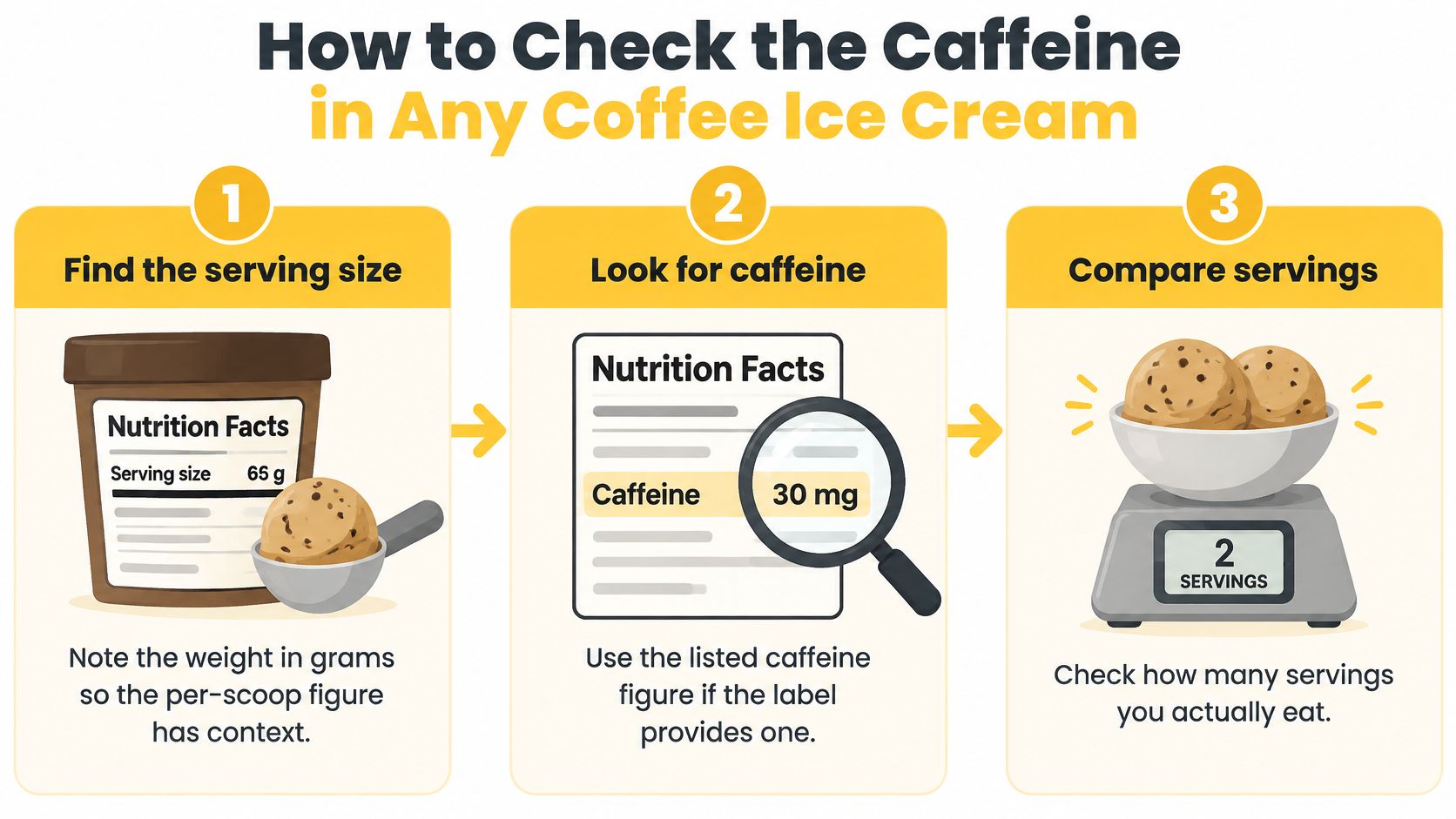
- Record the serving size in grams. A cup measure alone can mislead because whipped and dense products weigh different amounts. The common slip is treating every 2/3 cup as nutritionally identical.
- Look for a stated caffeine amount. Use it if the manufacturer provides one, and note whether it applies per serving or per 100 grams. If the package doesn't state a figure, compare a similar product in USDA FoodData Central.
- Scan the ingredients for the caffeine source. Look for coffee, espresso, cold brew, coffee extract, instant coffee, cocoa ingredients, or added caffeine. Terms such as “coffee flavor” tell you much less about the actual load.
- Treat missing information as unknown. No caffeine line doesn't prove zero. Don't fill the gap by judging how bold the product tastes, because flavoring can be intense without carrying much caffeine.
- Ask the manufacturer a precise question. Request caffeine per 100 grams of finished product and ask whether that value came from laboratory testing. A recipe description alone can't settle the amount.
- Convert the answer to your bowl. Multiply the grams you'll eat by the per-100-gram amount, then divide by 100. For example, at a hypothetical 20 mg per 100 grams, a 150-gram serving gives 30 mg.
Most common reading error: A per-100-gram value isn't a per-scoop value unless your scoop weighs exactly 100 grams.
What a Good Answer Looks Like
You should be able to finish with a sentence like this. “This serving weighs 120 grams, the maker reports caffeine per 100 grams, and my calculated portion fits within the amount I've left today.”
If one part is missing, say so plainly. “The ingredients include coffee extract, but the maker doesn't publish caffeine” is more honest than inventing a number. For a low-stakes treat, that may be enough. For pregnancy, children, medication concerns, or strong sensitivity, choose a product with clearer information or skip the caffeinated dessert.
At home, you control the input more directly. Use a measured coffee serving, record how much enters the batch, and divide by the finished servings. You'll still have an estimate, but it will be an estimate tied to your recipe rather than the flavor name.
Choosing Coffee Ice Cream for Your Caffeine Goal
Let your situation choose the product, not the other way around. Independent consumer guidance on coffee ice cream caffeine reports about 25 mg in a 2/3-cup serving of lighter products, 30-50 mg in super-premium products, 39-84 mg in coffee sorbetto, and 43-91 mg in coffee gelato. Those ranges make portion awareness the deciding skill.
Match the Choice to the Occasion
- Low-caffeine evening treat: Choose a lighter coffee ice cream and keep to one measured 2/3-cup serving. Don't assume an unlabeled product belongs in this category.
- Noticeable coffee lift: Pick a gelato or super-premium product only after confirming its amount. Even then, weigh the portion, because the top of the gelato range approaches coffee.
- No caffeine figure available: Budget cautiously using the upper end of the relevant category. For gelato, plan around 91 mg rather than hoping it's near the bottom.
- Shared family dessert: Keep young children away from caffeinated foods and choose a clearly caffeine-free alternative for them. A shared tub makes individual portions easy to underestimate.
- Late dessert after coffee or tea: Add the estimated dessert amount to your running total before ordering. If the total crowds your ceiling, reduce the portion or choose another flavor.
Coffee flavor also appears outside frozen desserts. If you're comparing coffee-themed products and want the label details for a protein option, NZ Supps Ghost whey coffee protein is an example of why product names alone shouldn't drive assumptions. Read the nutrition panel for that specific item.
The final rule is straightforward. Your daily ceiling and the measured serving decide. Flavor strength doesn't.
When you want coffee flavor with a measured single serving, Cartograph Coffee offers organic freeze-dried instant coffee in sealed packets that dissolve in hot or cold drinks without brewing equipment. It's a practical option for tracking coffee as coffee, while treating coffee ice cream as the separate dessert serving it is. Visit Cartograph Coffee to explore the medium roast and plan your next cup with clearer portion control.