You're reaching for an afternoon coffee when you notice a jar of chicory instant coffee promising a familiar roasted drink without the usual buzz. Before you swap your regular cup, it helps to know whether you're buying pure chicory, a coffee blend, or a health claim that the label doesn't support.
What Chicory Instant Coffee Is and Where It Came From
Chicory instant coffee is a soluble powder made from roasted chicory root, sold either on its own or blended with coffee. Pure chicory contains no caffeine, despite the word coffee on the package. The name describes how people prepare and drink it, not the plant it comes from.
Chicory is a root, rather than a coffee bean. When roasted, it develops dark, bitter, caramel-like flavors that make it useful as a coffee alternative or blending ingredient. A cup can feel rounded and substantial, but it won't reproduce every aroma you associate with brewed coffee.
Why New Orleans Kept the Taste
During the American Civil War, the Union blockade disrupted imported coffee supplies, and New Orleans residents used locally grown chicory to stretch what remained. The New Orleans Historical account describes approximately 18 million pounds of Brazilian coffee passing through New Orleans in 1861, followed by zero in 1862 and only about 14,700 pounds in 1864.
Roasted, ground chicory offered a practical response to that shortage. Residents could cultivate the root locally instead of depending entirely on imported beans. Adding it to scarce coffee supplied extra roasted flavor and body without requiring as much coffee.
After trade resumed, people continued drinking the mixture because they liked its flavor and smooth texture. What began as a necessity became a durable regional preference.
Chicory isn't simply a recent coffee trend. Its place in the cup grew from an established practice of making limited coffee supplies go further.
What Instant Changes
Say you want that roasted drink at work but don't have a brewer. Traditional roasted chicory grounds still need extraction and separation from the liquid. Instant chicory has already been extracted and dried, so you dissolve the powder instead.
That distinction matters when shopping. A bag labeled roasted chicory root may contain grounds intended for brewing, while a jar labeled soluble or instant should dissolve directly.
Today, the useful questions are less about whether chicory counts as coffee and more about what's inside the package. Its ingredient mix determines the caffeine question, its processing affects what reaches your cup, and your preparation determines whether you enjoy the result.
Chicory Instant Coffee Types Compared
| Type | Caffeine | Flavor | Body | Best for |
|---|---|---|---|---|
| Pure roasted chicory instant | None | Dark, bitter, caramel-like | Smooth, sometimes perceived as slightly sweet | Caffeine-free evenings |
| Coffee-chicory blend | Coffee contributes caffeine; check the finished serving | Coffee brightness with chicory depth | Often fuller and rounded | Partial caffeine reduction |
| Regular instant coffee | Standard caffeinated serving unless labeled decaffeinated | Bright to bold coffee | Often lighter than a chicory blend at comparable strength | Familiar coffee flavor and stimulation |
Pure roasted chicory suits someone who wants a roasted beverage without coffee beans. Expect a different drink, not an exact imitation of your usual instant coffee. Its darker, root-based flavor can be especially noticeable when you drink it black.
A coffee-chicory blend keeps some coffee aroma while adding chicory's bittersweet depth. Replacing part of the coffee with chicory can reduce caffeine when the comparison uses an equivalent serving, but the blend percentage alone doesn't establish the caffeine in your mug. Powder quantity and the coffee ingredient also matter.
Regular instant coffee is the more direct choice when you want coffee's characteristic aroma and caffeine effect. It isn't necessarily thin or harsh. Roast, concentration, and preparation can produce a substantial cup without chicory.
Read the Ingredients Before the Front Label
Product names can blur these categories. A prominent mention of chicory doesn't tell you whether it's the main ingredient or a smaller addition.
Use these checks before buying:
- Identify the base. Look for pure chicory, coffee and chicory, or coffee alone in the ingredient list.
- Find the proportion. A disclosed chicory percentage makes blends easier to compare. Without it, you can't reliably judge how much root-based ingredient you're buying.
- Separate the additions. Sugar, milk powder, flavorings, and other ingredients change the drink independently of chicory.
- Check the serving information. Compare prepared servings rather than assuming equally sized scoops contain equivalent amounts of coffee.
The same label-reading habit helps with other plant ingredients. Pumpernickel Health Foods' baobab guide offers a related resource for exploring another ingredient often discussed in nutrition terms, but evaluate each ingredient on its own evidence rather than transferring benefits between plants.
Treat Flavor Descriptions as a Starting Point
The table describes a useful tasting direction, not a promise. A heavily roasted chicory product may seem more bitter than a gentler roast, while milk can soften the contrast between chicory and coffee.
Try a new product without sweetener first, then adjust it. Otherwise, you may end up comparing sweetness rather than the underlying drink.
Choose pure chicory for caffeine avoidance, a transparent blend for partial reduction, and regular instant when you want the familiar coffee experience. Don't use darkness or bitterness as a caffeine gauge.
How Chicory Becomes Instant Powder
Manufacturers turn a bulky root into a soluble drink through preparation, roasting, extraction, and drying. The important distinction is that instant powder comes from a dried liquid extract, not from grinding the root very finely.
This overview shows the main production stages.
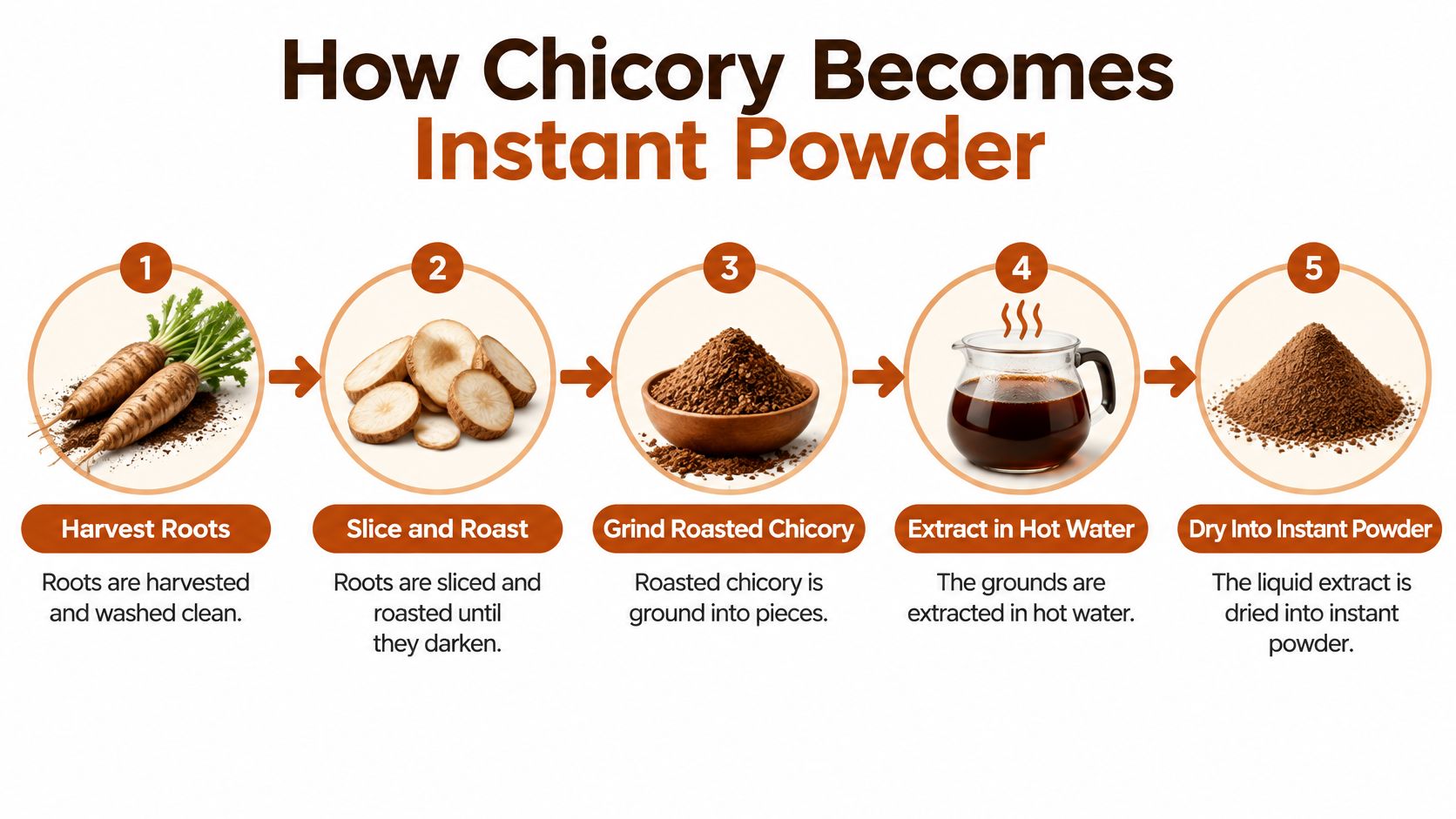
From Root to Soluble Extract
- Harvest and wash the roots. Cleaning removes soil before the roots enter food processing. Sound raw material gives the producer a more consistent starting point.
- Slice and roast. Slicing helps the pieces roast more evenly. Heating develops the dark color and roasted flavor that distinguish the finished beverage from the raw root.
- Grind the roasted chicory. Smaller pieces expose more surface area to water, allowing the producer to extract soluble material.
- Extract in hot water. Water carries soluble flavor and other compounds into a liquid. The spent root material is separated rather than packaged as instant powder.
- Concentrate the extract. Removing some water prepares the liquid for drying.
- Dry into powder or granules. Spray-drying or freeze-drying removes the remaining water and creates a convenient soluble product.
- Pack against moisture. Sealed packaging helps keep the powder dry. At home, a dry spoon and a tightly closed lid help prevent clumping.
Coffee beans follow a comparable extract-and-dry principle, although the raw material differs. Our explanation of the instant coffee production process provides more context for that distinction.
Why Roasting Deserves Scrutiny
Roasting develops flavor, but it also creates acrylamide, making raw-material selection and roast control important. A study indexed by FAO AGRIS measured raw-root free asparagine, an acrylamide precursor, at 444–2,786 mg/kg and found that selecting lower-asparagine material reduced acrylamide in roasted chicory from 11,097 to 2,249 µg/kg, approximately 80%.
That finding concerns manufacturing choices, not a method you can reproduce by changing the water temperature at home. Adding water makes a drink less concentrated, but it doesn't undo the compounds formed during roasting.
The useful buyer questions are specific:
- Root sourcing: Does the manufacturer identify its raw-material suppliers or cultivar traceability?
- Roast management: Does it describe controlled roasting rather than relying only on dark-roast language?
- Testing: Does it publish acrylamide testing information tied to production lots?
A company may not disclose its exact roast recipe. Still, meaningful information about sourcing, controls, and testing is more useful than an unsupported claim that a product is exceptionally clean or safe.
Caffeine, Gut Health and Who Should Be Careful
Pure chicory has no caffeine, coffee-chicory blends retain caffeine from coffee, and there's no established comparative evidence that chicory coffee is healthier than regular coffee. The practical question is whether a particular product suits your caffeine needs, digestion, and taste.
What the Root Contains Isn't What the Cup Delivers
Raw chicory root contains substantial inulin, a type of fructan associated with prebiotic activity. A Gut Health Times explanation of chicory processing places raw-root inulin at roughly 68–70%, while explaining that roasting breaks it down into smaller sugars and browning products.
That raw-root percentage is not a nutrition figure for your prepared drink. Between the field and your mug, the manufacturer roasts the root, extracts soluble material, dries the extract, and may blend it with coffee. You then dilute the powder with water or milk.
To assess a finished product, look for:
- Fiber per serving: A declared amount is more informative than a picture of a chicory root.
- Identified inulin content: If the manufacturer makes a prebiotic claim, check whether it states the actual amount in the serving.
- Evidence for the beverage: Results involving an isolated ingredient don't automatically establish benefits from a roasted drink.
A review of coffee and chicory identifies unresolved questions around blend ratios and compound bioavailability. That uncertainty is a reason to avoid treating every chicory drink as a clinically validated prebiotic product.
Label test: If the package promises gut support but doesn't disclose fiber or inulin per serving, you don't have enough information to estimate that contribution.
For broader dietary context, you can find prebiotic fiber sources through Yuve. Use that as a starting point for food choices, not as proof that a particular chicory powder supplies an equivalent amount.
Digestion and Allergy Need Separate Attention
Inulin can cause gas and bloating, and people sensitive to ragweed or related pollen may need extra caution with chicory, according to Cleveland Clinic's guidance on coffee alternatives.
If you're prone to digestive discomfort, begin with a smaller serving rather than making an immediate full replacement. Keep the other ingredients familiar so you're not changing the chicory, milk, and sweetener simultaneously. Stop if it causes symptoms rather than trying to force yourself to adjust.
Check with a clinician first if you have ongoing digestive complaints or relevant pollen allergies. Our guide to the best coffee for gut health offers further context for thinking about coffee choices and personal tolerance.
Finally, caffeine-free doesn't mean calorie-free, especially after adding milk or sugar. Nor does it promise caffeine-like alertness. Chicory can be an enjoyable beverage without needing to function as an energy product or digestive treatment.
How to Brew Chicory Instant Coffee at Home
| Method | Packet and water | Mixing order | Best for |
|---|---|---|---|
| Hot mug | A labeled serving with enough hot water for the intended cup | Stir until fully dissolved | Everyday cup |
| Iced | A labeled serving, a small water splash, then cold water and ice | Dissolve the splash before adding the rest | Warm days |
| Milk latte | A labeled serving, a little hot water, then warm milk | Dissolve before adding milk | Creamy drink |
| Travel bottle | A labeled serving with cool water, leaving shaking space | Seal and shake until dissolved | Work and camping |
Start with the product's serving direction, then adjust the liquid to your taste. Packets aren't a universal size, and a serving from a jar shouldn't be guessed from the size of another brand's sachet.
Make a Hot Cup First
- Open a packet or measure the labeled serving from the jar.
- Pour the powder into a clean mug or heat-safe travel cup.
- Add hot water just off the boil, initially holding some back.
- Stir along the bottom and sides until the powder dissolves.
- Taste, then add more water, milk, or sweetener if you want it.
Holding back some water gives you room to correct the strength. It's easier to lighten a concentrated cup than to rescue a watery one without adding more powder.
You don't need to steep instant chicory or filter it afterward. If substantial sediment remains, check that the package says instant or soluble. Ground roasted root is a different preparation.
Make Iced Chicory Without Clumps
Mix the powder with a small splash of water to form a smooth concentrate. Use warm water if the powder resists dissolving, then add cold water, milk if desired, and ice last.
Adding ice before dissolving the powder is the common slip. The cold mixture can make dissolving slower and leave powder stuck around the cubes. Stirring a concentrate first lets you see whether any dry pockets remain.
Avoid starting with a mug full of ice and then pouring in a large amount of hot water. You'll melt the ice and dilute the drink before you've judged its strength.
Build a Latte or Pack a Travel Bottle
For a latte, dissolve the chicory in a little hot water before adding warm milk. A handheld frother can incorporate the milk, but it shouldn't be used as a substitute for dissolving stubborn dry clumps first.
For a travel bottle, use cool water and leave space to shake. Check that the lid is secure, then shake and inspect the bottom before drinking.
Travel safety: Don't seal and shake hot liquid in an ordinary bottle. Dissolve it in an open heat-safe container, or use cool water in a suitable bottle.
A successful cup should be evenly mixed and free of dry grit. Look for roasted sweetness and a strength you enjoy, not an obligation to drink it as dark as possible. If the flavor seems harsh, reduce the powder or add milk; if it tastes hollow, reduce the water next time.
Recipes That Make Chicory Instant Coffee Shine
Chicory's roasted character gives you several useful directions: warm spice, cocoa, citrus aroma, and creamy desserts. Think of the powder as a concentrated flavor ingredient rather than something that belongs only in a plain mug.
These serving ideas show how differently the same base can be used.

Warm and Chocolatey
Cinnamon chicory latte: Dissolve a labeled serving in a small amount of hot water, then fill your cup with warm milk. Finish with a pinch of cinnamon. The spice complements the roasted aroma, while milk softens the bitter edge.
Chicory mocha: Mix cocoa powder and your preferred sweetener with the chicory before adding a splash of hot water. Stir into a smooth paste, then add warm milk. Cocoa reinforces the dark flavor, so taste before adding extra chicory.
Both recipes work better when the concentrate is smooth before you add the larger volume of liquid. Otherwise, cocoa or chicory can remain trapped in small dry lumps.
For another preparation demonstration, use the video below.
Chilled, Spooned, or Stirred Into Breakfast
Iced chicory with orange peel: Dissolve the powder, add cold water, and place a clean strip of orange peel in the drink. Chill, then remove the peel when the aroma suits you. Avoid much of the white pith, which can add unwanted bitterness; instant powder needs dissolving, not an overnight cold-brew extraction.
Chicory affogato: Prepare a concentrated splash of hot chicory and pour it over vanilla ice cream just before serving. The contrast between hot liquid and cold ice cream matters more than producing a large drink. For an afternoon dessert, choose the caffeine category deliberately.
Chicory oatmeal: Dissolve a little powder in warm milk, then stir it into cooked oats. Start lightly because a breakfast bowl can become overly bitter before it looks particularly dark. Cinnamon or vanilla makes a natural finishing touch.
Our instant coffee recipe ideas offer more preparation inspiration, though chicory's flavor may call for different proportions.
For camping, combine powder and cool water in a securely closed bottle and shake. You can prepare and drink from the same container without carrying a separate brewer.
Choose Your First Chicory Instant Coffee
Choose according to the drink you want, not the most ambitious claim on the package. A practical first purchase should answer your questions before asking you to commit to a large jar.
Make the Purchase Easy to Evaluate
- Caffeine need: Decide whether your priority is avoiding caffeine, reducing it, or keeping your usual coffee routine.
- Flavor preference: Choose root-based roasted depth if that appeals to you. Keep coffee in the picture if its brighter aroma is what you'd miss.
- Label transparency: Favor clearly stated ingredients, blend proportions, and useful serving information over broad wellness language.
Buy a small pack and prepare it both hot and iced on separate occasions. Note the amount you used, whether you added milk, how you liked the flavor, and whether you noticed digestive discomfort. Keep the preparation reasonably consistent before deciding it needs more sweetener or a stronger dose.
A good first choice is one you can assess clearly, not one that promises to solve every problem with your current coffee.
Keep Coffee-Based Options Distinct
Our Cartograph Organic Instant Coffee - Medium Roast is a coffee-based option, not a pure chicory product. It's made from organic coffee beans only, with no additives or chemicals added, and is freeze-dried in sealed single-serve packets.
It has a smooth body with subtle chocolate and cinnamon notes and dissolves without a grinder, brewer, or filters. Apply the same checks to our label: ingredient identity, your caffeine requirements, and the flavor you prefer.
That comparison doesn't require declaring a winner. You may want chicory for a particular occasion and coffee for another, provided each cup matches what you intended to buy.
Cartograph Coffee offers organic freeze-dried medium-roast coffee in single-serve packets for straightforward preparation at home, work, or camp. If you're comparing chicory with a coffee-only option, visit Cartograph Coffee and check the ingredients and preparation details against your taste and caffeine priorities.