The short answer? Yes, you absolutely can drink black coffee while fasting. For the vast majority of people and their fasting goals, a simple cup of plain black coffee is perfectly fine. It contains almost no calories and won't provoke a meaningful insulin response, which means your body stays in its fasted state.
You get to keep all the benefits of your hard work, and you get to enjoy your coffee.
Understanding Coffee and Your Fasting Goals
While the answer is usually "yes," the real nuance comes down to why you're fasting in the first place. Think of your fast as a quiet, undisturbed room. The whole point is to maintain that peace and quiet.
Plain black coffee is like a silent guest who slips into the room without making a peep. It doesn't really disturb anything.
On the other hand, adding sugar, milk, or creamer is like blasting loud music—the quiet is instantly shattered, and your fast is over.
Defining What "Breaks a Fast" Means
To really get this right, you have to match your beverage choices to your fasting goals. What's considered "breaking a fast" changes depending on what you're trying to achieve.
- Metabolic Health and Weight Loss: If your main objective is to keep insulin levels low and encourage your body to burn fat for fuel, then black coffee is a fantastic tool. It has no carbs or sugar, so it won’t spike your insulin.
- Gut Rest: For those who are fasting specifically to give their digestive system a complete break, even black coffee might be best avoided. Technically, anything you ingest can get the digestive gears turning, even if just a little.
- Cellular Cleanup (Autophagy): This is the body's incredible process of cleaning out and recycling old, damaged cells. The science here is still emerging, but the consensus is that the tiny impact of black coffee is highly unlikely to stop this vital process.
Let's quickly summarize how black coffee fits in with the most common fasting goals.
Black Coffee and Fasting Quick Guide
| Fasting Goal | Does Black Coffee Interfere? | Key Takeaway |
|---|---|---|
| Weight Loss / Fat Burning | No | It can actually help by boosting metabolism and suppressing appetite. |
| Metabolic Health (Insulin) | No | Black coffee does not cause a significant insulin spike. |
| Cellular Autophagy | Unlikely | Most research suggests coffee may even promote autophagy. |
| Complete Gut Rest | Potentially | It can stimulate stomach acid, so best to avoid for strict gut rest. |
For most people, the verdict is clear.
The key takeaway is this: If you're practicing any of the popular intermittent fasting methods, black coffee is not only acceptable but can make your fasting window much easier by curbing hunger and boosting your energy levels.
Understanding the caloric impact—or lack thereof—is central to this. You can dive deeper into the specific numbers in our guide to black coffee calories. This article will be your go-to resource as we explore the science of why coffee and fasting are such a great pair, the hard-and-fast rules to follow, and how to enjoy it without sabotaging your results.
How Coffee Interacts with Your Fasted Body
When you're fasting, you're essentially asking your body to flip a switch. It stops running on the easy-to-access fuel from food (glucose) and starts tapping into its energy reserves—your stored fat. The big question is whether a cup of black coffee messes with that switch.
It’s more than just a morning pick-me-up; coffee triggers a series of subtle reactions inside your body. Understanding what’s happening on a physiological level is the key to knowing why, for most people, it gets a green light during a fast.
The Impact on Insulin and Fat Burning
Think of insulin as the gatekeeper of fat storage. When you eat carbs or sugar, your blood sugar goes up, and insulin rushes out to move that sugar into your cells for immediate energy. As soon as insulin shows up, the gate to your fat stores slams shut. Fat burning stops.
A primary goal of fasting is to keep insulin levels low and stable. This is what unlocks your body's ability to burn fat for fuel.
Since plain black coffee has virtually zero calories and no carbs, it doesn’t cause a meaningful spike in blood sugar. No blood sugar spike means no significant insulin response. Your body stays in its fat-burning state, and the metabolic benefits of your fast continue uninterrupted.
This isn't just a guess. A 2020 study published in Current Developments in Nutrition looked at this exact scenario. Researchers had participants drink black coffee after a 10-hour fast and found no significant changes in their fasting glucose or triglyceride levels. This adds solid evidence to the idea that black coffee doesn't break a fast. You can dive into the full research about these findings to see the data for yourself.
Autophagy and Cellular Cleanup
One of the most powerful reasons people fast is to kickstart autophagy. You can think of it as your body's internal spring-cleaning service. During autophagy, your cells identify and clear out old, damaged, or dysfunctional parts, recycling them to build new, healthier components. It’s essential for cellular rejuvenation.
So, does coffee shut down the cleanup crew? The science here is a bit more complex, but the overall picture is positive.
- Caffeine's Role: Some research actually suggests that caffeine can stimulate autophagy, which would mean coffee could potentially give your fast an extra boost.
- A Minimal Pause: A more conservative view is that introducing anything into your system might cause a brief, tiny pause in the process. However, the consensus among experts is that the effect from a cup of black coffee is so minor it’s practically insignificant.
Ultimately, the powerful antioxidants in coffee likely provide benefits that far outweigh any minuscule interruption to autophagy.
Metabolism and Energy Boost
Let’s not forget coffee’s most famous trick: firing up your metabolism. The caffeine acts as a mild stimulant, kicking your central nervous system into a higher gear.
This creates a state known as thermogenesis, where your body’s core temperature rises slightly, causing you to burn a few more calories at rest.
So, not only does coffee help you feel sharper and more energetic during a fast, but it may also subtly enhance your body's fat-burning efforts. It's this one-two punch that makes a simple cup of black coffee such a valuable ally for so many people during their fasting window.
The Golden Rules for Fasting-Friendly Coffee
When you're trying to figure out if coffee fits into your fasting routine, the answer boils down to a few simple, non-negotiable rules. Sticking to them is the difference between supporting your fast and accidentally sabotaging it.
The most important rule is also the easiest to remember: your coffee must be black.
That means no sugar, no cream, no milk, no exceptions. Even those "innocent" little additions can trigger a metabolic response that pulls your body right out of its fasted state. The science behind it can get a little dense, but putting it into practice is incredibly straightforward.
What to Avoid at All Costs
Think of your fasted state as a carefully balanced system. The moment you introduce calories or anything that spikes your insulin, you knock that system off-kilter. To keep your fast intact, you have to steer clear of these usual suspects:
- Sugar and Syrups: This is the big one. Any kind of sugar—white, brown, honey, agave, flavored syrups—is loaded with calories and carbs. They’ll trigger an immediate insulin response and shut down your fast.
- Milk and Creamers: A splash of dairy or even plant-based milk adds protein, fats, and carbs. A little bit of oat milk, for example, introduces just enough fuel to tell your body the fast is over.
- "Zero-Calorie" Sweeteners: This one is tricky. While they don't technically have calories, many artificial sweeteners can still provoke an insulin response in some people. Your body tastes the sweetness and anticipates sugar, which can be enough to interfere with your metabolic goals.
If you're ever unsure, this simple decision guide can help you figure out if your coffee choice will keep you in a fasted state.
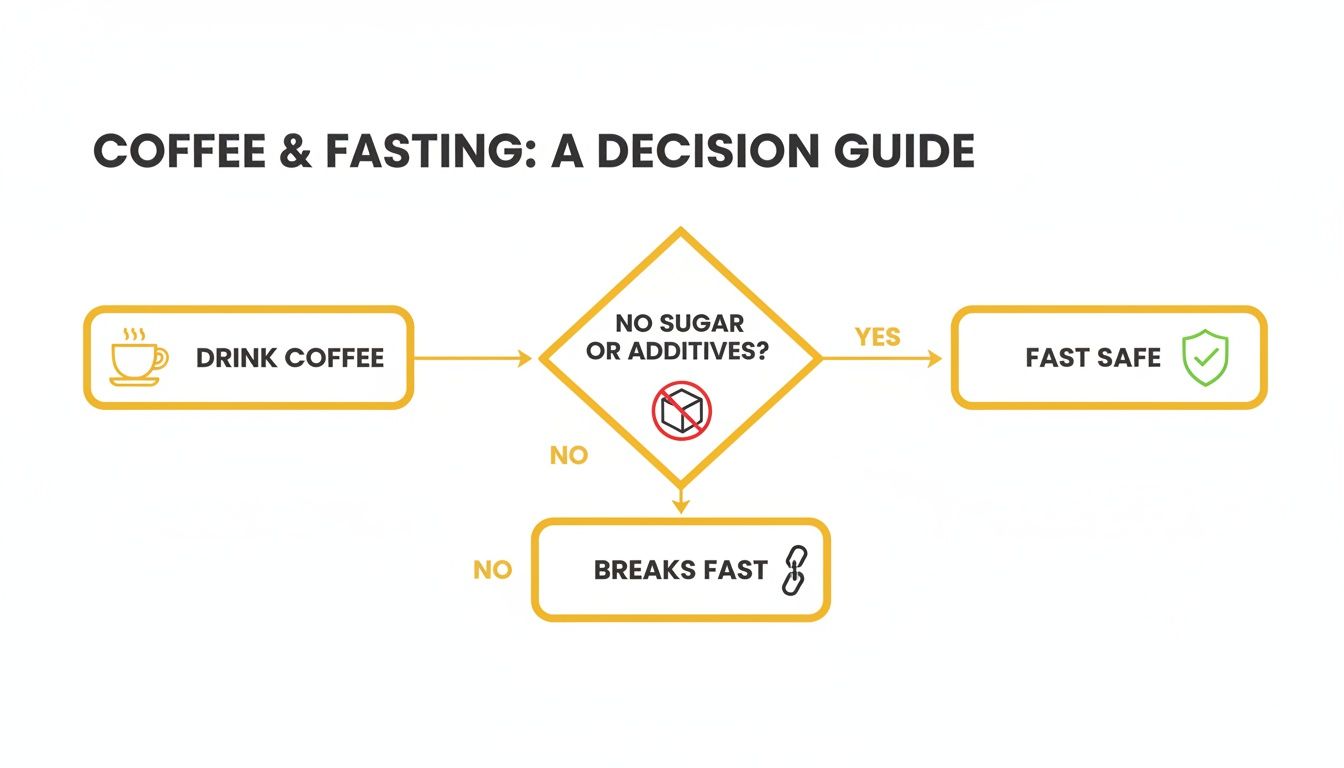
The takeaway here is crystal clear: as long as your coffee is free from sugar or other caloric add-ins, it's generally considered safe for most types of fasting.
To make it even clearer, here's a quick breakdown of what you can and can't add to your cup.
Fasting-Friendly Add-ins vs. Fast-Breakers
| Ingredient | Does It Break a Fast? | Why or Why Not? |
|---|---|---|
| Sugar/Honey/Syrup | Yes | Contains calories and carbs that spike insulin immediately. |
| Milk/Cream/Oat Milk | Yes | Adds protein, fat, and carbs, signaling your body to start digesting. |
| Artificial Sweeteners | Maybe | Can still trigger an insulin response in some individuals despite being zero-calorie. |
| Butter/MCT Oil | Yes | Pure fat contains calories. Breaks a strict fast but may be used in "fat fasting." |
| Plain Black Coffee | No | Has virtually zero calories and does not provoke an insulin response. |
| Cinnamon/Nutmeg | No (in small amounts) | A tiny pinch adds flavor without calories and won't disrupt your fast. |
| Salt | No | An electrolyte that can actually help with hydration and mineral balance while fasting. |
Ultimately, keeping your coffee pure and simple is the safest bet to ensure you get all the benefits of your fast.
The Calorie Rule: A Closer Look
You've probably heard the guideline that anything under 50 calories won't really break a fast. While that might work for someone whose only goal is general weight loss, it’s definitely not a universal rule. If your reasons for fasting are more specific, that guideline goes out the window.
For benefits like deep cellular cleanup (autophagy) or giving your digestive system a complete rest, the only number that truly counts is zero. Any caloric intake can interfere with these sensitive processes.
This is where having a reliable, pure coffee on hand makes all the difference. Using a high-quality instant coffee like Cartograph takes all the guesswork out of the equation. You get a clean, additive-free cup every single time. It's a foolproof way to make sure you're not derailing your hard work, whether you're at home or on the go.
Of course, if drinking coffee on an empty stomach gives you trouble, you might want to look into the best coffee for a sensitive stomach.
How Coffee Fits Into Different Fasting Styles
So, can you drink black coffee while fasting? The real answer isn't a simple yes or no. It all depends on why you're fasting and which protocol you're following.
Think of it this way: different fasts are like different sports, each with its own rulebook. What’s perfectly fine in one might be a foul in another. To get the results you want, you need to match the coffee rules to the game you’re playing.
Intermittent Fasting (e.g., 16:8 or 18:6)
This is where black coffee really shines. For the millions of people doing popular intermittent fasting schedules like 16:8 (a 16-hour fast with an 8-hour eating window), a cup of black coffee can be a total game-changer.
Because it has virtually zero calories, it won't trigger a significant insulin response, which means it doesn't break the fast's main goal: keeping your body in a fat-burning state. Even better, it can feel like a secret weapon during the fasting window. The caffeine helps crush morning hunger pangs and gives you that much-needed jolt of energy and focus to power through until your first meal.
For this type of fasting, plain black coffee is a definite green light.
Water Fasts and Strict Protocols
On the other end of the spectrum, you have the water fast. The name says it all—the only thing you’re consuming is water. Period. The entire point is to give your digestive system a complete rest and promote deep cellular cleanup.
In this scenario, coffee is a hard no. Even black coffee contains compounds that kickstart digestive processes, which completely defeats the purpose of a "water-only" fast. The same logic applies to certain religious fasts or medically supervised protocols that come with very strict guidelines. When in doubt, stick to the established rules.
The core principle here is your purpose. If your goal is absolute digestive rest with nothing but water, coffee is out. If your goal is metabolic flexibility and fat burning, coffee is usually in.
Fasting-Mimicking Diets
The Fasting-Mimicking Diet (FMD) is a unique hybrid. It’s a carefully designed, multi-day plan that’s low in calories, low in protein, and high in healthy fats. The idea is to trick your body into thinking it's fasting, giving you similar benefits while still allowing you to eat small amounts of food.
So, where does coffee fit in? It depends entirely on the specific FMD program you're following. These diets run on a razor-thin calorie budget, and the 3 to 5 calories in a cup of black coffee might need to be counted. Before you brew a cup, make sure you double-check the official guidelines of your FMD plan.
Amplifying Your Results with Coffee and Fasting
Drinking black coffee during a fast isn't just about getting by until your next meal. It's a strategic move to actually enhance the benefits you're already chasing. Think of fasting and coffee as a power couple—they're great on their own, but together, they can achieve something truly special.
Fasting is already a fantastic tool for sharpening your mind. Once your body enters a fasted state, it starts producing ketones, an incredibly clean and efficient fuel for your brain. Many people report a feeling of heightened focus and crystal-clear thinking during this time.
Boosting Brainpower and Mental Clarity
Now, bring coffee into the picture. You're essentially pouring high-octane fuel on an already-burning fire. The caffeine acts as a well-known stimulant, but it does more than just wake you up; it amplifies the cognitive lift you're getting from those ketones. This synergy can create a state of profound focus and mental stamina, perfect for tackling demanding work or diving deep into a creative project.
This isn't just anecdotal. The science shows that pairing black coffee with fasting can supercharge both your brain and your metabolism. Research consistently links moderate coffee intake—around 1 to 3 cups daily—to a lower risk of neurodegenerative conditions. This effect beautifully mirrors the ketone-fueled brain protection offered by fasting itself.
Caffeine can even give your ketone production a little nudge, while both coffee and fasting are known to promote autophagy (your body's cellular cleanup process), which is crucial for combating age-related decline.
By combining fasting's ketone production with coffee's caffeine, you create a powerful cognitive cocktail. It's not just about getting through the fast; it's about turning that period into your most productive time.
If you're looking to take your mental performance even further, it can be worthwhile to explore various supplements for energy and focus that work well alongside a fasting-friendly coffee routine.
Supporting Long-Term Metabolic Health
The benefits of this partnership go way beyond brain function. Both intermittent fasting and regular coffee consumption have been independently celebrated for their ability to support metabolic health and lower the risk of type 2 diabetes.
Fasting works wonders for your insulin sensitivity, simply by giving your system a much-needed break from constantly processing sugar. Coffee, packed with powerful antioxidants, also helps your body regulate blood sugar more effectively.
When you combine them, you’re creating a layered defense. You're not just using coffee as a crutch to get through hunger—you're using it as a proactive tool for your long-term wellness. This perspective changes the answer to "can you drink black coffee while fasting" from a simple "yes" to a resounding, strategic one.
Of course, some people add fats to their coffee, but it's important to know how that affects your fast. You can learn more about the specific impact of MCT oil in coffee from our detailed guide.
Potential Downsides and Who Should Be Cautious
Black coffee can be a fantastic tool for most fasters, but it's not a one-size-fits-all solution. The golden rule is always to listen to your body. For some people, drinking coffee on a totally empty stomach can stir up trouble, leading to digestive upset, a spike in stomach acid, or uncomfortable heartburn.
If you find yourself feeling a bit queasy or notice acid reflux after your morning cup, that's a clear signal from your body. It doesn’t necessarily mean you have to quit coffee, but you might need to tweak your timing or simply drink a little less.
Sleep, Stress, and Hydration
Beyond your stomach, it’s smart to think about coffee's wider effects on your body. The caffeine in your cup can give you a temporary bump in cortisol, which is your main stress hormone. While this doesn't break your fast, it's something to be mindful of. Learning how to reduce cortisol levels naturally can be a great way to support your fasting goals and overall health.
Sleep is another huge piece of the puzzle. Caffeine has a surprisingly long half-life, meaning it hangs around in your system for a good while.
As a general rule of thumb, it's best to cut off all coffee at least 8-10 hours before you plan to go to sleep. A mid-afternoon coffee can easily mess with your sleep quality, which cancels out many of the restorative benefits you're trying to get from fasting.
Lastly, don't forget that coffee is a diuretic. In simple terms, it makes you urinate more, which can lead to losing water and essential electrolytes faster than usual. So, while you're asking "can you drink black coffee while fasting," make sure you're also asking if you're drinking enough water alongside it. Staying properly hydrated is absolutely non-negotiable.
Who Should Be Cautious?
Not everyone is a good candidate for coffee during a fast. You might want to be extra careful or skip it altogether if you fall into one of these groups:
- Individuals with GERD or Acid Reflux: Coffee is known to relax the esophageal sphincter, which can make reflux symptoms noticeably worse.
- Those Sensitive to Caffeine: If even a small amount of coffee leaves you with jitters, anxiety, or heart palpitations, it’s probably not the right fasting companion for you.
- People with Sleep Issues: If you already struggle with insomnia or poor sleep, it’s best to avoid caffeine entirely or stick to a small cup very early in the morning.
At the end of the day, coffee is an incredible fasting aid for many people. The key is simply paying attention to your body's unique signals to ensure your fasting journey is both safe and successful.
Why Quality Coffee is Your Best Friend While Fasting
So, we've settled the big question: "Can you drink black coffee while fasting?" The answer is a resounding yes, but with a crucial caveat—it has to be pure. This isn't just about getting your caffeine kick. It's about choosing a coffee that genuinely supports your wellness goals instead of accidentally working against them.
Think of it this way: the quality of your coffee is a key player in your fasting game. A high-quality, pure brew means you're not unknowingly ingesting fillers, preservatives, or artificial flavorings that could kick you out of your fasted state. It gives you the confidence that every sip is aligned with your health objectives.
Making Great Coffee Easy
For anyone with a busy, on-the-go lifestyle, finding a coffee that is both trustworthy and convenient can feel like a tall order. That’s precisely why Cartograph Coffee’s organic instant coffee is such a perfect fit for a fasting routine. It was created for people who refuse to compromise on purity or practicality.
It dissolves in seconds on a hectic morning and is so lightweight you can toss it in your pack for any adventure, whether you're summiting a mountain or just enjoying a quiet sunrise by the campfire.
Because it’s organic and free from additives, you can be absolutely certain you're supporting your fast, not sabotaging it. This commitment to quality transforms your simple cup of coffee into a reliable tool for your well-being.
But the perks don't stop there. Drinking black coffee while fasting is also tied to some pretty impressive longevity benefits. Studies have shown that moderate coffee drinkers may have up to a 17% lower risk of death. One specific study found that drinking just one to two cups of caffeinated black coffee daily cut all-cause mortality by 14%. You can read more about these incredible findings and discover how fasting might even amplify coffee's natural anti-inflammatory powers.
When you choose a pure, organic coffee like Cartograph's instant blend, you're not just having a drink. You're making your fasting practice more enjoyable and effective on the path to a longer, healthier life.
Ready to elevate your fasting experience with a coffee you can trust? Cartograph Coffee offers a premium, organic instant coffee designed for both purity and convenience, making sure every single cup supports your health. Try it today and taste the difference.