Drip coffee is percolation brewing, where hot water drips through ground coffee held in a paper filter and collects in a carafe, rather than steeping like French press coffee or using pressure like espresso. In the United States, 32% of coffee drinkers used a drip coffee maker for past-day consumption in 2024, and drip remained the favorite brewing method despite lower use than in 2010 (Encyclopedia.com).
You probably know the scene. The machine clicks on before the household is fully awake, water moves through the reservoir, and a familiar aroma fills the kitchen while you pack a bag or answer an early message. A few minutes later, a carafe offers several cups without requiring you to stand over a kettle.
That combination of clean flavor, batch brewing, and low daily effort explains drip coffee's staying power. It also explains the current tension around the method. Drip remains a powerful home habit, while cafés and younger coffee drinkers increasingly explore espresso drinks, cold coffee, pods, instant coffee, and portable drip bags. Understanding the method makes the choice easier. You can decide whether drip belongs in your kitchen, whether another method suits your morning better, or whether each has a useful place in your routine.
Introduction to What Drip Coffee Really Means
At its simplest, drip coffee means water passes through coffee grounds instead of soaking with them for the entire brew. The grounds sit inside a paper or reusable filter, and gravity pulls the brewed liquid downward into a cup or carafe. An automatic machine controls most of the water delivery, while a manual cone lets you pour the water yourself.
That distinction matters because the filter changes the character of the drink. Paper catches much of the sediment and coffee oil that would remain in a French press, giving drip coffee a relatively clear, clean-bodied cup. The method also produces more than one serving conveniently, which makes it practical for a household, office, or meeting room.
Drip coffee became especially important in American homes after automatic machines began replacing percolators in the 1970s. By 1996, about 73% of American households owned an automatic drip coffee maker, according to Encyclopedia.com's history of coffeemakers. That history helps explain why “coffee” often means a pot of drip coffee in an American kitchen.
The method isn't old-fashioned just because it's familiar. It gives you a dependable starting point, then leaves room to improve flavor through coffee freshness, grind size, water quality, and brewing temperature. The same basic setup can serve a quick weekday breakfast, a long weekend brunch, or a full pot for guests.
How Drip Coffee Works From Filter to Carafe
Think of the brewing bed as a controlled patch of sand. Water enters at the top, moves through the spaces between particles, dissolves flavor compounds, and exits through the filter. The filter holds back the spent grounds while gravity carries the liquid into the carafe.
An automatic drip coffee maker usually follows this sequence:
- Water reservoir: You fill the tank with fresh water.
- Heating: The machine heats that water before sending it toward the brew basket.
- Brewing chamber: A showerhead spreads hot water over the grounds inside the filter.
- Carafe: Extracted coffee flows through the paper into the pot below.
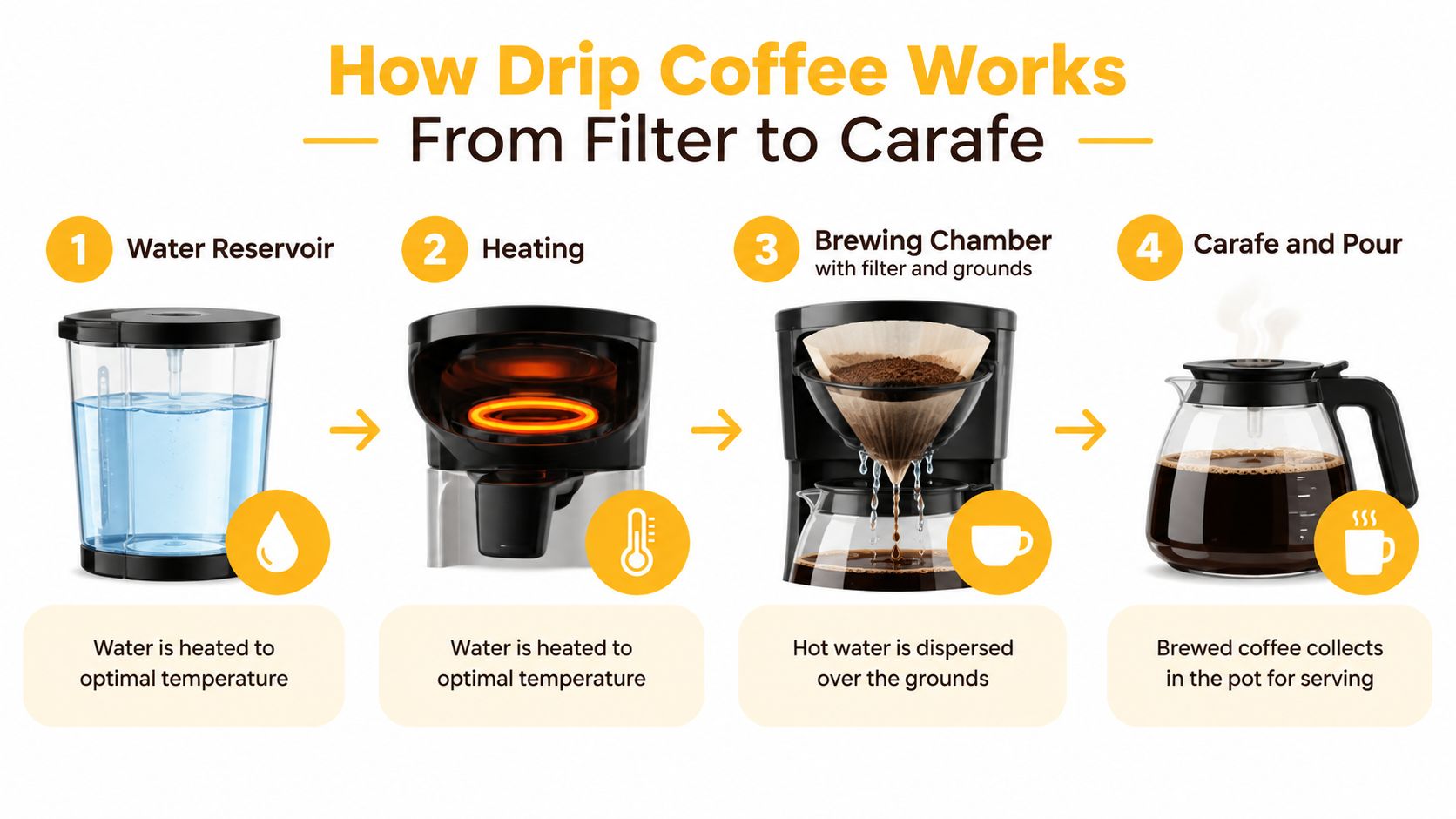
The filter does more than keep grounds out of your mug. It creates resistance, slows the water, and helps form a consistent contact path through the coffee bed. If the water races through one channel, some grounds contribute too little while others contribute too much, producing a cup that tastes both weak and harsh.
Manual pour-over uses the same broad principle but makes the brewer responsible for water distribution and flow. You control the pour pattern, pauses, and total contact time. An automatic brewer handles those tasks for you, though different machines vary in how evenly they wet the grounds.
For a broader overview of the main approaches, coffee brewing methods explained can help you compare percolation, steeping, and pressure-based brewing. If you're using an automatic machine, this practical guide on how to use a drip coffee maker covers the basic workflow from setup to serving.
Here's a useful visual companion that shows the path from water to finished coffee:
The modern method has a clear historical arc. In 1908, Melitta Bentz invented a paper coffee filter in Germany after using blotting paper from her son's school notebook, then received a patent on July 8 of that year. A circular paper-filter automatic brewer appeared in Switzerland in 1944, and Germany's Wigomat received a patent in 1954, helping move drip brewing from manual filtering toward household automation (Melitta Bentz history).
Key Variables That Shape Drip Coffee Flavor
A drip machine can be simple to operate, but the cup still depends on several connected controls. Change one, and you may need to adjust another.
Grind size controls the pace
A finer grind exposes more surface area, so water extracts flavor more quickly. If the grind is too fine for the filter and machine, the brew may become bitter or slow. A grind that's too coarse can let water pass quickly, leaving the coffee thin or sour.
For many automatic brewers, a medium grind provides a sensible starting point. Manual cones may need small adjustments because the shape of the bed and the pour rate change how long water stays in contact with the grounds.
Temperature unlocks soluble flavor
Water that's too cool can struggle to extract enough sweetness and structure. Near-boiling brewing water, roughly 198 to 204°F, or 92 to 96°C, improves solvent action without requiring the water to boil directly over the coffee (Sweet Maria's drip brewing guide). For more detail on how heat affects the cup, see this guide to the correct temperature for coffee.
Ratio sets the strength
The coffee-to-water ratio is your recipe's basic seasoning. A common range is 1:15 to 1:18, with 1:16 as a practical starting point, or roughly 60 grams of coffee per liter of water (CoffeeNutz guide to perfect drip coffee).
Practical rule: Start at 1:16, then change the amount of coffee before making dramatic changes elsewhere.
Time and agitation finish the picture
Automatic or manual drip brewing commonly takes about 4 to 5 minutes, while pour-over-style brewing often falls closer to 2:30 to 3:30, depending on bed depth and flow rate (CoffeeNutz guide to perfect drip coffee). Agitation comes from the water's flow, the pour pattern, or a gentle stir. Too little movement can leave dry pockets. Too much can disturb the bed and push fine particles into the filter.
Professional brewers often use an extraction-yield target of about 18 to 22%, a range intended to balance sweetness and complexity without pulling excessive bitter compounds (Sweet Maria's drip brewing guide). You don't need laboratory equipment to use the idea. If coffee tastes sharp and empty, increase extraction with a finer grind, hotter water, or a slightly longer brew. If it tastes dry and bitter, move in the opposite direction.
Drip Coffee Compared to Pour Over French Press and Instant
Drip coffee sits between several alternatives. It offers more automation than pour-over, a cleaner cup than French press, and more ritual than instant coffee. The best choice depends on whether you value control, body, speed, or batch size.
| Brewing Method | Flavor and Body | Effort and Time | Best For |
|---|---|---|---|
| Drip coffee | Clean, balanced, moderate body | Low effort, batch brewing | Daily home use and serving several people |
| Pour-over | Clear, detailed, highly adjustable | Requires active pouring | Brewers who enjoy control and attention |
| French press | Fuller body, more oils and sediment | Simple steeping and pressing | People who want a rich, heavier cup |
| Instant coffee | Fast, consistent, often lighter in body | Add hot water and stir | Travel, work, camping, and single servings |
Drip versus pour-over
Both methods use gravity and a filter, so the difference isn't the basic extraction principle. Pour-over gives you direct control over bloom, water placement, pauses, and flow. Drip removes much of that work, which can make it easier to repeat the same morning recipe.
If you enjoy adjusting a brew one small variable at a time, drip versus pour-over offers a useful comparison. Drip makes more sense when you want the machine to prepare several cups while you do something else.
Drip versus French press
French press coffee steeps grounds directly in water before you separate them with a plunger. That process leaves more oils and fine particles in the drink, creating greater body and a heavier texture. Drip's paper filter produces a cleaner mouthfeel, but some drinkers may find it less intense.
Drip versus instant
Instant coffee wins when the limiting factor is equipment, time, or cleanup. You don't need a brewer, filter, or carafe. Modern specialty instant can also provide a more deliberate flavor experience than older assumptions about instant coffee suggest, while still prioritizing speed.
For outdoor use, a guide to camp coffee brewing methods can help you weigh packability against flavor and cleanup. Drip is often excellent in a kitchen, but instant or compact single-serving methods may be more sensible beside a tent.
When Drip Coffee Is the Best Choice for You
A busy breakfast makes the choice clear. One person loads the basket, presses a button, and pours several cups while packing lunches or getting ready for work. Drip coffee fits households, offices, and hosts who want a shared carafe with limited attention. Its strength is a dependable routine rather than a ceremonial brewing process.
That helps explain why drip remains mainly a home habit, even as cafés shift attention toward espresso-based drinks and specialty preparation. One recent U.S. market measure places automatic drip as the leading past-day preparation method at 38%, while specialty coffee drinkers favored drip coffee makers at 36%. The same National Coffee Association market report coverage describes a different café pattern, with hot drip coffee sales falling 3.3% year over year in 2025 while lattes and espresso shots grew.
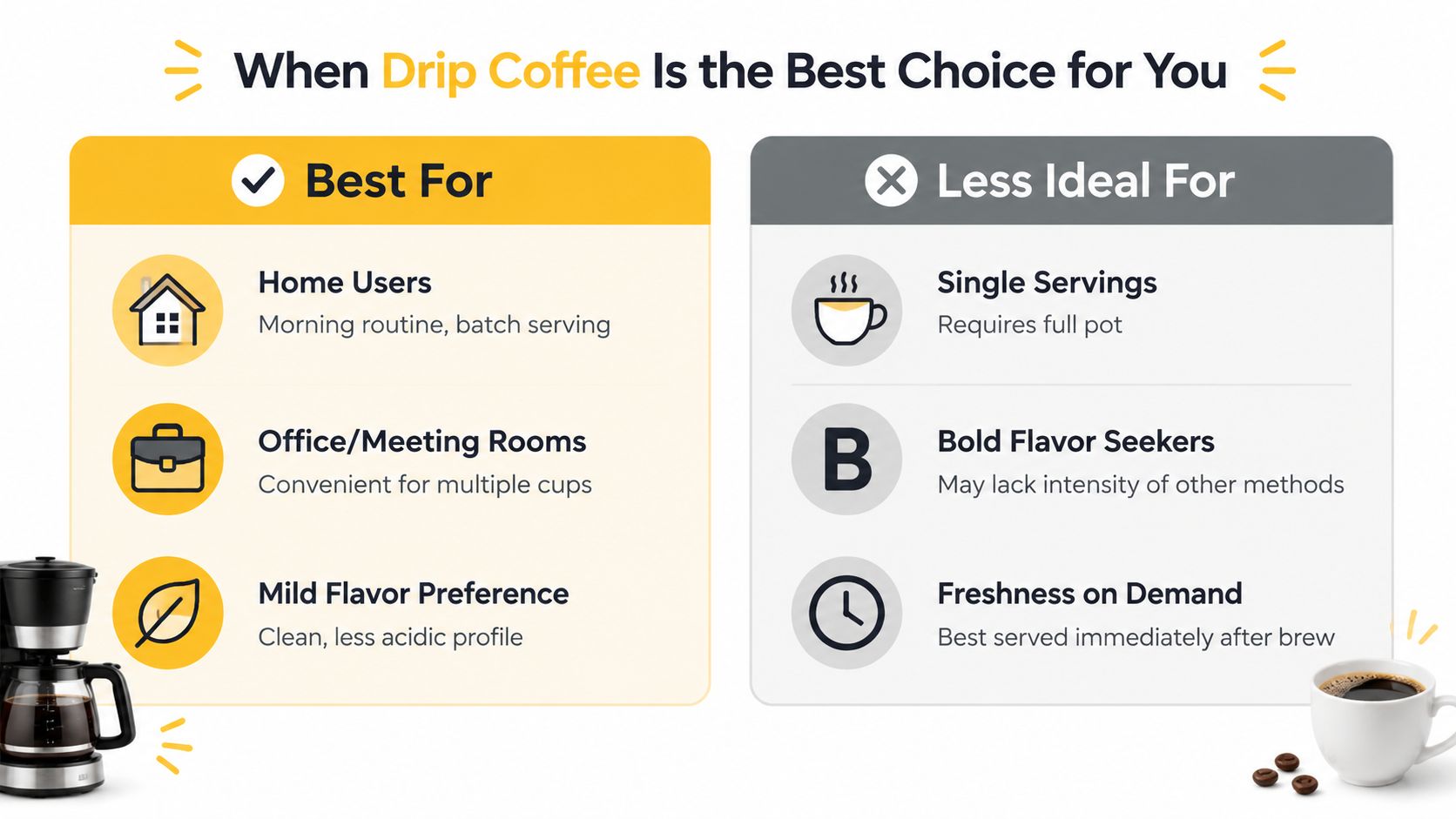
The practical rule is simple. Drip suits home mornings when several people want coffee from one brew. A café may devote its time and equipment to drinks that are made individually, while a home brewer can prepare a full carafe in the background.
Choose drip when
- You brew for more than one person: A carafe serves a shared morning without repeating a single-cup routine.
- You prefer a clear cup: Paper filtration limits sediment and produces a lighter texture.
- You value routine: The machine repeats a familiar recipe with little hands-on work.
- You want flexible coffee: Changing roast level can change the cup without changing your equipment.
Consider instant, pods, or drip bags when
- You need one cup away from home: Instant needs only hot water, while pods and drip bags reduce equipment needs.
- You travel or camp: Compact formats avoid carrying a machine, carafe, and filters.
- Speed matters most: Global trend coverage places instant coffee at 39% of worldwide choice, ahead of filter coffee at 28% and pods at 25%. The same Food Manufacture's global coffee trends coverage also highlights growing interest in drip bags, which pair filter-brewed coffee with portability, origin-focused presentation, and sustainability messaging.
- You want brewed flavor in a small format: A drip bag keeps the act of filtering while removing the need for a countertop brewer.
Choose drip for a shared home routine. Choose instant for the lightest setup, pods for quick consistency, and drip bags when portability and a brewed cup need to meet.
Pros and Cons of Drip Coffee at Home
Drip coffee's strongest argument is not that it produces the most dramatic cup. It's that it balances repeatability, volume, clarity, and manageable effort better than many alternatives.
What drip does well
- Consistency: Once you settle on a grind and ratio, the machine can repeat the routine.
- Batch brewing: One brew serves a household or small gathering.
- Clean cup: Paper filtration removes much of the sediment and oil that create a heavier texture.
- Simple cleanup: You can remove the paper filter and spent grounds together, then rinse the basket and carafe.
Where it falls short
- Less direct control: You can't adjust every pour, pause, and flow decision as easily as with a manual cone.
- Variable results across machines: A basic brewer may distribute water less evenly than a carefully designed manual setup.
- Counter space: The machine, carafe, filters, and storage occupy a permanent place in the kitchen.
- Holding quality: Coffee can lose freshness and aroma when it sits after brewing, especially if heat continues to affect it.
Use this short decision check before buying or keeping a brewer:
- Do you regularly want more than one cup?
- Will you value automation over hands-on control?
- Do you prefer a clear, lighter-textured cup?
- Can you keep the machine clean and serve the coffee soon after brewing?
If most answers are yes, drip is a sensible home tool. If you mainly need a single serving in changing locations, another format may fit more naturally.
Common Drip Coffee Questions and Quick Fixes
Why does drip coffee taste bitter?
The coffee may be extracting too quickly or too completely. Try a slightly coarser grind, reduce contact time, or check whether the machine is running unusually hot. Old coffee oils in the basket, lid, or carafe can also add harsh flavors, so clean the parts that touch the brew.
Why does it taste weak or sour?
The water may be passing through too quickly, or the grind may be too coarse. Move slightly finer, confirm that the filter is seated correctly, and check that the machine wets the grounds rather than sending water down one narrow channel.
Can you reuse drip coffee grounds?
Reusing grounds usually produces a thin, hollow cup because the first brew has already removed many readily soluble compounds. Use fresh grounds for each batch instead.
How can you keep coffee fresh without a hot plate?
Transfer the brewed coffee to a preheated insulated carafe as soon as brewing ends. This avoids prolonged heating, which can make the flavor taste flat or cooked.
For mornings, offices, travel, and camping trips when a full brewer isn't practical, Cartograph Coffee offers organic freeze-dried instant coffee packets designed to make a cup by adding hot water. Visit Cartograph Coffee to compare that portable option with your home drip routine and choose the format that fits your day.