Let's get right to it. Direct trade coffee is a pretty straightforward idea: coffee roasters buy their green coffee beans directly from the farmers who grow them.
Think about it like this: you could buy your produce from a massive supermarket chain, or you could go to the local farmers' market and buy it from the person who actually pulled it out of the ground. That's the essence of direct trade.
What Direct Trade Coffee Actually Means
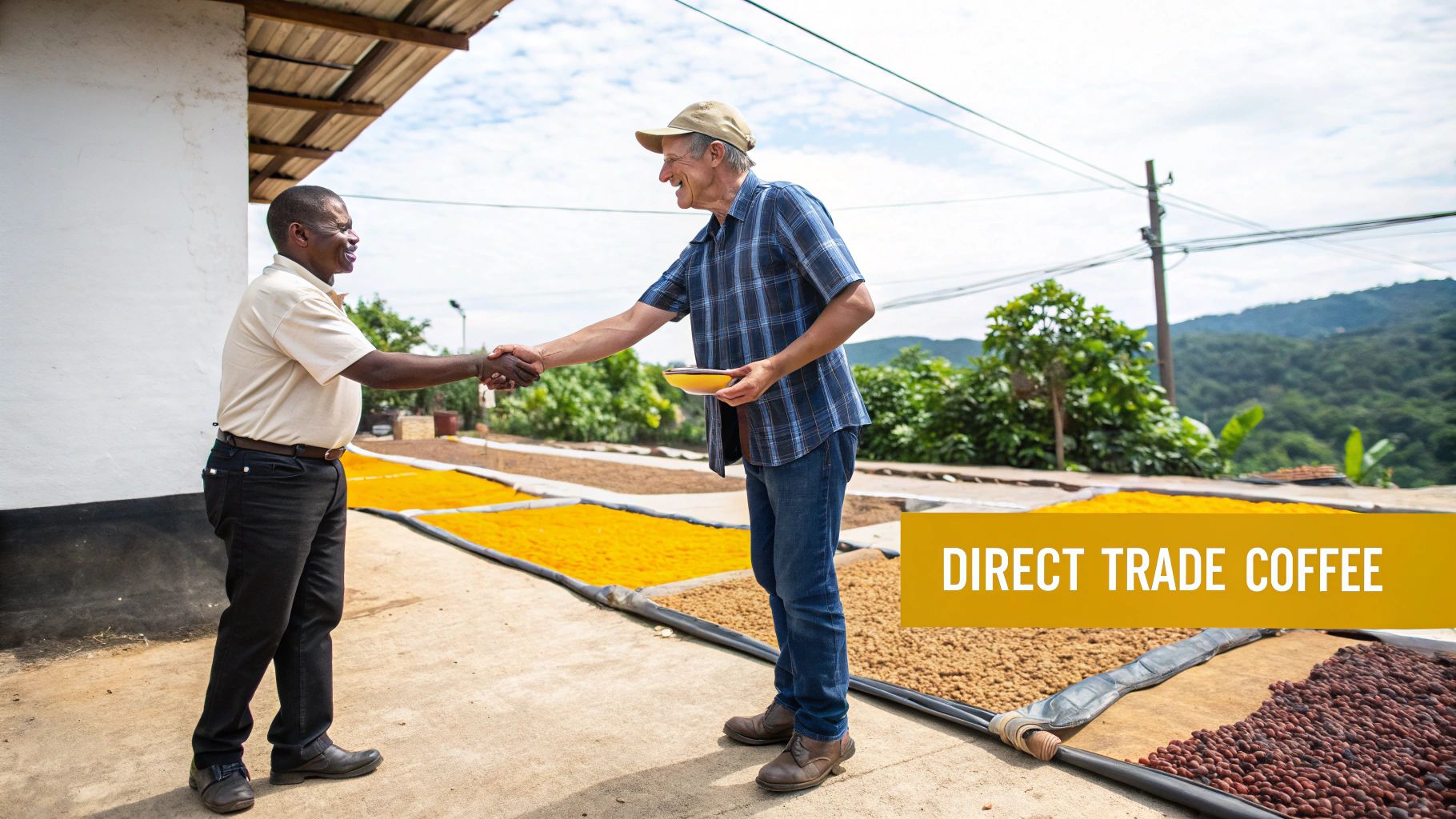
At its core, direct trade is a way of sourcing coffee that cuts out the traditional middlemen—the importers, exporters, and distributors. Instead, the roaster builds a personal, working relationship with the coffee producer. This whole approach grew out of a need to fix the confusing and often unfair conventional coffee supply chain, putting quality and fairness front and center.
This relationship-first model shifts coffee from being just another faceless commodity to a product born from a real, transparent partnership. It’s not just about a business deal; it’s about creating a connection that helps everyone from the farmer to the coffee drinker.
The Core Principles of Direct Trade
A few key ideas really define the direct trade model and set it apart. Once you understand these, you can see why it’s become such an important movement in specialty coffee.
To make it simple, we've broken down the core tenets of direct trade in the table below.
Key Principles of Direct Trade Coffee
| Principle | What It Means in Practice |
|---|---|
| Direct Relationships | Roasters and farmers actually talk to each other. They visit the farms, share goals, and build trust over multiple harvests. |
| Quality-Based Premiums | Farmers get paid well above the fluctuating commodity market price. The better the coffee, the higher the price—a direct reward for quality. |
| Unmatched Transparency | You can trace the coffee back to its source. Roasters can often tell you the exact farm, the farmer's name, and what they paid for the beans. |
| Collaborative Improvement | It's a two-way street. Roasters provide feedback, and farmers and roasters work together on everything from farming to processing to make the coffee better each year. |
This foundation of partnership and transparency is what makes direct trade so effective.
This close collaboration often looks a lot like how roasters work with a specific farm to highlight a unique coffee, a concept at the heart of single-origin offerings. You can dive deeper into that in our guide to what is single origin coffee.
By removing the layers of middlemen, direct trade creates a shorter, more honest supply chain. This means more money lands in the farmer's pocket and a higher-quality, story-rich coffee lands in your cup. It’s a win-win built on respect and a shared love for great coffee.
How Direct Trade Reshapes the Coffee Journey
To really get what makes direct trade special, you have to picture the old-school way coffee gets from the farm to your cup. It's a long, winding road with a ton of different stops.
A farmer sells their freshly picked coffee cherries to a local co-op or a middleman, sometimes called a "coyote." From there, the beans might go to a mill, then an exporter, then an importer in a country like the U.S. Finally, a roaster buys those beans from the importer. Every single one of those handoffs adds cost and puts more distance between the person who grew the coffee and the person roasting it.
From Complex Chains to Direct Handshakes
Direct trade completely bulldozes that cluttered path. It creates a straight line from the farm to the roastery. By cutting out most of those intermediaries, roasters can build real, lasting relationships with the farmers and cooperatives who actually grow the coffee.
This is more than just a logistical shortcut; it’s a total mindset shift. It moves coffee from a faceless commodity bought and sold on a global market to a true partnership. Instead of being stuck with fluctuating market prices set thousands of miles away, farmers and roasters can sit down together—often right there on the farm—and talk about quality, price, and what they want to achieve in the coming years.
A direct trade relationship transforms coffee from an anonymous agricultural product into a collaborative creation. It’s a journey built on handshakes and shared expertise, not just invoices and shipping containers.
This opens up an incredible feedback loop that just doesn't exist in the traditional model. A roaster can be on the farm, taste a coffee with the person who grew it, and say, "This is amazing, but I'm getting a little earthiness. What if we tried raising the drying beds a few more inches next year?" That kind of conversation is a game-changer.
A Partnership in Pursuit of Quality
This close communication and teamwork lead to real, measurable improvements, harvest after harvest. Farmers get a crystal-clear idea of what flavors roasters are looking for, and roasters get access to unique, top-tier coffees they had a hand in creating. It’s a true partnership where everyone has skin in the game.
Here’s how that collaborative spirit plays out in the real world:
- Joint Decisions: Roasters and farmers might team up to experiment with new processing techniques, like anaerobic fermentation or honey processing, to bring out exciting new flavors from the beans.
- Targeted Investment: A roaster might help pay for new equipment at the farm—like an upgraded de-pulping machine or better drying patios—because they know it will directly boost the quality of the coffee they buy.
- Shared Knowledge: Farmers bring generations of agricultural wisdom to the table, while roasters offer insights on what customers love and what's trending in the market. This two-way street helps everyone innovate.
At its core, direct trade makes the coffee journey shorter, clearer, and a whole lot more human. It makes sure the story of the coffee—and the dedicated people behind it—doesn't get lost on its way to your morning mug.
Understanding Direct Trade vs. Fair Trade
When you start digging into the world of ethical coffee, you'll quickly run into two big terms: Direct Trade and Fair Trade. It’s easy to assume they’re the same thing—after all, both are about creating a better deal for coffee farmers. But they go about it in completely different ways, with different philosophies and outcomes.
Think of it this way: Fair Trade is essentially a certification system. It’s run by third-party organizations (like Fair Trade USA) that set a minimum price for coffee. This acts as a crucial safety net, protecting farmers when the volatile coffee market takes a nosedive. To get the seal, farms or cooperatives also have to meet specific labor and environmental standards.
Direct Trade, on the other hand, is a relationship model. There’s no single organization policing it or a universal rulebook. It’s a sourcing philosophy built on a roaster forging a direct, personal connection with a farmer. This approach cuts out the middlemen, allowing for one-on-one negotiation and genuine collaboration.
Key Philosophical Differences
At its heart, Fair Trade is designed to establish a baseline of fairness for a huge number of producers, often working through large cooperatives. It ensures a minimum standard is met, which is incredibly important for farmers selling into the commodity market. If you want to dive deeper, we have a whole guide on what Fair Trade coffee is and how it all works.
Direct trade takes a much more hands-on, individualized approach. Here, quality is king. The price is driven almost entirely by how exceptional the beans are. Roasters pay significant premiums—often far above the Fair Trade minimum—for coffee that truly stands out. This creates a powerful incentive: the better the coffee, the higher the price, encouraging farmers to invest in practices that boost quality.
You can see just how much this model simplifies the supply chain in the diagram below.
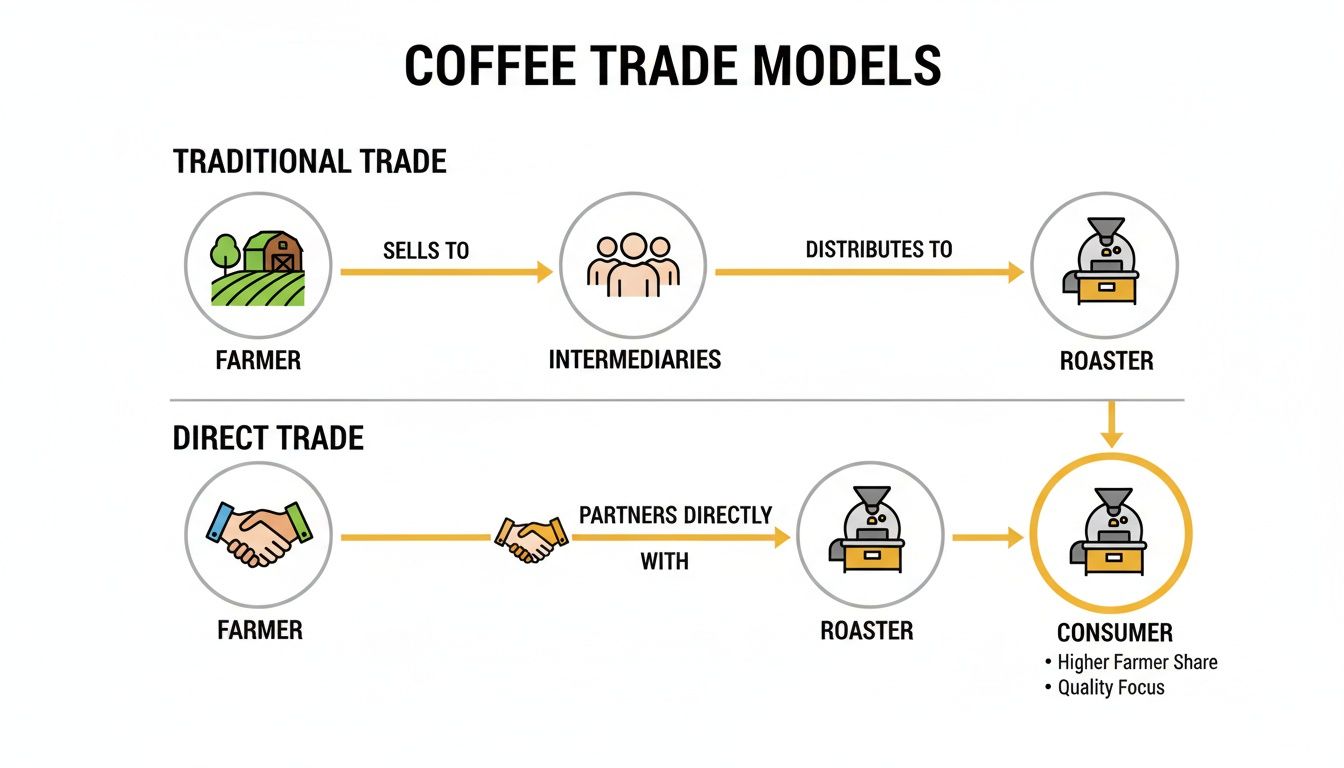
As the visual shows, direct trade creates a much cleaner, shorter path from the farm to the roaster, which is the foundation of the whole partnership.
A Head-to-Head Comparison
To really get to the bottom of it, let’s compare these two models side-by-side. Neither is inherently "better" than the other; they just have different strengths and serve different needs within the coffee industry. Knowing how they differ helps you choose a coffee that truly aligns with your values.
Comparing Direct Trade and Fair Trade Models
| Attribute | Direct Trade | Fair Trade |
|---|---|---|
| Core Model | A relationship-based sourcing philosophy without a central certifying body. | A third-party certification system with set standards and minimum pricing. |
| Pricing | Quality-based premiums negotiated directly between roaster and farmer, often 20-50% above market rates. | A guaranteed minimum price plus a fixed social premium for community projects. |
| Focus | Primarily on exceptional cup quality and direct, collaborative feedback. | Primarily on social equity, labor standards, and providing a financial safety net. |
| Transparency | Hyper-traceable, often down to the specific farmer and plot of land. | Traceable to the cooperative level, but not always to the individual farm. |
Ultimately, the choice comes down to a simple metaphor. Fair Trade sets a vital floor for farmer compensation, while Direct Trade builds a ladder. One provides a crucial safety net for many, and the other creates a direct path to higher earnings for individual farmers focused on outstanding quality.
What This Actually Means for Farmers, Roasters, and You
So, beyond the buzzwords and supply chain diagrams, what does direct trade really change? The ripple effect is huge, touching everyone from the farmer picking the coffee cherries to you holding the final, brewed cup. It’s a model built on mutual respect that creates a genuine win-win-win.
For coffee farmers, the difference is night and day. They're no longer price-takers, subject to the whims of a volatile global commodities market. Instead, they earn significantly higher and more stable incomes because the price is tied directly to the quality they produce. This stability gives them the confidence to invest back into their farms, their families, and their local communities.
A Powerful Cycle of Investment
This financial security is a game-changer. Imagine a roaster working with a producer in Colombia to help fund a new processing mill. That investment leads to better, more consistent coffee, which then commands an even higher price the next year. It creates a powerful, self-sustaining cycle of reinvestment and growth that lifts the entire community.
These aren't just one-off transactions; they're genuine partnerships. Roasters get access to rare and exclusive micro-lots—like a coveted Gesha variety—that they could never find on the open market. For them, it’s not just about buying a commodity; it’s about securing incredible, unique coffees and the authentic stories that come with them. You can see this philosophy in action by checking out our list of the best small batch coffee roasters, many of whom build their businesses on these very relationships.
In the direct trade model, a coffee's price is tied directly to its quality, not to a fluctuating global market. This simple shift empowers farmers to focus on excellence and gives roasters a reliable source for exceptional beans.
The Payoff in Your Morning Cup
What does all this mean for you, the person who just wants a great cup of coffee? It means you get a consistently better-tasting coffee with a transparent story you can feel good about. Knowing the name of the farm and the producer turns your morning ritual into a tangible connection to a real person and place.
This connection isn't just a feel-good bonus; it’s a smart way to do business. With coffee prices rising and climate change threatening harvests, direct trade helps both roasters and producers manage risk by working together. This focus on transparency and quality makes it both an ethical and a pragmatic choice in a complex global market.
Ultimately, everyone in the direct trade journey comes out ahead:
- Farmers get financial security and the resources to innovate and improve.
- Roasters secure a supply of top-tier, unique coffees and can build a brand story on true authenticity.
- You get to enjoy superior coffee with a clear, traceable, and ethical origin story.
The Bumps in the Road: Direct Trade's Challenges
While the direct trade model sounds great on paper, and often is in practice, it’s not a silver bullet. It comes with its own set of very real hurdles, and to get a complete picture of direct trade coffee, we need to look at its limitations just as closely as its benefits.
The biggest knock against direct trade is the complete lack of a universal standard or governing body. Think about it: unlike Fair Trade, which has an official third-party certification to enforce its rules, direct trade runs on trust and the individual ethics of each coffee roaster.
This opens the door to a major problem: "direct-washing." Because there are no rules, any company can slap the words "direct trade" on their packaging without having to prove they have a genuine, impactful relationship with a farmer. This makes it tough for you, the coffee drinker, to tell who’s truly committed and who’s just using clever marketing.
Big Demands on Time and Resources
Another significant challenge is simply a matter of scale. The very thing that makes direct trade special—building deep, personal, long-term relationships—is incredibly resource-intensive. It demands a serious investment of time, money, and travel from the roaster.
The hands-on nature of direct trade means roasters are on planes, visiting farms, cupping coffees right at the source, and working side-by-side with producers on quality improvements. This level of deep involvement is just not possible for huge corporations that need to buy coffee by the container load.
This reality means direct trade is a much better fit for passionate specialty roasters who put quality and human connection ahead of sheer volume. The model's greatest strength—its personal, hands-on approach—is precisely what keeps it from scaling up to a global, commodity level.
These hurdles don't make the model worthless, but they do shift the responsibility onto us as consumers. It's up to us to look for roasters who are radically transparent about their sourcing. Here’s what to look for:
- Specific farm or producer names right on the bag.
- Pricing details that show what they paid the farmer for their coffee.
- Travelogues, photos, or impact reports from their sourcing trips.
By understanding these challenges, you can become a much smarter coffee buyer, able to spot the roasters who are truly walking the walk.
How to Spot Authentic Direct Trade Coffee
Because the direct trade model operates without a central certifying body, the responsibility falls on you, the coffee drinker, to look beyond the marketing. Anyone can print "direct trade" on a bag, but a genuine commitment leaves a trail of evidence. Becoming a savvy coffee buyer means learning how to spot the roasters who are truly invested in ethical, transparent relationships.
The first and most important clue is on the packaging itself. Look for extreme specificity. Does the label name the farm, the producer, or the specific cooperative where the beans were grown? Vague regional descriptions like "Colombian Coffee" are a red flag, while names like "Finca El Mirador, Huehuetenango, Guatemala" signal a real, traceable connection.
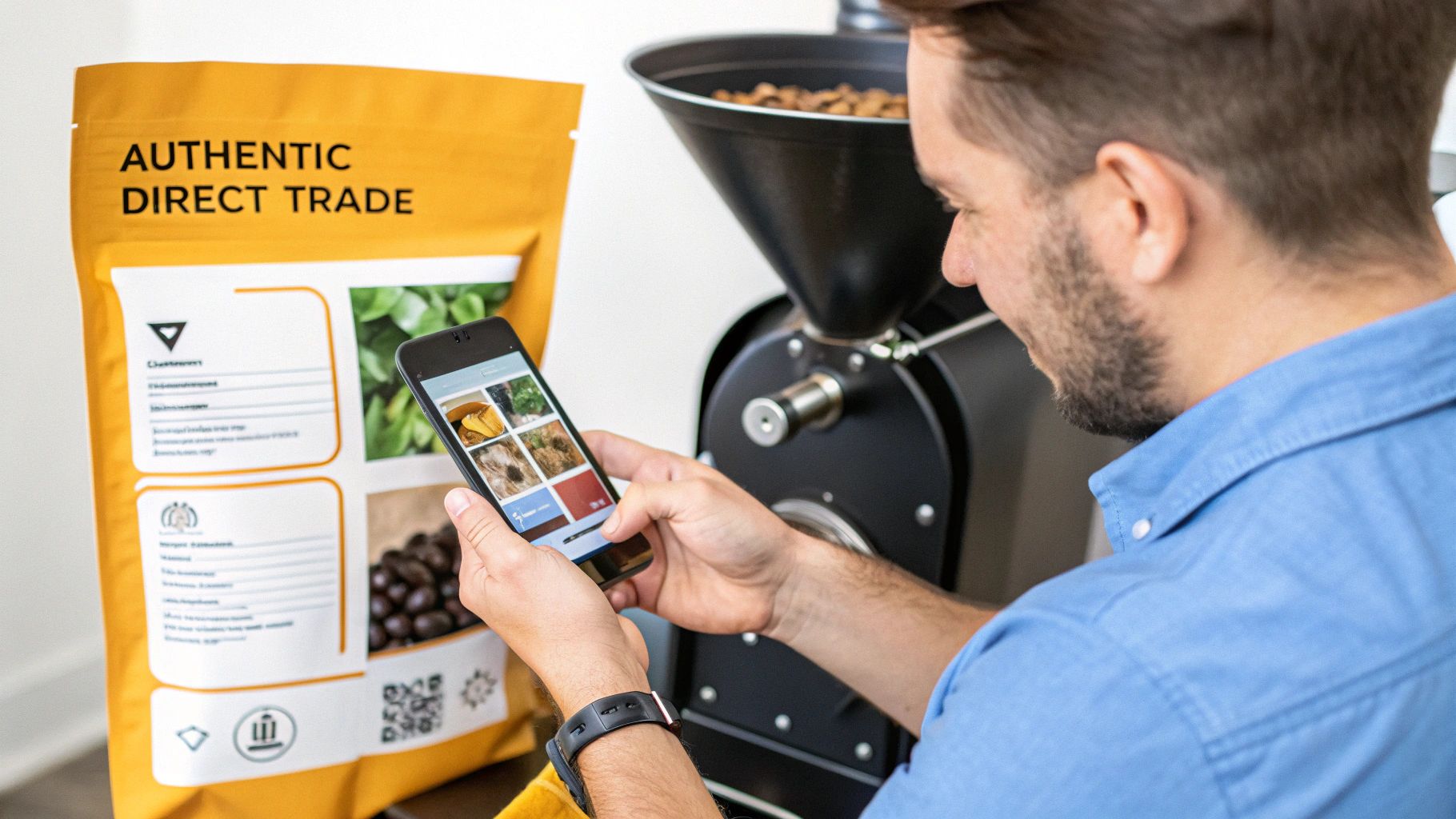
Go Beyond the Bag
Your investigation shouldn't stop with the packaging. A roaster’s website is a goldmine of information that can back up their claims. Look for content that brings their sourcing journey to life.
Transparency is the bedrock of authentic direct trade. Roasters who are proud of their partnerships will go out of their way to share the stories, faces, and places behind their coffee.
Do they feature detailed travelogues from their sourcing trips? Are there photos or videos of them on the farms, cupping coffee with the producers? This kind of content isn't just marketing fluff; it's proof of a real, hands-on relationship. It shows they’ve invested time and resources in building a genuine partnership, not just completing a transaction.
Questions to Ask Your Roaster
Finally, don't be afraid to ask direct questions, whether you're in a café or sending an email. An informed consumer signals that transparency matters, and a roaster who is truly practicing direct trade will be thrilled to answer.
Here are a few questions you can ask to gauge their commitment:
- Can you tell me more about the farmer who grew this coffee?
- How often do you visit this specific farm or cooperative?
- Do you have a story about your relationship with this producer?
The goal isn't to interrogate them but to start a conversation. Roasters who are passionate about their partnerships will have compelling, detailed answers that prove their direct trade claims are the real deal.
A Few Lingering Questions
Even after diving into the details, a few common questions usually pop up. Let's clear the air on some of the practical stuff so you can feel confident about what direct trade really means.
Is Direct Trade Coffee Always More Expensive?
Most of the time, yes—and that’s a good thing. The higher price you see on the bag isn't because of a bloated supply chain; it's because more of that money is going directly to the farmer for producing exceptional coffee.
Think of it less as a cost and more as an investment in a better cup and a better system. Research has shown that coffee drinkers are increasingly willing to pay a premium for beans they know are sourced ethically and can be traced back to the farm. That extra money gives farmers the stability to keep improving, experimenting, and producing the kind of coffee we all want to drink.
Are Direct Trade and Organic the Same Thing?
That’s a common mix-up, but no, they're different. "Direct trade" is all about the sourcing relationship—how the coffee is bought and sold. "Organic" is an agricultural certification that focuses on specific farming practices.
That said, the two often go hand-in-hand. Because direct trade fosters such a close partnership between the roaster and farmer, conversations about sustainable and organic methods happen naturally. Many roasters will encourage and even help fund a farm’s transition to organic, but a coffee can be direct trade without being organic, or vice-versa.
How Exactly Does Direct Trade Make the Coffee Better?
It all comes down to one powerful thing: a direct feedback loop. In the traditional, anonymous commodity market, a farmer has almost no idea who buys their coffee or what they think of it.
With direct trade, the roaster can visit the farm and say, "We absolutely loved the notes of cherry and almond in last year's crop. Can we try to enhance that this year?" This kind of specific, collaborative feedback is invaluable. It gives farmers a clear target and a financial incentive—a higher price—for hitting it. This constant push for quality is what leads to those truly special, memorable coffees.
At Cartograph Coffee, we believe the story behind your coffee is just as important as the flavor in your cup. We're committed to total transparency and exceptional quality, making sure every sip of our organic instant coffee is a testament to what better partnerships and thoughtful sourcing can achieve.
Explore our collection and taste the difference for yourself.