Coffee cupping isn't just about tasting coffee; it's a standardized, almost scientific way to evaluate it. Think of it less like sipping your morning cup and more like how a wine sommelier meticulously analyzes a vintage. It’s a systematic process professionals use to assess a coffee’s defining traits: its aroma, flavor, and mouthfeel.
This shared ritual is what connects a coffee farmer in Ethiopia, a roaster in Seattle, and a barista in Tokyo. It’s a methodical analysis that creates a common ground, a universal language, for everyone in the industry to discuss and score a coffee's unique character. In many ways, this process is the very backbone of the specialty coffee world.
At its heart, cupping serves a few critical purposes:
- For Quality Control: Roasters cup constantly to make sure every single batch meets their standards. It's how they catch any potential defects before the beans ever make it to your bag.
- To Make Smart Purchases: Before buying tons of green coffee, importers and roasters cup samples from different farms. This helps them pinpoint the lots with the most exciting and desirable flavor profiles.
- To Perfect the Roast: Cupping is essential for dialing in a roast profile. It's how a roaster can bring out a coffee's best features, whether that’s a bright, snappy citrus note or a deep, lingering chocolatey finish.
A Global Standard for Quality
What started as a simple trading practice has blossomed into the universal language of the entire coffee supply chain. This standardized approach is used by farming cooperatives in Colombia, exporters in Kenya, and quality control teams everywhere. It guarantees that everyone is evaluating coffee using the same playbook.
That level of consistency is absolutely vital in a global industry that generates around $200 billion in value each year, with nearly 3 billion cups of coffee consumed every single day.
"Cupping levels the playing field. It removes personal preference from the equation and allows the coffee's inherent quality to speak for itself through a structured, repeatable process."
As we dive into this universal language, it's also interesting to see the other side of the business, including the essential coffee shop equipment that helps bring these carefully chosen beans to the public. For us, cupping is our guarantee—it’s how we ensure every batch of Cartograph Coffee is ready for your next adventure.
The Official Coffee Cupping Protocol
To make sure a coffee roaster in Seattle and a coffee farmer in Ethiopia are on the same page, the industry relies on a standardized ritual. This isn't about being stuffy or overly rigid; it's about creating a level playing field where the only thing that matters is the coffee in the cup.
By controlling every variable—from the size of the coffee grounds to the temperature of the water—professionals can isolate the coffee's true character. Think of it as a controlled experiment for your senses. This systematic process ensures that when someone scores a coffee, they're judging its inherent quality, not the brewing method.
This process is the common language spoken all along the coffee supply chain, connecting everyone from the farm to the final cup.
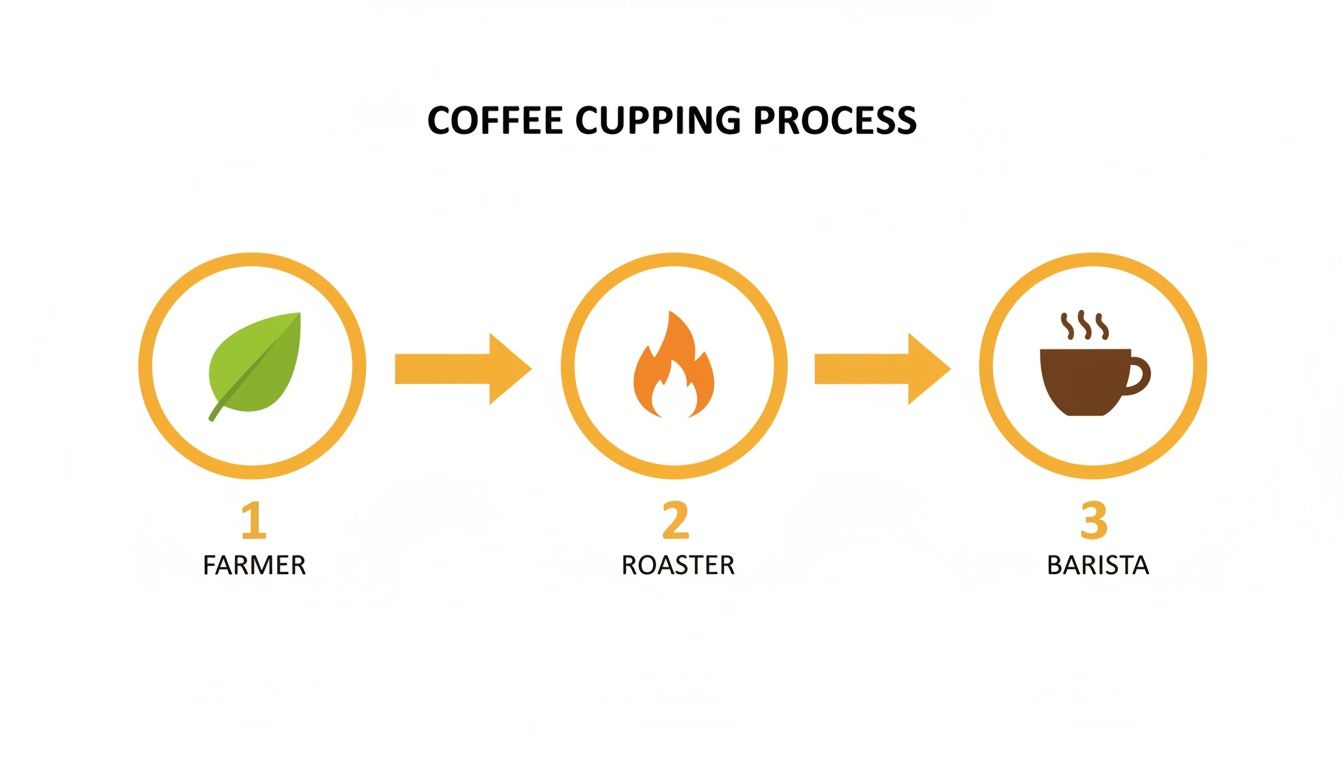
This shared evaluation method acts as a critical quality checkpoint, ensuring standards are met every step of the way.
Step 1: Ground Preparation and Fragrance
It all starts with precision. Cuppers use a specific coffee-to-water ratio, which is typically 8.25 grams of whole bean coffee for every 150 ml of water. The beans are then ground to a consistency that’s just a little coarser than what you’d use for a standard drip machine.
The moment the beans are ground, the sensory analysis begins. This first impression is called the fragrance. Cuppers lift the cup, get their nose right in there, and take a few deep sniffs. They’re looking for the very first clues. Is it sweet and nutty? Floral? Maybe a little spicy? These initial notes are just the beginning of the story.
Step 2: Adding Water and Assessing Aroma
Next, hot water is poured directly onto the grounds. Temperature is key here, with the sweet spot being around 200°F (93°C). The goal is to pour evenly and saturate all the grounds, which causes a "crust" of coffee to form on the surface.
The coffee is left to steep for about four minutes. Then comes a defining moment in the process: "breaking the crust." Using a special spoon, the cupper gently pushes aside the grounds, which releases a huge wave of trapped aromatics. This is the aroma, and it's often far more intense and revealing than the dry fragrance.
This step is where many of a coffee's most delicate and volatile notes are revealed. The difference between the dry fragrance and the wet aroma can tell a professional a great deal about the coffee's complexity and quality.
Step 3: The Iconic Slurp for Tasting
Once the crust is broken, any leftover foam or floating bits are carefully skimmed off the top. Now, the coffee needs to cool down a bit so it's safe to taste. If you're curious about the details, we have a complete guide on finding the correct temperature for coffee.
Finally, we get to the most famous (and loudest) part of cupping: the slurp. It might look a little dramatic, but it has a crucial purpose. By slurping the coffee forcefully, the liquid vaporizes and coats your entire palate at once, hitting every single taste bud.
This powerful aspiration also sends aromatic compounds rocketing up into your nasal cavity. It’s this combination of taste on the tongue and smell from the back of your throat (retronasal olfaction) that gives you the full, 360-degree picture of a coffee’s flavor. From there, cuppers judge everything from acidity to body before spitting it out and moving to the next cup.
Mastering the Vocabulary of Flavor
To really get what coffee cupping is all about, you have to learn to speak the language. It means moving past simple words like "strong" or "nice" and digging into a vocabulary that can actually describe the sensory experience. Think of it like learning the notes on a piano—once you know them, you can start to appreciate the whole symphony playing out in your cup.
The goal here is to get specific. Instead of just saying a coffee is "fruity," the language of cupping pushes you to pinpoint exactly what you're tasting. Are those the bright, sweet notes of a fresh strawberry? Or is it more like the sharp tartness of a lime, or the deep, jammy sweetness of a plum?

To get to that level of detail, professionals have a shared set of terms they use to evaluate coffee. This common vocabulary allows them to communicate clearly about a coffee's specific qualities, whether they're across the table or across the world.
To help you get started, here’s a quick guide to the core terms you'll hear on any cupping table.
Key Cupping Evaluation Terms Explained
| Term | What It Means | Example Analogy |
|---|---|---|
| Fragrance/Aroma | The scent of the coffee. Fragrance is the smell of the dry grounds; Aroma is the smell after adding hot water. | Think of the difference between smelling a bag of spices (fragrance) versus smelling a pot of simmering curry (aroma). |
| Flavor | The coffee's main character. It’s the combined sensation of taste on your tongue and aromatics in your nose. | This is the difference between simply tasting "sweet" and identifying notes of caramel, honey, or milk chocolate. |
| Aftertaste | Also called the "finish," it’s the flavor that lingers after you've spit or swallowed the coffee. | A great coffee has a pleasant aftertaste like a fine wine, while a poor one might leave a lingering, ashy bitterness. |
| Acidity | Not sourness! This is the bright, vibrant, tangy quality that gives a coffee life and sparkle. | It’s the pleasant tartness you find in a green apple or a squeeze of fresh lemon, not the sourness of spoiled milk. |
| Body | The physical weight and texture of the coffee on your tongue. Is it light and watery, or rich and creamy? | This is just like comparing skim milk (light body) to whole milk (medium body) or even heavy cream (full body). |
Understanding these individual components is the first step. The real magic, though, happens when you start to see how they all work together.
Putting It All Together: The Quest For Balance
Beyond just identifying individual notes, a huge part of evaluation is assessing how the coffee feels in your mouth and whether all its parts are playing nicely together. These qualities are often what separates a good coffee from a truly unforgettable one.
Balance is the holy grail. A well-balanced coffee is one where no single attribute—not the acidity, the body, or the sweetness—shouts over the others. Everything is in harmony, creating a complete and deeply satisfying experience.
Developing a knack for this takes practice, but it's a journey that can completely change how you experience flavor in everything you eat and drink. Once you start noticing these details in coffee, you'll see them everywhere—from a piece of chocolate to a complex coffee BBQ sauce.
If you want to dive deeper into how different coffees express these traits, it's worth learning about the various types of coffee beans and their classic flavor profiles. Every sip becomes a new opportunity to build your personal sensory library.
How Professionals Grade Coffee with Scoring Sheets
Once you’ve identified a coffee’s unique characteristics, the next step is to put a number on it. This isn't about whether you personally like the coffee; it's a systematic process for measuring its quality against globally recognized standards. To do this, professionals use a standardized scoring sheet, like the one from the Specialty Coffee Association (SCA), to grade every last detail.
Think of it like a judge at an Olympic diving event. They aren’t scoring based on personal taste—they’re evaluating how well the dive was executed against specific criteria like form, entry, and difficulty. Coffee cupping is the same idea. Points are awarded for key attributes like aroma, acidity, body, and balance.
Each category on the sheet has a potential score, and they all get tallied up for a final number out of 100. This score becomes a universal language that everyone in the coffee world, from a farmer in Ethiopia to a barista in Tokyo, can understand.
The Magic Number for Specialty Coffee
This scoring system is what draws the line between commodity coffee and the good stuff. For a coffee to earn the coveted specialty coffee grade, it has to hit a score of 80 points or higher. Anything below that is considered commercial-grade.
This isn't just an arbitrary number; it has a huge impact on the real world. A coffee’s score directly affects its market value. A high-scoring micro-lot from a small farm in Kenya will fetch a much higher price than a commercial-grade coffee that goes into a generic blend. This system gives farmers a real incentive to focus on producing the absolute best beans they can.
A coffee's final score is a reflection of its entire journey. It represents the meticulous work of the farmer, the precision of the processor, and the skill of the roaster, all captured in a single, objective number.
From Score to Market Impact
The focus on quality and scoring has completely changed the game. The specialty coffee movement has raised the bar for what consumers expect, and brands focused on quality, traceability, and sustainability have carved out a huge piece of the market.
Today, specialty coffee accounts for about 15% of the entire global coffee market and it's growing fast. This entire segment is built on the foundation of high-quality, graded beans roasted to bring out their unique flavors. It’s all about honoring the journey from farm to cup. You can dig deeper into these trends with these global coffee statistics.
Ultimately, this scoring system creates a transparent, merit-based marketplace. By putting a clear, objective value on quality, cupping ensures that excellence is recognized and rewarded at every step of the supply chain.
Your Practical Guide to At-Home Coffee Cupping
You don't need a professional lab or a bunch of fancy gear to start exploring the world of coffee cupping. The core idea is all about sensory evaluation, and you can bring that right into your own kitchen. By setting up a simple, consistent process, you can begin training your palate and discover just how wildly different coffees can be.
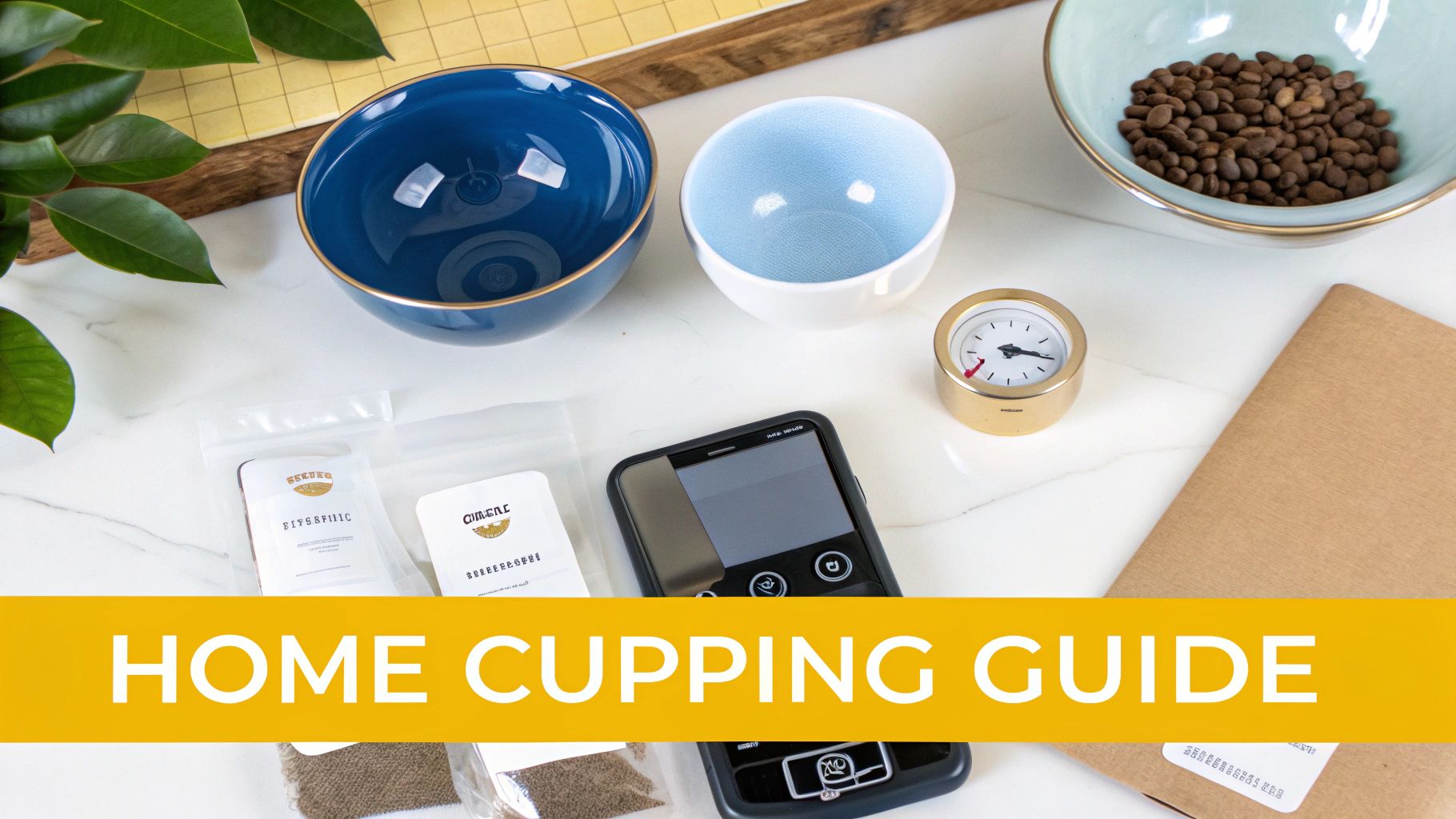
The secret isn’t owning the "right" equipment; it’s all about creating a repeatable process. The goal is to make the coffee the only thing that changes. This way, you can make fair comparisons and really start to understand what makes each bean unique.
Setting Up Your Home Cupping
First things first, gather a few basic items you probably already have. Remember, consistency is king here, so try to use matching items whenever you can.
- Vessels: Grab two or three identical small bowls, mugs, or even glasses. Using the same kind of vessel ensures a similar extraction rate for all your coffee samples.
- Spoons: You'll want two. A regular tablespoon works great for skimming, and a soup spoon is perfect for slurping.
- Scale and Grinder: A simple kitchen scale is all you need for measuring beans. If you have a burr grinder, even better—it’ll give you a much more consistent particle size.
- Timer: Your smartphone is the perfect tool for tracking the steep time.
A key to a successful home cupping is a consistent grind and coffee-to-water ratio. I suggest aiming for a medium-coarse grind and using about 2 tablespoons (10-12g) of coffee for every 6 ounces (180ml) of hot water.
A Simplified At-Home Cupping Process
Ready to dive in? This five-step process is a pared-down version of the professional protocol, adapted for anyone to try at home. It’s the perfect way to compare a few different coffees side-by-side.
- Assess Fragrance: Grind your coffees, placing the grounds in their separate bowls. Before you add any water, take a moment to lean in and smell the dry fragrance of each one. What do you notice?
- Add Hot Water: Start your timer and pour hot water (just off the boil, around 200°F) evenly over the grounds. Make sure you saturate them completely.
- Break the Crust: After four minutes, a crust of grounds will have formed on the surface. Use your soup spoon to gently push it back. As you do, get close and inhale—this is where you’ll get a huge burst of intense aroma.
- Skim the Surface: Now, take your tablespoon and carefully skim off any leftover foam or floating grounds from the top of each cup.
- Taste and Evaluate: Let the coffee cool for a few minutes. Around the 10-minute mark, it's ready to taste. Take your soup spoon, get it close to the surface, and give it a good, loud slurp. Don't be shy!
As you taste, just think about the basics: aroma, acidity, body, and flavor. If you get hooked and want to refine your daily brew, you can check out our guide on the best way to prepare coffee at home.
Cupping Instant Coffee
Believe it or not, this whole process isn't just for whole beans. You can absolutely apply the same principles to high-quality instant coffee, like ours at Cartograph.
Just prepare the samples according to the instructions, making sure to use the same water temperature and ratio for each one. You can assess the dry aroma from the crystals, the wet aroma after adding water, and then taste for flavor clarity, body, and balance. It's a mindful approach that helps you appreciate the craft behind a convenient product and truly taste the difference quality makes.
A Few Common Questions About Coffee Cupping
As you get more familiar with coffee cupping, a few questions always seem to pop up. Let's tackle some of the most common ones. Think of this as a quick FAQ to clear up any confusion and help you feel more comfortable, whether you're at a professional table or just getting started in your own kitchen.
We'll cut through the jargon and get straight to the practical stuff, so you can really get a handle on this whole sensory evaluation thing.
Do I Need Special Equipment to Start Cupping at Home?
Nope, not at all. While the pros use very specific, standardized gear to keep things consistent across the globe, you can absolutely get started with things you already have. The real goal is creating a process you can easily repeat, not spending a bunch of money.
To get going, you just need a few simple items:
- Identical Vessels: Grab a few matching mugs or small bowls. Using the same kind of vessel for each coffee ensures they all cool down at the same rate, which is key for a fair comparison.
- Spoons: Any old tablespoon will work for skimming the crust of grounds off the top. For tasting, a deeper soup spoon is actually perfect.
- Basic Tools: A simple kitchen scale to weigh your beans and the timer on your phone are all you need to keep things precise.
Remember, it's all about consistency, not complexity. If you keep the setup the same for every coffee you taste, you're letting the unique character of the beans shine through.
What Is the Slurp and Why Is It So Important?
That loud slurp is probably the most recognizable part of a coffee cupping, and it's done for a very good reason. It’s not just for show—it's a technique with a real scientific purpose. When you slurp the coffee forcefully, you're essentially atomizing it, spraying a fine mist across your entire palate. This engages all of your taste buds at once.
Even more importantly, that slurp sends the coffee’s aromatic compounds rocketing up into your retronasal passage, which connects the back of your throat to your nose. This is what allows you to "taste" with your sense of smell, giving you a far more vivid and complete flavor experience than you'd get from a simple sip.
It's this powerful one-two punch of taste and aroma that unlocks a coffee's full sensory profile. The slurp is the key that turns tasting into a full-blown evaluation.
Can I Use Cupping to Evaluate Instant Coffee?
Absolutely. The fundamental principles of sensory analysis—looking at aroma, body, flavor, and finish—apply to any coffee, and that includes a well-made instant coffee. You can easily adapt the standard cupping protocol to really explore what's in your cup.
Start by smelling the dry crystals before you add water, then take note of the aroma once the hot water hits. When you taste it, look for the same things you would in a traditionally brewed coffee: Is the flavor clear? Does it have a pleasant body? Is it sweet and balanced? It’s a brilliant way to discover the surprising nuances that distinguish a premium instant from the rest.
How Does Coffee Cupping Help Farmers and Roasters?
Cupping is the universal language of the coffee world. It's the critical feedback loop that connects everyone in the supply chain, from the person who grew the beans to the person who drinks the final cup.
For farmers, cupping is a tool to gauge the quality of their harvest. It helps them pinpoint their best lots, experiment with different processing methods to create new flavors, and ultimately, earn higher prices for their hard work. For roasters, it’s essential. They use cupping to make smart buying decisions, figure out the perfect roast profile to bring out a coffee's best qualities, and perform quality control to make sure every batch is consistently delicious.
At Cartograph Coffee, we use these very principles to ensure our organic instant coffee delivers an exceptional experience every time. Ready to taste the difference quality makes?