Diving into the world of coffee can feel a bit overwhelming at first, but it really all starts with just four main types of coffee beans: Arabica, Robusta, Liberica, and Excelsa. These four species are the ancestors of every single coffee you've ever had, from a delicate, single-origin pour-over to your go-to morning espresso.
The 4 Main Types of Coffee Beans
Think of the "big four" coffee beans like you would a family of apples. Arabica is your Honeycrisp—sweet, crisp, wonderfully aromatic, and always in high demand. Robusta, on the other hand, is more like a Granny Smith—tart, bold, undeniably powerful, and it definitely packs a punch.
Just like with apples, each type of coffee bean has its own distinct personality. That unique character is shaped by its genetics, the climate it's grown in, and the soil it's planted in. We're going to break down these key players, because understanding their core differences is the very first step to finding a coffee that you'll truly love.
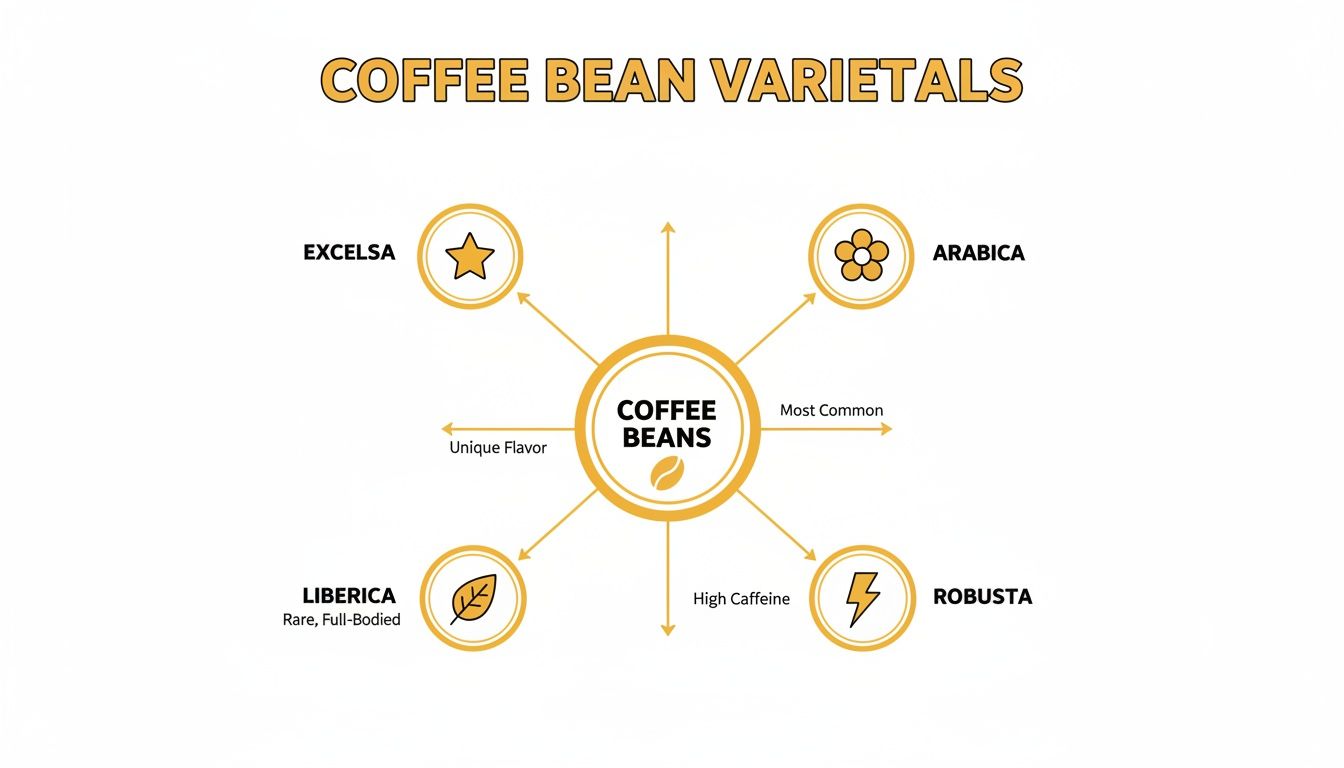
The image above gives you a great visual snapshot. Even the icons hint at what makes each one special—a delicate flower for Arabica and a lightning bolt for Robusta's serious caffeine kick. It's clear that while they're all "coffee," the experience they offer is worlds apart.
To give you a quick reference, here's a simple breakdown of how the four main types stack up against one another.
Quick Comparison of the Main Coffee Bean Types
| Bean Type | Common Flavor Profile | Caffeine Level | Best For |
|---|---|---|---|
| Arabica | Sweet, fruity, floral, bright | Lower | Specialty drip, pour-over, premium blends |
| Robusta | Bold, bitter, chocolatey, rubbery | Higher (2x Arabica) | Espresso blends, instant coffee, high-caffeine needs |
| Liberica | Smoky, woody, floral, fruity | Low | Niche markets, unique single-origin brews |
| Excelsa | Tart, fruity, dark, mysterious | Varies | Blending to add complexity and depth |
This table is just the starting point, of course. The real magic (and flavor) comes from a few other key factors that influence what you actually taste in the cup.
What Shapes the Flavor in Your Cup?
Beyond the bean's species, a few other elements are just as crucial in crafting the final taste. Think of the bean as the raw potential, and these are the steps that unlock it.
-
Terroir (The Origin Story): This is a wine term, but it fits coffee perfectly. It refers to the complete environment where the coffee grows—the soil, the specific climate, and even the altitude. All these factors leave a unique fingerprint on the bean’s flavor.
-
Processing Method: After the coffee cherries are picked, the bean inside needs to be removed and dried. How this is done—using washed, natural, or honey processing methods—dramatically changes the taste. It's the difference between a clean, bright flavor and a sweet, intensely fruity one.
-
Roast Level: Roasting is the final, fiery transformation. A light roast will let the bean's original, delicate flavors shine through. A dark roast, however, develops deeper, smokier, and chocolatey notes as the sugars inside caramelize.
A single Ethiopian Arabica bean can taste wildly different based on its journey. If it’s naturally processed and lightly roasted, you might get notes of blueberry. But if it’s washed and taken to a dark roast, you could end up with a rich, chocolatey flavor. The bean is just the starting point.
This entire path, from a humble cherry on a plant to the rich brew in your mug, is what makes exploring coffee so fascinating. Whether you're just starting out or you've been a coffee lover for years, understanding these fundamentals helps you choose your next brew with confidence. It’s this same focus on the bean's potential that inspires us at Cartograph Coffee, where we work to ensure even our organic instant coffee delivers a world-class experience.
Getting to Know the Big Two: Arabica and Robusta
When you start to really explore coffee, you’ll quickly find two names dominate the conversation: Arabica and Robusta. These aren't just beans; they're the foundational pillars of the entire coffee world, each with its own distinct personality and purpose. Nearly every cup you've ever had has been one or the other, or a blend of the two.
Just how dominant are they? Together, they make up almost all of the coffee grown on the planet. Arabica is the crowd favorite, accounting for about 60-70% of the global supply, with Brazil as its biggest producer. Robusta makes up most of the rest, and Vietnam is its powerhouse, growing nearly 40% of the world's total. The global coffee production numbers really put their significance into perspective.
The Aromatic Allure of Arabica
If coffee had a "fine wine" category, Arabica (Coffea arabica) would be it. It's all about complexity, nuance, and delicate flavors. Ever had a coffee that reminded you of berries, flowers, or bright citrus? You were almost certainly drinking an Arabica.
These beans are famous for their higher acidity—and I don't mean sour. In coffee, acidity is that pleasant, sparkling brightness that makes the flavors come alive on your tongue. Arabica plants are a bit picky, needing high altitudes, rich soil, and just the right amount of rain and shade to thrive. This fussiness, combined with a lower yield per plant, is why Arabica generally comes with a higher price tag.
- Flavor Profile: Think sweet and soft. You'll find notes of fruit, florals, caramel, and nuts.
- Acidity: Bright and crisp, giving the coffee a lively, vibrant quality.
- Body: Tends to be lighter and more elegant.
- Bean Shape: Noticeably oval.
Because it has so much to offer in the flavor department, Arabica is the star of the specialty coffee scene. It shines in brewing methods like pour-over or drip, where its subtle complexities can be front and center.
The Bold Power of Robusta
Then we have Robusta (Coffea canephora), Arabica's tough, powerful sibling. The name says it all. The Robusta plant is hardy and resilient, happy to grow in hotter climates and lower altitudes where Arabica plants would struggle.
Robusta's most famous trait? Its caffeine. It packs a serious wallop, containing nearly double the caffeine of an average Arabica bean. This isn't just a bonus for us; it’s the plant's built-in defense mechanism against pests.
That extra caffeine also contributes to its distinct taste: a strong, bold, and full-bodied flavor often described as rubbery or chocolatey. While it might lack the delicate finesse of Arabica, Robusta's intensity is exactly what’s needed in certain situations.
Its powerful flavor and knack for producing a thick, stable crema make it the secret weapon in traditional Italian espresso blends. This same boldness is why it's a perfect base for instant coffee—it provides a strong, consistent coffee flavor that doesn't get lost when you add milk or sugar.
Key Differences at a Glance
So, how can you spot the difference? While your taste buds are the final judge, there are some clear distinctions that set them apart from the farm all the way to your cup.
| Feature | Arabica | Robusta |
|---|---|---|
| Taste | Sweet, fruity, floral | Strong, bold, chocolatey |
| Acidity | High | Low |
| Caffeine | Lower (~1.5% by weight) | Higher (~2.5% or more) |
| Sugar | Higher | Lower |
| Shape | Oval | Round |
| Cost | Higher | Lower |
| Best For | Specialty brews, pour-over | Espresso blends, instant coffee |
Getting a handle on these two giants is the first real step into the wider world of coffee. Whether you lean toward the aromatic, nuanced experience of a single-origin Arabica or crave the powerful kick from a Robusta-based blend, knowing what makes them different is the key to finding your perfect cup.
Exploring the Rare Gems: Liberica and Excelsa
While Arabica and Robusta dominate the coffee world, they aren't the whole story. Let’s venture off the beaten path to meet two of coffee’s best-kept secrets: Liberica and Excelsa. These two make up less than 2% of the world's coffee consumption, making them a true discovery for any curious drinker.
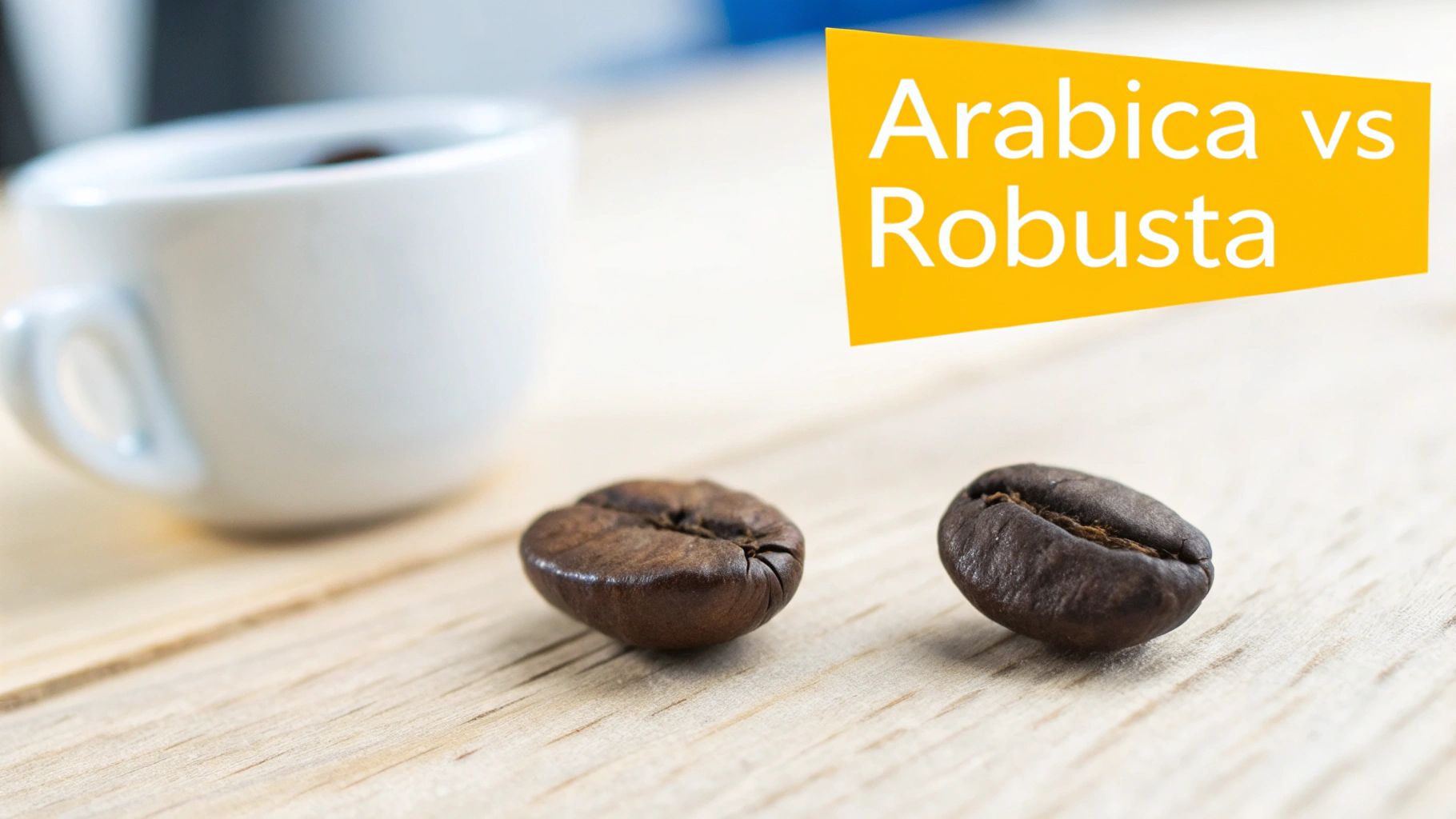
Finding them can feel like a treasure hunt, but their one-of-a-kind profiles are a powerful reminder of the incredible diversity within the coffee family. They offer a taste of coffee’s wilder, more untamed side.
The Bold and Unconventional Liberica
First up is Liberica (Coffea liberica). This bean, originally from West Africa, had a moment in the spotlight back in the late 19th century when coffee leaf rust wiped out most of the world's Arabica plants. Farmers in the Philippines picked it up, and to this day, it remains a cornerstone of their coffee heritage.
Liberica beans don't look like anything else. They're noticeably larger than other beans, often with an irregular, almost almond-like shape. But their unique appearance is just the start.
When you brew Liberica, you get a flavor that is truly its own. It's known for having an incredibly full body and a bold, smoky, almost woody character. While some people pick up on subtle floral and fruity notes in the aroma, the taste is an undeniably powerful, dark experience that sticks with you.
Think of Liberica's flavor like a smoky, peated Scotch. It’s definitely not for everyone, but those who fall for its intense, distinct profile become lifelong fans. It’s a complete departure from the familiar territory of Arabica and Robusta.
With its powerhouse flavor and low acidity, Liberica is what you’d call a polarizing coffee. Still, its rarity and fascinating history make it a prized find for enthusiasts eager to explore the entire spectrum of what coffee can be.
The Mysterious and Fruity Excelsa
Next, we have Excelsa (Coffea excelsa), a bean with a bit of an identity crisis. For a long time, it was considered its own species. Then, in 2006, botanists reclassified it as a variety of Liberica. But even with that scientific update, the coffee industry often treats it as a separate entity because its taste is so profoundly different.
Grown mainly in Southeast Asia, Excelsa has a fascinating dual personality. It has the tart, fruity notes you’d find in a lighter roast, but it also delivers the deeper, darker flavors common in a dark roast—all in the same cup. This creates a complex, layered experience that keeps you guessing with every sip.
- Taste: A wild combination of tart fruitiness and dark, roasted undertones.
- Body: It provides a full-bodied mouthfeel that gives blends a serious depth.
- Acidity: It has a noticeable tartness that adds to its complex character.
Because it can add so much complexity without completely taking over, roasters love using Excelsa in blends. It adds a pop of mystery and a lingering finish that elevates the whole cup. While finding a bag of 100% Excelsa is a rare treat, its impact on creating sophisticated, memorable blends is huge.
Together, Liberica and Excelsa prove there’s a vast, flavorful world waiting just beyond our everyday brew.
How Origin Shapes the Flavor in Your Cup
Ever wonder why a coffee from Ethiopia can taste like a delicate cup of floral tea, while a brew from Brazil is all about chocolate and nuts? The answer is geography. The place where coffee grows has a massive impact on its final flavor, a concept the wine world calls terroir. It’s the story of a bean's environment—the soil, the climate, the altitude—all coming together to create a taste you won't find anywhere else.
This means you can take the exact same type of coffee bean, say an Arabica, and its taste will be completely different depending on where it’s planted. A bean grown on a high-altitude farm in Colombia will have a totally different character than one from a sun-drenched estate in Sumatra. It’s a beautiful reminder that nature is the first and most important artisan in the coffee-making process.
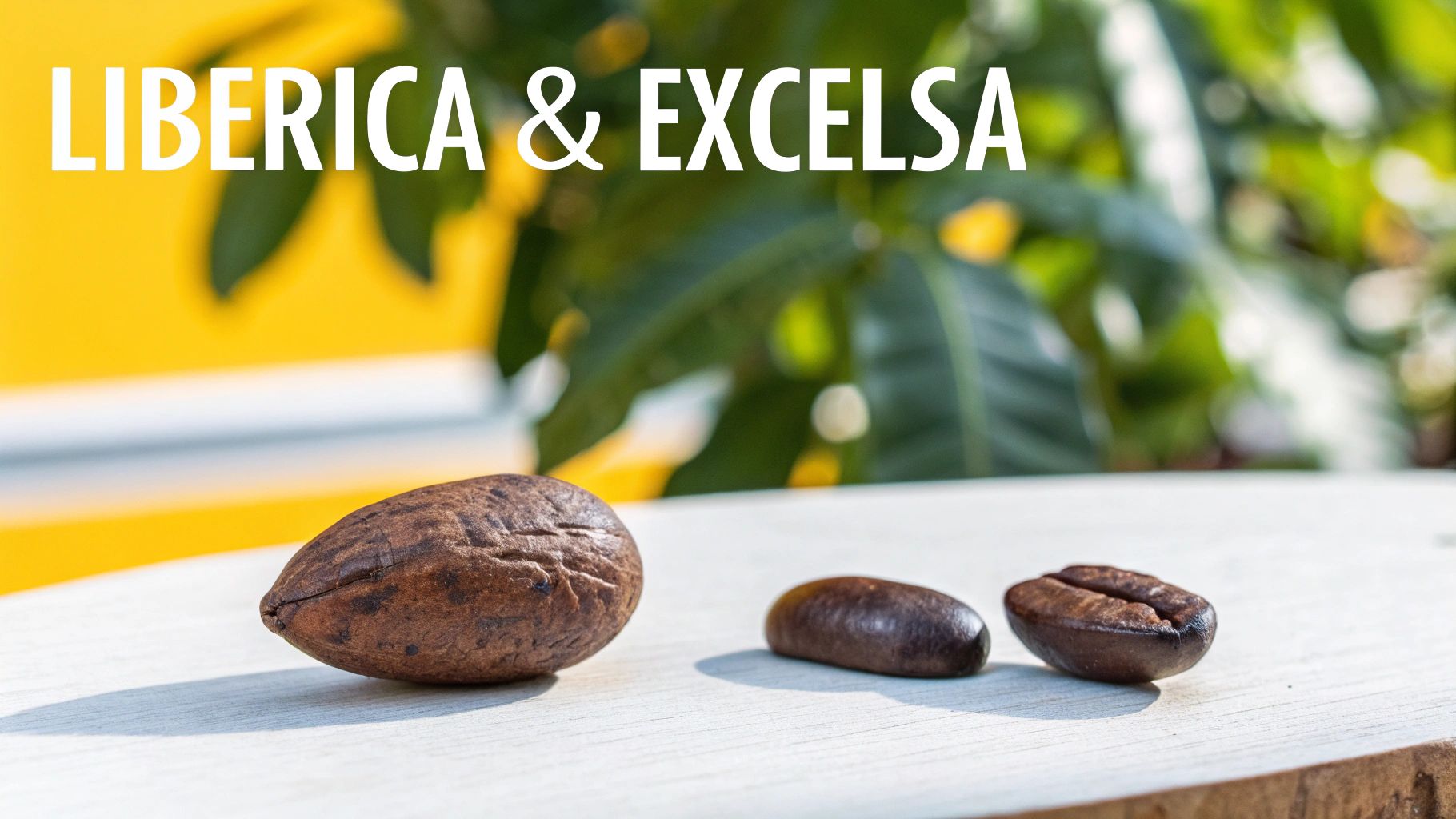
Understanding this is the key to appreciating the incredible diversity coffee has to offer. You can literally taste the difference between continents, which is why exploring single-origin coffees is so much fun. If you're curious, we dive deeper into this in our guide on what makes single-origin coffee special.
Distinguishing Species, Variety, and Origin
Before we take a trip around the globe, let's clear up a few terms that often get tangled.
Here’s a simple analogy: if coffee were a dog, its species would be "Canine." Its variety (or cultivar) would be its breed, like a "Golden Retriever." And its origin is where it grew up—say, "California."
- Species: This is the big-picture category. The main players we’ve talked about, Arabica and Robusta, are species.
- Variety: Think of this as a sub-category, like a specific breed. Famous Arabica varieties include Bourbon, Typica, Geisha, and Pacamara, each known for its own flavor potential.
- Origin: This is simply the geographical spot where the coffee was grown, which gives it that unique terroir.
So, you could have an Arabica coffee (species) of the Geisha variety from Panama (origin). Each piece of that puzzle adds another layer to what you can expect in the cup—in this case, the bright, floral notes Geisha is famous for, shaped by the Panamanian climate.
A Flavor Tour of the Coffee Belt
The "Coffee Belt" is the band around the equator where coffee trees thrive. Each major growing region brings its own signature character to the beans.
Africa: The Birthplace of Coffee
African coffees, especially from East Africa, are celebrated for their vibrant, bright, and often fruity or floral notes. They tend to have a lively, almost wine-like acidity that makes them pop.
- Ethiopia: As the birthplace of coffee, Ethiopia is home to over 10,000 unique heirloom Arabica varieties, which is why its coffees are some of the most complex in the world. You’ll find beans from Yirgacheffe are famously floral and tea-like, while those from Harrar can deliver rich blueberry notes.
- Kenya: Known for a bold, savory-sweet character. Kenyan coffees often punch through with a bright acidity and distinct notes of blackcurrant, tomato, or grapefruit.
Latin America: Balanced and Approachable
Coffees from Central and South America are often what people imagine when they think of a classic cup of joe. They're known for being smooth, clean, and incredibly versatile.
- Colombia: A global powerhouse, Colombian coffees are all about balance. They typically feature notes of caramel, chocolate, and nuts, with a mild, citrusy acidity. The "Supremo" grade is a mark of the largest, highest-quality beans.
- Brazil: As the world's largest coffee producer, Brazil gives us beans that are low in acidity, full-bodied, and nutty, with deep chocolate flavors. This profile makes them the perfect foundation for espresso blends.
Asia and the Pacific: Bold and Earthy
Coffees from this part of the world are often deep, earthy, and sometimes even a little spicy. Their profiles are typically bold, full-bodied, and unmistakably distinct.
- Indonesia: Beans from islands like Sumatra and Java are famous for their heavy body, low acidity, and earthy notes of cedar, tobacco, and dark chocolate.
- Vietnam: As the world’s leading Robusta producer, Vietnamese coffee is strong and intense. It often has a dark chocolatey and nutty flavor that stands up perfectly in a traditional Vietnamese iced coffee.
Pairing Coffee Beans with Your Brewing Method
Choosing the perfect coffee is a bit like casting an actor for a movie—the right bean needs the right stage to truly shine. A delicate, light-roasted Arabica that sings in a pour-over might get completely lost in the powerful punch of an espresso shot.
The secret is to think of your brewing method as a partnership with your coffee beans. Each brewer is designed to highlight specific characteristics, and when you get the pairing right, you unlock the absolute best flavor locked inside that bag.
Matching Beans to Drip and Pour-Over Methods
Brewing methods that rely on gravity and filtration, like a Hario V60, Chemex, or your standard automatic drip machine, are all about clarity. They produce a clean, crisp cup that lets nuanced flavors take center stage. You want a bean with a story to tell.
This is where light to medium-roasted Arabica beans are the undisputed champions. Their bright acidity and delicate floral, fruity, or citrus notes are perfectly preserved by the paper filter. Because the water passes through the grounds relatively quickly, these brewers prevent over-extraction, keeping bitterness at bay and letting the bean's unique origin flavors come through. A dark roast here can taste a bit flat, as its more subtle notes have already been muted by the roasting process.
Creating Richness with French Press and Cold Brew
Now, let's talk about immersion. When coffee grounds steep directly in water—think French press or the ever-popular cold brew—the goal is all about extracting body and depth.
For these methods, you need beans that can handle a longer hang-out time with water without turning unpleasantly bitter. This is where medium to dark-roasted beans really come into their own. Their notes of chocolate, nuts, and caramel are brought to the forefront, creating a rich, full-bodied, and satisfyingly smooth brew. The natural oils that a paper filter would trap remain in the cup, giving it that heavier, more luxurious mouthfeel that immersion fans crave.
Here’s a simple rule of thumb: If your brew method uses a paper filter, lean toward light-roasted, high-acidity beans. If it's an immersion method without a paper filter, a medium or dark roast will deliver a richer, fuller body.
Powering Espresso and Instant Coffee
Espresso is a whole different ballgame. It demands a bean that can deliver a concentrated wallop of flavor under intense pressure. This is where dark roasts and blends that include some Robusta truly excel. The caramelized sugars from a dark roast provide that classic, syrupy sweetness, while a touch of Robusta contributes to a thick, stable crema and a powerful caffeine kick.
This same need for a bold, consistent, and resilient flavor profile is also why certain beans are perfect for high-quality instant coffee. Robusta, which makes up 30-40% of the world's coffee production, is the workhorse behind the best instant coffees on the market.
Robusta’s natural hardiness and higher caffeine content make it the ideal choice for creating a soluble coffee that delivers a consistently great cup for busy professionals, campers, or anyone who needs organic quality on the go. The ready-to-drink coffee market, built on this kind of convenience, is now a massive $18 billion industry. At Cartograph Coffee, we specifically select premium organic beans to ensure our instant coffee gives you that exceptional taste, no equipment required.
How to Choose Your Perfect Coffee Beans
Alright, you've got the lay of the land—you know your Arabica from your Robusta. Now comes the best part: actually picking out a coffee that's perfect for you. Think of this as a personal journey, not a test. There are no right or wrong answers, only what matches your taste and how you like to brew.
The easiest way to start is by asking yourself a few key questions. These will act as your compass, guiding you toward a bag of beans you’ll genuinely enjoy.
- What flavors are you craving? Do you get excited about bright, almost citrusy notes, like you'd find in a great Kenyan Arabica? Or are you more of a classic, deep flavor person who loves the chocolatey, nutty profile of a good Brazilian bean?
- What’s your caffeine tolerance? If you need a serious kick to get going, don't shy away from a blend that has some Robusta in it. But for a mellower, less intense daily cup, a classic 100% Arabica is probably your best bet.
- How are you making it? As we've covered, different beans love different brewing methods. Light roasts really come alive in a pour-over, while a rich dark roast is just begging to be brewed in a French press or pulled as an espresso shot.
Decoding the Coffee Label
Once you're standing in the coffee aisle (or browsing online), the bag itself is like a treasure map. Learning to read the label is the single best skill you can develop to make confident choices every single time. It might look like a lot of jargon at first, but it’s actually pretty straightforward.
Think of a coffee label as the bean's résumé. It tells you its origin story, its core characteristics, and exactly what to expect in the cup. Understanding it is the key to buying smarter.
Here’s a quick rundown of the most common terms you’ll see and what they actually mean for your morning brew:
- Single-Origin vs. Blend: A single-origin coffee is all about a specific place—one farm, one region. It’s a snapshot of that location's unique flavor. A blend, on the other hand, is a thoughtful combination of beans from different places, designed to create a balanced, consistent, and often more complex taste.
- Roast Level: This is one of the most important clues to a coffee's flavor. Light roasts keep the bean's original bright, acidic character front and center. Medium roasts strike a nice balance, while dark roasts bring out those bold, smoky, and chocolatey notes with less acidity.
- Certifications: Look for seals like Organic, which means the coffee was grown without synthetic pesticides or fertilizers—just pure, natural coffee. A Fair Trade logo tells you the farmers received a fair price, which supports ethical and sustainable growing practices.
When you start connecting the dots—your personal taste, your go-to brewing method, and the story on the label—shopping for coffee stops being a guessing game. It becomes a deliberate and really rewarding process. You're empowered to explore with confidence. To see how some of the most passionate roasters put these principles into practice, take a look at our guide to the best small-batch coffee roasters.
A Few Common Questions About Coffee Beans
Stepping into the world of specialty coffee can feel like learning a new language. You've got terms like terroir, roast profiles, and processing methods flying around. It's easy to get a little lost. Let's clear up a few of the most common questions people have when they start digging deeper into what's in their cup.
What’s the Real Difference Between Arabica and Robusta?
At the most basic level, it all comes down to taste and caffeine. Think of Arabica as the nuanced, aromatic one of the family. It's known for its brighter acidity and complex notes of fruit, flowers, and sugar. It's a bit of a diva, though, demanding high altitudes and specific climates to thrive.
Robusta, true to its name, is the tough, bold sibling. It packs a much heavier, stronger flavor, often described as rubbery or chocolatey, and carries nearly twice the caffeine of Arabica. It’s a hardy plant that can grow in hot climates, which is why you’ll often find it in espresso blends (for a thick crema) and many instant coffees.
Does Roasting Actually Change the Type of Bean?
Nope. The bean’s origin and species are locked in its DNA—an Arabica bean is always an Arabica bean. Roasting, however, is what unlocks its potential flavor. It's a lot like toasting a slice of bread. You start with the same piece of bread, but you can toast it lightly to keep its soft, grainy flavor or toast it dark for a crunchy, caramelized taste. The bread doesn't change, but its character does.
A light roast lets the bean's unique, delicate origin flavors shine through—all those bright, floral, and fruity notes. A dark roast, on the other hand, mutes those origin flavors and brings out deeper, smokier, and bolder notes from the caramelization process. Roasting fundamentally shapes the final taste you experience.
Roasting is the art of transformation. It doesn't change what the bean is, but it completely defines the character and flavor it will express in your cup.
Are Single-Origin Beans Better Than Blends?
One isn't "better" than the other; they just serve different purposes. It’s like asking if a solo artist is better than a full orchestra.
Single-origin beans are all about showcasing the distinct, and sometimes wild, flavors of a specific place—a single farm or a small region. They're a direct expression of that location's soil, climate, and altitude, or what the wine world calls terroir. It's a pure, unblended taste of a very specific part of the world.
Blends are a roaster's creation, combining beans from different regions to craft a specific, consistent, and balanced flavor profile. The goal is to create something new and harmonious—maybe rounding out the sharp acidity of one bean with the chocolatey body of another.
How Do I Know If My Coffee Beans Are Actually Fresh?
Freshness is non-negotiable for good coffee. The single most important thing to look for on a bag is the “roasted on” date. Forget the "best by" date; you want to know when those beans actually came out of the roaster. For the best flavor, aim to use whole beans within a few weeks of that date.
Here are a few other clues:
- A powerful aroma: When you open a bag of fresh beans, the smell should be intoxicating. If it smells flat, stale, or just plain boring, the beans are past their prime.
- Whole beans are key: Ground coffee goes stale incredibly fast because so much more of its surface area is exposed to oxygen. Buying whole and grinding right before you brew is one of the biggest upgrades you can make.
- Look at the surface: For most light and medium roasts, the beans should look dry. If they're super shiny and oily, it can be a sign that they're older and their internal oils have migrated to the surface.
At Cartograph Coffee, we believe great coffee should be simple and delicious, no matter where you are. We start with incredible organic beans to craft an instant coffee that shatters expectations, making it perfect for your morning ritual or your next big adventure. Taste the difference that quality sourcing makes at https://cartographcoffee.com.