Stop chasing the longest steep you can tolerate. That's the most popular advice for cold brew, and it's also the fastest way to make a harsh, inconsistent batch you can't repeat. Good unsweetened cold brew isn't about pushing time to the limit. It's about controlling beans, grind, ratio, dilution, and storage so the cup you liked on Tuesday is the cup you get again on Friday.
What Unsweetened Cold Brew Really Is
Unsweetened doesn't mean weak, and it doesn't mean low in caffeine. That's the misunderstanding to drop first. Unsweetened cold brew is black coffee served chilled, so its nutritional profile comes from the coffee itself rather than milk, syrup, or sugar. Plain brewed coffee contains very few calories, and removing sweeteners makes it a low calorie choice compared with flavored drinks. None of that changes what's extracted from the grounds.
Caffeine is the variable people underestimate. The FDA caffeine guidance on typical servings and daily intake reports that a typical 12-fluid-ounce serving of regular brewed coffee can contain approximately 113 to 247 milligrams of caffeine, and that 400 milligrams per day is not generally associated with negative effects for most adults, roughly two or three 12-ounce cups.
Why Two Glasses Can Hit Differently
Volume alone tells you very little. Caffeine shifts with the coffee to water ratio, steeping time, dilution, bean type, and serving size. Two glasses that look identical can deliver materially different amounts if one came from a dense concentrate and the other was brewed ready to drink.
Unsweetened tells you what's absent, sugar and sweeteners. It tells you nothing reliable about caffeine strength.
That distinction matters if you're drinking cold brew for convenience or sustained alertness. A large mug from your office fridge, a refill on a drive, and another glass at a campsite can stack up quickly, especially when you're also getting caffeine from tea or soft drinks. I've learned to treat concentrate like a measured ingredient, not a free pour.
What You Can Actually Control
At home, you control the inputs that matter most. You choose the dose, you decide when to filter, and you set the final dilution before it goes over ice. If you record those choices, you can adjust strength deliberately instead of guessing why one batch felt jittery and the next tasted thin.
Think of unsweetened cold brew as a repeatable batch, not a vague recipe. The goal isn't to remove everything except coffee and water. The goal is to make black, chilled coffee where flavor, strength, and caffeine are choices you made on purpose.
Choosing Beans and Grind Size for Smooth Results
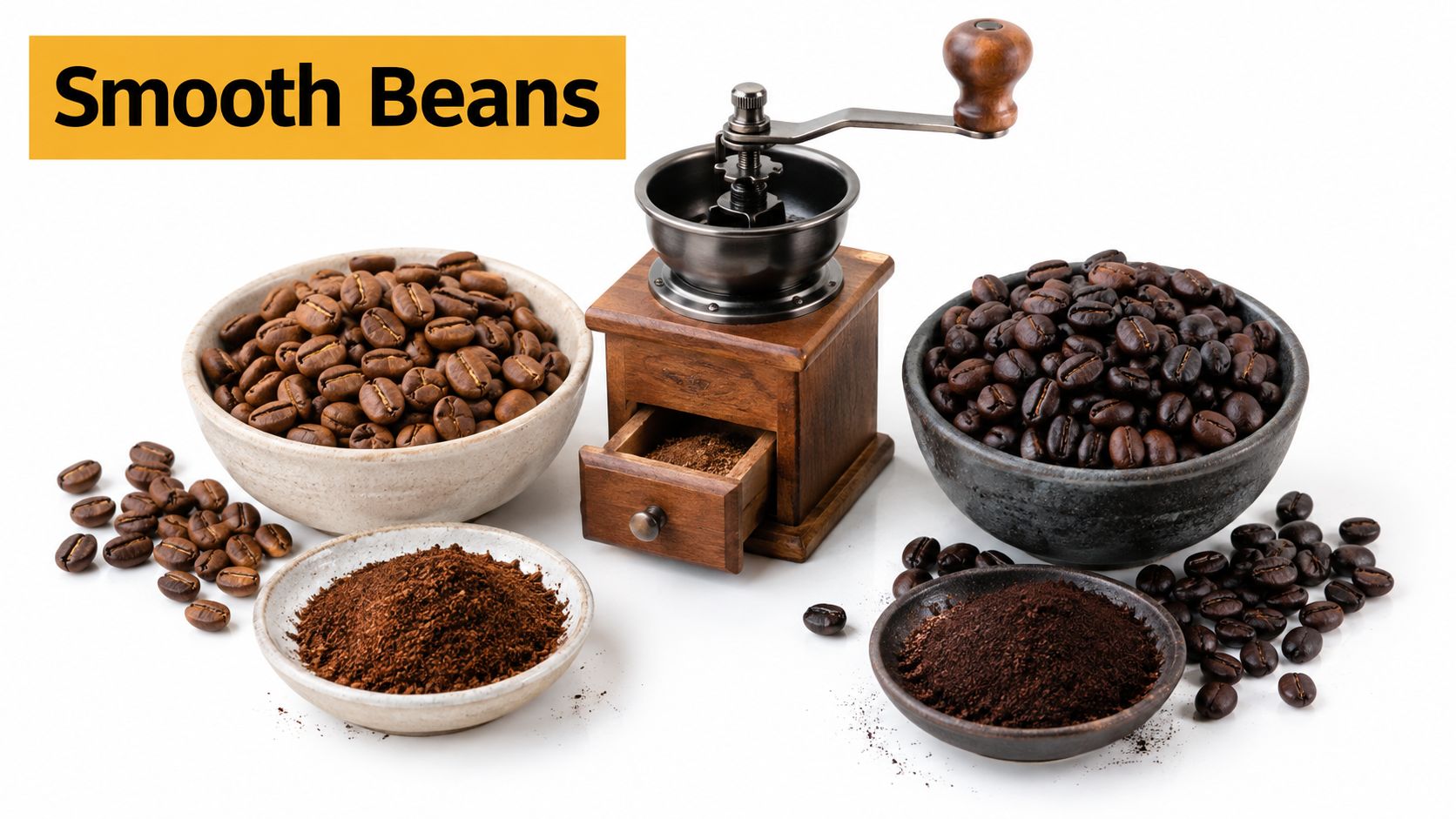
Your batch is mostly decided before water touches the grounds. Because there's no sugar to mask flaws, unsweetened cold brew exposes bitterness, stale notes, and uneven extraction more clearly than a sweetened drink does. A roast that tastes fine hot, especially with milk, can taste sharp or ashy when it's cold and black.
Start with whole beans you enjoy as a plain hot cup, then adjust from there. You're not looking for a label that promises smoothness. You're looking for beans with enough natural sweetness and balance to stand without help.
Roast Level in a Cold, Black Cup
Roast shapes the profile more than small timing tweaks do. Darker roasts often read as chocolatey and heavy at first, but they can turn bitter and drying if the extraction runs long. Lighter roasts can bring fruit and brightness, yet they may taste sour or thin if they're under extracted or diluted too aggressively.
A middle path is the easiest place to learn. Choose a roast that's developed enough to avoid grassy sharpness, but not so dark that roast flavor covers everything else. Then change one variable at a time. Origin matters, but freshness and roast consistency will show up in the glass first.
- Buy whole beans: Pre-ground coffee goes stale faster and locks you into someone else's grind choice.
- Grind just before brewing: You protect aroma and keep each batch closer to the last one.
- Keep the beans consistent while learning: Switching bags every batch makes it hard to know what changed the flavor.
Grind Size Is Your Extraction Lever
Use medium to coarse grounds for a repeatable concentrate. Finer grounds extract quickly and can pull bitter, muddy flavors into a long immersion brew. Very coarse grounds are more forgiving, but if they're wildly uneven, you'll get a mix of under extracted and over extracted particles in the same jar.
That unevenness is the hidden problem with cheap blade grinding. Dust over extracts, large chunks lag behind, and the result can taste both sour and bitter. A burr grinder won't make bad beans good, but it gives you a consistent particle size you can repeat.
If your cup is harsh, don't automatically blame the beans. Check the grind first, look for excessive fine dust, and keep a note of the setting. Small grind changes are easier to learn from than buying a new bag every time a batch disappoints you.
Steep Times and Ratios That Balance Flavor
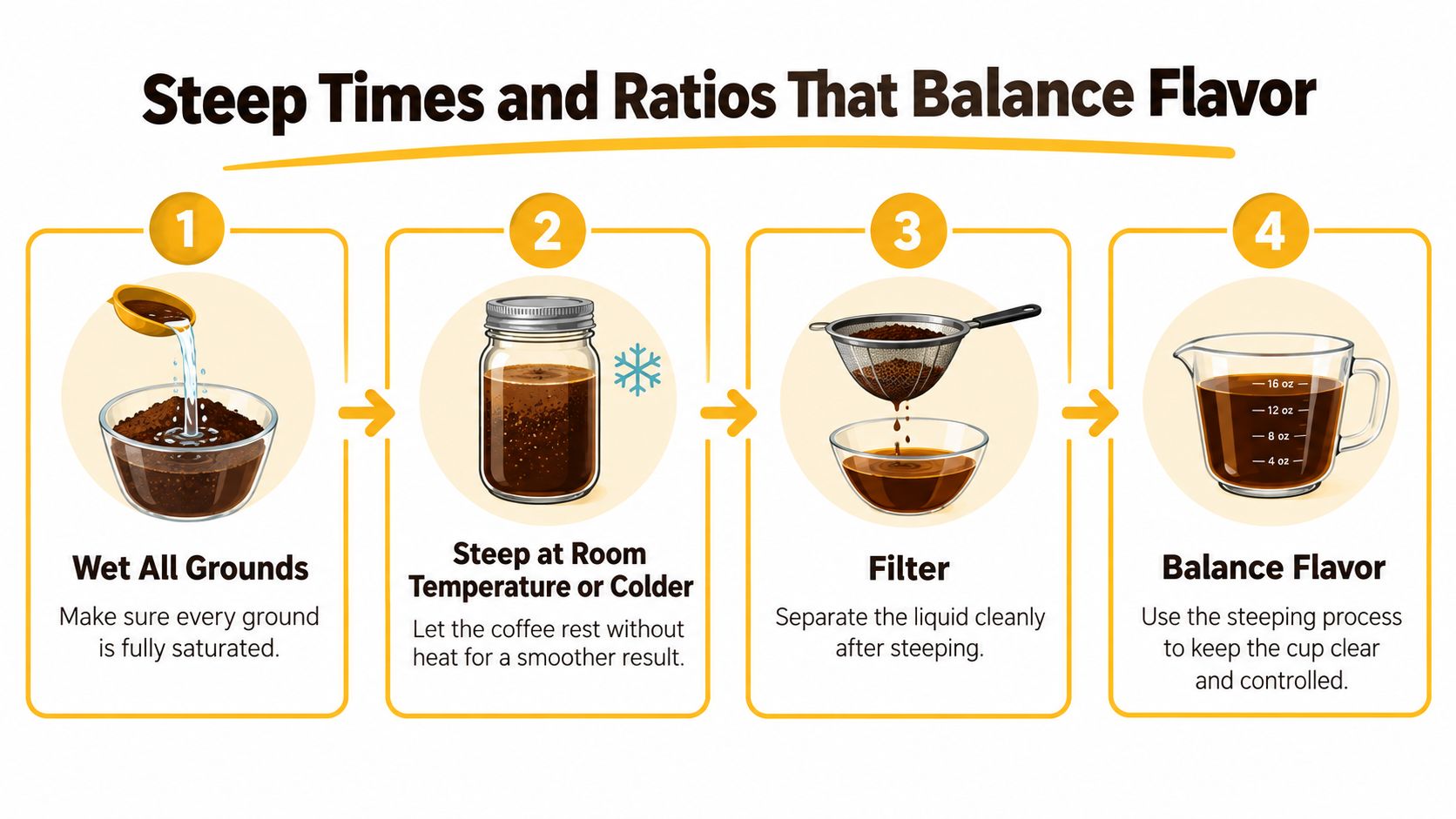
The workflow is simple, but the order matters. Weigh your coffee and water, pour slowly so every ground gets saturated, and stir gently if dry pockets remain on top. Dry grounds don't extract evenly, and you'll taste that unevenness later as a cup that's both weak and rough.
Once everything's wet, cover the vessel and steep at room temperature or colder. If you're checking guidance on timing windows, this overview of how long to steep cold brew is a useful companion while you test your own endpoint. When the steep ends, filter thoroughly before you dilute or store anything.
The Window That Actually Works
For a concentrate, control the brew around 14 to 22 hours at room temperature or colder. In research on Colombian specialty coffees comparing grind and extraction time, coarse grinding with a 14-hour extraction gave the strongest sensory scores, while 22 hours produced the highest total dissolved solids. The same body of research notes caffeine approached equilibrium at roughly 400 minutes, so extending the steep far beyond that point adds little caffeine.
That's the trade-off most guides skip. Longer isn't automatically stronger in the way people mean it. A longer steep can raise dissolved solids and acidity, which may add body, but it can also make an unsweetened cup taste heavier, sharper, and less clean.
Practical rule: Choose your endpoint for sensory balance, not for caffeine maximization.
Ratios Decide What Steeping Can Do
Time works on whatever ratio you've set. More coffee relative to water gives you a concentrate that needs deliberate dilution. Less coffee gives you something closer to ready to drink strength, with less room to adjust later. Neither approach is wrong, but confusing the two is where batches go sideways.
Use this sequence and write down what you did:
- Weigh both inputs: Record coffee dose and water volume before you start.
- Saturate fully: Pour in stages and confirm there are no dry clumps.
- Steep under temperature control: Keep the vessel covered and out of heat.
- Filter cleanly: Remove grounds and fine sediment before tasting.
- Taste before and after dilution: Judge the concentrate and the finished drink separately.
When a batch tastes dull, I don't first add more hours. I check whether the ratio was too lean, whether the grounds were fully wet, and whether I diluted past the flavor. Those fixes teach you more than blindly stretching every steep overnight and hoping strength solves balance.
Dilution and Measuring Strength at Home
Many home batches don't fail during steeping. They fail at the dilution stage, when a decent concentrate gets eyeballed into a glass and turns either watery or punishingly intense. If you want unsweetened cold brew you can repeat, measurement earns its place.
Cold brewing generally produces a lower strength extract at equilibrium than hot brewing unless your recipe compensates through dose, time, or dilution strategy. In a controlled full immersion comparison of cold, room temperature, and hot brews, average TDS was 3.76% for cold brews, versus 3.98% at room temperature and 4.27% for hot brews. That comparison also includes a published low temperature benchmark using 15 g of coffee in 240 mL of water at 5°C for 16 hours.
TDS Gives You a Number to Repeat
Total dissolved solids, or TDS, tells you how much coffee material is dissolved in the liquid. It doesn't tell you whether you'll love the flavor, but it tells you whether today's batch matches the strength of the one you liked. That's far more useful than relying on taste alone when your palate, ice melt, and serving temperature keep changing.
A calibrated refractometer lets you check the concentrate and the diluted drink as separate products. Define a target TDS for the finished cup, note your beverage to coffee ratio, and verify each batch the same way. This guide on how to make coffee concentrate fits well here if you're building a concentrate first routine.
| Check | What to record | Why it matters |
|---|---|---|
| Concentrate TDS | Reading after filtering | Shows whether the batch itself is consistent |
| Dilution | Water added per serving | Lets you recreate the finished strength |
| Filtration loss | Liquid retained by grounds and filter | Explains why yield changes between batches |
| Serving size | Final volume in the glass | Keeps caffeine and flavor comparisons honest |
A Practical Way to Dilute
Start from your benchmark, dilute a small sample, and taste it at serving temperature over ice. If it's muted, reduce the added water next time rather than extending the next steep without evidence. If it's bitter and heavy, add water in small steps and note where the flavor opens up.
Account for filtration loss too. Grounds and filters hold liquid, so the water you poured in isn't the yield you'll drink. Recording both numbers stops you from chasing phantom ratio changes.
Clean equipment and controlled refrigeration still matter during this stage. Cold extraction isn't automatically safer just because it's cold, and a measured batch stored carelessly is still a careless batch. Measure strength, then protect the result with hygienic handling.
Flavor Notes, Smoothness Tips, and Ways to Use It
Smoothness in unsweetened cold brew doesn't come from hiding the coffee. It comes from balance, where sweetness, acidity, and bitterness are present but none of them shouts. Depending on the beans and roast, you might notice chocolate, nutty, or fruity notes, and those impressions shift as dilution and temperature change.
Roast level has the largest effect on profile, while longer brew time has comparatively subtler effects once extraction levels off. That's why swapping beans can transform the cup more than adding a few extra hours. If a batch tastes flat, the problem may be the roast, not your patience.
The glass below shows the kind of simple serve that helps you judge flavor before you start mixing.

Make It Feel Smooth Without Sweetener
Start with dilution. A small splash of cold water can soften a concentrate that tastes dense or bitter, and serving over a larger ice cube slows melting so the last sip doesn't collapse into watery coffee. Good, fresh ice matters more than people admit, since old freezer ice can drag stale flavors into a clean batch.
Temperature changes perception too. A cup that seems harsh straight from concentrate may taste rounder once it's properly diluted and fully chilled. If you're sensitive to sharpness, this explanation of ways coffee can taste less acidic can help you separate acidity from bitterness when you're troubleshooting.
- Adjust water before additives: Dilution is the cleanest smoothness lever you have.
- Use larger ice for slow sipping: It keeps strength steadier in the glass.
- Taste black first: You can't fix a batch if milk or syrup hides the fault.
The video below is useful for a visual check on serving and presentation before you adapt the drink to your own routine.
Ways to Use a Black Batch
At a campsite, serve it straight over ice for a quick, cold pick me up that doesn't need a stove. In an office fridge, keep concentrate portioned so you can build an iced latte with milk or a non-dairy alternative without sweetening the whole jar. At home on a hot evening, use it as a mocktail base with citrus or herbal syrup, knowing the coffee underneath stays unsweetened until you decide otherwise.
Each use asks something different from the batch. A black serve needs the cleanest balance, a latte can handle a bolder concentrate, and a mocktail benefits from brighter notes that won't disappear behind citrus. Brew for the drink you plan to make, not for an abstract idea of strength.
Storing Your Batch and Deciding When Instant Makes Sense
A good batch can be ruined by lazy storage. Transfer filtered concentrate into a clean, sealed container, refrigerate it promptly, and keep the main jar closed as much as possible. Repeatedly opening one large container, pouring from it all week, and returning it to the fridge invites stale flavors and contamination.
Portioning solves most of that. Split the batch into smaller sealed jars, label each with the brew date and approximate strength, and open one at a time. You'll know which portion came from which steep, and you won't have to guess whether a flat glass reflects the recipe or old storage.
Labels Are Part of the Recipe
Write down the bean, grind setting, ratio, steep length, and dilution that worked. That sounds fussy until you make a batch you love and can't recreate it. A short label turns unsweetened cold brew from a lucky accident into a house method.
If you didn't label the strength, you're not storing a recipe. You're storing a mystery.
Keep your containers, funnels, and filters clean, and don't store concentrate in the brewing vessel with grounds still sitting in it. Once you've filtered, the job is protection, cold, sealed, and portioned.
Homemade Control Versus Convenient Backup
Homemade cold brew gives you control, but it demands planning. You need beans ground, a steep started ahead of time, fridge space, and a filtering step before anyone drinks. That rhythm works beautifully when you plan it, and poorly on the morning you forgot.
That's where instant makes sense as a backup, not a confession of failure. Cartograph Coffee is a small business offering organic instant coffee designed for quality on the go, whether you're at work, camping, or at home between batches. It won't replace the learning you get from dialing in your own jar, but it can cover travel days and busy mornings while your next steep is still hours away.
Use homemade batches when you want control and repetition. Use a convenient option when time, travel, or campsite logistics make brewing unrealistic. The honest choice is the one that keeps you drinking coffee you enjoy, without pretending every day allows a full production schedule.
Your next batch deserves a reliable backup for the days when steeping, filtering, and chilling just don't fit. Cartograph Coffee offers organic instant coffee built for quality and convenience at work, at home, or outdoors, so you can keep experimenting with unsweetened cold brew without missing a good cup. Explore the range at Cartograph Coffee and stock a fast option beside your home brewing setup.