You're standing in a hotel room, or maybe at a trailhead, and the coffee setup is laughably small. There's a kettle, maybe a paper cup, and not much else. That's where organic coffee packets stop feeling like a compromise and start feeling like the practical answer, because they travel well, brew fast, and still let you choose organic without hauling a full coffee kit.
That convenience has moved from niche to mainstream. One recent industry estimate puts the global organic coffee market at USD 10.32 billion in 2024, rising to USD 20.54 billion by 2033 at a 7.95% CAGR, with North America holding 51.8% of the market and stand-up pouches leading packaging formats (Straits Research). In other words, portable organic coffee isn't a fringe habit anymore. It sits inside a large, still-growing market that's clearly being shaped by busy routines, travel, and the desire for better single-serve options.
Why Organic Coffee Packets Are Everywhere Now
A commuter grabs a packet before the train. A camper drops three into a dry bag. A parent keeps one at the office for the afternoon reset. Those are small moments, but they explain why organic coffee packets keep showing up in grocery aisles, outdoor stores, and subscription boxes.
The packet format solves the same problem in all three settings. People want coffee that's fast, predictable, and easy to carry, but they also want the label to mean something. Organic coffee fits that request because the market behind it is no longer tiny, and the packaging has adapted to convenience without abandoning the category's organic positioning. The market data matters here because a format usually becomes visible only after buyers are already asking for it, and the size of the organic coffee market shows that the demand has matured (Straits Research).
Convenience changed the category
Coffee used to be sorted mainly by roast, origin, or grind. Now format matters just as much. Packets sit in the sweet spot between “I want better than gas-station coffee” and “I don't have time to grind beans at 6 a.m.”
That shift also explains why packaging design gets so much attention. The leading format in the market estimate is stand-up pouches, which tells you buyers are already comfortable with portable, portioned coffee formats (Straits Research). Packets are a close cousin of that logic. They're made for speed, storage, and low-friction use.
Practical rule: if a coffee format is easier to carry than to explain, it's probably built for a convenience-first buyer.
For many people, that's not a downgrade. It's the point. The modern organic coffee shopper often wants a cup that fits into a commute, a camping trip, or a hotel stay without demanding a grinder, scale, or French press.
What Organic Coffee Packets Actually Are
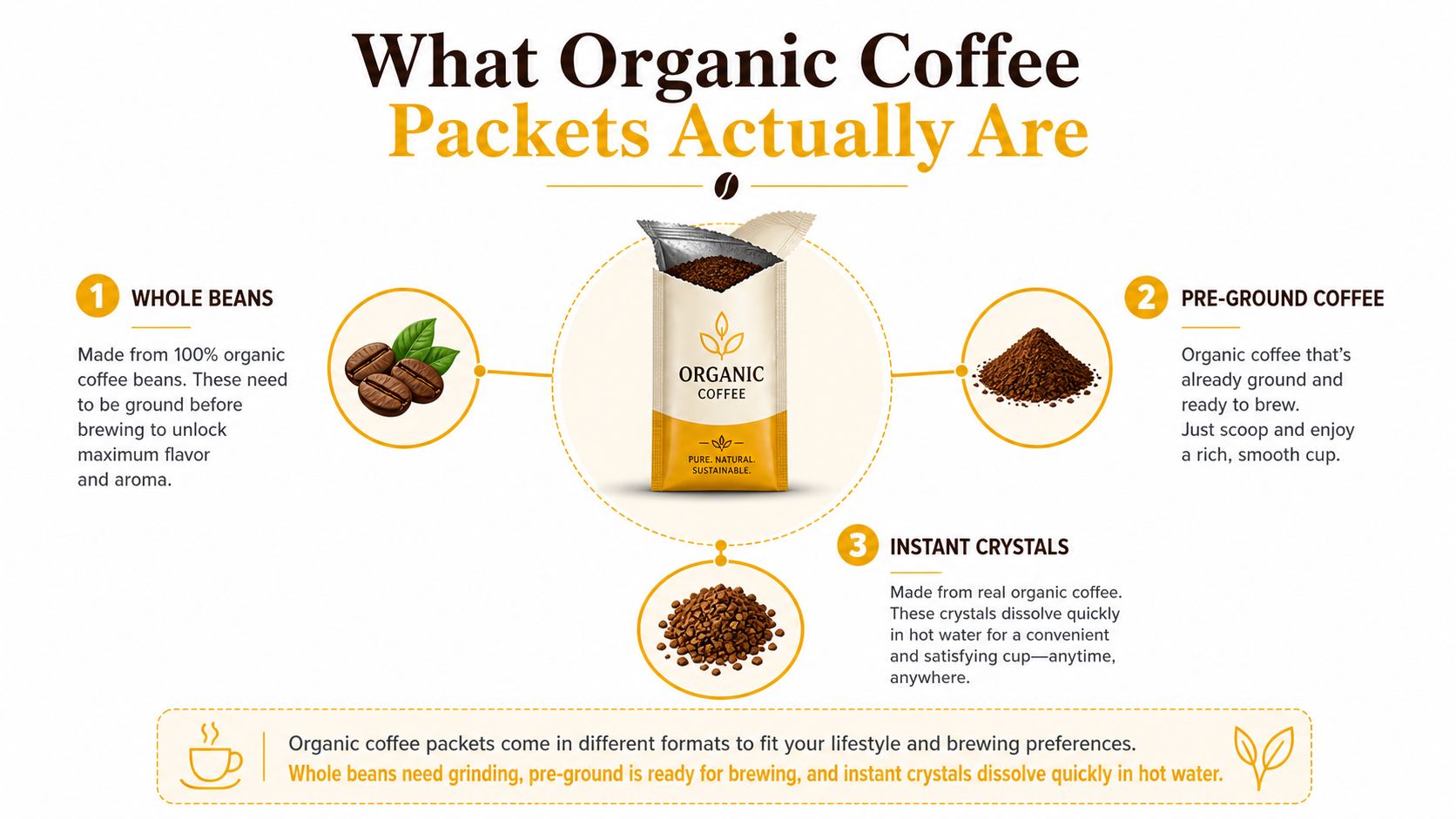
An organic coffee packet is a pre-portioned coffee format sold in a sealed packet, with organic sourcing attached to the coffee itself. The packet can hold soluble instant coffee, a single-serve freshpack, or another tightly controlled portion. What makes it a packet isn't the label. It's the combination of sealed packaging, portion control, and a coffee form that's ready to use with little or no equipment.
The packet is only half the product
The coffee inside can still vary a lot. A packet may contain whole beans for later grinding, pre-ground coffee for a brewer, or soluble coffee that dissolves directly in hot water. Those are very different experiences, even if they all travel in small packaging.
The difference is how the format behaves after opening. Industry packaging references for organic coffee bags emphasize high-barrier laminates or coatings, plus resealable zippers and heat seals, because instant and soluble coffee quality is affected by particle hygroscopicity and aroma loss after opening (Organic BioPack). That's a technical way of saying the packet has to protect what's inside, or the coffee starts losing the qualities people paid for.
Why the packaging matters so much
Packets are about containment as much as convenience. If moisture gets in, soluble coffee can clump. If oxygen gets in, aroma fades. If the dose is inconsistent, the cup changes from one packet to the next.
USDA soluble-coffee grading guidance says soluble coffee should be free flowing and free from lumps that don't compress with light pressure, which matters for both filling and dissolving performance (USDA AMS). That's one reason packet coffee is more than “coffee in a tiny bag.” It's a shelf-stable system, and every part of that system has to cooperate.
Reading the Labels on Organic Coffee Packets
A packet can look tidy and minimal while still telling you very little. That is why label reading matters. The common mistake is to assume organic covers every concern at once, from how the coffee was grown to whether the final product was independently checked for residue, or whether the brand's labor claims hold up.
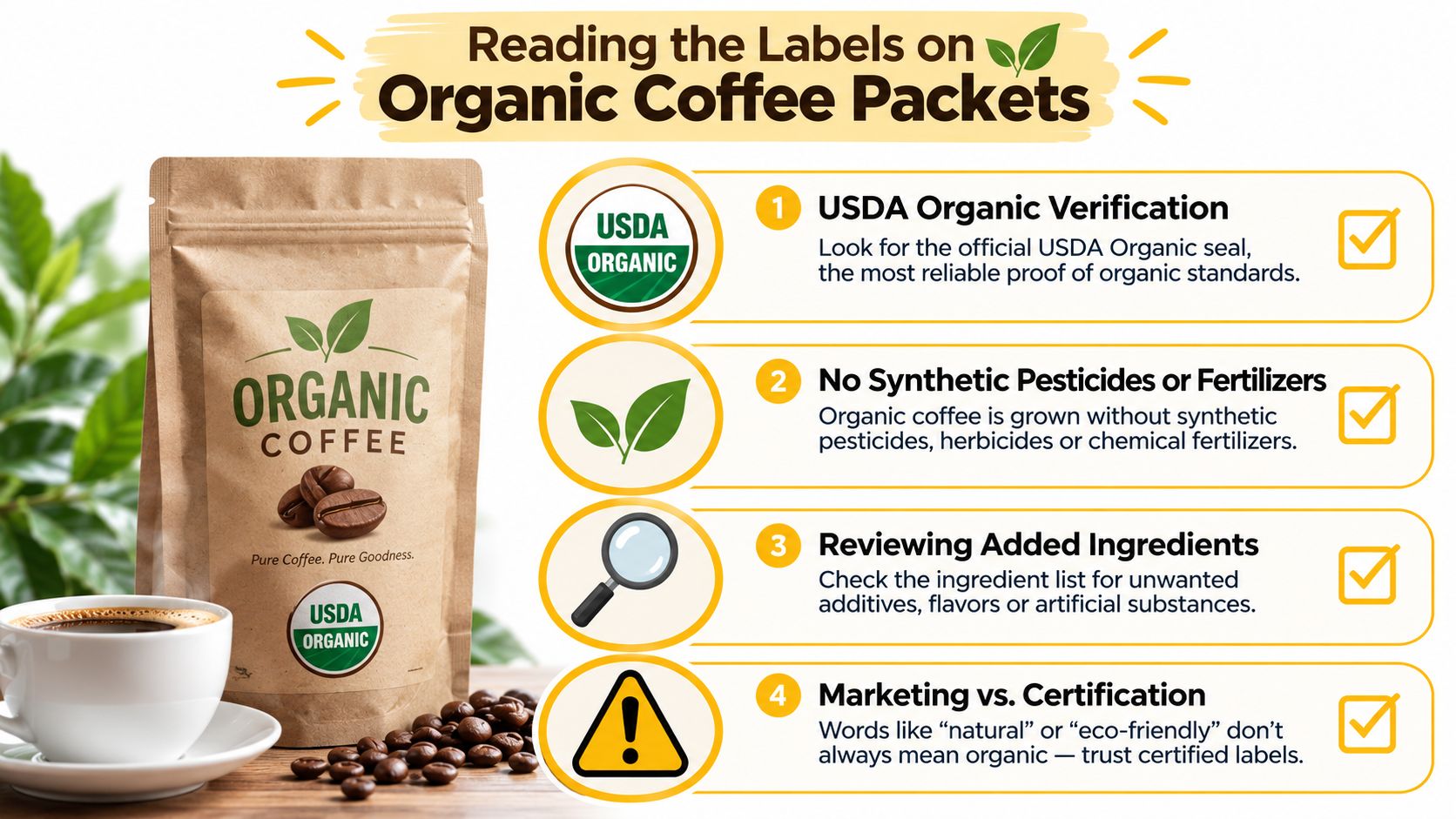
USDA Organic helps, but it has a clear boundary. It addresses how the coffee was grown and handled under organic rules, not every wider promise a brand may suggest on the front of the pack. A seal gives you more useful information than a packet that leans on words like “natural” or “clean” without showing what was verified.
What to check first
Start with the certification mark. A real seal is easier to trust than a polished phrase on the front panel. After that, read the ingredient list. A packet with one ingredient is easier to evaluate than a blend that includes flavoring, sweeteners, or added powders.
For soluble coffee, the physical texture matters too. USDA soluble-coffee guidance says the product should be free flowing and free from lumps that do not compress with light pressure (USDA AMS). In practice, that gives you a clue about fill quality and how the coffee may dissolve. If the contents clump before you even open the packet, the barrier or storage conditions may not be protecting the coffee well enough.
Testing claims can also be easier to judge when you know what kind of check a brand is talking about. A plain seal and an internal promise are not the same thing, and Fillaree explains third party testing in a way that helps separate those two ideas. That distinction matters if you are trying to sort out what was independently verified and what was stated on the package.
Read the claim, not just the design
A packet can be visually restrained and still be vague. Look at the wording closely. If a brand says “organic” and stops there, that tells you less than a packet that names the certification, lists the ingredients, and identifies whether the coffee is single-origin, blended, or instant.
Cartograph Coffee's discussion of certified organic coffee is a useful example of how a brand can explain the category in plain terms: organic certified coffee. That kind of explanation is helpful because it focuses on what the label communicates, instead of relying on design to do the work.
What you want is a packet that answers a few simple questions quickly. Is it really certified. What is inside. What form is the coffee in. Those answers tell you more about cup quality, honesty, and usefulness than a bag covered in broad wellness language.
Packets vs Beans vs Grounds vs Instant
A coffee packet sits at the intersection of three things people care about, flavor, effort, and what happens to the coffee after it leaves the roaster. Whole beans still give you the widest flavor range because you control the grind right before brewing. Pre-ground coffee removes that step. Traditional instant removes even more work. Organic coffee packets try to sit between those options by keeping the serving portioned while staying easier to carry and use.
| Format | Convenience | Flavor Potential | Freshness Window | Typical Cost Per Cup |
|---|---|---|---|---|
| Whole Bean | Low to medium | Highest when ground fresh | Shorter once opened and ground | Usually more variable |
| Pre-Ground | Medium | Good, but less vivid than fresh-ground | Moderate | Usually moderate |
| Traditional Instant | Very high | Depends on processing | Stable if sealed well | Usually lower to moderate |
| Organic Coffee Packets | Very high | Good for the format, strongest with quality packaging | Depends heavily on barrier integrity | Usually moderate |
The table shows the basic trade-off. Beans can offer the richest aroma, but they ask for a grinder and a little more time. Grounds are simpler, though they lose freshness faster once opened. Instant is the fastest path to a cup, but flavor depends heavily on how the coffee was processed. Packets do not change those rules, they just package the decision for you in a single serving.
Where packets win, and where they don't
Packets make sense in a hotel room, an office kitchen, a backpack, or any place where you want coffee without setting up a whole brew station. They also help with dose uniformity. If a packet contains a measured serving, the cup is less likely to swing because someone scooped a little too much or too little from a jar. That predictability matters more than people expect, especially for newcomers who are still figuring out how much coffee they like.
The trade-off is freshness and protection. A packet only behaves well if the barrier material holds up, and if the coffee inside is stored with care before it reaches you. Once the seal is broken, the clock starts ticking. That is why package design, oxygen exposure, and shelf handling matter so much to cup quality, even when the coffee itself is organic.
If you want a practical explanation of how the category is framed, Cartograph Coffee's article on instant coffee packets gives a clear look at convenience without pretending packets are the same as beans. It is a useful way to separate the promise on the label from the realities of storage, portioning, and brew consistency.
Packets are useful for a specific kind of coffee drinker. They help when speed, portability, and repeatable dosing matter more than grinding beans or building a ritual around the cup.
How to Brew Organic Coffee Packets for the Best Flavor
Most packet coffee goes wrong for one reason. The water is too hot. Boiling water can flatten aromatics and push a harsh note into a cup that should taste cleaner and rounder. You don't need fancy gear to avoid that, just a little restraint.
Start with water, not just the packet
Use hot water, not a rolling boil. Stir long enough to fully dissolve the coffee, then taste before adding more. A packet is already portioned, so your main job is to keep extraction even instead of overpowering the cup.
If you use milk, add it after the coffee has dissolved. If you like fat in the cup, it can soften the perception of bitterness, but it won't fix a poorly brewed packet. The coffee still has to dissolve cleanly first. That's why the USDA's free-flowing benchmark matters so much in soluble coffee, because clumps make the cup less predictable (USDA AMS).
A packet should disappear into the water, not sit there like a powdery surprise.
Adjust for iced and outdoor brewing
For iced coffee, dissolve the packet in a smaller amount of hot water first, then pour over ice. That helps the coffee fully open before the temperature drops. If you're camping or traveling and your water source has a strong mineral or chlorine note, the coffee can taste off even if the packet itself is good, and understanding post-filtration chlorine taste is a useful reminder that water quality can shape flavor as much as the coffee does.
Here's the simplest method.
- Heat water until it's hot but not boiling, because harsh water can flatten the aroma.
- Open one packet at a time, so the powder stays dry.
- Add a small splash first, stir until smooth, then top up to taste.
- Taste before adding milk or sweetener, so you know what the packet delivers.
That small routine gets you closer to what the product was designed to do.
What Organic Really Means for Your Health and the Planet
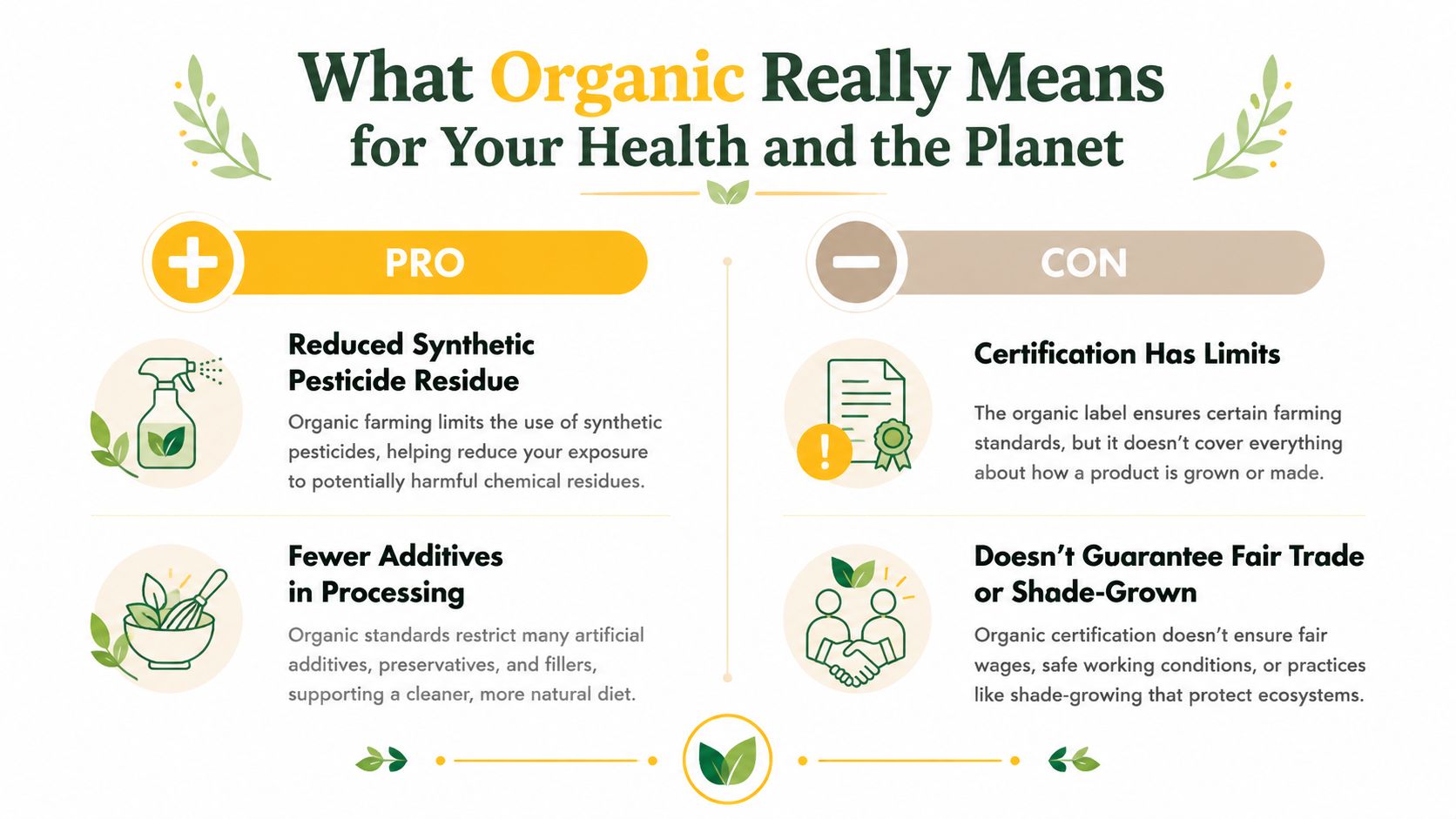
Organic is a useful label, but it isn't a magic word. It tells you something important about how the crop was grown, yet it doesn't automatically settle every question people ask about cleanliness, residues, farm ethics, or climate impact.
A consumer-lab report found that 100% of the organic coffees tested contained AMPA, the main breakdown product of glyphosate, which complicates the assumption that organic always means zero chemical residue (Clean Label Project). That doesn't erase the value of organic sourcing. It just means the label is not the same thing as absolute absence of every contaminant people worry about.
Health claims need a narrow reading
The clearest consumer benefit of organic coffee is about farming practice, not perfection. If you buy organic packets, you're choosing a supply chain that follows organic rules rather than a promise that every possible residue is gone.
That distinction matters because shoppers often bundle several ideas into one word. They may mean “less processed,” “cleaner,” “safer,” or “better for the planet.” Those are different claims. Organic supports some of them, but not all of them in the same way.
A broader view also matters for the planet. Recent sustainability research in coffee keeps circling back to agroforestry, certification governance, and climate resilience, which suggests that certification alone doesn't tell the whole story of environmental value. If you're comparing outdoor-friendly products and care about the wider footprint of what you carry, Eco Friendly Camping Gear is a helpful adjacent read because it uses the same kind of question, what does “eco-friendly” cover, and what doesn't it cover?
The farmer question is part of the label
The hardest part of the organic conversation is that consumer good intentions don't guarantee fair outcomes at origin. Sustainability claims are stronger when they include transparent producer pricing, wage disclosure, and living-income commitments, not just a badge on the front of the packet. That's the level of honesty shoppers should expect when they buy a convenience product and want it to reflect more than convenience.
The best organic packet is one that combines certification with sourcing transparency. Anything less is just a nicer-looking shortcut.
Storage and Travel Tips That Actually Matter
Packets stay good because the packaging does most of the work. The more exposure they get to heat, humidity, and air, the more likely the coffee is to lose aroma or clump. That's why the details of storage matter more than whether the packet looks sturdy.
Keep unopened packets in a cool, dry place. After opening a multi-pack, seal the outer pouch tightly if it has a zipper, or move the rest into another dry barrier container. If you're packing for travel, don't leave packets loose in a humid bag for days on end, because the coffee inside is still vulnerable even when the outside wrapper looks fine.
Make the packet do its job
Barrier packaging, resealing, and humidity control do the heavy lifting. That aligns with the packaging guidance already discussed, which emphasizes high-barrier materials and tight portioning for soluble coffee quality (Organic BioPack). The same logic applies whether the packet lives in a desk drawer or a backpack.
If you're buying packets for regular use, it helps to think like a packer, not just a drinker. The moment you open a pouch, you've started the countdown on aroma retention.
Cartograph Coffee's discussion of instant coffee packaging is a useful reference if you want to see how packaging choices affect shelf stability in a single-serve format.
Storage rule: dry air beats fancy storage jars. If the packet can't stay sealed, the coffee won't stay as fresh.
For travel, the safest approach is simple. Carry only what you'll use soon, keep the packets away from direct sun, and avoid repeated opening and closing of the same outer bag. The packet format gives you convenience, but it still depends on basic discipline to hold quality.
Buying Checklist and Common Questions
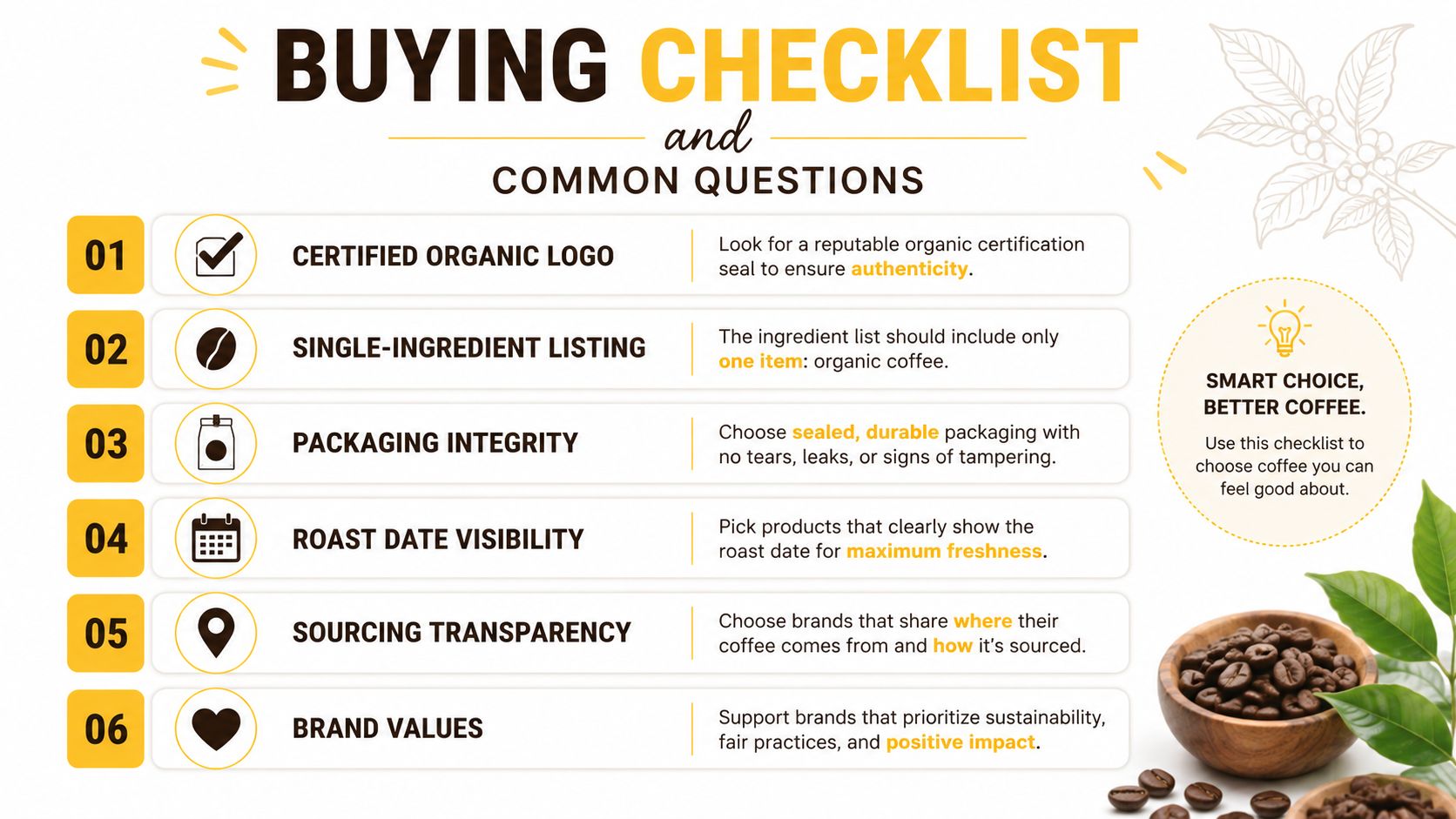
A packet should tell you what is inside without making you work for it. Check for a real organic certification mark, a single-ingredient list if that is the format you want, intact packaging, and enough sourcing detail to identify where the coffee came from. If the brand leans heavily on wellness language but stays vague about the coffee itself, that usually means the packet is selling the idea of quality more than the coffee.
Organic coffee has also been part of international trade for a long time, so the format did not appear out of nowhere. International Coffee Organization data show that in 2004, total exports of coffee labeled “organic” reached 596,389 bags, with 99.7% in green coffee form and Arabica accounting for 99.5% of organic exports that year (ICO). That earlier supply chain helped make the raw material behind today's packet formats more familiar to roasters and buyers.
The clip below can help if you want to see how single-serve coffee is discussed in practice.
Quick answers
Does organic instant coffee have less caffeine? No. Organic refers to how the coffee was grown and handled, not to whether the caffeine level changes.
Can I use packets for pour-over? Only if the packet contains pre-ground coffee. Instant coffee dissolves, while ground coffee still needs a brew method with water flow and a filter.
Can kids drink it? The organic label does not change the caffeine question. The issue is whether caffeine is appropriate for the child.
What should I buy first if I'm new? Start with a packet that lists one ingredient, closes well, and gives clear brewing directions. That combination gives you the cleanest read on quality and helps you spot whether the brand has paid attention to the details that matter.
If you want a straightforward place to start, choose a packet that treats convenience as a format choice, not as a reason to hide the coffee. Cartograph Coffee makes Organic Freeze-Dried Instant Coffee Packets for people who want a single-serve option for travel, work, or camping, and you can browse the current selection at Cartograph Coffee.