Most advice on low acid instant coffee brands starts with a list of jars. That's the wrong place to start. “Low acid” has no clear government definition, companies use the phrase inconsistently, and a higher pH in one test doesn't automatically mean a gentler experience for every drinker. Independent consumer guidance on low-acid coffee recommends asking brands to verify their claims rather than treating the label as proof.
Buy the claim, not the slogan. Look for the measurement, the coffee's origin and process, and enough flavor information to judge whether you'll finish the jar. The best choice isn't necessarily the product with the boldest low-acid language. It's the one whose method matches your sensitivity, taste, and routine.
| What to check | Why it matters | My buying verdict |
|---|---|---|
| Published pH | Shows free hydrogen-ion acidity, but not total acid content | Useful only with test conditions |
| Titratable acidity | Better reflects the total acid load and perceived sourness | Stronger evidence when disclosed |
| Bean origin | Can influence acid content and flavor | A clue, not proof |
| Processing method | Affects extraction, granule structure, and cup character | Freeze-dried products deserve closer inspection |
| Roast level | Darker roasting usually softens perceived brightness | Effective, but can flatten flavor |
| Independent verification | Separates measured performance from marketing | The most valuable claim on the label |
What Low Acid Instant Coffee Actually Means
Low-acid instant coffee isn't a fixed product category with one agreed formula. It's a broad marketing umbrella that can include lower-acid beans, darker roasting, processing treatments, blends, or decaffeinated coffee. Two jars can use the same phrase while delivering different chemistry and very different cups.
The starting point is modest. Independent health and coffee sources commonly place instant coffee near pH 5.13, while low-acid coffee is often cited around pH 5.7 to 6.0, according to a review of coffee acidity and pH. That difference may matter to a sensitive drinker, but it doesn't turn coffee into an acid-free beverage.
My rule: “Low acid” should describe a measured direction, not promise a medical outcome.
Perceived acidity isn't the whole story
Drinkers usually call a cup acidic when it tastes bright, citrusy, sharp, or sour. Those sensations don't perfectly match the stomach response. Coffee chemistry involves several acid compounds, including chlorogenic-acid-related compounds, and the cup's roast and concentration change how those compounds present themselves.
That creates an important distinction. A dark instant coffee may taste smoother because roasting suppresses brightness, while another product may use a process intended to reduce specific acid compounds. A coffee that feels gentle on the tongue still might not suit someone with reflux. Anyone managing persistent reflux or digestive symptoms should treat coffee tolerance as personal rather than assume a label guarantees relief. Cartograph's own educational discussion of the topic is available in its guide to low-acid coffee for acid reflux.
Instant coffee adds more variables
Instant coffee begins as brewed coffee that has been dried into soluble granules. Freeze-drying and spray-drying create different structures, and those structures affect aroma retention, dissolution, mouthfeel, and the way concentration builds in the cup.
The commercial history explains why convenience formats now support distinct specialty positioning. The earliest documented instant-coffee version appeared in Britain in 1771, the first American product followed in 1853, and Satori Kato developed the first successful stable powdered product in Japan in 1901. George Constant Washington later created the first commercially successful instant process, marketed as Red E Coffee. The historical record shows that instant coffee has never been a temporary novelty. Low-acid instant coffee is a refinement of an established format, not a separate species of drink.
How Acidity Gets Measured and Why the Numbers Vary
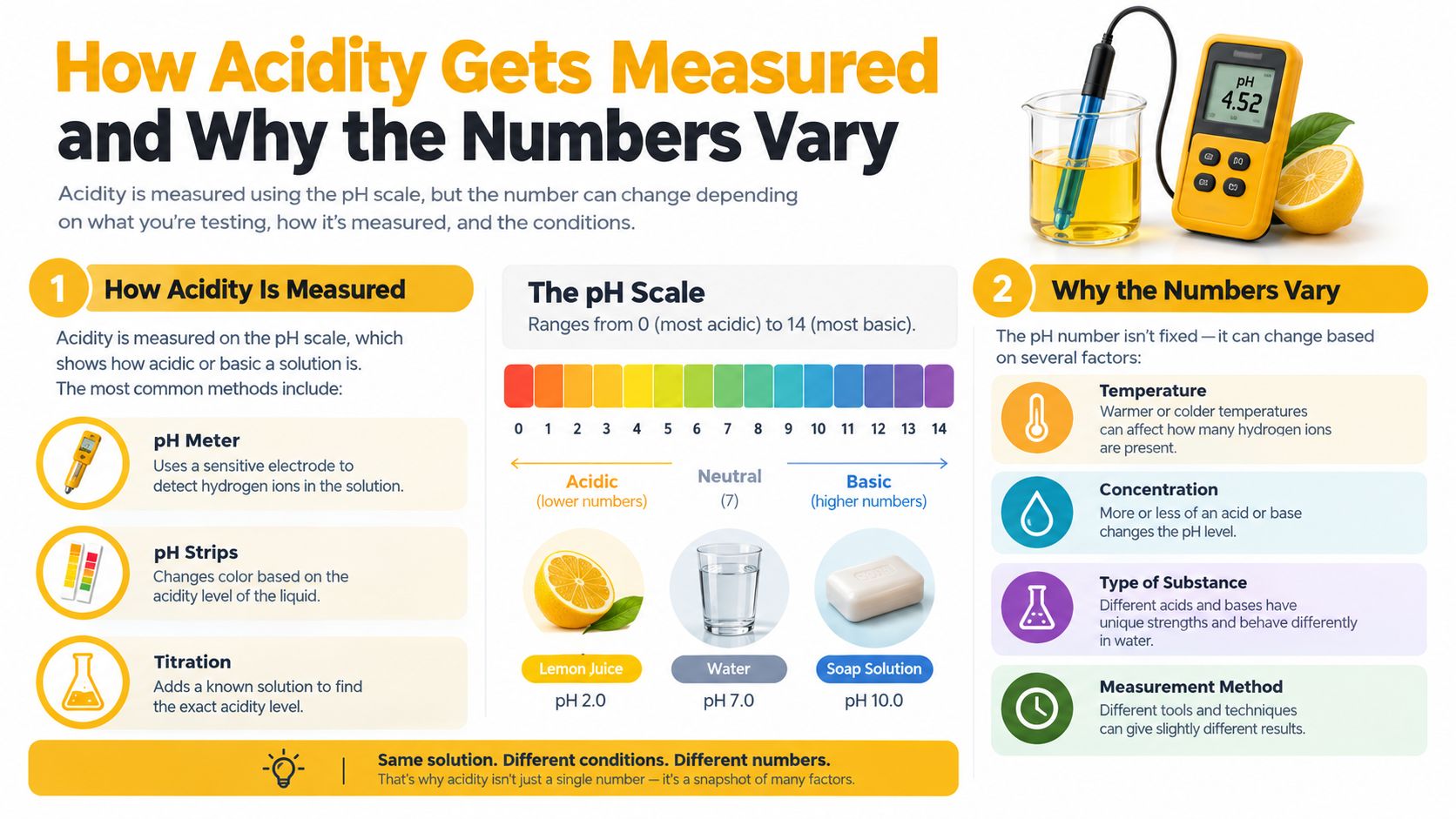
Brands often use the word acidity as if it were one simple measurement. It isn't. Three terms matter most, and each answers a different question.
Start with pH
pH measures hydrogen-ion activity. The scale is logarithmic, so a small numerical movement represents a meaningful chemical difference. Higher pH means lower measured acidity, but pH doesn't tell you how much total acid is present in the beverage.
Fresh instant coffee powder brewed for testing has measured around pH 5.07 ± 0.03, while another study found instant black coffee around pH 5.13 ± 0.02. Instant coffee with milk measured around pH 6.20 ± 0.01 in the same stability research, as reported in this technical study of instant coffee pH and storage. Those values aren't interchangeable because preparation and ingredients differ.
Then ask about titratable acidity
Titratable acidity measures the total acid content that reacts with a neutralizing solution. It usually offers a better picture of total acid load and perceived sourness than pH alone. A brand that publishes only a favorable pH figure may be leaving out the measurement that would make comparison more useful.
Chlorogenic acid data can add context, but it also needs careful interpretation. A technical review reports that acid content varies with bean type and processing, with Arabica-based instant coffees showing greater acid content than Robusta-based products. The coffee chemistry review also connects greater acid content with lower pH and stronger flavor and aroma expression.
Why the same jar can test differently
Water composition, coffee dose, extraction method, milk, storage humidity, and sample age can shift the result. In the stability study cited above, pH stayed broadly stable in recommended dry storage but fell below pH 5 after 180 days at 32% equilibrium relative humidity, with faster degradation at 65% ERH. Packaging isn't a minor detail. Moisture exposure can change the product over its shelf life.
Use this side-by-side checklist:
- Prefer a named independent test over a brand-only figure.
- Ask how the sample was prepared, including dose, water, and temperature.
- Look for titratable acidity if the brand provides it.
- Check whether the number belongs to the instant powder or the prepared drink.
- Treat “at least 50% less acid” as a product claim, not an industry definition, unless the brand explains the comparison.
The practical lesson is simple: a pH number can help, but a lone number isn't a complete buying decision. For a closer look at the production chain behind the granules, read Cartograph's explanation of how instant coffee works.
Comparing the Four Main Low Acid Instant Approaches
Shoppers usually encounter four routes to a smoother, lower-acid profile. They overlap, and the strongest labels often combine more than one. I rank them by how clearly they explain the mechanism, how much flavor they sacrifice, and how easy the claim is to verify.
| Approach | Typical pH Range | Flavor Trade-off | Stomach Sensitivity | Price Tier | Label Transparency |
|---|---|---|---|---|---|
| Low-acid bean selection | Often positioned toward the higher end of common instant ranges, but brands should verify the result | Can retain origin character, though heavier beans may taste earthy | A sensible first test for mild sensitivity | Mid to premium | Moderate if origin and varietal are named |
| Processing-based reduction | Product-specific, with claims ranging from modest reduction to substantially less acid | May produce a smooth, dark, or less distinctive cup | Strong fit when the process is documented | Mid to premium | Varies widely |
| Blended formulation | Depends on the blend and processing | Best chance of balancing body, sweetness, and brightness | Useful for drinkers who need moderation rather than maximum reduction | Budget to premium | Good when percentages and origins are disclosed |
| Decaf paired with another approach | No automatic low-acid advantage, so verify the finished product | Often softer, but decaffeination can reduce some aromatic detail | Useful for caffeine-sensitive routines, not proof of low acidity | Mid to premium | High when the decaf method is named |
Bean selection
This is the cleanest approach for purists. Brands select coffees with naturally gentler profiles, often emphasizing Brazilian, Sumatran, or lower-elevation Robusta inputs. The advantage is a recognizable coffee ingredient rather than a post-roast correction. The weakness is that origin alone doesn't prove pH, and flavor can shift toward nutty, earthy, or heavy.
Processing-based reduction
This route includes steam treatment, extra-dark roasting, and acid-neutralizing treatments applied before drying. It's common in mass-market positioning because a process can be standardized across batches. I'm more interested in a brand that explains the treatment than one that merely says “smooth.”
Extra-dark roasting can lower perceived brightness, but it can also erase the fruit, florals, and finish that make specialty instant worth buying. Chemical or mineral treatments deserve an ingredient and process explanation, especially for buyers avoiding unnecessary additives.
Blends
A blend can be the smartest compromise. A darker Robusta component can supply body and lower perceived brightness, while washed Arabica adds aroma and complexity. This approach suits people who dislike thin, flat low-acid coffee but still want a gentler profile.
Decaf
Decaf is a secondary filter, not an acidity guarantee. Swiss Water or sugarcane decaffeination may alter the acid and flavor profile slightly, but the finished product still needs its own evidence. Choose decaf because you want less caffeine, then evaluate its acidity using the same criteria as regular coffee.
Freeze-dried products are particularly worth comparing by granule structure, aroma, and dissolution. Cartograph's guide explains what freeze-dried coffee is, which helps distinguish format from the separate question of acidity.
Buyer Criteria That Matter Beyond the Label
Treat every jar as a scoring exercise. Don't reward a product merely because “low acid” appears on the front. The useful question is whether the brand gives you enough information to predict the cup and test the claim.
Give the evidence a weight
Published or testable pH comes first. A single figure without preparation details is weak evidence, but it's still more useful than an unsupported adjective. If the brand won't identify the sample, laboratory, or test method, record the claim as unverified.
Origin comes next. Brazilian and Sumatran coffees are frequently positioned as smoother, and Robusta-heavy formulations can show lower acid content than Arabica-based instant coffee. That makes origin and varietal useful clues, not guarantees.
Processing tells you what the brand did. Steam-washed beans, extended roasting, and natural extraction each imply a different trade-off. A clear process explanation earns more confidence than a vague promise of “gentle technology.”
Roast level helps predict perception. Darker coffee usually tastes less bright and more bitter, while medium roasting preserves more origin detail. If your stomach is highly reactive, roast and verified acidity deserve more weight than tasting notes.
Additives need attention. Chicory, fig, flavoring, minerals, and sweeteners can shift the cup's pH or mask sharpness. Read the full ingredient panel rather than treating a smoother taste as proof of lower acid.
Adjust the score to your routine
A person with frequent reflux should prioritize verified pH, roast level, and a transparent process. Someone with mild discomfort may care more about origin, aroma, and whether the product dissolves cleanly during travel.
Reject any jar with these red flags:
- Vague wording: “Low acid” appears without a number or test context.
- Missing origin: The brand won't identify the beans or blend.
- Hidden process: The company won't explain how it turns coffee into instant granules.
- Overpromised health language: The product implies a medical result instead of describing coffee chemistry.
- No batch or storage guidance: Moisture can affect instant coffee stability, so packaging information matters.
Use this embedded coffee preparation video as a practical complement to label evaluation. Preparation won't repair a misleading claim, but it can reveal whether a jar's flavor holds up under controlled use.
Preparing Low Acid Instant Coffee for Better Taste
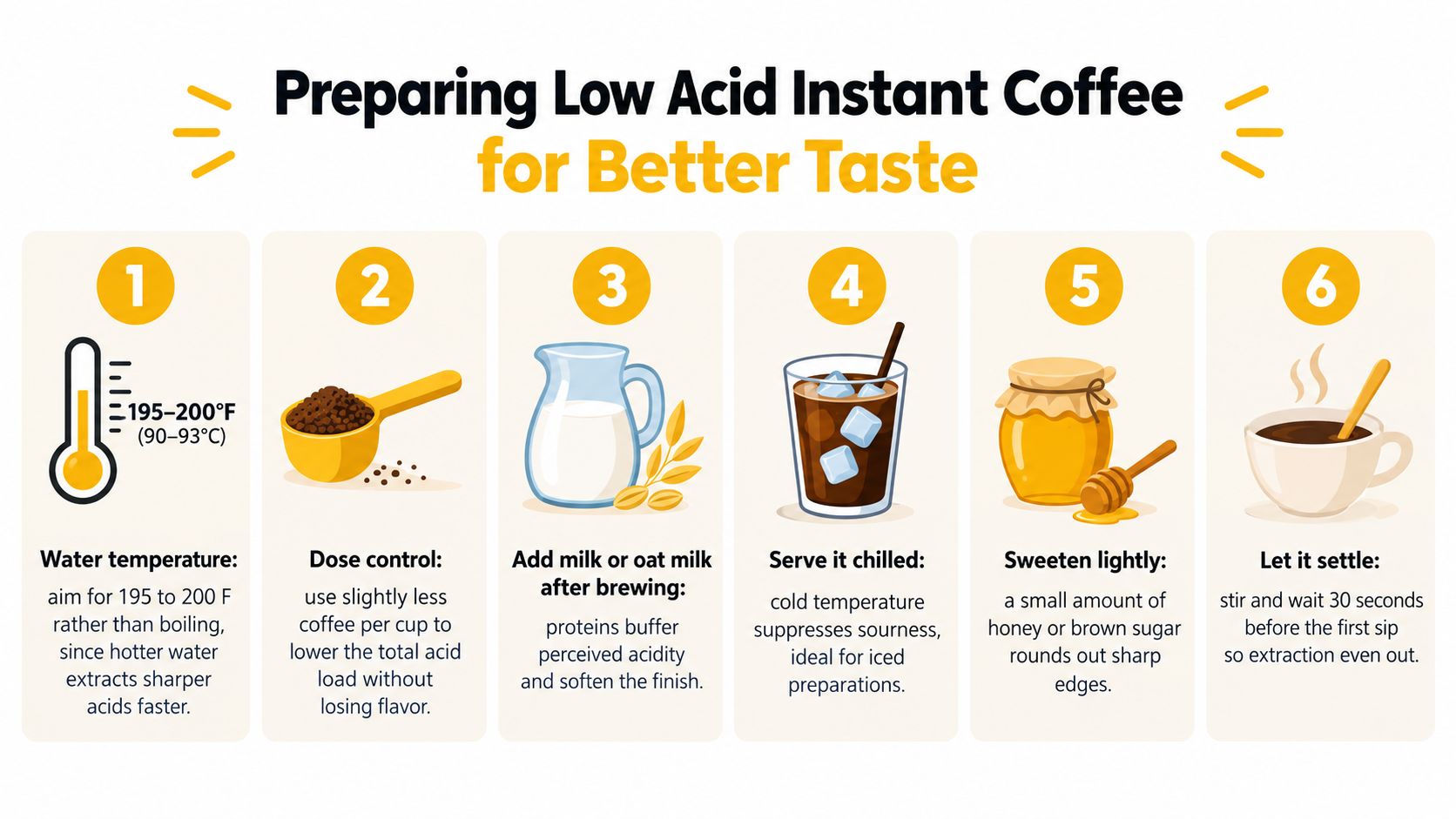
The same jar can taste harsh or rounded depending on how you prepare it. These changes don't necessarily alter the coffee's measured pH, but they can reduce perceived sharpness and prevent bitterness from dominating the cup.
Control heat and concentration
Start with water around 195 to 200°F, rather than freshly boiling water. Excessive heat can make the cup taste more bitter and aggressively extracted. Add the granules to a small amount of cool water first, stir into a smooth paste, then add the hot water. This prevents clumping and reduces the scorched flavor that many people mistake for acidity.
Keep the dose consistent while you test. Use a modest amount of instant coffee for a smaller cup, then adjust gradually. A cup that's too concentrated carries more total coffee compounds, while an under-dosed cup can taste hollow and force you to add sugar or flavorings.
Round the finish without hiding defects
Milk or oat milk can soften the perception of sharpness. Dairy brings fat and protein, while oat milk adds sweetness and body. Add it after the coffee dissolves so you can judge the base cup before changing its texture.
A tiny pinch of salt can mute bitterness, but use less than you think you need. Cinnamon, honey, or brown sugar can round the edges, yet heavy additions only conceal a weak instant coffee. For iced coffee, dissolve the granules in a small amount of warm water before adding cold water and ice. Cold serving suppresses some sour impressions and gives the drink a cleaner finish.
Best test: Taste the coffee plain first, then with milk. If the base cup is unpleasantly sharp, milk is a pairing, not a cure.
Timing matters for comfort. Don't use a low-acid label as permission to drink strong coffee on an empty stomach or late in the day if caffeine disrupts your routine. Test one preparation at a time, keep the dose stable, and judge both flavor and how you feel afterward.
Where Cartograph Coffee Fits in the Low Acid Landscape
Cartograph Coffee occupies the bean-selection and quality-focused side of the category. Its instant coffee is described as organic, freeze-dried, and made from selected low-acid beans, with single-origin Brazilian and Colombian Arabicas and regular and Swiss Water decaf options presented in the product information supplied for this article.
That positioning matters because it avoids claiming that every low-acid product must use the darkest roast or a chemical neutralization step. A medium roast preserves more origin character than a heavy, dark profile, but it also won't chase the lowest possible perceived acidity. Buyers should see that as a deliberate trade-off, not a flaw.
The practical advantage is transparency around origin, organic certification, format, and decaffeination method. The practical limitation is equally clear: if your only goal is the most aggressive acid reduction regardless of flavor, a darker processing-driven product may fit you better. Cartograph is more appropriate for someone who wants a smoother instant cup while retaining recognizable coffee character.
| Approach | Origin / Process | Roast Level | Organic Certified | Best Fit |
|---|---|---|---|---|
| Cartograph Coffee | Brazilian and Colombian Arabicas, freeze-dried, regular and Swiss Water decaf options | Medium | USDA certified organic, according to the supplied product information | Flavor-conscious drinkers seeking a traceable, gentler instant option |
| Bean-selection archetype | Selected lower-acid origins and varietals | Medium to medium-dark | Depends on brand | Purists who want reduction through sourcing |
| Processing-driven archetype | Steam treatment, extended roasting, or other acid-reduction processing | Often dark | Depends on brand | Drinkers prioritizing a heavier, smoother profile |
| Blend archetype | Robusta and Arabica combinations | Medium-dark to dark | Depends on brand | Buyers balancing body, aroma, and comfort |
| Decaf archetype | Decaffeination paired with any acidity strategy | Varies | Depends on brand | Evening drinkers who also need caffeine reduction |
The buying decision is straightforward. Choose Cartograph if organic certification, named origins, freeze-dried convenience, and cleaner flavor matter as much as lower perceived acidity. Don't choose it expecting a medical solution or the lowest pH claim in the category.
Matching Low Acid Instant Coffee to Your Routine
The right low-acid instant coffee depends on how often you drink it, how sensitive you are, and which flavor compromises you can tolerate. A daily drinker needs a repeatable cup. A traveler may care more about dissolution and packet convenience. A late-day drinker needs to consider decaf separately from acidity.
| Reader Profile | Best-Fit Archetype | Why It Works | Trade-off to Expect |
|---|---|---|---|
| Daily drinker with mild sensitivity | Low-acid bean selection | Offers a gentler profile without forcing an aggressively dark cup | Origin doesn't guarantee a measured pH |
| Highly sensitive drinker | Processing-driven reduction with verification | Gives the clearest mechanism for deliberately changing acidity | Darker flavor or process-related trade-offs |
| Traveler or camper | Transparent freeze-dried blend or bean-selection product | Dissolves quickly and can balance convenience with flavor | Portability doesn't prove low acidity |
| Evening coffee drinker | Decaf paired with a low-acid approach | Addresses caffeine timing and acidity as separate questions | Decaf alone isn't evidence of low acid |
| Flavor-first buyer | Arabica-led bean selection or balanced blend | Preserves aroma and origin character | May taste brighter than a dark processed option |
| Heavy-bodied coffee drinker | Robusta-led blend or darker roast | Delivers weight and a smoother perceived finish | Nuance can give way to bitterness |
For most people, I'd start with a transparent bean-selection product, prepare it with controlled heat, and track your response over several cups. Move to a processing-driven option only if the first approach tastes good but still feels uncomfortable. Choose decaf when caffeine is the problem, not because the word “decaf” settles the acidity question.
Cartograph Coffee fits the flavor-conscious, convenience-first profile. Its organic, freeze-dried instant format and stated low-acid bean positioning make it a practical product to evaluate against the framework above, especially for work, travel, camping, or home use.
Cartograph Coffee offers organic freeze-dried instant coffee in convenient single-serve formats, including regular and decaf options built around selected coffee origins. If you want to compare a gentler, traceable instant approach without giving up clean coffee flavor, visit Cartograph Coffee.