Yes, good instant coffee does exist today, and freeze-dried processing is the key reason premium instant can rival brewed coffee on aroma and flavor. The global instant coffee market was estimated at USD 80.2 billion in 2024 and projected to reach USD 110.28 billion by 2030, evidence that instant coffee now includes serious quality tiers, not only cheap convenience products.
Why, then, does “instant coffee” still bring to mind a flat, burnt cup that needs sugar or milk to become drinkable? Much of that skepticism comes from older spray-dried products, where intense heat can strip away delicate aromatic compounds before the coffee reaches your jar.
The modern category looks different. Producers are combining better sourcing, small-batch roasting, freeze-drying, and more transparent product formats. Recent coverage describes an instant coffee renaissance, with premium freeze-dried and micro-ground products narrowing the sensory gap with fresh brew, as reported by The Guardian's coverage of the new instant coffee landscape.
The useful question isn't which brand wins a ranking. It's how the coffee was processed, how much aroma survived, what the label reveals, and whether your brewing habits protect those qualities. This guide will help you judge instant coffee by those signals, taste the difference in your own cup, and choose a format that fits your mornings, office, travels, or camping kit.
Introduction Why Good Instant Coffee Exists Today
Is instant coffee automatically inferior, or have we been judging an entire category by its oldest examples? The answer matters because convenience and quality no longer have to sit at opposite ends of the coffee aisle.
Instant coffee begins as brewed coffee. Manufacturers roast and grind coffee, extract it with water, concentrate the resulting liquid, and remove the water so the coffee can be reconstituted later. The final product isn't ground coffee in a finer form. It's a brewed extract preserved for another moment.
That preservation step explains the historical reputation problem. Earlier mass-market instant coffee often prioritized low cost, long storage, and predictable flavor. Those goals still matter, but premium producers now treat aroma retention, origin, roast character, and clean dissolution as quality targets rather than incidental benefits.
A category with this much scale can support several tiers. One market dataset valued the global instant segment at USD 84,607.9 million in 2025 and projected it to reach USD 127,692.7 million by 2033, while the U.S. market alone was valued at USD 6.26 billion in 2024 in the Grand View Research instant coffee market report. Those figures don't prove that every jar tastes good. They do show that instant coffee has matured into a mainstream format large enough to support process innovation and premium products.
The practical shift: stop asking whether instant coffee is good in the abstract. Ask which instant coffee preserves the qualities you enjoy in brewed coffee.
For a clearer introduction to the category, Cartograph Coffee's explanation of premium instant coffee is a useful starting point. The most important clue is usually printed on the package: freeze-dried. That phrase doesn't guarantee a great cup, but it tells you the manufacturer has chosen a process better suited to protecting volatile aroma than conventional spray-drying.
How Instant Coffee Is Made and Why Method Matters
All instant coffee follows the same broad path. Coffee is roasted, ground, brewed into a concentrated extract, and dried into a soluble product. The drying method determines how much of the original coffee's aromatic personality remains when you add water again.
Spray-drying uses speed and heat
Spray-drying turns concentrated coffee into a fine mist inside a tall chamber filled with hot air. The droplets lose their water quickly and fall as powder. This method is efficient and widely used, but heat can drive off delicate volatile compounds, including some of the aromas you associate with fruit, flowers, toasted nuts, or caramel.
Think of the difference between drying fresh herbs in a hot oven and preserving them gently at low temperature. Both methods remove moisture, but the hotter treatment can leave you with less of the original fragrance. Spray-drying isn't automatically unsafe or undrinkable. It gives the manufacturer less help when the goal is a complex, aromatic cup.
Freeze-drying protects more of the cup
Freeze-drying takes a different route. The concentrated coffee is frozen, broken into granules, and placed under vacuum. Instead of melting into a liquid first, the ice changes directly into vapor through sublimation. Because the process operates at low temperature, it can preserve more of the compounds responsible for aroma.
A review reported that freeze-dried coffee retained about 17 to 20% more low-boiling aromatic compounds and 75% more higher-boiling volatile chemicals than spray-dried soluble coffee, as documented in this peer-reviewed review of instant coffee aroma and processing. A comparative study in the same source found freeze-dried products retained 75.98% and 73.39% of total volatile aroma compounds, compared with 50.11% and 45.13% for spray-dried products at laboratory and industrial scale.
That difference helps explain why two products made from coffee can taste unrelated. One may smell vivid when you open the packet, while another smells mostly roasted, dusty, or faintly burnt. The coffee's origin matters, but the process decides how much of that origin reaches your cup.
Commercial freeze-dried products appeared in the early 1960s. One historical account says Maxwell House launched Maxim in 1963, followed by Nestlé's Nescafé Gold Blend in 1965, both associated with a richer aroma promise. That milestone matters because instant coffee stopped being limited to one low-fidelity format. You can learn more about the production stages in this guide to the instant coffee production process.
What Defines Good Instant Coffee Beyond Convenience
A good instant coffee should make sense in both the packet and the cup. Look for evidence that the producer has protected aroma, disclosed meaningful information, and packaged the granules well enough to survive storage.
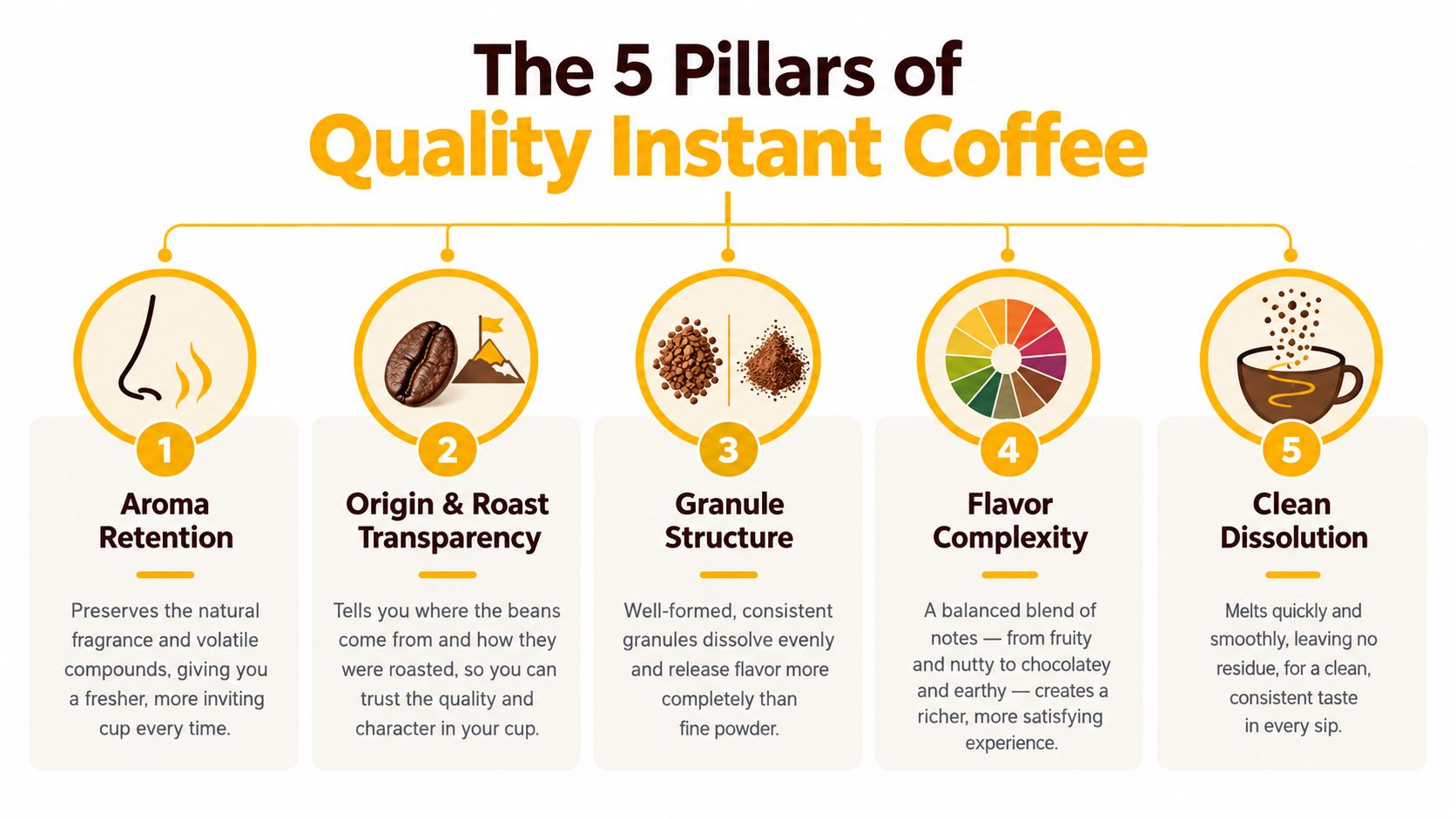
Start with aroma retention
Open the container before adding water. Quality instant coffee should offer a recognizable coffee aroma, not only a sharp burnt smell. You may notice cocoa, toasted grain, dried fruit, nuts, or caramel depending on the roast and coffee used.
Freeze-drying is the strongest first filter because it generally preserves more volatile aroma than spray-drying. It isn't the entire quality story, but it's a useful process signal when the label gives little else away.
Read the label like a taster
Origin and roast information help you form realistic expectations. A product that identifies its country or regional source gives you more context than one that says only “coffee.” Roast descriptions can also guide your choice. Lighter or medium profiles may show more acidity and origin character, while darker profiles tend to emphasize roast, bitterness, and heavier notes.
Transparency doesn't guarantee that you'll love the flavor. It does make the product easier to evaluate and compare.
Examine the granules
Freeze-dried coffee often appears as distinct, irregular crystals rather than an extremely fine, uniform powder. Granule structure affects how the coffee dissolves and how it handles moisture after opening. A product that clumps immediately, leaves stubborn sediment, or dissolves unevenly may have suffered from poor storage or packaging.
Good instant coffee should dissolve cleanly in hot water with gentle stirring. Some micro-ground products intentionally include very fine coffee particles, so a little texture isn't automatically a defect. The key is whether the cup tastes balanced and the product behaves consistently.
Moisture is a quiet quality marker
Moisture and water activity influence caking, shelf stability, and aroma loss. A coffee-science paper reported freeze-dried instant coffees with moisture around 2.1 to 3.0% dry basis and water activity roughly 0.202 to 0.326, while spray-dried samples showed a wider water-activity range of 0.186 to 0.461, according to this coffee research paper on instant coffee properties.
You won't usually find those laboratory measurements on a consumer label. Instead, use practical proxies: choose a product that looks dry, arrives in intact packaging, and closes tightly after opening. Discard coffee that has absorbed moisture, developed hard lumps, or smells stale.
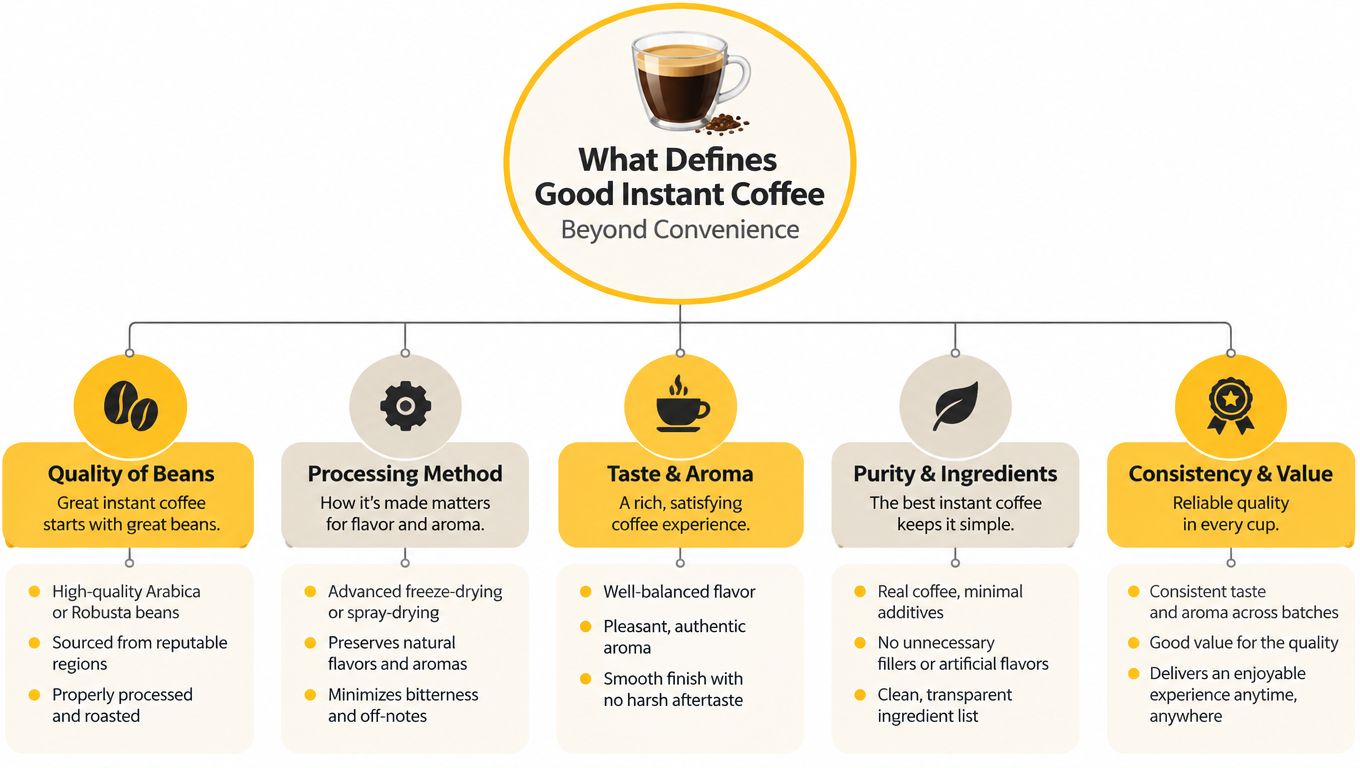
Organic certification and a short ingredient list can matter to shoppers who want a simpler product. They don't automatically predict flavor, but they can make the product's agricultural and formulation choices clearer. Specialty instant coffee is also becoming a distinct premium segment. One market report estimated that segment at USD 6.7 billion in 2025 and projected an 8.7% CAGR through 2034, while reporting that 38% of instant coffee buyers in the U.S. and U.K. would pay more than 25% above standard prices for specialty-grade soluble coffee, as described in this specialty coffee market report.
Instant Coffee Versus Freshly Brewed Coffee
Can premium instant coffee taste close to freshly brewed coffee? Yes, especially when you compare it with an ordinary, carefully prepared home cup rather than an idealized café extraction. But the two formats still create different experiences.
Freshly brewed coffee offers more control over grind size, water contact, extraction time, and serving style. It can deliver layered acidity, changing aromas, and a more expressive body. Instant coffee offers speed, portability, low equipment requirements, and repeatability. You trade some control and often some aromatic detail for convenience.
| Criteria | Premium Freeze-Dried Instant | Freshly Brewed Coffee |
|---|---|---|
| Flavor complexity | Can show clear roast and origin notes, with less depth than a carefully brewed specialty coffee | Offers broader control over extraction and flavor expression |
| Aroma | Stronger aroma retention than conventional spray-dried instant | Fresh grinding and brewing create a vivid immediate aroma |
| Body | Usually light to medium, depending on concentration and product style | Ranges from clean and delicate to rich and heavy |
| Convenience | Requires a cup, water, and the coffee itself | Requires a brewing device, coffee, and more preparation |
| Consistency | Easy to repeat when you use the same amount of coffee and water | Depends on grind, dose, water, technique, and equipment |
| Best use | Workdays, travel, camping, and quick cups at home | Leisurely preparation, tasting, and maximum control |
The gap has narrowed because producers now use better sourcing, small-batch roasting, freeze-drying, and micro-ground formats. That doesn't mean instant has replaced pour-over or espresso. It means the category can now satisfy people who want recognizable coffee flavor without a full brewing ritual.
For a quick visual comparison, watch the embedded guide below.
A useful test is to brew both formats without sugar or milk. Notice aroma first, then sweetness, acidity, bitterness, body, and finish. Premium instant may be less expansive, but it shouldn't taste merely flat or aggressively burnt. Fresh coffee may be more expressive, yet a poorly brewed cup can still taste thin, bitter, or dull.
How to Brew Instant Coffee for the Best Possible Taste
Good instant coffee can taste disappointing when the water is too hot, the dose is excessive, or the cup is too large. Treat the granules as a concentrated coffee extract, not as an ingredient that becomes better just because you add more.
Use water that respects the aroma
Boiling water can exaggerate bitterness and flatten delicate aromatics. Let freshly boiled water sit briefly before pouring, particularly when you're making a small cup. If your kettle has temperature control, choose a hot but not aggressively boiling setting.
Water quality matters just as much. Strong mineral flavors, chlorine, or stale water can mask sweetness and make a clean instant coffee seem harsh. Use fresh water and rinse the cup if it carries detergent or old coffee aromas.
Set a repeatable dose
Start with the serving guidance on the packet or jar, then adjust the coffee-to-water balance rather than adding random spoonfuls. A small amount of water produces a concentrated cup, while a larger mug can make the same dose taste weak.
Golden ratio: begin with the manufacturer's suggested serving and water volume, taste it plain, then adjust one variable at a time.
Add the granules to the cup first. Pour in a small splash of hot water and stir until the coffee forms a smooth concentrate. Then add the remaining water. This two-stage approach helps prevent floating granules and uneven strength.
Milk can soften bitterness and increase body, but taste the coffee black first so you know what the product offers. For cold coffee, dissolve the granules in a small amount of warm water before adding ice and cold water. Pouring cold water directly over a large spoonful often leaves undissolved particles.
For more practical adjustments, these tips for making instant coffee taste better cover simple changes that improve balance without hiding the coffee under sugar or flavored syrups.
How to Choose the Right Instant Coffee for Your Needs
The right product depends on what you need the cup to do. A commuter, camper, parent, and coffee hobbyist may all want instant coffee, but they won't prioritize the same packaging, flavor, or serving format.
Use this buying checklist
- Look for freeze-dried processing: Treat it as the first quality signal because the method is better suited to preserving volatile aroma.
- Check the origin details: A named country or region gives you more useful information than a generic blend description.
- Notice the roast language: Choose a lighter or medium profile for more origin character, or a darker profile if you prefer heavier roast notes.
- Inspect the ingredient list: A short list helps you distinguish plain soluble coffee from sweetened, flavored, or creamy sachet products.
- Assess the packaging: Single-serve packets protect portions from repeated exposure, while a jar needs a reliable seal and dry storage.
- Match the texture to your preference: Distinct crystals usually indicate a conventional soluble format, while micro-ground products may offer added texture and intensity.
A busy professional may value individual sticks that dissolve quickly at a desk. An outdoor adventurer may care more about light packaging, resistance to moisture, and preparation with limited equipment. Families often benefit from a straightforward unsweetened product because each person can choose milk or sweetener separately.
Health-conscious shoppers should separate organic positioning from flavor claims. Organic certification can align with your purchasing values, but it doesn't guarantee a sweeter or more aromatic cup. Look for both the certification and the processing information, then judge the coffee by aroma and taste.
Choose by flavor expectation
If you enjoy filter coffee, seek descriptions that suggest brightness, fruit, florals, or a clean finish. If you normally drink espresso or dark roasts, look for cocoa, nuts, caramel, and fuller roast character. Don't assume “strong” means high quality. It may describe concentration, bitterness, or roast intensity rather than complexity.
Cartograph Coffee offers organic freeze-dried instant coffee in single-serve packets, described as containing no sugar, flavors, or additives. That makes it one option for shoppers who want a portable, unsweetened product with the processing and ingredient cues discussed here.
Open one serving at home before taking a full supply outdoors. Brew it with plain water, then try it with your usual milk or sweetener. Your own palate is more useful than a ranking when the product fits your routine, budget, and preferred flavor profile.
Final Thoughts on Finding Good Instant Coffee
So, is there a good instant coffee that tastes great? Yes. The strongest candidates usually share three traits: a process designed to preserve aroma, enough product transparency to judge what you're buying, and packaging that keeps moisture away from the granules.
Freeze-drying is the most useful starting signal because it protects more volatile compounds than spray-drying. Origin and roast details help you predict the flavor direction. Dry, free-flowing granules and intact packaging suggest the coffee has been handled well. Careful water temperature, a sensible dose, and thorough dissolution then determine whether those qualities reach your cup.
Premium instant won't make every pour-over or espresso drinker abandon fresh brewing. It doesn't need to. Its advantage is different: a credible coffee experience when time, equipment, weight, or cleanup stands in the way. That can mean a workday desk, a hotel room, a campsite, or a quiet cup before the household wakes.
Start with one freeze-dried product and taste it without additions. Notice the aroma when the packet opens, the first flavor after stirring, and the finish after swallowing. If the cup has sweetness, balance, and identifiable character, you've found evidence that instant coffee can be more than a compromise.
Cartograph Coffee offers organic, freeze-dried instant coffee in single-serve packets for quick preparation at home, work, or outdoors. Visit Cartograph Coffee to explore a convenient option built around simple ingredients and better instant coffee moments.