For most people, the short answer is no. When you enjoy it in moderation, instant coffee is not unhealthy and can absolutely be part of a healthy routine. It actually shares many of the same powerful health benefits as regular coffee, like a rich supply of antioxidants.
The main worries people have—things like acrylamide or caffeine—are generally not big enough to cancel out the good stuff for the average person.
The Verdict on Instant Coffee's Health Impact
When you’re rushing out the door, the sheer convenience of instant coffee is a lifesaver. But that convenience often comes with a nagging question: is this quick cup actually good for me? The truth is, the health profile of instant coffee is surprisingly nuanced, balancing real benefits against a few potential drawbacks that are worth knowing about.
Unlike the fresh-ground stuff, instant coffee starts as brewed coffee that's then dehydrated into those familiar soluble crystals. This extra step in the process is what creates the key differences between it and a standard drip coffee. While it hangs onto a lot of the beneficial compounds, the processing also changes the final chemistry.
A Quick Health Comparison
To get a clear picture, it helps to put instant and brewed coffee side-by-side and look at the three main factors people worry about: acrylamide, antioxidants, and caffeine.
- Acrylamide: This is a chemical that can form when foods are cooked at high temperatures, like during the coffee roasting process. While instant coffee often has slightly higher levels than brewed, the amounts are still well within the safety limits set by major health organizations.
- Antioxidants: Here's some good news. Both types of coffee are loaded with antioxidants, especially a group called polyphenols that help protect your body from cellular damage. Studies confirm that instant coffee delivers a potent dose, often rivaling other healthy drinks.
- Caffeine: Looking to cut back a little? Instant coffee typically contains slightly less caffeine per cup. An average serving has about 60-90 mg, while a standard brewed cup can have anywhere from 95-140 mg. This makes it a great choice if you're sensitive to caffeine or just want to moderate your intake.
To make things even clearer, here’s a quick table breaking down the key differences.
Instant Coffee vs. Brewed Coffee: A Health Snapshot
| Health Factor | Instant Coffee | Brewed Coffee | Key Takeaway |
|---|---|---|---|
| Acrylamide | Slightly higher levels | Lower levels | Both are well within established safety guidelines. |
| Antioxidants | High in polyphenols | Also high in polyphenols | Both are excellent sources of beneficial antioxidants. |
| Caffeine | Lower (60-90 mg/cup) | Higher (95-140 mg/cup) | Instant is a good option for lower caffeine intake. |
| Convenience | Very high (just add water) | Lower (requires brewing) | The primary benefit of instant coffee. |
As you can see, the trade-offs are pretty straightforward. Neither one is a clear "winner" or "loser" from a health perspective; it's all about what matters most to you.
This infographic provides a simple visual summary of how instant and brewed coffee stack up on these key health metrics.
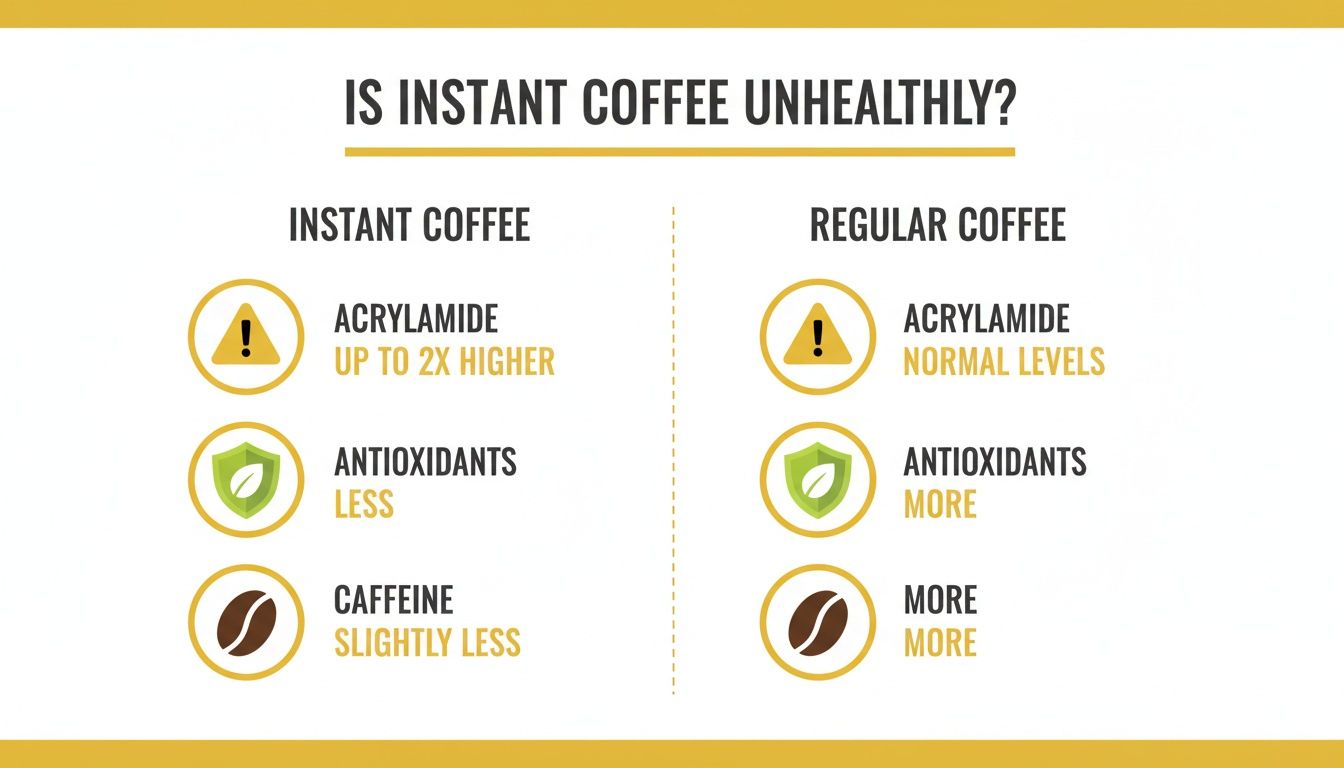
The visualization really drives home that while there are differences, neither option is inherently "bad for you." The best choice often just comes down to your personal priorities and lifestyle.
The Bottom Line: For the vast majority of healthy adults, enjoying instant coffee in moderation is perfectly safe. The main health considerations are the same ones you'd have with regular coffee—it’s more about how much you drink and what you add to it than the coffee itself.
Ultimately, the question "is instant coffee unhealthy?" doesn't have a simple yes or no answer. It's a matter of balance. Choosing a high-quality, organic instant coffee and skipping the heaps of sugar or artificial creamers is a great way to maximize the benefits and keep any potential risks to a minimum.
So, What's the Deal with Acrylamide?
If you’ve ever gone down the rabbit hole of "is instant coffee bad for you," you've almost certainly run into the word acrylamide. It sounds pretty serious, and frankly, it's often painted as the main villain in the story against instant coffee. But let’s break down what it is and whether you actually need to worry.
Acrylamide isn't some strange chemical added to your food. It’s a natural byproduct of a process you’re already very familiar with: the Maillard reaction. This is the same chemical reaction that gives toasted bread its beautiful brown color, roasted coffee its deep flavor, and french fries their crispy goodness.
Basically, when starchy foods are cooked at high temperatures—specifically above 248°F (120°C)—acrylamide forms. It’s not just in coffee; you’ll find it in potato chips, crackers, and even some breakfast cereals.
Why Does Instant Coffee Get the Spotlight?
So why does instant coffee get singled out? It comes down to how it's made. The coffee is first brewed into a super-strong concentrate. Then, it has to be dehydrated to create those familiar soluble crystals. This extra heating step, especially with lower-quality spray-drying methods, can generate more acrylamide than you'd find in regular brewed coffee. You can get the full scoop on how production methods impact the final product in our guide on what is freeze-dried coffee.
But here’s the most important part of the conversation: the dose makes the poison. Just because something is present doesn't mean it's harmful in the amounts we actually consume.
A Little Perspective Goes a Long Way: Yes, instant coffee has more acrylamide than brewed coffee. However, both have far less than many common snack foods, and the levels are well below what health organizations consider a significant risk.
This leads us to the real question: how much are we really talking about, and does it even matter?
Putting the Numbers in Context
Let's cut through the noise and look at the actual data. Studies confirm that instant coffee can have about double the acrylamide of its freshly brewed counterpart. This compound has been flagged as a probable human carcinogen, but that classification comes from animal studies that used extremely high doses.
Here’s the reassuring math: a standard cup of instant coffee contains around 10 micrograms of acrylamide per liter. To put that in perspective, health guidelines suggest a conservative daily limit of about 25 micrograms. You’d have to drink about 2.5 liters—that’s nearly 10 full cups—of instant coffee in one day just to get close to that limit. For a deeper dive, McGill University's analysis offers some great insights.
While the headlines can sound scary, the reality is much more nuanced. The tiny amount of acrylamide in a few daily cups of instant coffee is well within safe limits.
- Animal Studies vs. Human Reality: The studies that first raised alarm bells used doses thousands of times higher than any person would ever consume through food or drink.
- The Bigger Picture: The potential risk from these low levels of acrylamide is considered tiny when weighed against the proven health benefits of the antioxidants packed into coffee.
- Moderation is Your Friend: For most people, enjoying one to three cups of instant coffee a day presents a negligible risk from acrylamide.
At the end of the day, the acrylamide conversation is a perfect example of why context is king. It’s a real compound, and it’s in your coffee, but for the average healthy adult, the exposure from moderate consumption just isn't something to lose sleep over.
Exploring the Antioxidant Power of Instant Coffee
When people talk about instant coffee, concerns like acrylamide often steal the spotlight. But if you only focus on the potential downsides, you miss a massive part of the picture. The truth is, that quick and easy cup is loaded with beneficial compounds that help protect your body.
The real stars of the show here are antioxidants. I like to think of them as your body's personal defense squad, constantly working to neutralize rogue molecules called free radicals. When left unchecked, these unstable molecules cause oxidative stress, a major driver behind inflammation and many chronic diseases.
Believe it or not, coffee—in all its forms—is one of the biggest sources of antioxidants in the Western diet. And instant coffee absolutely pulls its weight, delivering a solid dose of these protective compounds in every single mug.
The Polyphenol Powerhouse in Your Mug
The main antioxidants you'll find in coffee are a class of plant compounds called polyphenols. You've probably heard of them before; they're the good stuff in red wine, dark chocolate, and berries. Instant coffee is especially rich in one specific type called chlorogenic acids.
These powerful compounds are well-known for their ability to fight inflammation and shield your cells from daily wear and tear. And here's the good news: even though instant coffee goes through a dehydration process, it holds on to a surprisingly high amount of these valuable polyphenols.
Key Insight: Some research even suggests that the unique processing of instant coffee might concentrate certain antioxidants, meaning it could contain even more of these compounds than some brewed coffees. Your quick cup might be punching well above its weight.
Sure, a freshly brewed cup might have a slight advantage in some antioxidant categories, but for most of us, the difference is pretty small. Instant coffee is still a fantastic and reliable source, contributing a major boost to your daily antioxidant intake. This is a huge benefit that often gets lost in the debate over whether is instant coffee unhealthy.
More Than Just Antioxidants
Beyond its antioxidant credentials, instant coffee also delivers a few essential micronutrients. It's not going to replace your multivitamin, but every little bit helps support your overall well-being.
Each cup gives you a small hit of several key minerals:
- Potassium: This mineral is crucial for keeping your fluids balanced, your nerves firing correctly, and your muscles contracting smoothly.
- Magnesium: An unsung hero, magnesium is involved in over 300 different processes in the body, from creating energy to keeping your bones strong.
- Niacin (Vitamin B3): Niacin helps your body convert food into usable energy and plays a role in maintaining a healthy nervous system, digestive system, and skin.
When you look at the whole package—powerful antioxidants plus these helpful micronutrients—you get a much clearer idea of what’s really in your mug. It's about more than just a caffeine fix; it’s about giving your body compounds that support both its daily functions and its long-term health. To dive deeper into the upside of your daily habit, check out our guide on the many instant coffee health benefits.
At the end of the day, the nutritional value packed into instant coffee adds a lot of weight to the "pro" column. When you opt for a high-quality product, you’re getting a beverage that’s convenient, delicious, and genuinely beneficial for a healthy lifestyle.
What’s the Long-Term Outlook? Emerging Research

The world of nutrition science is always moving forward. As researchers get their hands on better tools and bigger sets of data, what we know about how food affects us over a lifetime gets sharper. We've covered the basics of instant coffee—the good (antioxidants) and the questionable (acrylamide)—but now scientists are digging into more subtle, long-term impacts.
This newer research is looking at really complex topics, like how our cells age and the risk of specific health conditions down the road. It's important to keep these findings in perspective. They often point to correlations, not direct causes, and represent the very edge of scientific discovery rather than a settled verdict.
The goal here isn't to sound the alarm. It's to give you an honest look at where the science is headed, helping you build a complete picture of why mindful consumption is always a smart move.
The Surprising Link Between Instant Coffee and Eye Health
One of the most unexpected areas of new research is a potential link between high instant coffee intake and age-related macular degeneration (AMD). If you're not familiar, AMD is a primary cause of vision loss that impacts the central part of the retina.
A major genetic study out of China turned up a pretty startling correlation. Using a sophisticated analysis of huge genetic datasets, researchers found that instant coffee consumption was linked to a nearly eightfold increase in the risk for dry AMD. This is the most common form of the disease, which currently affects 200 million people across the globe.
According to their findings, just one standard deviation increase in daily intake—think about one extra cup a day—was associated with a 7.92 times higher chance of developing dry AMD. You can dig into the specifics of these genetic findings on instant coffee and AMD risk to learn more.
Now, it's crucial to understand what this means. This study doesn't prove that instant coffee causes AMD. What it does is flag a strong statistical connection that scientists need to look at more closely. Interestingly, the same study found no similar risk with ground or decaf coffee, which suggests something unique to instant coffee's processing or final composition might be the key factor.
Cellular Aging and the "Shoelace Tips" on Your DNA
Another fascinating research area explores how our daily habits might speed up or slow down the aging process deep inside our cells. This field focuses on things called telomeres. The best way to think of them is like the little plastic tips on your shoelaces—they are protective caps on the ends of our chromosomes that keep our DNA from fraying.
Every time our cells divide, these telomeres get a tiny bit shorter. This is a natural part of aging. Shorter telomeres are a marker of biological age; the faster they shrink, the higher the risk for age-related health problems. This has led scientists to wonder if what we eat and drink can influence how quickly this happens.
A Quick Note on Correlation: It's important to remember that these studies spot patterns in large groups of people. They show a connection between two things—like drinking instant coffee and telomere length—but they don't prove one causes the other. Lifestyle factors like your overall diet, how much you exercise, and stress levels also play a huge role in how our cells age.
Some observational studies have suggested a potential link between very high consumption of instant coffee and faster telomere shortening. While the exact "why" is still being investigated, these findings add another layer to the conversation about the long-term effects of our coffee habits.
This emerging science isn't a reason to panic, but it is a good reminder to be mindful. It suggests that while a cup or two of instant coffee can easily be part of a healthy routine, excessive amounts might have consequences we're only just beginning to grasp. This reinforces the value of moderation and choosing a high-quality product for your daily brew.
How Your Coffee Habit Might Affect Cellular Aging
Beyond the morning buzz, some of the most fascinating research on coffee looks at how it might influence the aging process itself, right down to the level of our DNA. We're not talking about wrinkles or gray hair here, but the invisible clock ticking away inside every cell in your body.
To really get this, we need to talk about telomeres. Imagine the little plastic tips on the ends of your shoelaces. Those are your telomeres. Your shoelaces are your chromosomes—the tightly coiled bundles of DNA inside your cells. Just like those plastic tips stop your laces from fraying, telomeres protect your genetic code every single time a cell divides.
Each time a cell splits, these telomeres get a tiny bit shorter. It's a natural part of aging, and scientists actually use telomere length as a marker for our "biological age," which can be older or younger than our age in years. When telomeres shorten too quickly, it's often linked to a higher risk of age-related health problems. This is why researchers are so interested in what parts of our lifestyle might speed up or slow down this process.
The Link to Instant Coffee
This is where things get interesting. Some large-scale observational studies have noticed a potential link between drinking a lot of instant coffee and how quickly telomeres shorten. It's crucial to know that these studies show a correlation, not a direct cause-and-effect. A whole host of other things—like diet, exercise, and stress—are also major players in our cellular health.
Still, the patterns are hard to ignore. One in-depth study of over 5,000 adults found that people who drank a lot of instant coffee showed faster telomere erosion. The data pointed to a startling connection: each additional daily cup of instant coffee was associated with an acceleration in telomere shortening equal to 0.38 years of biological aging. This effect seemed to be three times stronger than what they saw with regular brewed coffee. You can dig into the full study on telomere length and coffee consumption to see the data for yourself.
Key Takeaway: The science is still evolving, but this research suggests the type of coffee you drink could make a difference for your long-term cellular health. The way instant coffee is processed compared to brewed coffee might be a key factor.
What Does This Mean for Your Daily Cup?
So, should you toss your instant coffee? Not so fast. This research doesn't mean a single cup will instantly age you. Instead, it adds a really interesting piece to the larger health puzzle. It reminds us that moderation is key, especially when it comes to highly processed foods and drinks.
These findings are more of an invitation to be mindful about your coffee routine. Here’s how you can think about it:
- Moderation Is Your Friend: Sticking to one or two cups of instant coffee a day seems like a pretty reasonable way to minimize any potential long-term risks.
- Quality Matters: Choosing a high-quality, organic, and freeze-dried instant coffee could give you a better nutritional starting point.
- See the Big Picture: Remember that a healthy diet, getting some movement in, and managing stress are your most powerful tools for supporting healthy aging from the inside out.
Ultimately, this emerging science isn't a final judgment on instant coffee. It's a valuable glimpse into the incredibly complex relationship it has with our bodies over a lifetime.
How to Choose a Healthier Instant Coffee
Walking down the coffee aisle can feel a bit overwhelming, especially when you're trying to find something that's both convenient and good for you. Now that you've got the science down, let's put that knowledge into practice. Picking a healthier instant coffee isn't about hunting for some mythical "perfect" product; it's simply about knowing what to look for and how to prepare your cup.
Think of it like picking out vegetables at a farmer's market. You naturally gravitate toward the fresh, vibrant-looking options and steer clear of anything that looks a little off or overly processed. You can apply that same gut instinct to choosing your instant coffee. A few simple checks can make a huge difference in the quality and health benefits of your daily brew.
Opt for Organic Coffee Beans
One of the easiest and most impactful choices you can make is to go organic. When grown conventionally, coffee is one of the most heavily treated crops out there. Choosing organic guarantees the beans were grown without synthetic pesticides, herbicides, or fertilizers.
This directly reduces your exposure to chemical residues you probably don't want in your body. On top of that, organic farming is just plain better for the environment and often leads to a cleaner, purer-tasting coffee. It’s a win for your health and a win for the planet.
Why Organic Matters: This isn't just about following a trend. Choosing organic is a practical way to slash your intake of unwanted agricultural chemicals. When you see that USDA Organic seal, you know you're getting a cleaner cup, right from the source.
Understand the Drying Method
All instant coffee starts as brewed coffee that gets dehydrated. The how of that dehydration process really matters. The two main techniques are spray-drying and freeze-drying, and one does a much better job of preserving what makes coffee great.
- Spray-Drying: This is the fast-and-cheap method. A fine mist of liquid coffee is blasted with hot air, which makes the water evaporate almost instantly. The problem? That intense heat can destroy many of the delicate flavor compounds and beneficial antioxidants.
- Freeze-Drying: This is a much gentler approach. The brewed coffee is frozen solid and then placed in a strong vacuum, which causes the ice to turn directly into vapor. By avoiding high heat, this technique does a fantastic job of preserving the coffee’s natural aroma, taste, and nutrients.
For a cup that tastes much closer to a fresh brew and holds onto more of its goodness, always choose freeze-dried if you have the option.
Read the Ingredient List Carefully
The best choice is almost always the simplest one. Ideally, your instant coffee should contain just one thing: 100% coffee. Be wary of those popular "3-in-1" or flavored instant mixes, which are often packed with additives that can derail your health goals.
Keep an eye out for these common culprits:
- Added Sugars: Things like corn syrup solids, sugar, or fructose often top the list, adding nothing but empty calories.
- Hydrogenated Oils: Often used as cheap "creamers," these can be a source of unhealthy trans fats.
- Artificial Flavors and Preservatives: These chemicals offer zero nutritional value.
A quick scan of the label is your best defense. If the ingredient list is a mile long and filled with words you can't pronounce, it’s probably best to put it back. This simple habit helps you sidestep all the junk. For a deeper dive, check out our complete guide to finding the healthiest instant coffee.
Making a better choice doesn't have to be complicated. Here's a quick checklist you can use next time you're shopping.
Healthier Instant Coffee Checklist
| Checklist Item | Why It Matters | What to Look For |
|---|---|---|
| Check for Organic Certification | Reduces exposure to pesticides and supports sustainable farming practices. | Look for the USDA Organic seal or equivalent certification on the packaging. |
| Choose Freeze-Dried | Preserves more of the coffee's natural flavor, aroma, and antioxidants compared to high-heat spray-drying. | The label will usually state "freeze-dried." It often comes in larger, more irregular granules. |
| Scan the Ingredients | The healthiest option contains only coffee, avoiding hidden sugars, unhealthy fats, and artificial additives. | The ingredient list should be short and simple: "100% Coffee." |
| Avoid "3-in-1" Mixes | These pre-mixed products are typically loaded with sugar and hydrogenated oils. | Steer clear of products labeled "creamy," "sweetened," or "flavored." Add your own milk and sweetener at home. |
By keeping these few points in mind, you can confidently pick an instant coffee that delivers on convenience without compromising on quality or your health.
Common Questions About Instant Coffee and Health
Even after we've looked at the science, some practical questions always seem to pop up. Let's tackle some of the most common ones about instant coffee so you can feel good about what you're stirring into your mug each morning.
This is where the rubber meets the road—addressing the real-world concerns you might have, from an upset stomach to figuring out how much is too much. The idea is to give you clear, simple answers that build on everything we've covered.
Is Instant Coffee Worse for Your Stomach?
This is a big one. Lots of people wonder if instant coffee is harder on the stomach than a regular brew, and honestly, it really comes down to you and your body. For some, the acidity can feel a bit harsh and cause some discomfort. For others? No difference at all.
What's interesting is that the slightly lower caffeine content in most instant coffees could actually make it a gentler choice if you're sensitive to caffeine's gut-stimulating effects. If you find your stomach does get irritated, the quality of the coffee is often the culprit.
Pro Tip: If you have a sensitive stomach, try having your coffee with a bit of food to help buffer the acid. You might also find that switching to a high-quality, organic freeze-dried brand makes a huge difference, as they tend to have a much smoother profile.
How Much Instant Coffee Is Safe to Drink Per Day?
Most health authorities agree that up to 400 mg of caffeine a day is a safe upper limit for healthy adults. Since a typical cup of instant coffee has between 60-90 mg, you could technically drink 3-5 cups a day and still be within that guideline.
But a truly smart approach looks beyond just the caffeine numbers. When you factor in the acrylamide content and the ongoing research, aiming for a more moderate amount is probably the wisest path. Sticking to 1-3 cups daily lets you get all the convenience and antioxidant perks while keeping any potential downsides to a minimum.
Does Decaf Instant Coffee Have the Same Health Risks?
Opting for decaf instant coffee is a great move for managing certain health concerns, but it's not a complete free pass. The process gets rid of most of the caffeine, sure, but the coffee beans still go through the same heating and drying that forms acrylamide.
Here’s a quick look at the trade-offs:
- Pro: You sidestep any risks tied to caffeine, like jitters, anxiety, or messed-up sleep.
- Pro: You still get a good portion of the beneficial antioxidants found in regular coffee.
- Con: It contains about the same amount of acrylamide as the caffeinated version.
At the end of the day, decaf is a fantastic option if you're caffeine-sensitive or just love a warm cup in the evening. You get the antioxidant boost and quick prep without the buzz, but the acrylamide factor is something to keep in mind.
Ready to enjoy the convenience of instant coffee without compromising on quality? Cartograph Coffee offers a premium, organic, freeze-dried option that delivers exceptional taste and peace of mind. Experience a better cup by visiting us at https://cartographcoffee.com.