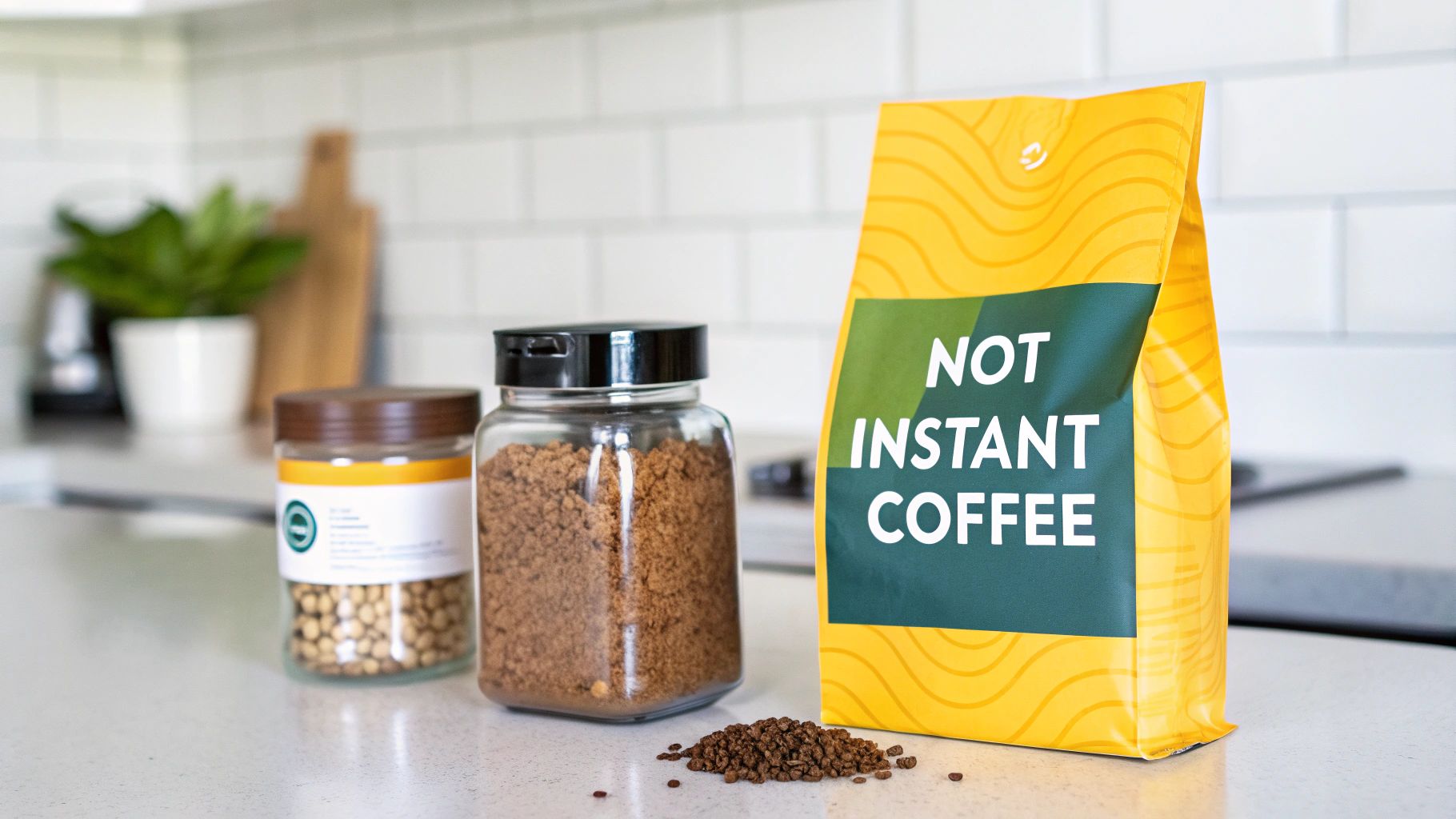
Let's get one thing straight from the start: ground coffee is not instant coffee. It’s a common point of confusion, but they are fundamentally different products.
Think of it like this: ground coffee is like fresh pasta dough. You have the raw ingredient, full of potential, but you still need to cook it to turn it into a meal. Instant coffee, on the other hand, is like a packet of ramen noodles—it's already been cooked and dehydrated. All you need to do is add hot water.
Understanding the Core Difference
One requires a brewing process to unlock its flavor, while the other is a finished coffee concentrate that's ready to be rehydrated. This single distinction is the key to understanding everything else about them, from how they taste to the best way to use them in your daily routine.
A Tale of Two Coffees
At its heart, ground coffee is exactly what it sounds like: whole, roasted coffee beans that have been ground into small particles. It’s an unfinished ingredient. All the complex aromas and flavors are trapped inside, waiting for you to extract them with hot water using a brewer like a drip machine, a French press, or a pour-over cone.
Instant coffee, however, has already gone through that brewing step. To make it, manufacturers brew enormous batches of coffee from ground beans. Then, they remove all the water from the brewed coffee, leaving behind soluble crystals or a fine powder. When you stir it into your mug, you're just adding the water back in.
The simplest way to remember it is this: Ground coffee is the raw material you use to make coffee. Instant coffee is the finished product, just in a dehydrated form.
To really nail down the comparison, let's break down the key differences in a quick table.
Ground Coffee vs Instant Coffee At a Glance
This chart gives you a quick snapshot of what sets these two coffee types apart.
| Characteristic | Ground Coffee | Instant Coffee |
|---|---|---|
| Form | Small, solid particles of roasted coffee beans. | Dehydrated, soluble crystals or powder. |
| Preparation | Requires a brewing method (drip, press, pour-over). | Dissolves instantly in hot water—no brewing needed. |
| Taste Profile | Complex, nuanced, aromatic, and fresh. | Consistent, straightforward, often milder. |
| Main Benefit | Flavor quality and sensory experience. | Unbeatable speed and convenience. |
As you can see, they're designed for completely different purposes. One prioritizes the rich experience of brewing, while the other is all about getting a decent cup of coffee in your hands as fast as possible.
The Journey from Bean to Ground Coffee
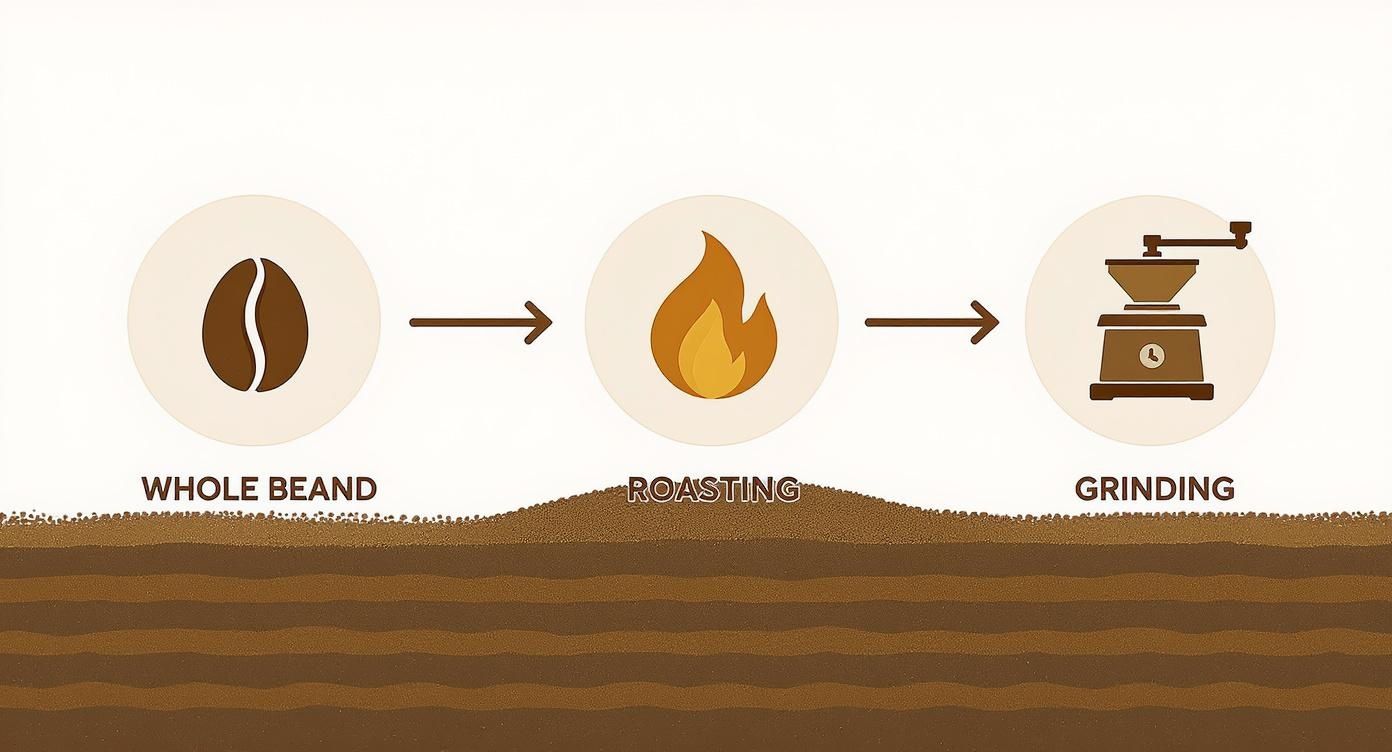
To really get why ground coffee and instant coffee are two totally different things, let's follow the coffee bean's path. This isn't about creating a product that dissolves in a snap; it's all about one thing: unlocking amazing flavor. Think of it as a physical makeover, not a complex chemical experiment.
It all begins with whole, green coffee beans. These are roasted in big, tumbling drums at temperatures that can top 400°F (204°C). Roasting is where the real magic happens. This intense heat sparks the creation of hundreds of aromatic compounds, transforming a pretty bland seed into the fragrant, complex bean we recognize. It’s a lot like toasting bread to bring out those warm, nutty flavors.
Once roasted and cooled, the beans are simply ground up. This step just breaks the whole beans into tiny pieces. The whole point is to increase the coffee's surface area, which makes it much easier for hot water to pull out all the good stuff—oils, flavors, and caffeine—when you brew it. It’s the same reason you crush spices before cooking; you get more flavor out of them.
From Coarse to Fine: Why Grind Size Matters
Grind size isn't random; it's deliberately chosen to match a specific brewing method. How coarse or fine the coffee is directly controls how quickly water extracts flavor, which completely changes how your final cup tastes.
- Coarse Grind: Looks like chunky sea salt. This is what you want for a French press, where the coffee and water hang out together for a while. The large grounds keep the coffee from getting bitter and over-extracted.
- Medium Grind: The consistency of regular table salt. This is the go-to for most standard drip coffee makers, striking a great balance for a classic, smooth cup.
- Fine Grind: Feels almost like a soft powder. This is non-negotiable for espresso. The tightly packed grounds create the resistance needed for hot, high-pressure water to pull a rich, concentrated shot in just 25-30 seconds.
The main thing to remember is that ground coffee is an unfinished ingredient. It has all the flavor potential locked inside, but it needs you to finish the job with hot water and a brewer.
This focus on freshness and taste is a huge reason why ground coffee dominates the market. Even as instant coffee grows in popularity for its convenience, many people still reach for ground coffee because they want that rich, full-flavored experience you only get from brewing it fresh. You can dive deeper by checking out some global coffee market insights. When you buy ground coffee, you're not just buying a product—you're buying the potential for a truly great cup of coffee.
How Instant Coffee Is Engineered for Convenience
While the story for ground coffee pretty much ends at the grinder, the journey for instant coffee is just beginning. It goes through a pretty wild transformation, turning a brewed liquid into a shelf-stable powder built for pure speed. The whole idea isn't to change the coffee, but simply to remove one thing: the water.
The process actually starts where regular coffee making finishes—with brewing. Huge batches of ground coffee are brewed to create a super-concentrated liquid extract. From that point on, the mission is to dehydrate this liquid, leaving behind only the solid bits of coffee that can dissolve again. This is where things get a little more scientific.
This visual shows the simple, direct path ground coffee takes before it’s ready to brew.
Unlike this straightforward route, instant coffee has a few more complex hoops to jump through after the brewing is done.
The Two Paths to Dehydration
To get the water out, manufacturers typically take one of two routes. Each has its own set of pros and cons when it comes to cost, speed, and, most importantly, preserving flavor.
- Spray-Drying: This is the quicker, more budget-friendly option. The coffee concentrate is blasted as a fine mist into a tower of hot air. The heat zaps the water almost instantly, and the tiny, dry coffee particles fall to the bottom as a fine powder.
- Freeze-Drying: This is a much gentler, more premium approach. First, the coffee extract is frozen solid. Then it’s placed in a powerful vacuum, which causes the ice to turn directly into a vapor without ever becoming liquid again—a cool process called sublimation. This method does a much better job of holding onto the delicate aromatic compounds that give coffee its amazing smell and taste.
No matter which method is used, you end up with soluble coffee crystals. You can dive deeper into how this works in our guide on the science of instant coffee. These little granules are primed and ready to release all their flavor the second they hit hot water.
In essence, instant coffee is pre-brewed coffee that's been put into a state of suspended animation. Your mug and kettle are just waking it back up.
This focus on convenience has been the main driver for decades. The first commercial instant coffee hit the scene in the early 1900s, but it was Nestlé’s Nescafé, launched in 1938, that really made it a household name. Today, with busy lifestyles and a need for portability, the instant coffee market is bigger than ever. This long history just goes to show that asking "is ground coffee instant coffee?" reveals two totally different philosophies: one built on craft, the other on pure convenience.
Comparing the Experience in Your Cup
Beyond the production process, the real difference between ground and instant coffee reveals itself the moment you take that first sip. They are two entirely different worlds, each designed to deliver a unique experience—from the aroma that fills your kitchen to the taste that lingers on your palate. Let's break down what truly sets them apart in your cup.
When you brew ground coffee, you're kicking off a rich, dynamic sensory journey. The second hot water hits the grounds, you get that fragrant "bloom" as carbon dioxide and volatile aromatic compounds escape. That's the smell of freshness, a complex bouquet that can be anything from floral and fruity to nutty and chocolatey.
The flavor is just as nuanced. Because you're extracting everything directly from the roasted bean, the final cup is a direct reflection of its origin, roast level, and how it was processed. The texture, or body, is also noticeably fuller, leaving a more satisfying mouthfeel.
Flavor Profile and Freshness
Instant coffee, on the other hand, is all about consistency and convenience. The flavor profile is generally more straightforward and less layered. Since the coffee has already been brewed once and then dehydrated, some of those delicate aromatic oils are inevitably lost along the way. This can sometimes result in a flatter taste.
But the instant coffee scene is definitely evolving. Modern specialty brands are now using much higher-quality beans and more sophisticated freeze-drying methods to preserve more of that original flavor. While it might not capture the full, vibrant complexity of a freshly ground pour-over, a good specialty instant offers a surprisingly clean and enjoyable cup that's miles ahead of the old stuff. For a deeper dive, you can explore the key differences between instant coffee vs ground coffee in our complete guide.
Key Takeaway: Ground coffee gives you a complex, aromatic, and fresh flavor experience that showcases its origins. Instant coffee delivers a consistent, straightforward taste built for convenience, though modern specialty options are closing the quality gap fast.
The Caffeine Question
When it comes to caffeine, there’s no simple winner. The amount in your cup is influenced by a lot of things, but on average, a standard cup of brewed coffee usually packs more of a punch than a serving of instant.
Here’s a general breakdown:
- Brewed Ground Coffee: An 8-ounce cup typically contains between 70 to 140 milligrams of caffeine, with the average hovering around 95 milligrams.
- Instant Coffee: A standard 8-ounce cup made with one teaspoon of powder usually has between 30 to 90 milligrams.
This difference often boils down to the beans. Many instant coffees are made with a higher percentage of Robusta beans, which have nearly double the caffeine of their Arabica cousins. However, since you typically use less instant powder per cup, it often balances out.
Here is a quick look at how the sensory experience and caffeine levels stack up.
Sensory and Caffeine Comparison
| Attribute | Ground Coffee (Freshly Brewed) | Instant Coffee |
|---|---|---|
| Taste | Complex, nuanced, with distinct origin notes (fruity, floral, nutty). | More uniform and straightforward; can sometimes have a slightly processed taste. |
| Aroma | Rich, vibrant, and aromatic, especially during the "bloom" phase of brewing. | Milder and less complex; the most delicate aromas are often lost in processing. |
| Texture | Fuller body with a more satisfying mouthfeel, sometimes with fine sediment. | Lighter body, completely smooth and uniform with no sediment. |
| Caffeine | Typically 70-140 mg per 8-ounce cup, averaging around 95 mg. | Generally lower, around 30-90 mg per 8-ounce cup. |
Ultimately, it’s clear that their distinct sensory and chemical profiles give you two very different coffee experiences.
Choosing the Right Coffee for Any Situation

The whole "ground versus instant" debate kind of misses the point. It’s not about which one is better overall, but which one is better for right now. Honestly, both have a place in your pantry. The real trick is knowing which to grab to make your coffee moment perfect.
Think of it like tools in a toolbox. You don't use a sledgehammer for a picture hook, and you don’t use a tiny precision screwdriver to demolish a wall. Your coffee choice should fit the situation, whether you’re looking for a slow, aromatic ritual or just need caffeine in your system, stat.
The global coffee market backs this up. Roasted coffee—the source of our beloved ground coffee—dominates the revenue charts because it’s tied to that premium, café-quality experience we all crave. But at the same time, instant coffee has built its own massive following by being the undisputed king of speed and convenience, a fact detailed in this coffee industry report.
When Ground Coffee Is Your Best Bet
Ground coffee is for when time is a luxury and the experience is just as important as the caffeine. It’s the go-to for moments that call for a bit of ritual, a higher standard of quality, and a hands-on approach.
You’ll want to stick with ground coffee when you’re:
- Enjoying a Slow Weekend Morning: There's something deeply satisfying about the ritual of a pour-over or French press. It just makes the coffee taste better.
- Hosting Brunch or Dinner: Serving a pot of freshly brewed coffee is a simple gesture that shows you care and makes the whole meal feel more special.
- Honing Your Home Barista Skills: If you love playing with grind size, water temperature, and brew times, you need fresh grounds. It's a hobby where the quality of your ingredients is everything.
Simply put, ground coffee is for when the process of making it is part of the pleasure. It’s about savoring the aroma, dialing in the flavor, and enjoying the moment.
When to Reach for Instant Coffee
Instant coffee is the hero of convenience, no question about it. It’s designed for those times and places where a full brew setup is out of the question, delivering a decent cup without any equipment or cleanup.
Instant is the perfect partner for:
- Busy Workdays: When you’re jumping between meetings and have 30 seconds to spare, nothing beats the speed of instant.
- Travel and Camping: It’s practically weightless, takes up no space, and just needs hot water. This makes it a non-negotiable for any trip. We even break down why it’s a top pick in our guide to the best coffee for backpacking.
- Baking and Cooking: Need a coffee kick in your brownies, chili, or steak rub? A spoonful of instant coffee powder dissolves right in, giving you concentrated flavor without watering anything down.
Your Coffee Questions, Answered
After digging into the worlds of ground and instant coffee, you've probably got a few lingering questions. Let's tackle some of the most common ones that pop up, so you can feel confident choosing, brewing, and storing your coffee like a true enthusiast.
Can You Just Add Hot Water to Ground Coffee?
It's a question we hear all the time, but the short answer is no—not if you want a drink you'll actually enjoy. Unlike instant coffee, which is designed to dissolve completely, ground coffee is made of tiny, solid particles of the coffee bean. If you just stir them into hot water, you'll end up with a gritty, muddy mess in your mug.
Ground coffee needs extraction, not just dissolving. Think of it like making tea with loose leaves. The brewing process—whether you're using a drip machine, a French press, or a pour-over cone—is all about letting hot water pass through the grounds to pull out all the good stuff (flavor, aroma, oils) while leaving the solid bits behind.
Is One Healthier Than the Other?
From a health perspective, both ground and instant coffee are pretty similar. They're both packed with antioxidants and offer many of the same benefits. Neither is inherently "unhealthy," but there are a couple of small distinctions. Because ground coffee is less processed, it often holds onto more of the bean's natural oils and unique compounds.
On the flip side, some studies have noted that instant coffee can have slightly higher levels of acrylamide, a compound that forms when foods are roasted at high temperatures. It's important to know, though, that the amounts found in both coffee types are well below what's considered harmful and are similar to what you'd find in many other roasted foods, like toast or roasted potatoes.
The real decider for your coffee's health impact isn't the beans—it's what you add to your cup. Piling in sugar, cream, and flavored syrups will have a much bigger effect than your choice between ground and instant.
What Is "Barista Style" Instant Coffee?
You've likely seen instant coffees labeled "barista style" or "microground" and wondered what makes them different. These are essentially a clever hybrid product designed to give you the convenience of instant with a flavor that's much closer to a fresh brew.
Here's how they do it. These products are a blend of two components:
- Standard Instant Coffee Granules: These are the soluble crystals that provide the fast-dissolving base.
- Very Finely Ground Coffee Beans: A small amount of actual coffee, milled into an ultrafine powder, is mixed in.
That tiny addition of real coffee grounds makes a huge difference. It creates a richer flavor, a fuller body, and can even produce a thin layer of foam that looks a bit like the crema on a shot of espresso. It's a smart way to elevate the instant experience.
Do Coffee Pods Contain Ground or Instant Coffee?
This is another common point of confusion. Coffee pods, like K-Cups, are filled with real ground coffee, not instant coffee. The machine itself is basically a super-fast, single-serving drip brewer.
When you pop in a pod, the machine pierces it and forces hot, pressurized water through the bed of coffee grounds inside. A small paper filter within the pod makes sure only the brewed liquid ends up in your cup, trapping the used grounds for a mess-free cleanup. This is why pods and instant coffee are often compared; both are all about speed and convenience, but they get there in very different ways.
Ready to experience the peak of convenient, high-quality coffee? Cartograph Coffee delivers organic, specialty-grade instant coffee that never compromises on flavor. Perfect for your busiest days and wildest adventures, it’s the simple way to enjoy a truly exceptional cup, anytime.