You take a sip of cold brew and pause. It tastes smooth, almost gentle, yet the caffeine seems to arrive with more force than expected. So, is cold brew strong, or does its low-bitterness flavor make it easier to drink?
The answer depends on what you mean by strong. Cold brew can be high in caffeine, concentrated in flavor, or feel intense because it's served in a large glass over ice. Those qualities often overlap, but they aren't the same thing. A smooth drink can still contain substantial caffeine, while a bold-tasting coffee may not deliver the strongest stimulant effect.
That confusion matters whether you're buying a ready-to-drink bottle, ordering a café cold brew, mixing a concentrate at home, or preparing an instant coffee while traveling. The brewing method, coffee-to-water ratio, serving size, dilution, grind, steep time, and even the way the drink feels on your palate can all change the result.
This guide separates cold brew strength into three useful dials: caffeine content, flavor concentration, and perceived smoothness or intensity. You'll learn why cold brew earned its powerful reputation, how it compares with hot and iced coffee, which variables control its character, and how to adjust a cup so it's stronger, softer, or easier to enjoy every day.
What Strong Really Means for Cold Brew
When someone asks whether cold brew is strong, they may be asking one of three questions:
- How much caffeine does it contain?
- How concentrated does it taste?
- How intense does it feel while drinking?
Those are separate measurements of the same cup.
The caffeine dial
Caffeine strength is about the amount of caffeine in the finished serving. Cold brew can contain a lot because many recipes begin as a concentrate, meaning the brewed liquid contains more coffee material before water, ice, milk, or cream is added.
Serving size changes the answer, too. A small glass of diluted concentrate may provide a different caffeine experience from a large ready-to-drink bottle, even if both are called cold brew. The label, recipe, and dilution matter more than the name alone.
The flavor dial
Flavor concentration describes how much coffee character reaches your palate. A concentrate may taste dense, dark, woody, chocolatey, or syrup-like. A ready-to-drink version may taste lighter because the brewer has already added water.
Flavor intensity also depends on the bean and roast. A dark roast can taste more roasty and bitter, while a lighter roast may show fruit, flowers, or acidity. Neither automatically tells you how much caffeine the drink contains.
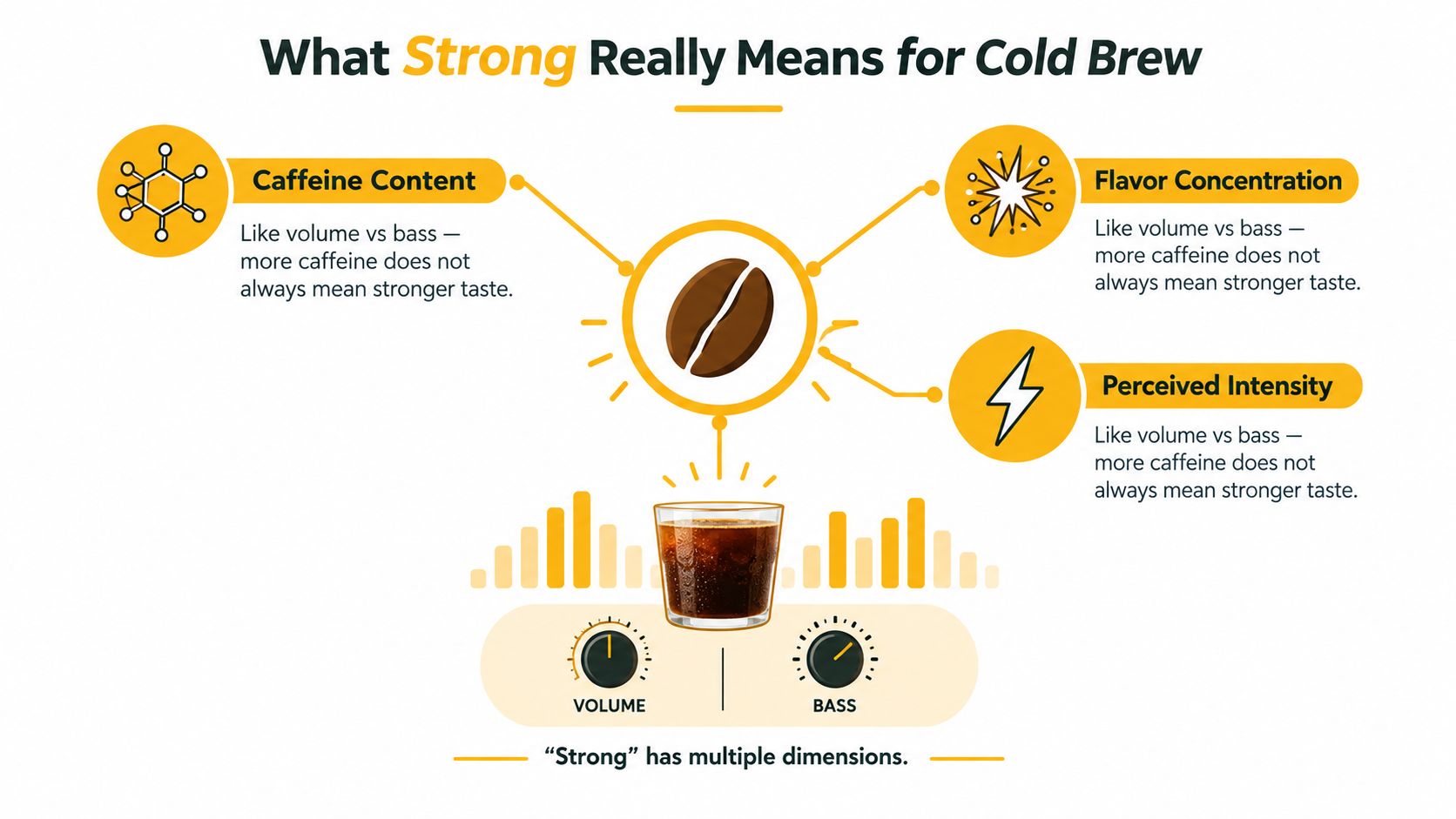
The smoothness and intensity dial
Perceived intensity is the way the coffee feels. Cold brew often seems powerful because it has a thick body and concentrated aroma, but it may taste less sharp than hot-brewed coffee. Cold water extracts coffee differently, and the drink is usually chilled, diluted, or served with ice. Those factors can soften the edges without necessarily removing caffeine.
A useful analogy is an audio system. Caffeine is one control, flavor concentration is another, and smoothness changes how loudly the whole drink seems to play. Turning up the bass doesn't always increase the volume. In the same way, a smooth cold brew can taste mellow while still being caffeine-heavy.
Core idea: Smoothness doesn't mean weak. Cold brew can be gentle on the palate and powerful in caffeine or concentration.
This three-dial model keeps comparisons honest. If you want a stronger morning lift, focus on caffeine and serving size. If you want a bolder coffee flavor, adjust concentration. If a drink feels too aggressive, add water, milk, or ice without assuming you need to abandon cold brew entirely.
How Cold Brew Compares to Hot Coffee and Iced Coffee
Cold brew isn't automatically stronger than every hot coffee. The more accurate answer depends on the serving recipe.
A pilot study of commercially prepared cold brew concentrate found a mean of 207.22 ± 39.17 milligrams of caffeine in a 355 milliliter serving across five batches. A separate peer-reviewed study reported about 149.52 ± 13.80 milligrams per cup for cold brew coffee. Both findings are reported in the peer-reviewed cold brew caffeine study.
For context, an average eight-ounce brewed coffee is often cited in the United States as roughly 95 milligrams of caffeine, as noted in that same source. A cold brew serving can therefore land well above standard drip coffee, but the comparison changes with dilution, serving size, and the amount of concentrate used.
Caffeine strength compared by brew method
| Brew Method | Typical Serving | Caffeine Range |
|---|---|---|
| Cold brew concentrate | 355 mL serving in one pilot study | 207.22 ± 39.17 mg |
| Cold brew coffee | Cup serving in a peer-reviewed study | 149.52 ± 13.80 mg |
| Brewed drip coffee | Eight-ounce average often cited in the U.S. | Roughly 95 mg |
The table shows why cold brew can be stronger, but it doesn't make every cold brew stronger than every iced coffee or espresso drink. Iced coffee is usually hot-brewed coffee that has been cooled and served over ice, while cold brew is extracted in cold or room-temperature water for a longer period. The ice may dilute iced coffee, and the cold brew may be diluted too.
Serving volume creates another common mistake. People often compare a large cold drink with a smaller hot mug and conclude that the brewing method caused the difference. In practice, the amount of coffee used, the final liquid volume, and the dilution ratio can matter just as much.
For a helpful explanation of the distinction between the two drinks, see Cartograph Coffee's guide to caffeine in iced coffee. The practical takeaway is simple: cold brew can be stronger when it contains a concentrated base or a high caffeine serving, but the label “cold brew” doesn't guarantee a fixed strength.
Espresso complicates the comparison in another way. It tastes intense because it's concentrated in a small volume, yet a full cold brew serving may contain more total caffeine because you drink more liquid. That's why flavor intensity and total caffeine should be treated as separate questions.
Why Cold Brew Became Known as Strong A Brief History
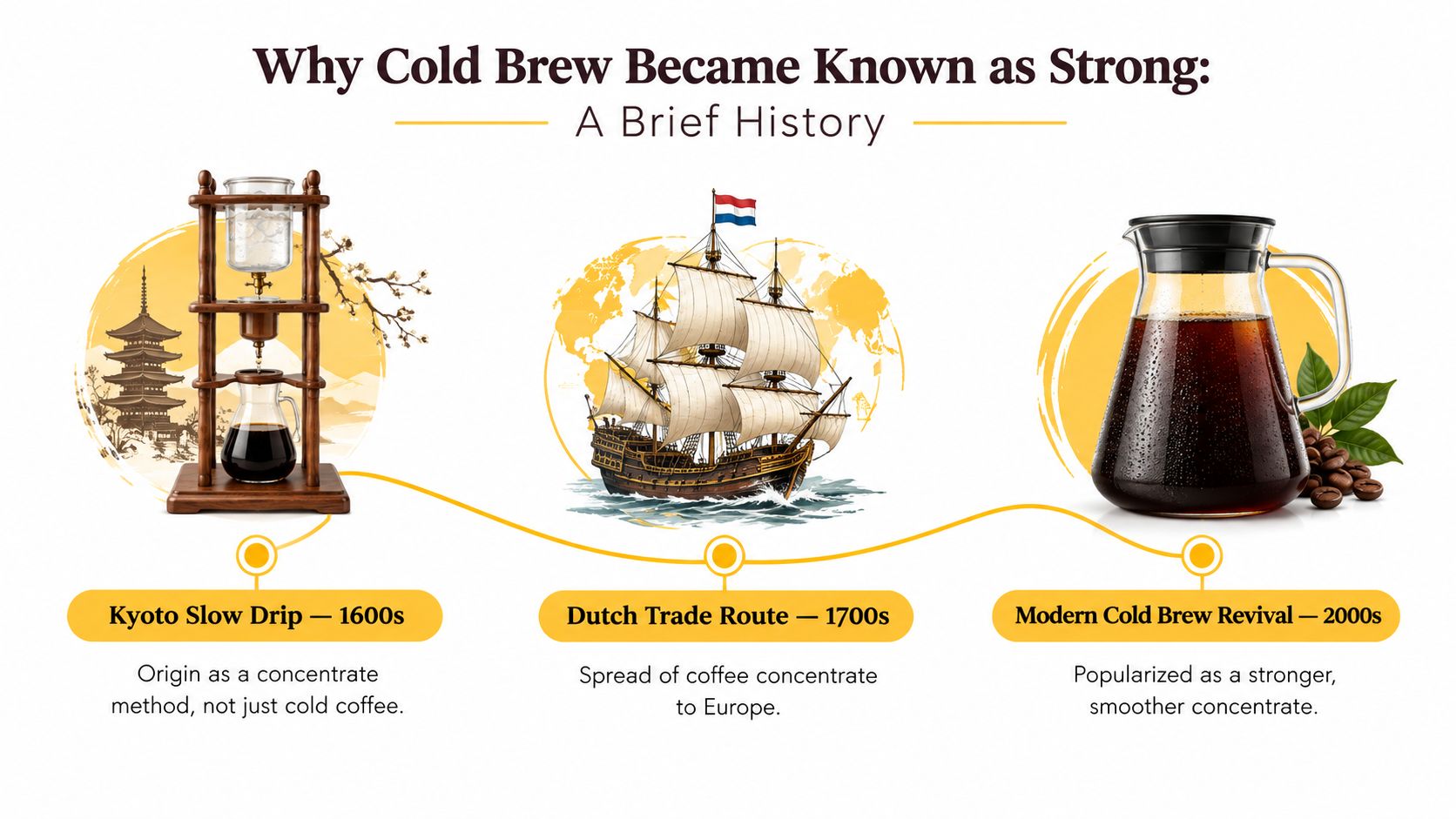
Cold brew became associated with strength because early versions were often designed as concentrated coffee extracts, not as iced versions of hot coffee.
Historical documentation traces early cold-brewing practices to 17th-century Japan and Dutch trade routes, according to this history of cold brew. Kyoto-style slow-drip brewing used water that passed gradually over coffee grounds for 10 to 12 hours. Other historical accounts describe concentrates prepared for long sea voyages, where a compact coffee base could later be diluted for drinking.
That format explains much of the modern reputation. A brewer who uses a relatively high coffee-to-water ratio and then adds water at serving time creates two products in one process: a dense base and a finished cup. The base tastes heavy and potent. The final drink may be much softer, depending on how much dilution the person adds.
Slow extraction shaped the style
Hot coffee uses heat to accelerate extraction. Cold brew takes a slower path, allowing water to draw soluble compounds from the grounds over an extended period. That slower process helped create the rounded, low-sharpness profile people now associate with cold brew.
The historical concentrate model also encouraged flexible serving. A café can pour the base over ice, mix it with milk, or add water. A bottled producer can formulate a ready-to-drink beverage before it reaches the shelf. A home brewer can keep the extract strong and adjust each glass separately.
The original idea wasn't simply “cold coffee.” It was coffee prepared in a form that could travel, store, dilute, and serve in different ways.
Modern cold brew still carries that history, even when it comes in a can or bottle. The product may be convenient and ready to drink, but consumers often expect the same smooth, concentrated character associated with the older methods.
That expectation is changing as cold formats move into mainstream and year-round use. One 2026 industry summary says U.S. non-espresso cold formats rose nearly 42% from 2020 to 2025, while the global cold brew market was worth almost USD 4 billion in 2026 and is projected to double by 2031, according to Nestlé's summary of cold coffee market growth. The same source notes that ready-to-drink cold brew reached $572.07 million in sales, with 14.3% dollar growth and 10.6% unit growth.
As cold brew becomes more convenient, “strong” can mean more than extraction. It can also mean satisfying, good value, easy to drink, and substantial enough for a daily routine.
What Actually Controls How Strong Your Cold Brew Tastes and Feels
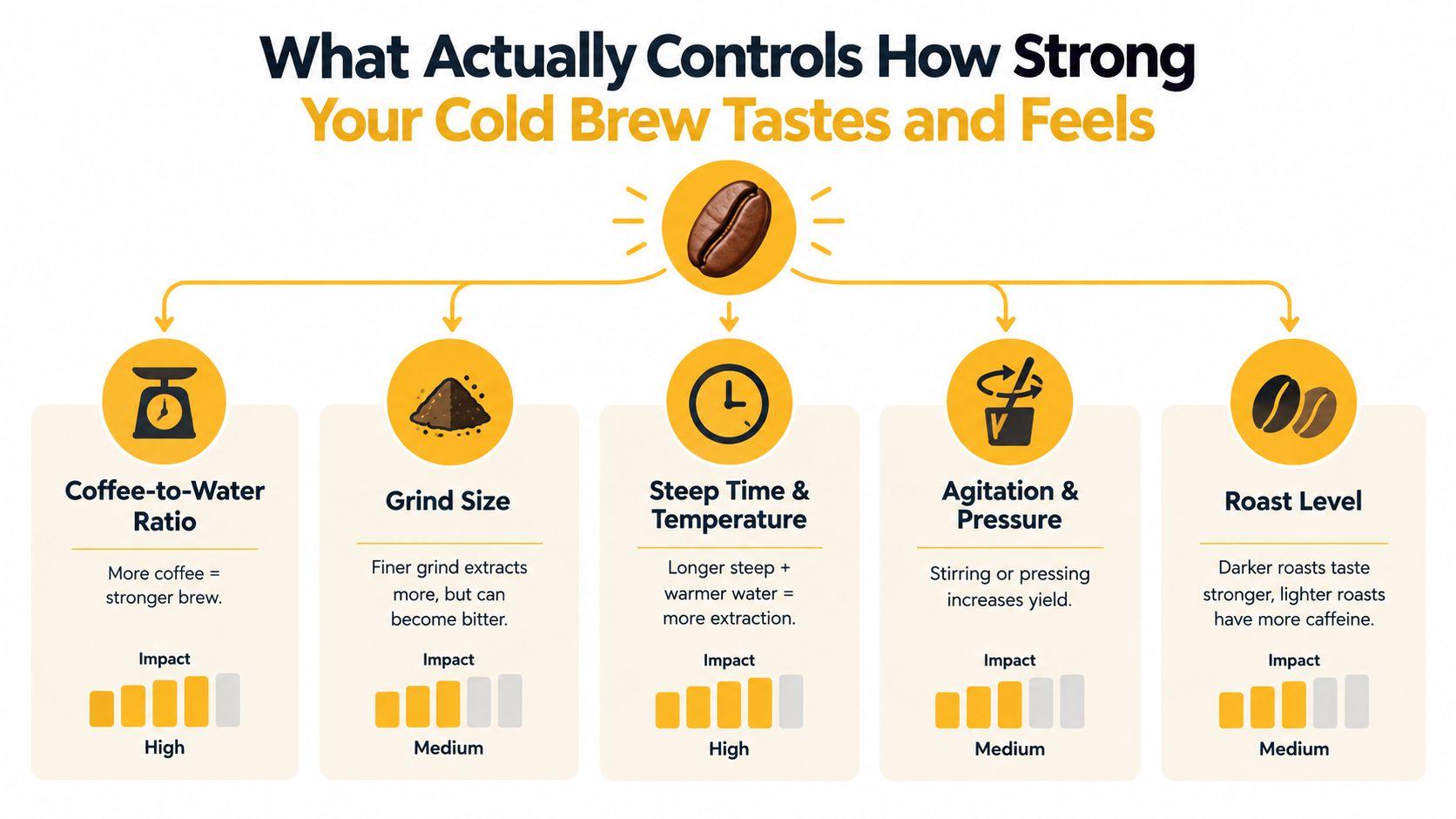
Cold brew strength comes from a group of variables, not from steeping alone. Change one part of the recipe and you may alter caffeine concentration, body, bitterness, clarity, or all four.
Coffee-to-water ratio
This is usually the clearest control. More coffee relative to water creates a more concentrated brew. Less coffee or more water produces a lighter drink.
A high-ratio concentrate may taste thick and intense straight from the jar, while a ready-to-drink recipe may be designed for immediate serving. If your cold brew tastes weak after adding ice and milk, the problem may be dilution rather than poor extraction.
Grind size
Grind size controls how easily water reaches the coffee's interior. A finer grind exposes more surface area and can increase extraction, but it may also produce sediment, harshness, or bitterness.
A coarse grind often gives home brewers a cleaner, calmer cup. If the coffee tastes thin, moving slightly finer may help. Make small changes rather than turning coarse grounds into powder.
Steep time and temperature
Time gives water more opportunity to dissolve coffee compounds, but longer doesn't mean unlimited strength. One controlled study found that caffeine extraction approached equilibrium in about 6 to 7 hours, and brewing times near 400 minutes extracted most available caffeine and chlorogenic acid from medium- and dark-roast beans at medium and coarse grinds, according to the controlled cold-extraction study.
Temperature matters, too. Warmer water generally speeds extraction, while colder water slows it. That changes how quickly the drink reaches its target, but extending time after caffeine extraction has largely plateaued may mainly shift flavor and bitterness.
Agitation and pressure
Stirring helps wet the grounds evenly. Agitation can increase contact between water and coffee, while pressure-assisted methods change how quickly water moves through the bed.
An optimized cold-extraction study reported 3.98 milligrams per milliliter of extracted caffeine, 11.20 °Brix, and a 93.9% caffeine yield at 24°C, with a 30% coffee-to-water ratio and 400 rpm stirring. A separate process study found vacuum-assisted methods could raise extraction yield to 22%, showing how strongly agitation, ratio, grind, and pressure can affect the result. These findings are detailed in the cold-extraction process research.
Roast level
Roast level changes flavor more reliably than it predicts caffeine. Darker coffee often tastes heavier, smokier, and more bitter. Lighter coffee may taste brighter and more aromatic, and roast density means caffeine comparisons based only on roast color can mislead.
The best diagnosis starts with taste. Thin and watery usually points toward more coffee, less dilution, or improved extraction. Harsh and drying may signal too fine a grind, too much agitation, or an extraction that has gone too far.
How to Make Cold Brew Stronger or Smoother at Home
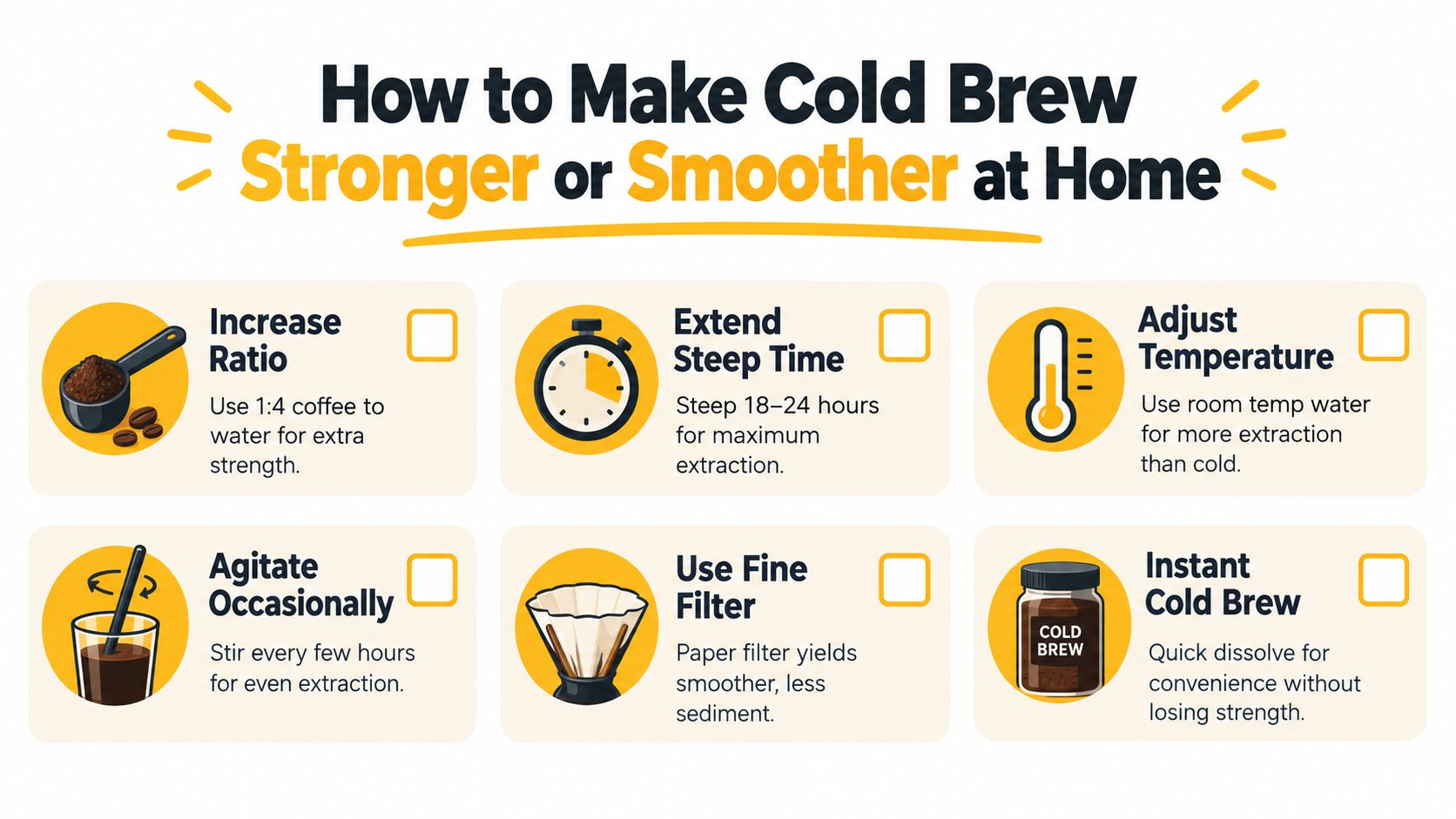
You don't need a new brewer to change the strength of cold brew. Start with the ratio, then adjust grind, time, temperature, and dilution one at a time so you know which change made the difference.
To make it stronger
- Use more coffee: A higher coffee-to-water ratio gives you a denser base. A 1:4 ratio is commonly used for concentrate, but your final serving still depends on how much water, milk, and ice you add.
- Reduce dilution: Pour less water into the finished glass, or use coffee ice cubes so melting ice doesn't flatten the flavor.
- Move slightly finer: If the brew tastes hollow rather than merely light, a modestly finer grind may improve extraction. Stop if the cup becomes gritty or bitter.
- Stir thoroughly at the beginning: Every ground should become wet. Unevenly saturated grounds can leave the finished coffee weak even when the recipe uses plenty of coffee.
To make it smoother
Smoother doesn't always mean less coffee. Filter the brew carefully with a paper filter or fine mesh system to remove sediment, then soften the cup with water, milk, or cream. Ice can lower perceived intensity as it melts, although it also changes the flavor over time.
Time deserves a careful adjustment. Research found that caffeine extraction can reach near-equilibrium in about 6 to 7 hours, so adding many more hours isn't a guaranteed way to create a more caffeinated drink. The cold brew timing research supports treating steep duration as a control, not a race.
For a more traditional home method, brewing guidance often uses a longer steep to develop deeper flavor, but the ideal point depends on your ratio, grind, and water temperature. Keep a simple note of those variables and taste the result before changing the next batch. Cartograph Coffee's cold brew timing guide can help you think through the timing decision without treating one steep length as universal.
Instant cold brew for busy days
Instant cold brew offers a different kind of control. Add the coffee to cold water, stir or shake until dissolved, and then adjust the drink with more water, ice, or milk. It works at a desk, on a campsite, or during travel because you can change the final concentration in the glass instead of carrying a brewing setup.
Cartograph Coffee's organic instant coffee is one option for people who want a portable preparation that dissolves quickly. It can be prepared as a stronger small drink or softened into a longer cold beverage, depending on the amount of water and additions.
If you want a lower-intensity evening drink with warm spices rather than a caffeine-focused cold coffee, this soothing evening chai guide offers a useful alternative direction. The main lesson is to choose the drink that fits the time of day, not to chase maximum strength at every hour.
Choosing Your Ideal Strength and Enjoying It Daily
The strongest cold brew isn't automatically the most useful one. Your ideal cup should match the moment, the serving size, and how long you want to enjoy it.
Use this quick decision guide:
- For a morning lift: Choose a concentrated base or a clearly labeled ready-to-drink serving, then avoid adding so much ice or milk that the flavor disappears.
- For an afternoon sipper: Use more water and ice to lower perceived intensity. A smooth, lighter cup may be easier to drink slowly.
- For work or travel: Choose an instant format that lets you control the concentration without a jar, filter, or long steep.
- For outdoor use: Prioritize portability and easy cleanup. A small packet and cold water can be more practical than preparing concentrate in advance.
- For a creamy drink: Add milk after tasting the coffee first. This guide to milk in cold brew explains how dairy and alternatives can change body and balance.
The market's growth has expanded the meaning of strength. As cold coffee becomes a ready-to-drink, year-round category, a strong product may mean a bold flavor, a satisfying serving, good value, or enough convenience to become part of a daily routine. Those qualities matter alongside caffeine.
Taste before you adjust. If the drink feels too sharp, add water or milk. If it tastes empty, increase concentration or improve extraction. If it feels heavy but not flavorful, try a cleaner filter or a different coffee rather than adding more grounds.
You don't need to solve cold brew with one perfect recipe. Treat caffeine, flavor, and smoothness as three separate dials, then turn each one until the cup fits your routine.
Cartograph Coffee offers organic instant coffee for convenient preparation at home, work, or outdoors, letting you adjust your cold drink's concentration with the water, ice, or milk you choose. Visit Cartograph Coffee to find a practical coffee option for your next stronger, smoother, or more portable cup.