On a rushed weekday, instant coffee earns its place. You pour hot water into a mug, stir once or twice, and watch the granules disappear before you've fully woken up. Then you notice the small Fairtrade or organic badge on the jar and wonder what, exactly, that symbol represents once the coffee has dissolved.
The answer isn't found in the mug alone. Before becoming a spoonful of powder, the coffee passed through farms, cooperatives, mills, exporters, roasters, extraction plants, drying equipment, and packaging lines. Fair trade can improve conditions at important points in that chain, but the label doesn't automatically explain who benefits, how much value stays at origin, or what happens during instant processing.
This guide separates those questions in plain language. It looks at what fair-trade certification delivers at the green-coffee stage, what it can cover in soluble-coffee production, and where buyers still need to investigate price, flavor, labor, and packaging trade-offs.
A Familiar Morning and a Quiet Question
The kettle clicks off. You're standing in the kitchen with one hand on your phone and the other around a jar of instant coffee. A teaspoon of brown granules drops into the mug, hot water follows, and within seconds the drink is ready. Convenience is the whole point.
The label, however, tells a much longer story. A Fairtrade mark may represent coffee purchased through a certified supply chain, with rules intended to protect farmer economics and working conditions. An organic seal addresses how the coffee was grown. Neither mark describes the moment the granules dissolve, and neither one guarantees that every business involved in the product follows the same standard.
That distinction matters because instant coffee is a processed food, not just ground beans in a jar. Green coffee must be sourced, sorted, roasted, brewed into an extract, concentrated, dried, and packed. Some products use spray-drying, while others use freeze-drying to turn brewed coffee into granules that can be rehydrated at home.
Convenience hides a long chain
A cup made in seconds may depend on years of cultivation and a complex commercial relationship. Farmers grow and harvest the coffee, producer organizations aggregate it, mills prepare it, and exporters or importers move it toward manufacturers. At the processing end, a soluble-coffee facility transforms the roasted coffee into the format buyers recognize as instant.
That chain creates both opportunity and uncertainty. Certification can establish a meaningful floor beneath the price paid for qualifying coffee, while a social premium can support producer organizations and community decisions. But those benefits don't automatically answer whether the processing workforce receives comparable protection or whether the premium reaches every farmer connected to the product.
The useful question isn't only “Is this fair trade?” It's “Which part of the chain does the certification cover, and what evidence shows where the value goes?”
The sections that follow treat instant coffee fair trade as a supply-chain question rather than a badge-recognition exercise. You'll see what the major labels mean, how premiums and price floors work, why processing changes the economics, and how to make a more informed choice without pretending any single seal solves every problem.
What Fair Trade Actually Means for Instant Coffee
Fair trade is a third-party verified sourcing system. In coffee, it can include a guaranteed minimum price, a separate social premium, and standards covering labor, producer organization, and environmental practices. The exact rules depend on the certification scheme, so “fair trade” isn't one universal contract.
A simple analogy is a minimum wage combined with a community fund. The price floor is intended to prevent qualifying coffee from falling below an established level during weak market conditions. The premium is additional money paid into the producer organization, where members decide how to use it under the applicable rules.
For instant coffee, the process usually begins with green coffee rather than finished granules.
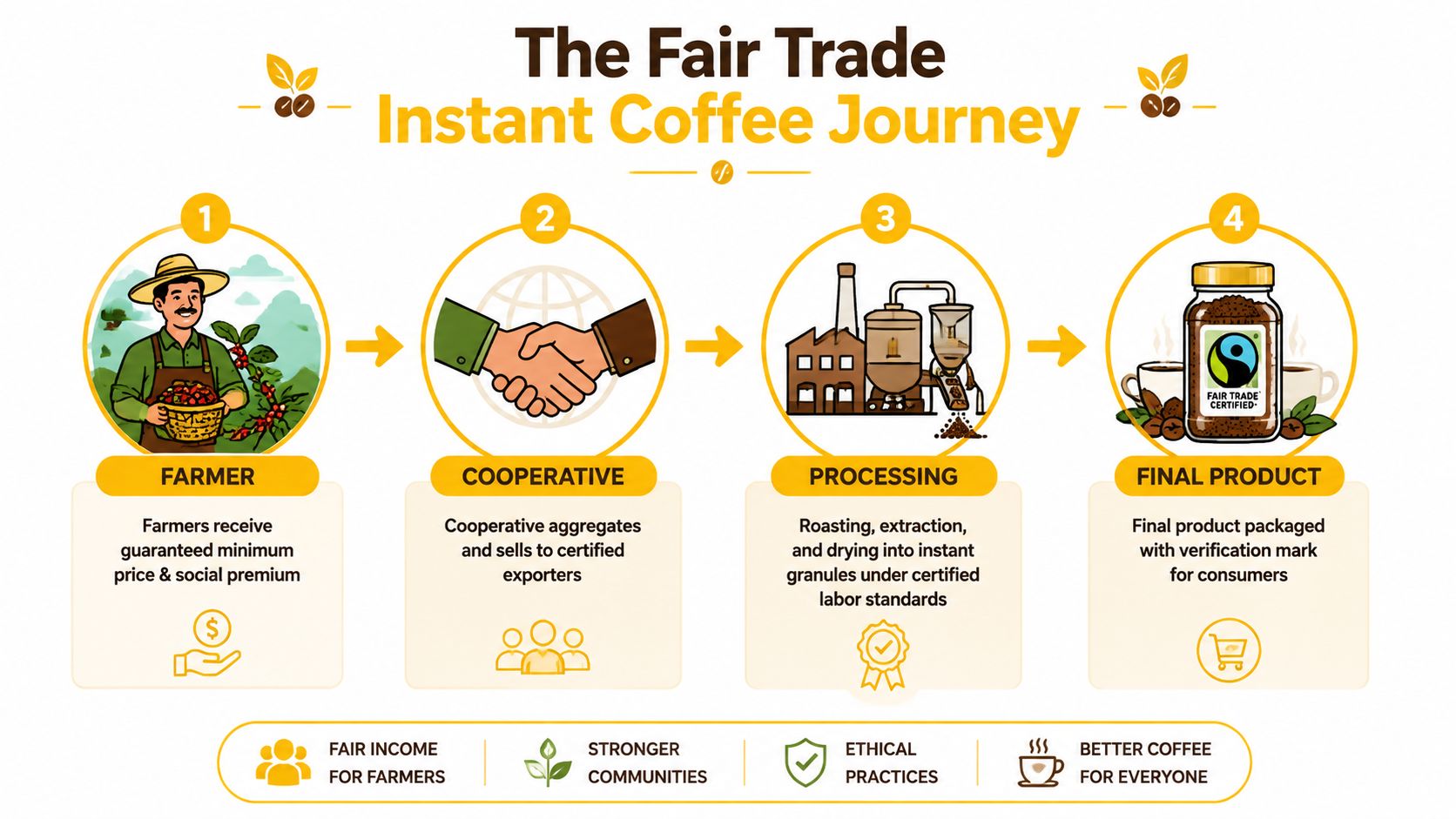
- A brand or importer buys qualifying green coffee from a cooperative, producer organization, or estate.
- The coffee is milled, graded, exported, and transported to a roasting or soluble-coffee facility.
- The manufacturer roasts and extracts the coffee, creating a concentrated liquid.
- The extract is dried, commonly through spray-drying or freeze-drying, and then packed into jars, sachets, or other formats.
- Audits and chain-of-custody records connect the certified input and approved businesses to the final claim.
Who pays and who receives the money
The brand, importer, or other licensed buyer pays for certified coffee under the relevant commercial arrangement. The producer organization receives the money connected to the coffee sale, and the premium is generally managed through the cooperative or qualifying organization rather than handed to a consumer-facing charity.
That structure is important. A cooperative may use premium funds for processing equipment, farm support, community infrastructure, training, or direct distributions, depending on member decisions and program rules. A buyer shouldn't assume that the premium becomes an equal cash payment to every worker or household.
Certification also doesn't cover every actor automatically. A farm, cooperative, exporter, processor, and brand may each have different obligations, licenses, or audit status. The mark on the jar therefore represents a defined claim about an approved supply chain, not a blanket guarantee about every business that touched the coffee.
For a concise introduction to the underlying concept, see this plain-language guide to what fair trade coffee means. The key point is straightforward: the certification operates through documented transactions and verified standards, not through the fact that instant coffee is convenient or ethically marketed.
The Certifications You Will See on the Shelf
A shelf can hold several labels that look morally similar but make different promises. Fairtrade International uses the familiar blue-and-green mark associated with producer standards, minimum pricing in relevant coffee categories, and a social premium. Fair Trade USA is a separate North American certification system, so its requirements and pricing arrangements shouldn't be treated as identical to Fairtrade International.
Rainforest Alliance focuses heavily on environmental stewardship, farm management, labor conditions, and ecosystem protection. It isn't interchangeable with a fixed fair-trade price floor. UTZ, now incorporated into the Rainforest Alliance system, is more likely to appear on older packaging or legacy materials than on newly designed products.
Other marks answer different questions. Smithsonian Bird Friendly emphasizes habitat and biodiversity requirements, while EU Organic and USDA Organic address production methods and permitted inputs. Organic certification doesn't itself promise a minimum coffee price or a social premium.
A practical shelf comparison
| Certification | Price Guarantee | Premium | Key Focus | Covers Instant Processing |
|---|---|---|---|---|
| Fairtrade International | Uses a defined minimum price for covered coffee when the market price falls below it | Yes, under program rules | Farmer economics, producer organization, labor and environmental standards | Can cover approved processing and chain-of-custody activities |
| Fair Trade USA | Uses its own pricing and sourcing rules | Program-dependent | Fair trade sourcing, producer and worker standards | Depends on the certified product and approved facilities |
| Rainforest Alliance | No general Fairtrade-style fixed coffee floor | May involve market arrangements, but isn't the same as a Fairtrade premium | Farming practices, ecosystems, labor and resilience | May cover certified supply-chain actors under its rules |
| UTZ | Not a Fairtrade-style fixed minimum price guarantee | Historically associated with a premium structure | Farm management, traceability and labor practices | Legacy claims depend on the product and certification period |
| Smithsonian Bird Friendly | No fixed fair-trade price guarantee | Not the central promise | Bird habitat, shade and biodiversity | Applies primarily to qualifying coffee production and supply-chain verification |
| EU Organic or USDA Organic | No fair-trade price guarantee | No social premium created by the organic seal alone | Organic production methods and permitted inputs | Organic status can apply to the ingredient and finished product if requirements are met |
The table simplifies standards for shelf reading, not legal interpretation. A product carrying Organic + Fair Trade may combine two audits and two different kinds of assurance. Organic addresses production methods, while fair trade addresses commercial and social conditions. The seals can complement each other, but one doesn't duplicate the other perfectly.
Claims that aren't certification marks
“Ethically sourced,” “farmer-friendly,” and “direct trade” can describe a real purchasing philosophy, but these phrases are usually brand claims rather than standardized third-party certifications. A direct relationship may provide more information than a conventional supply chain, or it may provide less independent verification. The buyer needs to ask what the company means, how it sets prices, and whether it publishes producer or lot information.
Instant processing adds another layer. A certified green-coffee input doesn't automatically mean every factory worker, packaging supplier, or logistics provider operates under the same standard. Read the label as a map of verified claims, not as a universal ethical verdict.
How Fair Trade Reaches the Farmer
The money doesn't travel from your jar to one farmer in a straight line. It moves through contracts, producer organizations, mills, exporters, importers, manufacturers, distributors, retailers, and taxes. The farmer's outcome depends on the price paid for qualifying coffee, the organization's decisions, production costs, and the strength of the local supply chain.
A cooperative aggregates coffee from members and may provide services such as processing, storage, technical assistance, and market access. An estate, by contrast, controls production on a larger farm or plantation, with a different labor and ownership structure. The same certification language can therefore sit over very different realities.
What the evidence supports
Fair Trade certification can matter most when the market price falls below the guaranteed minimum. A Harvard-linked study of Costa Rican coffee mills found certification was associated with higher sales prices, greater sales, and more revenue, and it reduced the probability that a mill would close or leave the industry when the Fair Trade floor was binding. The study's findings are discussed in the research paper on Fair Trade and coffee mills.
The benefits weren't universal. The research found gains concentrated at the mill level and in farm-owner income, with no measurable benefit for unskilled workers. That limitation matters because a label can improve the economics of a supply relationship without creating equal gains for everyone who works within it.
Fairtrade International's reporting shows the system has substantial scale. Earlier reporting counted 582 certified coffee producer organizations across 32 countries, representing 762,392 farmer members, while coffee sales volumes grew 15% from 2016 to 2017 and reached 214,335 metric tonnes in 2017. More recent reporting said that in 2024, Fairtrade worked with 522 coffee producer organizations representing about 679,000 smallholder households, and Fairtrade coffee sales totaled 142,000 metric tonnes, about 2% of global coffee volumes. These figures appear in Fairtrade International's coffee monitoring report.
The soluble-coffee complication
| Value Chain Step | Typical Share of Retail Price | Farmer-Relevant? |
|---|---|---|
| Farm production | Varies by origin, yield, labor, and contract | Yes, this determines the initial coffee price and farm income |
| Cooperative or estate processing | Varies by services and operating costs | Yes, processing quality and costs affect what the producer can sell |
| Exporting and importing | Varies by logistics, finance, and risk | Indirectly, these costs shape the buyer's offer |
| Roasting and soluble extraction | Varies by equipment, scale, and product format | Indirectly, these costs affect how much value remains for sourcing |
| Drying and packaging | Varies by technology and packaging format | Indirectly, these costs shape the retail price and product positioning |
| Retail and distribution | Varies by channel and commercial terms | Indirectly, retailer margins affect the final price consumers see |
For instant coffee, spray-drying plants and soluble extractors add significant manufacturing steps after the green-bean purchase. The premium still has to be administered through the certified relationship, but downstream costs can make it harder for a buyer or consumer to see how much value reaches the farm.
That doesn't make certification meaningless. It means a careful buyer should distinguish between a protected purchase condition for the coffee input and a complete account of labor and income throughout the finished-product chain.
Where Fair Trade Meets Organic and Quality
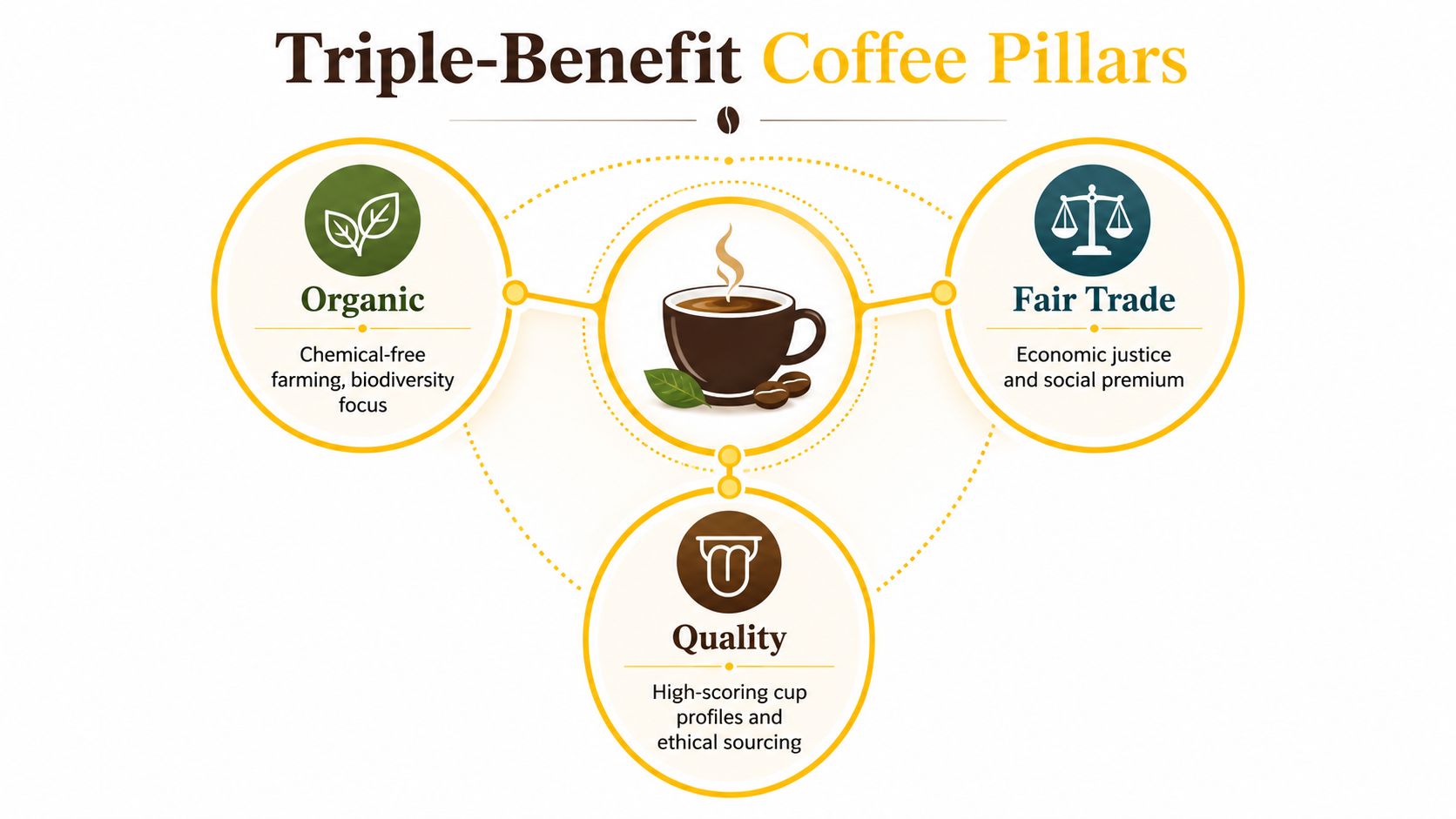
Organic, fair trade, and quality describe different dimensions of one product. Organic certification concerns farming methods and permitted inputs. Fair trade concerns economic and social conditions within a defined sourcing system. Quality concerns the coffee's sensory character, consistency, and how well the producer and manufacturer preserve it.
These attributes often appear together because they appeal to overlapping buyers and can share parts of the documentation process. They don't guarantee one another. Organic coffee can be poorly roasted, fair-trade coffee can taste ordinary, and a flavorful product can make no certified ethical claim at all.
Why organic and fair trade often share a label
Farmers pursuing organic certification may need training, record keeping, input controls, and inspection. Fair-trade producer organizations may already have member structures and administrative systems that make additional certification more practical. The two seals can therefore reinforce one another operationally, even though they answer separate buyer concerns.
The trade-off appears at farm and factory level. Organic rules can constrain pest-management options and may require more careful attention to soil health and farm labor. Instant manufacturers also need coffee that extracts efficiently and delivers a stable flavor in a soluble format. Some blends may use robusta or lower-grade arabica for body, cost control, or extraction performance, while others emphasize distinctive arabica lots.
Quality survives when the process respects the coffee
Freeze-drying can preserve more of the aroma and character of the brewed extract than a harsher process, but the result still depends on the green coffee, roast profile, extraction method, and storage. Specialty instant products show that ethical sourcing and flavor ambition aren't automatically opposed. They also tend to expose the cost of small-batch production more clearly than mass-market jars.
A product carrying organic, fair-trade, and Rainforest Alliance or UTZ-related claims may offer several forms of assurance, but the seals can overlap in labor and environmental areas. They still don't answer every question about processing wages, packaging, or how a premium is distributed.
For a closer look at the farming side of the organic claim, see this guide to organic certified coffee. Then taste the coffee without treating the label as a flavor description. Certification can improve the conditions around production, but it can't replace sound roasting and careful soluble processing.
How to Verify a Fair Trade Claim Before You Buy
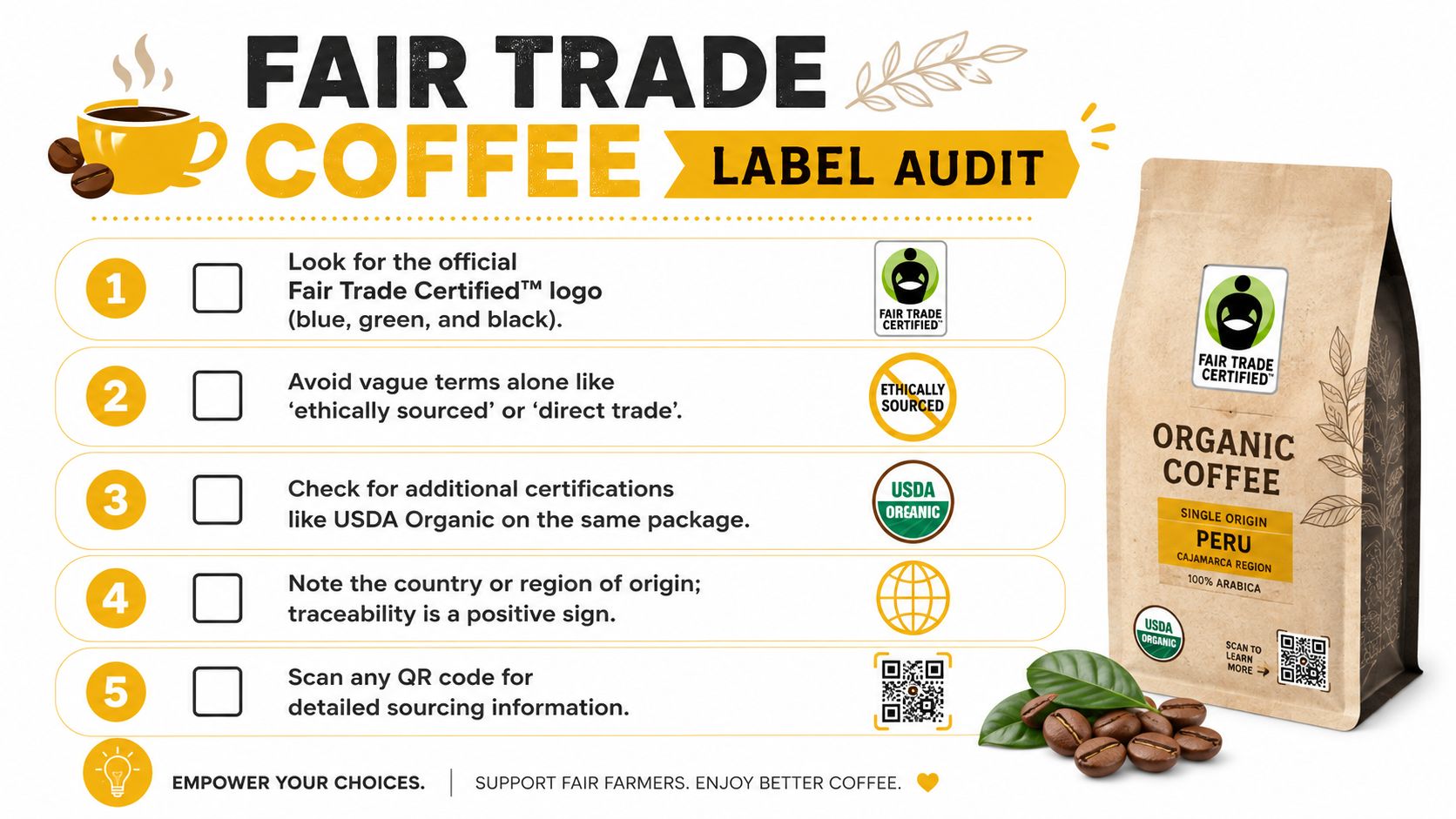
A useful label audit takes less than a minute if you know what to look for. Start with the mark itself, not the front-of-pack language. A recognized certification logo carries more weight than a green image, a smiling farmer, or a phrase such as “responsibly sourced.”
Five checks for the shelf
- Find the official mark. Look for the relevant Fairtrade International or Fair Trade USA logo and any licensing or certification information printed on the package. A brand-created symbol isn't equivalent to a third-party mark.
- Read the wording closely. “Made with Fairtrade coffee” may describe an ingredient rather than the entire product. Ask whether the package states the certified share clearly.
- Separate organic from fair trade. USDA Organic or EU Organic can confirm production methods, but those seals don't create a fair-trade price floor or social premium.
- Look for traceability clues. Country, region, producer organization, lot number, roast information, or a QR code can give the buyer more to investigate. None proves a claim by itself, but missing detail makes follow-up harder.
- Check the brand or certification database. If the product matters to you, compare the printed mark and license information with the certifier's current public information or the brand's sourcing documentation.
Instant-specific greenwashing signals
Composite products deserve extra attention. A jar may contain a blend in which only part of the coffee carries the certified claim, depending on the applicable product rules. A front label showing a farm, a hand, or a community project doesn't establish certification, either.
Price can provide context, but it isn't proof. Certified coffee can command a premium, and one pricing study found Fair Trade Certified coffee averaged $10.98 compared with $7.44 for all coffees, while estimating a certification-linked increase of about $0.12 per pound in a fixed-effects model. Cross-sectional comparisons showed differences of as much as $2.42 per pound. Those findings are summarized in the verified product and pricing information provided for this topic, but retail price alone can't reveal how a brand distributes value.
Practical rule: Treat a precise claim as an invitation to ask for its definition, not as a substitute for evidence.
Use the following video as a visual introduction to reading coffee sourcing claims and recognizing the difference between a logo and a promise.
Three quick heuristics help. Official mark beats vague language. Specific origin and traceability beat stock imagery. A clear explanation of the certified ingredient and processing chain beats a broad promise about helping farmers.
How Cartograph Coffee Approaches Ethical Sourcing
A small instant brand can make its sourcing philosophy visible by connecting the product to identifiable origins and explaining what happens after the coffee leaves the farm. Cartograph Coffee describes a model built around producer cooperatives in Colombia, Peru, and Ethiopia, with attention to traceability and quality rather than treating instant coffee as an anonymous commodity.
Its stated approach combines fair pricing with origin investment. The company describes paying above Fair Trade minimum prices and reinvesting a documented percentage into projects such as seedling nurseries and water treatment. Those practices go beyond printing an ethical phrase on a packet because they give buyers specific categories to investigate, including the price paid, the project recipient, and the reporting period.
The processing question remains central
Cartograph Coffee's instant product uses an organic coffee input and a soluble format designed for convenience. The company's stated processing model contracts spray-drying through a B-Corp facility in Portugal audited for labor standards. That distinction is useful because it addresses a part of the chain that a farm-focused label may leave unclear.
Transparency also depends on records. Cartograph Coffee describes lot numbers on its jars and an annual impact report, which can help connect a finished product to sourcing and production information. Buyers should still read those documents critically, asking whether they identify producer organizations, explain price mechanisms, and separate certified claims from broader company commitments.
The model illustrates a practical middle path. Third-party certification can establish a baseline, while direct relationships and public reporting can add context about origin projects and processing. Neither approach should be treated as complete on its own.
For readers comparing formats, Cartograph Coffee's organic instant coffee packets offer an example of how organic sourcing, instant convenience, and origin-focused communication can appear in one product. The relevant test isn't whether a brand uses the right vocabulary. It's whether the company makes its claims specific enough for a buyer to check.
Common Questions Buyers Actually Ask
Does fair-trade instant coffee taste different?
Not because of the certification alone. Fair trade describes sourcing conditions, not a roast profile or flavor score. Taste depends on origin, species, variety, processing, roasting, extraction, drying method, and storage.
Freeze-dried instant coffee can preserve more aromatic detail than a heavily processed product, while spray-dried coffee may emphasize consistency, body, and cost efficiency. A well-sourced coffee can still taste flat if the roast or extraction is poorly handled. Conversely, a conventional instant coffee may taste appealing even though it makes no fair-trade claim.
Why does it cost more?
Certified sourcing can involve premiums, auditing, record keeping, and producer-organization administration. Specialty instant coffee can also require smaller production runs and more expensive freeze-drying equipment than commodity agglomerated products.
That cost doesn't make every expensive jar worthwhile. It does explain why a premium convenience product may sit above a supermarket staple. The buyer is paying for more than dissolved coffee, including sourcing, manufacturing, packaging, and the commercial risk of producing a differentiated product.
Why isn't it everywhere?
Mass grocery distribution favors products with predictable volume, broad consumer recognition, and established manufacturing economics. Fair-trade instant coffee may be easier to find through specialist retailers, roasters, brand websites, and online marketplaces than in every local shelf set.
Availability also changes by region. Look for the actual certification mark, origin information, and a clear ingredient statement rather than assuming that a scarce product is automatically more ethical.
Does certification matter if a roaster buys direct?
It can. Direct trade may offer detailed relationships, negotiated prices, and origin projects, but the phrase itself usually isn't a standardized third-party certification. Certification provides an audit framework and defined requirements. A direct relationship can provide richer context, but it depends heavily on the roaster's transparency and records.
The strongest model may combine both: independent verification for baseline claims, plus direct information about prices, producer organizations, processing, and long-term commitments.
How should I store it?
Keep the jar or packets sealed, dry, and away from heat and strong odors. Close an opened jar promptly because moisture can cause clumping and gradually dull the aroma. Flavor degradation is usually gradual rather than dramatic, so buy an amount you can use comfortably and judge the coffee by smell and taste rather than relying only on the printed date.
Fair trade isn't a reason to ignore flavor, price, or packaging. Choose the product whose sourcing evidence, taste, format, and environmental trade-offs fit your priorities, then use it consistently enough to know whether the promise holds up in your daily mug.
Cartograph Coffee offers organic instant coffee in a convenient format for work, travel, camping, and home use, with sourcing information intended to connect the product to this wider conversation about ethical coffee. Visit Cartograph Coffee to review its instant options and sourcing approach before choosing your next jar or packet.