You're halfway to work, the ice is ready, and the instant coffee is sitting beside a carton of cold milk. You pour the granules straight into the glass, stir hard, and end up with a pale drink, gritty sediment, and very little coffee flavor. The fix isn't more ice or an arbitrary extra spoonful of powder. It's learning how to make iced latte with instant coffee as a controlled dilution, so the coffee dissolves fully before milk and melting ice change its strength.
Why Your Instant Iced Latte Tastes Weak
The usual failure happens in a hurry. You add instant coffee to cold milk, drop in ice, and expect stirring to do the rest. Cold milk is thick enough to slow dispersion, while the ice immediately starts adding water to the drink. Some powder may dissolve, but the coffee base never becomes concentrated enough to hold its flavor.
That's why the finished latte can taste weak even when the glass contains plenty of coffee. You've diluted the drink before the granules have had a fair chance to dissolve. The problem is mainly sequence, not necessarily the quality of the instant coffee.

Instant coffee was built for this kind of convenience
Instant coffee has always been associated with portability. The earliest known powdered coffee product dates to 1771, when Britain granted John Dring a patent for a “coffee compound.” Later developments included David Strang's 1890 patent for soluble coffee powder in New Zealand and Sartori Kato's powdered coffee, introduced publicly in Buffalo in 1901. George Washington developed commercially viable coffee crystals around 1910, and the product became popular during World War I because it was lightweight and easy to prepare. In 1938, Nestlé introduced Nescafé using spray-drying technology, a major step in turning brewed coffee into a dry product that could be rehydrated. The Smithsonian's history of instant coffee places today's quick preparation in that longer story of convenience.
The same design makes instant coffee useful for an iced latte. It's already a soluble coffee extract, so you don't need a brewer, espresso machine, or long steep. You need enough warm liquid to activate it, followed by deliberate dilution.
The practical shift
Think of the first liquid as a coffee concentrate, not the final drink. Dissolve the powder in a small amount of warm water, sweeten it while it's still easy to stir, then combine it with cold milk and ice. This keeps the coffee flavor present after the drink cools and the ice begins to melt.
For a deeper look at the amount of water that works with different doses, use this instant coffee water ratio guide. The useful principle is simple: concentrate first, dilute second.
The Concentrate-First Method
A reliable iced latte begins in a small cup or measuring glass, not in the serving glass. You're making a compact coffee base that can dissolve completely and still taste distinct after you add milk and ice.
Start with the coffee base
Use approximately 1.2–1.7 grams of instant coffee and 50–100 milliliters of water heated to about 80–90°C, following the practical range described in this instant coffee dissolution research. The lower water volume produces a thicker, more intense base. The larger volume gives the powder more room to disperse and may be easier when you're working without a scale.
Add the water to the powder and stir vigorously. Don't sprinkle the coffee over a full glass of milk and hope it disappears. A small warm-water volume lets every granule contact liquid directly.
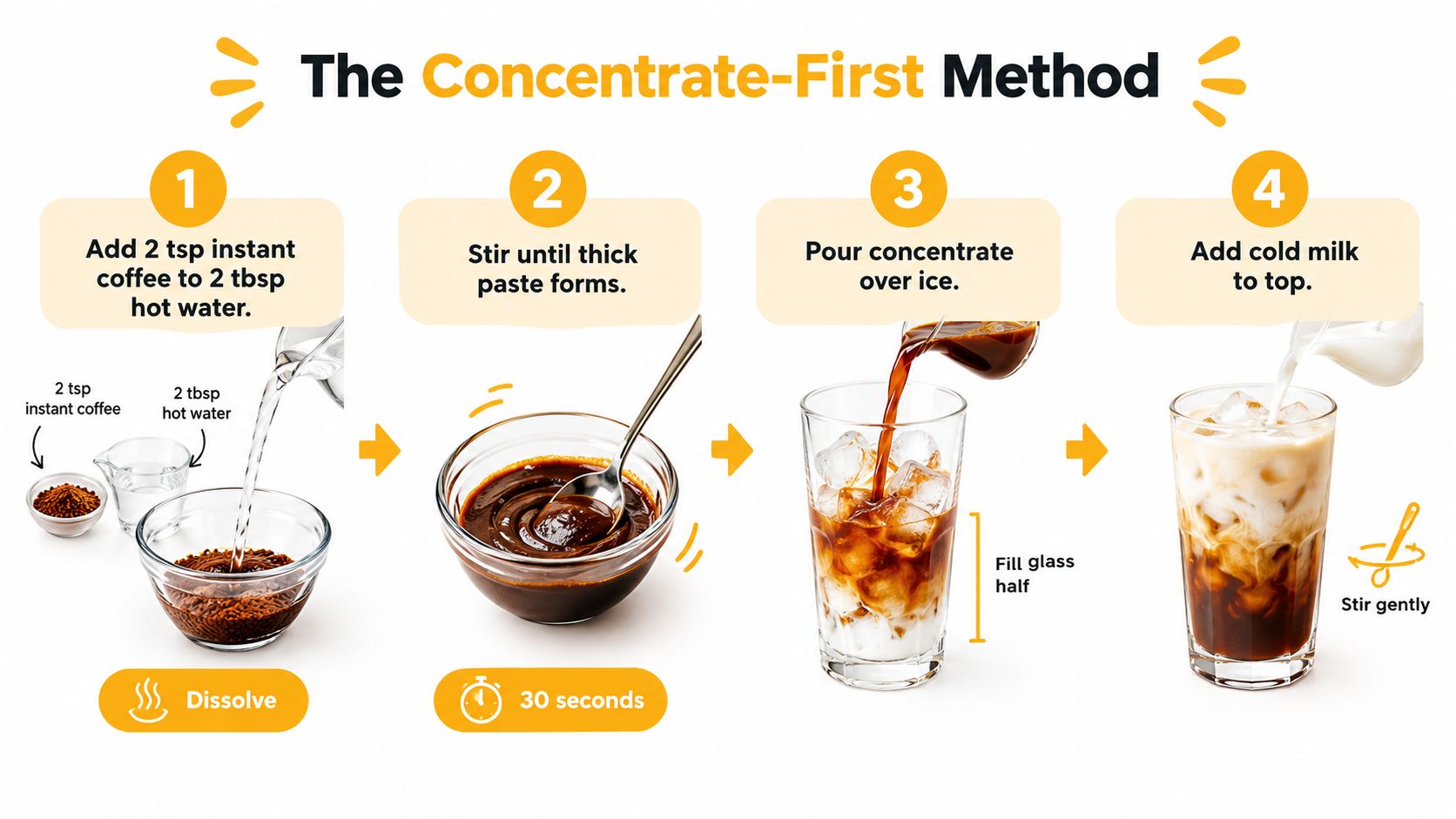
Stir until the concentrate is smooth
Keep stirring until you can't see dry flecks or floating particles. A practical quality check is complete visual dissolution within roughly 10–20 seconds of vigorous stirring. If granules remain, the water may be too cool, the agitation may be too gentle, or the dose may be too high for the amount of water.
Use water that's hot but not boiling. Higher heat generally helps instant coffee dissolve, but boiling water can push bitterness forward and cause aromatic notes to fade faster. For a portable setup, water from a thermos can work well if it's still hot enough to disperse the powder.
Add sugar, honey, or another sweetener to the concentrate now. Sweetener dissolves more readily in the warmer, less viscous coffee base than in cold milk or over ice. You'll also taste the sweetness before dilution, which makes adjustment more predictable.
Assemble without shocking the drink
Put 120–180 milliliters of cold milk and 100–150 grams of ice in your serving glass, then pour in the concentrate. Alternatively, pour the concentrate over the ice first and add the milk afterward for a layered appearance. Stir gently at the end so you combine the drink without rapidly warming the ice.
For a complete concentrate-focused workflow, see this concentrated coffee recipe. The approach works at a desk, in a hotel room, or at a campsite because the dry coffee and sweetener can be measured in advance. All you need at the destination is a small vessel, hot water, cold milk, and ice.
Practical rule: If the coffee still looks grainy before the milk goes in, the drink isn't ready for ice yet.
Understanding Dilution and Ice Melt
An iced latte is a dilution problem with three changing components: coffee concentrate, milk, and water released by melting ice. Control them separately, and you can adjust coffee intensity, texture, and caffeine without changing every part of the recipe.
Start with 2 grams of instant coffee, 60 milliliters of hot water, 150 milliliters of milk, and 120 grams of ice. This starting ratio, supported by research on coffee extraction and dilution, keeps the coffee noticeable while leaving room to adjust the final drink.
The first water addition becomes part of the latte, so measure it deliberately. Too much creates a weak base before milk or ice enters the glass. Too little can leave powder undistributed. Use enough water to dissolve the coffee fully, while keeping the concentrate dense enough to withstand later dilution.
What melting ice changes
Melting ice adds plain water, lowering the concentration of coffee and milk solids. A latte that tastes balanced right after mixing can become thin if it sits over small pieces that melt quickly.
Dense cubes usually stay intact longer than crushed ice, preserving the original balance for more time. Chill the milk before assembly too. Cold milk gives the ice less cooling work, which helps reduce melt during mixing.
Change one variable at a time:
- More coffee intensity: Keep the initial water modest and increase the coffee only according to the product's serving guidance.
- More milk flavor: Keep the concentrate unchanged and add cold milk, accepting a softer coffee profile.
- Less dilution: Use dense cubes and drink the latte soon after assembly.
- A milder glass: Keep the coffee amount steady and increase the milk instead of adding extra water to the concentrate.
For repeatable results, record the recipe by mass. Cup volume can mislead, and ice pieces differ in size and melt rate. Weighing the milk and ice gives you a steadier starting ratio than filling a glass “about halfway.”
Reconstitution is different from cold brew
Ground coffee needs time for water to extract soluble compounds. A controlled coffee extraction comparison reported equilibrium times of about 36 hours at 4°C and 12 hours at 22°C for cold-water extraction. Instant coffee has already been processed into a soluble extract, so it does not need that steeping period.
That difference makes a short warm-water concentrate practical. You are rehydrating coffee that has already been extracted, then controlling how much milk and melted ice reach the finished drink. The coffee dose controls intensity and caffeine, while milk and ice control texture and dilution.
Customizing Milk and Flavor
Once the coffee base is smooth, milk choice becomes a texture decision as much as a flavor decision. Dairy milk usually brings a rounded body and a familiar latte profile. Oat milk often contributes sweetness and a fuller sensation, while almond milk can make the drink feel lighter and more nutty. Soy milk adds a distinct bean-like flavor and can provide a substantial mouthfeel, while coconut milk introduces a pronounced tropical note that may compete with delicate coffee.

Match the milk to the concentrate
A thinner milk can make the same coffee dose taste sharper because it contributes less body. Start with the concentrate-first method, then adjust milk rather than immediately adding more powder. If the drink tastes hollow, try a milk with more body. If it tastes heavy, use a lighter milk or increase the cold milk slightly.
Sweetened plant-based milk also changes the balance before you add syrup. Taste the assembled latte first, then add flavor in small increments to the coffee base the next time you make it. Syrup added to cold milk can sink or distribute unevenly, while syrup stirred into the warm concentrate becomes part of the drink from the start. For ideas on pairing flavors without burying the coffee, explore these flavored syrups for coffee.
Vanilla works with nearly any milk. Caramel can support a darker, fuller profile. Chocolate adds sweetness and makes the drink more dessert-like. Strong spices should be used carefully because they can dominate a small coffee base.
Control taste and caffeine separately
A stronger-tasting latte doesn't always contain proportionally more caffeine. The final caffeine concentration depends on the amount of powder, the product's serving size, and how much milk and melted ice you add.
The Mayo Clinic lists approximately 62 milligrams of caffeine in an 8-ounce serving of regular instant coffee, compared with about 63 milligrams in a 1-ounce espresso serving. The Mayo Clinic caffeine reference is a useful benchmark, but your package label should take priority because products differ.
The U.S. Food and Drug Administration says up to 400 milligrams of caffeine per day is an amount not generally associated with negative effects for most adults. The FDA caffeine guidance also makes clear that individual sensitivity matters. Count servings across the day, especially if you make a stronger latte or prepare more than one. Pregnant people, children, and caffeine-sensitive individuals may need more conservative limits or medical advice.
For decaf, use a decaffeinated instant coffee and follow the same concentrate method. Don't assume decaf means caffeine-free. For a stronger flavor without guessing, check the package serving information, use a measured dose, and reduce the milk before automatically doubling the powder.
Cold Milk vs Hot Concentrate Comparison
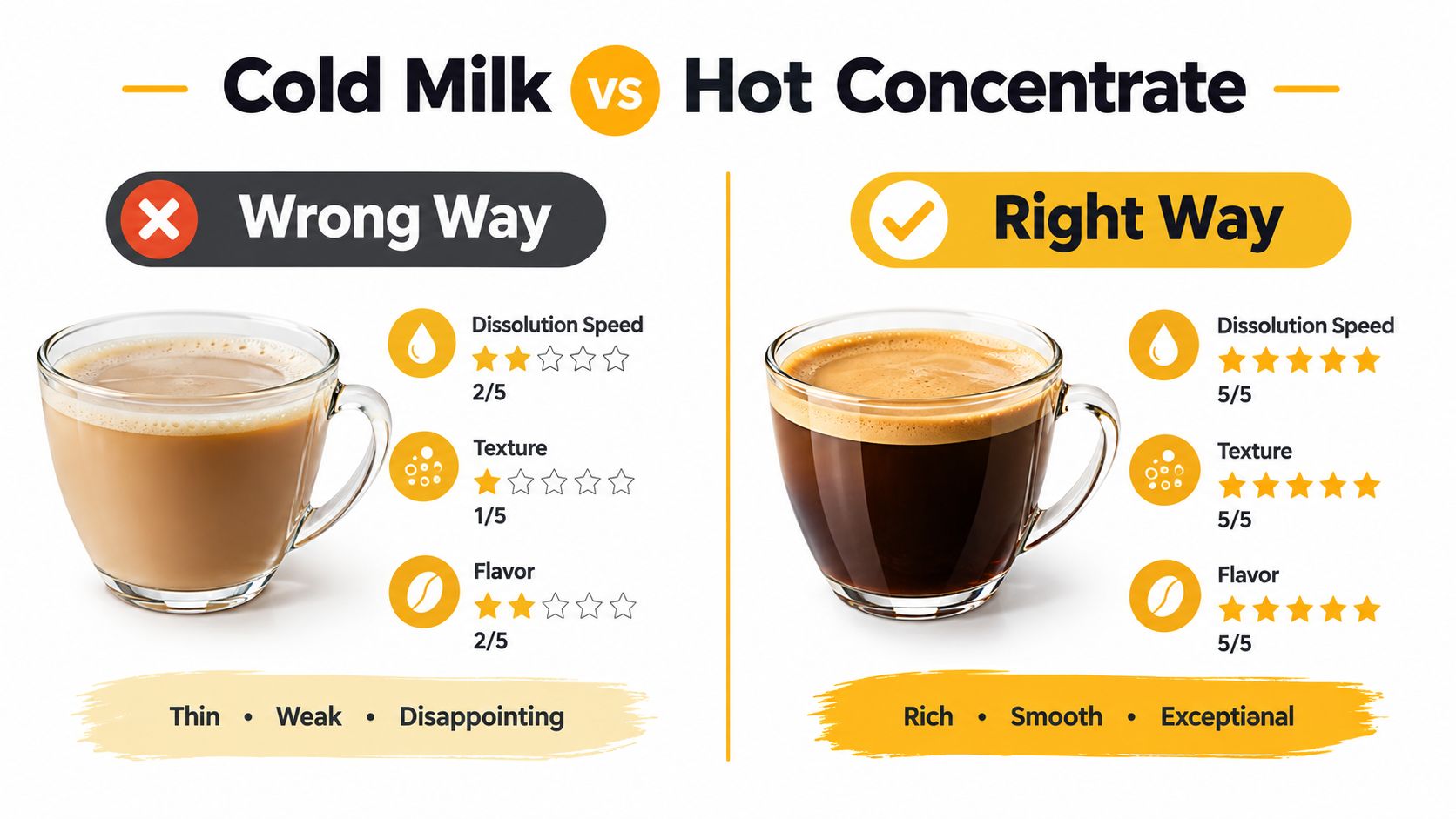
Dissolving instant coffee directly in cold milk is possible, but it's a compromise. You may save the time needed to heat water, yet you'll often spend that time stirring, scraping granules from the bottom, and accepting a less even drink.
The warm concentrate method wins because it separates dissolution from cooling. Warm water activates the powder first. Cold milk and ice then handle the temperature and texture of the finished latte.
| Approach | What usually happens | Best use |
|---|---|---|
| Coffee straight into cold milk | Slower dispersion, possible grit, weaker flavor | A rushed shortcut when texture isn't the priority |
| Coffee dissolved in warm water first | Smoother base, easier sweetener mixing, stronger control | Commuting, camping, office preparation, and repeatable drinks |
| Coffee added directly over ice | Rapid cooling and uneven contact with liquid | A poor choice when you want a consistent latte |
The issue isn't that cold milk can never dissolve instant coffee. It's that cold milk gives you less margin for error, particularly when the glass also contains ice. Extra ice makes the drink colder but also increases dilution as it melts.
Cold coffee has become a mainstream format rather than a niche summer habit. A 2025 U.S. coffee-industry survey reported that 32% of respondents had consumed cold brew, frozen or blended, or nitro coffee in the previous week, while instant coffee reached 17% of past-day consumption, as reported by Daily Coffee News. That makes a repeatable instant method useful beyond emergencies.
If you're running out the door, use the cold shortcut. If you want the drink to taste deliberate, heat a small amount of water and make the concentrate.
Portable Workflow and Troubleshooting Tips
For commuting or camping, pre-measure the dry coffee and sweetener into a small leakproof container. Carry cold milk separately, and use hot water from a thermos to dissolve the mixture when you're ready. Add the concentrate to a cup filled with dense ice, pour in the milk, and stir gently.
At an office, a small digital scale and a heatproof measuring cup make the process repeatable without taking much space. If you use countertop appliances or want broader guidance on adapting kitchen routines, IT'S A CHEF tips for Thermomix success offers practical equipment-focused ideas, although this latte itself doesn't require a Thermomix.
Use the symptom to identify the cause:
- Grit at the bottom: Stir the powder in warm water for longer before adding milk. Persistent granules usually mean insufficient agitation, unusually cool liquid, or too much powder for the water volume.
- Watery flavor: Reduce the initial water, use denser ice, or increase the coffee concentration next time. Don't solve every weak drink by adding more ice.
- Bitterness: Use slightly less coffee, avoid boiling water, or add more milk. More powder can intensify bitterness as well as coffee character.
- Too strong: Add cold milk gradually. This changes intensity without introducing unnecessary water.
- Poorly mixed sweetener: Add it to the warm concentrate, not the iced latte.
The repeatable checklist is short: dissolve completely, sweeten early, chill the milk, use controlled ice, and adjust one variable at a time.
Cartograph Coffee offers organic instant coffee packets designed for convenient preparation at home, at work, or outdoors, including chilled latte-style drinks. Visit Cartograph Coffee to explore instant coffee options and put the concentrate-first method into practice on your next commute or camping trip.