Making great iced coffee at home is a lot simpler than most people think. It really just comes down to one thing: controlling dilution. The goal is to start with a strong coffee base, like a cold brew concentrate or a flash-chilled brew, so that when the ice melts, it brings the drink to perfection instead of watering it down. Once you get this right, you'll never have to put up with a disappointing, watery cup again.
Why Your Homemade Iced Coffee Is Always Watery
Ever feel that frustration? The iced coffee from your local shop is rich and bold, but the one you make at home tastes… well, like a sad, watery mess. It's a common problem, and the culprit is almost always the same: dilution gone wrong.
Pouring hot, standard-strength coffee directly over ice is a recipe for disaster. The hot liquid shocks the ice, causing it to melt instantly and flood your drink with extra water. Before you even take a sip, your coffee is already a shadow of its former self.
This is the fundamental challenge we need to solve. It’s not about fancy gadgets; it’s about rethinking the process to cool the coffee without killing its flavor. A weak brew, the wrong coffee-to-water ratio, or just the wrong method will set you up for failure from the start.
The New Era of Iced Coffee at Home
If you're trying to perfect your iced coffee game at home, you're in good company. The demand for cold coffee has exploded, with the global market hitting over USD 6.12 billion. What's even more interesting is that 70% of coffee drinkers are now making their coffee at home, looking for better quality and the ability to make it just how they like it. This massive shift shows that people are serious about creating great coffee experiences in their own kitchens. You can read more about current iced coffee market trends here.
The secret to amazing iced coffee isn't some complicated, secret recipe. It’s simply using a method that was designed for cold coffee from the get-go—one that treats ice as an ingredient, not an afterthought.
To get past the dilution dilemma for good, we’re going to walk through three tried-and-true methods. Each one offers a different path to a consistently fantastic and refreshing iced coffee, so you can get great results whether you have 24 hours to plan or just two minutes.
-
For the Patient Perfectionist: Cold Brew. This is the classic set-it-and-forget-it method. You steep coarse coffee grounds in cold water for 12–24 hours to create a super-smooth, low-acid concentrate that you can dilute to your exact liking.
-
For Instant Gratification: The Japanese Flash-Chill. This clever technique involves brewing hot coffee directly over a pre-weighed amount of ice. It instantly chills the coffee, locking in all the bright, delicate flavors that can be lost in other methods, all while achieving the perfect dilution.
-
For the Smart and Speedy: Modern Instant Coffee. Forget what you think you know about instant. Using a high-quality, specialty instant coffee and a quick "hot bloom," you can whip up a surprisingly rich and full-bodied iced coffee in seconds. It's proof that you don't have to sacrifice taste for convenience.
Consider this your new playbook. Let's dive in and leave watery iced coffee in the past.
Three Proven Methods for Perfect Iced Coffee
So, you get it now. The number one enemy of good iced coffee is uncontrolled dilution. The great news is that beating it is simple once you have the right strategy. Learning how to make good iced coffee at home really just boils down to picking the technique that fits your taste, your schedule, and frankly, your personality.
Each of these three methods tackles the watery coffee problem head-on, guaranteeing a rich, full-flavored cup every single time.
The Patient Perfectionist: Cold Brew Concentrate
If your dream coffee is unbelievably smooth, shockingly low in acid, and ready to pour the second your alarm goes off, then cold brew is for you. Think of it as meal prep for your coffee routine. A little bit of patience upfront pays off with a full week of fantastic iced coffee on demand.
The magic here is in the gentle, slow extraction. Instead of blasting grounds with hot water, you’re steeping coarse coffee in cold or room-temperature water for 12 to 24 hours.
This slow-and-steady approach actually changes the coffee's chemistry. The compounds that create bitterness and acidity don't dissolve easily in cold water, which is why the final brew is naturally sweeter and so easy on the stomach. You're often left with deep, chocolatey notes that are just incredible over ice.
You don't need any fancy gear to get started. A big mason jar or a French press is all it takes. The real keys are the grind and the ratio.
- The Golden Ratio: A 1:8 ratio of coffee to water by weight is the perfect starting point for a potent concentrate. That means 100 grams of coffee for every 800 grams (or 800 ml) of water.
- The Right Grind: Go coarse. You're looking for a consistency like rough sea salt. If the grind is too fine, you'll get a muddy, bitter brew that’s a nightmare to filter.
- The Steep Time: Let it hang out on your counter or in the fridge for at least 12 hours. Want a stronger, bolder flavor? Push it to 24 hours. You'll have to experiment to find your personal sweet spot.
Once the time is up, just strain out the grounds with a fine-mesh sieve, some cheesecloth, or the plunger on your French press. What you're left with is a powerful coffee base you can keep in the fridge for up to a week. To serve, just pour it over ice and add water or milk to your desired strength. For a deeper dive into this liquid gold, check out our guide on what is coffee concentrate.
Instant Gratification: The Japanese Flash-Chill
What if you want the bright, vibrant aroma of a freshly brewed coffee, but you want it ice-cold right now? Meet the Japanese flash-chill method. It's the best of both worlds—the speed of hot brewing combined with the crisp refreshment of iced coffee.
The technique is brilliantly simple: you brew hot coffee directly over ice. As the coffee hits the ice, it cools down almost instantly. This rapid chilling is crucial because it locks in all the delicate aromatic compounds that normally escape as coffee cools slowly. The result is a cup that’s incredibly clean and bright, without any of that stale, oxidized flavor.
This isn’t just about dumping hot coffee over a glass of ice. The Japanese method is precise. The ice is a calculated part of your total brew water, not just an afterthought. By accounting for it from the start, you get perfect dilution without any guesswork.
Here’s how you do it with a pour-over:
- Calculate Your Brew: Decide your total volume—say, 300 ml. You’ll use roughly half as hot water (150g) and half as ice (150g).
- Measure Your Coffee: A standard 1:16 coffee-to-water ratio works great. For that 300 ml brew, you'd use about 18-20g of medium-fine ground coffee.
- Set It Up: Put the ice in your server or carafe, then place the dripper with your coffee grounds on top.
- Get Brewing: Slowly pour the hot water over the grounds, just like a normal pour-over. The concentrated coffee will drip right onto the ice, flash-chilling on contact.
You’ll be rewarded with a remarkably crisp and aromatic iced coffee that lets the bean's unique character shine. It’s my go-to method for showcasing a really special, fruity single-origin coffee.
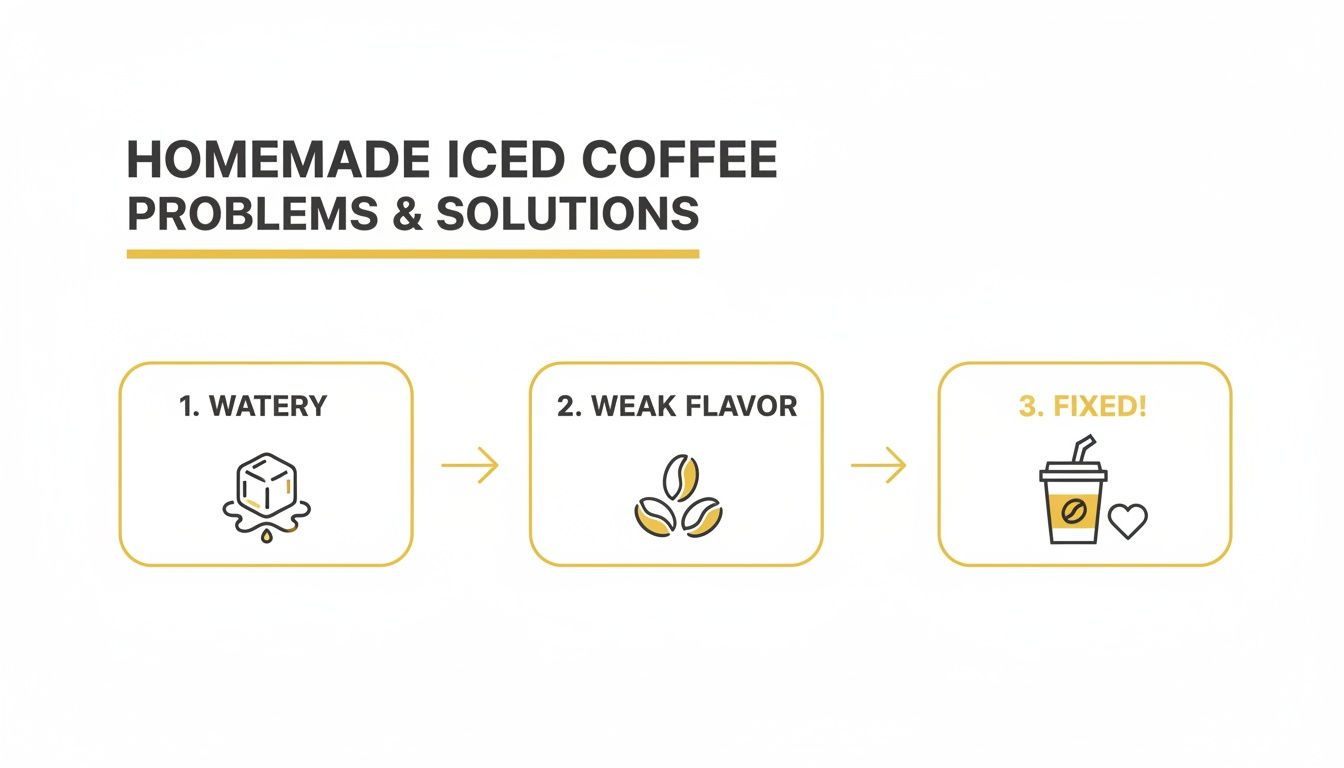
Once you understand that uncontrolled dilution is the real villain, you can finally move from a weak, watery brew to a perfectly balanced cup every time.
Smart and Speedy: Modern Instant Coffee
Forget everything you think you know about instant coffee. The high-quality, specialty instant coffee available today has completely changed the game. It’s now possible to make a genuinely delicious iced coffee in less than 60 seconds. This is the ultimate shortcut for anyone who values both incredible taste and their precious time.
The trick to unlocking amazing flavor from a product like Cartograph Coffee's organic instant is a little technique I call the "hot bloom." You just dissolve the coffee crystals in a tiny splash of hot water first. This small step allows the coffee to fully express its rich, complex flavor profile before you add the cold water and ice. Trust me, it makes a world of difference.
This approach neatly dodges all the usual problems. There's no 12-hour wait time and zero special equipment needed. You get complete control over the strength and flavor with almost no effort. It's an absolute lifesaver for busy mornings, travel, or camping.
The real power of a quality instant coffee is consistency. You can replicate your perfect iced coffee every single time, anywhere you are, just by following a few simple steps.
To make an exceptional iced coffee this way:
- Add 1-2 tablespoons of Cartograph organic instant coffee to your glass.
- Pour in just enough hot water (about 195°F is perfect) to cover the coffee.
- Stir like you mean it for about 30 seconds until you have a smooth, syrup-like concentrate. That’s your bloom.
- Top it off with about 8oz of cold water and give it another good stir.
- Finally, add your ice.
Iced Coffee Brewing Method Comparison
To help you decide which path to take, here’s a quick rundown of the three methods. Each one shines in different situations, so having all three in your back pocket means you're ready for any iced coffee craving.
| Method | Time Required | Flavor Profile | Best For |
|---|---|---|---|
| Cold Brew | 12-24 hours | Ultra-smooth, low acid, rich, deep | Making a large batch; people who prefer a less acidic, sweeter coffee. |
| Japanese Flash-Chill | Under 5 minutes | Bright, aromatic, crisp, clean | Showcasing the nuanced flavors of a high-quality single-origin bean. |
| Modern Instant Coffee | Under 1 minute | Balanced, rich, consistent, convenient | Busy mornings, travel, or when you need a great coffee with no fuss. |
Ultimately, the "best" method is the one that gives you the coffee you love with the effort you're willing to put in. Don't be afraid to experiment
Mastering Your Ratios and Ingredients

Alright, you've picked your brewing method. Now comes the part where we turn a good idea into a great drink. The secret isn't in some fancy, expensive gear; it's in paying attention to the two things most people ignore: water and ice.
It sounds almost too simple, but these two ingredients make up over 98% of what's in your glass. So, if you get them right, you're most of the way to an amazing iced coffee. Many people see ice as just a way to cool things down, but in iced coffee, its main job is actually dilution. Every single ice cube that melts is actively changing the strength and flavor of your drink. This is exactly why pouring leftover hot coffee over a handful of ice from the freezer almost always ends in a watery, sad cup.
The Critical Role of Ice
The shape and size of your ice cubes matter. A lot. Smaller bits like crushed or nugget ice have a ton of surface area, which means they melt fast. That's fine if you're going to drink it in the next two minutes, but it’s a recipe for disaster if you're a slow sipper.
For a drink that stays consistently bold and flavorful, you need bigger, denser cubes. Think about the ones from a 2x2 inch silicone mold. They melt so much more slowly, preserving the coffee's character from the first sip to the very last. It’s a small change that feels incredibly professional.
Pro Tip: Coffee Ice Cubes The ultimate defense against a watery brew? Make your ice cubes out of coffee. Just brew an extra-strong batch, let it cool completely, and pour it into an ice cube tray. As these melt, they reinforce the coffee flavor instead of watering it down. Game changer.
Why Water Quality Is a Game Changer
Since coffee is almost all water, the quality of your H2O has a huge impact on the final taste. Straight from the tap, water often carries minerals and chlorine that can create weird, off-flavors, completely masking the delicate notes in your beans.
Switching to filtered water is probably the single biggest upgrade you can make to your coffee game, hot or cold. It gives you a clean, neutral canvas that lets the coffee’s real personality—whether it's fruity, chocolatey, or nutty—come through loud and clear. This isn't just a hot coffee thing; if you want to geek out more on this, our guide on the best water temperature for brewing coffee explains why these details are so important: https://cartographcoffee.com/blogs/news/best-water-temperature-for-brewing-coffee.
Dialing in Your Perfect Ratio
That café-quality taste comes down to hitting the right balance of strength and dilution, aiming for a Total Dissolved Solids (TDS) of around 1.5% to 2%. A Japanese-style iced pour-over, for example, nails this with a precise 1:1.5 ratio of hot coffee concentrate to ice by weight. This method flash-chills the brew and manages to lock in up to 95% of its delicate aromatics.
Learning how to scale a recipe for perfect results is an invaluable skill for getting consistent results every time. To get you started, here are a couple of solid recipes to try:
- For Bold Black Iced Coffee: Start with a strong base, like a cold brew concentrate made with a 1:8 coffee-to-water ratio. To serve, dilute it with one part water for every one part concentrate (1:1) and pour that over a glass packed with large ice cubes.
- For a Balanced Iced Latte: The coffee needs to be even more potent here to cut through the milk. Use a strong cold brew concentrate or a flash-chilled shot. A great starting point is one part coffee concentrate to two parts milk (1:2), which keeps the coffee flavor from getting lost.
Think of these ratios as starting points, not strict rules. The best part about making iced coffee at home is that you're in complete control. Want it a little lighter? Add more water. Prefer a more coffee-forward latte? Use less milk. Experiment until you find what you love.
How to Customize Your Iced Coffee

Okay, you’ve mastered the brewing process and have a fantastic coffee base. Now for the fun part. This is where you go from coffee technician to coffee artist, turning a simple chilled drink into your signature cup.
The right additions don’t just cover up the coffee—they enhance it. They create new layers of flavor and texture that can transform your daily ritual into a real treat.
The most common starting point is, of course, milk. Your choice here can completely change the character of the drink, affecting everything from its richness to its subtle flavor notes.
For instance, whole milk brings a creamy, luxurious mouthfeel that perfectly mellows the intensity of a strong cold brew. Non-dairy milks, on the other hand, each bring their own unique personality to the party.
Finding Your Perfect Milk Match
Every milk alternative interacts with coffee a little differently. Figuring out which one you prefer is the key to crafting that perfect iced latte at home. It’s a fascinating world to dive into, and we cover it in more detail in our guide to the best substitute for milk in coffee.
Here's a quick rundown of what to expect from the most popular options:
- Oat Milk: There's a reason it's the reigning champion in cafes. It's incredibly creamy with a subtle, natural sweetness that complements coffee beautifully without stealing the show.
- Almond Milk: A much lighter choice, unsweetened almond milk adds a delicate, nutty flavor. It's less creamy, which is great if you want to thin out a thick concentrate while letting the coffee's flavor shine through.
- Soy Milk: Rich and full-bodied, soy milk is texturally similar to dairy. It has a distinct flavor profile that many people love, especially in iced lattes.
- Coconut Milk: If you're going for a more tropical vibe, coconut milk adds its own prominent flavor and a velvety texture that pairs amazingly well with chocolate or caramel notes.
Moving Beyond Basic Sweeteners
Once your milk is sorted, it's time to think about sweetness. Granulated sugar is the old standby, but it has one major flaw in iced drinks: it just doesn't dissolve. You're almost always left with a gritty, sugary sludge at the bottom of your glass.
The easy fix? Simple syrup. By dissolving sugar in hot water ahead of time, you create a liquid sweetener that mixes in perfectly every single time. A batch takes minutes to make and will last for weeks in the fridge.
Simple Syrup Ratio: The classic, can't-go-wrong ratio is 1:1 by volume. Just combine one cup of sugar with one cup of hot water. Stir until the sugar is completely gone, then let it cool before using.
But don't feel like you have to stop at plain sugar. Different sweeteners can add their own unique flair:
- Maple Syrup: Gives your coffee a warm, slightly woodsy sweetness that's especially good on a cool day.
- Agave Nectar: This one offers a cleaner, more neutral sweetness and is a bit thinner than maple syrup.
- Honey: Can bring lovely floral notes, but stick to a milder variety so it doesn't completely overpower the coffee's flavor.
Getting Creative with Flavors and Spices
This is your chance to really experiment and replicate your favorite coffee shop specials right in your own kitchen. Making your own flavored syrups is surprisingly simple and gives you total control over the ingredients and sweetness.
For a quick homemade vanilla syrup, just drop a split vanilla bean or a teaspoon of vanilla extract into your simple syrup while it cools. To make caramel syrup, carefully heat the sugar in a pan until it melts and turns a deep amber color, then slowly and carefully add the water.
And don't forget to raid your spice rack. A quick dash of ground cinnamon or nutmeg adds a comforting warmth. For a refreshing kick, a tiny drop of peppermint extract can turn your iced coffee into a minty mocha masterpiece. The possibilities are endless, so start playing around and find what you love.
Troubleshooting Common Iced Coffee Problems
Even when you follow a recipe to the letter, things can go wrong. Don't worry if your first few attempts at homemade iced coffee don't quite measure up to your favorite café. Every batch is a learning experience, and tweaking your process is part of the fun.
Let's walk through some of the most common hiccups and how to fix them. Think of this as your field guide to diagnosing and solving iced coffee issues, so you can get a perfect cup every single time.
Why Does My Iced Coffee Taste Weak?
This is the big one. It's the most common complaint I hear, and it's incredibly frustrating to go through all the effort just to end up with a watery, disappointing drink. The good news is the fix is usually straightforward and comes down to one of two things: brew strength or dilution.
Your coffee has to be brewed extra-strong from the get-go because it needs to hold its own against melting ice. As soon as that ice starts to melt, it’s adding water to your drink.
- Your Ice is the Culprit: If you're using small, cloudy ice from your fridge's automatic ice maker, you're setting yourself up for a watery coffee. That kind of ice melts in a flash. The simple solution is to switch to large, dense ice cubes. I use silicone molds to make big, solid cubes that melt slowly and chill your drink without killing the flavor.
- Your Ratio is Off: You can't just brew a regular pot of hot coffee and pour it over ice—it's not concentrated enough. For flash-chilling, you need a stronger brew-to-ice ratio. For cold brew, you should be making a true concentrate, something around 1:8 (coffee to water), which you then dilute to your preferred strength.
My Cold Brew Tastes Too Bitter or Sour
Cold brew's long, slow steep is great for creating a smooth flavor, but it can also go sideways if your variables aren't dialed in. An off-taste almost always points to an extraction problem—either you've pulled too much from the grounds, or not enough.
A bitter, harsh flavor is a classic sign of over-extraction. This means the coffee grounds sat in the water for too long or were too fine. The first thing to check is your grind size; it should be very coarse, like chunky sea salt. If that's right, try shortening your steep time. Just pulling it back by two hours can make a huge difference.
If your brew tastes sour or unpleasantly acidic, that’s under-extraction. The water didn't have enough contact time to pull out the sweet, rich flavors. The fix is just the opposite of what you'd do for bitterness: either let your next batch steep for a couple of hours longer or use a slightly finer grind to give the water more surface area to work with.
My Instant Coffee is Clumpy
There's nothing more jarring than taking a sip of what should be a smooth, refreshing iced coffee and getting a gritty clump of undissolved powder. This is a common issue when you add a high-quality instant coffee, like Cartograph Coffee, directly into cold liquid. The crystals just can't dissolve properly in the cold.
The secret to perfectly smooth instant iced coffee is the 'hot bloom.' First, dissolve the coffee crystals in just a tablespoon or two of hot water. Stir it like you mean it until you have a smooth, syrupy concentrate. Then add your cold water, milk, and ice.
This extra ten-second step is a game-changer. It guarantees every single crystal dissolves, unlocking the full flavor and giving you a silky-smooth drink from the first sip to the last. For anyone learning how to make good iced coffee at home with the instant method, this isn't just a tip—it's essential.
Iced Coffee Problem Solver
Sometimes you just need a quick answer. Use this table to diagnose what might be going wrong with your brew and find a fast solution to get you back on track.
| Problem | Likely Cause | Quick Fix |
|---|---|---|
| Weak & Watery | Brew isn't strong enough; ice is melting too fast. | Use a stronger coffee-to-water ratio. Switch to large, dense ice cubes. |
| Bitter or Astringent | Over-extraction. The grind is too fine or it steeped too long. | Use a coarser grind. Reduce the steeping time by 1-2 hours. |
| Sour or Too Acidic | Under-extraction. The grind is too coarse or it didn't steep long enough. | Use a slightly finer grind. Increase the steeping time by 1-2 hours. |
| Cloudy Appearance | Fine coffee particles ("fines") in the brew. | Double-filter your cold brew (e.g., through a paper filter) after steeping. |
| Clumpy Instant Coffee | Coffee crystals not dissolving in cold liquid. | Dissolve instant coffee in 1-2 Tbsp of hot water before adding cold liquid/ice. |
Think of these issues not as failures, but as feedback. Your coffee is telling you what it needs—a little less time, a coarser grind, or better ice. Listen to it, make a small adjustment, and your next cup will be that much better for it.
Frequently Asked Questions
Even with the best recipes in hand, questions are bound to come up as you get the hang of making iced coffee at home. Let's tackle some of the most common ones we hear from fellow coffee lovers.
What Kind of Coffee Is Best for Iced Coffee?
You’re looking for beans with a flavor profile that won’t get washed out by the ice and cold temperatures. I almost always reach for a medium or dark roast. Their deep, chocolatey, and nutty notes really hold up well and create that classic, satisfying iced coffee taste.
Lighter roasts can be fantastic, too, but they're a bit more finicky. Their brighter, more acidic flavors really shine with the Japanese flash-chill method, but they can taste a little weak or sour in a cold brew if you're not careful.
As for the grind, it all comes down to your brewing method:
- Cold Brew: Go for a very coarse grind, something that looks like rough sea salt. This prevents over-extraction and keeps the final brew smooth, not bitter.
- Japanese Flash-Chill: You’ll want a medium-fine grind, the same consistency you’d use for a regular pour-over.
- Instant Coffee: The best part? No grinder needed. A high-quality instant coffee like Cartograph Coffee gives you a consistently delicious base without any of the guesswork.
Can I Make a Big Batch of Iced Coffee for the Week?
Absolutely! This is one of the best things about making cold brew. It’s practically designed for making a big batch ahead of time.
Just scale up the 1:8 coffee-to-water ratio to make a large batch of concentrate. Once it’s done steeping, strain it well and pour it into a big mason jar or another airtight container. Stored in the fridge, it'll stay fresh and ready to go for up to a week. It’s a real game-changer for busy mornings.
How Much Caffeine Is in Homemade Iced Coffee?
That’s the million-dollar question, and honestly, it depends entirely on how you make it. The brew method, the coffee-to-water ratio, and how much you dilute it all play a huge role.
There's a common myth that cold brew has less caffeine. The cold water does extract caffeine more slowly, but because you use so much coffee to make the concentrate, the undiluted liquid is actually incredibly potent. Your final cup’s caffeine level is all about how much of that concentrate you use versus water or milk.
Ultimately, the strength of your drink is completely up to you.
Do I Need Fancy Equipment to Make Good Iced Coffee?
Not a chance. While there’s plenty of cool gear out there, you don't need any of it to make amazing iced coffee. It’s all about the technique, not the toys.
You can whip up a fantastic cold brew with nothing more than a glass jar and some cheesecloth. A simple plastic pour-over cone is all it takes to master the Japanese method. The secret to great iced coffee isn't a hefty price tag—it's paying attention to your ratios and using quality ingredients.
Ready to skip the prep and get straight to a perfect glass? Cartograph Coffee is a premium organic instant that dissolves instantly for a rich, smooth iced coffee every single time. Experience the difference and simplify your coffee routine today at cartographcoffee.com.