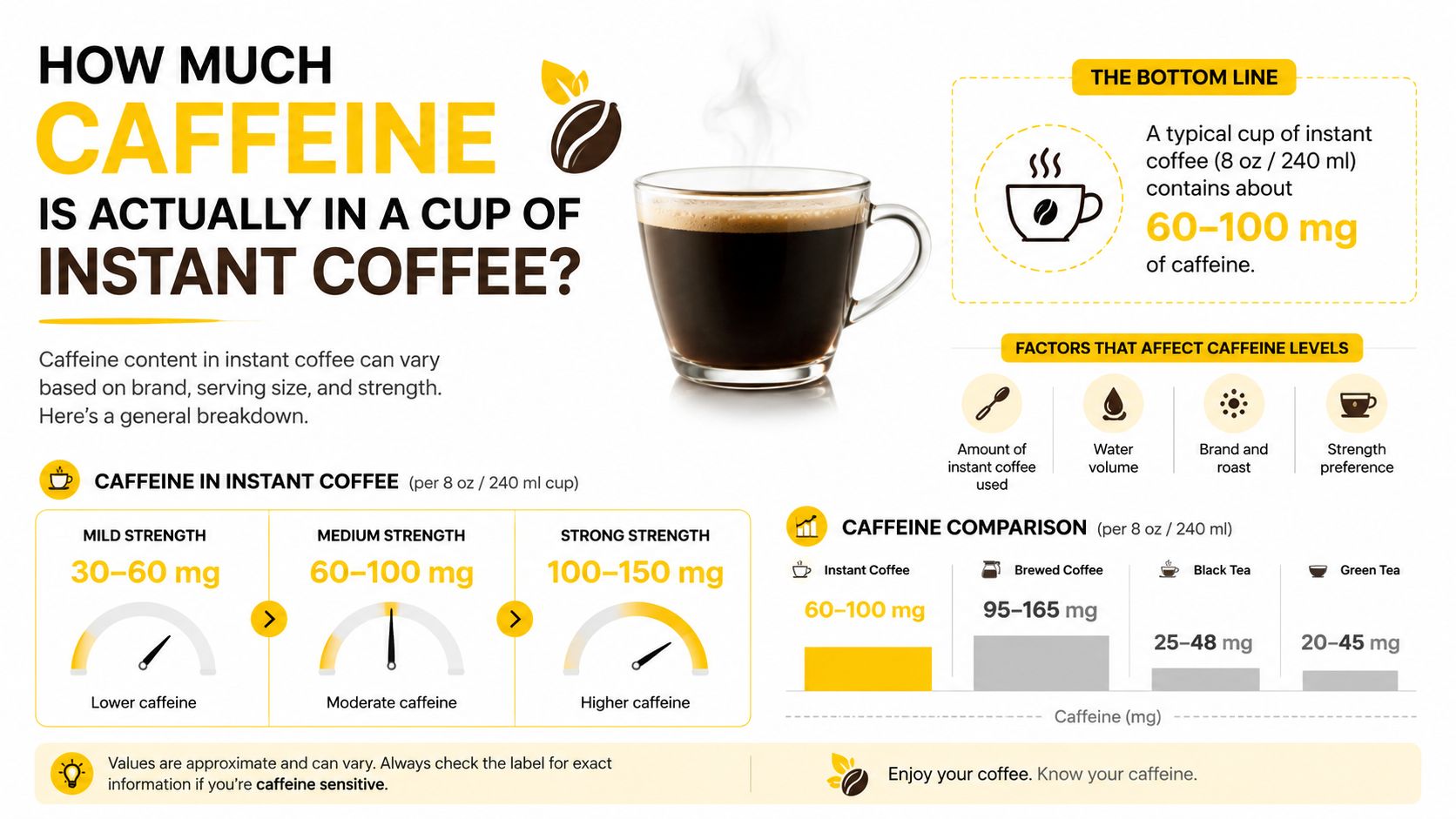
A standard 8 oz cup of instant coffee typically contains about 30–90 mg of caffeine, with roughly 57–62 mg serving as the most useful everyday benchmark. Your actual amount can be higher or lower depending on how much powder you use, the product's formulation, and the size of your mug.
That range answers the basic question, but it also exposes the problem with treating instant coffee as one fixed beverage. A level teaspoon, a heaped scoop, and a single-serve packet can contain different amounts of powder, even when each becomes “one cup.” Water changes the drink's strength by dilution, but it doesn't remove the caffeine already present in the granules.
The practical question isn't only how much caffeine is in instant coffee. It's how many grams are in your scoop, what kind of coffee the manufacturer used, and how the label defines a serving. The sections below turn those variables into usable estimates.
How Much Caffeine Is in a Cup of Instant Coffee
For a conventional 8 oz serving, instant coffee commonly contains 30 to 90 mg of caffeine, according to Healthline's instant coffee analysis. A separate summary places a standard 8 oz cup near 57 mg, while the Mayo Clinic caffeine table lists instant coffee at 62 mg per 8 oz, or 237 mL, serving.
Those figures are useful starting points, but your actual cup depends on the powder's weight, the product's formulation, and the serving size printed on the package. A measured scoop and a heaped teaspoon do not necessarily contain the same amount of coffee. The water mostly changes how concentrated the drink tastes. It does not remove the caffeine already present in the granules.
Product differences can be substantial. A Malaysian market study of 15 instant coffee products measured per-serving amounts from 36.43 to 183.33 mg, showing how formulation and serving definitions can shift the result. The study is available through this peer-reviewed analysis of instant coffee caffeine.
The four variables behind your mug
Start with four questions:
- How much powder did you use? More grams generally mean more caffeine.
- How much water did you add? More water weakens the concentration, while the total caffeine stays tied to the powder.
- What formulation did the manufacturer use? Bean selection, processing, and blending affect caffeine delivered per gram.
- What does the package call a serving? A packet, teaspoon, and scoop may contain different weights.
A measured 8 oz cup made with a moderate serving may sit near the 57–62 mg benchmark. A fuller scoop can push the same mug toward the upper end of the broad range, while a light scoop may approach the lower end. The same jar can produce both results.
Practical rule: Use a general caffeine chart as a starting estimate, then check the powder weight. Grams in the scoop are the clearest variable you can control.
What Changes the Caffeine From Cup to Cup
A few extra grams of powder can change the caffeine in your mug more than the water volume does. Two cups may each contain 8 oz of water, yet deliver different amounts because their scoops contain different weights of instant coffee.
Water changes concentration, not the caffeine supplied by the powder. Adding water spreads the same caffeine through a larger drink, so the cup tastes weaker without removing caffeine. The preparation principle is also covered in Healthline's guide to instant coffee preparation.
The product formula matters as well. A blend with a higher proportion of Robusta beans can contain more caffeine than an Arabica-focused product at the same powder weight. Freeze-dried and spray-dried granules may also have different densities, which makes a teaspoon an unreliable substitute for grams.
The variables worth watching
| Variable | Typical effect | Example |
|---|---|---|
| Powder weight | Usually the largest change | A fuller scoop adds more caffeine than a level scoop |
| Water volume | Changes concentration, not total caffeine | The same powder tastes weaker in a larger mug |
| Bean formulation | Can raise or lower caffeine per gram | A blend with more Robusta beans may be stronger than an Arabica-focused blend |
| Drying and granule structure | Changes scoop density and consistency | Two teaspoons from different jars may not weigh alike |
| Roast and preparation style | Usually a secondary influence | A darker flavor profile does not automatically mean substantially more caffeine |
A measured study found sharp differences across product formats and preparation methods. Its dataset reported an average of 23 mg per sample for instant coffee, while the same paper cited 64 mg for a 160 mL serving made with one teaspoon of concentrate. The findings appear in the published coffee caffeine measurement study.
The clearest rule is simple: scoop weight dominates the equation. Bean selection and processing explain why products differ, while the grams of granules in your cup determine how much of that formula you consume. Check the scoop size, weigh the powder when possible, and treat the package's serving definition as a starting point rather than a universal measure.
Instant Coffee vs Brewed Coffee and Espresso
Instant coffee isn't automatically the mildest coffee option. A standard 8 oz serving of instant often sits below many brewed coffees, but the categories overlap when serving strength changes.
For comparison, the following ranges come from the verified comparative figures supplied for common coffee preparations:
| Coffee type | Serving size | Caffeine range |
|---|---|---|
| Instant coffee | 8 oz | 30–90 mg |
| Drip coffee | 8 oz | 95–200 mg |
| French press | 8 oz | 80–135 mg |
| Espresso | 1 oz shot | 63–80 mg |
The comparison needs careful reading. Drip and French press coffee usually deliver more caffeine in a full cup, but espresso is concentrated into a much smaller volume. An instant coffee prepared near the top of its usual range can contain more caffeine than a single espresso shot, while a mild instant cup can contain less.
Serving size also changes the conclusion. A single shot and an 8 oz mug aren't equal containers, and a double espresso or larger espresso-based drink can quickly exceed a single instant serving. That's why coffee comparisons work best when you compare both total caffeine and volume.
Why “instant is always weaker” doesn't work
Instant coffee is made from brewed coffee that has been dehydrated into soluble granules. The final caffeine depends on how much concentrated coffee ends up in the serving, not only on whether the coffee began as a powder. Stronger formulations can overlap with weaker brewed coffee.
For a separate discussion of the comparison, see this explanation of whether instant coffee has more caffeine. The useful conclusion is that instant belongs in the middle of the coffee caffeine spectrum for many ordinary preparations. It's often milder than a full mug of drip coffee, but it isn't caffeine-free, and it can outpace a small, weak coffee serving.
Estimating the Caffeine in Your Own Cup
You can make a reasonable estimate without laboratory equipment if you know the powder weight. A useful working assumption is that one rounded teaspoon weighs about 2 grams, and that each gram may provide approximately 30–40 mg of caffeine, based on the practical range in Cartograph Coffee's instant coffee serving guide. These are estimates, so product-specific testing or label information should take priority.
Try three common scenarios:
- One 2 g packet: Using the 30–40 mg-per-gram estimate, the serving works out to approximately 60–80 mg.
- Two rounded teaspoons: At roughly 4 g of powder, the estimate becomes approximately 120–160 mg.
- Half a teaspoon: At roughly 1 g, the estimate is approximately 30–40 mg.
A heaped teaspoon can be especially misleading because its weight depends on granule size and how densely the powder settles. A kitchen scale gives you a much better starting point than a spoon, particularly if you use different brands or alternate between freeze-dried granules and fine spray-dried powder.
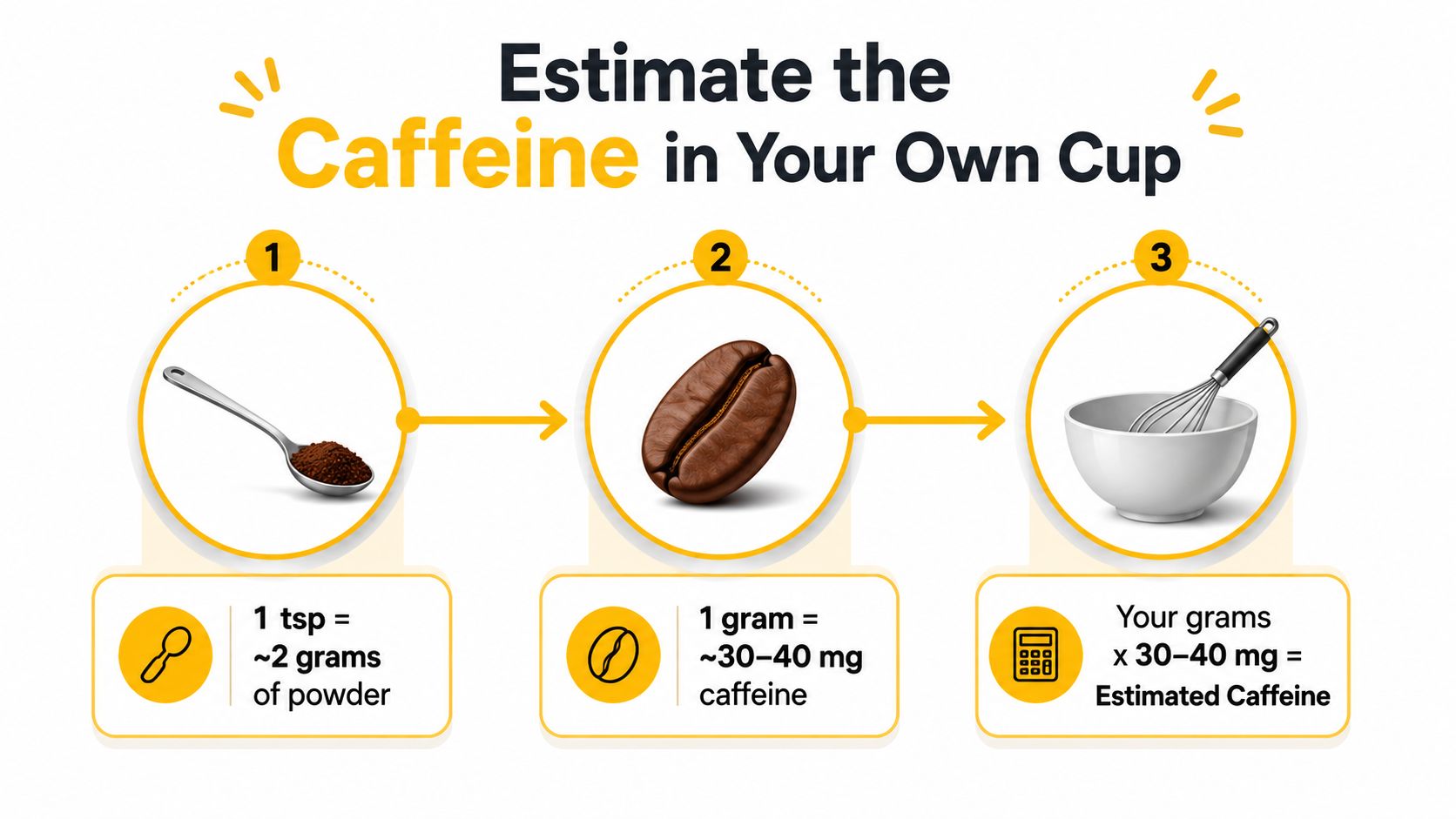
Use this quick check:
grams of powder × 35 mg = approximate caffeine per serving
For example, 3 g of powder would produce an estimate near 105 mg using that midpoint. The result can still vary because products differ, but weighing the scoop makes your estimate far more defensible.
For another practical look at serving ratios, visit this guide to how much instant coffee belongs in one cup.
Decaf Instant Coffee and Reading the Label
Decaf instant coffee still contains some caffeine. The Mayo Clinic lists about 2 mg per 8 oz serving for instant decaf, while the verified industry reference describes a 12 oz serving averaging under 15 mg. Those figures come from different serving sizes and products, so they shouldn't be treated as one universal decaf value.
| Coffee type | Typical caffeine per 8 oz | Notes |
|---|---|---|
| Regular instant coffee | 30–90 mg | Powder amount and formulation create broad variation |
| Instant decaf | About 2 mg in the Mayo Clinic table | Not necessarily zero |
| Decaffeinated instant in a larger serving | Under 15 mg in the cited industry FAQ | Serving size changes the total |
The label can make this harder to interpret. A product may describe itself as decaffeinated without displaying a precise caffeine amount, leaving shoppers to infer exposure from the serving size and preparation instructions. “Decaf” means caffeine has been substantially removed, not that every granule contains none.
What shoppers can and can't infer
Bean origin, roast description, and decaffeination method may provide useful context, but they don't provide a dependable caffeine calculation by themselves. A dark roast label, for example, tells you about flavor development more clearly than it tells you the exact caffeine in your mug.
People who are highly sensitive to caffeine, managing sleep disruption, or limiting exposure should treat decaf as low caffeine rather than caffeine-free. Check the package for a stated amount, follow the listed serving size, and avoid assuming that a larger mug has the same caffeine as the reference serving.
Managing Caffeine Intake Around Daily Limits
For healthy adults, the FDA-cited daily guideline is up to 400 mg of caffeine, as summarized in the verified Mayo Clinic reference. Using the broad instant coffee range, that could represent roughly four to seven standard cups, but the estimate changes substantially with scoop size and product strength.
Pregnancy changes the calculation. The supplied evidence uses a 200 mg daily limit during pregnancy, while the same planning notes identify 100 mg or less for adolescents. Those limits are not interchangeable with the healthy-adult guideline, and people with anxiety, reflux symptoms, sleep disruption, medication interactions, or unusual sensitivity may need a lower personal threshold.
| Situation | Daily limit | Approximate instant cups |
|---|---|---|
| Healthy adults | Up to 400 mg | Roughly four to seven standard cups |
| Pregnancy | 200 mg | Roughly two to six standard cups |
| Adolescents | 100 mg or less | About one to three standard cups |
| Personal sensitivity | Individual limit | Track symptoms and adjust |
The cup estimates above use the verified 30–90 mg range per 8 oz serving. They're not a recommendation to consume the maximum. A stronger scoop can use much of a daily allowance in one drink, while a small serving leaves more room for tea, chocolate, medication sources, or another coffee.
Practical ways to reduce exposure
- Use less powder: Halving the scoop generally reduces the caffeine in proportion to the amount of powder used.
- Switch to decaf: Decaf instant can lower exposure substantially, although it isn't always caffeine-free.
- Choose half-caf: Blending regular and decaf can preserve some coffee character while reducing the total.
- Change timing: If caffeine affects sleep, move your final regular cup earlier rather than relying only on a smaller mug.
- Track your response: Note the product, grams, time, and symptoms for several days. Your personal pattern is more useful than a generic average.
Choosing Instant Coffee for the Caffeine You Want
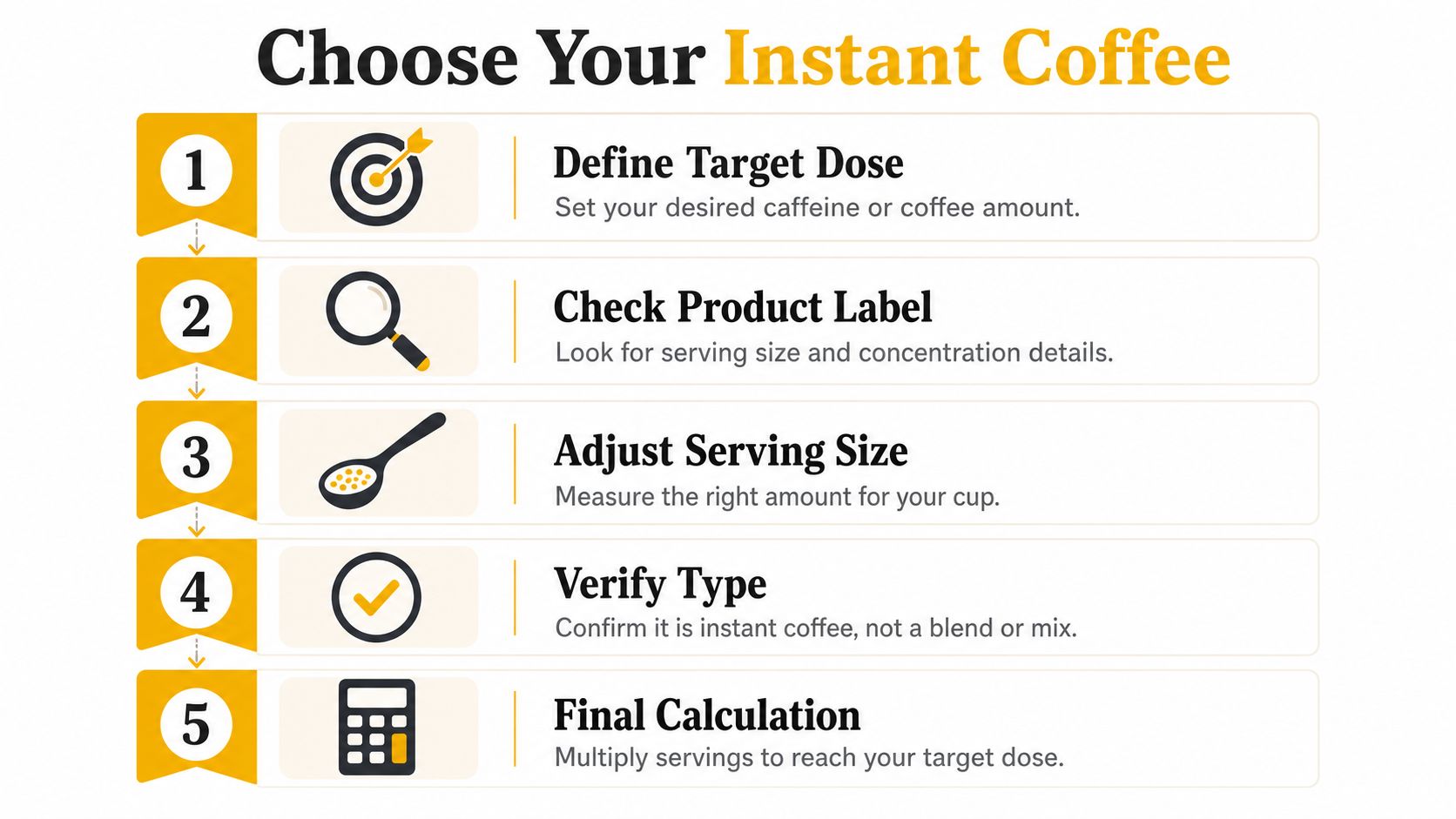
Choose the dose first, then choose the coffee. A five-part selector keeps the decision practical:
- Define your target dose. Decide whether you want a light, moderate, or stronger cup.
- Check the serving size. Look for grams per packet or the manufacturer's stated scoop weight.
- Set the water volume. A small cup and a large mug will taste different even with the same powder.
- Choose the format. Packets make portions easier to repeat, while jars let you adjust strength.
- Select regular or decaf. Match the product to your sensitivity, schedule, and daily caffeine budget.
If you're aiming near 50 mg, a rounded teaspoon in a smaller cup may be a reasonable starting point, but the exact result depends on the product's tested caffeine content. If you want approximately 100 mg, two teaspoons may reach that neighborhood with some products, while a higher-caffeine formulation could require less powder. Don't treat these examples as guarantees. Use the package serving information whenever it's available.
Read beyond the roast name
Premium freeze-dried granules may offer a more consistent sensory experience when the producer controls bean sourcing and serving weight, but the word “premium” alone doesn't certify a caffeine amount. Supermarket products can vary widely, and a specialty product can still require a measured scoop.
For a product-focused comparison, see this guide to instant coffee with the highest caffeine. The useful habit is to compare grams, not just teaspoons, and to question any claim that instant coffee is automatically mild.
Cartograph Coffee offers organic instant coffee for home, work, travel, and outdoor use, giving shoppers another option when convenience and product quality both matter. Visit Cartograph Coffee to explore its instant coffee range, then read the jar, weigh the scoop, and brew with intention.