You're standing at a café counter, comparing two drinks that appear almost interchangeable. The cappuccino and flat white may sit in similarly sized cups, use the same espresso machine, and cost the same, yet one arrives with a visible foam cap while the other looks smooth and glossy. If you order by name alone, the result can vary more than you'd expect.
The practical difference is not just foam versus no foam. Espresso dose, serving volume, milk texture, pouring technique, and local café habits all shape the drink. This guide breaks down cappuccino vs flat white from the barista's side of the counter, so you can understand what's in the cup and order with more confidence.
Why Cappuccino and Flat White Confuse Even Coffee Lovers
Both drinks begin with espresso and steamed milk. That shared foundation makes the comparison seem easy, especially when a café places the cappuccino and flat white beside each other on a short menu. The trouble starts when the drinks arrive: one flat white may be small and intensely coffee-led, while another may resemble a smooth latte. A cappuccino may have a dry, tall foam cap at one café and a thin, silky surface at another.
The basic descriptions still help. A traditional cappuccino is built around distinct layers of espresso, steamed milk, and foam. A flat white aims for integrated espresso and finely textured milk, with little visible separation. But those descriptions describe an intention, not a universal recipe.
Practical rule: Ask about the café's recipe, not just the drink's name.
Serving size changes your perception of strength. A smaller drink with the same espresso quantity will taste more concentrated because less milk surrounds the coffee. Milk texture changes the mouthfeel, too. Airy foam creates a lighter, more separated sip, while fine microfoam feels dense, creamy, and unified with the espresso.
The confusion becomes clearer when you compare these drinks with a latte. A useful overview of the difference between a cappuccino and a latte shows why menu categories overlap. A latte generally emphasizes a larger proportion of steamed milk, while cappuccino and flat white are usually chosen for more noticeable espresso character or a more defined texture.
What the names fail to tell you
The word “cappuccino” often communicates a familiar European café style. “Flat white” suggests modern specialty coffee and a smaller, velvety drink. Neither name reliably tells you the exact number of espresso shots, the final volume, or the thickness of the foam in front of you.
That matters if you want a repeatable daily coffee. If you prefer bold espresso, ordering a flat white may work, but only if the café uses a concentrated recipe. If you love a clear foam layer, a cappuccino is the safer starting point, although you may still need to ask whether the milk is airy or glossy.
The most useful comparison therefore has three parts: history explains the identity, technique explains the texture, and local definitions explain the variation.
The Surprising History Behind Each Drink
Cappuccino and flat white don't come from the same generation of coffee culture. Cappuccino has a much older lineage, while flat white appeared after espresso culture had already spread internationally. That difference helps explain why one feels like a traditional café category and the other feels like a specialty-coffee refinement.
The cappuccino traces back to Kapuziner Kaffee, an Austrian coffee drink associated with the late 1700s. An earliest recorded reference appears in a 1790 Austrian recipe book, before the drink evolved through Italy into the modern espresso-based cappuccino. Its identity formed within older European café traditions, where coffee, milk, and foam were already connected to established service customs.
The flat white emerged as a distinct drink in Oceania during the 1980s, with competing origin claims from Sydney and Wellington. One widely cited milestone is 1985, when Sydney café owner Alan Preston said he began serving an “official” version after a customer mistakenly asked for a flat white. The competing claims matter because the drink's history is less settled than cappuccino's older lineage.

Two different coffee eras
Cappuccino developed long before modern specialty coffee, so its identity became associated with a classic European format. The familiar combination of espresso, steamed milk, and a defined foam layer reflects that history. Even when cafés modernize the technique, the drink usually retains its recognizable cap.
Flat white arrived later, after espresso preparation had become global. Baristas in the Antipodes could work from an established espresso foundation while refining milk texture and drink balance for contemporary café service. The result was a beverage associated with a smaller format, strong coffee presence, and smooth milk integration.
The historical timeline also helps explain why disagreements about the flat white remain so persistent. Cappuccino inherited a long-established category identity. Flat white developed through competing regional practices and later spread into cafés that interpreted the recipe in different ways.
Why history still affects your order
A cappuccino's older identity encourages cafés to preserve visible foam and a layered drinking experience. A flat white's newer identity leaves more room for experimentation with cup size, espresso quantity, and microfoam. That doesn't make one drink more authentic by default. It means the names carry different expectations before the barista even starts steaming milk.
Technical Breakdown of Espresso Ratios and Milk Texture
The clearest technical distinction in cappuccino vs flat white is foam structure and drink ratio, not necessarily the espresso itself. Both can be espresso-forward, but they distribute milk and air differently.
| Specification | Cappuccino | Flat White |
|---|---|---|
| Traditional composition | One-third espresso, one-third steamed milk, one-third foam | About one-third espresso and two-thirds textured milk |
| Common drink size | Often around 6 ounces, with equal thirds | Commonly 5 to 6 ounces |
| Espresso description | Single or double depending on café recipe | Often described as a double espresso |
| Milk texture | Airier, more pronounced foam cap | Glossy microfoam with little visible foam |
| Foam specification | At least 1 cm under the SCA specification, also described as at least 0.4 inches in service standards | Often around 3 to 5 mm of fine microfoam in technical café descriptions |
| Representative standard | 25 ml espresso topped with 100 ml steamed milk under the Italian National Espresso Institute | Definitions vary by standard and café |
A traditional cappuccino uses one-third espresso, one-third steamed milk, and one-third milk foam. A typical flat white uses roughly one-third espresso and two-thirds textured milk, with little to no separate foam layer. These proportions explain why a cappuccino can feel more segmented, while a flat white feels more blended.
For practical volume, sources commonly describe a flat white as a 5 to 6-ounce drink using a double espresso and roughly 4 ounces of milk, while a classic cappuccino is often around 6 ounces and divided among espresso, steamed milk, and foam (technical comparison of flat white and cappuccino recipes). Because recipes differ, those figures are useful reference points rather than guarantees.
Milk steaming creates the real contrast
A cappuccino requires more air early in the steaming process. The barista stretches the milk more aggressively, creating a drier, airier foam layer that remains visibly distinct after pouring. Under the Specialty Coffee Association specification, a cappuccino is a 150 to 180 ml drink with at least 1 cm of microfoam, while service descriptions also express that foam depth as at least 0.4 inches (technical service standards for cappuccino and flat white).
Flat-white milk receives minimal air incorporation. The barista introduces enough air to create fine microfoam, then rolls the milk so the bubbles become small and evenly distributed. The resulting top layer is often around 3 to 5 mm, producing a glossy surface rather than a thick cap.
Cappuccino foam sits on the drink. Flat-white microfoam becomes part of the drink.
Espresso quality still matters. Extraction provides the coffee's sweetness, body, and clarity, while milk determines how those qualities reach your palate. If you're learning the foundation, a practical guide to espresso brewing basics can help you understand why dose, grind, and extraction affect a milk drink even after milk is added. For a closer look at how shot volume is discussed, see this guide to espresso shot size.
Standards don't eliminate interpretation
The Italian National Espresso Institute defines cappuccino as 25 ml of espresso topped with 100 ml of steamed milk. The SCA describes cappuccino as 150 to 180 ml with at least 1 cm of microfoam. These specifications show that cappuccino has a tighter formal identity than many customers realize.
Flat white recipes are less uniform. A café might use a double espresso in a small cup, while another follows a single-shot standard. The final taste depends on the relationship among espresso quantity, milk volume, and texture, not on the label alone.
Why Your Flat White Tastes Different at Every Café
Order the same flat white in Sydney and London, and you may receive two different drinks. Flat white definitions vary enough that the same order can produce very different cups depending on the café.
One account of current specialty-coffee standards describes the SCA flat-white definition as a 150 to 180 ml drink with a single espresso shot and at least 1 cm of microfoam. Other cafés describe a flat white as a double-shot drink with a 1:2 or 1:3 relationship between espresso and milk. A single-shot version with generous microfoam may taste softer and less concentrated than a double-shot drink served in a smaller cup.
Neither result automatically signals a mistake. The café may be following a regional convention, a different standard, or its own menu recipe. The name gives you a starting point, while the recipe determines what reaches the cup.
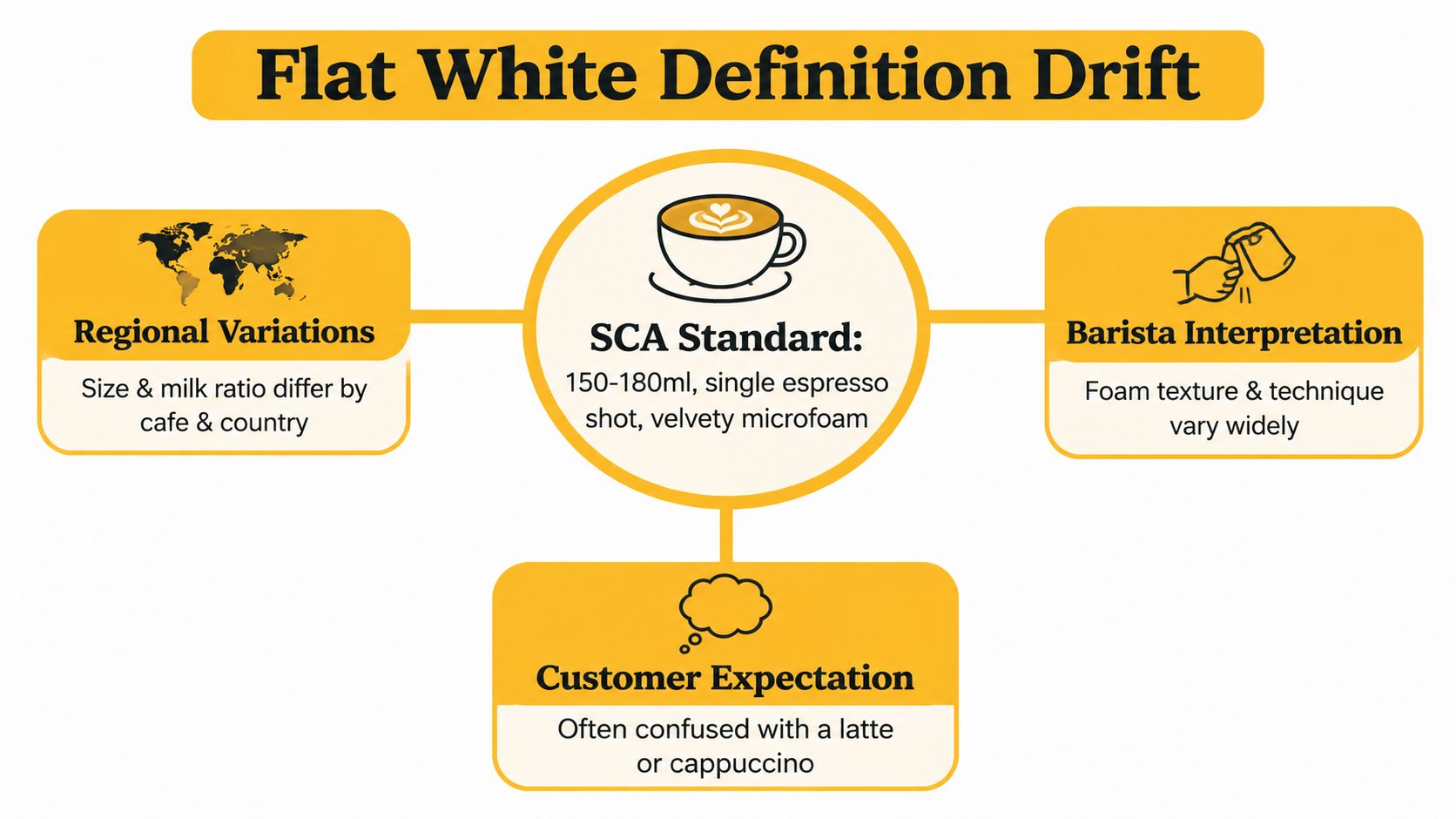
The same name can signal different priorities
Some cafés treat a flat white as a concentrated milk drink. They use a small serving, a double espresso, and a thin layer of glossy microfoam. Others prioritize a softer texture and serve a larger drink that sits closer to a small latte.
Milk technique can change the result even when the espresso recipe remains constant. One barista might create wet, integrated microfoam, while another incorporates more air and produces a surface closer to cappuccino foam. You are then comparing shot quantity, serving size, milk volume, and texture at the same time.
Current menu-standardization discussions reflect this tension. The industry has no single globally enforced interpretation that guarantees the same flat white in every country or café (recent discussion of flat-white standardization). The practical answer to “What should I expect?” depends on the local café.
Questions that improve your chances
Ask short, specific questions before ordering:
- Shot count: “Is your flat white made with a single or double espresso?”
- Size: “What's the usual serving volume?”
- Milk texture: “Is it glossy microfoam or a more foamy cappuccino texture?”
- Strength: “Which drink has the stronger espresso presence here?”
- Customization: “Can you make the cappuccino with a thinner foam layer?”
You can also taste more deliberately. A tasting guide such as how to use Drinkist for coffee can help you notice aroma, texture, sweetness, and finish instead of judging the drink by appearance alone. That habit turns definition drift into useful information: you learn what the café means by the name and whether its interpretation suits you.
When to Choose Cappuccino and When to Choose Flat White
Choose based on the experience you want, not on the assumption that one drink is objectively stronger or better. The cappuccino and flat white can both carry clear espresso flavor, but they deliver it through different textures and serving formats.
A flat white makes sense when you want the coffee and milk to act as one texture. Its smaller common format and integrated microfoam can give the espresso a more immediate presence. The drink feels smooth rather than airy, and each sip brings coffee, sweetness, and milk together instead of separating them into a foam-led finish.
A cappuccino suits a slower, more layered experience. The foam cap changes how the drink enters your mouth, creating a lighter top layer before the steamed milk and espresso arrive. If you enjoy a visible textural contrast or a classic European café style, that separation is part of the pleasure.

Match the drink to your moment
| If you want | Start with | Why |
|---|---|---|
| A compact coffee with velvety milk | Flat white | The milk is finely textured and usually less foamy |
| A visible foam cap | Cappuccino | More air is incorporated during steaming |
| A modern specialty-coffee style | Flat white | The drink emphasizes integration and espresso presence |
| A traditional café ritual | Cappuccino | The layered structure is part of its identity |
| A more predictable result while traveling | Ask the barista first | Flat-white recipes vary widely by café and country |
For a morning coffee, many people prefer a flat white when they want a direct espresso impression without a large milk-heavy format. The key isn't the time of day itself. It's the combination of concentrated coffee, smaller volume, and silky texture.
A cappuccino can work better as an afternoon treat when the foam gives the drink a more indulgent feel. That doesn't mean it contains more sugar or is richer. The airier texture changes the perceived weight and pace of the drink.
Consider food and consistency
Texture matters beside food. A flat white's smooth milk can complement a pastry without adding a separate foam sensation. A cappuccino's cap can make each sip feel more pronounced, which some people enjoy with a simple breakfast or a lightly sweet baked item.
Consistency requires more attention. If you visit the same café repeatedly, ask what recipe the baristas use and order according to that recipe. If you're traveling, a flat white may change more dramatically from place to place because its definition is less settled, while cappuccino usually preserves its foam-led identity even when the exact size changes.
Order the drink that matches the texture you want, then confirm the shot count if strength matters.
Making Better Coffee Choices Going Forward
A good order starts with a preference, not a category. Decide whether you want foam, integration, concentration, or volume, then use the drink name as a starting point. That small shift makes café conversations easier and protects you from disappointing surprises.
Use a quick decision framework
- Want a defined foam cap? Order a cappuccino and ask for a traditional airy texture.
- Want creamy sipping with minimal foam? Order a flat white and request glossy microfoam.
- Want stronger espresso presence? Ask which drink uses the larger shot, because the café's recipe may differ.
- Want a smaller drink? Ask for the flat white's serving size before ordering.
- Want a familiar classic? Choose cappuccino, then confirm whether the café serves it with a dry or wet foam.
- Feel unsure? Tell the barista what you disliked in your last drink. “I don't want a large latte-style milk drink” is more useful than saying “strong.”

Make the request precise
When ordering internationally, ask about shot count, cup size, and foam texture. Those three details reveal far more than the menu label. If you're ordering a flat white in a new café, “Is it your smaller double-shot milk drink?” quickly tells you whether the café uses the concentrated interpretation.
At home, equipment affects how closely you can reproduce café texture. An espresso machine with a steam wand gives you direct control over air incorporation and milk rolling. A separate frother can still create an enjoyable drink, but it may produce a different foam structure from steam-textured microfoam.
For a flat white, introduce only enough air to create fine bubbles, then swirl the milk until it looks glossy and pours as one fluid texture. For a cappuccino, add more air early in steaming so the foam remains visibly distinct. In both cases, pour soon after steaming so the milk and foam don't separate in the pitcher.
Cartograph Coffee offers organic instant coffee for convenient preparation at home, work, camping, or other situations where an espresso machine isn't available. It can be one practical option for experimenting with a coffee-and-milk drink, while the final texture will depend on how you heat and froth the milk.
Treat recipes as guides, not rules
The phrase “proper flat white” can create unnecessary anxiety. Café standards matter when you're comparing drinks, but your own preference matters when you're making one. Try the same coffee with more or less air, compare a smaller and larger serving, and change one variable at a time.
The useful goal is consistency with your own taste. Once you know whether you prefer a thin glossy surface or a firm foam cap, you can communicate that preference anywhere.
Common Questions About Cappuccino and Flat White
Does one drink contain more caffeine?
Not automatically. Caffeine depends mainly on the amount and type of espresso used, while milk changes dilution and texture rather than creating caffeine. Because flat-white recipes often use a double espresso in some cafés and cappuccino recipes may use a single or double, ask about the shot count instead of relying on the name. This guide to cappuccino caffeine explains why the recipe matters.
Which drink is better for latte art?
Both can support latte art when the milk is smooth and evenly textured. Flat white microfoam often creates a particularly glossy canvas because the foam is integrated, while cappuccino foam can sit higher and make the pattern feel more dimensional. The barista's steaming and pouring control matter more than the name on the cup.
How do they compare with a latte or macchiato?
A latte generally emphasizes more steamed milk and a softer coffee impression. A macchiato is usually much smaller and more espresso-dominant, with only a small amount of milk or foam. Café terminology varies, so ask for the shop's description if the menu doesn't show sizes or ingredients.
Do plant-based milks work for both?
Yes, but results vary by product. Barista-formulated oat and soy milks often produce more stable texture than versions designed only for drinking, while almond and other alternatives may foam differently. Tell the barista whether you want the milk glossy and integrated or more aerated.
What if the drink doesn't match your expectation?
Ask politely what recipe the café uses. If you expected a small, concentrated flat white and received a larger, milkier drink, explain that you prefer less milk or a double espresso next time. A clear request usually works better than arguing about which definition is correct.
Cartograph Coffee offers organic instant coffee for quick coffee-and-milk drinks at home, work, or outdoors, including situations where espresso equipment isn't practical. Visit Cartograph Coffee to explore a convenient option, then experiment with milk texture and strength until you find your preferred cappuccino-style or flat-white-style cup.