The magic number for brewing incredible coffee is somewhere between 195°F and 205°F (that’s 90°C to 96°C). Coffee pros call this the "golden range" for a reason—it’s the sweet spot where you unlock all the rich, delicious flavors locked away in your coffee beans. Just dialing in your water temperature is one of the single biggest improvements you can make to your morning cup.
Why Water Temperature Is a Game Changer for Your Coffee

Think of hot water as the key that unlocks flavor from your coffee grounds. This whole process is called extraction, and temperature is what controls the speed and quality of that extraction.
Here’s a simple analogy: try dissolving a sugar cube in iced tea versus hot tea. It dissolves instantly in the hot liquid, right? But it just sits at the bottom of the cold glass. Coffee brewing works the same way. If your water is too cold, it's just not powerful enough to pull out all the good stuff, leaving you with a weak, disappointingly sour cup. We call this "under-extracted."
On the flip side, using water that’s too hot—like a full, rolling boil—is like using a sledgehammer when you need a delicate touch. It rips everything out of the grounds, including the harsh, bitter compounds. This leads to an "over-extracted" brew that tastes burnt and astringent, completely hiding the coffee's natural sweetness.
The Science Behind the Golden Range
That 195°F to 205°F range isn't just a random recommendation; it's a carefully defined window that ensures you get a balanced brew every time. Different flavor compounds in coffee dissolve at different rates, and this temperature range nails the timing perfectly.
- Acids: These come out first, giving coffee its bright, fruity, and floral notes.
- Sugars: Next up are the sugars, which create sweetness, body, and balance.
- Lipids (Oils): These contribute to the wonderful aroma and smooth mouthfeel.
- Bitter Compounds: These are extracted last. You want some for depth, but not too many.
The goal is to get all the delightful acids and sugars without pulling out too many of those bitter flavors. The 195-205°F range is the perfect bullseye for hitting that target.
This is why industry leaders like the Specialty Coffee Association (SCA) are so specific about it. The SCA requires their certified home brewers to heat water to at least 197.6°F (92°C) within the first minute and stay below 204.8°F (96°C). They’ve done the research, and the results are clear. If you want to dive deeper, you can learn more about how temperature affects your cup from other experts in the field.
How Temperature Unlocks Your Coffee's Flavor
Think of brewing coffee as a controlled chemical reaction, and water temperature is your primary catalyst. Your goal is to pull out all the delicious, soluble stuff from the ground coffee—the sugars, oils, and delicate acids—while leaving the nasty, bitter compounds behind. Temperature is the single most powerful tool you have to get this right.
It's all about finding that "just right" zone. When your water is in the sweet spot, it acts as the perfect solvent, dissolving all the right flavor compounds in the right order. But if the temperature is off, even by just a few degrees, the whole process gets thrown out of whack, and you're left with a cup that’s either sour or bitter.
What's Happening Inside the Brewer?
Let's get a little nerdy for a second. When hot water meets coffee grounds, a process called extraction begins. We're essentially dissolving solids from the coffee and moving them into the water. In the coffee world, we measure this in a couple of ways that directly translate to what you taste.
- Total Dissolved Solids (TDS): This is just a fancy way of saying "how much coffee stuff is in the water?" It tells you the strength of your brew. A high TDS is a strong, punchy cup, while a low TDS is weaker and more tea-like.
- Extraction Yield (PE): This tells you how much of the coffee bean's total mass you actually dissolved. The golden range, recognized by coffee pros everywhere, is between 18% and 22%. If you fall below that, your coffee is almost guaranteed to be sour.
Don't let the terms scare you. Think of TDS as the volume knob on your stereo and Extraction Yield as the EQ. You need both dialed in to get the best sound—or in this case, the best taste. Water temperature is the key to controlling that EQ.
The Sour Problem: Under-Extraction
When your water isn't hot enough (say, below 195°F), it just doesn't have the energy to do its job properly. It easily dissolves the fast-moving, bright acids but struggles to pull out the heavier sugars and complex oils that bring sweetness and body.
This is what we call under-extraction. The coffee tastes sharp, sour, and hollow. It's like a song with all treble and no bass—it feels thin and incomplete.
The Bitter Downfall: Over-Extraction
On the flip side, water that’s too hot (anything over 205°F) is like a sledgehammer. It's way too aggressive, blasting through the good stuff—the acids and sugars—in seconds. But it doesn't stop there. It keeps extracting, pulling out bitter, dry, and chalky-tasting compounds called tannins.
This is over-extraction. The result is a harsh, bitter, and astringent cup that dries out your mouth.
The rule of thumb is simple: Sour coffee usually means your water was too cool. Bitter coffee often points to water that was too hot.
Nailing your water temperature gives you incredible control over your brew. It allows you to navigate the fine line between sour and bitter, hitting that delicious, balanced sweet spot every single time.
Matching Water Temperature to Your Brewing Method
Now that we've covered the why behind water temperature, let's get practical. How do you apply this to your daily coffee ritual?
The truth is, every brewing method has its own quirks. The best water temp for coffee isn't a one-size-fits-all number; it depends on factors like how long the water and coffee are in contact and how much heat escapes during the process. Think of it like cooking: a slow-roast needs a different temperature than a quick sear. Your V60 isn't a French press, and treating them the same is a recipe for a disappointing cup.
Pour-Over Perfection (V60, Chemex, Kalita Wave)
Pour-over brewing is all about precision, but it has one major enemy: heat loss. As you slowly pour water over that open bed of coffee grounds, the temperature of the slurry can plummet. It’s just open to the air, losing heat by the second.
To fight back, you need to start hotter than you might think. Aim for water between 200°F and 205°F (93°C to 96°C). This gives you a buffer, ensuring the average temperature stays in that sweet spot for extraction. It's the key to unlocking those bright, floral, and nuanced flavors without the whole thing turning sour.
Immersion Brewing Done Right (French Press, AeroPress)
Immersion methods, where the coffee grounds hang out in the water for the whole brew time, are a different beast entirely. They're much more forgiving because the brewing chamber is usually insulated and closed off, holding onto heat far better than a pour-over cone.
For a classic French press, the long four-minute steep time means you can actually back off the temperature a bit. A great starting point is between 195°F and 200°F (90°C to 93°C). This gives the water enough energy to extract all the good stuff but keeps it from becoming harsh and bitter over that extended contact time.
The AeroPress, of course, is a world of its own. It's wildly versatile. You’ll find recipes calling for water as cool as 175°F (80°C) for ultra-smooth, low-acid coffee, all the way up to the standard 200°F (93°C). This flexibility is why coffee nerds love it so much. If you're just getting started, 195°F (90°C) is a fantastic, reliable place to begin.
Key Takeaway: Faster brew methods that lose heat quickly (pour-over) need hotter water to start. Slower methods that retain heat well (French press) can use slightly cooler water to avoid over-extraction.
Automatic Drip Coffee Machines
Your trusty automatic drip machine might seem simple, but temperature is just as vital. This is where many home brewers go wrong without even knowing it. A lot of budget-friendly machines just don't get hot enough, failing to reach the minimum 195°F (90°C) needed for a good extraction. That's a huge reason why drip coffee so often tastes weak, flat, or sour.
If you have a higher-end model, especially one certified by the Specialty Coffee Association (SCA), you can rest easy. It’s been engineered to heat water to the optimal 195°F-205°F range every single time. If you suspect your brewer is running cool, try this simple trick: run a brew cycle with just water first. This preheats all the internal parts and can give you a crucial temperature boost for the real brew.
Now, here’s a fascinating twist. While that golden range is an excellent guide, it’s not the final word. Recent research has shown that when variables like brew strength are kept constant, temperatures between 188°F and 199°F (87°C and 93°C) produced brews that were almost indistinguishable to most people's palates. This suggests that skilled baristas have a bit of wiggle room to play with temperature to achieve specific results, a finding you can read more about in the detailed study.
This level of control is what separates different brewing styles, a topic you can dive into by exploring the best coffee brewing methods.
Simple Ways to Measure and Control Water Temperature
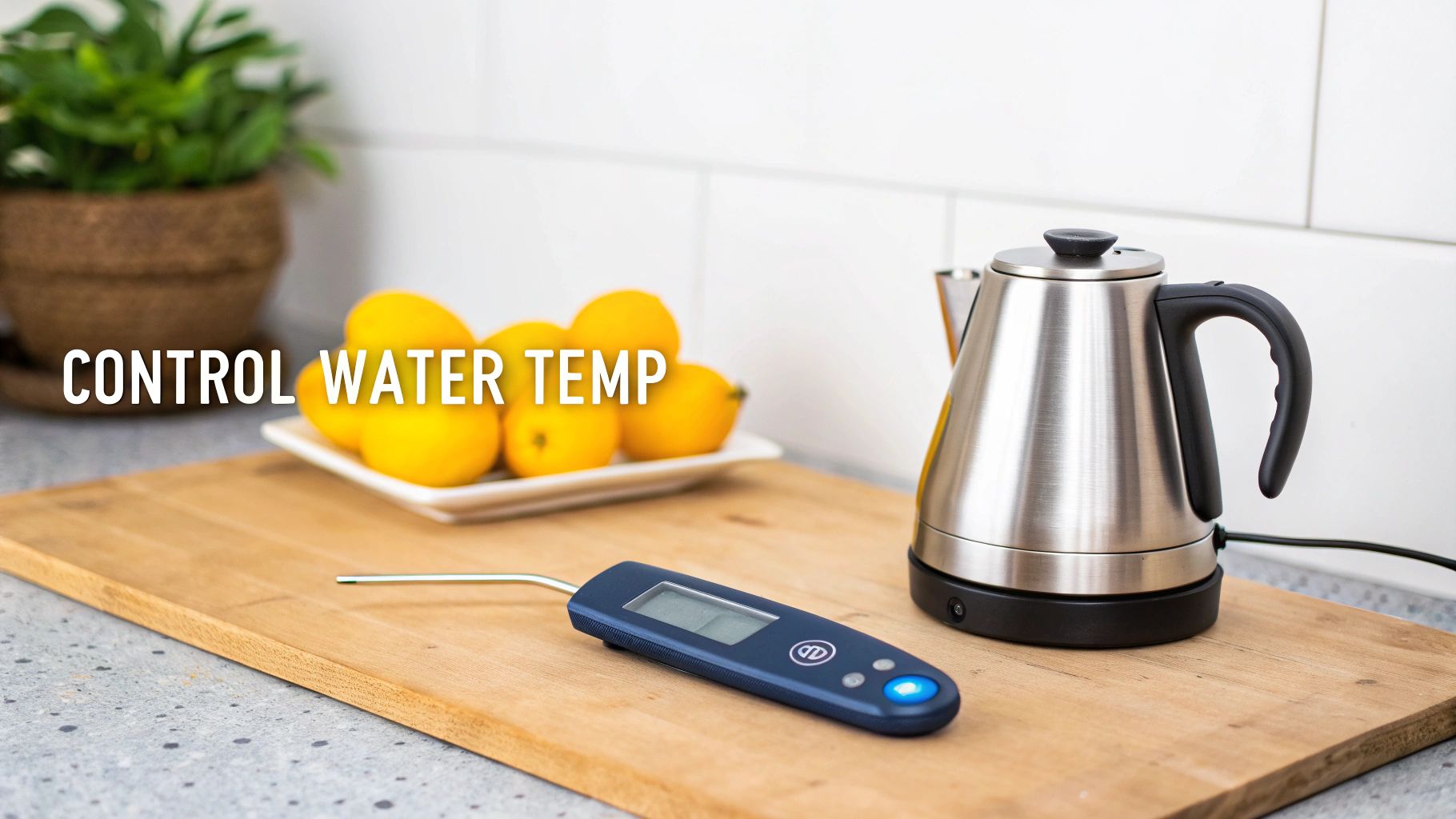
You definitely don't need a full-blown science lab to get your brew water just right. Hitting that sweet spot of 195-205°F is surprisingly simple at home, and there are great options no matter your budget or how deep you want to dive into the coffee rabbit hole.
The real goal here is building a reliable and repeatable routine. Whether you're using high-tech gear or just the kettle on your stove, consistency is the one thing that will elevate your daily cup from just "good" to consistently great.
The Precision Approach: The Gooseneck Kettle
For anyone who wants ultimate control over their brew, nothing comes close to a variable temperature gooseneck kettle. These kettles are the gold standard for a reason. You just dial in your exact target temperature, press a button, and it heats the water precisely—often holding it there for you.
And that long, elegant spout isn’t just for show. It gives you a slow, steady, and incredibly precise stream of water. This is a game-changer for pour-over methods like a V60 or Chemex, where your pouring technique directly impacts the evenness and quality of the extraction.
Affordable Accuracy: The Kettle and Thermometer Method
Don't have a fancy gooseneck? No problem at all. You can get the exact same precision with a standard stovetop or electric kettle and a simple digital thermometer. Honestly, a good thermometer is one of the most useful and inexpensive tools a coffee lover can own.
Just heat your water, take it off the stove, and use the thermometer to track the temperature as it cools to your target. It's a straightforward, budget-friendly approach that guarantees you're brewing in that ideal zone every single time. This works for everything from French press to AeroPress and even helps you nail specialty instant coffee. For more on that, check out our guide on how to make instant coffee.
Pro Tip: The Boil and Wait Method
What if you don't have a thermometer? Easy. Just "boil and wait." Bring your water to a full, rolling boil (212°F or 100°C at sea level), then immediately remove it from the heat. Let it stand for about 30 to 60 seconds with the lid off. This gives the water just enough time to cool down and settle right into that 195-205°F range. It’s a surprisingly effective trick that costs you nothing.
What About Altitude and Other Curveballs?
Just when you think you've got the perfect temperature dialed in, your environment steps in to change the game. The ideal water temperature for coffee isn't some universal constant; it’s a moving target, and one of the biggest factors that shifts it is altitude.
It all comes down to basic physics. As you go up, air pressure drops, and with less pressure holding it back, water boils at a lower temperature. This isn't just a tiny difference, either. The boiling point drops by about 1°F for every 500 feet you climb.
High-Altitude Brewing: A Whole New Ballgame
This completely upends the usual advice for brewers living in the mountains. If you're in a place like Denver, Colorado—the "Mile High City"—water boils at around 202°F (94.4°C). Forget the old "boil and wait 30 seconds" trick. At that elevation, your boiling water is already perfectly in the sweet spot for brewing.
So, if you live at a high altitude, the rule is simple: just bring your water to a boil and you're good to go. Waiting any longer will just let the temperature drop below the ideal range, leading to a sour, under-extracted cup.
Altitude, machine design, and water chemistry create measurable adjustments to the ideal brewing temperature. For instance, at 1,524 m (5,000 ft), water boils at a point where 92°C is nearly boiling, leading baristas to often set their extraction temperatures 1–3°C lower than at sea level. You can find more great insights into how elevation affects coffee brewing over on Perfect Daily Grind.
A Few Other Variables to Watch
While altitude is the big one, it’s not the only outside factor at play. A couple of other things can nudge your extraction one way or the other, even if their impact is more subtle.
- Water Chemistry: The mineral content of your water matters. "Hard" water, which is high in minerals like calcium and magnesium, extracts flavor differently than "soft" water. These minerals can sometimes dull a coffee's bright acidity or, more practically, cause scale to build up in your kettle and throw off its heating efficiency.
- Ambient Room Temperature: Brewing in a chilly kitchen will sap heat from your kettle, your brewer, and the coffee slurry itself much faster than in a warm one. This is especially noticeable with methods that are open to the air, like a pour-over.
Ultimately, great coffee comes from seeing the whole picture. When you start thinking about everything from the height of your city to the temperature of your kitchen, you're on the path to truly mastering your brew.
Troubleshooting Your Coffee With Temperature Adjustments
Think of the temperature dial on your kettle as the master control for your coffee's flavor. Once you understand how heat drives extraction, you can stop just blindly following recipes and start troubleshooting your brew like a pro. This shift in mindset is what separates a recipe-follower from a true home barista who can diagnose and perfect every single cup.
Once you learn to recognize the tell-tale signs of a brew gone wrong, making small, targeted adjustments becomes second nature. You'll be able to easily steer your coffee away from the unpleasant edges and right back into that delicious sweet spot.
Your Coffee Tastes Sour, Watery, or Thin
Does your coffee have a sharp, lemony tang that makes you pucker? Or maybe it just tastes weak, grassy, and disappointingly thin. These are the classic calling cards of under-extraction.
Under-extraction is what happens when your water isn't hot enough to pull all the good stuff—the sugars and complex flavor compounds—out of the coffee grounds. It only manages to dissolve the acids, which extract very quickly, leaving the deeper, sweeter notes behind.
The fix is usually pretty simple: increase your water temperature. Try bumping it up by three to five degrees on your next attempt. That little bit of extra heat gives the water the energy it needs to do its job properly, leading to a much fuller and more balanced extraction. If you're consistently battling sourness, you can learn more about how to reduce the acid in coffee with other brewing tweaks.
Your Coffee Tastes Bitter, Harsh, or Hollow
On the flip side, if your coffee is overwhelmingly bitter, aggressive, or leaves your mouth feeling dry and chalky, you've got a case of over-extraction. This happens when the water is too hot, causing it to aggressively strip everything from the grounds, including the unpleasant, bitter-tasting compounds that should have been left behind.
That aggressive bitterness completely smothers the coffee’s natural sweetness, leaving you with a cup that tastes flat, empty, and hollow.
To fix this, you just need to dial it back. Lower your water temperature by three to five degrees and try again. This gentler heat will extract all the desirable sugars and acids without scalding the grounds and pulling out those harsh, bitter elements. The result? Balance is restored.
The Simple Rule for Temperature Troubleshooting
Is your coffee tasting off? Just remember this simple relationship. Sour? Go hotter. Bitter? Go cooler. This core principle is the key to mastering the best water temp for coffee and unlocking consistently delicious results.
Coffee Taste Troubleshooting Guide
To help you diagnose your brew, we've put together a quick guide. Remember that temperature is your primary tool for fixing taste, but adjusting your grind size or brew time can also solve these common problems.
| Problem (Taste) | Likely Cause | Primary Solution (Temperature) | Secondary Solution (Grind/Time) |
|---|---|---|---|
| Sour, Acidic, Grassy | Under-extraction | Increase water temperature | Use a finer grind or increase brew time |
| Bitter, Harsh, Chalky | Over-extraction | Decrease water temperature | Use a coarser grind or decrease brew time |
| Weak, Watery, Thin | Under-extraction | Increase water temperature | Use a finer grind or a higher coffee-to-water ratio |
| Flat, Boring, Hollow | Over-extraction | Decrease water temperature | Use a coarser grind to preserve delicate flavors |
Think of these variables—temperature, grind, and time—as three levers you can pull. If one doesn't quite fix the problem, try a small adjustment to another. With a little practice, you'll be dialing in the perfect cup every time.
Got Questions About Coffee Water Temperature? Let's Brew Some Answers.
Getting the water temperature just right can feel a bit fussy at first, but it's one of those small details that makes a huge difference. Let's clear up a few common questions that pop up on the journey to a better cup.
Should I Use Different Temperatures for Light vs. Dark Roasts?
Absolutely. This is a great way to fine-tune your brew and get the most out of your specific beans. Think of it like cooking: you wouldn't use the same heat to sear a steak as you would to gently cook an egg.
Lighter roasts are much denser and less soluble—their flavors are locked up tight. To properly unlock their bright, often fruity or floral notes, you need a bit more thermal energy. Go hotter, somewhere in the 200-205°F (93-96°C) range, to give those delicate compounds the push they need to dissolve into your water.
Dark roasts are the opposite. The roasting process has made them more brittle, porous, and ready to give up their flavors. Hit them with water that’s too hot, and you’ll instantly pull out all the bitter, ashy compounds. For a smooth, rich, and chocolatey dark roast, pull back a bit to 195-200°F (90-93°C). This gentler heat will extract the deep sweetness without the harsh bite.
What About the Water Temperature for Cold Brew?
Here, we're playing a completely different game. Cold brew is all about trading heat for time. Instead of a quick, hot extraction, you're doing a long, slow steep. For this method, you should always be using cold or room-temperature water.
The whole point of cold brew is the 12-to-24-hour steep. This extended time coaxes out the smooth, low-acid, and naturally sweet flavors without the bitter compounds that heat would release. Using hot water would just give you a funky, over-extracted mess.
So, Can I Just Use Water Straight from a Rolling Boil?
Please don't! It’s one of the most common mistakes and a surefire way to get a bitter cup. At a full boil (212°F or 100°C at sea level), water is just too hot and volatile for delicate coffee grounds. It literally scalds them, aggressively stripping out harsh flavors you definitely don't want to taste.
The easiest fix is what I call the "boil and wait" trick. Bring your water to a boil, click the kettle off (or take your pot off the stove), and just let it sit for 30 to 60 seconds. That short pause is all it takes for the temperature to settle down into that beautiful 195-205°F sweet spot, ensuring you extract flavor, not bitterness.
Ready to elevate your coffee game with convenience and quality? Cartograph Coffee offers premium organic instant coffee, perfect for busy mornings, outdoor adventures, or any time you need a delicious cup without the fuss. Discover the difference at Cartograph Coffee.