To make your coffee less acidic, you can start by choosing dark roast beans, using a coarser grind, and switching to a cold brew method. These simple changes can dramatically lower the perceived acidity, making your daily cup much gentler on your stomach without losing all that great flavor.
Your Quick Guide to a Gentler Cup of Coffee
If you love your coffee but don't love the acidic bite or stomach issues that can come with it, you've come to the right place. Thankfully, brewing a smoother, gentler cup doesn't involve a chemistry degree or a ton of expensive gear.
Often, all it takes is a small tweak—like choosing a different type of bean, adjusting your grinder, or trying a new brew method. This guide is your cheat sheet for quick, effective ways to tone down the acidity. We'll hit the key things you can control, from the roast level you buy to the temperature of your water, so you can bring out those smooth, rich flavors you're after.
High Acid vs. Low Acid Coffee Preparation at a Glance
Making a lower-acid coffee is all about making intentional choices at each step. This visual guide breaks down the key factors that push your coffee towards either a bright, tart profile or a smooth, mellow one.
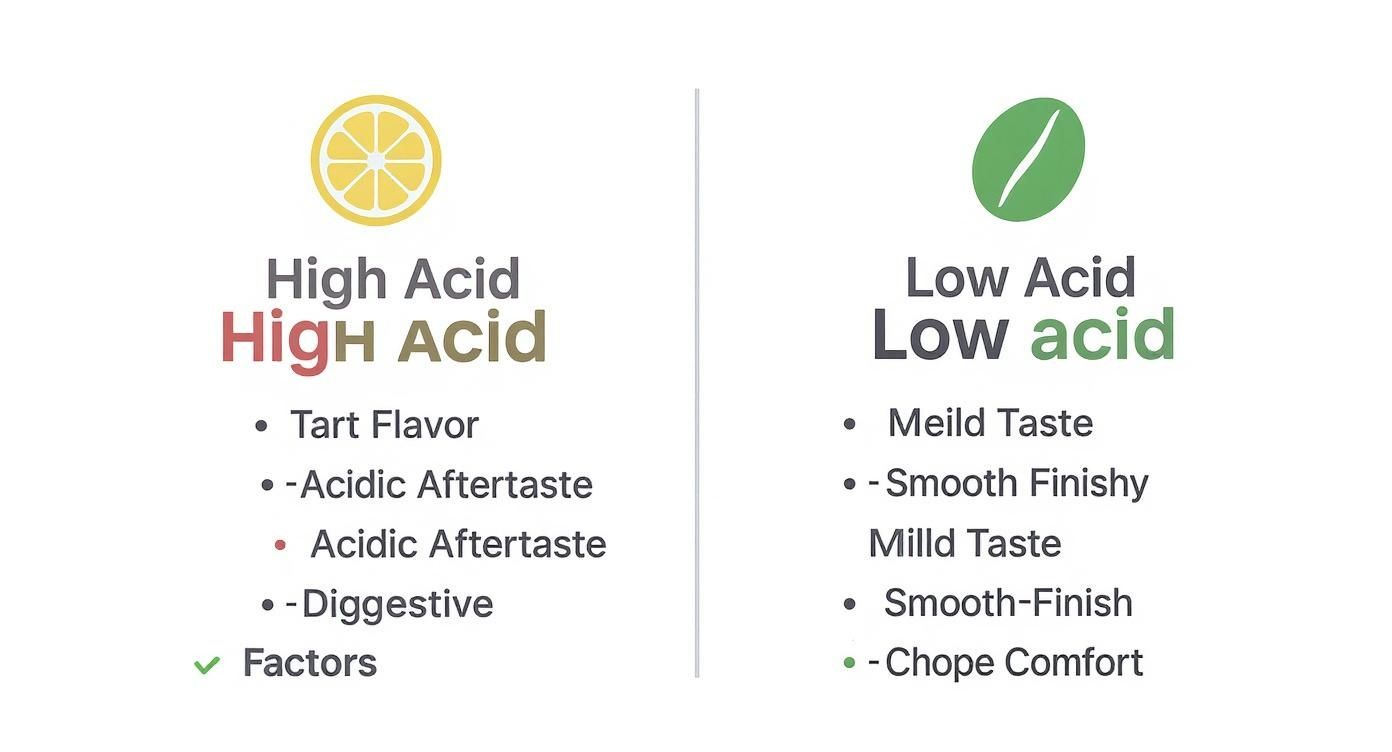
The image above gives you a great snapshot, but let's break it down even further. The table below offers a quick comparison of the brewing choices that either pump up the acidity or help mellow it out.
| Factor | Tends to Increase Acidity | Tends to Reduce Acidity |
|---|---|---|
| Roast Level | Light or medium roasts | Dark or espresso roasts |
| Grind Size | Fine grinds (more surface area) | Coarse grinds (less surface area) |
| Brew Time | Shorter brew times (under-extraction) | Longer brew times (cold brew) |
| Water Temp | Hotter water (around 205°F / 96°C) | Cooler water (room temp or cold) |
| Bean Origin | High-altitude, African beans | Low-altitude, Indonesian beans |
As you can see, every decision—from the beans you buy to how you brew them—plays a role. Keep this in mind as we dive deeper into each technique, and you'll be well on your way to crafting a perfectly smooth, stomach-friendly cup of coffee every time.
What's Really Going on with Coffee Acidity?
To get a handle on reducing acid in your coffee, it helps to know why it's there in the first place. Acidity isn't automatically a bad thing. In fact, in the specialty coffee world, we often call it "brightness," and it's a quality we chase after. It's that lively, complex fruit note that makes a coffee pop—think the crisp snap of a green apple or the gentle tang of citrus.
The problem comes when that brightness veers into outright sourness, creating a harsh flavor or, for some people, stomach trouble. This is the key distinction. We're not trying to kill all the acidity, just tame it for a smoother, more balanced cup.
The Main Acids Brewing in Your Cup
Coffee is full of different acids that show up at every step, from the moment the cherry grows on the plant to the final roast. It's a complex cocktail, but a few key players are behind most of what you taste and feel.
- Chlorogenic Acids: These are the big ones in green, unroasted coffee beans. They contribute to both acidity and bitterness but start breaking down pretty quickly once the heat of the roaster hits them.
- Citric and Malic Acids: Sound familiar? They're the same acids found in fruit, and they give coffee those pleasant, bright, and fruity flavors. Malic acid gives you that crisp apple vibe, while citric acid is more like the tartness of a lemon.
- Quinic Acid: This is the one you want to avoid. It shows up when other acids break down, either from over-roasting or when brewed coffee sits around getting stale. It's the culprit behind that sour, stomach-turning taste of old coffee from a diner pot.
Knowing about these helps you figure out why a coffee might taste a little too sharp. A super light roast, for example, will have more of those chlorogenic acids intact, making for a brighter, more perceptibly acidic brew.
On the pH scale, where lower numbers mean more acidity, most brewed coffee lands somewhere between a pH of 4.8 and 5.2. That makes it a bit more acidic than a banana but definitely less acidic than tomato juice.
Where a Coffee Bean Gets Its Acidic Personality
A coffee's potential for acidity is locked in long before it ever meets your grinder. The type of bean and where it was grown play a huge role. For instance, Arabica beans are almost always more acidic than Robusta beans. If you're curious about that, we break it all down in our guide to Arabica vs. Robusta beans.
Geography is another massive piece of the puzzle. Beans from high-altitude regions like Ethiopia and Kenya tend to develop more of the acids that create those wonderfully complex and bright flavors. On the flip side, coffees from lower-altitude places like Brazil or Sumatra are famous for their naturally lower acidity and earthier, heavier body.
It’s worth noting that hard scientific data on exactly how much each reduction method lowers acidity is surprisingly scarce. Most research focuses on bigger market trends, which you can read about in reports on global coffee consumption on CoffeeBI.com. So, starting with the right bean from one of these low-acid regions is your best first move for a gentler brew.
Choosing the Right Beans and Roast Level
Your path to a smoother, gentler cup of coffee starts long before the water hits the grounds. Honestly, the single biggest factor determining your coffee's final acidity is the bean itself—where it grew and how it was roasted. Getting this part right at the store is the most powerful move you can make.
I like to compare it to choosing an apple. A Granny Smith is always going to be tart and crisp, while a Red Delicious is naturally mellow and sweet. Coffee beans are no different. Their origin and environment create their inherent flavor profile, which the roaster then shapes and refines.
Seek Out Low-Altitude Origins
One of the simplest ways to find a naturally low-acid coffee is to look for beans grown at lower elevations. High-altitude environments, with their cooler nights and slower maturation, tend to produce dense beans that develop more of those complex, bright acids that specialty coffee lovers often chase.
On the other hand, beans from lower altitudes often have a milder, earthier character. When you’re shopping, keep an eye out for these regions known for their smoother profiles:
- Brazil: A classic choice, famous for nutty, chocolatey, and reliably low-acid coffees.
- Sumatra (Indonesia): Known for a heavy body with deep, earthy, and sometimes herbal notes.
- Mexico: Often delivers a gentle, sweet cup with an incredibly smooth finish.
By starting with a bean that’s less acidic from the get-go, you're giving yourself a massive head start. You won't have to fight the coffee's nature during brewing; you'll just be coaxing out its naturally mellow qualities.
Why Darker Roasts Are Your Friend
The roast level is where a roaster can really tame a coffee's acidity. As beans heat up, the chemical compounds inside them break down and transform. The longer they roast, the more the bright, sharp chlorogenic acids degrade, giving way to smoother, deeper flavors.
A common misconception is that all acidity is bad. In reality, it provides the "brightness" that makes some coffees taste vibrant and exciting. The goal here isn't to eliminate it entirely but to find a roast where that brightness has matured into a rich, comfortable flavor.
This means you should actively look for darker roasts. Light roasts are designed to preserve a lot of the bean's original, often acidic, character. Dark roasts, however, bring out those roasty, chocolatey, and caramel-like notes while significantly toning down the perceived sourness.
- Medium Roast: A good starting point that offers a nice balance.
- Dark Roast (French, Italian, Espresso): Your best bet for low acidity. The extended heat mellows the beans out considerably. You can learn more about the benefits of a dark roast organic coffee in our detailed guide.
When you're reading a coffee bag, look for tasting notes like "full-bodied," "smooth," "chocolatey," or "nutty." These are almost always clues that the coffee inside will be less acidic and much gentler on your stomach—exactly the kind of comfortable coffee experience you're after.
Mastering Low-Acid Brewing Techniques
Once you've picked the right beans, the real magic happens in the brewing process. This is where you get to play a hands-on role in dialing down the acidity of your final cup. Think of your grinder, your kettle, and your brewer as a set of controls you can adjust to craft a smoother, gentler coffee. You’d be surprised what a few small, intentional tweaks can do.

It’s a bit like cooking. The same ingredients can give you vastly different results depending on whether you roast, fry, or slow-cook them. Coffee works the same way. Hot and fast brewing methods tend to pull out more of those bright, sometimes sharp, acidic compounds. On the other hand, cooler and slower methods coax out the deep, mellow flavors.
Cold Brew: The Undisputed Champion of Smoothness
When it comes to making low-acid coffee, nothing beats cold brew. It’s in a league of its own.
By steeping coarse grounds in cold or room-temperature water for 12 to 24 hours, you completely change the chemistry of extraction. Cold water is far less aggressive, dissolving fewer of the acidic compounds that can cause a sharp bite or stomach discomfort.
What you're left with is a coffee concentrate that is incredibly smooth, rich, and often naturally sweet. In fact, studies show that cold brew can be over 60% less acidic than hot-brewed coffee made from the exact same beans. For anyone serious about cutting down on acid, this is the most effective method, bar none.
Pro Tip: Don't get cold brew mixed up with iced coffee. Iced coffee is just regular hot coffee that's been cooled down and poured over ice. This does nothing to lower the acidity and often just leaves you with a watery, underwhelming drink. True cold brew never even sees hot water.
Tweak Your Grind and Water Temperature
Even if you’re a die-hard fan of a hot cup of coffee, you can still slash the acidity by adjusting two key variables: your grind size and your water temperature. These two elements are locked in a dance, controlling how quickly flavors are pulled from the grounds. Finer grinds and hotter water mean a faster extraction, which often brings more acids along for the ride.
To slow things down and get a smoother result, give these adjustments a try:
- Go for a Coarser Grind: When you grind your beans more coarsely, you reduce the total surface area the water can touch. This puts the brakes on extraction, leaving more of those pesky acidic compounds behind in the grounds. This trick works especially well for brewing methods like the French press.
- Lower Your Water Temperature: Boiling water is often too aggressive for delicate coffee grounds. Try aiming for water that’s just off the boil, somewhere around 195°F to 200°F (90°C to 93°C). Dropping the temperature by even a few degrees can make a real, noticeable difference in the perceived acidity, especially with pour-over or drip coffee.
Making these changes helps create a much more forgiving brewing process. It becomes harder to over-extract your coffee, which is a common culprit behind both sourness and bitterness.
How Different Hot Brewing Methods Stack Up
While cold brew is the gold standard for low acidity, not everyone has the patience to wait 24 hours. The good news is that your choice of hot brewer also plays a huge role. If you're curious about different techniques, our guide on the best coffee brewing methods is a great place to dig deeper.
For now, here’s a quick rundown of how common brewers compare when you’re aiming for a low-acid cup:
| Brewing Method | Acidity Potential | Why It Works (or Doesn't) |
|---|---|---|
| French Press | Low to Medium | The coarse grind and metal filter let more coffee oils into the cup, which adds body and a feeling of smoothness. You can also shorten the brew time to limit acid extraction. |
| AeroPress | Low to Medium | This brewer is incredibly versatile. By using a lower water temperature and a quick press time (say, around 30 seconds), you can produce a smooth, low-acid shot of concentrate. |
| Pour-Over (V60) | Medium to High | This method is really designed to highlight brightness and clarity, which often translates to a more acidic cup. You can mellow it out, though, by using a coarser grind and cooler water. |
| Drip Coffee Maker | Medium | Results can be all over the place depending on the machine. If your model brews with scalding hot water, it’s probably going to produce a more acidic coffee. |
At the end of the day, experimentation is your best friend. Try brewing your favorite dark roast beans in a French press with a coarse grind. You'll likely discover a rich, comfortable cup that's easy on the stomach. Each little adjustment gets you one step closer to your own perfect, gentle brew.
Quick Fixes for Taming Acidity in Any Cup of Coffee
Let's be realistic—sometimes you can't meticulously select your beans or control your entire brewing process. You might be stuck with the office coffee, traveling, or simply trying to get through a bag of beans that turned out a little too bright for your liking. In these situations, a few simple additions can be a lifesaver, quickly taming that acidic bite without a lot of fuss.

Think of these tricks as first aid for your coffee. They work by either neutralizing or buffering the acids already in your brew, providing immediate relief so you can enjoy a cup that might have otherwise been a bit harsh.
The Old-School Baking Soda Trick
Here's a home remedy that’s been around forever for a good reason: it works. By adding a tiny pinch of baking soda (sodium bicarbonate) to your coffee grounds before you brew, you can dramatically lower the acidity. Baking soda is alkaline, so it directly neutralizes some of the acids that can cause stomach upset.
But be careful. A little goes a very long way. Start with a truly tiny amount, maybe 1/16 of a teaspoon for a whole pot. If you overdo it, your coffee will taste flat, or worse, slightly salty and chemical. When you get it right, though, you won't taste it at all—you'll just notice a much smoother, gentler cup.
The goal isn't to make your coffee alkaline. It's just to nudge the pH up slightly, taking that sharp, aggressive edge off. For anyone with a sensitive stomach, this small adjustment can make a world of difference.
Bring on the Milk (Dairy or Not)
Adding milk or cream is probably the most common way people cut the acidity in their coffee, often without even realizing it. The fats, proteins, and especially the calcium in dairy products act as a fantastic buffer. They don't technically remove the acid, but they change how you perceive it, making the coffee taste much rounder and mellow.
And this isn't just a dairy thing. Plenty of plant-based milks do a great job, too:
- Almond Milk: Its natural creaminess is great for smoothing out harsh notes without overpowering the coffee’s flavor.
- Soy Milk: Because it’s higher in protein, soy milk adds a richness that really helps to mellow out any sharpness.
- Oat Milk: This is a fan favorite for a reason. The thick, creamy texture is fantastic at creating a smoother, less acidic-tasting drink.
Other Pantry Staples to Try in a Pinch
If you're still searching for a solution, a couple of other common household ingredients can help. These work by tweaking how your taste buds register flavors, effectively masking that sour tang.
One popular method is adding a tiny pinch of salt to your grounds. It might sound strange, but salt is brilliant at suppressing bitterness, and it can also help balance out the sour notes from the acid. Just like with baking soda, the key is to use an amount so small you can't actually taste the salt itself.
You can also find acid-reducing drops or powders made specifically for coffee. These products usually contain minerals like calcium, potassium, and magnesium to neutralize acid. They're a more direct solution, but honestly, a simple household item often works just as well.
Common Questions About Coffee Acidity
Diving into the world of low-acid coffee often brings up a handful of questions. As you start tweaking your brewing routine to find that perfect, gentle cup, it's totally normal to wonder what actually works and why. Let's clear up some of the most common ones.
Think of this as your quick-reference guide. Once you get these core ideas down, you’ll find it much easier to consistently brew a smooth, stomach-friendly coffee every single time.
Does Dark Roast Coffee Have Less Acid?
It sure does. As a general rule, the darker the roast, the lower the acidity. The roasting process itself is key here—the longer the beans are heated, the more the bright-tasting chlorogenic acids get broken down.
This is why a French or Italian roast often has that deep, mellow flavor profile, making it a go-to for anyone who finds lighter roasts too sharp. The intense heat essentially "cooks off" many of the compounds that give coffee that tangy, acidic bite.
Is Cold Brew Really That Much Less Acidic?
You bet it is. Cold brew is a game-changer for anyone looking to slash acidity. By using cold water over a very long steeping time (usually 12 to 24 hours), you completely change the chemistry of the extraction.
Research has found that cold brew can be over 60% less acidic than hot coffee brewed with the same beans. It’s brilliant at pulling out the smooth, chocolatey flavor notes while leaving many of the harsher, acidic compounds behind in the grounds.
This makes it arguably the single most effective method for producing a flavorful coffee that's also incredibly gentle on your system.
Can Adding Milk Lower The Acidity Of My Coffee?
While milk doesn't magically zap the acids away, it does a fantastic job of buffering them, making the coffee feel much less acidic. The calcium in milk acts as a natural neutralizer, slightly raising the overall pH of your cup.
This simple chemical reaction smooths out the flavor, softening any sharp or bitter edges. The fats and proteins in the milk also contribute to this mellowing effect, creating that classic creamy, rounded taste that so many people love.
Does A Paper Filter Help Reduce Acidity?
It can make a surprisingly big difference. Paper filters are designed to trap the finest particles and, most importantly, a lot of the coffee's natural oils. Some of the acidic compounds are actually bound up in these oils.
By filtering them out, you end up with a much cleaner, lighter-bodied brew. This is why a pour-over often tastes less acidic than a French press, which uses a metal filter that allows all those oils and micro-grounds to pass right into your cup. It’s a simple but effective tweak.
Ready to enjoy a rich, flavorful, and incredibly convenient cup of coffee without the hassle? Cartograph Coffee offers premium organic instant coffee designed for busy lives and discerning palates. Discover your new favorite go-to coffee at https://cartographcoffee.com.