You're late for work, the kettle has just clicked off, and the coffee on the shelf needs to do more than provide caffeine. You want the bold, smoky-sweet character of a dark roast, but you don't want a cup that tastes flat, burnt, or tired. The same problem appears outdoors, when carrying a grinder and brewing equipment isn't practical but settling for harsh instant coffee feels like a poor trade.
That's why the search for the best instant dark roast coffee needs a better method than choosing the most familiar label. Roast level matters, but so do the drying process, aroma retention, dissolution, and the package's ability to keep moisture and oxygen away from the granules. A dark roast can taste rich and chocolatey, or it can taste ashy, depending on how those variables work together.
This guide treats instant dark roast as a product-performance question. It's designed for busy professionals, campers, travelers, and families who need speed without abandoning flavor. If you're also exploring drinks beyond black coffee, you can find coffee recipes for your menu for ideas that work with instant coffee, milk, and flavored additions.
Introduction to Finding Your Perfect Instant Dark Roast
“Best” depends on the moment you're trying to improve. An office drinker may value clean dissolution and predictable strength, while a camper may care more about compact single-serve packaging and a profile that remains satisfying without milk. At home, aroma may be the deciding factor because the pleasure begins before the first sip.
Instant coffee has earned serious attention because convenience is not a temporary feature of the category. The global instant coffee market was estimated at USD 80.2 billion in 2024 and is projected to reach USD 110.28 billion by 2030, with a 5.4% CAGR from 2025 to 2030, according to Grand View Research's instant coffee market analysis. That outlook identifies ease of preparation and convenience as major demand drivers, which helps explain why better-quality instant coffee can serve demanding routines rather than only emergency use.
The dark roast paradox
Dark roasting creates a recognizable style. You'll usually look for bittersweet chocolate, cocoa, caramel, toasted nuts, and smoky roast notes, with less obvious acidity than a light roast. Those flavors can be compelling in an instant format, especially when you drink coffee with milk or need a strong base for a latte-style drink.
The risk is that roast intensity can hide defects. A heavily roasted coffee may overwhelm whatever character the beans originally had, leaving bitterness as the dominant impression. Instant processing then adds another challenge, because brewed coffee must be dried and later rebuilt with water. The best products preserve enough aroma and body to make the cup feel deliberate rather than merely convenient.
A practical comparison at a glance
| Evaluation factor | Strong signal | Warning sign |
|---|---|---|
| Roast profile | Cocoa, toasted nut, caramel, controlled smokiness | Ash, burnt rubber, sharp bitterness |
| Drying process | Freeze-dried granules with clear process information | No processing detail |
| Solubility | Granules dissolve fully without prolonged stirring | Sediment or uneven strength |
| Aroma | Fragrance appears as soon as hot water hits the coffee | Weak or papery smell |
| Packaging | High-barrier, moisture-resistant individual packs or container | Package feels poorly sealed after opening |
| Routine fit | Dose and format match your mug, office, or campsite | Requires guesswork every morning |
A sound choice therefore starts with process evidence, not just branding. Taste remains personal, but processing and packaging give you more reliable clues about whether a dark roast will retain the qualities you're paying for.
What Makes a Dark Roast Instant Coffee Truly Great
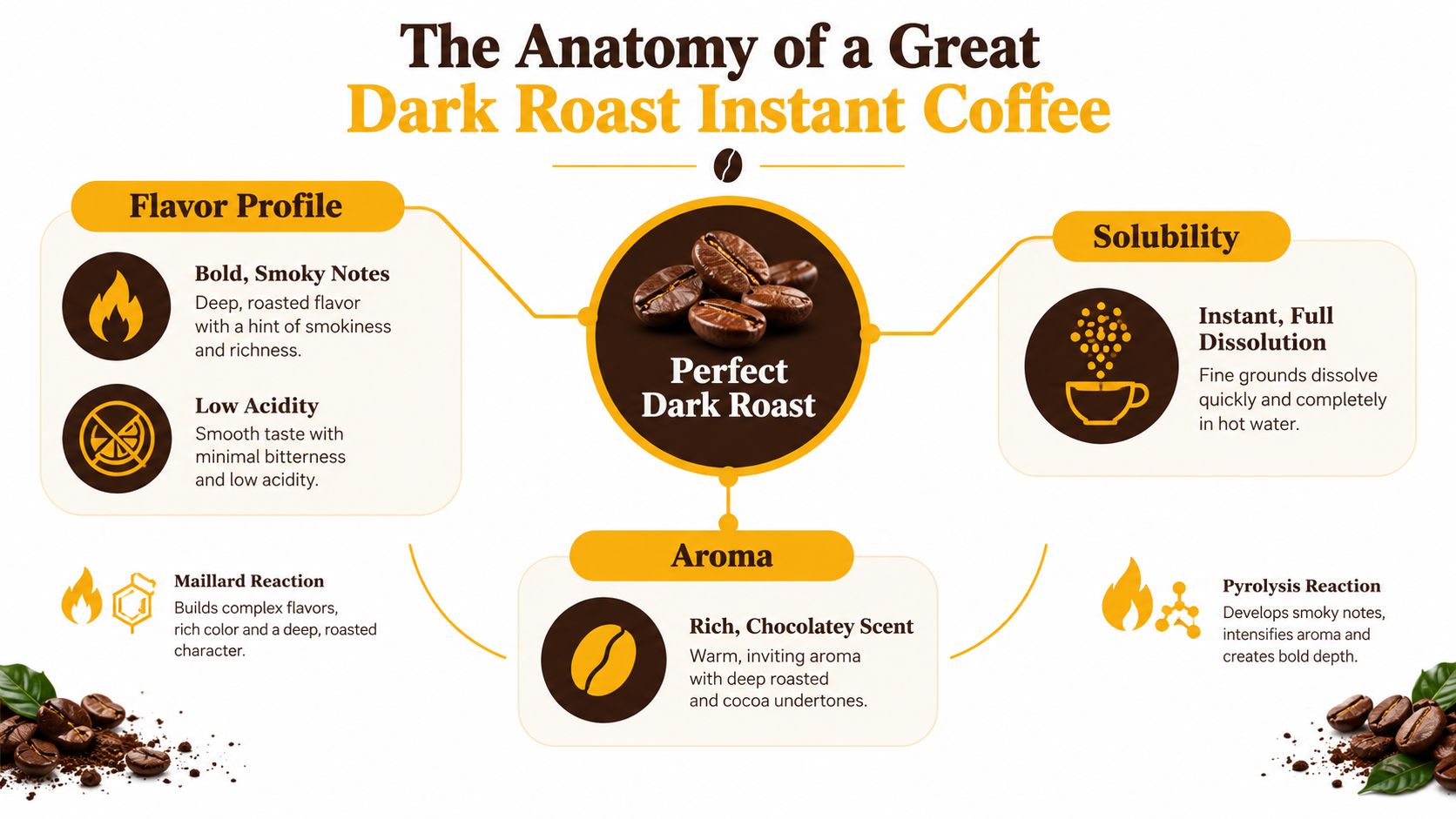
A dark roast is defined by more than color. As coffee roasts, Maillard reactions create layers of browned, toasted flavor, while pyrolysis contributes deeper roast character and darker aromatic compounds. The result can suggest cocoa, toasted nuts, caramel, bittersweet chocolate, and smoke. Those notes should support the coffee's body, not bury it beneath an acrid finish.
Acidity usually feels lower in a dark roast because the roast profile emphasizes heavier, more developed flavors. That doesn't mean a good dark roast should taste lifeless. A balanced cup can still have sweetness, a rounded mouthfeel, and enough aromatic lift to prevent the bitterness from becoming one-dimensional.
Freeze-dried versus spray-dried
The drying method determines how much of the brewed coffee's aroma survives manufacturing. Spray drying turns concentrated coffee into powder through contact with hot, dry air. It's efficient and widely used, but heat exposure can reduce delicate volatile compounds.
Freeze drying freezes concentrated coffee, breaks it into granules, and removes water under vacuum. The lower-temperature pathway is important because dark roast coffee already contains a strong roast signature. If processing removes too much aroma, the cup can become blunt and bitter rather than rich.
A review comparing the two methods reported that freeze-dried coffee had 1.52 times, or 25.87%, higher total volatile aroma compounds at laboratory scale, and 1.63 times, or 28.26%, higher at industrial scale, than spray-dried coffee. Those figures come from the review of aroma compounds in instant coffee. Another review cited in the same evidence set found that freeze-dried coffee retained 17% to 20% more low-boiling aromatic components and 75% more high-boiling volatiles than spray-dried soluble coffee.
What those numbers mean in the cup
Aroma retention matters especially for dark roast because the profile depends on more than bitterness. Cocoa, caramel, toasted nut, and smoky sweetness are experienced partly through smell. When those volatile compounds remain present, the coffee can taste deeper without requiring an excessive dose.
Solubility matters just as much. A granule that dissolves quickly and evenly gives you predictable strength. If it leaves residue or produces uneven pockets of concentrated coffee, the cup may seem harsh even when the underlying product is sound.
The useful distinction: A dark roast should taste intense because it has preserved roast sweetness and body, not because bitterness is doing all the work.
The category's technical maturity supports this approach. One industry report states that instant coffee accounts for 25% of total global retail coffee sales, while Mordor Intelligence's market study reports USD 10.0 billion in European instant coffee sales, representing 48.1% of global market value. The same study reports that spray-dried instant coffee held 72.3% of the material segment. That combination shows why consumers encounter both highly efficient commodity formats and more aroma-focused freeze-dried products.
How to Compare Instant Dark Roast Coffees Like an Expert
The fastest way to compare products is to separate sensory character from manufacturing performance. Start with the flavor, but don't stop at the first sip. A dark roast that smells strong but dissolves poorly, loses aroma after opening, or turns aggressively bitter with normal dosing isn't a complete success.
Instant Dark Roast Evaluation Matrix
| Criteria | What to Look For | Why It Matters for Dark Roast |
|---|---|---|
| Roast depth | Cocoa, toasted nut, caramel, and measured smokiness | Keeps intensity from becoming ashy |
| Bitterness balance | Bitterness supports sweetness and body | Dark roasts can become harsh when roast dominates |
| Processing method | Freeze-dried granules, with process information provided | Freeze drying generally preserves more aroma |
| Aroma intensity | Fragrance appears immediately after adding water | Aroma adds complexity beyond roast bitterness |
| Body | Rounded, substantial texture without residue | Gives dark roast its satisfying weight |
| Solubility | Full dissolution with ordinary stirring | Prevents uneven strength and gritty texture |
| Acidity | Low or restrained acidity, without dullness | Matches the expected dark-roast profile |
| Sourcing transparency | Origin, bean type, and certification details where available | Helps distinguish a considered product from vague labeling |
| Organic certification | Verifiable organic claim | Relevant to shoppers who prioritize production standards |
| Packaging barrier | Strong protection from moisture, oxygen, light, and humidity | Protects aroma and limits staling |
| Convenience | Dose suits the cup and setting | A good coffee must work in the routine you actually have |
Reading the roast correctly
A useful tasting sequence begins with aroma, then sweetness, then bitterness, then finish. Cocoa and toasted nut notes suggest a roast that has developed flavor without stripping away all character. Smoke can add depth, but an ashy or charred impression usually signals that roast intensity has overwhelmed balance.
Milk changes the equation. A coffee that seems forceful when black may become appropriately rich in a latte, while a more delicate dark roast may disappear under dairy. For black coffee, prioritize aromatic clarity and a clean finish. For milk drinks, body and roast persistence can carry more weight.
Processing is the major separator
Freeze-dried and spray-dried coffees can both dissolve into hot water, but they shouldn't be judged as interchangeable. The evidence on volatile compounds gives freeze drying a meaningful advantage when aroma is central to the experience. Spray drying can still suit buyers who prioritize availability, familiar flavor, or lower cost, but the cup may rely more heavily on roast intensity than on aromatic detail.
For a broader look at products and format differences, the guide to instant coffee brands can help you expand your comparison set. Keep the matrix above beside you while shopping, because terms such as “premium,” “barista-style,” and “rich” don't tell you how a coffee was dried or packaged.
A premium label is a starting point, not proof of aroma retention. The process and pack should support the promise.
Sourcing Organic Beans and Packaging That Preserves Freshness
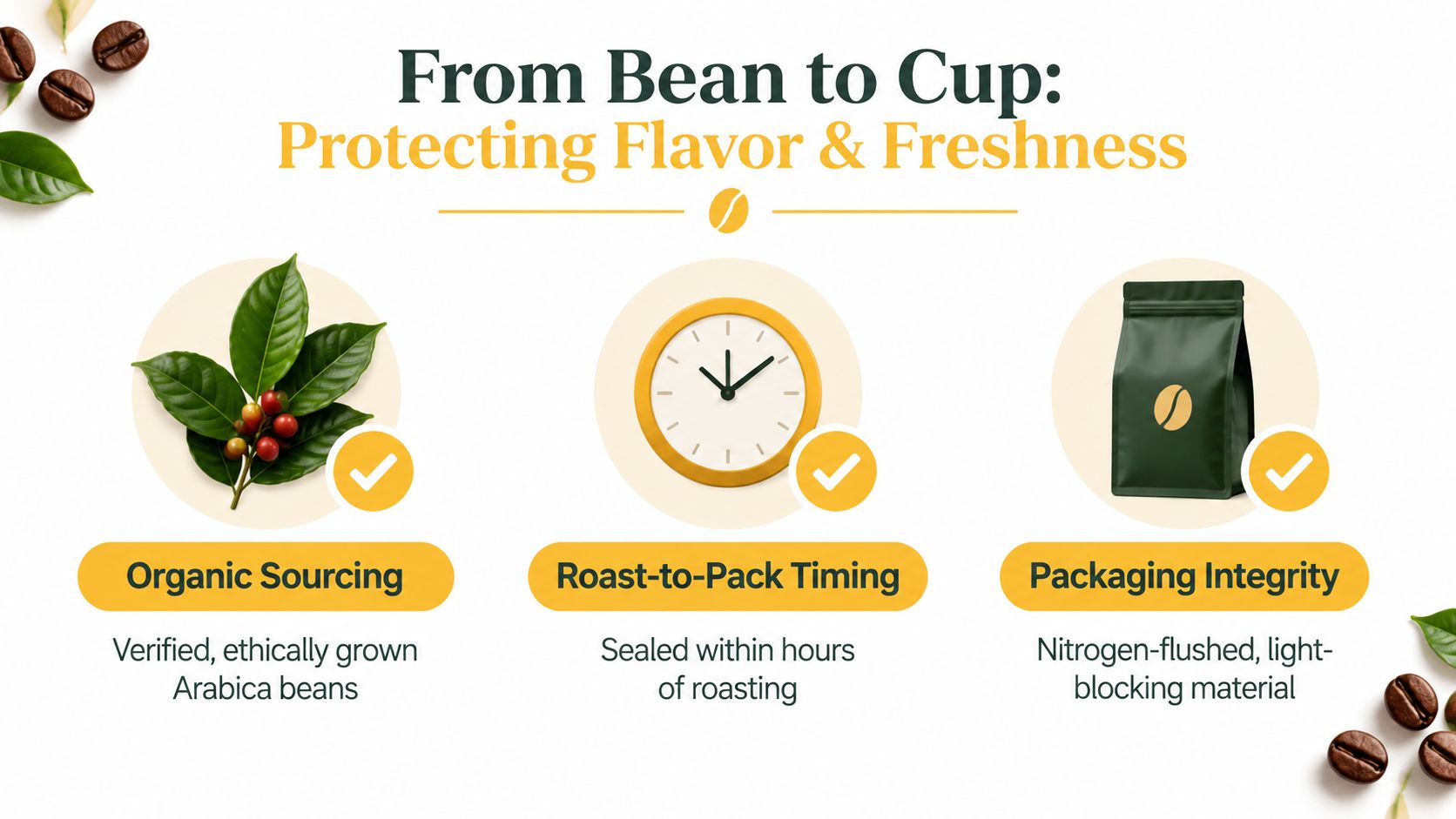
Organic sourcing and packaging answer different questions. Organic certification concerns how the coffee was produced and processed under the relevant standard. Packaging determines whether the flavor created during roasting and drying survives storage and repeated opening.
That distinction matters because a carefully sourced coffee can still fade if the pack admits moisture or oxygen. Conversely, excellent packaging can preserve a product whose sourcing story remains unclear. For a buyer evaluating the best instant dark roast coffee, both sides deserve separate attention.
Traceability is useful, but it isn't the whole test
Look for a clear origin statement, bean information, certification language, and a roast or production reference where the producer provides one. These details don't guarantee a perfect cup, but they make the product easier to assess and compare. A vague label gives you fewer ways to understand why the coffee tastes the way it does.
Roast-to-pack timing also matters in practical terms. Dark roast aroma can feel vivid immediately after preparation, but that impression depends on whether the manufacturer protected volatile compounds through concentration, drying, and sealing. The package is the final barrier between that retained aroma and the surrounding environment.
Moisture is the quiet quality killer
Instant coffee is a dry product, but it isn't immune to humidity. A comparative study of 12 instant coffees found visible quality loss at 10% to 12% dry-basis moisture content, while evaluated products showed water activity in the 0.202 to 0.326 range and moisture of 2.1% to 3.0% dry basis for some drying methods. The Coffee Science comparative study provides the technical basis for these measurements.
Water activity describes how available water is within a product. You don't need to calculate it at home, but you can understand the buying implication. Granules must remain dry, free-flowing, and aromatic. If they clump soon after opening, the package may not be protecting them adequately, or the container may be exposed to a humid environment.
What strong packaging looks like
The same study reported oxygen transmission rates above 1,000 mL (STP) m⁻².day⁻¹ and water vapor transmission rates below 0.017 g/package/day under one test condition, rising to 0.048 g/package/day under a warmer, more humid condition. These are packaging-performance measurements, not promises that every commercial product meets them.
For shoppers, the practical checklist is simpler:
- Choose sealed portions when possible: Individual packets reduce the number of times the remaining coffee meets humid air.
- Inspect the closure: A jar or pouch should reseal firmly after each serving.
- Protect the container: Store it away from steam, sunlight, and the kettle.
- Watch the granules: Clumping, muted aroma, and flattened bitterness suggest quality loss.
For a deeper packaging-focused perspective, Mastering Instant Coffee Packaging offers relevant context on how the container supports the coffee inside it.
Brewing Tips to Unlock Bold Flavor Without Bitterness
Instant coffee doesn't need complicated equipment, but it does respond to technique. Dark roast granules dissolve quickly, and an oversized dose can make the cup taste harsh before milk or sugar has a chance to soften it.
Build the cup in stages
Start with a small amount of hot water and stir the granules into a smooth concentrate. Add the remaining water afterward. This method wets the coffee evenly and makes it easier to judge strength before you commit to a full mug.
Use water that has stopped boiling rather than pouring aggressively at the point of maximum heat. Instant coffee has already been brewed and extracted before drying, so you aren't extracting it again in the same way as ground coffee. The main goal is even dissolution and controlled temperature, which helps preserve sweetness and prevents the roast from seeming more abrasive than it is.
A useful routine looks like this:
- Dissolve first: Mix the granules with a small splash of hot water.
- Stir thoroughly: Break up every visible pocket of powder or granule.
- Dilute gradually: Add water until the body suits your mug.
- Taste before modifying: Decide whether the issue is strength, bitterness, or aroma.
- Adjust one variable: Add water for harshness, coffee for weakness, or milk for a rounder texture.
For more ideas on improving an ordinary cup, see this practical guide on making instant coffee taste better.
Match the method to the setting
At the office, pre-portioning the coffee prevents repeated guessing and keeps the routine clean. At camp, use a compact mug and add water in stages, because a large volume of water can make a dark roast seem thin while an undersized volume can exaggerate bitterness.
Milk-based drinks need a stronger concentrate. Dissolve the coffee in less water, add warm milk, and taste before adding sweetener. For black coffee, use more water and let the aroma develop before deciding the roast is too intense.
If you want to see a visual preparation example after trying the staged method, this video provides another reference point.
Troubleshoot by symptom
Flat aroma usually points toward aged coffee, weak packaging protection, or water that has muted the fragrance. Excessive bitterness often comes from too much powder for the amount of water, not necessarily from the dark roast itself. A thin cup needs more coffee or less water, while a harsh cup needs dilution before you change the product.
Cartograph Coffee in Focus and How It Compares
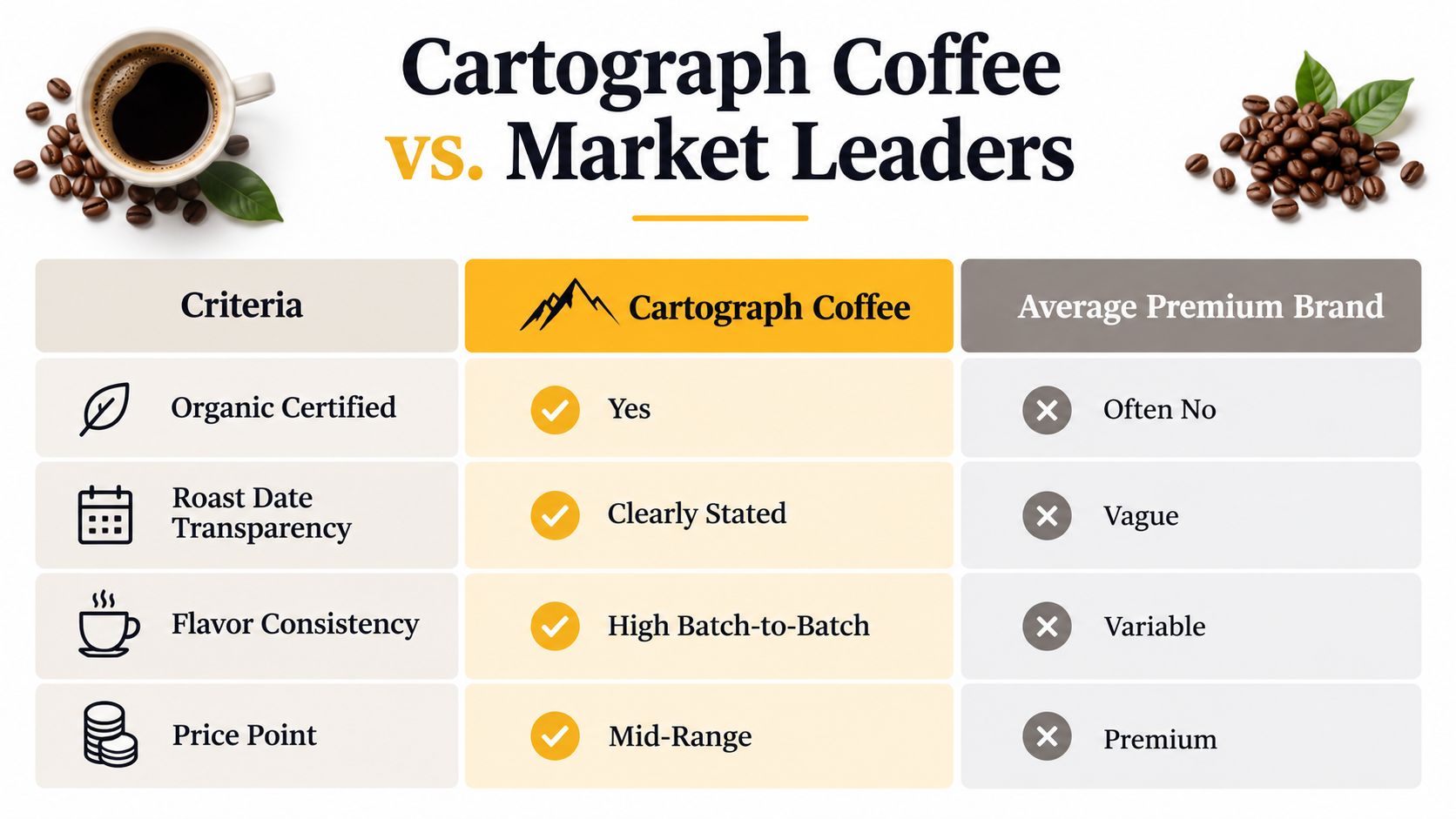
Cartograph Coffee fits the instant category through a combination of organic positioning, freeze-dried processing, and single-serve convenience, according to the product information provided for this guide. Those features align with the decision framework above, but they don't remove the need to match the coffee to your preferences.
A busy professional may value a packet that can be prepared without measuring from a jar. An outdoor user may prefer the portability and reduced exposure to humidity that individual portions provide. A family may care about a straightforward preparation method that works consistently for different drink styles.
Where the format makes sense
Freeze drying is the strongest technical fit for a dark roast when aroma matters. The evidence reviewed earlier indicates that freeze-dried products generally retain more volatile aromatic compounds than spray-dried products, giving them a better chance of expressing cocoa, toasted nut, caramel, and smoky sweetness as distinct impressions rather than one blunt roast note.
Organic certification adds a separate value for shoppers who want production standards to form part of the purchase decision. It doesn't predict whether you'll prefer a heavier or gentler roast, so tasting remains essential. Someone who wants a very smoky, forceful coffee may still choose a different product from someone seeking a rounded black cup.
A balanced comparison
| Buyer priority | Cartograph Coffee may fit when | Another format may fit better when |
|---|---|---|
| Aroma | You want a freeze-dried style with a pronounced roast fragrance | You accept a simpler aroma for easier availability |
| Convenience | You prefer single-serve preparation at work or outdoors | You brew many cups from one larger container |
| Sourcing | Organic certification is part of your buying criteria | Certification isn't important to your decision |
| Roast preference | You enjoy a bold, lower-acidity direction | You prefer bright acidity or lighter roast character |
| Storage | You want individual portions that limit repeated opening | You already have a well-sealed container and use it quickly |
The key comparison isn't whether one brand can satisfy everyone. It's whether the product's process, sourcing, pack format, and flavor direction agree with your routine. Cartograph's offering is relevant for buyers who want an organic instant option in a freeze-dried, portable format, while a different product may suit a household that prioritizes bulk storage or a lighter sensory profile.
Choosing the Right Instant Dark Roast for Your Lifestyle
Choose by routine first, then by roast preference. The best instant dark roast coffee for an office desk isn't automatically the best choice for a mountain trip, and a product that works beautifully with milk may taste too forceful when served black.
Use case one, daily work coffee
Look for full dissolution, repeatable dosing, and a sealed format. A dark roast with cocoa and toasted-nut character usually performs better during a rushed morning than one built around delicate acidity. If the office kettle runs hot and the coffee is often prepared quickly, a staged dissolve and gradual dilution can prevent an aggressive cup.
Use case two, camping and travel
Prioritize lightweight portions, simple preparation, and aroma that remains noticeable without equipment. Freeze-dried granules are a logical choice when you want more retained fragrance, while individual packaging can limit exposure to humid outdoor air. Keep packets in a dry pouch rather than beside cooking steam.
Use case three, family use
Choose a balanced dark roast that can work black, with milk, or in a sweetened drink. A product that becomes harsh when concentrated may be less versatile than one with rounded body and controlled bitterness. Test the coffee in the drinks your household makes instead of judging it only as a small black sample.
Use case four, flavor-first home drinking
Start with aroma. Open the packet or container, smell the dry coffee, then smell it again after adding water. If the fragrance is muted before the first sip, no brewing adjustment can fully replace lost volatile character. Freeze-dried processing is the strongest evidence-based starting point when aroma retention is a priority, as established earlier.
Store the coffee away from humidity and reseal the container immediately after serving. Brew one cup using a measured amount of water, then change only one variable at a time. That simple tasting routine will tell you more about whether a coffee suits you than a front-label promise.
Cartograph Coffee offers organic freeze-dried instant coffee in convenient single-serve packets for work, travel, camping, and home preparation. If you want to compare a portable dark-roast option against the process and packaging criteria in this guide, visit Cartograph Coffee and choose a format that fits your daily routine.