You're standing at a campsite at sunrise, kettle steaming, coffee ready, and the scoop in your hand says 1 oz. Does that mean one ounce by weight, one fluid ounce, two tablespoons, or enough coffee for a mug? The label looks simple, but coffee's low density makes the answer less obvious than it seems.
A 1 oz scoop can still be a useful everyday tool. You just need to separate mass, volume, and serving size, then use the scoop consistently for the coffee in front of you.
What a 1 Oz Scoop Really Means
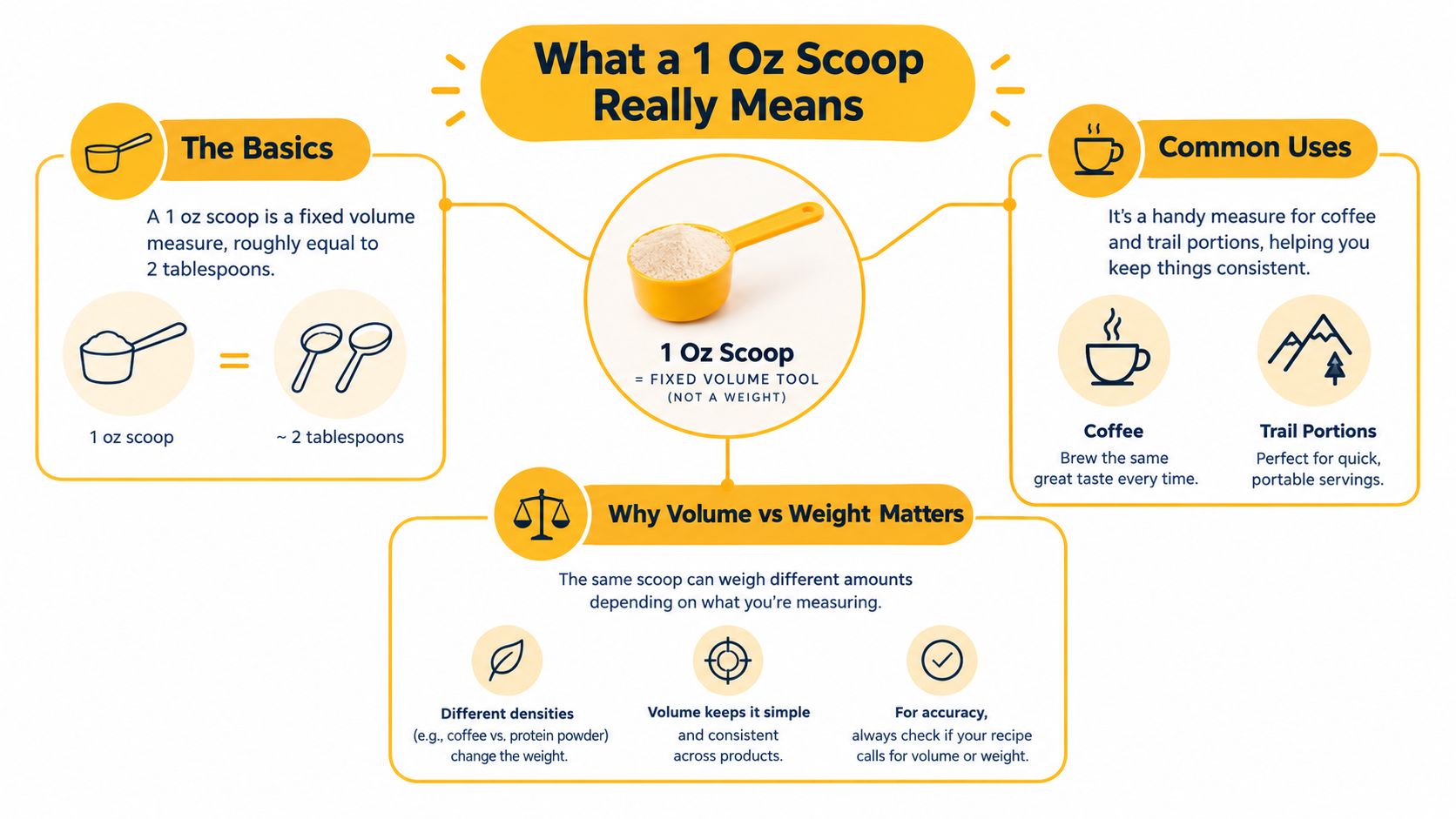
A 1 oz scoop is a small, fixed-volume measuring tool commonly used for coffee, food powders, supplements, and other dry ingredients. In practical kitchen terms, it's often close to two tablespoons of capacity, although the exact amount depends on the scoop's shape and the material being measured.
The important distinction is that 1 oz normally refers to weight, not fluid volume. One avoirdupois ounce equals exactly 28.349523125 grams, usually rounded to 28.35 grams for everyday use, as described in the history and measurement background of the ounce. A US fluid ounce, by contrast, measures liquid volume and equals about 29.57 milliliters, so it isn't interchangeable with a weight ounce.
Why the label can confuse coffee drinkers
Coffee is a dry good with plenty of air between particles. A scoop marked “1 oz” may describe the volume the scoop holds, while the coffee inside weighs much less than 28.35 grams. Grind size, roast style, particle shape, and how firmly you fill the scoop all affect the result.
That's why a scoop can be convenient without being a precision instrument. It fits into a coffee tin, works at a trailhead, and gives you a repeatable visual portion when you use the same filling method each time. For a deeper look at brewing with the right scoop, compare the scoop's stated capacity with the coffee maker's serving guidance.
The ounce itself has a long history. The Roman uncia represented one-twelfth of a pound, and that twelfth-based system later influenced both the English ounce and the inch. The modern avoirdupois ounce eventually became 1/16 of a pound, while the troy ounce remained 31.1034768 grams, about 9.7% heavier than the avoirdupois ounce, according to the Museo Galileo's account of the unit's development.
For brewing, you usually want the avoirdupois ounce. Think of the 1 oz scoop as a handy portioning reference first, then use a scale when the coffee's density or recipe demands more control.
Converting 1 Oz to Grams, Tablespoons, and Teaspoons
Start with the conversion that matters most:
1 avoirdupois ounce = 28.349523125 grams, or 28.35 grams rounded. That conversion applies to mass, regardless of whether the product is coffee, flour, or another dry ingredient. The scoop itself may not deliver that mass of coffee, because a volume scoop and a weight measurement are different things.
For loose coffee, volume estimates are only approximations. A standard 2-tablespoon coffee scoop may hold coffee in the range of 8.9 to 13.6 grams, depending on grind and density, while product labels often round servings to 10 to 12 grams, as summarized in this reference on scoop utensils and coffee measurement). That means a scoop with roughly two tablespoons of capacity can be much lighter than a true 1 oz weight of coffee.
| Unit | Exact Value | Rounded Practical Value |
|---|---|---|
| Avoirdupois ounce by mass | 28.349523125 g | 28.35 g |
| US fluid ounce | About 29.57 mL | About 30 mL |
| Common coffee scoop capacity | Varies by design and product | Often about 2 tbsp |
| Two tablespoons | Volume varies by ingredient density | Use as a visual portion, not a weight guarantee |
How to use the conversions
If you're brewing ordinary ground coffee without a scale, start with the scoop's volume. Level it, keep the grind and filling technique consistent, and adjust the next brew according to taste. A scale gives you a more reliable result because it measures the coffee itself rather than the air spaces inside the scoop.
For a standard mug, coffee guidance commonly treats a scoop as a convenient starting point, but serving size and strength preferences still matter. Cartograph Coffee's coffee measurement guide is useful when you want to connect scoop measurements with gram-based brewing decisions.
Rounding works well for casual drip brewing, camping, and office coffee. More exact measurement matters for espresso, baking, or any recipe where a small change affects extraction or texture. The practical rule is simple: use 28.35 grams when you mean a true weight ounce, and use “one scoop” only as a volume shortcut.
How Density Changes a 1 Oz Scoop of Coffee
The same scoop can produce different results because coffee formats don't pack the same way. Fine crystals settle tightly, while larger ground particles leave more air between them. Moisture, particle size, and how much you tap or compress the scoop also change the mass delivered.
A coffee conversion reference gives a helpful example: a 2-tablespoon scoop has a volume of about 29.6 milliliters, yet medium-ground coffee in that scoop averages about 11.2 grams, as shown in this coffee unit conversion reference. The scoop's volume stays constant, but the coffee's weight does not.
| Coffee Type | Grams per 1 Oz Scoop | Brewing Implication |
|---|---|---|
| Instant coffee | Varies by product and fill method | Compact crystals can give a concentrated serving |
| Fine ground coffee | Varies with grind and packing | A tighter fill can produce a stronger, heavier dose |
| Medium ground drip coffee | Often around 10 to 12 g in a 2-tablespoon scoop | Air between particles makes the scoop lighter than a weight ounce |
What changes in the cup
A scoop of instant coffee dissolves completely, so the drink's strength depends directly on the amount of soluble coffee added to the water. Ground coffee behaves differently. The brew also depends on grind size, contact time, water temperature, and filtration, so a heavier scoop doesn't automatically produce a better cup.
Treat the table as a reminder, not a universal calibration chart. The verified measurement references show why a scoop marked in ounces should be checked against the product being used. If you switch from instant coffee to ground coffee, keep the scoop level and expect to adjust the amount after tasting.
Practical rule: A scoop measures space. A scale measures coffee.
That distinction is especially useful when moving between a jar of instant coffee and a bag of ground coffee. The physical scoop may be identical, but the delivered dose and the brewing method can be completely different.
Dosing Cartograph Coffee with a 1 Oz Scoop
For an 8-ounce mug, begin with a level scoop rather than a mound. A level fill gives you a repeatable reference, while a packed scoop compresses the particles and changes the dose. If the cup tastes thin, add coffee next time. If it tastes harsh, reduce the amount or check the grind and brewing time before assuming the scoop is the problem.
For instant coffee, dissolve the measured coffee directly in hot water and stir thoroughly. For ground coffee, the scoop is only the starting portion. Water passes through the grounds, so extraction depends on the brewer, grind, and contact time as well as the amount of coffee.
A simple serving guide
| Serving Size | Brewed Ground, Level Scoops | Instant Coffee, Level Scoops |
|---|---|---|
| 8 oz mug | Start with 1 | Start with 1 |
| 12 oz travel mug | Start with 1, then adjust to taste | Start with 1, then adjust to taste |
| Larger batch | Keep the scoop level and scale servings consistently | Follow the packet or product directions |
The table deliberately uses starting points rather than pretending that one scoop guarantees the same strength for every coffee. Coffee density changes from product to product, and personal preference changes the target as well.
A packed scoop can taste noticeably bolder because it holds more material in the same space. A mound can also vary from one brew to the next, which makes it difficult to tell whether a flavor change came from the coffee, the water, or the measurement.
Use this routine:
- Fill the scoop without pressing down.
- Level the top with a straight edge.
- Brew the same way for several cups.
- Adjust by taste, not by adding a random mound.
Cartograph Coffee's pre-portioned instant format is designed for convenience, so single-serve packets can reduce the need to estimate from a shared container. When you're using ground coffee instead, the level-scoop habit is the best no-scale substitute for a measured dose.
Measuring a 1 Oz Scoop Without a Scale
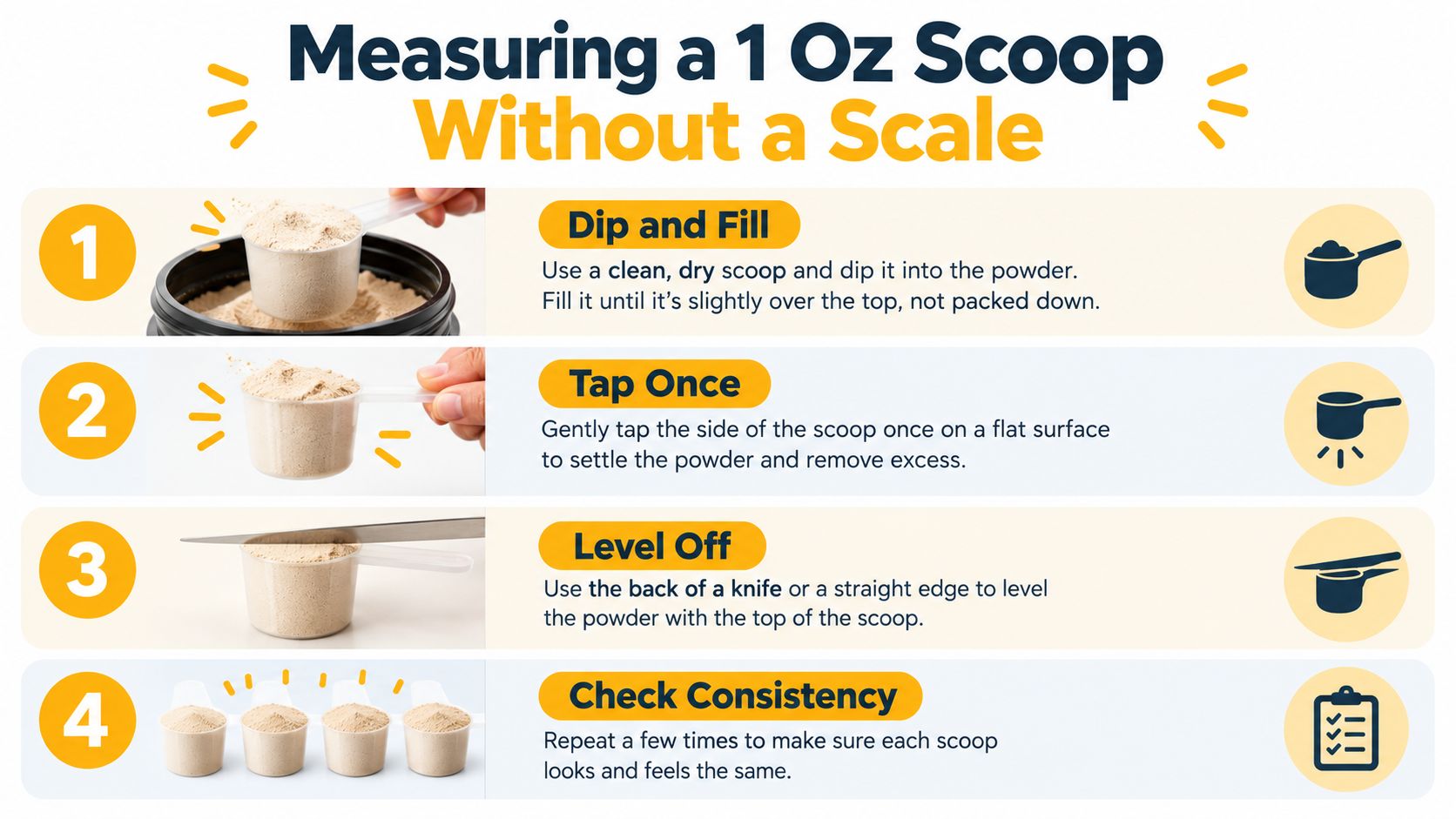
You can get consistent results without carrying a digital scale. The goal isn't to create a laboratory measurement. It's to remove the biggest source of variation, which is changing the way you fill the scoop every time.
Use the same sequence whenever you brew:
- Dip and fill. Push the scoop into the coffee and lift it full.
- Tap once. Give the scoop one light tap on the counter to settle loose grounds.
- Level off. Sweep a butter knife, the back of a spoon, or another flat edge across the rim.
- Check consistency. Look for a flat surface that sits flush with the scoop, not a mound.
Build a visual reference
A level scoop of ground coffee may look similar to the volume of two heaping tablespoons, but that comparison describes space, not guaranteed weight. Instant coffee can appear slightly lower or more compact because its particles settle differently.
If you want to calibrate your eye, fill the scoop and compare it with a tablespoon measure once. After that, keep the same scoop, coffee format, and leveling motion. Consistency will usually help more than chasing a gram target you can't verify.
A short demonstration can make the motion easier to copy:
For road trips and campsite mornings, this low-tech method works well because it needs no battery and takes seconds. If you're planning longer travel and need to stay connected while working remotely, you can pair a simple coffee routine with practical best RV internet solutions. For more serving guidance, compare your routine with Cartograph Coffee's advice on how many tablespoons of coffee are in a cup.
Single-Serve Scoops for Travel, Camping, and Work
A measured portion becomes more valuable when you're away from the kitchen. At home, you can grab a scale, tablespoon, or extra measuring cup. At a campsite, in a hotel room, or beside an office kettle, you may have only coffee, hot water, and a small scoop.
That's why ounce-based portions fit naturally with single-serve coffee. A pre-measured packet removes the question of whether the scoop is level, packed, or heaped. You open the serving, add hot water, and keep moving.
Where the format helps
- Camping: A scoop or packet avoids carrying a scale into the backcountry.
- Travel: Dry coffee takes little preparation and works with a kettle or hot-water dispenser.
- The office: A consistent portion is easier to repeat than estimating from a communal jar.
- Family routines: Each person can adjust water or add a little more coffee without changing the basic starting point.
Cartograph Coffee's coffee-camping guidance on coffee camping hacks fits this use case because outdoor brewing rewards compact tools and simple routines. The value of the 1 oz scoop isn't that it magically weighs the same across every coffee. It's that a familiar portion gives you a repeatable action when equipment is limited.
For workdays, the same idea reduces friction. You don't need to calculate a recipe before the first meeting. You can use the packet or level scoop as your baseline, then change the water amount or serving size when you want a lighter or stronger drink.
Common Misconceptions About a 1 Oz Scoop
The most common mistake is treating a fluid ounce and a weight ounce as the same unit. Water makes the confusion feel harmless because its density is close to one gram per milliliter, but coffee doesn't behave that way. A fluid-ounce measure describes liquid space, while an avoirdupois ounce describes mass.
A second mistake is assuming that every scoop labeled “1 oz” delivers the same coffee dose. Scoop walls, shape, rim size, particle size, moisture, and packing all matter. The verified measurement guidance recommends treating ounce-marked scoops as references and calibrating dry goods by mass when repeatability matters, as explained in this food measurement resource.
Three assumptions to discard
- “The scoop always weighs 28.35 grams.” It only does if the product inside has the density needed to fill that volume at that mass.
- “A heaping scoop is a reliable stronger setting.” It may be stronger, but the mound changes from one person and brew to the next.
- “A scoop that works for coffee works identically for instant coffee.” Different particles settle differently, so the same tool can deliver a different mass.
A better approach is to treat the scoop as a convenient volume reference. Use the manufacturer's serving guidance, level the scoop the same way, and let taste guide small adjustments. If the recipe requires exact mass, weigh the coffee.
Quick Answers on 1 Oz Scoops
How many grams does a 1 oz scoop of instant coffee hold?
There isn't one universal weight because instant coffee density and scoop design vary. A true weight ounce is 28.35 grams, but a scoop labeled 1 oz may describe capacity rather than the mass of the instant coffee inside.
Why use ounce-based portions for travel packets?
They provide a familiar, repeatable serving format without requiring a scale. That makes them practical for hotel rooms, offices, camping, and other places where you have hot water but limited equipment.
How much should I use for an 8-ounce mug?
Start with one level scoop or one pre-portioned serving, then adjust based on flavor. A second scoop may be appropriate for a stronger drink, but it can also overpower the cup, so change one variable at a time.
Should I pack the scoop?
No. A level scoop is easier to repeat. Packing changes the amount of coffee in the same space and makes comparisons between brews less dependable.
Can I measure without a scale?
Yes. Fill the scoop, tap it once, level it with a flat edge, and repeat that motion every time. A scale remains the better choice when you need exact mass.
Use 28.35 grams as the weight-ounce conversion, but use your scoop as a consistent volume tool. That small distinction will help you make better coffee at home, on the trail, and wherever your next kettle boils.
Cartograph Coffee offers organic instant coffee in convenient single-serve formats for workdays, travel, camping, and home brewing. Visit Cartograph Coffee to explore coffee designed around practical portions and easy preparation.