You're standing at the counter, staring at a “regular” coffee that looks nothing like the mug you use at home. Or maybe you're packing a travel cup for work, and the size on the lid, the bag, and the menu all seem to mean different things. That confusion is normal, because standard coffee cup sizes aren't one universal rule, they're a set of conventions shaped by the drink, the region, and the way the coffee gets served.
The fastest way to make sense of it is to stop looking for one perfect number. A cup for espresso, a mug for drip coffee, and a takeaway cup for a latte all solve different problems, so they're built differently on purpose. Once you see cup sizing as a match between drink format, milk ratio, lid fit, and use case, the numbers stop feeling random.
Why Coffee Cup Sizes Feel So Confusing
You ask for a “regular” coffee, and one place hands you a small ceramic cup, another gives you a paper cup with a lid, and a third fills a giant mug you can barely finish. The coffee is all “coffee,” but the vessel changed the experience before you took the first sip. That's the core of the confusion.
A standard coffee cup size is not a single global object. It's a family of habits that grew up around different drink styles, local serving traditions, and the practical realities of heat, foam, and portability. A formal coffee service wants one thing, a café takeaway counter wants another, and the mug on your kitchen shelf follows its own logic.
Practical rule: if the drink is small and concentrated, the cup shrinks. If it carries milk, ice, or a commute, the cup grows.
That's why the same word, “cup,” can mean very different things depending on who's speaking. In a recipe, a cup might mean a measuring unit. In a café, it might mean a serving vessel. At 7 a.m., it might just mean the thing you need to stay upright.
The easiest way to read cup sizes is to treat them as a decoder ring, not a fixed chart. A cup's real job is to fit the drink and the situation, whether that means a formal espresso service, a cappuccino at the café bar, or a big mug on a desk that'll be refilled once or twice.
The Basic Cup, Mug, and Demitasse Explained
The three coffee vessels you're likely to encounter are the demitasse, the standard cup, and the mug. The demitasse is the smallest of the group and is tied to espresso service. The standard cup sits in the middle, and the mug is the roomy option people reach for at home or at work.
The clearest baseline is this, a standard U.S. coffee cup is commonly treated as 6 ounces (177 ml) in historical coffee culture, while modern café service often uses 8 oz, 12 oz, and 16 oz formats for practical reasons. A quick conversion trick helps here, 1 fluid ounce is about 30 ml for everyday use, so you can estimate size without reaching for a calculator. A 6 oz cup is roughly 177 ml, 8 oz is about 237 ml, 12 oz about 355 ml, and 16 oz about 473 ml.
The trickiest part is the word cup itself. In recipes, a cup is a measuring unit. On a menu, a cup is a serving container. That's why a home brewer can follow a recipe perfectly and still end up with a drink that feels too small or too weak, because the recipe and the vessel are talking about two different things.
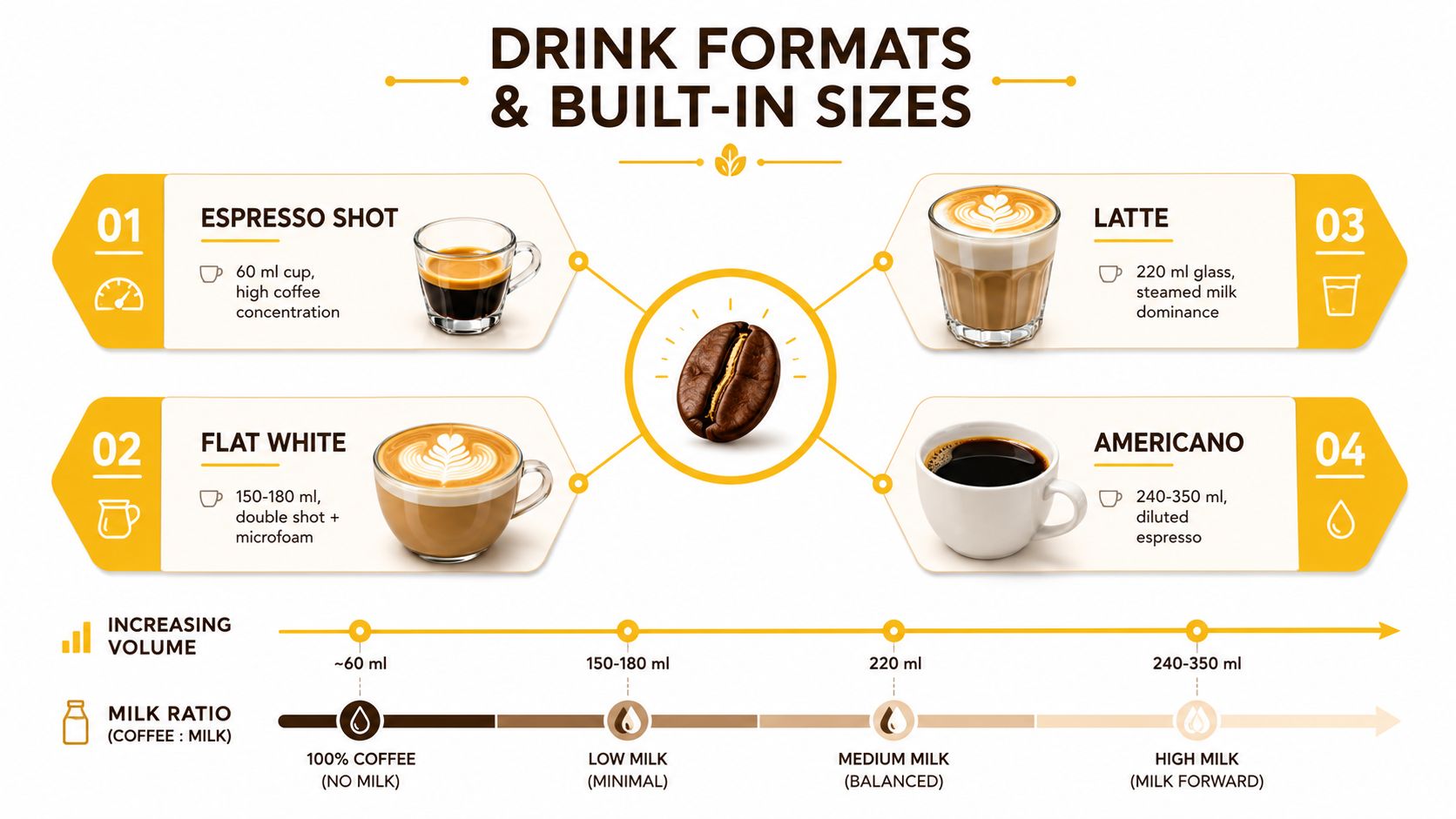
A good visual shortcut is simple. Think demitasse for a tiny, concentrated pour, cup for a balanced serving, and mug for something that sits comfortably in the hand and lasts longer. If a menu says cappuccino, flat white, or latte, the vessel is usually telling you how the drink is built, not just how much liquid it holds.
Drink Formats and Their Built-In Sizes
Coffee drinks don't just use cup sizes, they often create them. An espresso works because it's concentrated, so a small vessel keeps the drink tight, hot, and visually correct. A latte needs more space because the milk volume changes the whole structure of the drink.
Nescafé's guide gives a useful spread, with an espresso cup at 60 ml, a cappuccino cup at 180 ml, a flat white cup at 160 ml, a standard mug at 200 ml, a latte glass at 220 ml, a Turkish coffee cup at 75 ml, and an Irish coffee glass at 250 ml. That range, from 60 ml to 250 ml, shows how much the drink format shapes the vessel. An espresso serving is roughly one-quarter the volume of a 200 ml mug, which is why size is really about the drink's balance, not just how much liquid fits.
For a quick comparison, the structure usually looks like this:
- Espresso: tiny cup, high concentration, minimal dilution.
- Macchiato: small cup, still espresso-led, with just enough milk to soften the edge.
- Cappuccino: mid-small cup, built for foam and a tight espresso-to-milk ratio.
- Flat white: slightly smaller than a standard mug, with microfoam and a more milk-aware texture.
- Latte: larger glass or cup, because steamed milk dominates the profile.
- Lungo: larger than espresso, since the extra water changes the strength and extraction feel.
- Turkish coffee: very small cup, dense and intense, usually served as a short, slow drink.
- Irish coffee: taller glass, because the drink includes a mixed, layered presentation.
For a precise espresso reference, see espresso shot size. The important pattern is that the cup is not random. It supports crema, foam, temperature, and the ratio the drink is supposed to have.
Practical rule: if the drink depends on foam or concentration, the cup gets narrower and smaller. If it depends on milk or layering, the vessel gets taller or wider.
Regional Differences from the US to the Middle East
A “regular coffee” in one country can look like an entirely different drink in another. That's because regions standardize around local habits, not around one global size. In the U.S., coffee sizing changed over time, and that history still affects what people expect today.
CoffeePlusThree notes that a standard coffee cup in the United States started around 6 ounces (177 ml) in the early 20th century, then settled closer to 8–10 ounces (237–296 ml) by the mid-20th century as serving styles changed. The same source also shows how regional “standards” vary widely, with 2–4 ounces in Europe, 8–10 ounces in Australia and New Zealand, and 1–2 ounces in the Middle East. That spread makes one thing clear, there is no universal coffee cup size, only local norms.
That's why a menu word can mislead if you assume it means the same thing everywhere. In New York, “regular” can imply a larger mug than an older diner-style pour. In Melbourne, the expectation around flat whites is tied to a compact milk balance. In Istanbul, a coffee service built around small servings follows a different logic entirely.
For a closer look at the social side of that tradition, the finjan ritual explained offers useful cultural context. It helps show why some coffee traditions prize small, ceremonial servings rather than a bigger mug you carry around.

The takeaway is straightforward. Standard coffee cup sizes are regional, not universal. If you travel, order abroad, or read a café menu from another country, don't assume the size label means what it would mean at home.
Café Takeaway Sizes and What They Mean in Practice
For day-to-day café service, the most useful sizes are 8 oz, 12 oz, and 16 oz. Those three formats cover most of the work a café needs to do, from small espresso-based drinks to bigger takeaway orders and iced drinks. They also line up with the way modern paper cups are built, not just with how much liquid they hold.
The geometry matters more than people think. One industry guide lists typical paper-cup top diameters at about 80 mm for 8 oz, 80–90 mm for 12 oz, and 90 mm for 16 oz, while another notes that 12 oz cups are about 112 mm tall and 16 oz cups about 135 mm tall. That extra height changes stackability, heat loss, and how the drink feels in hand, while the rim size affects lid fit and pour stability. For ordering supplies, the lid diameter can matter more than the ounce number.
| Size (oz) | Volume (ml) | Rim Diameter (mm) | Height (mm) | Best For |
|---|---|---|---|---|
| 8 oz | 237 ml | about 80 mm | varies by style | Cappuccinos, flat whites |
| 12 oz | 355 ml | 80 to 90 mm | about 112 mm | The common café regular |
| 16 oz | 473 ml | 90 mm | about 135 mm | Milk-heavy drinks, iced drinks |
A 12 oz cup is often the most useful middle ground because it works for many café orders without forcing the barista to switch formats constantly. A 16 oz cup makes more sense when the drink has more milk, ice, or takeaway time built into it. An 8 oz cup stays closer to classic espresso-based structure, especially when the barista wants the foam and espresso ratio to stay tight.
Practical rule: if the lid doesn't fit, the cup size doesn't matter.
That's why many cafés converge on a few workhorse SKUs and keep separate hot and cold lines. The cup size on the sleeve is only part of the story. The actual decision is how the cup performs in service.
Choosing the Right Cup for Home, Commuting, and Camping
At home, a coffee cup is mostly about comfort and heat. A ceramic 8 to 12 oz mug keeps the drink stable, feels good in the hand, and gives you room for a second pour if you want one. It's also the least fussy option, because you're not matching it to a car holder or a lid system.
For commuting, the priorities shift. A 12 to 16 oz insulated tumbler is usually the better fit because it keeps the lid secure and gives you enough volume for a real morning drink without spilling in traffic. If you need sizing help for that kind of daily carry, you can also find it in our console cup holder through find it in our console cup holder, since fit matters just as much as capacity when you're on the move. For readers who want a broader travel setup, on-the-go coffee cups is the better starting point.
Camping and travel need a different balance. A 6 to 10 oz lightweight cup is easier to pack, faster to rinse, and less awkward at a campsite where sink space is limited. Smaller cups also cool faster, which can be useful when the goal is to drink, move, and clean up without fuss.
The brewing math changes with the vessel too. A single scoop of instant coffee in a 6 oz cup tastes stronger than the same scoop in a 12 oz cup, because the water-to-coffee ratio changed. That's why the same mug can feel bold at breakfast and flat in a travel tumbler if you don't adjust.
Quick check: choose by where you'll drink it, not just by how much it holds.
The best cup is the one that matches the routine. At home, that usually means comfort. In the car, it means lid fit. On a trail, it means portability and easy cleanup.
Scoops and Ratios for Instant Coffee by Cup Size
Instant coffee works best when you treat the cup size as part of the recipe. A scoop isn't just a scoop, it's a strength decision. Put the same amount of instant coffee into a small cup and a large tumbler, and you'll taste two different drinks.
A simple starting point looks like this:
| Cup Size | Starting Amount | Best Use |
|---|---|---|
| 6 oz | 1 rounded teaspoon, about 2 g | Balanced, compact cup |
| 8 oz | 1 heaping teaspoon | Stronger morning cup |
| 12 oz | 1.5 teaspoons | Desk tumbler, slower sipping |
If you want a deeper practical reference, see how much instant coffee per cup. Milk, ice, and altitude can all change the final result, so the smartest move is to taste first and then adjust one scoop at a time. That keeps you from overshooting strength and ending up with a cup that tastes harsh instead of bold.
The easiest loop is simple. Brew once. Taste once. Add a little more only if the cup still feels thin. That works better than trying to memorize one perfect formula for every vessel.
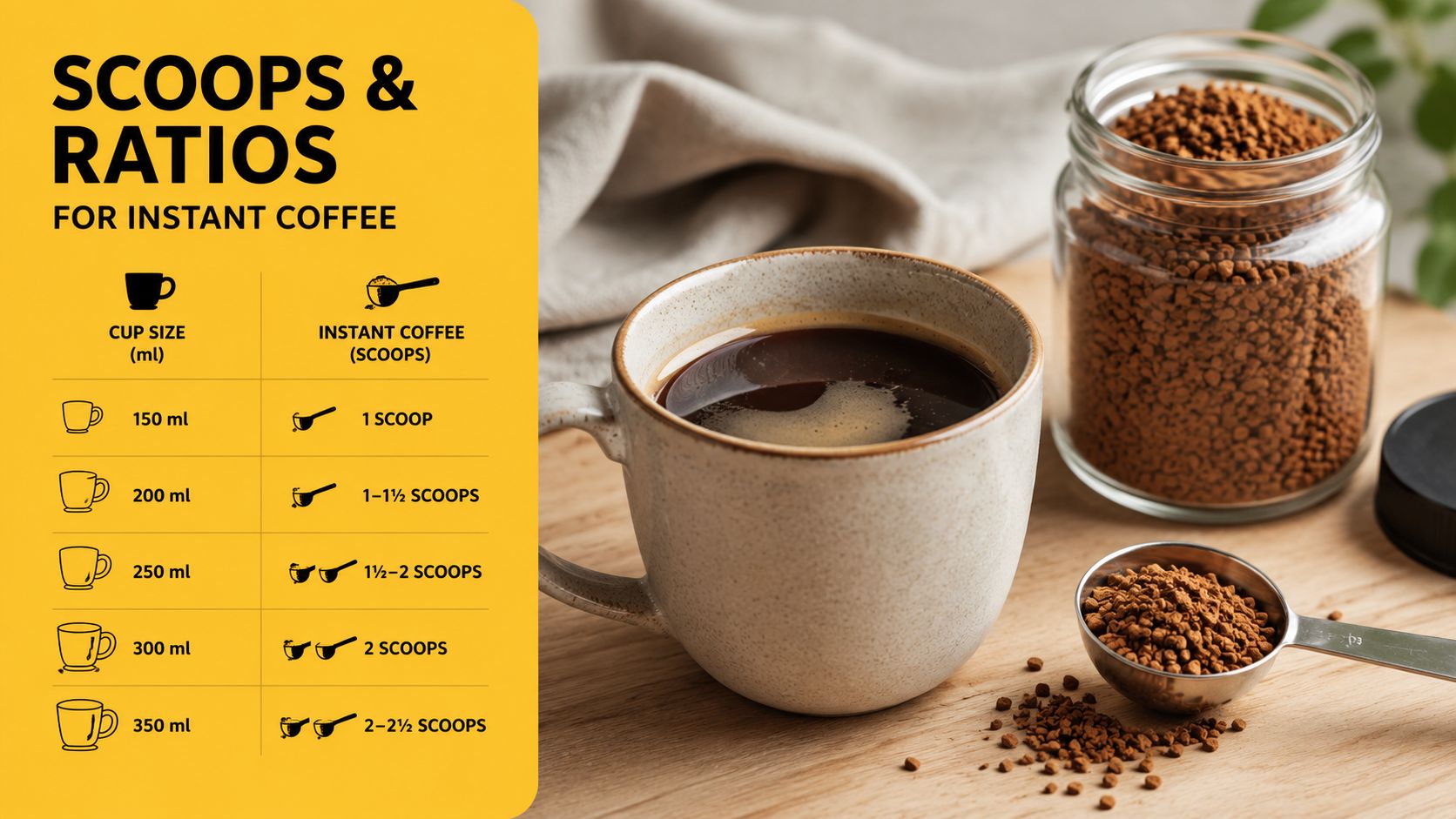
If you keep one rule in mind, make it this. Bigger cup, lighter ratio unless you adjust the coffee. Smaller cup, stronger ratio unless you dilute it. That's the simplest way to make instant coffee behave across home mugs, commuting tumblers, and travel cups.
If you want coffee that's easy to match to real life, from a desk mug to a trail break, visit Cartograph Coffee and see how a better instant cup fits the way you drink. It's a useful place to start if you want convenience without giving up a thoughtful coffee routine.